Developing a responsive social and learning environment


The environment and language development Understanding of your environment is fundamental to the way you interact and access it:  determines they way you behave helps you make sense of your world how you adapt your social skills from setting to setting increases security and reduces anxiety The way you  interpret your environment  determines how you  interact  with it  and manipulate it  for your own benefit environmental cues exist within all level s  of society
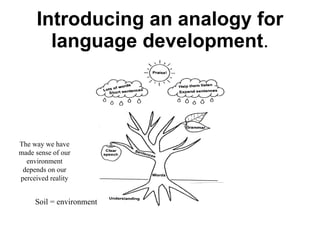
Introducing an analogy for language development . The way we have made sense of our environment depends on our perceived reality Soil = environment
A compatible environment? Very often we put students in an environment which, by its very nature they can’t access We can make environmental adaptations to ensure understanding across a range of settings
What are we aiming to achieve? Adults  relinquishing control  – giving children more control over their environment Increasing children’s  independence  and problem solving skills Increasing security, understanding of role and expectations within a routine Providing a stable,secure,  predictable  and  meaningful environment A decrease in ‘ negative communicative behaviours ’ An environment that children need,  and want ,  to interact with
Connecting with your environment Relationship with your physical environment Relationship with your symbolic environment Relationship with your social environment How you respond to environmental prompts  Ability to attach meaning to symbols Awareness of how time is represented Understanding of your role within a given setting
-  TEACCH: Organising the environment into clearly defined areas -play, ‘office’, work, putting down mats to indicate where students should sit etc. - Physical prompting and backward chaining - Labelling the environment  - Written/symbol commands - Base boards - Floor markings - Menu boards - Accessible communication systems (AAC) - Routines - Social Stories Comic Strip  Conversations  Power Stories - Scripts - All about me books - Generic ‘All about me books’ - Preparation Books, ‘Guide books’ - ‘Visual/Interactive’ nursery rhymes -  Daily schedules - Weekly timetables - Task schedules - Calendars - Clocks - Check lists - Diary Adapting the environment Physical   Symbolic Social
Setting Up The Classroom: 8 Areas Designated learning areas   Labelling the school with Baseboards   Differentiating between similar areas, such as work stations   Refining learning areas to support contextual understanding   Integrating communication systems within the classroom   Setting up schedules   Labelling the classroom to support independence   Considering the sensory environment
1. Setting up designated learning areas
2. Labelling Learning Areas with Base Boards
3. Differentiating between similar areas
4. Refining Learning Areas to support contextual Understanding
5. Accessible Communication Systems
6. Supporting Time concepts / Transition Schedules
7. Labelling the classroom
8. The sensory Environment

Developing A Responsive Social And Learning Environment

  • 1.
    Developing a responsivesocial and learning environment
  • 2.
  • 3.
  • 4.
  • 5.
    The environment andlanguage development Understanding of your environment is fundamental to the way you interact and access it: determines they way you behave helps you make sense of your world how you adapt your social skills from setting to setting increases security and reduces anxiety The way you interpret your environment determines how you interact with it and manipulate it for your own benefit environmental cues exist within all level s of society
  • 6.
    Introducing an analogyfor language development . The way we have made sense of our environment depends on our perceived reality Soil = environment
  • 7.
    A compatible environment?Very often we put students in an environment which, by its very nature they can’t access We can make environmental adaptations to ensure understanding across a range of settings
  • 8.
    What are weaiming to achieve? Adults relinquishing control – giving children more control over their environment Increasing children’s independence and problem solving skills Increasing security, understanding of role and expectations within a routine Providing a stable,secure, predictable and meaningful environment A decrease in ‘ negative communicative behaviours ’ An environment that children need, and want , to interact with
  • 9.
    Connecting with yourenvironment Relationship with your physical environment Relationship with your symbolic environment Relationship with your social environment How you respond to environmental prompts Ability to attach meaning to symbols Awareness of how time is represented Understanding of your role within a given setting
  • 10.
    - TEACCH:Organising the environment into clearly defined areas -play, ‘office’, work, putting down mats to indicate where students should sit etc. - Physical prompting and backward chaining - Labelling the environment - Written/symbol commands - Base boards - Floor markings - Menu boards - Accessible communication systems (AAC) - Routines - Social Stories Comic Strip Conversations Power Stories - Scripts - All about me books - Generic ‘All about me books’ - Preparation Books, ‘Guide books’ - ‘Visual/Interactive’ nursery rhymes - Daily schedules - Weekly timetables - Task schedules - Calendars - Clocks - Check lists - Diary Adapting the environment Physical Symbolic Social
  • 11.
    Setting Up TheClassroom: 8 Areas Designated learning areas Labelling the school with Baseboards Differentiating between similar areas, such as work stations Refining learning areas to support contextual understanding Integrating communication systems within the classroom Setting up schedules Labelling the classroom to support independence Considering the sensory environment
  • 12.
    1. Setting updesignated learning areas
  • 13.
    2. Labelling LearningAreas with Base Boards
  • 14.
  • 15.
    4. Refining LearningAreas to support contextual Understanding
  • 16.
  • 17.
    6. Supporting Timeconcepts / Transition Schedules
  • 18.
  • 19.
    8. The sensoryEnvironment