PECS Training
Presentation
Kelsie Dunaway, Shelby Haggard, Sydney Schakel,
Brooke Way, Kellie Wojciechowski
Introduction
Ellison Preschool is an inclusion school that serves 50 students in general education
and 150 students in special education, all of which are ages 3 to 5 years old. 25 of the
students who receive speech therapy are nonverbal and 20 of them do not have any
way to communicate other than grunting or pointing. The lack of these students'
ability to communicate has consistently created problems during playtime as they do
not know how to ask peers to play with them or their toys. Teachers said that instead
of asking, the students will grab toys from their peers which causes fights and
tantrums. The core of the behavior issues is the inability of these nonverbal students
to communicate. To facilitate effective communication, these 20 children will be
trained in Picture Exchange Communication System (PECS). This presentation
outlines the implementation of this intervention.
Research Background
• Developed in 1985 for use with preschoolers with autism
• Has effectively taught functional communication skills to diverse learners
• All ages
• Various cognitive, physical, and communication abilities
• Dozens of diagnoses
• Possible gateway for speech development or use of a speech
generating device (SGD)
(Pyramid Educational Consultants, n.d.)
How to Implement
• This intervention will be implemented using 6 phases: physical exchange,
expanding spontaneity, picture discrimination, sentence structure, “what do
you want” and commenting. Prior to the intervention, a preference
assessment will be conducted to conclude what the student is motivated for
and what to include in the PECS binder.
• This intervention supports the needs of the students because some students
at Ellison Preschool are nonverbal and have difficulty communicating their
needs and wants to others. Using a picture exchange communication system
will enable them to communicate independently to their peers.
Modeling of Strategy
How it can be Used
• Various environments: classroom, home, etc.
• Request toys from peers
• Communicate with parents, caregivers, siblings
• PECS becomes their voice
Schoolwide Implementation Plan
Goal: Help verbal and
nonverbal students
communicate during
playtime
Leadership team: BCBA and
speech therapists
Implemented at Tier 2 and
Tier 3
All materials supplied by the
school
Schoolwide Implementation Plan Cont.
PECS students:
training by speech
therapists and in
classroom
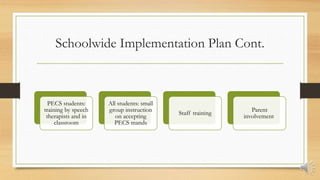
All students: small
group instruction
on accepting
PECS mands
Staff training
Parent
involvement
Final Tips
• Generalize PECS to various settings
• Continue encouraging parent involvement
• Visit https://pecsusa.com for supplemental
materials
• Reach out for extra support

Pecs presentation

  • 1.
    PECS Training Presentation Kelsie Dunaway,Shelby Haggard, Sydney Schakel, Brooke Way, Kellie Wojciechowski
  • 2.
    Introduction Ellison Preschool isan inclusion school that serves 50 students in general education and 150 students in special education, all of which are ages 3 to 5 years old. 25 of the students who receive speech therapy are nonverbal and 20 of them do not have any way to communicate other than grunting or pointing. The lack of these students' ability to communicate has consistently created problems during playtime as they do not know how to ask peers to play with them or their toys. Teachers said that instead of asking, the students will grab toys from their peers which causes fights and tantrums. The core of the behavior issues is the inability of these nonverbal students to communicate. To facilitate effective communication, these 20 children will be trained in Picture Exchange Communication System (PECS). This presentation outlines the implementation of this intervention.
  • 3.
    Research Background • Developedin 1985 for use with preschoolers with autism • Has effectively taught functional communication skills to diverse learners • All ages • Various cognitive, physical, and communication abilities • Dozens of diagnoses • Possible gateway for speech development or use of a speech generating device (SGD) (Pyramid Educational Consultants, n.d.)
  • 4.
    How to Implement •This intervention will be implemented using 6 phases: physical exchange, expanding spontaneity, picture discrimination, sentence structure, “what do you want” and commenting. Prior to the intervention, a preference assessment will be conducted to conclude what the student is motivated for and what to include in the PECS binder. • This intervention supports the needs of the students because some students at Ellison Preschool are nonverbal and have difficulty communicating their needs and wants to others. Using a picture exchange communication system will enable them to communicate independently to their peers.
  • 5.
  • 6.
    How it canbe Used • Various environments: classroom, home, etc. • Request toys from peers • Communicate with parents, caregivers, siblings • PECS becomes their voice
  • 7.
    Schoolwide Implementation Plan Goal:Help verbal and nonverbal students communicate during playtime Leadership team: BCBA and speech therapists Implemented at Tier 2 and Tier 3 All materials supplied by the school
  • 8.
    Schoolwide Implementation PlanCont. PECS students: training by speech therapists and in classroom All students: small group instruction on accepting PECS mands Staff training Parent involvement
  • 9.
    Final Tips • GeneralizePECS to various settings • Continue encouraging parent involvement • Visit https://pecsusa.com for supplemental materials • Reach out for extra support

Editor's Notes

  • #3 Ellison Preschool is an inclusion school that serves 50 students in general education and 150 students in special education, all of which are ages 3 to 5 years old. 25 of the students who receive speech therapy are nonverbal and 20 of them do not have any way to communicate other than grunting or pointing. The lack of these students' ability to communicate has consistently created problems during playtime as they do not know how to ask peers to play with them or their toys. Teachers said that instead of asking, the students will grab toys from their peers which causes fights and tantrums. The core of the behavior issues is the inability of these nonverbal students to communicate. To facilitate effective communication, these 20 children will be trained in Picture Exchange Communication System (PECS). This presentation outlines the implementation of this intervention.
  • #4 PECS was initially developed in 1985 for use with preschoolers with autism. Since then, research has shown that PECS can successfully teach functional communication skills to diverse learners--from toddlers to geriatric care; individuals of various cognitive, physical, and verbal and nonverbal communication abilities; and those with dozens of different medical or psychiatric diagnoses. PECS has even helped some nonverbal learners develop verbal speech, and some who have completed the PECS program have gone on to successfully use a speech generating device.
  • #5 This intervention will be implemented in 6 phases. The first phase is called “physical exchange”. During this phase, the student will be physically prompted to take a picture card of a preferred item and release the picture card into the communicators hand. The communicator will immediately let the student interact with the chosen item. Over several trials, the communicator will fade out the prompts and promote indepence.  The second phase is called expanding spontenaity . during this phase, the student will learn to how to be consistent when delivering pictures to the communicator. The student will also learn that the pictures they need to communicate are not always in front of them, and they will learn to search for their PECS binder. Phase three is called picture discrimination. During this phase, the student will be presented with two pictures, one picture is a reinforcing item, the other picture is not. If the student picks the reinforcing item he/she will get praise and be immediately presented with that item. If they choose the distractor picture, they will not get praise and be given the item which has no reinforcing value. The fourth phase is called sentence structure. During this phase, the students are taught how to create sentences using the phrase “I want”. This is where/how students who use PECS request what they want properly. A sentence strip will be attached to the PECS binder. The student will be taught to take the “I want” picture and put it on the sentence strip followed by a preferred item picture. The communicator will turn the strip back to face the student and read it back out loud to them while handing them the desired item.  The fifth phase is called “what do you want” phase. Here, the student is taught how to respond to a question like “what do you see” or “what do you want”. The question will be paired with a prompt to prompt the student to tell the communicator what he/she wants. Overtime, a delay will be inserted between the onset of what do you want and the students response. The goal during this phase is for the student to begin answering the questions before a prompt is used.  The last phase is called commenting and the phrase “I see” will be added to the students sentence structure. During this phase, the communicator relies on the skills the student has taught in the previous phases. There will be a picture with the phrase “I see” to the PECS board. The teacher will then use the verbal cue “what do you see” while they point to the I see picture on the PECS board. Due to their previous learning skills on responding to pointing prompts, the student will grab the I see picture and then grab a picture of the item they see. The teacher will then respond with “yes youre right, I see a blue car too”. Prior to implementation, a preference assessment will be conducted to conclude what the student is motivated for and what pictures to place in the binder. The preferecne assessment will be multiple stimulus without replacement procedure. There will be an array of three items. Once the student grabs an item, they will have 10 seconds to interact with the item. After the 10 seconds, the teacher will replace the item back within the array. An item will be considered preferred when they student selected the item 5 times. Once it is preferred, it will be replaced with a new item.
  • #6 This is a video that gives an in person visual of what PECS implementation should look like during phase one. It also shows what the PECS board looks like and gives an idea of what kinds of materials you will need to implement the procedures. Time 1:58-2:35 can be ignored due to the video talking about selling their products.
  • #7 This intervention can be used across various environments. PECS can be used within the classroom to help non-verbal children communicate with their peers and teachers. Specifically, PECS can be used to help non vocal children request toys from their peers.  PECS can later be transferred outside of the classroom and be used in homes or out and about to help non vocal children communicate with their parents, caregivers, and siblings. Once the child has been taught how to use PECS, the PECS book essentially becomes their voice. They can use it to communicate with multiple people and request items that they vocally can not ask for. 
  • #8 The goal of Ellison Preschool's schoolwide implementation plan is to help verbal and nonverbal students communicate effectively during playtime to help prevent tantrums and fighting. As demonstrated throughout this presentation, this will help students learn appropriate communication skills that can generalize to all of their environments. The implementation plan will be led by the school's BCBA and two speech therapists, who will train staff in the use of PECS. PECS will be implemented through Tier 2 (small group instruction) and Tier 3 (individual instruction). All needed materials will be provided by the school through the general supply fund.
  • #9 Students determined by the implementation team to benefit from PECS will receive individual PECS instruction with the speech therapists and classroom teaching assistants. The students will be issued their own PECS binders containing laminated pictures of preferred items and attached velcro strips. Group instruction of accepting PECS mands will be conducted by teachers and assistants in small groups in the classroom for all students. All staff will be trained in PECS implementation in a training session at the beginning of the year.  This will include an overview of PECS and small group breakouts to role-play PECS with each other. A follow-up training will provide a brief refresher and allow staff to troubleshoot any current difficulties. The Back to School parent night will include a discussion of PECS similar to the staff training. This will help students generalize PECS to multiple environments.
  • #10 It can be very beneficial for the students to learn PECS in other places outside of the spaces designated for PECS training. Make sure to contrive situations outside of the classroom and speech therapy room. Continue to encourage parent involvement even after the initial information session. Include PECS information on parent newsletters or classroom updates.  the PECS official website (https://pecsusa.com) offers access to plenty of research and materials that can aid in PECS implementation. Finally, don't be afraid to reach out to your BCBA for extra support when you need it. They are there to help you through this process!