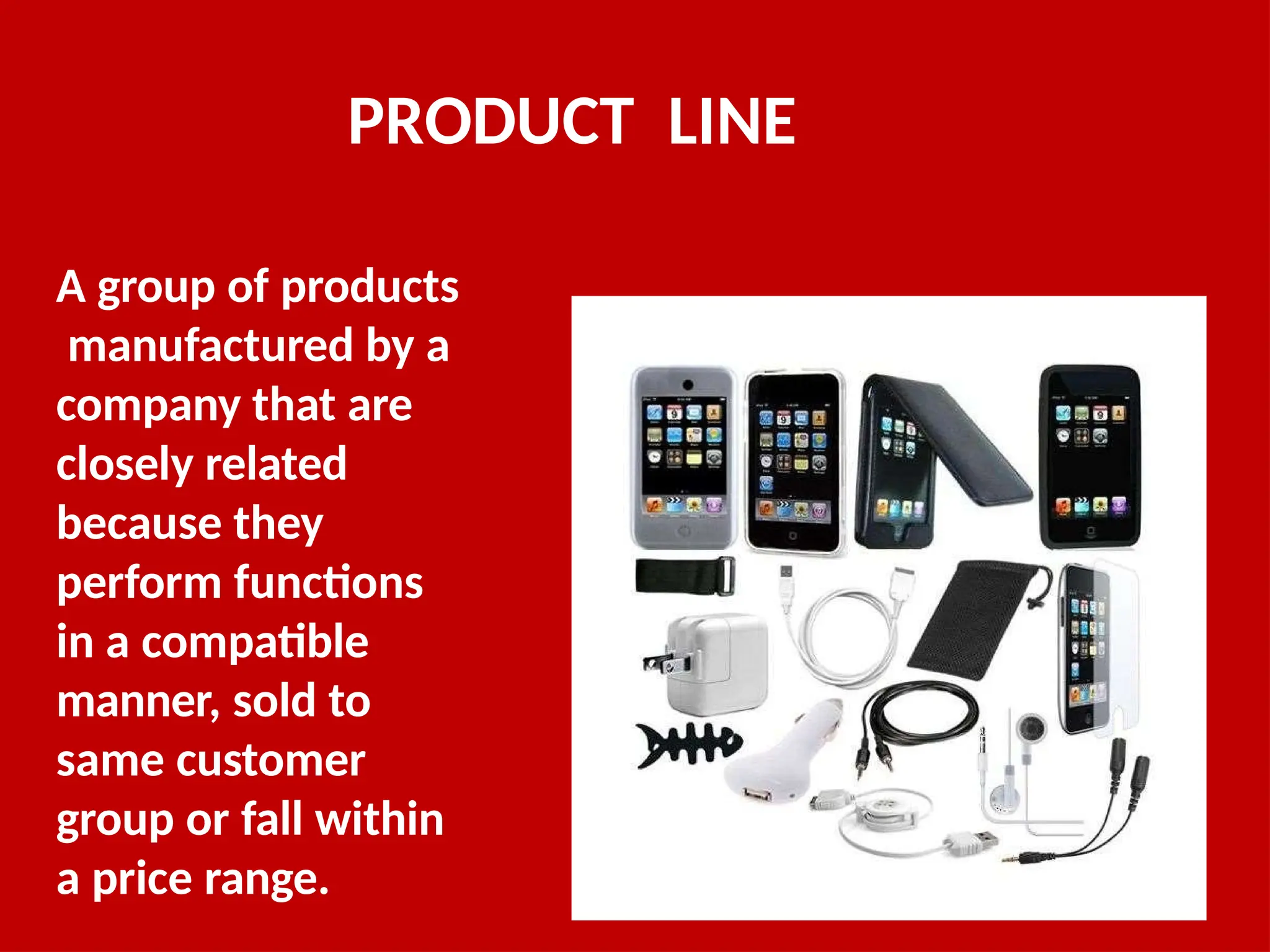
PRODUCT LINE
A groupof products
manufactured by a
company that are
closely related
because they
perform functions
in a compatible
manner, sold to
same customer
group or fall within
a price range.
4.
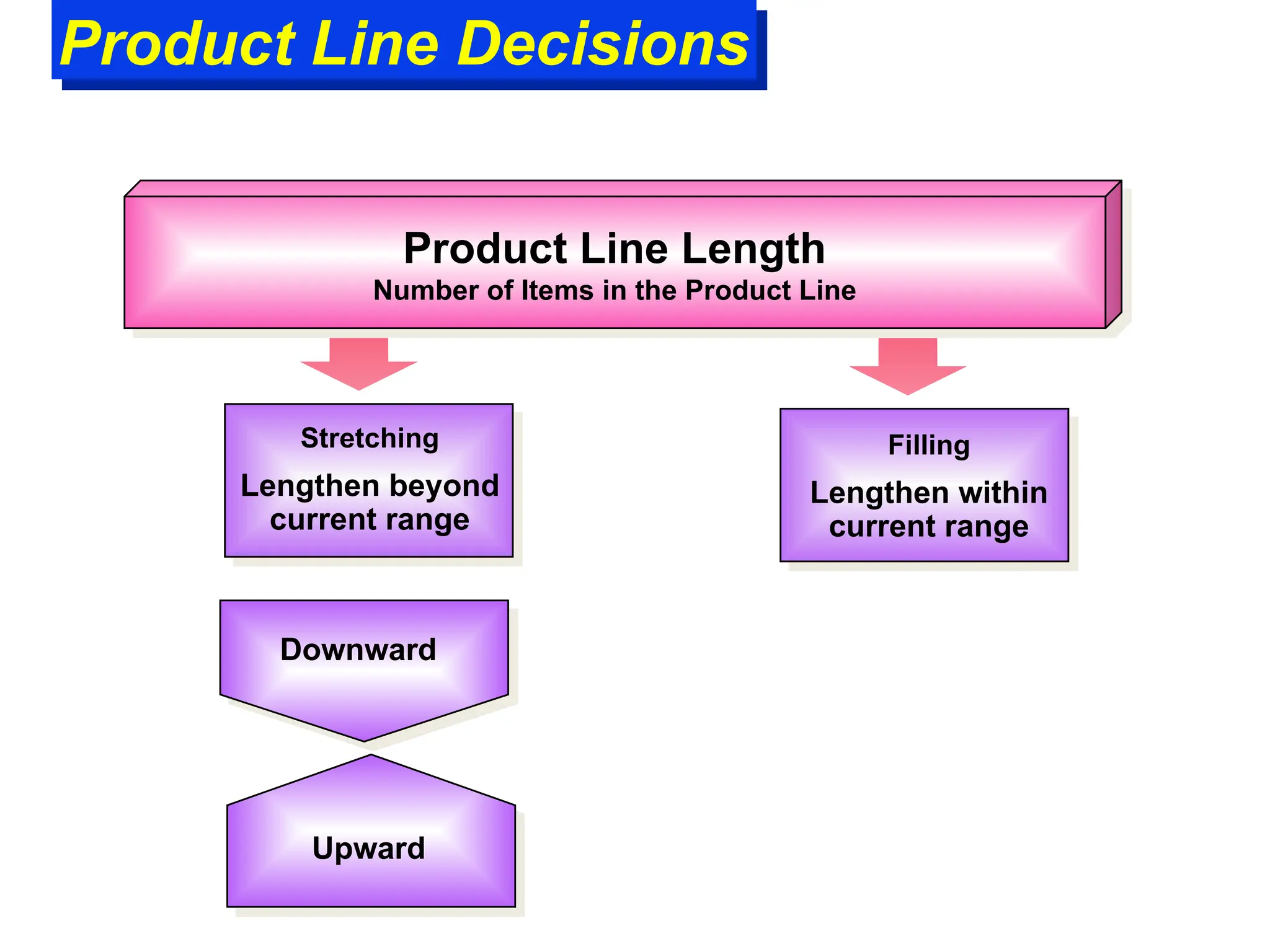
Product Line Length
Numberof Items in the Product Line
Product Line Decisions
Stretching
Lengthen beyond
current range
Filling
Lengthen within
current range
Downward
Upward
5.
Product Line Length
Themajor product line decision involves product line
length
• The line is too short if the manager can increase profits by
adding items;
• The line is too long if the manager can increase profits by
dropping items.
• Managers need to analyze their product lines periodically to
assess each item’s sales and profits and understand how each
item contributes to the line’s overall performance
• A company can expand its product line in two ways: by line filling or line
stretching
6.
Product line filling
Productline filling involves adding more items
within the present range of the line.
Reasons:
• Reaching for extra profits,
• Satisfying dealers,
• Using excess capacity, being the leading full-line company,
• And plugging holes to keep out competitors.
Risks :
• Line filling is overdone if it results in self-cannibalization and customer
confusion. The company needs to differentiate each item in the
consumer’s mind with a just-noticeable difference.
7.
Product line stretching
Itrefers to lengthening the product line beyond
its current range to attract buyers from all the
segments
The company can stretch its line
• Downward,
• Upward,
• Or Both Ways.
8.
Product line stretching
Down-MarketStretch - A company positioned in the middle market may
want to introduce a lower-priced line for any of three reasons:
1. The company may notice strong growth opportunities as mass retailers such as
Walmart, and others attract a growing number of shoppers who want value-
priced goods.
2. If the company has been attacked by a low-end competitor, it often decides to
counterattack by entering the low end of the market.
3. The company may find that the middle market is stagnating or declining
Moving down-market carries risks.
Example: Kodak introduced Kodak Funtime Film to counter lower priced brands, but it
did not price it low enough to match the lower-priced film. It also found some of its
regular customers buying Funtime, so it was cannibalizing its core brand. Kodak
withdrew the product and may have also lost some of its quality image in the process.
9.
Product line stretching
Up-MarketStretch - Companies may wish to enter the high
end of the market to achieve more growth, realize higher
margins, or simply position themselves as full-line
manufacturers.
Example: P&G did that with brands such as Cascade dishwashing detergent and
Dawn dish soap by adding “Platinum” versions at higher price points.
10.
Product line stretching
Two-WayStretch - Companies serving the middle market
might stretch their line in both directions.
Example: Over the years, BMW has expanded downward with its MINI Cooper line
and upward with Rolls-Royce. Its BMW line brims with models from the low end to
the high end to everything in between.
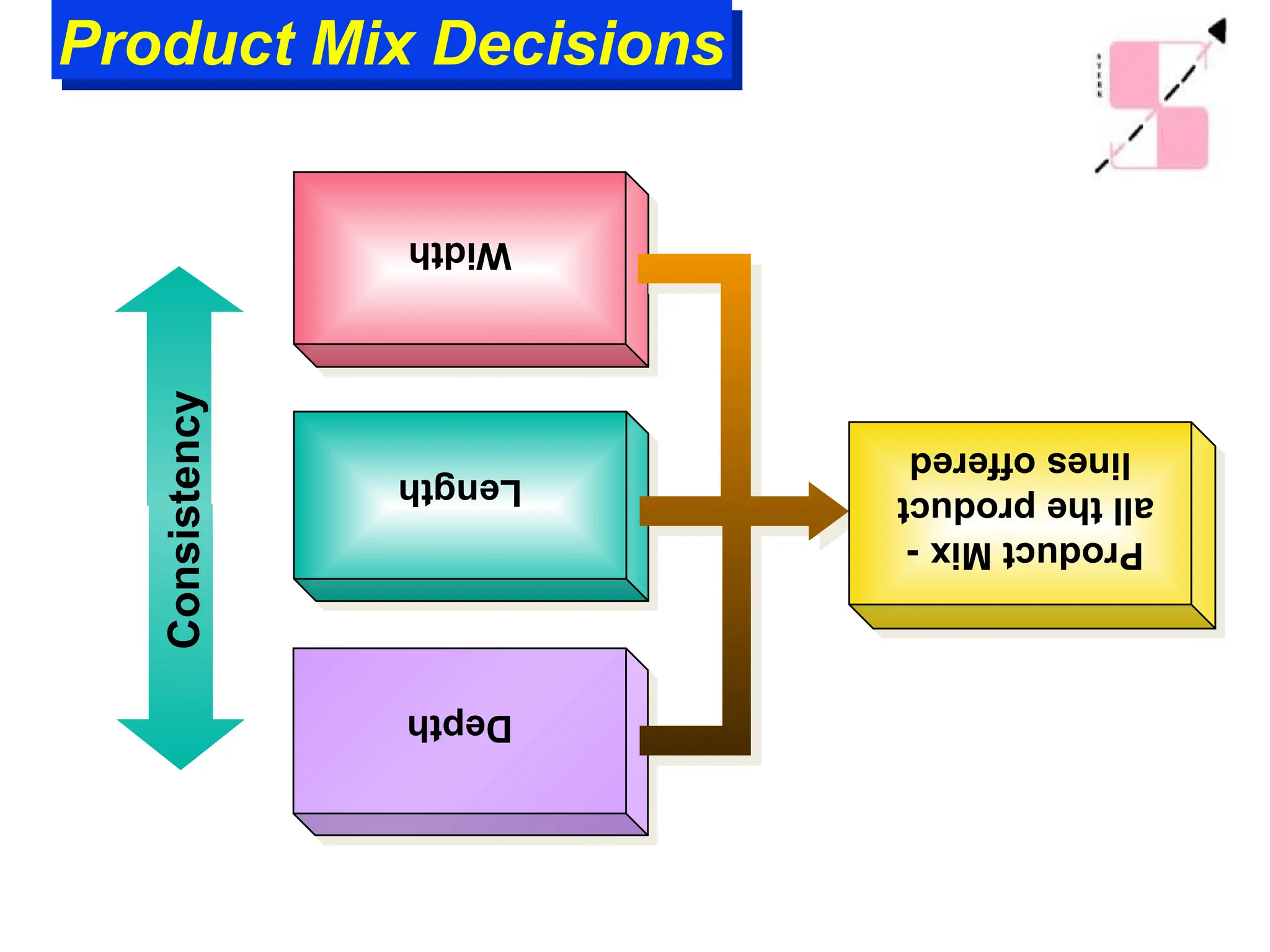
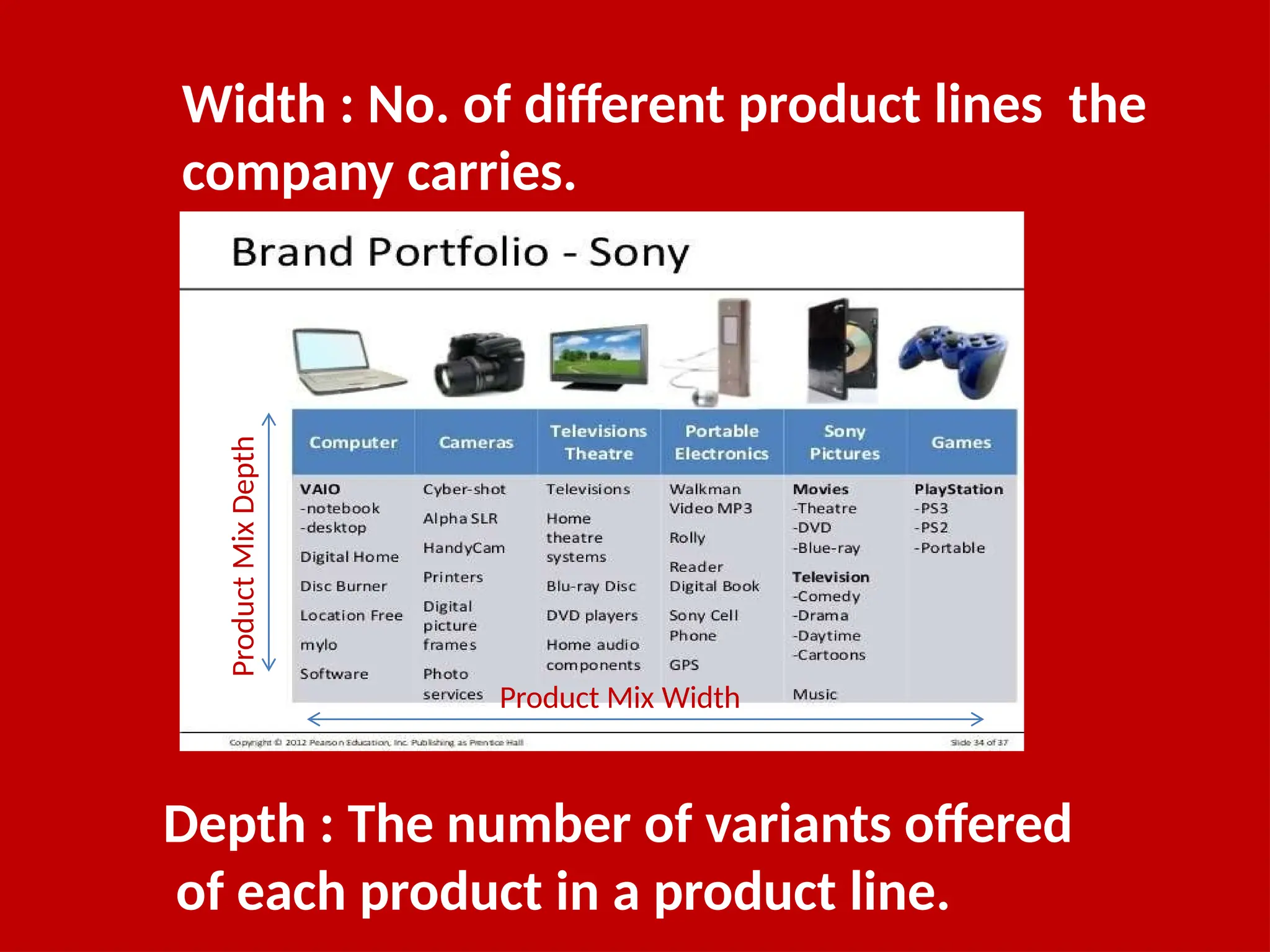
Width : No.of different product lines the
company carries.
Depth : The number of variants offered
of each product in a product line.
Product Mix Width
Product
Mix
Depth
14.
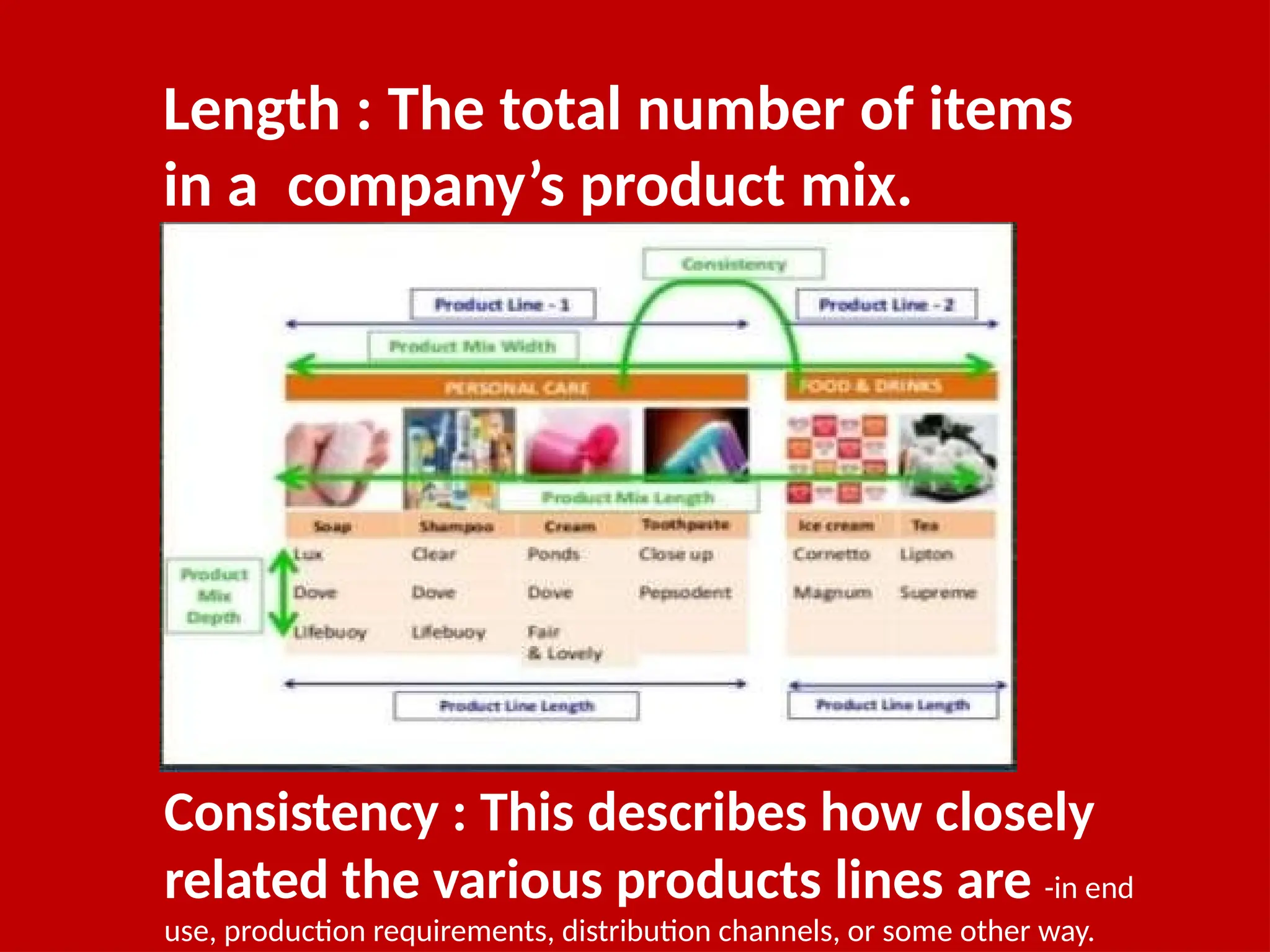
Length : Thetotal number of items
in a company’s product mix.
Consistency : This describes how closely
related the various products lines are -in end
use, production requirements, distribution channels, or some other way.
PACKAGING
It include allthe activities of
designing and producing
the container for a product.
Often known as fifth ’P’ of
the marketing mix.
17.
1. Self-service -An increasing number of products are
sold on a self-serve basis. A good package draws the
consumer in and encourages product choice. In effect,
they can act as “five-second commercials” for the
product.
2. Consumer affluence - Rising affluence means
consumers are willing to pay a little more for the
convenience, appearance, dependability, and prestige
of better packages
Factors contributing to growing
use of packaging as a marketing
tool
18.
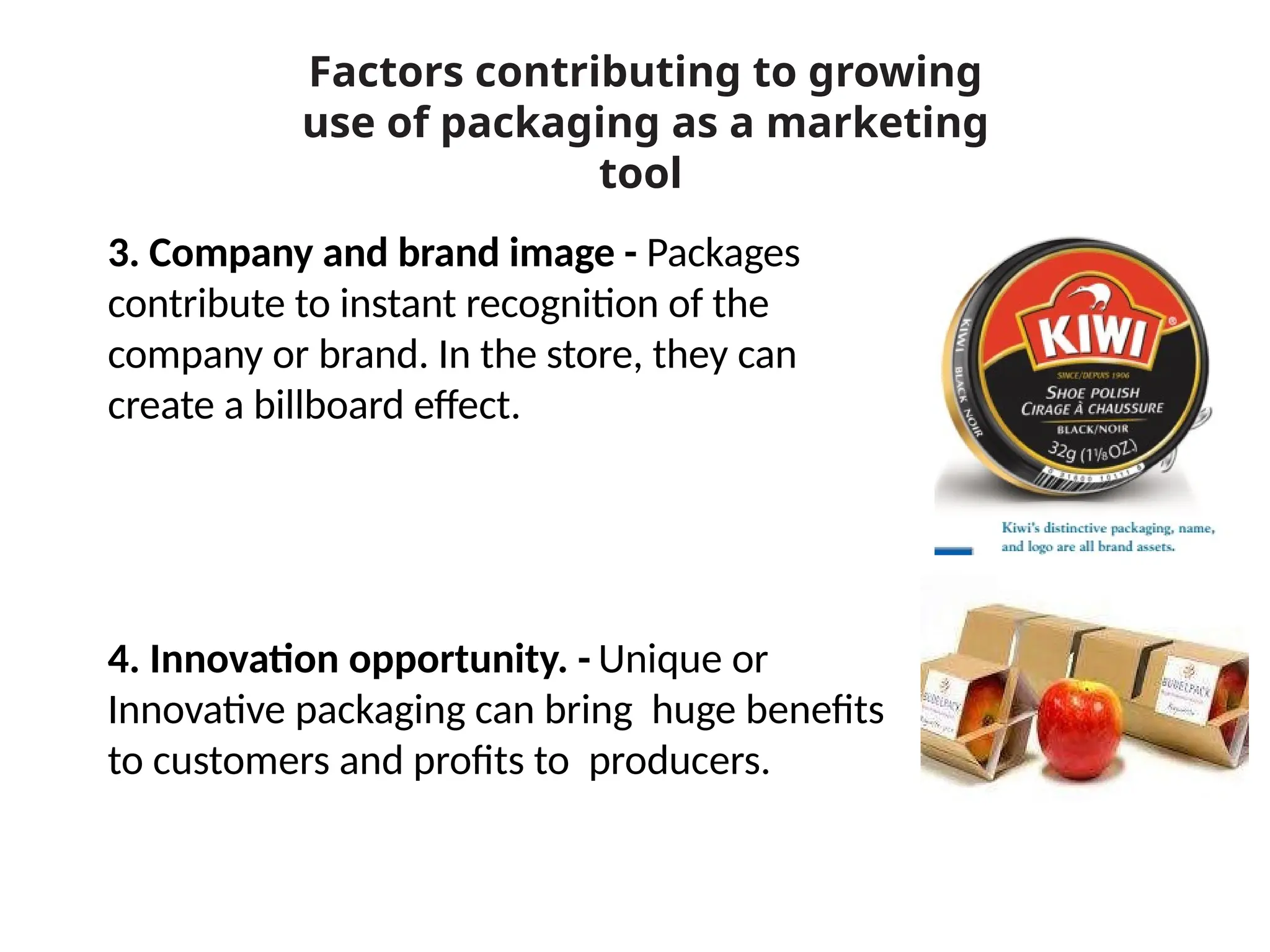
3. Company andbrand image - Packages
contribute to instant recognition of the
company or brand. In the store, they can
create a billboard effect.
4. Innovation opportunity. - Unique or
Innovative packaging can bring huge benefits
to customers and profits to producers.
Factors contributing to growing
use of packaging as a marketing
tool
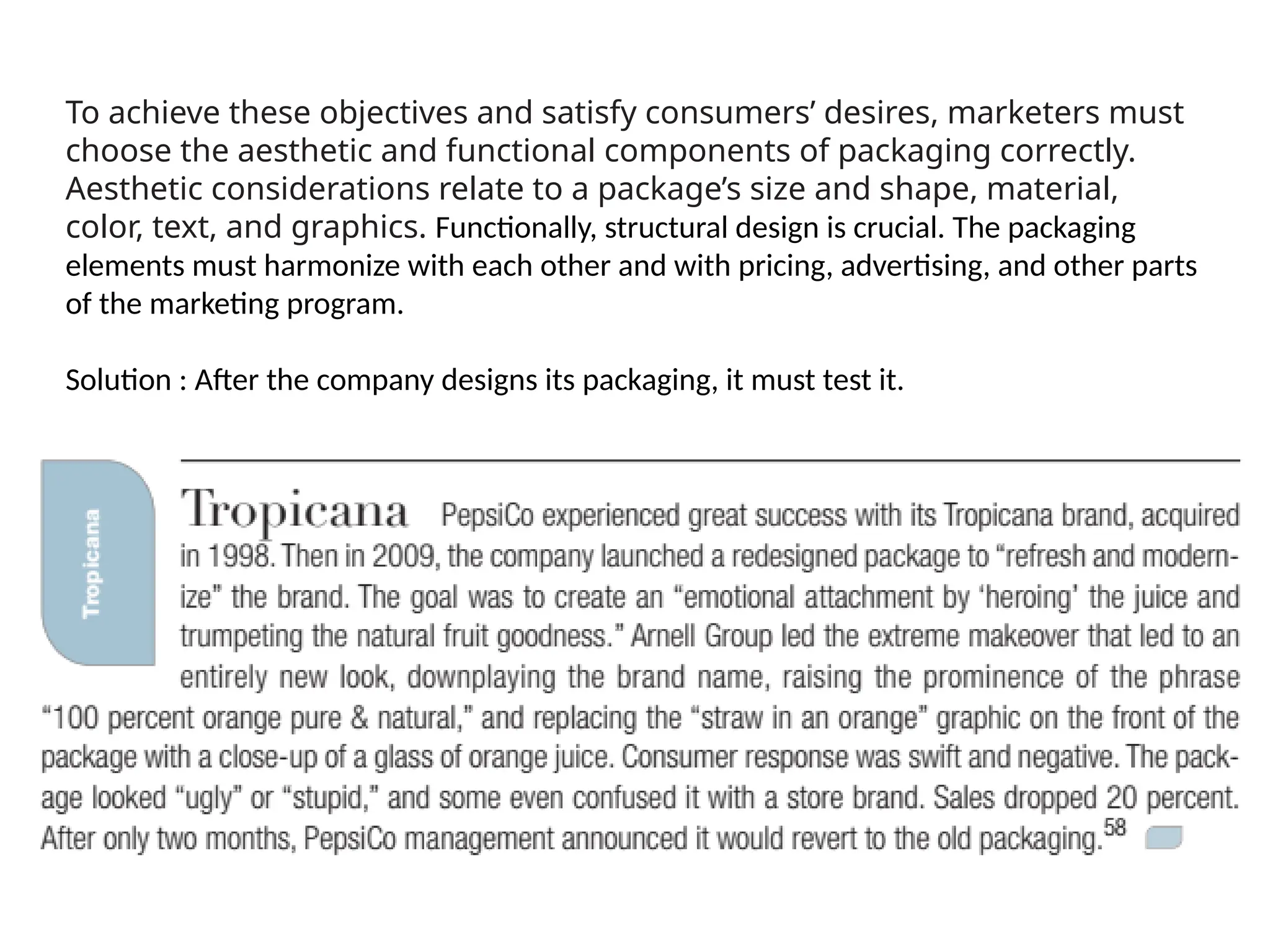
To achieve theseobjectives and satisfy consumers’ desires, marketers must
choose the aesthetic and functional components of packaging correctly.
Aesthetic considerations relate to a package’s size and shape, material,
color, text, and graphics. Functionally, structural design is crucial. The packaging
elements must harmonize with each other and with pricing, advertising, and other parts
of the marketing program.
Solution : After the company designs its packaging, it must test it.
21.
LABELING
Label is asimply attached tag or an
elaborately designed graphic that is part of
the package.
Labels eventually need freshening up. The label on
Ivory soap has been redone at least 18 times since the 1890s, with gradual changes
in the size and design of the letters
22.
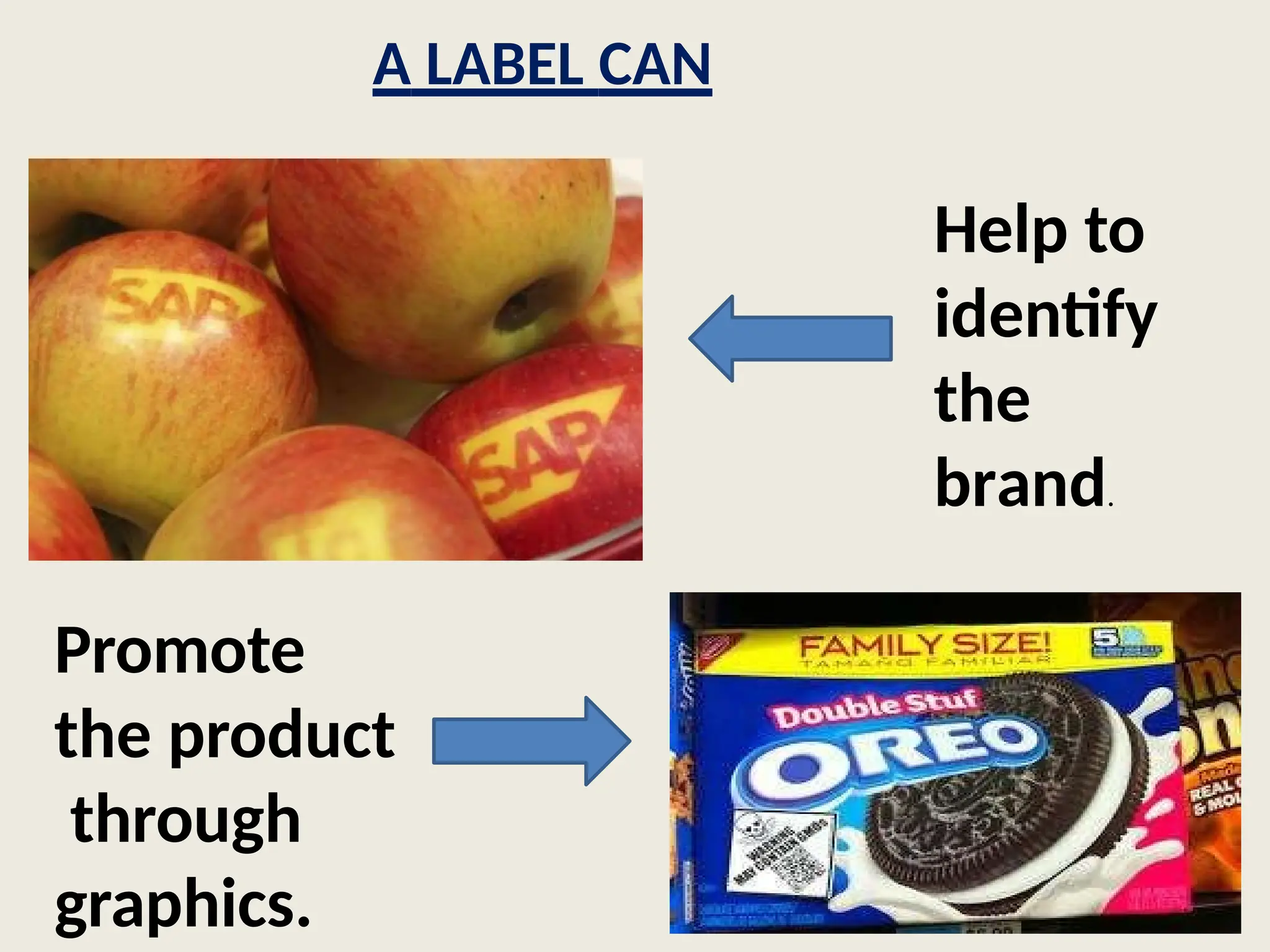
A LABEL CAN
Helpto
identify
the
brand.
Promote
the product
through
graphics.
23.
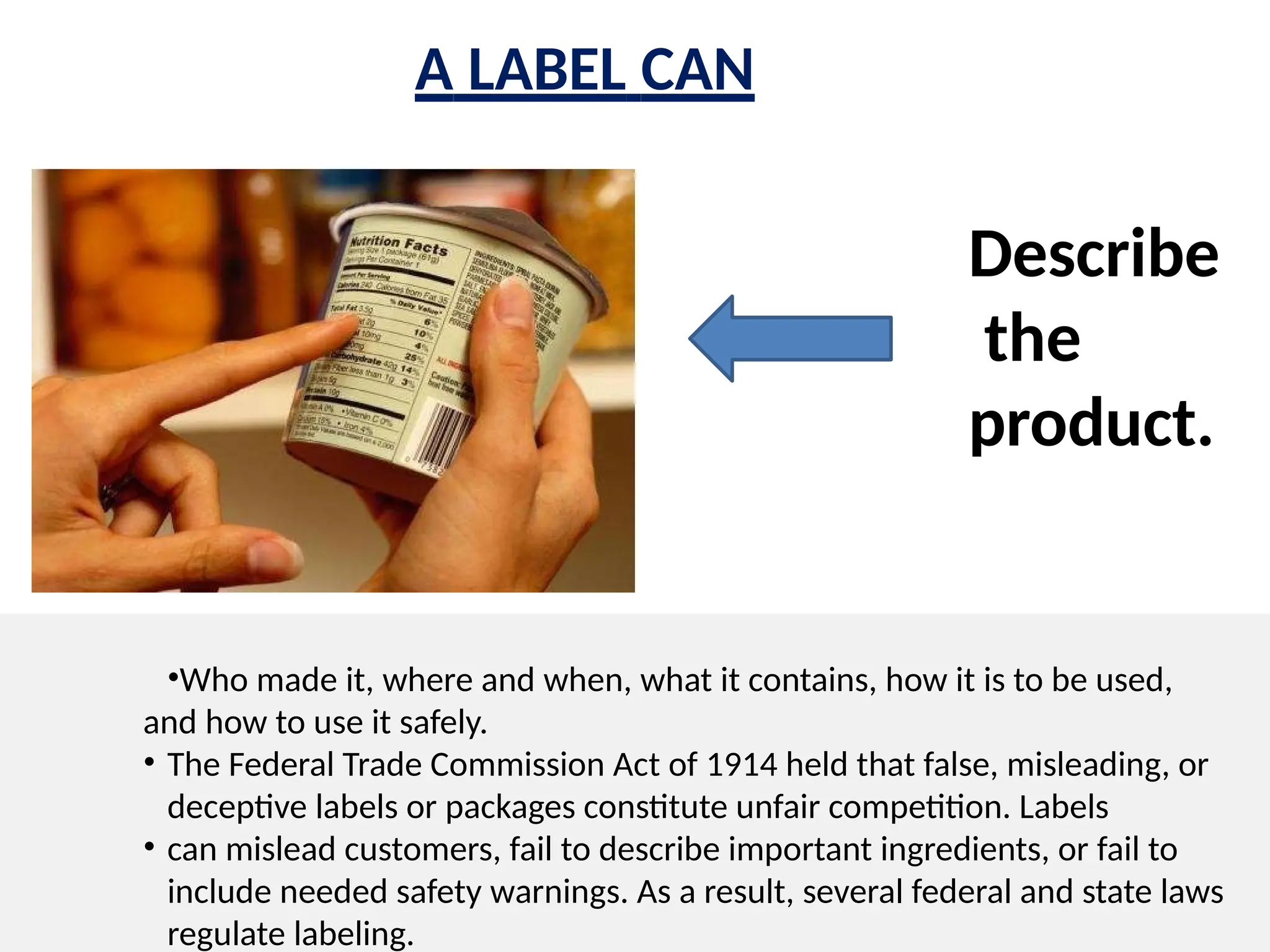
•Who made it,where and when, what it contains, how it is to be used,
and how to use it safely.
• The Federal Trade Commission Act of 1914 held that false, misleading, or
deceptive labels or packages constitute unfair competition. Labels
• can mislead customers, fail to describe important ingredients, or fail to
include needed safety warnings. As a result, several federal and state laws
regulate labeling.
A LABEL CAN
Describe
the
product.
24.
Warrantie
s
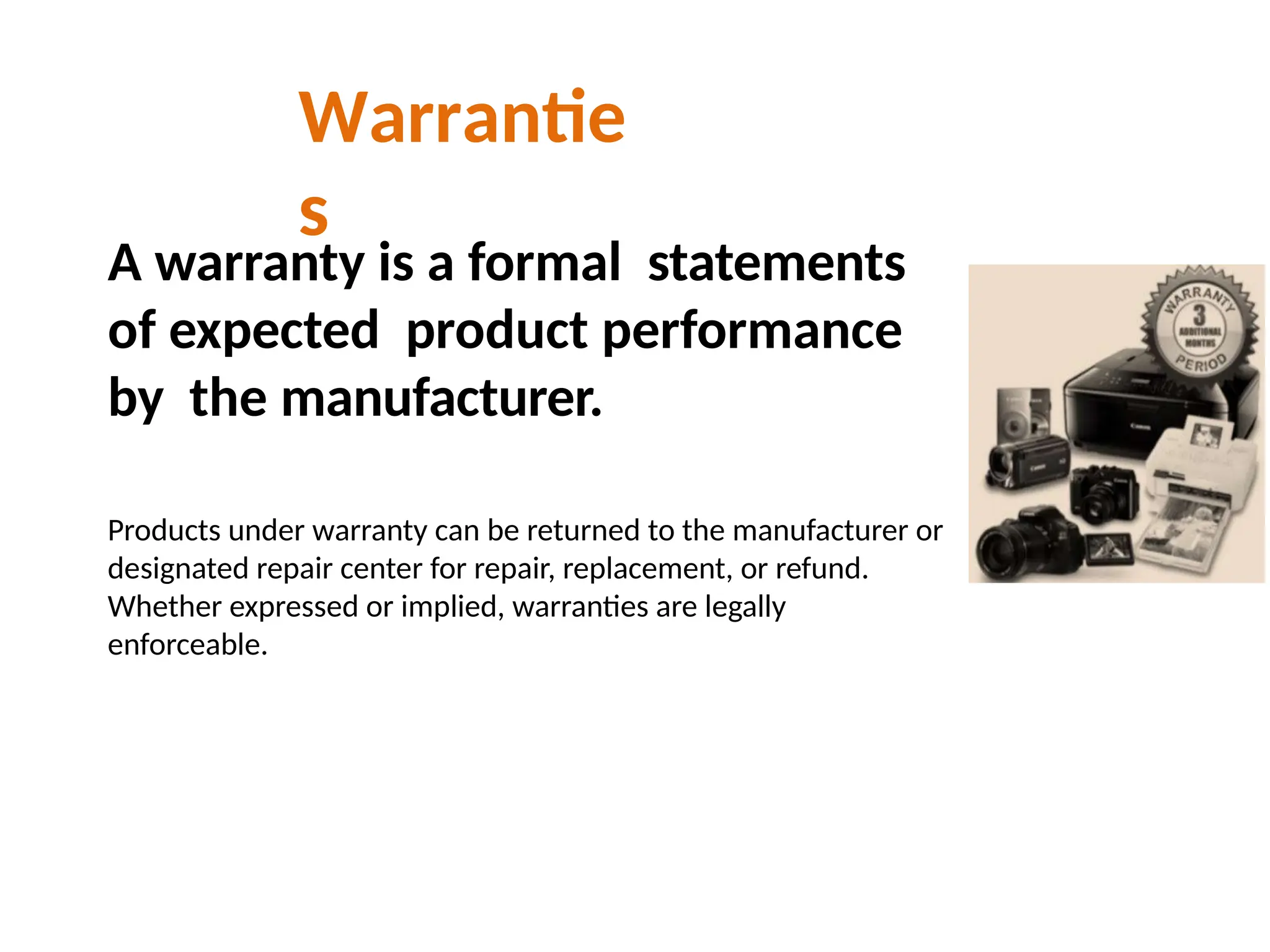
A warranty isa formal statements
of expected product performance
by the manufacturer.
Products under warranty can be returned to the manufacturer or
designated repair center for repair, replacement, or refund.
Whether expressed or implied, warranties are legally
enforceable.
25.
Guarantees
Many sellers offereither general or specific guarantees. A
company such as Procter & Gamble promises general or
complete satisfaction—”If you are not satisfied for
any reason, return for replacement, exchange, or refund.” A. T.
Cross guarantees its Cross pens and pencils for life. The
customer mails the pen to A. T. Cross (mailers are provided at
stores), and the pen is repaired or replaced at no charge.
Guarantees reduce the buyer’s perceived risk. They suggest
that the product is of high quality and the company and its
service performance are dependable. They can be especially
helpful when the company or product is not well known or
when the product’s quality is superior to that of competitors.


![Module_-_3_Product_Mgt_&_Pricing[1].pptx](https://cdn.slidesharecdn.com/ss_thumbnails/module-3productmgtpricing1-240418034836-e464c428-thumbnail.jpg?width=640&height=640&fit=bounds)


