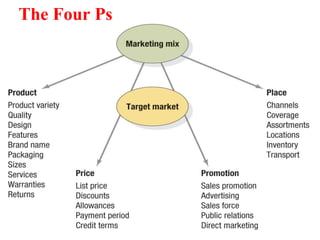
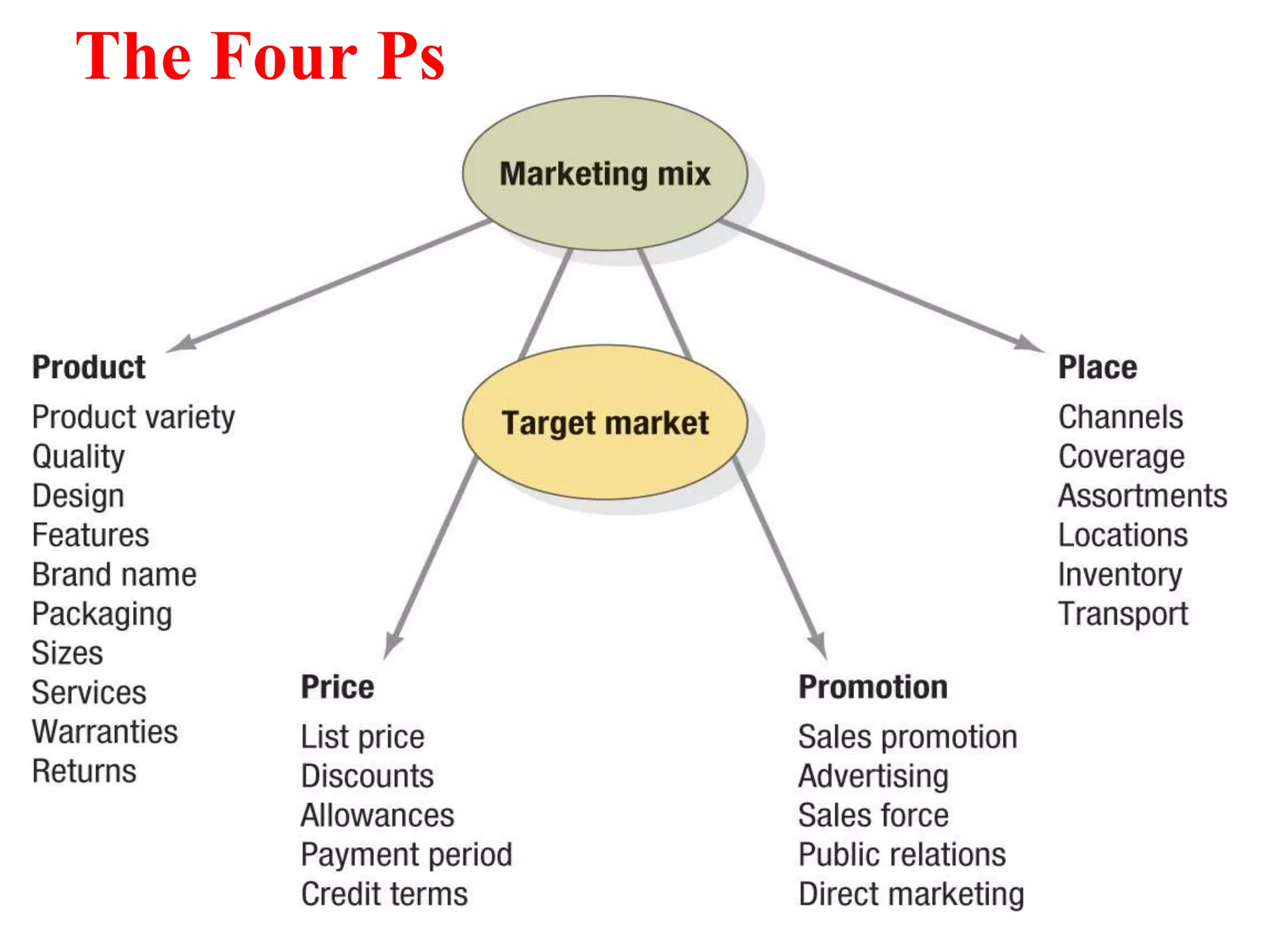
The Four Ps
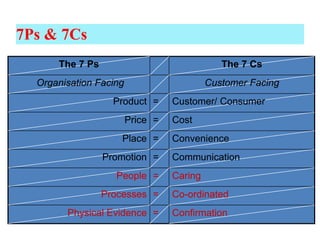
7Ps & 7Cs
The 7 Ps The 7 Cs
Organisation Facing Customer Facing
Product = Customer/ Consumer
Price = Cost
Place = Convenience
Promotion = Communication
People = Caring
Processes = Co-ordinated
Physical Evidence = Confirmation
Product
A product is anything that is offered to a market to satisfy customer wants and
needs. The product includes both tangible and intangible items available for sale in
the market.
A company sells a variety of products at a time. For example, PepsiCo sells hundred
of products under the product lines of beverages, food, and nutritional products.
These product lines, when combines, are known as product mix.
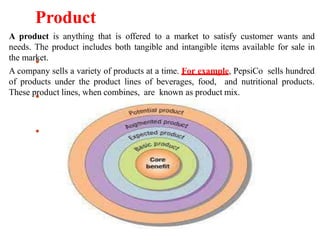
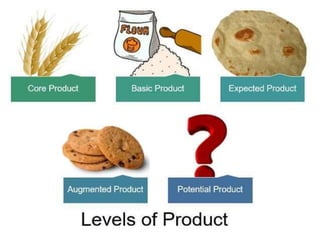
1.Core or Generic Product
It is the raw product that satisfies the customer’s primary need. The core product is
at its raw form, not bearing any brand name and remains undifferentiated.
For example: – Wheat is a grain that one can consume.
2.Basic Product
The core products differentiated from the rest become the basic product. It adds
some necessary features to the products like Brand Name, Packaging and Label, etc.
For example: – Fortune Chakki Fresh Atta (wheat flour).
3.Expected Product
These products include the key features that customers look forward to. It also
contains standard features that a product should have.
For example: – Chapati is prepared from wheat flour.
4.Augmented Product
To differentiate products from competitors, companies add distinctive features to
them. These additions depend on the market survey conducted for the product. They
try to create a Unique Selling Proposition (USP) for their products.
For example -Brown Bread and Cookies.
5.Potential Product
It refers to all the possible features that a product can have in the future. These
features depend on the market conditions and economic changes.
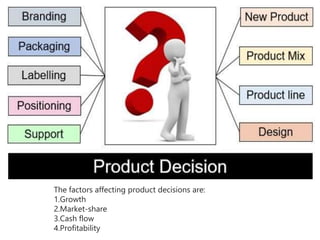
The factors affecting product decisions are:
1.Growth
2.Market-share
3.Cash flow
4.Profitability
Product Mix
Definition: The Product Mix also called as Product Assortment, refers to the
complete range of products that is offered for sale by the company.
In other words, the number of product lines that a company has for its customers is
called as product mix.
It refers to the aggregate range of products that a company owns. In other words, the
total number of products that a company offers for sale is the product mix of the
company.
Product mix decisions depend upon the following four characteristics:
Length
Width
1.Depth
2.Consistency
There are various decisions the marketers have to take regarding the product mix. It
may include:-
1.Expansion
2.Contraction
3.Product Differentiation
4.Deepening and Alteration, etc.
Product Line
The Product Line refers to the list of all the related products
manufactured or marketed by a single firm.
The number of products within the product line are called
as the items, and these might be similar in terms of
technology used, channel employed, customer’s needs and
preferences or any other aspect.
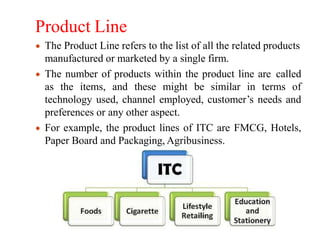
For example, the product lines of ITC are FMCG, Hotels,
Paper Board and Packaging, Agribusiness.
Breadth of a product mix
The product mix has four dimensions
Breadth, Length, Depth, and Consistency.
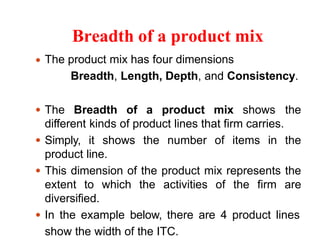
The Breadth of a product mix shows the
different kinds of product lines that firm carries.
Simply, it shows the number of items in the
product line.
This dimension of the product mix represents the
extent to which the activities of the firm are
diversified.
In the example below, there are 4 product lines
show the width of the ITC.
Length of a Product mix
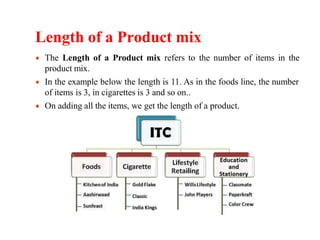
The Length of a Product mix refers to the number of items in the
product mix.
In the example below the length is 11. As in the foods line, the number
of items is 3, in cigarettes is 3 and so on..
On adding all the items, we get the length of a product.
Depth of a product mix
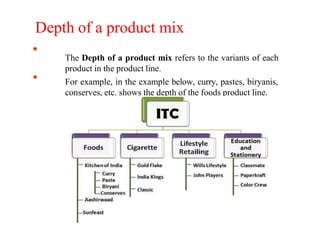
The Depth of a product mix refers to the variants of each
product in the product line.
For example, in the example below, curry, pastes, biryanis,
conserves, etc. shows the depth of the foods product line.
Consistency of a product mix
The Consistency of a product mix shows the extent to
which the product lines are closely related to each other in
terms of their end-use, distribution requirements,
production requirements, price ranges, advertising media,
etc.
In the above example, it is clear that ITC’s product lines are
less consistent as these perform different functions for the
buyers.
Product Branding
What Is a Brand?
A brand is an identifying symbol, mark,
logo, name, word, and/or sentence that
companies use to distinguish their product
from others.
Product branding is a strategy that defines a
unique set of marketing elements to differentiate
a given product.
It is an activity that defines the way the product’s
image is communicated to its customers.
Branding is the process of assigning
characteristics and properties within and outside
an offering to give that generic offering an identity
which helps it to be recognized and differentiated
in the market.
Branding
1. Name: The name which we use to identify the product with.
2. Logo: A symbol or other design adopted by the business to identify its brand.
3. Colour: A colour mostly used by the business in its marketing messages to
describe or complement the brand.
4. Vision: The group of goals or objective behind the brand that help guide its
activities and its future.
5. Shape: Either the distinct shape of the offering or the shape of the packaging.
6. Aroma: The distinct smell which the user experiences before, during, or after he
uses the offering.
7. Graphics: The uniform and distinct aesthetics used in the marketing messages.
8. Sound: The sound used in the marketing messages to reinforce the brand
identity.
Packaging is the outermost covering of the product. It enables product
protection, conveys information and creates sale appeal. And is not restricted to
just the safety of the product.
Packaging has evolved as the medium of marketing. Marketers use packaging
to reposition or renovate their products.
Packaging decisions include:
1.Size
2.Design
3.Innovation
4.Aesthetics
5.Convenience
6.Material
7.Environmental factors
Labeling is a part of the packaging. It contains all the essential details about
the product in written form. Also, it conveys information regarding performance,
features, quality and price, etc.
The marketers must perform an in-depth analysis at the time of Labelling. It is a
medium of communicating with customers. Vital decisions based on labelling are:
1.Brand Label
2.Descriptive Label
3.Grade Label
4.Informative Labels
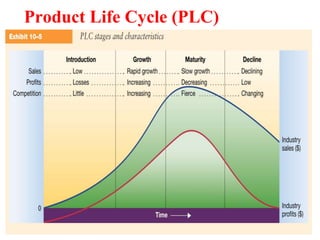
Product Life Cycle (PLC)
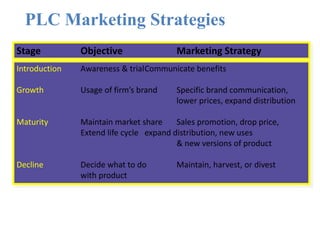
PLC Marketing Strategies
Stage Objective Marketing Strategy
Introduction Awareness & trialCommunicate benefits
Growth Usage of firm’s brand Specific brand communication,
lower prices, expand distribution
Maturity Maintain market share Sales promotion, drop price,
Extend life cycle expand distribution, new uses
& new versions of product
Decline Decide what to do Maintain, harvest, or divest
with product
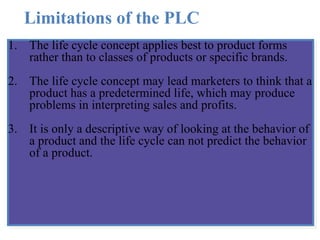
Limitations of the PLC
1. The life cycle concept applies best to product forms
rather than to classes of products or specific brands.
2. The life cycle concept may lead marketers to think that a
product has a predetermined life, which may produce
problems in interpreting sales and profits.
3. It is only a descriptive way of looking at the behavior of
a product and the life cycle can not predict the behavior
of a product.
New Product Development
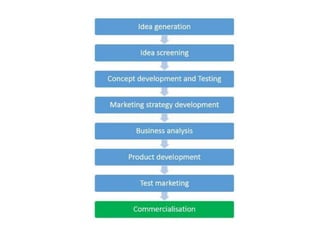
Idea generation
The new product development process starts with idea generation. Idea
generation refers to the systematic search for new-product ideas.
Typically, a company generates hundreds of ideas, maybe even
thousands, to find a handful of good ones in the end. Two sources of
new ideas can be identified:
Internal idea sources: the company finds new ideas internally. That
means R&D, but also contributions from employees.
External idea sources: the company finds new ideas externally. This
refers to all kinds of external sources, e.g. distributors and suppliers, but
also competitors. The most important external source are customers,
because the new product development process should focus on creating
customer value.
Idea screening
he next step in the new product development process is
idea screening.
Idea screening means nothing else than filtering the ideas
to pick out good ones.
In other words, all ideas generated are screened to spot
good ones and drop poor ones as soon as possible.
While the purpose of idea generation was to create a large
number of ideas, the purpose of the succeeding stages is
to reduce that number.
The reason is that product development costs rise greatly
in later stages.
Therefore, the company would like to go ahead only with
those product ideas that will turn into profitable products.
Dropping the poor ideas as soon as possible is,
consequently, of crucial importance.
Concept development
Imagine a car manufacturer that has developed an all-electric car. The idea
has passed the idea screening and must now be developed into a concept.
The marketer’s task is to develop this new product into alternative product
concepts.
Then, the company can find out how attractive each concept is to customers
and choose the best one.
Possible product concepts for this electric car could be:
1. Concept 1: an affordably priced mid-size car designed as a second family
car to be used around town for visiting friends and doing shopping.
2. Concept 2: a mid-priced sporty compact car appealing to young singles
and couples.
3. Concept 3: a high-end midsize utility vehicle appealing to those who like
the space SUVs provide but also want an economical car.
Concept testing
New product concepts, such as those given above, need to be tested
with groups of target consumers.
The concepts can be presented to consumers either symbolically or
physically.
The question is always: does the particular concept have strong
word or picture description might be
consumer appeal?
For some concept tests, a
sufficient.
However, to increase the reliability of the test, a more concrete and
physical presentation of the product concept may be needed.
After exposing the concept to the group of target consumers, they will
be asked to answer questions in order to find out the consumer appeal
and customer value of each concept.
Marketing strategy development
The next step in the new product development process is the marketing
strategy development.
When a promising concept has been developed and tested, it is time to
design an initial marketing strategy for the new product based on the
product concept for introducing this new product to the market.
The marketing strategy statement consists of three parts and should be
formulated carefully:
A description of the target market, the planned value proposition, and
the sales, market share and profit goals for the first few years
An outline of the product’s planned price, distribution and marketing
budget for the first year
The planned long-term sales, profit goals and the marketing mix
strategy.
Business analysis
The fifth step in the new product development process
involves a review of the sales, costs and profit projections
for the new product to find out whether these factors
satisfy the company’s objectives.
If they do, the product can be moved on to the product
development stage.
In order to estimate sales, the company could look at the
sales history of similar products and conduct market
surveys.
Then, it should be able to estimate minimum and
maximum sales to assess the range of risk.
When the sales forecast is prepared, the firm can estimate
the expected costs and profits for a product, including
marketing, R&D, operations etc.
All the sales and costs figures together can eventually be
used to analyse the new product’s financial attractiveness.
Product development
The new product development process goes on with the actual product development.
Up to this point, for many new product concepts, there may exist only a word
description, a drawing or perhaps a rough prototype.
But if the product concept passes the business test, it must be developed into a
physical product to ensure that the product idea can be turned into a workable
market offering.
The problem is, though, that at this stage, R&D and engineering costs cause a huge
jump in investment.
The R&D department will develop and test one or more physical versions of the
product concept.
Developing a successful prototype, however, can take days, weeks, months or even
years, depending on the product and prototype methods.
Test marketing
In this stage of the new product development process, the product and its
proposed marketing programme are tested in realistic market settings.
Therefore, test marketing gives the marketer experience with marketing the
product before going to the great expense of full introduction.
In fact, it allows the company to test the product and its entire marketing
programme, including targeting and positioning strategy, advertising,
distributions, packaging etc. before the full investment is made.
The amount of test marketing necessary varies with each new product.
Especially when introducing a new product requiring a large investment,
when the risks are high, or when the firm is not sure of the product or its
marketing programme, a lot of test marketing may be carried out.
Commercialisation
Commercialisation means nothing else than introducing a new product
into the market.
At this point, the highest costs are incurred: the company may need to
build or rent a manufacturing facility.
Large amounts may be spent on advertising, sales promotion and other
marketing efforts in the first year.
Some factors should be considered before the product is
commercialized:
Introduction timing. For instance, if the economy is down, it might be
wise to wait until the following year to launch the product. However, if
competitors are ready to introduce their own products, the company
should push to introduce the new product sooner.
Where to launch the new product? Should it be launched in a single
location, a region, the national market, or the international market?
Unit 2.1 Product _Brand_PLC_New PD.pptx

Unit 2.1 Product _Brand_PLC_New PD.pptx

  • 1.
  • 2.
    7Ps & 7Cs The7 Ps The 7 Cs Organisation Facing Customer Facing Product = Customer/ Consumer Price = Cost Place = Convenience Promotion = Communication People = Caring Processes = Co-ordinated Physical Evidence = Confirmation
  • 3.
    Product A product isanything that is offered to a market to satisfy customer wants and needs. The product includes both tangible and intangible items available for sale in the market. A company sells a variety of products at a time. For example, PepsiCo sells hundred of products under the product lines of beverages, food, and nutritional products. These product lines, when combines, are known as product mix.
  • 5.
    1.Core or GenericProduct It is the raw product that satisfies the customer’s primary need. The core product is at its raw form, not bearing any brand name and remains undifferentiated. For example: – Wheat is a grain that one can consume. 2.Basic Product The core products differentiated from the rest become the basic product. It adds some necessary features to the products like Brand Name, Packaging and Label, etc. For example: – Fortune Chakki Fresh Atta (wheat flour). 3.Expected Product These products include the key features that customers look forward to. It also contains standard features that a product should have. For example: – Chapati is prepared from wheat flour. 4.Augmented Product To differentiate products from competitors, companies add distinctive features to them. These additions depend on the market survey conducted for the product. They try to create a Unique Selling Proposition (USP) for their products. For example -Brown Bread and Cookies. 5.Potential Product It refers to all the possible features that a product can have in the future. These features depend on the market conditions and economic changes.
  • 6.
    The factors affectingproduct decisions are: 1.Growth 2.Market-share 3.Cash flow 4.Profitability
  • 7.
    Product Mix Definition: TheProduct Mix also called as Product Assortment, refers to the complete range of products that is offered for sale by the company. In other words, the number of product lines that a company has for its customers is called as product mix. It refers to the aggregate range of products that a company owns. In other words, the total number of products that a company offers for sale is the product mix of the company. Product mix decisions depend upon the following four characteristics: Length Width 1.Depth 2.Consistency There are various decisions the marketers have to take regarding the product mix. It may include:- 1.Expansion 2.Contraction 3.Product Differentiation 4.Deepening and Alteration, etc.
  • 8.
    Product Line The ProductLine refers to the list of all the related products manufactured or marketed by a single firm. The number of products within the product line are called as the items, and these might be similar in terms of technology used, channel employed, customer’s needs and preferences or any other aspect. For example, the product lines of ITC are FMCG, Hotels, Paper Board and Packaging, Agribusiness.
  • 9.
    Breadth of aproduct mix The product mix has four dimensions Breadth, Length, Depth, and Consistency. The Breadth of a product mix shows the different kinds of product lines that firm carries. Simply, it shows the number of items in the product line. This dimension of the product mix represents the extent to which the activities of the firm are diversified. In the example below, there are 4 product lines show the width of the ITC.
  • 10.
    Length of aProduct mix The Length of a Product mix refers to the number of items in the product mix. In the example below the length is 11. As in the foods line, the number of items is 3, in cigarettes is 3 and so on.. On adding all the items, we get the length of a product.
  • 11.
    Depth of aproduct mix The Depth of a product mix refers to the variants of each product in the product line. For example, in the example below, curry, pastes, biryanis, conserves, etc. shows the depth of the foods product line.
  • 12.
    Consistency of aproduct mix The Consistency of a product mix shows the extent to which the product lines are closely related to each other in terms of their end-use, distribution requirements, production requirements, price ranges, advertising media, etc. In the above example, it is clear that ITC’s product lines are less consistent as these perform different functions for the buyers.
  • 13.
  • 15.
    What Is aBrand? A brand is an identifying symbol, mark, logo, name, word, and/or sentence that companies use to distinguish their product from others.
  • 16.
    Product branding isa strategy that defines a unique set of marketing elements to differentiate a given product. It is an activity that defines the way the product’s image is communicated to its customers. Branding is the process of assigning characteristics and properties within and outside an offering to give that generic offering an identity which helps it to be recognized and differentiated in the market.
  • 17.
    Branding 1. Name: Thename which we use to identify the product with. 2. Logo: A symbol or other design adopted by the business to identify its brand. 3. Colour: A colour mostly used by the business in its marketing messages to describe or complement the brand. 4. Vision: The group of goals or objective behind the brand that help guide its activities and its future. 5. Shape: Either the distinct shape of the offering or the shape of the packaging. 6. Aroma: The distinct smell which the user experiences before, during, or after he uses the offering. 7. Graphics: The uniform and distinct aesthetics used in the marketing messages. 8. Sound: The sound used in the marketing messages to reinforce the brand identity.
  • 18.
    Packaging is theoutermost covering of the product. It enables product protection, conveys information and creates sale appeal. And is not restricted to just the safety of the product. Packaging has evolved as the medium of marketing. Marketers use packaging to reposition or renovate their products. Packaging decisions include: 1.Size 2.Design 3.Innovation 4.Aesthetics 5.Convenience 6.Material 7.Environmental factors Labeling is a part of the packaging. It contains all the essential details about the product in written form. Also, it conveys information regarding performance, features, quality and price, etc. The marketers must perform an in-depth analysis at the time of Labelling. It is a medium of communicating with customers. Vital decisions based on labelling are: 1.Brand Label 2.Descriptive Label 3.Grade Label 4.Informative Labels
  • 19.
  • 20.
    PLC Marketing Strategies StageObjective Marketing Strategy Introduction Awareness & trialCommunicate benefits Growth Usage of firm’s brand Specific brand communication, lower prices, expand distribution Maturity Maintain market share Sales promotion, drop price, Extend life cycle expand distribution, new uses & new versions of product Decline Decide what to do Maintain, harvest, or divest with product
  • 21.
    Limitations of thePLC 1. The life cycle concept applies best to product forms rather than to classes of products or specific brands. 2. The life cycle concept may lead marketers to think that a product has a predetermined life, which may produce problems in interpreting sales and profits. 3. It is only a descriptive way of looking at the behavior of a product and the life cycle can not predict the behavior of a product.
  • 22.
  • 24.
    Idea generation The newproduct development process starts with idea generation. Idea generation refers to the systematic search for new-product ideas. Typically, a company generates hundreds of ideas, maybe even thousands, to find a handful of good ones in the end. Two sources of new ideas can be identified: Internal idea sources: the company finds new ideas internally. That means R&D, but also contributions from employees. External idea sources: the company finds new ideas externally. This refers to all kinds of external sources, e.g. distributors and suppliers, but also competitors. The most important external source are customers, because the new product development process should focus on creating customer value.
  • 25.
    Idea screening he nextstep in the new product development process is idea screening. Idea screening means nothing else than filtering the ideas to pick out good ones. In other words, all ideas generated are screened to spot good ones and drop poor ones as soon as possible. While the purpose of idea generation was to create a large number of ideas, the purpose of the succeeding stages is to reduce that number. The reason is that product development costs rise greatly in later stages. Therefore, the company would like to go ahead only with those product ideas that will turn into profitable products. Dropping the poor ideas as soon as possible is, consequently, of crucial importance.
  • 26.
    Concept development Imagine acar manufacturer that has developed an all-electric car. The idea has passed the idea screening and must now be developed into a concept. The marketer’s task is to develop this new product into alternative product concepts. Then, the company can find out how attractive each concept is to customers and choose the best one. Possible product concepts for this electric car could be: 1. Concept 1: an affordably priced mid-size car designed as a second family car to be used around town for visiting friends and doing shopping. 2. Concept 2: a mid-priced sporty compact car appealing to young singles and couples. 3. Concept 3: a high-end midsize utility vehicle appealing to those who like the space SUVs provide but also want an economical car.
  • 27.
    Concept testing New productconcepts, such as those given above, need to be tested with groups of target consumers. The concepts can be presented to consumers either symbolically or physically. The question is always: does the particular concept have strong word or picture description might be consumer appeal? For some concept tests, a sufficient. However, to increase the reliability of the test, a more concrete and physical presentation of the product concept may be needed. After exposing the concept to the group of target consumers, they will be asked to answer questions in order to find out the consumer appeal and customer value of each concept.
  • 28.
    Marketing strategy development Thenext step in the new product development process is the marketing strategy development. When a promising concept has been developed and tested, it is time to design an initial marketing strategy for the new product based on the product concept for introducing this new product to the market. The marketing strategy statement consists of three parts and should be formulated carefully: A description of the target market, the planned value proposition, and the sales, market share and profit goals for the first few years An outline of the product’s planned price, distribution and marketing budget for the first year The planned long-term sales, profit goals and the marketing mix strategy.
  • 29.
    Business analysis The fifthstep in the new product development process involves a review of the sales, costs and profit projections for the new product to find out whether these factors satisfy the company’s objectives. If they do, the product can be moved on to the product development stage. In order to estimate sales, the company could look at the sales history of similar products and conduct market surveys. Then, it should be able to estimate minimum and maximum sales to assess the range of risk. When the sales forecast is prepared, the firm can estimate the expected costs and profits for a product, including marketing, R&D, operations etc. All the sales and costs figures together can eventually be used to analyse the new product’s financial attractiveness.
  • 30.
    Product development The newproduct development process goes on with the actual product development. Up to this point, for many new product concepts, there may exist only a word description, a drawing or perhaps a rough prototype. But if the product concept passes the business test, it must be developed into a physical product to ensure that the product idea can be turned into a workable market offering. The problem is, though, that at this stage, R&D and engineering costs cause a huge jump in investment. The R&D department will develop and test one or more physical versions of the product concept. Developing a successful prototype, however, can take days, weeks, months or even years, depending on the product and prototype methods.
  • 31.
    Test marketing In thisstage of the new product development process, the product and its proposed marketing programme are tested in realistic market settings. Therefore, test marketing gives the marketer experience with marketing the product before going to the great expense of full introduction. In fact, it allows the company to test the product and its entire marketing programme, including targeting and positioning strategy, advertising, distributions, packaging etc. before the full investment is made. The amount of test marketing necessary varies with each new product. Especially when introducing a new product requiring a large investment, when the risks are high, or when the firm is not sure of the product or its marketing programme, a lot of test marketing may be carried out.
  • 32.
    Commercialisation Commercialisation means nothingelse than introducing a new product into the market. At this point, the highest costs are incurred: the company may need to build or rent a manufacturing facility. Large amounts may be spent on advertising, sales promotion and other marketing efforts in the first year. Some factors should be considered before the product is commercialized: Introduction timing. For instance, if the economy is down, it might be wise to wait until the following year to launch the product. However, if competitors are ready to introduce their own products, the company should push to introduce the new product sooner. Where to launch the new product? Should it be launched in a single location, a region, the national market, or the international market?