Setting Anterior Teeth
Esthetics & Phonetics
Look for Symmetry
View from anterior,
occlusal
View from many
angles
Symmetry
Perfect
Symmetry
Gross
Asymmetry
Facial Asymmetry
2 Left Sides “Normal” 2 Right Sides
Smile Asymmetry
2 Left Sides “Normal” 2 Right Sides
Setting Anterior Teeth
– Incisal edges of
central incisors &
canines at level of
the occlusal plane
– Laterals placed
approximately
0.5 mm above
the occlusal plane
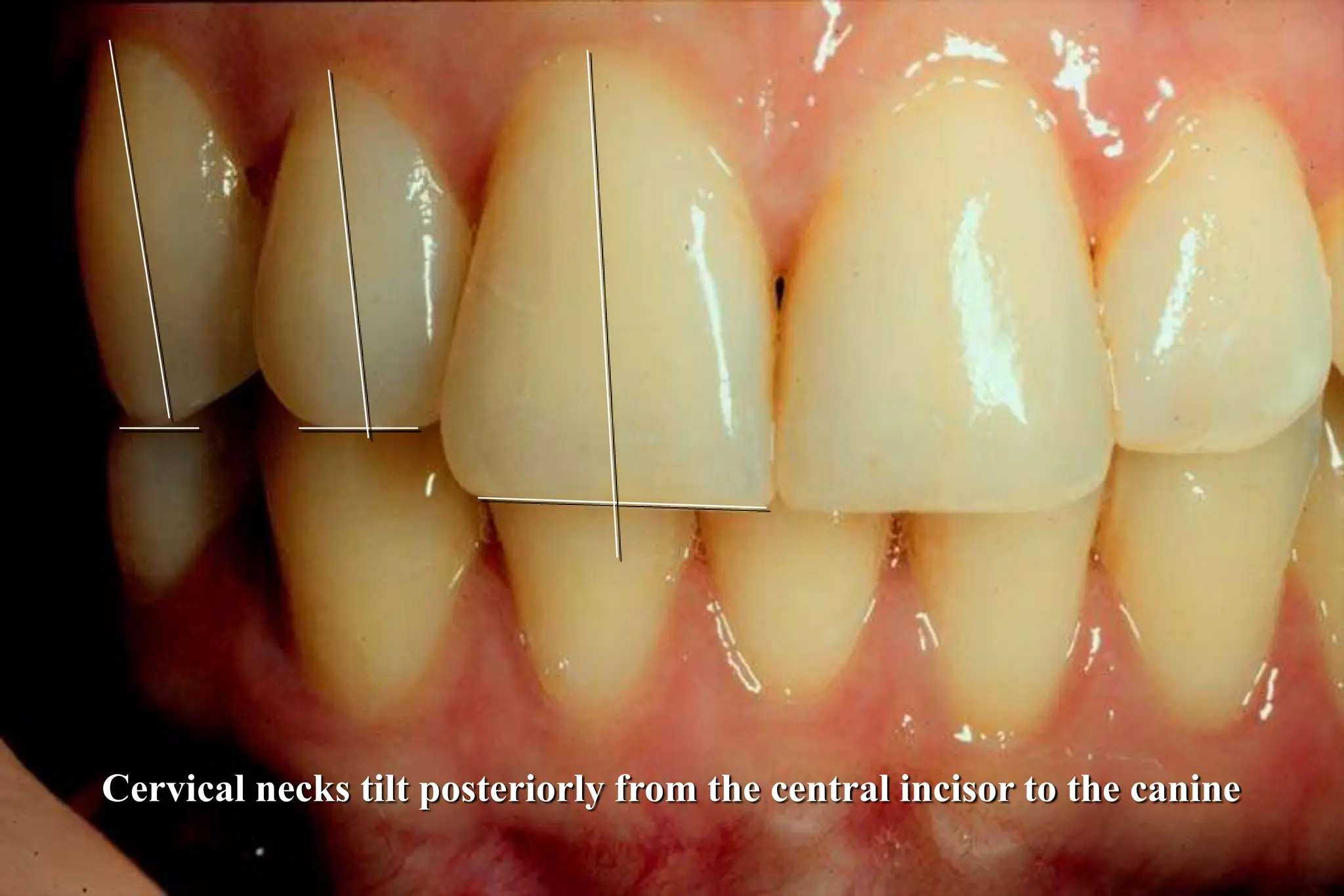
Cervical necks tilt posteriorly from the central incisor to the canine
The greatest height
of the free gingival
margin is slightly
distal to the
mesiodistal center
of the tooth
Setting Mandibular Anteriors
Lower anterior
teeth incline
similar to the
maxillary teeth
Setting Mandibular Anteriors
• Incisal edges are placed at the same level
• Even with the occlusal plane
Setting Mandibular Anteriors
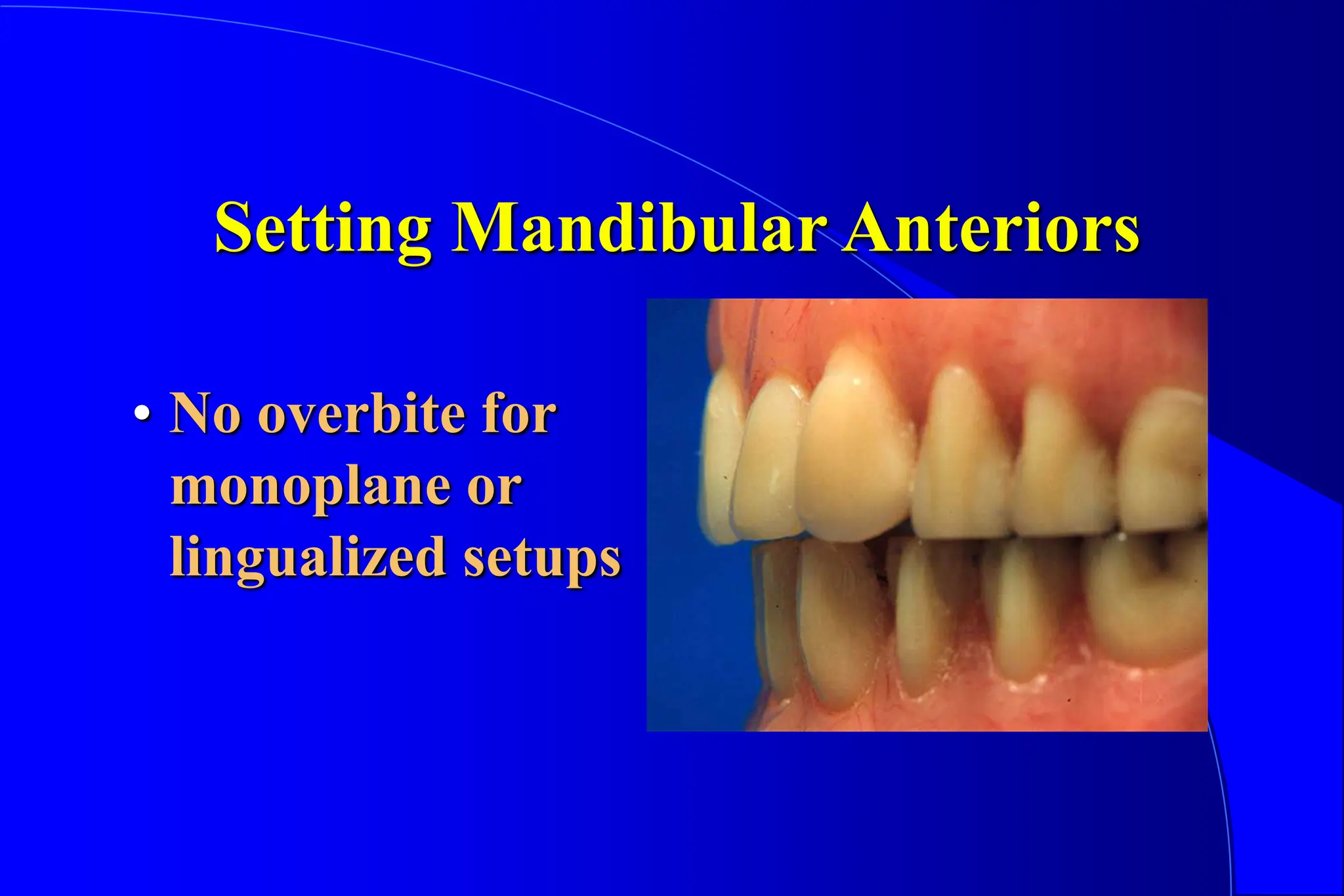
• No overbite for
monoplane or
lingualized setups
Canines should be tilted more
posteriorly than other teeth, with a
more prominent cervical neck
Bucco-Lingual Tilt
Maxillary Anterior Teeth
• Facial surface of central is
perpendicular occlusal plane
• Neck of lateral is depressed
• Neck of canine is prominent
Central Canine
Bucco-Lingual Tilt
Mandibular Anterior Teeth
• Central is proclined
• Lateral is more upright
• Canine has a
prominent neck
Central Canine
Anterior Tooth Setup
• Check symmetry with
reference lines
• Anterior teeth don’t contact
in centric position
• Grazing contacts in
excursions Overjet = 2mm
Overbite = 0mm
No Anterior
Contact in Centric
Correct
Insufficient
Excessive
Canine Offset
• Check for one half tooth offset between
maxillary & mandibular teeth
• Ensures posterior teeth have normal
cusp to fossa relationship for
lingualized occlusion
Cannine
Offset
Correct
Insufficient
Improper offset
results in a space
or half tooth
replacement
Phonetic Assessment
• Maxillary centrals should
lightly touch vermilion
border of lower lip for ‘F’,
‘V’ sounds
• ‘S’ sounds - incisal edges
should approximate each
other
Intraoral Assessment of
Anterior Teeth
Incisal edges of
maxillary incisors
should follow line of
lower lip when
smiling (‘smile line’)
Follow the
‘Smile line’
Placing & Moving
Anterior Teeth
• Crown removing forceps to
bodily move and tilt teeth
• Grind record base/tooth if
record base is impairing ability
to position properly
Intraoral Assessment of
Anterior Teeth
• Nasolabial angle ≈ 90°
• If insufficient support,
the vermilion border
will be reduced
Intraoral Assessment of
Anterior Teeth
• Junction of oral mucosa
(glossy) should just be
visible when lips are
slightly separated
• If not visible - insufficient
support
• Lips meet at junction of
oral & transitional
epithelium
Intraoral Assessment of
Anterior Teeth
Excessive block-out of record base will
push the lip out at the height of the
vestibule, distorting appearance
Lisping
• Too much horizontal overlap
• Can’t approximate incisal edges
• Anterior teeth too far labially
• Spaces allow air leakage
Lisping
• Palatal contour too constricted
• Remove wax to provide more room
• Arch form too broad
• Experiment with placement of wax
Anterior Teeth
Not Identical Position of Natural Teeth
• Slightly altered position from
precursors
• Denture stability compromised
• No anchorage from roots
Avoid the ‘Denture Smile’
• Teeth too small
• Teeth not showing
• Too straight across
anterior
• “Chiclets”
Central & lateral
incisors must
begin to turn
along the
curvature of the
arch
Circumference Follows Arch Shape
Facial Support, OVD & Tooth Setup
Can Dramatically Affect Appearance
Effect of Incisor Length
Variation of Appearance with
Different Dentures
Variation of Appearance
with Different Dentures

Setting Maxillary Anterior Teeth for aesthetics and phonetics.ppt