SETTING ANTERIORTEETH
– Incisaledges of
central incisors &
canines at level of the
occlusal plane
– Laterals placed
approximately
0.5 mm above
the occlusal plane
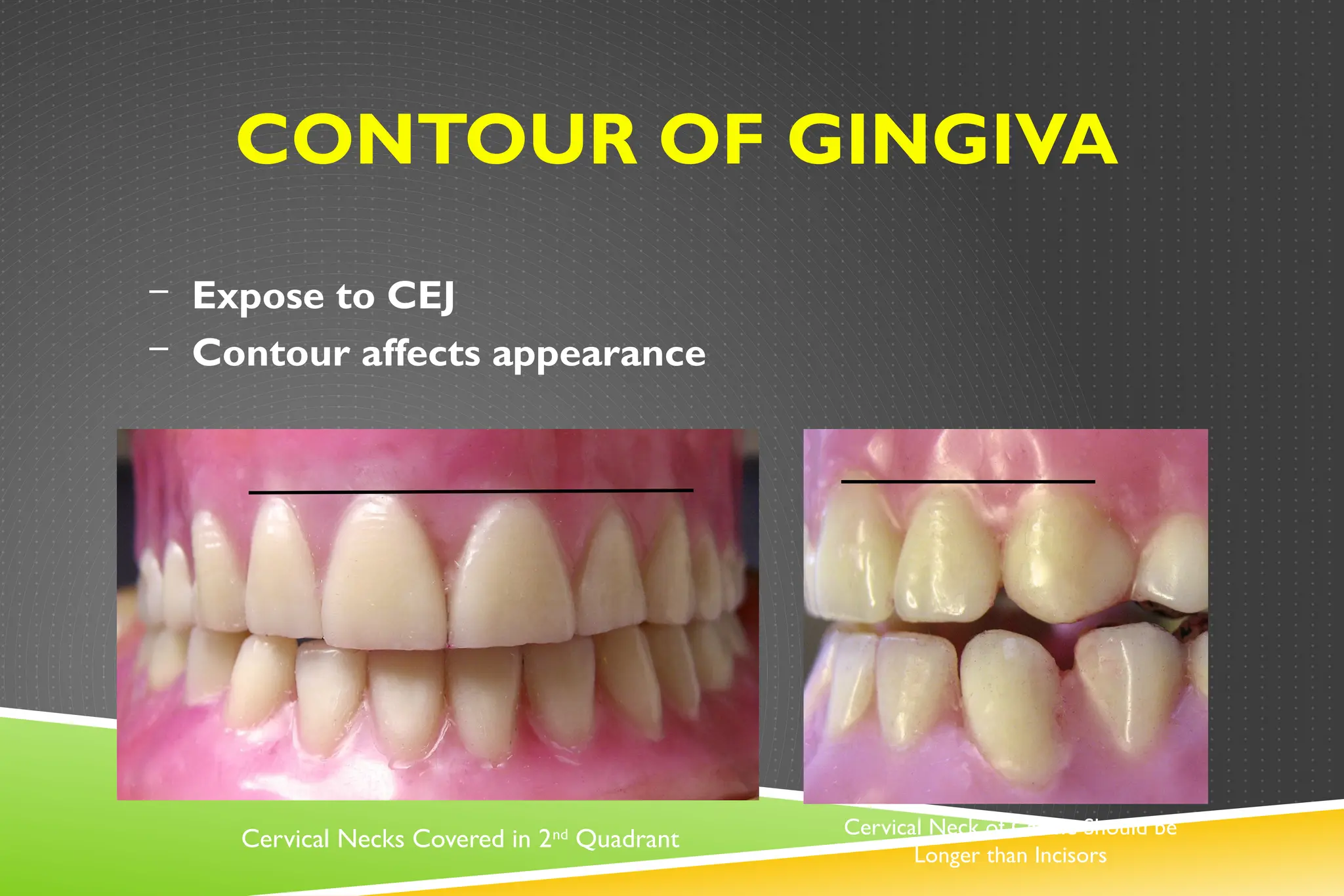
CONTOUR OF GINGIVA
–Expose to CEJ
– Contour affects appearance
Cervical Necks Covered in 2nd
Quadrant Cervical Neck of Canine Should be
Longer than Incisors
CANINE OFFSET
• Checkfor one half tooth offset between maxillary
& mandibular teeth
• Ensures posterior teeth have normal cusp to
fossa relationship for lingualized occlusion
PHONETIC ASSESSMENT
• Maxillarycentrals should lightly
touch vermilion border of lower
lip for ‘F’,‘V’ sounds
• ‘S’ sounds - incisal edges should
approximate each other
PLACING & MOVING
ANTERIORTEETH
•Crown removing forceps to
bodily move and tilt teeth
• Grind record base/tooth if
record base is impairing ability
to position properly
INTRAORAL ASSESSMENT OF
ANTERIORTEETH
•Junction of oral mucosa
(glossy) should just be visible
when lips are slightly
separated
• If not visible - insufficient
support
• Lips meet at junction of oral &
transitional epithelium
Orientation of theocclusal plane:
The anterior end of the occlusal plane is oriented according
to esthetics.
The vertical level at which the anterior teeth are set is the
level of the anterior end of the occlusal plane.
This level is usually 1-2 mm below the resting upper lip.
The posterior end of the occlusal plane should be located so
that it would be in level with the junction between the middle
and the distal third of the retromolar pad.This guideline will
place the occlusal plane that is familiar to the tongue.
36.
The inclinationof the occlusal plane is an important factor in
stability or instability of dentures. Ideally, the occlusal plane
should be parallel to both ridges.
The vertical orientation and inclination is also governed by the
relative amount of bone lost from the two ridges.
The occlusal plane should be placed at a level that would favor
the weaker of the two ridges. ( If more bone has been lost from
the maxilla than from the mandible, the occlusal plane must be
closer to the maxilla than the mandible. If more bone has been
lost from the mandible than from the maxilla, the occlusal plane
must be closer to the mandible than the maxilla).
However the level of the occlusal plane must be placed as nearly
as possible to the position of the occlusal plane of the natural
teeth.
37.
BUCCOLINGUAL POSITION OFPOSTERIORTEETH
The buccolingual position of the posterior teeth and the posterior arch
form are determined anteriorly by the positions of the anterior teeth.
Posteriorly, it is determined by the shape of the basal seat provided by
the maxilla and mandible. The mandibular posterior teeth should be
placed so that the antero-posterior groove (central) is placed on the
crest(centre) of the residual ridge.
The crest of the mandibular residual ridge is marked on the edentulous
cast by a line drawn from the crest of the ridge in the 1st
premolar and
canine area up to the mesial of the retromolar pads.
If the teeth are placed buccal to the ridge, the dentures may tip on the
opposite side when pressure is applied to these teeth.The teeth should
not be placed lingual to the residual ridge because this will cause lack of
space for the tongue, and the dentures will be displaced when the
tongue moves.
38.
The posteriorpart of the arch form will be determined to a great extent by the
neutral zone between the cheeks and the tongue.
Neutral zone is the area between the tongue on one side and the cheeks and lips
on the other, where opposing soft tissue displacing forces create a zone of neutral
or minimal muscular force, the teeth should be placed as far as possible with
respect for these muscle forces.
Post extraction changes may lead to a gradual shifting of the neutral zone with
the tongue spreading laterally. In other words the buccolingual space available
for placing teeth is reduced. This is of particular importance in the case of the
lower denture. The artificial teeth used are considerably narrower than the
natural teeth and this allows them to be placed so that the denture is stable.
39.
POSITION OF MAXILLARYPOSTERIORTEETH
The maxillary 1st premolar
The maxillary first premolar is placed with its long axis
perpendicular to the occlusal plane (vertically upright).The
buccal cusps are raised 0.5mm from the occlusal plane.
The maxillary 2nd
premolar
The long axis is perpendicular to the occlusal plane ( parallel to
the vertical axis). The buccal cusp is 0.5 mm above the
occlusal plane and the palatal cusp touches the occlusal plane.
The maxillary 1st
molar:
Thelong axis (viewed from side ) may slightly incline
mesially.
When viewed from the front the tooth slopes buccally.
The mesiobuccal cusp of the first molar is raised 0.5 mm
above the occlusal plane.
The mesiopalatal cusp is in contact with the occlusal plane.
The distobuccal cusp is raised about 1 mm above the occlusal
plane.
42.
The maxillary 2nd
molar:
Thelong axis ( viewed from side, cervical area) may slightly
incline mesially.
The mesiobuccal cusp of the 2nd
molar is raised 1 mm above
the occlusal plane.
The distobuccal cusp 1.5 mm above the occlusal plane. No
cusp touches the occlusal plane.
When viewed from the front the tooth slopes buccaly (more
than the 1st
molar).
43.
OCCLUSAL VIEW :
The distobuccal surface of the canine, the buccal surfaces of the
premolars and the mesiobuccal surface of the 1st
molar should follow a
straight line.
Buccal surfaces of the 2nd
molar are slightly inwards and are placed so
that all buccal surfaces of the 1st and 2nd
molars follow a straight line.
The posterior teeth should be placed so that the central grooves of the
maxillary posterior teeth follow the line of the crest of the mandibular
residual ridge.
44.
THE POSITION OFTHE MANDIBULAR POSTERIOR TEETH:
The placement of the mandibular posterior teeth determines how well the
teeth occlude, both in centric occlusion and in lateral and protrusive
excursions.
The mandibular 1st
molar is first placed in position followed by the 2nd
molar, and then the two bicuspids.
After placing each mandibular tooth in the correct position the incisal
guide pin should be checked to insure that it is in contact with the guide
table.
45.
Position of themandibular 1st
molar:
The mesibuccal cusp of the maxillary 1st
molar fits into the buccal
groove of the mandibular 1st
molar.
The mesiolingual cusp of the maxillary 1st
molar fits into the central
groove of the mandibular 1st
molar. This provides proper buccal overjet.
Position of the mandibular 2nd
molar:
The mandibular 2nd
molar is placed with the mesiobuccal cusp fitting
between the maxillary 1st
and 2nd
molars and contact with their marginal
ridges.
The lingual cusps of the maxillary 2nd
molar fit into the central groove of
the mandibular 2nd
molar.
47.
Position of themandibular 2nd
premolar:
The mandibular 2nd
premolar is placed with the buccal cusp fitting
between the maxillary 1st
and 2nd
premolars and in touch with their
marginal ridges.
The lingual cusp fits in between the palatal cusps of the maxillary
bicuspids.
Position of the mandibular 1st
premolar:
The buccal cusp of the mandibular 1st
premolar fits between the
maxillary canine and the 1st
premolar.
Usually this tooth is not placed until the anterior and posterior teeth are
placed. If there isn’t sufficient space for the placement of this tooth it
may be trimmed and made narrower to fit into the available space rather
than alter the placement of anteriors.
48.
In centric occlusionthe buccal cusps of the mandibular teeth contact the
central fossae of the maxillary teeth while the lingual cusps of the
maxillary teeth fit into the central fossae of the mandibular teeth.
Occlusal contacts during lateral movements:
Contacts on the working side i.e. the side to which the mandible is
moving.
Working or functional occlusion occurs when the buccal cusps of the
maxillary teeth meet the buccal cusps of the mandibular teeth, and the
palatal (lingual) cusps of maxillary teeth meet the lingual cusps of the
mandibular teeth. However the relationship is not cusp tip to cusp tip,
but cusp tip into cusp “valley” with each maxillary cusp distal to the
corresponding mandibular cusp.
There should be contact of anterior maxillary and mandibular teeth on
the working side.