SET THEORY AND LOGICPROBLEM SET NUMBER 1RICHARD B. PAULINO1
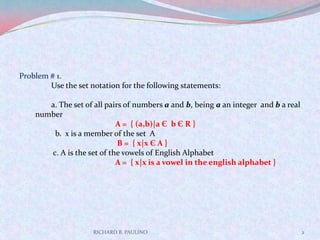
RICHARD B. PAULINO2Problem # 1.Use the set notation for the following statements:	a. The set of all pairs of numbers a and b, being a an integer  and b a real number	A =  { (a,b)|a Є  b Є R }	  b.  x is a member of the set  A  B =  { x|x Є A }	 c. A is the set of the vowels of English Alphabet 	A =  { x|x is a vowel in the english alphabet }
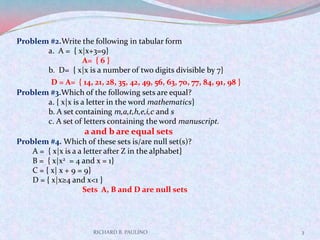
RICHARD B. PAULINO3Problem #2.Write the following in tabular form	a.  A =  { x|x+3=9}    A=  { 6 }	b.  D=  { x|x is a number of two digits divisible by 7}D = A=  { 14, 21, 28, 35, 42, 49, 56, 63, 70, 77, 84, 91, 98 }Problem #3.Which of the following sets are equal?	a. { x|x is a letter in the word mathematics}	b. A set containing m,a,t,h,e,i,cand s	c. A set of letters containing the word manuscript.  a and b are equal setsProblem #4. Which of these sets is/are null set(s)? A =  { x|x is a a letter after Z in the alphabet}B =  { x|x2  = 4 and x = 1}C = { x| x + 9 = 9}D = { x|x≥4 and x<1 }Sets  A, B and D are null sets
RICHARD B. PAULINO4Problem #5. Which sets are subsets of the others?		A =  { x|x is a Quadrilateral}		B = { x|x is a rhombus}		C = { x|x is a rectangle}		D = { x|x is a square}   Properties of Quadrilaterals  and Parallelograms	- All parallelograms are Quadrilaterals	Square, Rectangle and Rhombus are parallelograms	B ⊆ A	  ᴧ	B     AC ⊆ A	     ᴧ	C     A	D ⊆ A	     ᴧ	D     A	-  All squares are rectangles/rhombus, but not all rectangles/rhombus  are squares.   C ⊆ D   C  D     ᴧ         D ⊆ C  but  D    C                   B ⊆ D   B  D    ᴧ          D ⊆ B but  D    B
RICHARD B. PAULINO5Problem #6. State whether   each of  the following sets is infinite or finite.a. The set of lines parallel to y-axis                                                            b. The set of articles through the originc. The roots of the equation (x-1)(x-2)(x-3)d. The set of number & which are multiple of 7a. infiniteb. finitec. infinited. infinite  Problem #7. Write true or false for the following statements if A = {1, {4,5}, 4}	a. {4,5}    A   a. FALSE	b. {{4,5}}   A  b. TRUE
RICHARD B. PAULINO6Problem #8.    If     A = {-1 ≤ X ≤ 1}B = {1 < X < 0}C = {0 ≤ X < 2}Find:A U C	b.  A ∩ B	c . A U B U C	d.   (A U B) ∩ C       e. B∩CSolution:	A = {-1 ≤ X ≤ 1}	 B = {1 < X < 0} C= {0 ≤ X < 2} 		a. A U C = { -1 ≤x <2} 		b.  A ∩B ={ -1 ≤x <0}		c. A U B U C = { -1 ≤x <2} 		d.(A U B) ∩C  = { 0 ≤x ≤ 1} 		e.  B∩C = { } 
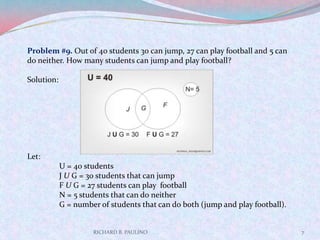
RICHARD B. PAULINO7 Problem #9. Out of 40 students 30 can jump, 27 can play football and 5 can do neither. How many students can jump and play football? Solution: Let:U = 40 studentsJ U G = 30 students that can jumpF U G = 27 students can play  footballN = 5 students that can do neitherG = number of students that can do both (jump and play football). 
RICHARD B. PAULINO8Problem #9 cont’n.J U G U F= U – N  40 – 5 = 35		J + G = 30							F + G = 27							J + G + F = 35					J + G + F = 35           J +  G      = 30				             F   = 5    number of students that can play football only	            J + G + F   =  35 F+  G   =  27 	         J   =  8    number of students that can  jump only Hence,       J + G + F   = 35                  8 + G + 5   = 35 G = 35 – ( 8 + 5 )         G = 22  number of students that can both  jump and play football
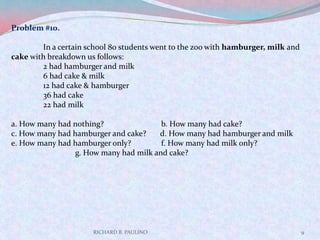
RICHARD B. PAULINO9Problem #10. In a certain school 80 students went to the zoo with hamburger, milk and cake with breakdown us follows:	2 had hamburger and milk	6 had cake & milk	12 had cake & hamburger	36 had cake	22 had milka. How many had nothing?		           b. How many had cake?c. How many had hamburger and cake?       d. How many had hamburger and milke. How many had hamburger only?	           f. How many had milk only?		g. How many had milk and cake?
RICHARD B. PAULINO10Problem #10. Cont’n. Solution:        a. How many had nothing?			b. How many had cake only?IUI - I A U B U C I + I A П B П C I		ICI - I A П C I - I B П C I = 80 – ( 14 + 22 + 36 ) + (20)		= 36 – 12 – 6 = 28= 18c. How many had hamburger and cake?     d. How many had hamburger and milk?= 12					= 2e. How many had hamburger only?              f. How many had milk only?= 0					IBI - I B П C I - I B П C Ig.How many had milk and cake?                         = 22 – 6 – 2 = 6					 = 14
11THANK YOU VERY MUCH!fromRichard	JosieXyraXyron

problem set

  • 1.
    SET THEORY ANDLOGICPROBLEM SET NUMBER 1RICHARD B. PAULINO1
  • 2.
    RICHARD B. PAULINO2Problem# 1.Use the set notation for the following statements: a. The set of all pairs of numbers a and b, being a an integer and b a real number A = { (a,b)|a Є b Є R } b. x is a member of the set A B = { x|x Є A } c. A is the set of the vowels of English Alphabet A = { x|x is a vowel in the english alphabet }
  • 3.
    RICHARD B. PAULINO3Problem#2.Write the following in tabular form a. A = { x|x+3=9} A= { 6 } b. D= { x|x is a number of two digits divisible by 7}D = A= { 14, 21, 28, 35, 42, 49, 56, 63, 70, 77, 84, 91, 98 }Problem #3.Which of the following sets are equal? a. { x|x is a letter in the word mathematics} b. A set containing m,a,t,h,e,i,cand s c. A set of letters containing the word manuscript. a and b are equal setsProblem #4. Which of these sets is/are null set(s)? A = { x|x is a a letter after Z in the alphabet}B = { x|x2 = 4 and x = 1}C = { x| x + 9 = 9}D = { x|x≥4 and x<1 }Sets A, B and D are null sets
  • 4.
    RICHARD B. PAULINO4Problem#5. Which sets are subsets of the others? A = { x|x is a Quadrilateral} B = { x|x is a rhombus} C = { x|x is a rectangle} D = { x|x is a square}  Properties of Quadrilaterals and Parallelograms - All parallelograms are Quadrilaterals Square, Rectangle and Rhombus are parallelograms B ⊆ A ᴧ B AC ⊆ A ᴧ C A D ⊆ A ᴧ D A - All squares are rectangles/rhombus, but not all rectangles/rhombus are squares. C ⊆ D C D ᴧ D ⊆ C but D C B ⊆ D B D ᴧ D ⊆ B but D B
  • 5.
    RICHARD B. PAULINO5Problem#6. State whether each of the following sets is infinite or finite.a. The set of lines parallel to y-axis b. The set of articles through the originc. The roots of the equation (x-1)(x-2)(x-3)d. The set of number & which are multiple of 7a. infiniteb. finitec. infinited. infinite  Problem #7. Write true or false for the following statements if A = {1, {4,5}, 4} a. {4,5} A a. FALSE b. {{4,5}} A b. TRUE
  • 6.
    RICHARD B. PAULINO6Problem#8. If A = {-1 ≤ X ≤ 1}B = {1 < X < 0}C = {0 ≤ X < 2}Find:A U C b. A ∩ B c . A U B U C d. (A U B) ∩ C e. B∩CSolution: A = {-1 ≤ X ≤ 1}  B = {1 < X < 0} C= {0 ≤ X < 2}  a. A U C = { -1 ≤x <2} b. A ∩B ={ -1 ≤x <0} c. A U B U C = { -1 ≤x <2} d.(A U B) ∩C = { 0 ≤x ≤ 1} e. B∩C = { } 
  • 7.
    RICHARD B. PAULINO7 Problem#9. Out of 40 students 30 can jump, 27 can play football and 5 can do neither. How many students can jump and play football? Solution: Let:U = 40 studentsJ U G = 30 students that can jumpF U G = 27 students can play footballN = 5 students that can do neitherG = number of students that can do both (jump and play football). 
  • 8.
    RICHARD B. PAULINO8Problem#9 cont’n.J U G U F= U – N 40 – 5 = 35 J + G = 30 F + G = 27 J + G + F = 35 J + G + F = 35 J + G = 30 F = 5 number of students that can play football only   J + G + F = 35 F+ G = 27  J = 8 number of students that can jump only Hence, J + G + F = 35 8 + G + 5 = 35 G = 35 – ( 8 + 5 ) G = 22 number of students that can both jump and play football
  • 9.
    RICHARD B. PAULINO9Problem#10. In a certain school 80 students went to the zoo with hamburger, milk and cake with breakdown us follows: 2 had hamburger and milk 6 had cake & milk 12 had cake & hamburger 36 had cake 22 had milka. How many had nothing? b. How many had cake?c. How many had hamburger and cake? d. How many had hamburger and milke. How many had hamburger only? f. How many had milk only? g. How many had milk and cake?
  • 10.
    RICHARD B. PAULINO10Problem#10. Cont’n. Solution:        a. How many had nothing? b. How many had cake only?IUI - I A U B U C I + I A П B П C I ICI - I A П C I - I B П C I = 80 – ( 14 + 22 + 36 ) + (20) = 36 – 12 – 6 = 28= 18c. How many had hamburger and cake? d. How many had hamburger and milk?= 12 = 2e. How many had hamburger only? f. How many had milk only?= 0 IBI - I B П C I - I B П C Ig.How many had milk and cake? = 22 – 6 – 2 = 6 = 14
  • 11.
    11THANK YOU VERYMUCH!fromRichard JosieXyraXyron