DHI
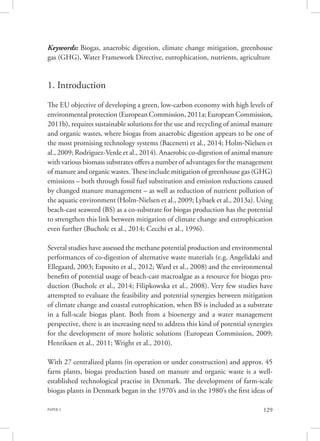
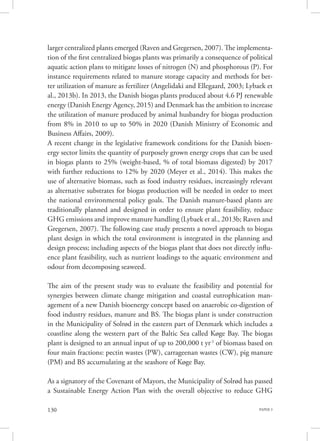
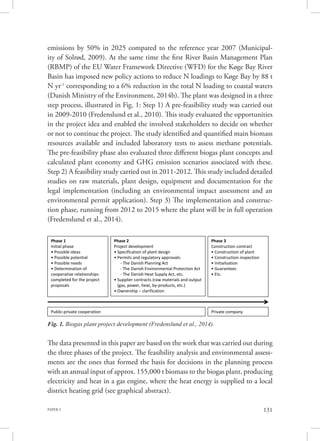
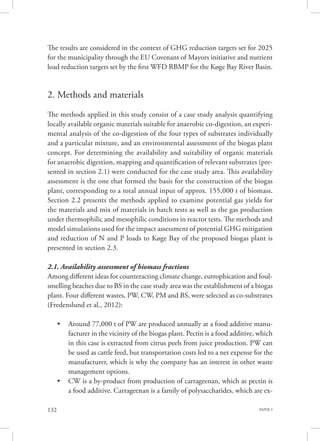
Hørsholm, Denmark
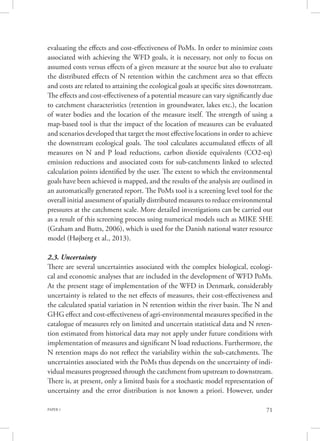
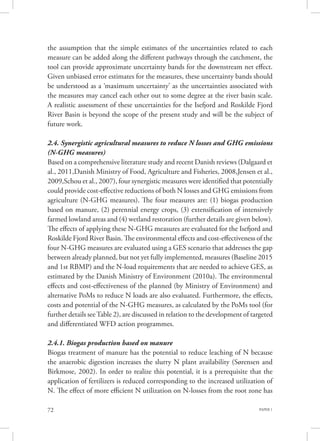
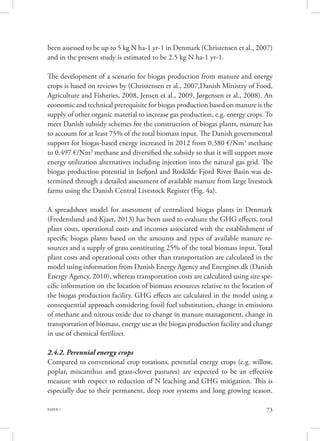
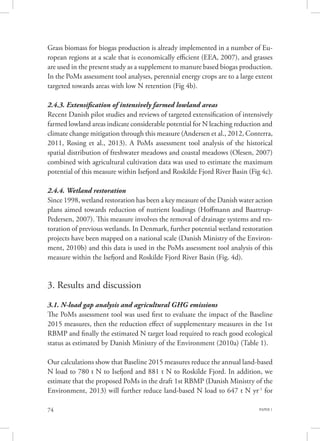
and
Department of Environmental, Social and Spatial Change
Roskilde University, Denmark
July 2015
The EU Water Framework Directive
PhD Thesis
Bjarke Stoltze Kaspersen
Action Programmes and Climate Change Challenges
The EU Water Framework Directive
Action Programmes and Climate Change Challenges
Ph.D. Thesis by
Bjarke Stoltze Kaspersen
DHI
Hørsholm, Denmark.
and
Department of Environmental, Social and Spatial Change
Roskilde University, Denmark
July 2015
© 2015 Bjarke Stoltze Kaspersen
Layout: Bjarke Stoltze Kaspersen and Ritta Juel Bitsch
Front pages layout: Bjarke Stoltze Kaspersen and Ritta Juel Bitsch
Print: Prinfo Paritas Digital Service
ISBN 978-87-7349-922-1
3SUMMARY
Summary
The EU Water Framework Directive (WFD), which was adopted in 2000, is one
of the most ambitious and wide-ranging pieces of European environmental legisla-
tion to date, with the aim of achieving ‘good status’ for all water bodies. Bringing
together several European Directives that relate to water, the WFD provides an
opportunity for a more holistic planning approach, where the protection of water
resources is linked to other environmental objectives and land-use challenges. The
WFD has precipitated a fundamental change in management objectives from
merely pollution control to ensuring ecosystem integrity as a whole, and the Di-
rective has initiated a shift towards a more targeted planning approach through
its focus on river basins as management units.
Complying with the ‘good ecological status’ (GES) objective for surface waters in
Denmark requires appropriate Programmes of Measures (PoMs) to reduce nutrient
emissions from agriculture. Denmark is characterised as having one of the most
intensive and export-oriented agricultural sectors in the world. With farming ac-
counting for more than 60% of the total land use and a 7500 km long coastline
with shallow estuaries and coastal waters vulnerable to eutrophication. Thirty years
of Danish action plans for the aquatic environment have reduced nitrogen (N)
and phosphorous (P) loads from both point and diffuse sources significantly, but
further reductions are still needed to meet the WFD objectives.
The WFD has introduced a formal series of six year cycles with river basin manage-
ment plans (RBMPs) based on a stepwise planning approach. The first planning
cycle ended in 2015 and for the 2nd and 3rd RBMP cycles (2015-2027) it is a
requirement that climate change is fully integrated into the process of river basin
management. This PhD thesis provides new insights on the potential incorpo-
ration of climate change considerations into the design and implementation of
cost-effective PoMs at the river basin scale. This includes both the incorporation
of mitigation of greenhouse gas (GHG) emissions as well as adaptation to climate-
related risks. The present thesis deals with the implementation of the WFD in
two case study river basins in the eastern part of Denmark: (1) the Isefjord and
Roskilde Fjord River Basin and (2) the Køge Bay River Basin.
4 SUMMARY
For the Isefjord and Roskilde Fjord River Basin, the effect of expected far-future
climate change on N leaching rates was investigated, and it was examined to what
extent a map-based PoMs assessment tool can support the development of adaptive
N management strategies tailored to the river basin. The map-based assessment
tool was also used to explore the potential for synergies between reduction of N
losses and mitigation of GHG emissions from agriculture. For the Køge Bay Ri-
ver Basin a new bioenergy concept developed in the Municipality of Solrød was
evaluated in order to assess the feasibility of the projected biogas plant and the
extent to which it can contribute to strengthening the linkages between climate
change mitigation strategies and WFD action planning.
Effects of climate change on nitrate leaching in the Isefjord and Roskilde Fjord
River Basin were evaluated using the dynamic agro-ecosystem model ‘Daisy’. The
results show that nitrate leaching rates increase by approx. 25% under current
management practices. This impact outweighs the expected total N reduction
effect of Baseline 2015 and the first RBMP in the case study river basin. The
PoMs assessment tool was used to analyze alternative PoMs scenarios to achieve
spatially targeted and cost-effective N load reductions in the context of a changing
climate. The particular PoMs investigated show that WFD N reduction targets
can be achieved by targeted land use changes on approx. 4% of the agricultural
area under current climate conditions and approx. 9% of the agricultural area,
when projected climate change impacts on nitrate leaching rates are included in
the assessment.
PoMs assessment tool analyses also indicate a substantial potential for cost-effective
integration of climate change mitigation into WFD action programmes through
the implementation of agri-environmental measures related to land use change,
cultivation of perennial energy crops and manure based biogas systems. These
measures can ensure fulfilment of the WFD GES objectives for Isefjord and Ros-
kilde Fjord in a cost-effective way and at the same time reduce GHG emissions
significantly, corresponding to a 35-65% reduction of total agricultural GHG
emissions within the river basin.
The analyses of the novel bioenergy concept in the Køge Bay River Basin, with
beach-cast seaweed as a co-substrate in anaerobic co-digestion of food industry
residues and manure, show that the projected biogas plant seems to be feasible
and contains a significant potential for cost-effective mitigation of both GHG
5SUMMARY
emissions and nutrient loadings. The environmental assessments of the biogas
plant indicate an annual GHG reduction corresponding to approx. 1/3 of cur-
rent total GHG emissions in the Municipality of Solrød. In addition, nutrient
loads to Køge Bay are reduced corresponding to the achievement of more than
70% of the nutrient reduction target set for Køge Bay in the first WFD RBMP
for the river basin.
Implementation of the WFD is going to be a long-running process. By addressing
the targeting, synergy and cost-effectiveness of the PoMs, the WFD objectives
will be met more rapidly and with lower associated costs. The 1st generation of
WFD RBMPs in Denmark must be regarded as a preliminary basis with additional
need for local approaches, geographical targeting of measures and more integrated
agri-environmental initiatives. This project demonstrates how the integration of
climate change challenges into the development of WFD action programmes can
be a driver for this transition. A change from a general ‘one size fits all’ approach
towards river basin tailored action programmes is not only a prerequisite for ap-
propriate integration of climate change considerations but could also advance
public participation and the development of holistic and cost-effective solutions.
7SAMMENDRAG (DANISH SUMMARY)
Sammendrag (Danish Summary)
EU’s vandrammedirektiv (VRD) blev vedtaget i år 2000 og er et af de mest ambi-
tiøse og vidtrækkende lovgivningstiltag på miljøområdet i EU – med det formål
at sikre ’god tilstand’ for alle vandforekomster. VRD samler en række tidligere
direktiver vedrørende kvalitets- og udledningskrav, og direktivet understøtter en
mere helhedsorienteret planlægning, hvor beskyttelsen af vandressourcer knyttes
til relaterede miljømålsætninger og arealanvendelsen. Målene i VRD relaterer sig
principielt til hver enkelt vandforekomst, f.eks. en konkret sø, og direktivet lægger
op til en målrettet og differentieret indsatsplanlægning på vandoplandsniveau.
For at opfylde målsætningen om ’god økologisk tilstand’ for overfladevande i
Danmark skal der iværksættes indsatser, der kan reducere landbrugets udledning
af næringsstoffer. Danmark er karakteriseret ved at have en af verdens mest inten-
sive og eksportorienterede landbrugssektorer. Mere end 60% af det samlede areal
anvendes til landbrugsproduktion, og samtidig har Danmark en 7500 km lang
kyststrækning med lavvandede fjorde og kystvande, der er sårbare over for eutro-
fiering. Danske vandmiljøhandlingsplaner har gennem de seneste 30 år reduceret
udledningen af kvælstof (N) og fosfor (P) fra både punktkilder og diffuse kilder
markant, men der er behov for at reducere næringsstoftilførslerne til vandmiljøet
yderligere, hvis VRD’s mål skal nås.
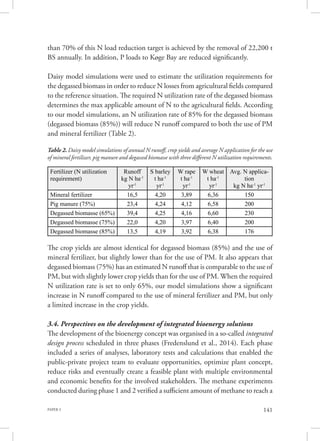
Med VRD er der indført seksårige planperioder med vandplaner baseret på en
trinvis fremgangsmåde i planlægningen. Den første vandplancyklus løb frem til
2015, og i 2. og 3. generation vandplaner (2015-2027) er det et krav, at klima-
ændringer integreres fuldt ud i planarbejdet. Dette omfatter både forebyggelse af
klimaforandringer (gennem reduktion af drivhusgasudledninger) og tilpasning
til klimaændringer. Denne ph.d.-afhandling bidrager med ny viden om, hvordan
klimaændringer kan integreres i den næste generation vandplaner via omkost-
ningseffektive indsatsprogrammer på oplandsniveau. Afhandlingen beskæftiger
sig med implementeringen af VRD i to hovedvandoplande i den østlige del af
Danmark: (1) Isefjord og Roskilde Fjord og (2) Køge Bugt.
For hovedvandopland Isefjord og Roskilde Fjord er effekten af forventede klima-
ændringer på N-udvaskningen blevet undersøgt, og det er blevet vurderet, i hvilket
omfang et GIS-baseret VRD virkemiddelværktøj kan understøtte udviklingen af
8 SAMMENDRAG (DANISH SUMMARY)
adaptive og omkostningseffektive vandplaner på oplandsniveau. Virkemiddelværk-
tøjet er desuden blevet brugt til at undersøge potentialet for synergieffekter mellem
reduktion af næringsstoftab og drivhusgasemissioner fra landbrugsproduktion i
oplandet. I hovedvandopland Køge Bugt er der i Solrød Kommune blevet udviklet
et nyt koncept til produktion af bioenergi. I nærværende ph.d.-afhandling er der
blevet foretaget teknisk-økonomiske vurderinger af det planlagte biogasanlæg,
ligesom det er blevet undersøgt, i hvilken udstrækning bioenergikonceptet kan
styrke sammenhængen mellem strategiske energiplaner og VRD handleplaner.
Vurderingen af effekter af klimaændringer på udvaskningen af nitrat fra land-
brugsjorde i Isefjord og Roskilde Fjord oplandet er foretaget ved brug af den
dynamiske agro-økosystem model ’Daisy’. Modelberegningerne viser, at nitratud-
vaskningen stiger med ca. 25% som følge af klimaændringer ved en fastholdelse
af nuværende dyrkningspraksis. Denne stigning i N-udvaskningen opvejer den
forventede totale reduktion i den landbaserede N-udledning som følge af både
Baseline 2015 og den første VRD vandplan for Isefjord og Roskilde Fjord op-
landet. Virkemiddelværktøjet er blevet anvendt til at undersøge mulighederne
for målrettet og omkostningseffektiv reduktion af N-udledningen med fokus på
tilpasning til klimaændringer. Analyserne af indsatsprogrammer med målrettede
virkemidler viser, at N-reduktioner til opfyldelse af miljømålene i VRD kan opnås
ved målrettede indsatser på ca. 4% af oplandets samlede landbrugsareal under
nuværende klimatiske forhold, og ca. 9% af landbrugsarealet når der tages højde
for klimaændringernes effekt på N-udvaskningen.
Analyser foretaget med virkemiddelværktøjet indikerer også, at der er et bety-
deligt potentiale for at opnå synergieffekter mellem reduktion af næringsstoftab
og udledning af drivhusgasser fra landbruget via virkemidler relateret til ændret
arealanvendelse, dyrkning af flerårige energiafgrøder og etablering af husdyr-
gødningsbaserede biogasanlæg. Disse foranstaltninger kan sikre opfyldelsen af
de fastsatte miljømål for Isefjord og Roskilde Fjord på en omkostningseffektiv
måde og samtidig reducere udledningen af drivhusgasser svarende til 35-65% af
landbrugets samlede drivhusgasudledning i hovedvandoplandet.
Undersøgelserne af det nye bioenergikoncept i Køge Bugt – baseret på en bio-
massesammensætning bestående af tang fra strandrensning (fedtemøg), organisk
industriaffald og svinegylle – viser, at det planlagte biogasanlæg er økonomisk
fordelagtigt, og at det er forbundet med et stort potentiale for omkostningseffektiv
9SAMMENDRAG (DANISH SUMMARY)
reduktion af både drivhusgasemissioner og næringsstofbelastning. De miljømæssige
vurderinger af biogasanlægget viser en årlig reduktion af drivhusgasudledninger
svarende til ca. 1/3 af Solrød Kommunes samlede nuværende drivhusgasemissioner.
Dertil kommer, at næringsstofbelastningen af kystvande reduceres svarende til
mere end 70% af målet for reduktion af næringsstoffer til Køge Bugt i den første
vandplan for hovedvandoplandet.
Implementering af VRD vil være en mangeårig udfordring. Jo mindre målretning,
synergieffekt og omkostningseffektivitet, jo længere tid til målopfyldelse og jo
højere pris. Det bliver ikke mindre relevant med udsigt til effekt af klimaændrin-
ger. Første generation vandplaner i Danmark må betegnes som en foreløbig basis
med yderligere behov for lokal forankring, geografisk målretning af indsatsen
og udvikling af mere integrerede landbrugsinitiativer. I denne ph.d.-afhandling
demonstreres det, hvordan integration af klimaændringer i VRD planlægningen
kan være en driver for denne omstilling. Et skift fra en generel ”one size fits all”
planlægningstilgang til mere oplandsorienterede indsatsplaner tilpasset konkrete
lokale forhold er ikke kun en forudsætning for en hensigtsmæssig integration af
klimaudfordringer i vandplanerne, men kan også styrke en aktiv interessentinvolve-
ring og udviklingen af mere helhedsorienterede og omkostningseffektive løsninger.
11PREFACE
Preface
This PhD thesis is submitted as partial fulfilment of the requirements for the
degree of Philosophiae Doctor (PhD) at Roskilde University (RUC), Denmark.
The thesis consists of four papers, of which one has been published and the re-
maining three are submitted for publication. The published paper appears in both
the original Danish version and a translated English version. The articles appear as
appendices and will in the following be referred to by the numbers given below.
1.	 Kaspersen, B.S., Jacobsen,T.V., Butts, M.B., Boegh, E., Müller, H.G., Stut-
ter, M., Fredenslund, A.M., Kjaer,T. Integrating climate change mitigation
into river basin management planning for the Water Framework Directive
– A Danish case. Submitted to Environmental Science & Policy.		
	
2.	 Kaspersen, B.S., Jacobsen, T.V., Butts, M.B., Jensen, N.H., Boegh, E.,
Seaby, L.P., Müller, H.G., Kjaer, T. Using a map-based assessment tool for
the development of cost-effective WFD river basin action programmes in
a changing climate. Submitted to Journal of Environmental Management.	
	
3.	 Kaspersen, B.S., Christensen, T.B, Fredenslund, A.M., Møller, H.B.,
Butts, M.B., Jensen, N.H., Kjaer, T. Linking climate change mitigation
and coastal eutrophication management through biogas technology: Evi-
dence from a new Danish bioenergy concept. Submitted to Science of the
Total Environment.								
	
4.	 Kaspersen, B.S, Jacobsen, T.V., Butts, M.B., Müller, H.G., Boegh, E.,
Kjaer, T. 									
A) Målrettede vandplaner – hvordan? [original Danish version]		
B) Targeted WFD action programmes – how? [English version] 		
Published in Vand & Jord [Water & Soil] 4, 2013, 136-141.
Looking back at the last five years as a research assistant and a PhD student at
RUC and DHI, I feel very privileged to have had the opportunity to immerse
myself in a research area that I am passionate about. I have been surrounded by
skilful and helpful people without whose guidance this project would not have
been possible. During my time at RUC I have had the experience and pleasure
12 PREFACE
of being a supervisor for more than 15 bachelor and master project theses, and I
have been teaching on more than 10 different courses in five different education
programmes. Furthermore, my principal supervisor Tyge Kjær has provided me
with the unique opportunity of being involved in a number of relevant research
projects in the Region of Sealand, including the Solrød Biogas project (see paper
3) and the IVOSE project dealing with controlled drainage as a Water Framework
Directive and climate change adaptation measure (Kaspersen et al., 2014).
My work has involved the help and support of a number of people and I would
like to express my gratitude to those who deserve special attention. First and
foremost, I would like to thank my principal supervisor Tyge Kjær for many years
of passionate supervision and guidance. Tyge has shown me absolute confidence
through all of my work and he has been a constant source of inspiration. Also, a
special thanks to my three co-supervisors Eva Bøgh, Torsten Vammen Jacobsen
and Michael Brian Butts. I could not have asked for more expertise and thorough
feedback during my studies. Yes, it would have been easier without your critical
reviews, but more importantly, it wouldn’t have been as good.
In the beginning of my PhD, I spent a spring semester at The James Hutton Insti-
tute in Craigiebuckler Aberdeen, Scotland, where I met a multitude of interesting
people who introduced me to a world of integrated and transdisciplinary research
that sparked my interest in catchment management even further. I would like to
give a special thanks to Marc Stutter for all the kindness and support as well as
the tough lunchtime runs.
I am grateful to Jørgen Dan Petersen who awoke my interest in environmental is-
sues when I was just a small boy and has followed my studies ever since. Thanks are
also due to Niels H. Jensen for invaluable help with the Daisy model simulations,
Henrik G. Müller for helping me through the many challenges related to the ap-
plication of a map-based assessment tool, Ritta J. Bitsch for the graphical assistance
and Lauren P. Seaby for providing me with climate change data and good humour.
Thanks to colleagues in the METRIK group, especially Anders M. Fredenslund for
the sparring on biogas assessments and Thomas B. Christensen for his support in the
last critical months. I am also grateful to my fellow PhD students Kristina Hansen,
KarthiMatheswaran,MortenGraversgaardandTueDamsøforallthesharedlaughs.
13PREFACE
Last but not least, a very special thanks to my friends and family. Thanks to my
brother Theis and my friends Høgh and Henrik for keeping me reminded of all
the wonderful things in life that have nothing to do with water management and
spatial change. Thanks to my parents for always being there for me. Thanks to
my girlfriend Joy for making me feel like the luckiest guy around.
	
			 Bjarke Stoltze Kaspersen
			 Roskilde, July 2015
“Plans are nothing. Planning is everything”
Dwight D. Eisenhower (1890-1969)
TABLE OF CONTENTS
Contents
Summary....................................................................................................3
Sammendrag (Danish Summary) ...............................................................7
Preface......................................................................................................11
Chapter 1. Introduction...........................................................................17
	 1.1 The EU Water Framework Directive and climate change challenges... 17
	 1.2. Objectives and content...................................................................... 20
Chapter 2. Background.............................................................................23
	 2.1. Historical perspective on the Danish action plans for
		 the aquatic environment................................................................... 23
	 2.2. The WFD management and planning processes................................ 27
	 2.3. WFD and climate change considerations........................................... 29
	 2.4. Methodology..................................................................................... 30
Chapter 3. Synthesis.................................................................................37
	 3.1. The PoMs assessment tool and WFD river basin planning ................ 37
	 3.2. WFD action programmes and climate change mitigation.................. 39
	 3.3. WFD action programmes and climate change adaptation.................. 40
	 3.4. Assessment of the novel bioenergy concept based on
	 a holistic planning approach.............................................................. 41
Chapter 4. Critical Reflections..................................................................45
	 4.1. Project relevance................................................................................ 45
	 4.2. Project planning and limitations........................................................ 46
Chapter 5. Outlook..................................................................................49
Chapter 6. References...............................................................................51
TABLE OF CONTENTS
Chapter 7. Papers.....................................................................................59
	
	 Paper 1. Integrating climate change mitigation into river basin
			 management planning for the Water Framework Directive
			 – A Danish case.......................................................................... 61
	 Paper 2. Using a map-based assessment tool for the development
			 of cost-effective WFD river basin action programmes
			 in a changing climate.................................................................. 89
	 Paper 3. Linking climate change mitigation and coastal
			 eutrophication management through biogas technology:
			 Evidence from a new Danish bioenergy concept....................... 125
	 Paper 4. Målrettede vandplaner – hvordan? [Danish version]................. 147
			 Targeted WFD action programmes – how? [English version]
17CHAPTER 1. INTRODUCTION
Chapter 1
1. Introduction
The following introduction presents the objectives and content of this PhD thesis,
starting out with the EU Water Framework Directive (WFD) (Directive 2000/60/
EC) as a driver for integrated water and environmental management and the
challenges related to the integration of climate change into the second round of
river basin management plans (RBMPs).
1.1 The EU Water Framework Directive and climate change
challenges
“Since water sustains life, effective management of water resources demands a
holistic approach, linking social and economic development with protection of
natural ecosystems. Effective management links land and water uses across the
whole of a catchment area or groundwater aquifer” (ICWE, 1992).
“Climate change will increasingly drive ecosystems including marine and freshwa-
ter ecosystems and biodiversity loss, affecting individual species and significantly
impacting ecosystems and their related services (…) Addressing climate change
requires two types of response. Firstly, the greenhouse gas (GHG) emissions should
be reduced (mitigation action) and secondly adaptation action should be taken to
deal with the unavoidable impacts” (European Commission, 2010).
The first of the above quotes presents the need for a holistic approach to water
resource management identifying the river basin scale as appropriate for strategic
planning as summarised in the guiding principles of the Dublin Statement on
Water and Sustainable Development (ICWE, 1992). The second quote is from
a European Commission report on the incorporation of climate change conside-
rations in EU water policies (European Commission, 2010). This illustrates the
18 CHAPTER 1. INTRODUCTION
importance of addressing climate change in river basin management planning
and that the actions required are two-fold: to mitigate climate change through
the reduction of greenhouse gas (GHG) emissions and to adapt to a changing
and more variable climate.
In Europe, the WFD was adopted in 2000, establishing new requirements for
integrated river basin planning in order to achieve “good status” for all water bodies
by 2015 and no later than 2027 (chemical status for all waters, ecological status
for surface waters and quantitative status for ground waters). Bringing together
several European Directives that relate to water, the WFD provides an opportunity
for a more holistic planning approach, where the protection of water resources is
linked to other environmental objectives and land-use challenges (Frederiksen et
al., 2008, Harris, 2010).
The WFD has precipitated a fundamental change in management objectives from
merely pollution control to ensuring ecosystem integrity as a whole (Hering et
al., 2010). The Directive has introduced a formal series of six years cycles with
RBMPs based on a stepwise approach including risk characterisation, monitoring
and programmes of measures (PoMs) (Quevauviller et al., 2012). The first plan-
ning cycle ended in 2015 and for the 2nd and 3rd RBMP cycles (2015-2027) it
is a requirement that climate change is fully integrated into the process of river
basin management (European Commission, 2009). A key challenge in this con-
text is the incorporation of climate change considerations into the design and
implementation of cost-effective PoMs at the river basin scale (Kronvang et al.,
2005, Quevauviller, 2011, Wilby et al., 2006).
In the Danish implementation of the WFD, eutrophication of surface waters is
recognized as being one of the most important problems to overcome in order
to meet the ‘good ecological status’ (GES) objective (Conley et al., 2002, Kron-
vang et al., 2005, Windolf et al., 2012). The first generation of Danish WFD
RBMPs (2009-2015) have been considerably delayed, but in 2014 RBMPs for
the 23 Danish river basins were adopted. However, a major part of the estimated
nitrogen (N) and phosphorous (P) load reductions necessary to meet the GES
objective in Danish surface waters has been postponed to the next WFD plan-
ning cycles (Danish Ministry of the Environment, 2010, Danish Ministry of the
Environment, 2014).
19CHAPTER 1. INTRODUCTION
Several Danish studies have stressed that further N reductions should be achieved
through spatially targeted action programmes tailored to the river basin (Com-
mission on Nature and Agriculture, 2013, Dalgaard et al., 2014, Kronvang et al.,
2008, Refsgaard et al., 2014, Windolf et al., 2012). It is also widely recognised
that a more regional or local planning approach is necessary in order to address
climate change considerations in a WFD context and exploit potential synergies
(Commission on Nature and Agriculture, 2013, Harris, 2010). These linkages
are, however, not very well explored, and new approaches, tools and measures are
called for in the future process of moving European waters towards good status.
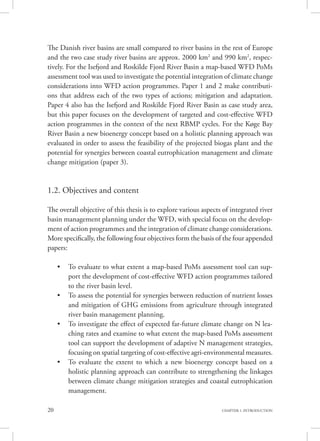
The present thesis deals with the implementation of the WFD in two case study
catchments in the eastern part of Denmark: (1) the Isefjord and Roskilde Fjord
River Basin and (2) the Køge Bay River Basin (see Fig. 1).
Fig. 1. Map of Denmark showing the 23 Danish river basins and the two case study river
basins: Isefjord and Roskilde Fjord River Basin, and Køge Bay River Basin.
20 CHAPTER 1. INTRODUCTION
The Danish river basins are small compared to river basins in the rest of Europe
and the two case study river basins are approx. 2000 km2
and 990 km2
, respec-
tively. For the Isefjord and Roskilde Fjord River Basin a map-based WFD PoMs
assessment tool was used to investigate the potential integration of climate change
considerations into WFD action programmes. Paper 1 and 2 make contributi-
ons that address each of the two types of actions; mitigation and adaptation.
Paper 4 also has the Isefjord and Roskilde Fjord River Basin as case study area,
but this paper focuses on the development of targeted and cost-effective WFD
action programmes in the context of the next RBMP cycles. For the Køge Bay
River Basin a new bioenergy concept based on a holistic planning approach was
evaluated in order to assess the feasibility of the projected biogas plant and the
potential for synergies between coastal eutrophication management and climate
change mitigation (paper 3).
1.2. Objectives and content
The overall objective of this thesis is to explore various aspects of integrated river
basin management planning under the WFD, with special focus on the develop-
ment of action programmes and the integration of climate change considerations.
More specifically, the following four objectives form the basis of the four appended
papers:
•	 To evaluate to what extent a map-based PoMs assessment tool can sup-
port the development of cost-effective WFD action programmes tailored
to the river basin level.
•	 To assess the potential for synergies between reduction of nutrient losses
and mitigation of GHG emissions from agriculture through integrated
river basin management planning.
•	 To investigate the effect of expected far-future climate change on N lea-
ching rates and examine to what extent the map-based PoMs assessment
tool can support the development of adaptive N management strategies,
focusing on spatial targeting of cost-effective agri-environmental measures.
•	 To evaluate the extent to which a new bioenergy concept based on a
holistic planning approach can contribute to strengthening the linkages
between climate change mitigation strategies and coastal eutrophication
management.
21CHAPTER 1. INTRODUCTION
In the following background chapter (Chapter 2), the overall framework of the
four appended papers is presented, including a historical perspective on the Danish
action plans for the aquatic environment, the management and planning process
of the WFD, and the methodologies used for addressing the objectives of this
thesis. Chapter 3 comprises a synthesis summarising the main results of the four
appended papers and discussing the findings in relation to other relevant studies
and contemporary WFD implementation challenges. Chapter 4 then provides
reflections on the development of the research project and the relevance of the
studies carried out. Finally, issues of relevance to future research and the imple-
mentation of the next generation WFD RBMPs, in light of this PhD study, are
raised in the outlook chapter (Chapter 5).
23CHAPTER 2. BACKGROUND
Chapter 2
2. Background
This chapter presents the development of Danish action plans for the aquatic
environment since the 1980s, outlining the significant effects of policy actions
toward N and P loadings, and the prospects of nutrient management in a WFD
perspective. It also presents the planning process of the WFD and the climate
change challenges related to the next generation RBMPs. Finally, the chapter
provides a presentation of the methodology used for addressing the objectives of
this thesis in the four appended papers.
2.1. Historical perspective on the Danish action plans for the
aquatic environment
The current implementation of the WFD in Denmark should be considered in
relation to the development of national action plans for the aquatic environment
through the last decades. Denmark is characterised as having one of the most
intensive and export-oriented agricultural sectors in the world. With farming ac-
counting for more than 60% of the total land use and a 7500 km long coastline
with shallow estuaries and coastal waters, this has led to severe environmental
problems (Dalgaard et al., 2014).
Excess N and P loading from point and non-point sources have been recognized
as one of the most urgent problems to overcome in order to improve the env-
ironmental state of lakes, streams and marine waters in Denmark (Conley et al.,
2002, Kronvang et al., 2005). Danish surface waters were markedly affected by
eutrophication during the twentieth century, accelerating between 1950 and the
1980s, and events of widespread oxygen depletion in the marine environment
in the 1980s prompted political action (Kronvang et al., 1993, Riemann et al.,
2015). As a response, from the mid-1980s and onwards, several national action
24 CHAPTER 2. BACKGROUND
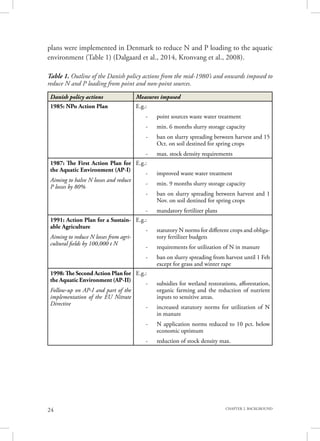
plans were implemented in Denmark to reduce N and P loading to the aquatic
environment (Table 1) (Dalgaard et al., 2014, Kronvang et al., 2008).
Danish policy actions Measures imposed
1985: NPo Action Plan E.g.:
-- point sources waste water treatment
-- min. 6 months slurry storage capacity
-- ban on slurry spreading between harvest and 15
Oct. on soil destined for spring crops
-- max. stock density requirements
1987: The First Action Plan for
the Aquatic Environment (AP-I)
Aiming to halve N losses and reduce
P losses by 80%
E.g.:
-- improved waste water treatment
-- min. 9 months slurry storage capacity
-- ban on slurry spreading between harvest and 1
Nov. on soil destined for spring crops
-- mandatory fertilizer plans
1991: Action Plan for a Sustain-
able Agriculture
Aiming to reduce N losses from agri-
cultural fields by 100,000 t N
E.g.:
-- statutory N norms for different crops and obliga-
tory fertilizer budgets
-- requirements for utilization of N in manure
-- ban on slurry spreading from harvest until 1 Feb
except for grass and winter rape
1998: The Second Action Plan for
the Aquatic Environment (AP-II)
Follow-up on AP-I and part of the
implementation of the EU Nitrate
Directive
E.g.:
-- subsidies for wetland restorations, afforestation,
organic farming and the reduction of nutrient
inputs to sensitive areas.
-- increased statutory norms for utilization of N
in manure
-- N application norms reduced to 10 pct. below
economic optimum
-- reduction of stock density max.
Table 1. Outline of the Danish policy actions from the mid-1980’s and onwards imposed to
reduce N and P loading from point and non-point sources.
25CHAPTER 2. BACKGROUND
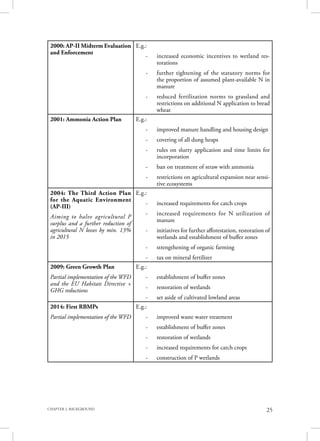
2000: AP-II Midterm Evaluation
and Enforcement
E.g.:
-- increased economic incentives to wetland res-
torations
-- further tightening of the statutory norms for
the proportion of assumed plant-available N in
manure
-- reduced fertilization norms to grassland and
restrictions on additional N application to bread
wheat
2001: Ammonia Action Plan E.g.:
-- improved manure handling and housing design
-- covering of all dung heaps
-- rules on slurry application and time limits for
incorporation
-- ban on treatment of straw with ammonia
-- restrictions on agricultural expansion near sensi-
tive ecosystems
2004: The Third Action Plan
for the Aquatic Environment
(AP-III)
Aiming to halve agricultural P
surplus and a further reduction of
agricultural N losses by min. 13%
in 2015
E.g.:
-- increased requirements for catch crops
-- increased requirements for N utilization of
manure
-- initiatives for further afforestation, restoration of
wetlands and establishment of buffer zones
-- strengthening of organic farming
-- tax on mineral fertilizer
2009: Green Growth Plan
Partial implementation of the WFD
and the EU Habitats Directive +
GHG reductions
E.g.:
-- establishment of buffer zones
-- restoration of wetlands
-- set aside of cultivated lowland areas
2014: First RBMPs
Partial implementation of the WFD
E.g.:
-- improved waste water treatment
-- establishment of buffer zones
-- restoration of wetlands
-- increased requirements for catch crops
-- construction of P wetlands
26 CHAPTER 2. BACKGROUND
Whereas the first Action Plan for the Aquatic Environment was effectively tar-
geting point sources, the following action plans were more directed towards dif-
fuse sources. The series of national action plans imposed in Denmark have had
remarkable effects on point source discharges and agricultural losses of N and P.
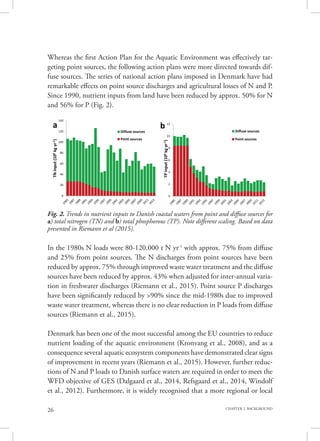
Since 1990, nutrient inputs from land have been reduced by approx. 50% for N
and 56% for P (Fig. 2).
In the 1980s N loads were 80-120.000 t N yr-1
with approx. 75% from diffuse
and 25% from point sources. The N discharges from point sources have been
reduced by approx. 75% through improved waste water treatment and the diffuse
sources have been reduced by approx. 43% when adjusted for inter-annual varia-
tion in freshwater discharges (Riemann et al., 2015). Point source P discharges
have been significantly reduced by >90% since the mid-1980s due to improved
waste water treatment, whereas there is no clear reduction in P loads from diffuse
sources (Riemann et al., 2015).
Denmark has been one of the most successful among the EU countries to reduce
nutrient loading of the aquatic environment (Kronvang et al., 2008), and as a
consequence several aquatic ecosystem components have demonstrated clear signs
of improvement in recent years (Riemann et al., 2015). However, further reduc-
tions of N and P loads to Danish surface waters are required in order to meet the
WFD objective of GES (Dalgaard et al., 2014, Refsgaard et al., 2014, Windolf
et al., 2012). Furthermore, it is widely recognised that a more regional or local
Fig. 2. Trends in nutrient inputs to Danish coastal waters from point and diffuse sources for
a) total nitrogen (TN) and b) total phosphorous (TP). Note different scaling. Based on data
presented in Riemann et al (2015).
0
20
40
60
80
100
120
140
TNinput(106kgyr-1)
Diffuse sources
Point sources
0
2
4
6
8
10
12
TPinput(106kgyr-1)
Diffuse sources
Point sources
a b
27CHAPTER 2. BACKGROUND
approach to the development of WFD PoMs is necessary in future, if the environ-
mental objectives are to be met in a cost-effective way (Commission on Nature
and Agriculture, 2013, Kronvang et al., 2008, Refsgaard et al., 2014). The risk of
nutrient losses, the pressure of nutrient loads, and the sensitivity of water bodies
depend strongly on local geology, soil, climate and recipient ecosystems (Blicher-
Mathiesen et al., 2013, Dalgaard et al., 2014), and this makes a general (one size
fits all) approach unsuitable for the development of WFD action programmes.
Due to the substantial reductions in nutrient loads from point sources, agriculture
is today the major source of both N and P inputs to Danish surface waters. As a
result the Danish WFD implementation is focused on cost-effective reductions of
diffuse losses from agriculture. A major part of the estimated nutrient load reduc-
tions necessary to meet the GES objective in surface waters has been postponed
to the next WFD planning cycles (Danish Ministry of the Environment, 2010,
Danish Ministry of the Environment, 2014).
2.2. The WFD management and planning processes
The WFD builds on the principles of Integrated Water Resources Management
(IWRM), which promotes the co-ordinated development and management
of water, land and related resources in order to maximise economic and social
welfare in an equitable manner without compromising the sustainability of vital
ecosystems (GWP, 2000, Quevauviller, 2010). In new guidelines on water re-
sources management planning, the importance of integrated approaches, cross-
sectoral planning and public participation in the planning process are emphasised
(European Commission, 2003, GWP, 2000, Refsgaard, 2007). According to
the WFD Guidance Document on Planning Processes, planning is defined as
“a systematic, integrative and iterative process that is comprised of a number of
steps executed over a specified time schedule” (European Commission, 2003).
The WFD planning process, where RBMPs are prepared, implemented and re-
viewed every six years, has four distinct elements: 1) Characterisation of status,
impacts, pressures and environmental objectives 2) development of appropriate
PoMs, 3) implementation of measures and 4) evaluation of the effects of measures
(Refsgaard et al., 2007). The cyclical and iterative character of the WFD planning
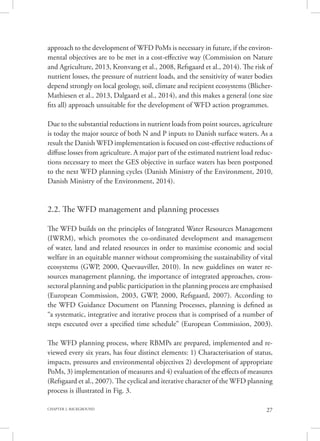
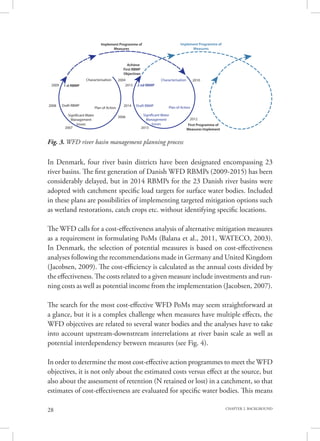
process is illustrated in Fig. 3.
28 CHAPTER 2. BACKGROUND
In Denmark, four river basin districts have been designated encompassing 23
river basins. The first generation of Danish WFD RBMPs (2009-2015) has been
considerably delayed, but in 2014 RBMPs for the 23 Danish river basins were
adopted with catchment specific load targets for surface water bodies. Included
in these plans are possibilities of implementing targeted mitigation options such
as wetland restorations, catch crops etc. without identifying specific locations.
The WFD calls for a cost-effectiveness analysis of alternative mitigation measures
as a requirement in formulating PoMs (Balana et al., 2011, WATECO, 2003).
In Denmark, the selection of potential measures is based on cost-effectiveness
analyses following the recommendations made in Germany and United Kingdom
(Jacobsen, 2009). The cost-efficiency is calculated as the annual costs divided by
the effectiveness. The costs related to a given measure include investments and run-
ning costs as well as potential income from the implementation (Jacobsen, 2007).
The search for the most cost-effective WFD PoMs may seem straightforward at
a glance, but it is a complex challenge when measures have multiple effects, the
WFD objectives are related to several water bodies and the analyses have to take
into account upstream-downstream interrelations at river basin scale as well as
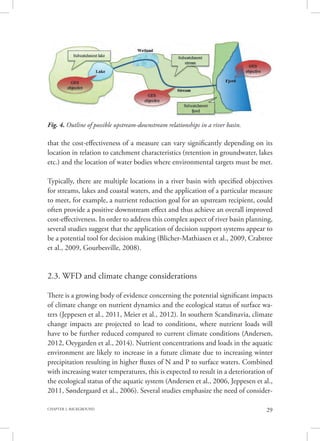
potential interdependency between measures (see Fig. 4).
In order to determine the most cost-effective action programmes to meet the WFD
objectives, it is not only about the estimated costs versus effect at the source, but
also about the assessment of retention (N retained or lost) in a catchment, so that
estimates of cost-effectiveness are evaluated for specific water bodies. This means
Fig. 3. WFD river basin management planning process
1 st RBMP 2 nd RBMP
Characterisation Characterisation
Implement Programme of
Measures
Implement Programme of
Measures
Achieve
First RBMP
Objectives
First Programme of
Measures Implement
2009
2010
2008
2007
2006
2013
2014
2004
2015
Draft RBMP Draft RBMP
Plan of Action Plan of Action
Significant Water
Management
Issues
Significant Water
Management
Issues
2012
29CHAPTER 2. BACKGROUND
that the cost-effectiveness of a measure can vary significantly depending on its
location in relation to catchment characteristics (retention in groundwater, lakes
etc.) and the location of water bodies where environmental targets must be met.
Typically, there are multiple locations in a river basin with specified objectives
for streams, lakes and coastal waters, and the application of a particular measure
to meet, for example, a nutrient reduction goal for an upstream recipient, could
often provide a positive downstream effect and thus achieve an overall improved
cost-effectiveness. In order to address this complex aspect of river basin planning,
several studies suggest that the application of decision support systems appear to
be a potential tool for decision making (Blicher-Mathiasen et al., 2009, Crabtree
et al., 2009, Gourbesville, 2008).
2.3. WFD and climate change considerations
There is a growing body of evidence concerning the potential significant impacts
of climate change on nutrient dynamics and the ecological status of surface wa-
ters (Jeppesen et al., 2011, Meier et al., 2012). In southern Scandinavia, climate
change impacts are projected to lead to conditions, where nutrient loads will
have to be further reduced compared to current climate conditions (Andersen,
2012, Oeygarden et al., 2014). Nutrient concentrations and loads in the aquatic
environment are likely to increase in a future climate due to increasing winter
precipitation resulting in higher fluxes of N and P to surface waters. Combined
with increasing water temperatures, this is expected to result in a deterioration of
the ecological status of the aquatic system (Andersen et al., 2006, Jeppesen et al.,
2011, Søndergaard et al., 2006). Several studies emphasize the need of consider-
Fig. 4. Outline of possible upstream-downstream relationships in a river basin.
30 CHAPTER 2. BACKGROUND
ing this in the next generation RBMPs (Oeygarden et al., 2014, Quevauviller et
al., 2012, Wright et al., 2010).
The relationship between river basin management planning and mitigation of
climate change – through the reduction in emissions of GHG – has received
limited attention (Henriksen et al., 2011). This is primarily because the issues are
dealt with by different research communities and within different policy contexts.
Still, the integration of climate change mitigation into river basin management
planning is an important aspect of the European climate change response and
more focus on this specific issue is needed (Wright et al., 2010). The effects of
the instruments and measures adopted through the Danish action plans for the
aquatic environment show a close linkage between reduction of nutrient losses
and GHG emissions from agricultural production (Nielsen et al., 2013). An
assessment by the Danish Committee on WFD measures has shown that some
agri-environmental measures, such as biogas production based on manure and
cultivation of perennial energy crops, have a socio-economic benefit when CO2
equivalent (CO2
-eq.) effects are included in the economic analyses (Jensen et al.,
2009). According to the Danish Commission on Nature and Agriculture (2013),
potential synergies like this should be further explored in the future implementa-
tion of agri-environmental measures.
2.4. Methodology
2.4.1. Research design
The four appended papers address the objectives of this thesis, each paper covering
two of the four objectives presented in chapter 1 (see Table 2).
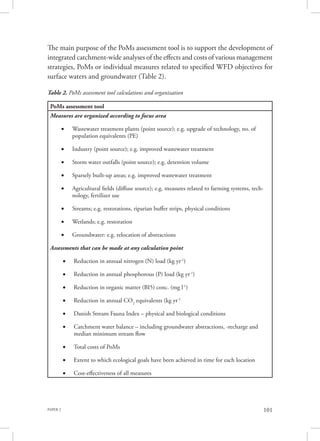
Table 2. Overview of the four main objectives addressed through the four appended papers
(CC = climate change).
Objectives
Paper no. PoMs tool WFD
planning
WFD & CC
mitigation
WFD & CC
adaptation
New bioenergy
concept
1 X X
2 X X
3 X X
4 X X
31CHAPTER 2. BACKGROUND
Paper 1, 2 and 4 examine to what extend a map-based PoMs assessment tool
can support the development of cost-effective WFD action programmes and the
integration of climate change considerations. The PoMs assessment tool analyses
were carried out for the Isefjord and Roskilde Fjord River Basin in northeastern
Denmark. This river basin encompasses a broad spectrum of different types of
water bodies such as lakes, streams, fjords and groundwater as well as major pol-
lution sources, e.g. intensive agricultural production and a range of different point
sources such as waste water treatment plants and storm water outfalls. Paper 1
and 4 explore the potential for synergies between reduction of nutrient losses
and mitigation of GHG emissions from agricultural production through the de-
velopment of alternative WFD PoMs. Paper 2 investigates the potential effect of
expected climate change on N leaching rates and the extent to which the PoMs
assessment tool can support climate change adaptation through targeted WFD
action programmes tailored to the river basin. Paper 3 assesses the extent to which
a new bioenergy concept based on a holistic planning approach can contribute
to strengthening the linkages between climate change mitigation strategies and
coastal eutrophication management in the Køge Bay River Basin. The biogas plant,
currently under construction in the Municipality of Solrød, has been designed to
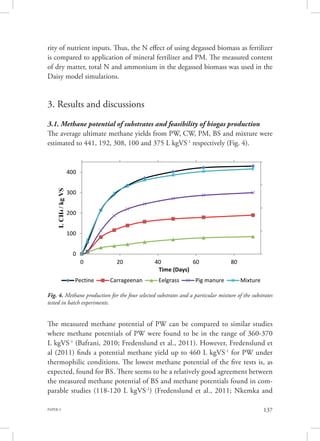
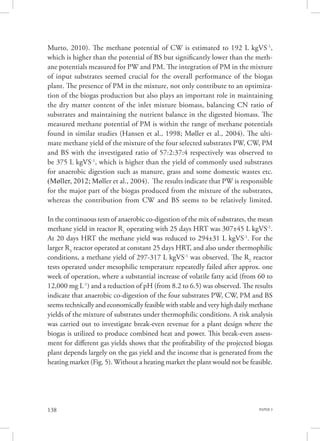
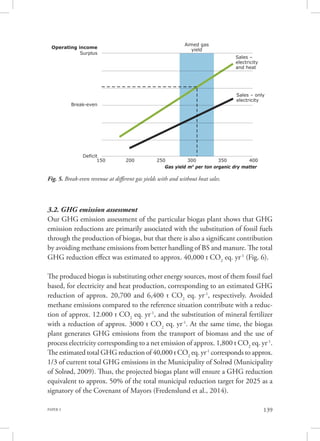
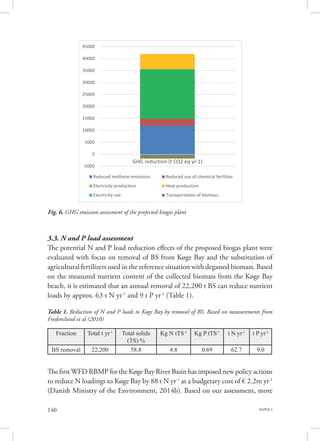
handle an annual input of up to 200,000 t of biomass based on four main frac-
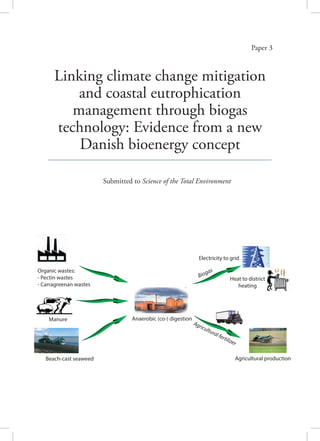
tions: pectin wastes, carrageenan wastes, manure and beach-cast seaweed.
All four appended papers are based on planning approaches that address the need
for more localized and integrated solutions. The PoMs assessment tool analyses
of the Isefjord and Roskilde Fjord River Basin are used to support a WFD action
planning tailored to the river basin level, where identification and targeting of
appropriate measures can be assessed on the basis of specific local conditions. The
investigation of the new bioenergy concept in the Køge Bay River Basin serves as
an example of the potential development of integrated environmental solutions
through local and holistic planning approaches.
The methodological approach to the development of WFD PoMs in paper 1, 2
and 4 is based on the proposed ‘three step approach’ related to the WFD cost-
effectiveness analysis of alternative mitigation measures to achieve GES (Article 11
and Annex III of the Directive) (WATECO, 2003, Jacobsen, 2007). This approach
is closely related to the RBMP process, and it consists of the following steps:
32 CHAPTER 2. BACKGROUND
Step 1: Characterisation of the river basin, including assessment of present
status, analysis of impacts, pressures and establishment of environmental
objectives.
Step 2: Identification of significant water management issues and risk
of non-compliance with the environmental objectives of the WFD (gap
analysis).
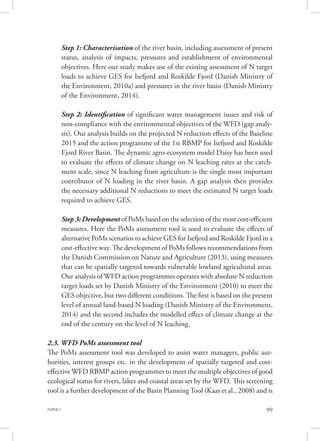
Step 3: Development of PoMs based on the selection of the most cost-
efficient measures. Here the PoMs assessment tool is used to evaluate the
effects of alternative PoMs scenarios to achieve GES in a cost-effective way.
The selection of measures in the studies is based on a comprehensive literature
study and recent Danish reviews as well as recommendations from the Danish
Commission on Nature and Agriculture (2013). Paper 3 is based on the analysis
of a single measure, which has been locally planned for and developed in order
to find cost-effective solutions to mitigate climate change and reduce nutrient
loading of surface waters. The methodological approach used in paper 3 is linked
to the project development of the bioenergy concept, including a feasibility study
and environmental assessments of the potential effects on GHG emissions and
nutrient loadings to Køge Bay.
2.4.2. WFD PoMs assessment tool
The PoMs assessment tool used in the studies was developed to assist water ma-
nagers, public authorities, interest groups etc. in the development of spatially
targeted and cost-effective action programmes to meet the multiple objectives
of good ecological status for rivers, lakes and coastal areas set by the WFD. This
screening tool is a further development of the Basin Planning Tool (Kaas et al.,
2008) and is specifically designed to provide a simple, easy to use, flexible but
technically sound map-based assessment tool. PoMs scenarios can be saved, edited
and further developed through a web-based user interface (Fig. 5).
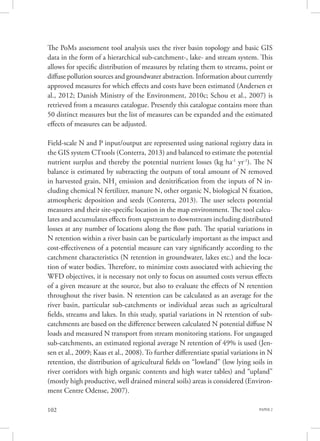
The PoMs assessment tool analysis is based on river basin topology and basic GIS
data in the form of a hierarchical sub-catchment-, lake- and stream system. This
allows for site-specific distribution of measures by relating them to streams, point
or diffuse pollution sources. Field-scale N and P input/output are represented using
national registry data in the GIS system CTtools (Conterra, 2013) and balanced to
33CHAPTER 2. BACKGROUND
estimate the potential nutrient surplus and thereby the potential nutrient losses (kg
ha-1
yr-1
). The N balance is estimated by subtracting the outputs of total amount
of N removed in harvested grain, NH3
emission and denitrification from the in-
puts of N including chemical N fertilizer, manure N, other organic N, biological
N fixation, atmospheric deposition and seeds (Conterra, 2013). The user selects
potential measures and their site-specific location in the map environment. The
tool calculates and accumulates effects from upstream to downstream including
distributed losses at any number of locations along the flow path.
The timing of implementation of different measures is specified so this can be
taken into account in the evaluations of whether the expected goals are achieved
in for example 2015 and 2021, thus supporting the planning process over several
years, where implemented and planned measures can be continuously updated as
implementation of the WFD progresses. The tool calculates accumulated effects
of all measures on N, P, CO2
-eq etc. and the associated costs for sub-catchments
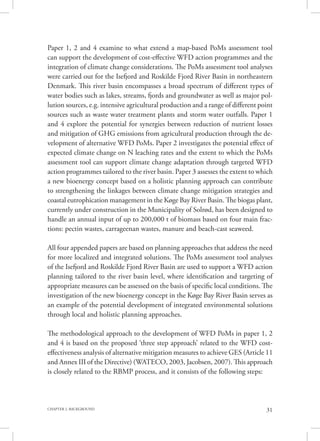
linked to calculation points specified by the user. The extent to which the WFD
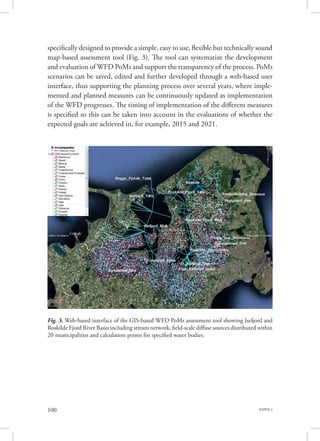
Fig. 5. Web-based interface of the GIS-based WFD PoMs assessment tool showing Isefjord and
Roskilde Fjord River Basin including stream network, field-scale diffuse sources distributed within 20
municipalities and calculation points for specified water bodies.
34 CHAPTER 2. BACKGROUND
objectives are achieved is illustrated using maps, and the results of the analysis are
outlined in an automatically generated report. The PoMs tool is a screening level
tool for the overall initial assessment of spatially distributed measures to reduce
environmental pressures at the catchment scale. More detailed investigations can
be carried out as a result of this screening process using numerical models such
as MIKE SHE (Graham and Butts, 2006), which is used for the Danish national
water resource model (Højberg et al., 2013).
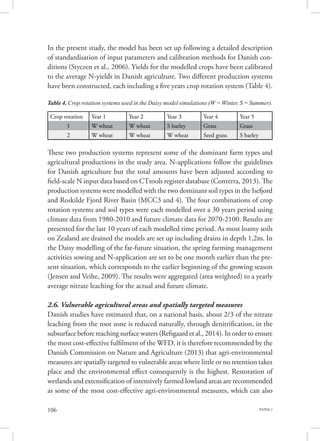
2.4.3. Daisy model simulations
In paper 2 and 3, the dynamic agro-ecosystem model ‘Daisy’ is used to analyze
potential changes in N dynamics due to climatic changes and changes in fertil-
izer use, respectively. Daisy is a soil-plant-atmosphere system model (Abrahamsen
and Hansen, 2000, Hansen et al., 1991), which simulates plant growth and soil
processes in agro-ecosystems, including water and N dynamics. Daisy has been
tested and validated in several international comparative validation studies (Diek-
kruger et al., 1995, Palosuo et al., 2011, Smith et al., 1997), which have shown
it to be both reliable and among the best performing agro-ecosystem models.
For each of the two case study river basins, the model has been set up with the
dominant soil types and agricultural production systems within the river basins.
2.4.4. Projected climate change and meteorological data
In order to investigate the potential effects of expected climate change on N leach-
ing rates (paper 2), daily meteorological data are needed as input in the Daisy
simulations. WFD RBMPs have a near term planning horizon, however, the evo-
lution of climate change as simulated by climate models is dominated by natural
variability in this timeframe. By the end of the century, climate change signals are
clear and robust, and most importantly, are distinguishable from natural variability
(Seaby et al., 2013). Therefore, a future period at the end of the century is used
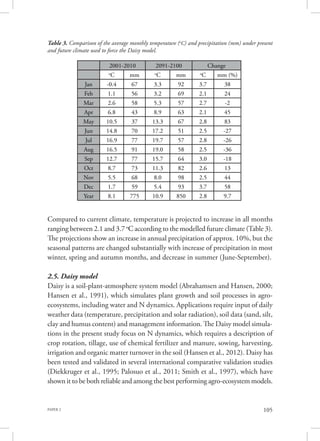
rather than within the WFD planning timeframe. Current and future climate is
represented using daily values of temperature, solar radiation and precipitation
from 2001-2010 and 2091-2100, respectively.
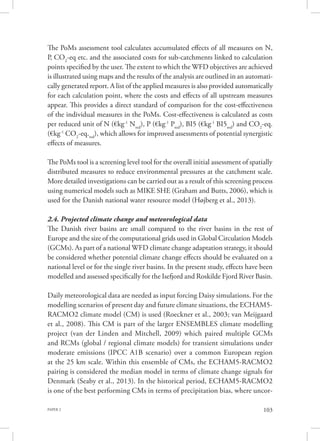
For the modelling scenarios of present day and future climate situations, the
ECHAM5-RACMO2 climate model is used (Roeckner et al., 2003, van Meijgaard
et al., 2008). This climate model is part of the larger ENSEMBLES climate mod-
elling project (van der Linden and Mitchell, 2009) which paired multiple global
regional climate models for transient simulations under moderate emissions (IPCC
35CHAPTER 2. BACKGROUND
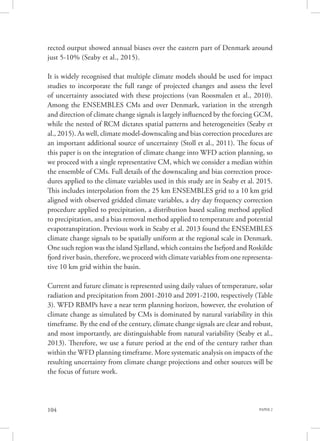
A1B scenario) over a common European region at the 25 km scale. Within this
ensemble of climate models, the ECHAM5-RACMO2 pairing is considered the
median model in terms of climate change signals for Denmark (Seaby et al., 2013).
In the historical period, ECHAM5-RACMO2 is one of the best performing climate
models in terms of precipitation bias, where uncorrected output showed annual
biases over the eastern part of Denmark around just 5-10% (Seaby et al., 2015).
37CHAPTER 3. SYNTHESIS
Chapter 3
3. Synthesis
In this chapter, the results of the studies addressed in the four appended papers
are summarised and discussed in relation to the objectives put forward in the
introduction of this thesis (chapter 1). Firstly, a discussion of the potential use
of the map-based PoMs assessment tool for the development of cost-effective
WFD action programmes tailored to the river basin scale. Secondly, an evalu-
ation of the potential for synergies between reduction of nutrient losses and
GHG emissions through integrated river basin management. Thirdly, the results
of Daisy model simulations of the effects of climate change on N leaching rates
will be discussed as well as the extent to which the PoMs assessment tool can
support adaptive N management strategies. Finally, the assessments of the new
bioenergy concept developed in the Køge Bay River Basin will be discussed.
The studies of this thesis illustrate the linkages between water management, land
use planning and climate change actions. The analyses carried out are based on
planning approaches at the river basin level and the local level which enhances the
opportunities for developing integrated solutions, because they typically depend
on specific local conditions. While the studies deal with climate change adapta-
tion and mitigation separately, there appears to be a large potential for synergies
between each of the two types of actions within a WFD planning context.
3.1. The PoMs assessment tool and WFD river basin planning
The design and implementation of WFD PoMs is a challenging task which needs
support from appropriate information systems and modelling tools that are able
to cope with the complexity of the water system and planning process (Vanrol-
leghem, 2011). The map-based PoMs assessment tool used in this PhD study is one
among many tools that have been developed to help decision makers understand
and evaluate alternative WFD measures and decisions at the scale of river basins.
The studies carried out for the Isefjord and Roskilde Fjord River Basin (paper 1,
2 and 4) demonstrate that the application of the PoMs assessment tool to a large
extent can support the development of cost-effective action programmes tailored
to the river basin, where identification and targeting of appropriate measures can
be assessed on the basis of specific local conditions. This screening tool makes it
possible to evaluate combined effects and cost-effectiveness of any given combi-
nation of measures at any number of locations, taking into account the spatial
variation in nutrient retention. Information about the underlying data, planned
measures, costs and derived environmental benefits can be shared both between
central and local authorities and relevant stakeholders. Thus, the PoMs assess-
ment tool also has the potential to support and facilitate public participation as
required by the WFD.
The first WFD RBMPs in Denmark have highlighted the need for a more
integrated water management strategy that supports spatial targeting of agri-
environmental measures and better exploits potential synergies (Commission
on Nature and Agriculture, 2013). The effects of several of the measures used in
the first RBMPs are estimated on the basis of calculated average effects on the
national level. Thus, there is no specific evaluation of the site-specific location of
these measures or estimations of the maximum potential for a given measure at
river basin level. The PoMs assessment tool analyses presented in this thesis show
that the local effects and costs associated with the implementation of WFD ac-
tion programmes can be significantly different from average national estimates,
particularly as a result of distributed losses and retention factors related to both
surface waters and subsurface conditions. It is also evident from the case studies
of this thesis that the development of ‘win-win’ solutions in the context of the
WFD is highly dependent on specific local conditions such as river basin typol-
ogy, land use and the distribution of locally available resources (e.g. manure from
large livestock farms). The PoMs assessment tool can provide an effective screen-
ing of potential N management strategies across a river basin, where non-expert
users can be offered easier access to WFD scenario formulations. However, more
targeted WFD PoMs with related analyses at smaller scales requires more detailed
data and more knowledge about the uncertainty related to estimates (Refsgaard
et al., 2014). Due to limitations in the monitoring station network data and the
models used to estimate N retention maps in Denmark, downscaling to farm or
field level remains a challenge.
39CHAPTER 3. SYNTHESIS
3.2. WFD action programmes and climate change mitigation
Many studies emphasize the significant and cost-effective potential for reduction
of nutrient losses and mitigation of GHG emissions in agriculture (Dalgaard
et al., 2011,Henriksen et al., 2011,Newell Price et al., 2011,Smith and Olesen,
2010). These linkages are, however, not very well explored and there is a need
to investigate to what extent a river basin planning approach can support this
kind of integration in a WFD context. Agricultural production is estimated to
contribute around 55% of the nitrogen entering the European seas and reduc-
ing nutrient losses from agriculture is crucial to the successful implementation
of the WFD (Bouraoui and Grizzetti, 2012). At the same time there is a very
significant cost-effective GHG mitigation potential in the sector and agricultural
GHG mitigation options are found to be cost competitive when compared to
non-agricultural options (e.g. energy, transportation, forestry) in achieving long-
term climate objectives (IPCC, 2007,Smith and Olesen, 2010).
In this thesis, the potential for synergies between reduction of nutrient losses and
mitigation of GHG emissions in a WFD planning perspective was investigated
through a case study of the Isefjord and Roskilde Fjord River Basin (paper 1 and
4). Based on a comprehensive literature study and recent Danish reviews (Dalgaard
et al., 2011, Danish Ministry of Food, Agriculture and Fisheries, 2008, Jensen
et al., 2009, Schou et al., 2007), four synergistic measures were identified that
potentially could provide cost-effective reductions of both N losses and GHG
emissions from agriculture (N-GHG measures). The four measures were: (1) biogas
production based on manure, (2) perennial energy crops, (3) extensification of
intensively farmed lowland areas and (4) wetland restoration. The environmental
effects and cost-effectiveness of the four N-GHG measures were evaluated using
the PoMs assessment tool.
The analyses of these alternative supplementary PoMs indicate that it is possible
to meet the estimated WFD N target loads to provide GES for Isefjord and
Roskilde Fjord using a combination of the four selected measures. Besides the
significant N load reduction to the fjords of 357 t N yr-1
, GHG emissions are
reduced corresponding to 35-65% of the estimated total agricultural emissions
within the river basin. Assessments of the cost-effectiveness of the four selected
measures show that biogas based on manure and perennial energy crops in com-
bination with wetlands has a cost per reduced kg N to coastal waters of approx.
40 CHAPTER 3. SYNTHESIS
5-6 € yr-1
, which corresponds to the estimated average cost of the measures in
the 1st RBMP of approx. 5 € yr-1
. Extensification of intensively farmed lowland
areas is less cost-effective with an average cost per reduced kg N to coastal waters
of approx. 19 € yr-1
.
Overall, it is concluded that in order to attain the full potential of the win-win
solutions offered by these synergistic agri-environmental measures, a spatially tar-
geted and differentiated approach to the development of WFD PoMs is necessary.
It is anticipated that this will accelerate in the development of 2nd generation
RBMPs – with climate change adaptation needs as an additional driver for a shift
towards more regional or local approaches.
3.3. WFD action programmes and climate change adaptation
The need for responses to tackle climate change impacts on water resources is
recognised worldwide as illustrated by the IPCC Technical Paper on Water (Bates
et al., 2008). Across EU Member States discussions are on-going as to how to
integrate climate change adaptation into the implementation of EU water policy. A
key challenge in this context is the adaptation to climate change impacts through
the design and implementation of WFD PoMs at the river basin scale (European
Commission, 2009b, Kronvang et al., 2005, Quevauviller, 2011, Wilby et al.,
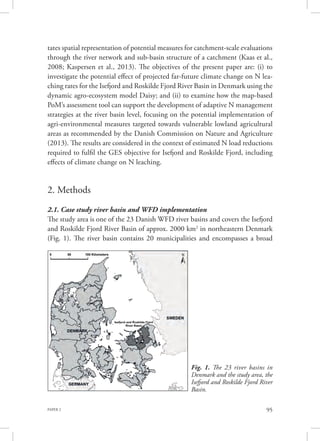
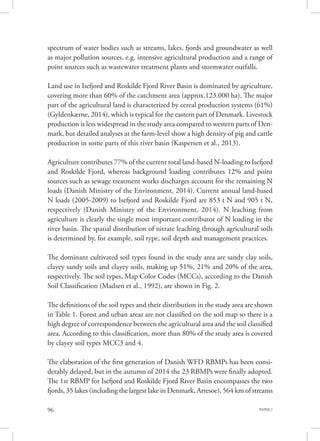
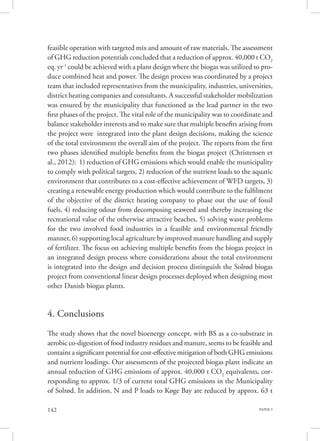
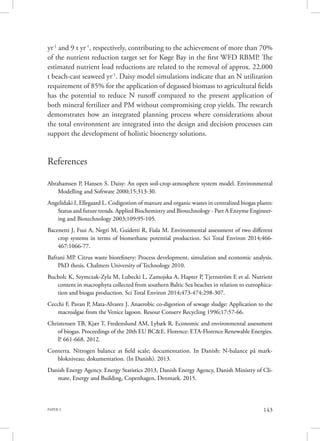
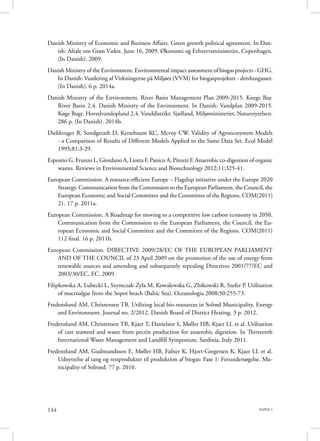
2006). In Denmark, N leaching from agriculture accounted for approx. 70%
of the total N loadings to coastal waters in the period 2007-11 (Dalgaard et al.,
2014), and the importance of addressing potential effects of climate change on N
leaching rates has been emphasized in numerous studies (Børgesen and Olesen,
2011, Jensen and Veihe, 2009, Van Der Keur et al., 2008).
The Daisy model simulations carried out for the Isefjord and Roskilde Fjord
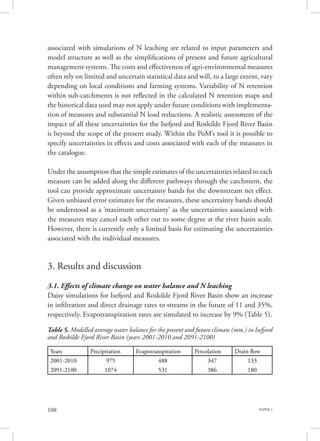
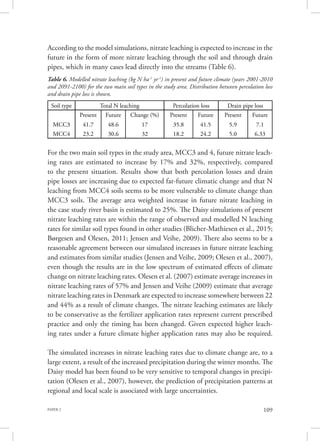
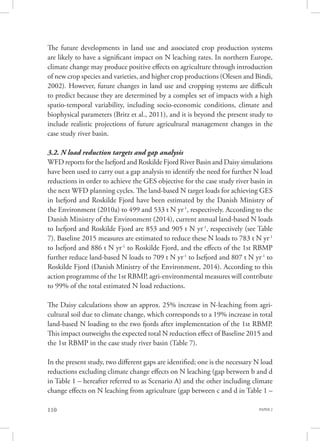
River Basin (paper 2) show that nitrate leaching rates increase by approx. 25%
under current management practices as a result of expected far-future climatic
change. This impact outweighs the expected total N reduction effect of Baseline
2015 and the first RBMP in the case study river basin. The PoMs assessment tool
was used to analyze alternative PoMs scenarios to achieve spatially targeted and
cost-effective N load reductions in the context of a changing climate (also paper
2). The development of alternative PoMs followed recommendations from the
Danish Commission on Nature and Agriculture (2013), using measures targeted
41CHAPTER 3. SYNTHESIS
vulnerable lowland agricultural areas. The two selected measures were 1) restora-
tion of wetlands and 2) extensification of intensively farmed lowland areas, which
are recommended as some of the most cost-effective agri-environmental measures
that can also provide synergies in terms of reduction of GHG emissions and
establishment of valuable and more cohesive nature. The particular PoMs inves-
tigated show that WFD N reduction targets can be achieved by targeted land use
changes on approx. 4% of the agricultural area under current climate conditions
and approx. 9% of the agricultural area, when projected climate change impacts
on nitrate leaching rates are included in the assessment.
While many studies have been conducted on climate change impacts on the
hydrological cycle, N dynamics and the ecological state of surface water bodies
(Jeppesen et al., 2011, Meier et al., 2012, Oeygarden et al., 2014, Quevauviller
et al., 2012), attempts to link this to the development of WFD action programmes
are limited. This important aspect of WFD implementation needs to be further
investigated in the next generation RBMPs and it has the potential to stimulate
more localized and differentiated approaches to the mitigation of nutrient loads
from agricultural areas to surface water. Despite uncertainties and lack of knowl-
edge, there is enough information about the negative future impacts of climate
change on Danish surface water bodies to include this now in the development
of risk analyses and environmental management decision-making.
3.4. Assessment of the novel bioenergy concept based on a holistic
planning approach
Both from a bioenergy and water management perspective, there is an increasing
need to develop energy and environmental technology systems that are conside-
rably more sustainable (in all aspects) than currently seen (European Commis-
sion, 2011, Smith and Olesen, 2010). Anaerobic co-digestion of various biomass
substrates offers a number of advantages for the management of manure and
organic wastes, and it appears to be one of the most promising technology systems
(Bacenetti et al., 2014, Holm-Nielsen et al., 2009, Rodriguez-Verde et al., 2014).
The multiple benefits associated with anaerobic co-digestion include mitigation
of GHG emissions – both through fossil fuel substitution and emission reduc-
tions caused by changed manure management – as well as reduction of nutrient
pollution of the aquatic environment (Holm-Nielsen et al., 2009, Lybaek et al.,
42 CHAPTER 3. SYNTHESIS
2013). Using beach-cast seaweed as a co-substrate in the production of biogas has
the potential to strengthen this link between mitigation of climate change and
eutrophication even further (Bucholc et al., 2014, Cecchi et al., 1996).
Several studies have assessed the methane potential production and environmental
performances of co-digestion of alternative waste materials (e.g. Angelidaki and
Ellegaard, 2003, Esposito et al., 2012, Ward et al., 2008) and the environmen-
tal benefits of potential usage of beach-cast macroalgae as a resource for biogas
production (Bucholc et al., 2014, Filipkowska et al., 2008). However, very few
studies have attempted to investigate the feasibility and potential synergies bet-
ween mitigation of climate change and coastal eutrophication, when beach-cast
seaweed is included as a substrate in a full-scale biogas plant.
In this thesis, the evaluation of the novel bioenergy concept in the Køge Bay River
Basin, with beach-cast seaweed as a co-substrate in aerobic co-digestion of food
industry residues and manure, shows that the projected biogas plant seems to be
feasible and contains a significant potential for cost-effective mitigation of both
GHG emissions and nutrient loadings. The environmental assessments of the
biogas plant indicate an annual GHG reduction corresponding to approx. 1/3 of
current total GHG emissions in the Municipality of Solrød. In addition, nutrient
loads to Køge Bay are reduced corresponding to the achievement of more than
70% of the nutrient reduction target set for Køge Bay in the first WFD RBMP
for the river basin.
The study demonstrates how an integrated planning process, where considera-
tions about multiple environmental and economic benefits are integrated into
the design and decision processes, can strengthen the linkages between climate
change mitigation strategies and WFD action planning. The development of the
bioenergy concept was organised in a so-called integrated design process that enabled
the public-private project team to evaluate opportunities, optimize plant concept,
reduce risks and eventually create a feasible plant with multiple environmental and
economic benefits for the involved stakeholders. Besides cost-effective mitigation
of GHG emissions and nutrient loads, the multiple benefits identified included:
The production of renewable energy that would contribute to the fulfilment of
the objective of the district heating company to phase out the use of fossil fuels,
the reduction of odour from decomposing seaweed at the local beaches, a solution
to waste problems for the two involved food industries in a feasible and environ-
43CHAPTER 3. SYNTHESIS
mental friendly manner, and improved conditions for local agriculture through
better manure handling and supply of fertilizer.
45CHAPTER 4. CRITICAL REFLECTIONS
Chapter 4
4. Critical Reflections
4.1. Project relevance
The need for integrated responses to tackle the challenges of water management,
land use planning and climate change has been recognized globally (Carter et
al., 2005, IPCC, 2014). Suitable management systems, relevant tools and local
involvement are required to ensure that potential synergies are exploited and ap-
propriate adaptation actions are taken. The scale that is increasingly being adopted
across the world to address this task of integration is that of the river catchment,
considered to be the most appropriate for the necessary building of collaboration
between multiple stakeholders and the development of capacity to deal with the
issues identified (Harris, 2010). The WFD reflects this trend and places particular
emphasis on building linkages between water management, other environmental
resources and land use through the development of RBMPs. Numerous studies
also highlight the opportunities for and necessity of integration of climate change
challenges within the step-wise and cyclical approach of the WFD planning pro-
cess (Quevauviller et al., 2012, Wilby et al., 2006, Wright et al., 2010). In this
light, the theme of the present thesis appears to be very relevant, addressing the
question of how to integrate climate change adaptation and mitigation into the
development of WFD PoMs in a real world setting.
Changes in current agricultural practises are key to the delivery of WFD objectives
in Denmark. However, there are many obstacles for implementing agri-environ-
mental measures in actual farming systems in order to reduce diffuse nutrient
losses even further. The lack of active involvement of relevant stakeholders in the
development of the first Danish RBMPs has contributed to increasing reluctance
towards the implementation of agri-environmental measures such as buffer strips
and catch crops (Gertz et al., 2012, Graversgaard et al., 2015). One of the most
important strengths of stakeholder involvement is that it increases the level of
46 CHAPTER 4. CRITICAL REFLECTIONS
public accountability and it may increase the public support for implementation
of subsequent management decisions (Refsgaard et al., 2007). All four appended
papers touch on the application of information systems and methods which may
support and facilitate more local and participatory approaches. The case study
of the new bioenergy concept developed in the Køge Bay River Basin (paper 3)
serves as an example of how local authorities can facilitate a successful stakeholder
mobilization. The vital role of the municipality in the development of the biogas
plant was to coordinate and balance stakeholder interests and to make sure that
potential multiple benefits arising from the project were integrated into the plant
design decisions.
4.2. Project planning and limitations
A PhD study is a learning process and this has been reflected in a continued re-
evaluation of the initial project planning. The initial project plan has not been gre-
atly revised, but the five years delay of the first generation of Danish WFD RBMPs
has influenced the development of the project. It was originally planned that the
PhD should provide input to and get feedback from the municipalities within
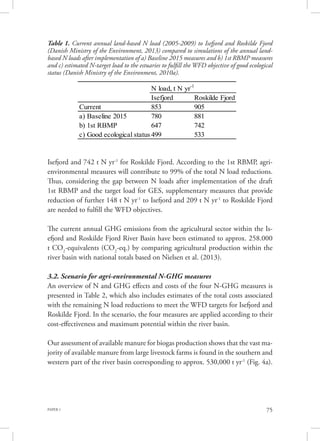
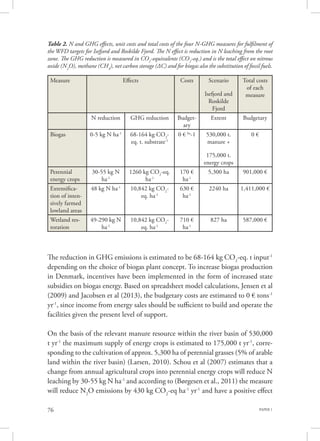
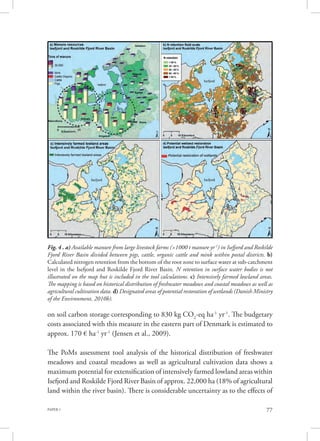
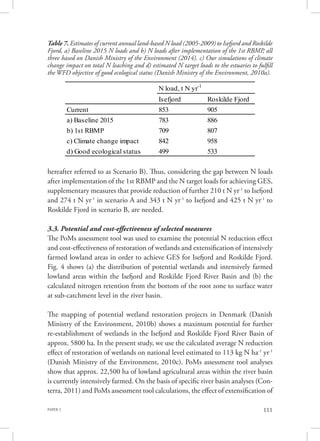
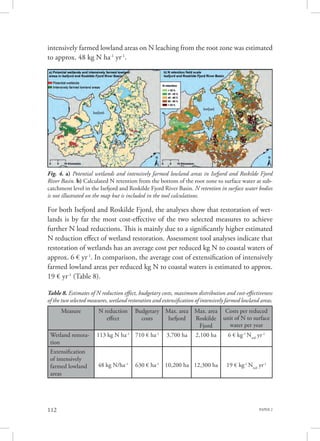
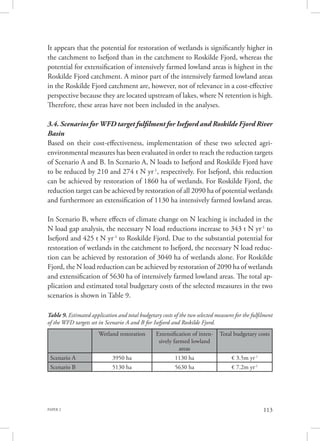
the Isefjord and Roskilde Fjord River Basin in connection with the preparation
of WFD action plans. However, so far, the municipalities have only to a limited
extent been involved in the implementation of the WFD in Denmark due to the
strong nationally led approach to the development of the first generation RBMPs.
It proved hard to contribute to a local planning process that was characterized
by insufficient funding and lack of influence. The local Danish authorities have
in the course of the RBMPs development process expressed dissatisfaction with
both the planning process and the content of the plans (Rigsrevisionen, 2014).
The chosen methodological approaches to assess potential impacts of climate
change as well as adaptation and mitigation strategies have their advantages and
limitations. The impact of climate change on N leaching rates was evaluated for
current agricultural practises in the case study river basin, because future changes
in land use and cropping systems are very difficult to predict as they are determi-
ned by a complex set of impacts with a high spatio-temporal variability, including
socio-economic conditions, climate and biophysical parameters (Britz et al., 2011).
Still, it is likely that the future developments in agricultural production systems
will have a significant impact on the losses of nutrients. For the assessment of
47CHAPTER 4. CRITICAL REFLECTIONS
potential synergies between reduction of nutrient losses and GHG emissions from
agriculture, only the N-GHG measures with the strongest knowledge base from
recent Danish studies were included in the analyses. Other agri-environmental
measures are expected to have similar effects.
A wide range of uncertainties have to be taken into account in the development
of WFD RBMPs (Refsgaard et al., 2007). At the present stage of implementa-
tion of the WFD in Denmark, considerable uncertainty is associated with the
complex biological, ecological and economic analyses that are included in PoMs
assessments. The costs and effects of agri-environmental measures often rely on
limited and uncertain statistical data and will, to a large extent, vary depending
on local conditions and farming systems. Spatial variations in N retention within
a river basin estimated from historical data may not apply under future conditions
with implementation of measures and significant N load reductions. A realistic
assessment of these uncertainties was beyond the scope of this PhD study and
will be the subject of future work.
49CHAPTER 5. OUTLOOK
Chapter 5
5. Outlook
Until now, the Danish regulatory approach to reduce nutrient losses from agri-
culture has primarily involved the implementation of general measures (fertilizer
reduction, catch crops, afforestation etc.) with largely non-differentiated restric-
tions toward farmers (Windolf et al., 2012). The studies of this thesis emphasize
that a general “one size fits all” regulation is less cost-effective than a spatially dif-
ferentiated planning approach, where agri-environmental measures are targeted
towards areas with low N retention. Furthermore, the current nationally-driven,
top-down approach to the WFD implementation does not support the develop-
ment of locally designed and optimised solutions.
There is increasingly awareness of these problems, and one of the central recom-
mendations of the Danish Commission on Nature and Agriculture (2013) is the
establishment of a differentiated and spatial targeted regulation of agriculture
which supports more localized and output-based approaches. In order to provide
support for management decisions on identifying vulnerable and robust agricul-
tural areas, respectively, further investigations of nutrient transport and retention
processes on a local scale are needed. In addition, a shift in agricultural regulation
calls for new management and planning approaches with active involvement of
key stakeholders.
The requirements of the 2nd and 3rd WFD RBMPs concerning integration of
climate change challenges aggravate the demand for integrated and adaptable
management systems. The quantitative projections of changes in temperature,
precipitation and water levels at the river basin scale are associated with uncer-
tainties, but it is very likely that the negative impacts on surface water bodies
outweigh the benefits. Not least in relation to eutrophication problems, climate
change seems to present a significant additional threat to the achievement of the
environmental objectives of the WFD. The inability to incorporate climate vari-
50 CHAPTER 5. OUTLOOK
ability and climate change at critical stages of the WFD implementation process
can result in disproportionately high costs, which may undermine the benefits
of action programmes over time and could ultimately prevent the environmental
objectives from being reached. Given these underlying uncertainties WFD RBMPs
need to be flexible and adaptable to climate change impacts such as increased
nitrate leaching.
This thesis shows that the integration of climate change mitigation into WFD
action programmes, to a large extent, depends on changes in current agricultural
practices. The challenge for the agricultural sector is to increase productivity to
feed a growing population with dwindling resources in a changing climate whilst
reducing environmental burdens (Foresight, 2011). Policy and planning will have
to support the development of win-win solutions in agriculture by encouraging
greater integration of agricultural strategies to achieve the triple aims of climate
change mitigation, renewable energy production and WFD objectives. It appears
from this thesis that WFD action programmes tailored to the particular river basin
hold a potential to facilitate this integration in practice.
A better scientific understanding of the natural processes and the effects of potential
mitigation measures at river basin scale is a key element of the WFD implementa-
tion. However, it is evident from the implementation of the first Danish RBMPs
that more tools and data alone will not provide the necessary solutions to the com-
plex problem of achieving the WFD objectives. The first RBMPs must be regarded
as a preliminary basis with additional need for alternative planning approaches,
active involvement of key stakeholders and more integrated agri-environmental
initiatives. By addressing the spatial targeting, synergy and adaptive capacity of
the PoMs, the WFD objectives will be met more rapidly and with lower associated
costs. A change from the uniform regulation of agriculture towards river basin
tailored action programmes is not only a prerequisite for appropriate integration
of climate change considerations but could also advance public participation and
the development of holistic and cost-effective solutions.
51CHAPTER 6. REFERENCES
Chapter 6
6. References
Abrahamsen, P., Hansen, S., 2000. Daisy: An open soil-crop-atmosphere system model. Environ-
mental Modelling and Software 15, 313-330.
Andersen, J.H., 2012. Ecosystem-Based Management of Coastal Eutrophication. Connecting
science, policy and society. University of Copenhagen. 182 p.
Andersen, H.E., Kronvang, B., Larsen, S.E., Hoffmann, C.C., Jensen, T.S., Rasmussen, E.K.,
2006. Climate-change impacts on hydrology and nutrients in a Danish lowland river basin.
Sci. Total Environ. 365, 223-237.
Angelidaki, I., Ellegaard, L., 2003. Codigestion of manure and organic wastes in centralized biogas
plants: Status and future trends. Applied Biochemistry and Biotechnology - Part A Enzyme
Engineering and Biotechnology 109, 95-105.
Bacenetti, J., Fusi, A., Negri, M., Guidetti, R., Fiala, M., 2014. Environmental assessment of
two different crop systems in terms of biomethane potential production. Sci. Total Environ.
466-467, 1066-1077.
Balana, B.B., Vinten, A., Slee, B., 2011. A review on cost-effectiveness analysis of agri-environ-
mental measures related to the EU WFD: Key issues, methods, and applications. Ecol. Econ.
70, 1021-1031.
Bates, B.C., Kundzewicz, Z.W., Wu, S., Palutikof, J.P., Eds., 2008. Climate Change and Water.
Technical Paper of the Intergovernmental Panel on Climate Change, IPCC Secretariat,
Geneva, 210 pp.
Blicher-Mathiasen, G., Andersen, H.E., Børgesen, C.D., Hansen, E.M., Sørensen, P., Hasler, B.,
Jacobsen, B.H., 2009. N risk assessment tool for optimal distribution of measures. In Dan-
ish: N-risikoværktøj til optimal fordeling af virkemidler. Vand & Jord. 4 p. (In Danish). 2.
Blicher-Mathiesen, G., Rasmussen, A., Grant, R., Jensen, P.G., Hansen, B., Thorling, L., 2013.
Danish Stream Monitoring Programme 2012. NOVANA. In Danish: Landovervågningsop-
lande 2012, NOVANA. DCE, Aarhus University. 152 p. (In Danish). http://dce2.au.dk/
pub/SR74.pdf.
Børgesen, C.D., Olesen, J.E., 2011. A probabilistic assessment of climate change impacts on yield
and nitrogen leaching from winter wheat in Denmark. Natural Hazards and Earth System
Science 11, 2541-2553.
52 CHAPTER 6. REFERENCES
Bouraoui, F., Grizzetti, B., 2012. Modelling mitigation options to reduce diffuse nitrogen water
pollution from agriculture. Sci. Total Environ.
Britz, W., Verburg, P.H., Leip, A., 2011. Modelling of land cover and agricultural change in Europe:
Combining the CLUE and CAPRI-Spat approaches. Agric. , Ecosyst. Environ. 142, 40-50.
Bucholc, K., Szymczak-Zyla, M., Lubecki, L., Zamojska, A., Hapter, P., Tjernström, E., Kow-
alewska, G., 2014. Nutrient content in macrophyta collected from southern Baltic Sea beaches
in relation to eutrophication and biogas production. Sci. Total Environ. 473-474, 298-307.
Carter, N., Kreutzwiser, R.D., de Loë, R.C., 2005. Closing the circle: linking land use planning
and water management at the local level. Land Use Policy 22, 115-127.
Cecchi, F., Pavan, P., Mata-Alvarez, J., 1996. Anaerobic co-digestion of sewage sludge: Application
to the macroalgae from the Venice lagoon. Resour. Conserv. Recycling 17, 57-66.
Commission on Nature and Agriculture, 2013. Richer nature, new environmental regulation and
new growth opportunities for agriculture. Executive summary The Danish Commission on
Nature and Agriculture. Available at www.naturoglandbrug.dk.
Conley, D.J., Markager, S., Andersen, J., Ellermann, T., Svendsen, L.M., 2002. Coastal eutro-
phication and the Danish National Aquatic Monitoring and Assessment Program. Estuaries
25, 848-861.
Conterra, 2013. Nitrogen balance at field scale; documentation. In Danish: N-balance på mark-
blokniveau; dokumentation. (In Danish).
Crabtree, B., Kelly, S., Green, H., Squibbs, G., Mitchell, G., 2009. Water framework directive
catchment planning: A case study apportioning loads and assessing environmental benefits
of programme of measures. Water Science and Technology 59, 407-416.
Dalgaard, T., Hansen, B., Hasler, B., Hertel, O., Hutchings, N.J., Jacobsen, B.H., Jensen, L.S.,
Kronvang, B., Olesen, J.E., Schjørring, J.K., Kristensen, I.S., Graversgaard, M., Termansen,
M., Vejre, H., 2014. Policies for agricultural nitrogen management-trends, challenges and
prospects for improved efficiency in Denmark. Environmental Research Letters 9.
Dalgaard,T., Olesen, J.E., Petersen, S.O., Petersen, B.M., Jørgensen, U., Kristensen,T., Hutchings,
N.J., Gyldenkærne, S., Hermansen, J.E., 2011. Developments in greenhouse gas emissions
and net energy use in Danish agriculture - How to achieve substantial CO2 reductions?
Environmental Pollution 159, 3193-3203.
Danish Ministry of Food, Agriculture and Fisheries, 2008. Agriculture and Climate. In Danish:
Landbrug og klima. Analyse af landbrugets virkemidler til reduktion af drivhusgasser og
de økonomiske konsekvenser. Report. Danish Ministry of Food, Agriculture and Fisheries,
Copenhagen, ISBN 978-87-7083-291-5, 146 p. (In Danish).
Danish Ministry of the Environment, 2014. River Basin Management Plan 2009-2015. Isefjord
and Roskilde Fjord. River Basin 2.2. Danish Ministry of the Environment. In Danish: Van-
dplan 2009-2015. Isefjord og Roskilde Fjord. Hovedvandopland 2.2. Vanddistrikt: Sjælland,
Miljøministeriet, Naturstyrelsen. 302 p. (In Danish).
53CHAPTER 6. REFERENCES
Danish Ministry of the Environment, 2010. Draft River Basin Management Plan River Basin
- Isefjord and Roskilde Fjord 2.2. In Danish: Udkast til Vandplan - Hovedvandopland 2.2
Isefjord og Roskilde Fjord. 234 p. (In Danish).
Diekkruger, B., Sondgerath, D., Kersebaum, K.C., Mcvoy, C.W., 1995. Validity of Agroecosystem
Models - a Comparison of Results of Different Models Applied to the Same Data Set. Ecol.
Model. 81, 3-29.
Esposito, G., Frunzo, L., Giordano, A., Liotta, F., Panico, A., Pirozzi, F., 2012. Anaerobic co-di-
gestion of organic wastes. Reviews in Environmental Science and Biotechnology 11, 325-341.
European Commission, 2011. A resource-efficient Europe – Flagship initiative under the Europe
2020 Strategy. Communication from the Commission to the European Parliament, the
Council, the European Economic and Social Committee and the Committee of the Regions.
COM(2011) 21. 17 p.
European Commission, 2010. Climate change adaptation and mitigation strategies already in
practice based on the 1st River Basin Management Plans of the EU Member States. European
Commission. Joint Reasearch Centre. Institute for Environment and Sustainability. 133 p.
European Commission, 2009. River basin management in a changing climate, Common Imple-
mentation Strategy for the Water Framework Directive, Guidance document No. 24, ISBN
978-92-79-14298-7.
European Commission, 2003. Common implementation strategy for the Water Framework Direc-
tive (2000/60/EC). Guidance document no. 11. Planning Processes. 2003.
Filipkowska, A., Lubecki, L., Szymczak-Zyla, M., Kowalewska, G., Zbikowski, R., Szefer, P.,
2008. Utilisation of macroalgae from the Sopot beach (Baltic Sea). Oceanologia 50, 255-273.
Foresight, 2011. The Future of Food and Farming: Final Project Report. Government Office for
Science, London.
Frederiksen, P., Mäenpää, M., Hokka, V., 2008. The Water Framework Directive: Spatial and
institutional integration. Management of Environmental Quality 19, 100-117.
Gertz, F., Knudsen, L., Wiborg, I., 2012. Problematic Danish Implementation. In Danish: Prob-
lematisk dansk implementering. Vand & Jord, no. 3, 100-103, 2012. (In Danish).
Gourbesville, P., 2008. Integrated river basin management, ICT and DSS: Challenges and needs.
Phys. Chem. Earth 33, 312-321.
Graham, D.N., Butts, M.B., 2006. Flexible, integrated watershed modelling with MIKE SHE.
In: Watershed Models (ed. by V.P. Singh, D.K. & Frevert), 245–272. CRC Press, ISBN
0849336090.
Graversgaard, M., Gertz, F., Wiborg, I., Kjeldsen, C., Dalgaard, T., 2015. Vandråd - et nybrud i
dansk vandforvaltning. Vand & Jord, nr. 1, Feb. 2015. 4 p. (In Danish).
GWP, 2000. Integrated Water Resources Management (IWRM). Stockholm: Global Water
Partnership.
54 CHAPTER 6. REFERENCES
Hansen, S., Jensen, H.E., Nielsen, N.E., Svendsen, H., 1991. Simulation of nitrogen dynamics
and biomass production in winter wheat using the Danish simulation model DAISY. Fertil-
izer Research 27, 245-259.
Harris, B., 2010. Chapter 1.1: Are we able to adapt water resource management practices in a
fast moving world. The Water Framework Directive, Action Programmes and Adaptation to
Climate Change. Issues in Environmental Science and Technology , 3-13.
Henriksen, C.B., Hussey, K., Holm, P.E., 2011. Exploiting soil-management strategies for climate
mitigation in the European union: Maximizing “win-win” solutions across policy regimes.
Ecology and Society 16.
Hering, D., Borja, A., Carstensen, J., Carvalho, L., Elliott, M., Feld, C.K., Heiskanen, A.-.,
Johnson, R.K., Moe, J., Pont, D., Solheim, A.L., de Bund, W.V., 2010. The European Water
Framework Directive at the age of 10: A critical review of the achievements with recommen-
dations for the future. Sci. Total Environ. 408, 4007-4019.
Højberg, A.L., Troldborg, L., Stisen, S., Christensen, B.S.B., Henriksen, H.J., 2013.
Stakeholder driven uptake and improvement of a national water resources model. Environ-
mental Modelling & Software, 40, 202-213. http://dx.doi.org/10.1016/j.envsoft.2012.09.010.
Holm-Nielsen, J.B., Al Seadi, T., Oleskowicz-Popiel, P., 2009. The future of anaerobic digestion
and biogas utilization. Bioresour. Technol. 100, 5478-5484.
ICWE, 1992. The Dublin Statement and report of the conference. International Conference on
Water and the Environment: Development issues for the 21st century. 26-31 January 1992,
Dublin, Ireland.
IPCC, 2014. Climate Change 2014: Synthesis Report. Contribution of Working Groups I, II and
III to the Fifth Assessment Report of the Intergovernmental Panel on Climate Change [Core
Writing Team, R.K. Pachauri and L.A. Meyer (eds.)]. IPCC, Geneva, Switzerland, 151 pp.
IPCC, 2007. Climate Change 2007. Intergovernmental Panel on Climate Change Fourth Assess-
ment Report (AR4). Intergovernmental Panel on Climate Change, Geneva, Schwitzerland.
104 p.
Jacobsen, B.H., 2009. Farm economic consequences of the water framework directive in Europe.
Farm Management, vol 13, no. 10, pp. 687-696.
Jacobsen, B.H., 2007. In search of cost-effective measures. Danish report on the use of cost-
effectiveness analysis when implementing the EU Water Framework Directive. Institute of
Food and Resource Economics. Report No. 191.
Jensen, P.N., Hasler, B., Waagepetersen, J., Rubæk, G.H., Jacobsen, B.H., 2009. Note on the
measures and the costs of implementation of the Water Framework Directive. In Danish:
Notat vedr. virkemidler og omkostninger til implementering af vandrammedirektivet. Aarhus
University. 103 p. (In Danish).
Jensen, N.H., Veihe, A., 2009. Modelling the effect of land use and climate change on the water
balance and nitrate leaching in eastern Denmark. Journal of Land Use Science 4, 53-72.
55CHAPTER 6. REFERENCES
Jeppesen, E., Kronvang, B., Olesen, J.E., Audet, J., Søndergaard, M., Hoffmann, C.C., Andersen,
H.E., Lauridsen, T.L., Liboriussen, L., Larsen, S.E., Beklioglu, M., Meerhoff, M., Özen, A.,
Özkan, K., 2011. Climate change effects on nitrogen loading from cultivated catchments
in Europe: Implications for nitrogen retention, ecological state of lakes and adaptation.
Hydrobiologia 663, 1-21.
Kaas, H., Jacobsen, T.V., Refsgaard, A., Møhlenberg, F., Müller, H.G., Krogsgaard, J., Jørgensen,
P.E., Poulsen, R.N., 2008. River Basin Susaa - Karrebaek Fjord - Dybsaa Fjord, Basin Plan-
ning and PoM’s assessment Tool, WFD action programme. In Danish: Oplandene til Suså
- Karrebæk Fjord - Dybsø Fjord, Oplands- og virkemiddelværktøj. Forslag til indsatsprogram.
105 p. (In Danish).
Kaspersen, B.S., Kjaer,T., Linde, J.J., Bang, R., Graversgaard, M., Groenborg,T., 2014. Intelligent
forecasting and management of extreme precipitation events. In Danish: Intelligent varsling
og styring af ekstremregn. Solrød Municipality. 36 p. (In Danish).
Kronvang, B., Aertebjerg, G., Grant, R., Kristensen, P., Hovmand, M., Kirkegaard, J., 1993.
Nationwide monitoring of nutrients and their ecological effects: state of the Danish aquatic
environment. Ambio 22, 176-187.
Kronvang, B., Andersen, H.E., Børgesen, C., Dalgaard, T., Larsen, S.E., Bøgestrand, J., Blicher-
Mathiasen, G., 2008. Effects of policy measures implemented in Denmark on nitrogen pol-
lution of the aquatic environment. Environmental Science and Policy 11, 144-152.
Kronvang, B., Jeppesen, E., Conley, D.J., Søndergaard, M., Larsen, S.E., Ovesen, N.B., Carstensen,
J., 2005. Nutrient pressures and ecological responses to nutrient loading reductions in Danish
streams, lakes and coastal waters. Journal of Hydrology 304, 274-288.
Lybaek, R., Christensen, T.B., Kjaer, T., 2013. Enhancing the transition capability of Danish bio-
mass technology by applying a futures study backcasting methodology on the biogas sector.
European Journal of Sustainable Development. Special issue. 14 p. 2, no. 4.
Meier, H.E.M., Hordoir, R., Andersson, H.C., Dieterich, C., Eilola, K., Gustafsson, B.G., Hö-
glund, A., Schimanke, S., 2012. Modeling the combined impact of changing climate and
changing nutrient loads on the Baltic Sea environment in an ensemble of transient simulations
for 1961-2099. Clim. Dyn. 39, 2421-2441.
Newell Price, J.P., Harris, D.,Taylor, M., Williams, J.R., Anthony, S.G., Duethmann, D., Gooday,
R.D., Lord, E.I., Chadwick, D.R., Misselbrook, T.H., Chambers, B.J., 2011. An inventory
of mitigation methods and guide to their effects on diffuse water pollution, greenhouse gas
emissions and ammonia emissions from agriculture - user guide. Defra project WQ0106, 162p.
56 CHAPTER 6. REFERENCES
Nielsen, O.K., Plejdrup, M.S., Winther, M., Nielsen, M., Gyldenkærne, S., Mikkelsen, M.H.,
Albrektsen, R., Thomsen, M., Hjelgaard, K., Hoffmann, L., Fauser, P., Bruun, H.G., Jo-
hannsen, V.K., Nord-Larsen, T., Vesterdal, L., Møller, I.S., Caspersen, O.H., Rasmussen, E.,
Petersen, S.B., Baunbæk, L., Hansen, M.G., 2013. Denmark’s National Inventory Report
2013. Emission Inventories 1990-2011 - Submitted under the United Nations Framework
Convention on Climate Change and the Kyoto Protocol. Aarhus University, DCE – Danish
Centre for Environment and Energy, 1202 pp. Scientific Report from DCE – Danish Centre
for Environment and Energy. http://www.dmu.dk/Pub/SR56.pdf.
Oeygarden, L., Deelstra, J., Lagzdins, A., Bechmann, M., Greipsland, I., Kyllmar, K., Povilaitis,
A., Iital, A., 2014. Climate change and the potential effects on runoff and nitrogen losses in
the Nordic–Baltic region. Agric. , Ecosyst. Environ. 198, 114-126.
Palosuo, T., Kersebaum, K.C., Angulo, C., Hlavinka, P., Moriondo, M., Olesen, J.E., Patil, R.H.,
Ruget, F., Rumbaur, C., Takác, J., Trnka, M., Bindi, M., Çaldag, B., Ewert, F., Ferrise, R.,
Mirschel, W., Saylan, L., Šiška, B., Rötter, R., 2011. Simulation of winter wheat yield and
its variability in different climates of Europe: A comparison of eight crop growth models.
Eur. J. Agron. 35, 103-114.
Quevauviller, P., 2011. Adapting to climate change: Reducing water-related risks in Europe - EU
policy and research considerations. Environmental Science and Policy 14, 722-729.
Quevauviller, P., 2010. Is IWRM achievable in practice? Attempts to break disciplinary and sec-
toral walls through a science-policy interfacing framework in the context of the EU Water
Framework Directive. Irrig. Drain. Syst. 24, 177-189.
Quevauviller, P., Barceló, D., Beniston, M., Djordjevic, S., Harding, R.J., Iglesias, A., Ludwig, R.,
Navarra, A., Navarro Ortega, A., Mark, O., Roson, R., Sempere, D., Stoffel, M., van Lanen,
H.A.J., Werner, M., 2012. Integration of research advances in modelling and monitoring
in support of WFD river basin management planning in the context of climate change. Sci.
Total Environ. 440, 167-177.
Refsgaard, J.C., 2007. Hydrological Modelling and River Basin Management. Doctoral Thesis.
Geological Survey of Denmark and Greenland.
Refsgaard, J.C., Van der Sluijs, J.P., Højberg, A.L., Vanrolleghem, P.A., 2007. Uncertainty in the
environmental modelling process - A framework and guidance. Environmental Modelling
and Software Volume 22, Issue 11, 2007, Pages 1543-1556.
Refsgaard, J.C., Auken, E., Bamberg, C.A., Christensen, B.S.B., Clausen,T., Dalgaard, E., Effersø,
F., Ernstsen, V., Gertz, F., Hansen, A.L., He, X., Jacobsen, B.H., Jensen, K.H., Jørgensen,
F., Jørgensen, L.F., Koch, J., Nilsson, B., Petersen, C., De Schepper, G., Schamper, C., Sø-
rensen, K.I., Therrien, R., Thirup, C., Viezzoli, A., 2014. Nitrate reduction in geologically
heterogeneous catchments - A framework for assessing the scale of predictive capability of
hydrological models. Sci. Total Environ. 468-469, 1278-1288.
57CHAPTER 6. REFERENCES
Riemann, B., Carstensen, J., Dahl, K., Fossing, H., Hansen, J.W., Jakobsen, H.H., Josefson,
A.B., Krause-Jensen, D., Markager, S., Stæhr, P.A., Timmermann, K., Windolf, J., Andersen,
J.H., 2015. Recovery of Danish Coastal Ecosystems After Reductions in Nutrient Loading:
A Holistic Ecosystem Approach. Estuaries and Coasts .
Rigsrevisionen, 2014. Extract from the report to the Public Accounts Committee on Denmark’s
River Basin Management Plans. 3 p.
Rodriguez-Verde, I., Regueiro, L., Carballa, M., Hospido, A., Lema, J.M., 2014. Assessing anaero-
bic co-digestion of pig manure with agroindustrial wastes: The link between environmental
impacts and operational parameters. Sci. Total Environ. 497, 475-483.
Roeckner, E., Bäuml, G., Bonaventura, L., Brokopf, R., Esch, M., Giorgetta, M., Hagemann, S.,
Kirchner, I., Kornblueh, L., Manzini, E., Rhodin, A., Schlese, U., Schulzweida, U.,Tompkins,
A., 2003. The atmospheric general circulation model ECHAM5. Part I: Model description.
Max Planck Institute for Meteorology Rep. 349. MPI for Meteorology, Bundesstr. 53, 20146
Hamburg, Germany.
Schou, J.S., Kronvang, B., Birr-Pedersen, K., Jensen, P.L., Rubæk, G.H., Jørgensen, U., Jacobsen,
B., 2007. Virkemidler til realisering af målene i EUs Vandrammedirektiv. Udredning for
udvalg nedsat af Finansministeriet og Miljøministeriet: Langsigtet indsats for bedre vandmiljø.
Danmarks Miljøundersøgelser, Aarhus Universitet. 132 s. Faglig rapport fra DMU nr. 625.
http://www.dmu.dk/Pub/FR625.pdf (In Danish).
Seaby, L.P., Refsgaard, J.C., Sonnenborg, T.O., Højberg, A.L., 2015. Spatial uncertainty in bias
corrected climate change projections and hydrogeological impacts. Hydrological Processes
(accepted).
Seaby, L.P., Refsgaard, J.C., Sonnenborg, T.O., Stisen, S., Christensen, J.H., Jensen, K.H., 2013.
Assessment of robustness and significance of climate change signals for an ensemble of
distribution-based scaled climate projections. Journal of Hydrology 486, 479-493. Journal
of Hydrology 486, 479-493.
Smith, P., Olesen, J.E., 2010. Synergies between the mitigation of, and adaptation to, climate
change in agriculture. J. Agric. Sci. 148, 543-552.
Smith, P., Smith, J.U., Powlson, D.S., McGill, W.B., Arah, J.R.M., Chertov, O.G., Coleman, K.,
Franko, U., Frolking, S., Jenkinson, D.S., Jensen, L.S., Kelly, R.H., Klein-Gunnewiek, H.,
Komarov, A.S., Li, C., Molina, J.A.E., Mueller,T., Parton, W.J., Thornley, J.H.M., Whitmore,
A.P., 1997. A comparison of the performance of nine soil organic matter models using datasets
from seven long-term experiments. Geoderma 81, 153-225.
Søndergaard, M., Kronvang, B., Pejrup, M., Jensen, S.-., 2006. Water and weather in Denmark
in 100 years. Climate change and the Danish aquatic environment. In Danish: Vand og vejr
om 100 år - klimaforandringer og det danske vandmiljø. (In Danish). 144 p.
Van Der Keur, P., Hansen, J.R., Hansen, S., Refsgaard, J.C., 2008. Uncertainty in simulation of
nitrate leaching at field and catchment scale within the Odense River Basin. Vadose Zone
Journal 7, 10-21.
58 CHAPTER 6. REFERENCES
van der Linden, P., Mitchell, J.F.B., 2009. ENSEMBLES: climate change and its impacts: sum-
mary of research and results from the ENSEMBLES project. Technical Report, Met Office
Hadley Centre, Exeter, 1–160.
van Meijgaard, E., van Ulft, L.H., van de Berg, W.J., Bosveld, F.C., van den Hurk, B.J.J.M., Len-
derink, G., Siebesma, A.P., 2008. The KNMI regional atmospheric climate model RACMO,
version 2.1. KNMI Technical Report 302. KNMI, De Bilt, The Netherlands.
Vanrolleghem, P.A., 2011. Decision Support for Water Framework Directive Implementation.
ISBN: 9781843393276. 3, 162.
Ward, A.J., Hobbs, P.J., Holliman, P.J., Jones, D.L., 2008. Optimisation of the anaerobic diges-
tion of agricultural resources. Bioresour. Technol. 99, 7928-7940.
WATECO, 2003. WATECO (Working Group 2.6 WATer Framework Directive ECOnomics),
2003. Policy Summary to Guidance Document No 1: Economics and the Environment – The
Implementation Challenge of the Water Framework Directive. Common implementation
strategy for the Water Framework Directive (2000/60/EC).
Wilby, R.L., Orr, H.G., Hedger, M., Forrow, D., Blackmore, M., 2006. Risks posed by climate
change to the delivery of Water Framework Directive objectives in the UK. Environ. Int.

32, 1043-1055.
Windolf, J., Blicher-Mathiesen, G., Carstensen, J., Kronvang, B., 2012. Changes in nitrogen loads
to estuaries following implementation of governmental action plans in Denmark: A paired
catchment and estuary approach for analysing regional responses. Environmental Science
and Policy 24, 24-33.
Wright, J., Horvath, B., Wilby, R., 2010. Chapter 2.1: River Basin management in a changing
climate. The Water Framework Directive, Action Programmes and Adaptation to Climate
Change. Issues in Environmental Science and Technology , 17-33.
 
59CHAPTER 7. PAPERS
Chapter 7
7. Papers
	
Paper 1.
Kaspersen, B.S., Jacobsen,T.V., Butts, M.B., Boegh, E., Müller, H.G., Stutter,
M., Fredenslund, A.M., Kjaer, T. Integrating climate change mitigation
into river basin management planning for theWater Framework Directive
– A Danish case. Submitted to Environmental Science & Policy.
Paper 2.
Kaspersen, B.S., Jacobsen,T.V., Butts, M.B., Jensen, N.H., Boegh, E., Seaby,
L.P., Müller, H.G., Kjaer, T. Using a map-based assessment tool for the
development of cost-effective WFD river basin action programmes in
a changing climate. Submitted to Journal of Environmental Management.
Paper 3.
Kaspersen, B.S., Christensen, T.B, Fredenslund, A.M., Møller, H.B., Butts,
M.B., Jensen, N.H., Kjaer,T. Linking climate change mitigation and coa-
stal eutrophication management through biogas technology: Evidence
from a new Danish bioenergy concept. Submitted to Science of the Total
Environment.
Paper 4.
Kaspersen, B.S, Jacobsen,T.V., Butts, M.B., Müller, H.G., Boegh, E., Kjaer,T.
A) Målrettede vandplaner – hvordan? [original Danish version]
B) Targeted WFD action programmes – how? [English version]
Published in Vand & Jord [Water & Soil] 4, 2013, 136-141.
Integrating climate change
mitigation into river basin
management planning for the
Water Framework Directive –
A Danish case
Paper 1
Submitted to Environmental Science & Policy
PAPER 1 63
Integrating climate change
mitigation into river basin
management planning for the
Water Framework Directive –
A Danish case
Bjarke Stoltze Kaspersena,b,*
, Torsten Vammen Jacobsenb
,
Michael Brian Buttsb
, Eva Boegha
, Henrik Gioertz Müllerb
,
Marc Stutterc
, Anders Michael Fredenslunda
, Tyge Kjaera
a.	 Department of Environmental, Social and Spatial Change, 		
Roskilde University, P.O. Box 260, DK 4000, Roskilde, Denmark
b.	 DHI, Agern Alle 5, DK 2970, Hoersholm, Denmark
c.	 The James Hutton Institute, Craigiebuckler, Aberdeen, UK
Highlights
•	 A map-based tool is used to integrate climate change mitigation into WFD
action programmes
•	 Synergies between nitrogen and GHG emission reductions for agriculture
are assessed
•	 Agri-environmental measures can reduce both nutrient losses and GHG
emissions cost-effectively
•	 We find a very significant potential for synergistic WFD action program-
mes for the case study catchment
•	 A differentiated approach tailored to the river basin is key to successful
integration of climate change mitigation
PAPER 164
Abstract
The growing interest in integrating climate change considerations into Programmes
of Measures (PoMs) under the EU Water Framework Directive (WFD) is being
driven in part by the requirements of the next generation of river basin management
plans (RBMPs). However, so far most studies have focused on potential impacts
of climate change on water bodies and the adaptation to climate change-related
risks, whereas the relationship between RBMP’s and mitigation of climate change
– through the reduction in emissions of greenhouse gasses (GHG) – has only been
touched upon. This paper addresses the potential for synergies between reduction
of nutrient losses from agriculture and climate change mitigation in a case study
of the Isefjord and Roskilde Fjord River Basin in Denmark. A map-based PoMs
assessment tool is used to analyse the effects and cost-effectiveness of possible
measures to reduce both nitrogen loads and GHG emissions from agriculture at
the river basin scale. The results indicate a substantial potential for cost-effective
integration of climate change mitigation into WFD action programmes with
special emphasis on four agri-environmental N-GHG measures applied in com-
bination: (1) biogas production based on manure, (2) perennial energy crops, (3)
extensification of intensively farmed lowland areas and (4) wetland restoration.
This study suggests that a targeted and differentiated approach to the development
of PoMs is necessary in order to attain the full potential of these kinds of win-win
solutions in the context of the WFD.
Keywords: Water Framework Directive, climate change mitigation, river basin
management planning, programmes of measures, decision support systems, ag-
riculture, nutrients
1. Introduction
Complying with the “good ecological status” (GES) objective of the European
Water Framework Directive (WFD) in Denmark requires appropriate Programmes
of Measures (PoMs) to reduce nitrogen (N) loads to surface water bodies. Integra-
tion of climate change considerations into the WFD PoMs is subject to growing
interest and is required for the next generation (2015-2027) of WFD river basin
management cycles (European Commission, 2009). However, most studies fo-
cus on potential impacts of climate change on water bodies and the adaptation
PAPER 1 65
to climate-related risks (Beniston et al., 2011, Quevauviller, 2011, Wilby et al.,
2006), whereas the relationship between river basin management planning and
mitigation of climate change – through the reduction in emissions of greenhouse
gasses (GHGs) – has received limited attention (Henriksen et al., 2011). Still, the
integration of climate change mitigation into river basin management planning
is an important aspect of the European climate change response and more focus
on this specific issue is needed (Wright et al., 2010).
It is widely acknowledged that the WFD provides an opportunity for a more
holistic approach, where the protection of water resources are linked to other
environmental objectives and land-use challenges (Frederiksen et al., 2008, Har-
ris, 2010, Quevauviller, 2010). Especially within agricultural production there
seems to be a large potential for synergies between the reduction of nutrient losses
and GHG mitigation (Dalgaard et al., 2011, Henriksen et al., 2011, Smith and
Olesen, 2010). These linkages are, however, not very well explored and there is a
need to investigate to what extent a catchment-based approach can support this
kind of integration in the process of moving European waters towards good status.
Agricultural production is estimated to contribute around 55% of the nitrogen
entering the European seas and reducing nutrient losses from agriculture is
crucial to the successful implementation of the WFD (Bouraoui and Grizzetti,
2012). At the same time there is a very significant cost-effective GHG mitiga-
tion potential in the sector and agricultural GHG mitigation options are found
to be cost competitive when compared to non-agricultural options (e.g. energy,
transportation, forestry) in achieving long-term climate objectives (IPCC, 2007,
Smith and Olesen, 2010).
1.1. The case of Denmark
Denmark is one of the world’s most intensively farmed countries. Diffuse agricul-
tural N-losses are the most important sources of land-based N loading to Danish
surface waters (Kronvang et al., 2008) and account for about 17% of the total
national GHG emissions (Nielsen et al., 2013). Since the mid-1980s several na-
tional water action plans have been implemented in Denmark to reduce nutrient
losses from agriculture (Kronvang et al., 2008). The effects of the instruments and
measures adopted in Denmark show a close relationship between reduction of N
losses and GHG emissions from agricultural production. As a result of the Dan-
ish water action plans, the total loss of N from farmland has decreased by almost
PAPER 166
50% since 1985 (Kronvang et al., 2008) and as an (unintentional) side-effect
GHG emissions from agriculture have been reduced by 23% from 1990 to 2011
(Nielsen et al., 2013). These effects have been achieved while still increasing the
animal production and the value of agricultural production (Danish Agriculture
and Food Council, 2013) (Fig. 1).
Until now, the Danish regulatory approach to reduce nutrient losses from agricul-
ture has mainly involved implementation of general measures (fertilizer reduction,
catch crops, afforestation etc.) with largely non-differentiated restrictions toward
farmers (Windolf et al., 2012). During the WFD implementation process the
Danish environmental authorities have been operating with three different N load
reduction targets to waters represented by a) Baseline 2015 (effect of adopted but
not yet fully implemented measures); b) the draft first River Basin Management
Plans (RBMPs) valid for WFD planning cycle 1 (2009-2015); and c) estimates
of the total N load reduction required to achieve GES. However, the integra-
tion of climate change mitigation into water action planning has not yet been
specifically planned for. In order to meet the demands of the WFD and to fully
integrate climate change mitigation into the next generation river basin manage-
ment cycles, a more targeted and differentiated approach to the development of
PoMs is necessary in order to meet the WFD requirements of cost-efficiency. A
map-based PoMs assessment tool, based on specific river basin characteristics,
Fig. 1. Development of nitrogen surplus, GHG emissions and production (fixed prices) in Danish
agriculture 1985-2011 (modified from Blicher-Mathiesen et al., 2012,Danish Agriculture and Food
Council, 2013,Nielsen et al., 2013).
0
25
50
75
100
125
150
Index(1985=100)
N surplus GHG emissions Production
PAPER 1 67
spatially distributed representation of nutrient losses and evaluation of potential
WFD measures, has been developed to assist water managers in meeting these
challenges (Kaas et al., 2008). This paper presents the application of this PoMs
assessment tool to the development and evaluation of alternative WFD action
programmes for the Isefjord and Roskilde Fjord River Basin in Denmark. The
objective of the study is to analyse the potential effects of implementation of
different cost-effective measures to reduce both runoff N loads and GHG emis-
sions from agriculture at the river basin scale. The scenarios used for evaluation
of potential synergies between reduction of N losses and GHG emissions aim
to achieve the N load reduction targets set for the two fjords to fulfil the GES
objective of WFD. The extent to which the alternative PoMs were able to reduce
N loads and GHG emissions was evaluated for a set of supplementary measures
needed to close the gap between already adopted and planned measures (Baseline
2015 and 1st RBMP) and the calculated N load reduction targets to achieve GES
(see Table 1 in chapter 3.1).
2. Materials and methods
2.1. Study area and WFD action programme
The analyses were carried out for the Isefjord and Roskilde Fjord River Basin in
northeastern Denmark (Fig. 2), which covers an area of approx. 2000 km2
and
Fig. 2. Map of Denmark showing
Isefjord and Roskilde Fjord River Basin.
PAPER 168
Fig. 3. Land use in Isefjord and Roskilde Fjord River Basin (EEA CORINE, 2010)
contains 20 municipalities. The river basin encompasses a broad spectrum of
different types of water bodies such as lakes, streams, fjords and groundwater as
well as major pollution sources, e.g. intensive agricultural production and a range
of different point sources such as waste water treatment plants and storm water
outfalls.
Land use in Isefjord and Roskilde Fjord River Basin is dominated by agriculture,
covering more than 60% of the catchment area (approx.123.000 ha) (Fig. 3).
Within the Isefjord and Roskilde Fjord River Basin, agriculture contributes 77%
of the current total land-based N loading, whereas background loading contributes
12% and point sources such as sewage treatment works discharges account for
the remaining N loads. The proportion of N loads originating from agricultural
production in the river basin is close to the Danish national average, where N-
leaching from agriculture accounted for approx. 70% of the total N loadings to
coastal waters in the period 2007-2011 (Dalgaard et al., 2014).
PAPER 1 69
Current annual land-based N loads (2005-2009) to Isefjord and Roskilde Fjord
are estimated to 853 t N and 905 t N, respectively (Danish Ministry of the En-
vironment, 2013). Of total land-based P-losses, diffuse sources account for 45%
and waste water treatment plants and storm-water outfalls for 38% and 17%
respectively (Danish Ministry of the Environment, 2013). Achieving the WFD
objectives is furthermore complicated by internal nutrient loading sources, in
particular from the bottom sediments of the streams, lakes and fjords (Refsgaard,
2007).
The elaboration of the 1st generation of Danish WFD RBMPs has been consider-
ably delayed, but in 2013 a draft 1st WFD RBMP was published for Isefjord and
Roskilde Fjord River Basin (Danish Ministry of the Environment, 2013) including
catchment specific load targets and a suite of recommended mitigation options
(buffer strips, catch crops, wetland restorations). The 1st RBMP is based on a
baseline analysis extrapolating the risk of failure for 2015 by taking into account
already agreed but not yet fully implemented measures (Baseline 2015), among
these remaining effects of the Third Action Plan for the Aquatic Environment
(Kronvang et al., 2008). In the 1st RBMP, the needs for actions were estimated
for the two fjords, 52 lakes (including the largest lake in Denmark, Arresoe),
680 km streams and 19 groundwater bodies. The future impacts of nutrient
loading have been identified as a key pressure (Danish Ministry of the Environ-
ment, 2013) when assessing the risk of not fulfilling the environmental objec-
tives for the lakes and coastal waters in Isefjord and Roskilde Fjord River Basin.
2.2. Description of the PoMs assessment tool
The PoMs assessment tool used in this study is a further development of the Basin
Planning Tool (Kaas et al., 2008) and has also been used to evaluate WFD action
programmes and adaptation to climate change. It is a screening tool developed
specifically for integrated catchment-wide analyses of the effects and costs of vari-
ous management strategies, measures and programmes to improve the status of
the aquatic environment and develop future scenarios.
The main purpose of the tool is to assist water managers, public authorities, inter-
est groups etc., in developing cost-effective PoMs to meet the multiple objectives
of good ecological status for rivers, lakes and coastal areas set by the WFD. The
tool has then been extended to support the evaluation of GHG emission effects
of action programmes. This tool makes it possible to develop PoMs scenarios at
PAPER 170
river basin scale using currently approved measures for which effects have been es-
timated (Andersen et al., 2012,Danish Ministry of the Environment, 2010c,Schou
et al., 2007) and to evaluate their site specific cost-effectiveness as well as the
extent to which the ecological goals can be achieved. Information about effects
and costs for a given measure is retrieved from a catalogue of measures, while
their downstream effect relies on distributed N retention maps representing flow
paths through groundwater, streams, lakes and wetlands. At present more than
50 distinct measures can be selected from the catalogue, and it is thus possible to
compare a wide range of alternative measures and alternative locations for their
implementation.
Field-scale nitrogen and phosphorous input/output are registered by Ministry of
Food, Agriculture and Fisheries and represented in the GIS using CTtools (Con-
terra, 2013) and balanced to estimate the potential nutrient surplus and thereby
potential nutrient losses from the root zone (kg ha-1 yr-1). The N balance is
estimated by subtracting the outputs of total amount of N removed in harvested
grain, NH3 emission and denitrification from the inputs of N including chemi-
cal N fertilizer, manure N, other organic N, biological N fixation, atmospheric
deposition and seeds (Conterra, 2013).
The user selects suitable measures from the catalogue and their site specific use in
the map environment. The tool calculates and accumulates effects from upstream
to downstream including distributed losses at any number of locations. Spatial
variations in N retention are obtained from the retention maps. These retention
maps are based on both calculated N transport in sub-basins where diffuse N-loads
at sub-basin level are compared with measured N transport in stream monitoring
stations and an estimated regional average (49%) representing N retention in
ungauged sub-basins (Jensen et al., 2009,Kaas et al., 2008). The distribution of
agricultural fields as either “lowland” (low lying soils in river corridors with high
organic contents and high water tables) or “upland” (mostly high productive, well
drained mineral soils) areas is taken into account in the calculations (Environment
Centre Odense, 2007). The lowland map was developed in 1984 by digitizing
historical maps showing signatures of meadows, bogs and marsh since the begin-
ning of the 1900s (Olesen, 2007).
The calculated spatial variations in sub-basin scale N retention are used as input
data in the PoMs assessment tool (Fig. 4b) and are of particular importance when
PAPER 1 71
evaluating the effects and cost-effectiveness of PoMs. In order to minimize costs
associated with achieving the WFD goals, it is necessary, not only to focus on
assumed costs versus effects of a given measure at the source but also to evaluate
the distributed effects of N retention within the catchment area so that effects
and costs are related to attaining the ecological goals at specific sites downstream.
The effects and cost-effectiveness of a potential measure can vary significantly due
to catchment characteristics (retention in groundwater, lakes etc.), the location
of water bodies and the location of the measure itself. The strength of using a
map-based tool is that the impact of the location of measures can be evaluated
and scenarios developed that target the most effective locations in order to achieve
the downstream ecological goals. The tool calculates accumulated effects of all
measures on N and P load reductions, carbon dioxide equivalents (CO2-eq)
emission reductions and associated costs for sub-catchments linked to selected
calculation points identified by the user. The extent to which the environmental
goals have been achieved is mapped, and the results of the analysis are outlined in
an automatically generated report. The PoMs tool is a screening level tool for the
overall initial assessment of spatially distributed measures to reduce environmental
pressures at the catchment scale. More detailed investigations can be carried out
as a result of this screening process using numerical models such as MIKE SHE
(Graham and Butts, 2006), which is used for the Danish national water resource
model (Højberg et al., 2013).
2.3. Uncertainty
There are several uncertainties associated with the complex biological, ecologi-
cal and economic analyses that are included in the development of WFD PoMs.
At the present stage of implementation of the WFD in Denmark, considerably
uncertainty is related to the net effects of measures, their cost-effectiveness and
the calculated spatial variation in N retention within the river basin. The N and
GHG effect and cost-effectiveness of agri-environmental measures specified in the
catalogue of measures rely on limited and uncertain statistical data and N reten-
tion estimated from historical data may not apply under future conditions with
implementation of measures and significant N load reductions. Furthermore, the
N retention maps do not reflect the variability within the sub-catchments. The
uncertainties associated with the PoMs thus depends on the uncertainty of indi-
vidual measures progressed through the catchment from upstream to downstream.
There is, at present, only a limited basis for a stochastic model representation of
uncertainty and the error distribution is not known a priori. However, under
PAPER 172
the assumption that the simple estimates of the uncertainties related to each
measure can be added along the different pathways through the catchment, the
tool can provide approximate uncertainty bands for the downstream net effect.
Given unbiased error estimates for the measures, these uncertainty bands should
be understood as a ‘maximum uncertainty’ as the uncertainties associated with
the measures may cancel each other out to some degree at the river basin scale.
A realistic assessment of these uncertainties for the Isefjord and Roskilde Fjord
River Basin is beyond the scope of the present study and will be the subject of
future work.
2.4. Synergistic agricultural measures to reduce N losses and GHG emissions
(N-GHG measures)
Based on a comprehensive literature study and recent Danish reviews (Dalgaard et
al., 2011,Danish Ministry of Food, Agriculture and Fisheries, 2008,Jensen et al.,
2009,Schou et al., 2007), four synergistic measures were identified that potentially
could provide cost-effective reductions of both N losses and GHG emissions from
agriculture (N-GHG measures). The four measures are: (1) biogas production
based on manure, (2) perennial energy crops, (3) extensification of intensively
farmed lowland areas and (4) wetland restoration (further details are given below).
The effects of applying these N-GHG measures are evaluated for the Isefjord and
Roskilde Fjord River Basin. The environmental effects and cost-effectiveness of the
four N-GHG measures are evaluated using a GES scenario that addresses the gap
between already planned, but not yet fully implemented, measures (Baseline 2015
and 1st RBMP) and the N-load requirements that are needed to achieve GES, as
estimated by the Danish Ministry of Environment (2010a). The environmental
effects and cost-effectiveness of the planned (by Ministry of Environment) and
alternative PoMs to reduce N loads are also evaluated. Furthermore, the effects,
costs and potential of the N-GHG measures, as calculated by the PoMs tool (for
further details seeTable 2), are discussed in relation to the development of targeted
and differentiated WFD action programmes.
2.4.1. Biogas production based on manure
Biogas treatment of manure has the potential to reduce leaching of N because
the anaerobic digestion increases the slurry N plant availability (Sørensen and
Birkmose, 2002). In order to realize this potential, it is a prerequisite that the
application of fertilizers is reduced corresponding to the increased utilization of
N. The effect of more efficient N utilization on N-losses from the root zone has
PAPER 1 73
been assessed to be up to 5 kg N ha-1 yr-1 in Denmark (Christensen et al., 2007)
and in the present study is estimated to be 2.5 kg N ha-1 yr-1.
The development of a scenario for biogas production from manure and energy
crops is based on reviews by (Christensen et al., 2007,Danish Ministry of Food,
Agriculture and Fisheries, 2008, Jensen et al., 2009, Jørgensen et al., 2008). An
economic and technical prerequisite for biogas production based on manure is the
supply of other organic material to increase gas production, e.g. energy crops. To
meet Danish subsidy schemes for the construction of biogas plants, manure has
to account for at least 75% of the total biomass input. The Danish governmental
support for biogas-based energy increased in 2012 from 0.380 €/Nm3
methane
to 0.497 €/Nm3
methane and diversified the subsidy so that it will support more
energy utilization alternatives including injection into the natural gas grid. The
biogas production potential in Isefjord and Roskilde Fjord River Basin was de-
termined through a detailed assessment of available manure from large livestock
farms using the Danish Central Livestock Register (Fig. 4a).
A spreadsheet model for assessment of centralized biogas plants in Denmark
(Fredenslund and Kjaer, 2013) has been used to evaluate the GHG effects, total
plant costs, operational costs and incomes associated with the establishment of
specific biogas plants based on the amounts and types of available manure re-
sources and a supply of grass constituting 25% of the total biomass input. Total
plant costs and operational costs other than transportation are calculated in the
model using information from Danish Energy Agency and Energinet.dk (Danish
Energy Agency, 2010), whereas transportation costs are calculated using site spe-
cific information on the location of biomass resources relative to the location of
the biogas production facility. GHG effects are calculated in the model using a
consequential approach considering fossil fuel substitution, change in emissions
of methane and nitrous oxide due to change in manure management, change in
transportation of biomass, energy use at the biogas production facility and change
in use of chemical fertilizer.
2.4.2. Perennial energy crops
Compared to conventional crop rotations, perennial energy crops (e.g. willow,
poplar, miscanthus and grass-clover pastures) are expected to be an effective
measure with respect to reduction of N leaching and GHG mitigation. This is
especially due to their permanent, deep root systems and long growing season.
PAPER 174
Grass biomass for biogas production is already implemented in a number of Eu-
ropean regions at a scale that is economically efficient (EEA, 2007), and grasses
are used in the present study as a supplement to manure based biogas production.
In the PoMs assessment tool analyses, perennial energy crops are to a large extent
targeted towards areas with low N retention (Fig 4b).
2.4.3. Extensification of intensively farmed lowland areas
Recent Danish pilot studies and reviews of targeted extensification of intensively
farmed lowland areas indicate considerable potential for N leaching reduction and
climate change mitigation through this measure (Andersen et al., 2012, Conterra,
2011, Rosing et al., 2013). A PoMs assessment tool analysis of the historical
spatial distribution of freshwater meadows and coastal meadows (Olesen, 2007)
combined with agricultural cultivation data was used to estimate the maximum
potential of this measure within Isefjord and Roskilde Fjord River Basin (Fig 4c).
2.4.4. Wetland restoration
Since 1998, wetland restoration has been a key measure of the Danish water action
plans aimed towards reduction of nutrient loadings (Hoffmann and Baattrup-
Pedersen, 2007). This measure involves the removal of drainage systems and res-
toration of previous wetlands. In Denmark, further potential wetland restoration
projects have been mapped on a national scale (Danish Ministry of the Environ-
ment, 2010b) and this data is used in the PoMs assessment tool analysis of this
measure within the Isefjord and Roskilde Fjord River Basin (Fig. 4d).
3. Results and discussion
3.1. N-load gap analysis and agricultural GHG emissions
The PoMs assessment tool was used first to evaluate the impact of the Baseline
2015 measures, then the reduction effect of supplementary measures in the 1st
RBMP and finally the estimated N target load required to reach good ecological
status as estimated by Danish Ministry of the Environment (2010a) (Table 1).
Our calculations show that Baseline 2015 measures reduce the annual land-based
N load to 780 t N to Isefjord and 881 t N to Roskilde Fjord. In addition, we
estimate that the proposed PoMs in the draft 1st RBMP (Danish Ministry of the
Environment, 2013) will further reduce land-based N load to 647 t N yr-1
for
PAPER 1 75
Isefjord and 742 t N yr-1
for Roskilde Fjord. According to the 1st RBMP, agri-
environmental measures will contribute to 99% of the total N load reductions.
Thus, considering the gap between N loads after implementation of the draft
1st RBMP and the target load for GES, supplementary measures that provide
reduction of further 148 t N yr-1
to Isefjord and 209 t N yr-1
to Roskilde Fjord
are needed to fulfill the WFD objectives.
The current annual GHG emissions from the agricultural sector within the Is-
efjord and Roskilde Fjord River Basin have been estimated to approx. 258.000
t CO2
-equivalents (CO2
-eq.) by comparing agricultural production within the
river basin with national totals based on Nielsen et al. (2013).
3.2. Scenario for agri-environmental N-GHG measures
An overview of N and GHG effects and costs of the four N-GHG measures is
presented in Table 2, which also includes estimates of the total costs associated
with the remaining N load reductions to meet the WFD targets for Isefjord and
Roskilde Fjord. In the scenario, the four measures are applied according to their
cost-effectiveness and maximum potential within the river basin.
Our assessment of available manure for biogas production shows that the vast ma-
jority of available manure from large livestock farms is found in the southern and
western part of the river basin corresponding to approx. 530,000 t yr-1
(Fig. 4a).
Isefjord Roskilde Fjord
Current 853 905
a) Baseline 2015 780 881
b) 1st RBMP 647 742
c) Good ecological status499 533
N load, t N yr-1
Table 1. Current annual land-based N load (2005-2009) to Isefjord and Roskilde Fjord
(Danish Ministry of the Environment, 2013) compared to simulations of the annual land-
based N loads after implementation of a) Baseline 2015 measures and b) 1st RBMP measures
and c) estimated N-target load to the estuaries to fulfill the WFD objective of good ecological
status (Danish Ministry of the Environment, 2010a).
PAPER 176
The reduction in GHG emissions is estimated to be 68-164 kg CO2
-eq. t input-1
depending on the choice of biogas plant concept. To increase biogas production
in Denmark, incentives have been implemented in the form of increased state
subsidies on biogas energy. Based on spreadsheet model calculations, Jensen et al
(2009) and Jacobsen et al (2013), the budgetary costs are estimated to 0 € tons-1
yr-1
, since income from energy sales should be sufficient to build and operate the
facilities given the present level of support.
On the basis of the relevant manure resource within the river basin of 530,000
t yr-1
the maximum supply of energy crops is estimated to 175,000 t yr-1
, corre-
sponding to the cultivation of approx. 5,300 ha of perennial grasses (5% of arable
land within the river basin) (Larsen, 2010). Schou et al (2007) estimates that a
change from annual agricultural crops into perennial energy crops will reduce N
leaching by 30-55 kg N ha-1
and according to (Børgesen et al., 2011) the measure
will reduce N2
O emissions by 430 kg CO2
-eq ha-1
yr-1
and have a positive effect
Measure Effects Costs Scenario
Isefjord and
Roskilde
Fjord
Total costs
of each
measure
N reduction GHG reduction Budget-
ary
Extent Budgetary
Biogas 0-5 kg N ha-1
68-164 kg CO2
-
eq. t. substrate-1
0 € ha
-1 530,000 t.
manure +
175,000 t.
energy crops
0 €
Perennial
energy crops
30-55 kg N
ha-1
1260 kg CO2
-eq.
ha-1
170 €
ha-1
5,300 ha 901,000 €
Extensifica-
tion of inten-
sively farmed
lowland areas
48 kg N ha-1
10,842 kg CO2
-
eq. ha-1
630 €
ha-1
2240 ha 1,411,000 €
Wetland res-
toration
49-290 kg N
ha-1
10,842 kg CO2
-
eq. ha-1
710 €
ha-1
827 ha 587,000 €
Table 2. N and GHG effects, unit costs and total costs of the four N-GHG measures for fulfilment of
the WFD targets for Isefjord and Roskilde Fjord. The N effect is reduction in N leaching from the root
zone. The GHG reduction is measured in CO2
-equivalents (CO2
-eq.) and is the total effect on nitrous
oxide (N2
O), methane (CH4
), net carbon storage (∆C) and for biogas also the substitution of fossil fuels.
PAPER 1 77
Fig. 4 . a) Available manure from large livestock farms (>1000 t manure yr-1
) in Isefjord and Roskilde
Fjord River Basin divided between pigs, cattle, organic cattle and mink within postal districts. b)
Calculated nitrogen retention from the bottom of the root zone to surface water at sub-catchment
level in the Isefjord and Roskilde Fjord River Basin. N retention in surface water bodies is not
illustrated on the map but is included in the tool calculations. c) Intensively farmed lowland areas.
The mapping is based on historical distribution of freshwater meadows and coastal meadows as well as
agricultural cultivation data. d) Designated areas of potential restoration of wetlands (Danish Ministry
of the Environment, 2010b).
on soil carbon storage corresponding to 830 kg CO2
-eq ha-1
yr-1
. The budgetary
costs associated with this measure in the eastern part of Denmark is estimated to
approx. 170 € ha-1
yr-1
(Jensen et al., 2009).
The PoMs assessment tool analysis of the historical distribution of freshwater
meadows and coastal meadows as well as agricultural cultivation data shows a
maximum potential for extensification of intensively farmed lowland areas within
Isefjord and Roskilde Fjord River Basin of approx. 22,000 ha (18% of agricultural
land within the river basin). There is considerable uncertainty as to the effects of
PAPER 178
this measure. Based on specific river basin analyses (Conterra, 2011) and our calcu-
lations of potential N-losses from relevant lowland areas, the effect on N leaching
from the root zone is estimated to be approx. 48 kg N ha-1
. The GHG effect of this
measure is highly uncertain and is affected by climate change, site management
etc. (Herbst et al., 2013). Based on figures from Dalgaard et al (2011), the total
GHG effect of the measure is considered here to be 10,842 kg CO2
-eq. ha-1
yr-1
,
which is equivalent to the total effect of wetland restoration. The budgetary costs
of the measure is estimated to 630 € ha-1
yr-1
based on Jacobsen (2012).
Mapping of potential wetland restoration projects in Denmark (Danish Ministry of
the Environment, 2010b) shows a maximum potential for further re-establishment
of wetlands within the Isefjord and Roskilde Fjord River Basin of approx. 6000
ha. Preliminary examinations of specific potential wetland restoration projects
within the river basin estimate N removal effects between 49 and 290 kg N ha-1
yr-1
(Jensen, 2010), whereas the average N effect on national level is estimated to
113 kg N ha-1
yr-1
(Danish Ministry of the Environment, 2010c). The GHG effects
of this measure are controlled by a combination of biological, climatological and
management factors and show large spatial and temporal variability (Hendriks et
al., 2007). An estimate of the average GHG effect of 10,842 kg CO2
-eq. ha-1
yr-1
(Table 2) was derived from Danish Ministry of Food, Agriculture and Fisheries
(2008). The budgetary costs of the measure were estimated at 710 € ha-1
yr-1
(Jacobsen, 2012).
3.3. Cost-effectiveness of the agri-environmental measures
The WFD explicitly requires a cost-effectiveness analysis of the PoMs (Annex III
of the WFD) as an economic tool for the minimization of costs when formulating
action programmes in order to achieve the environmental objectives (Balana et
al., 2011, European Commission, 2000, WATECO, 2003). Since in this study
biogas based on manure depends on the production of perennial energy crops,
the effects and cost-effectiveness of these two measures are considered collectively.
The implementation of all four measures has been adjusted according to the N
target loads for the two fjords and the distribution is to a great extent targeted
fields downstream lakes, where N retention effects are limited.
This assessment shows that the combination of biogas based on manure and
perennial energy crops is the most cost-effective way to achieve both reductions
in N loading and GHG emissions. Biogas based on manure is considered to be
a measure with no budgetary costs. Because the measure is closely related to the
PAPER 1 79
existing farm structure, it is only possible to a limited degree, to carry out a tar-
geted implementation of this measure. In contrast, perennial energy crops are a
very suitable measure for a targeted spatial distribution and this contributes to a
high efficiency in reducing N loads to the two fjords. The results of the assessment
indicate that biogas based on manure and perennial energy crops in combination
has a cost per reduced kg N to coastal waters of approx. 5 € yr-1
in Isefjord and
Roskilde Fjord River Basin.
Restoration of wetlands is a more cost-effective measure than extensification of
intensively farmed lowland areas due to a potentially much higher N reduction
effect. The development of a scenario for GES achievement based on specific
wetlands restoration projects in Isefjord and Roskilde Fjord River Basin indicate
that restoration of wetlands has an average cost per reduced kg N to coastal waters
of approx. 6 € yr-1
but with considerable variation. In comparison, the average
cost of extensification of intensively farmed lowland areas per reduced kg N to
coastal waters is estimated to approx. 19 € yr-1
. The average cost per reduced kg
N to coastal waters in the 1st RBMP is estimated to approx. 5 € yr-1
(Danish
Ministry of the Environment, 2013). Wetland N-removal rates (and associated
cost-effectiveness of the measure) depend on the transport into the wetlands and
with extensive use of restoration of wetlands it is likely that the efficiency and
cost-effectiveness will decrease looking at the entire upstream to downstream
chain. The potential mutual effects of measures when applied in combina-
tion have not been addressed in the PoMs analyses or in the draft 1st RBMP.
3.4. WFD target fulfilment for Isefjord and Roskilde Fjord River Basin
To meet the estimated GES N target loads for Isefjord and Roskilde Fjord (Table
1), further reductions of 148 t N yr-1
to Isefjord and 209 t N yr-1
to Roskilde
Fjord are needed after the implementation of the 1st RBMP. A scenario for GES
achievement was developed based on the basin-wide cost-effectiveness analysis
of the four selected N-GHG measures. In this GES fulfilment scenario the first
measures to implement are biogas production based on 530,000 t manure yr-1
and a change from annual agricultural crops into perennial grasses on approx.
5,300 ha. Assuming that the application of fertilizers is reduced corresponding
to the increased utilization of N in biogas treated slurry and the cultivation of
perennial energy crops is targeted towards areas with low N retention, the ana-
lysis shows a total N reduction potential for the two measures of 179 t N yr-1
(50% of remaining GES N reduction requirement). This estimated reduction is
PAPER 180
distributed as a reduction to Isefjord of 121 t N yr-1 and to Roskilde Fjord of
58 t N yr-1. In addition, a substantial reduction in greenhouse gas emissions is
achieved in the range of 60,000 to 134,000 t CO2-eq. yr-1 depending on the
choice of
biogas technology system concept.
For both Isefjord and Roskilde Fjord, our analyses show that restoration of wet-
lands is the most cost-effective measure to achieve the remaining N reductions
needed. Based on preliminary examinations of specific potential wetland restora-
tion projects (Jensen, 2010), it is estimated that the remaining N reduction to
Isefjord of 27 t N yr-1
could be achieved by further restoration of 157 ha wetlands.
For Roskilde Fjord, our analysis based on Ministry of the Environment (2010b)
shows a maximum potential for further restoration of wetlands of approx. 2000
ha. In this scenario it is assumed that 1/3 of this potential corresponding to 670
ha and a total effect of 76 t N yr-1
is realized (average N effect of 113 t N ha-1
yr-1
).
However, in order to meet the WFD target for Roskilde Fjord a further N reduc-
tion of 75 t N yr-1
is needed. Our analyses show that this could be accomplished
by a targeted extensification of 2240 ha of intensively farmed lowland areas located
downstream of the lakes within the catchment to Roskilde Fjord. The total GHG
mitigation effect of the restoration of 827 ha wetlands and the extensification
of 2240 ha intensively farmed lowland areas is estimated to 33,000 t CO2-eq.
yr-1.
Thus, addressing the GES objectives for Isefjord and Roskilde Fjord using
the four selected measures has the potential of reducing GHG emissions in the
order of 93.000-167.000 t CO2-eq. yr-1
, corresponding to a 35-65% reduction
of agricultural GHG emissions within the river basin.
4. General discussion of the potential of N-GHG measures
The requirements of the 2nd and 3rd WFD RBMPs concerning integration of
climate change challenges have the potential to change the current Danish WFD
water action planning which is implemented primarily on a national scale. For
the particular PoMs investigated in the present study of Isefjord and Roskilde
Fjord River Basin we find a substantial potential for synergies between reduction
of nutrient losses from agriculture and climate change mitigation. However, all of
the four agri-environmental N-GHG measures examined in this study are highly
dependent on specific local conditions such as river basin typology, flows paths,
land use and the distribution of available manure from large livestock farms. A
PAPER 1 81
general (one size fits all) approach to the development of WFD PoMs does not take
account of local conditions and can only be used to a limited extent in assessing
the implementation of these kinds of measures. To attain the full potential of the
win-win solutions offered by these synergistic agri-environmental measures, a tar-
geted and differentiated approach to the development of WFD PoMs is necessary.
The PoMs assessment tool used in the present study supports the development
of tailored river basin WFD action programmes and allows the rapid evaluation
of effects (N, P, CO2
-eq. etc.) and cost-effectiveness of any given combination
of WFD measures at any number of locations, taking into account the spatial
variation in nutrient retention. The perspective of this PoMs assessment tool is
that it can be used for independent analyses of WFD action programmes at river
basin scale and that it can be refined as the scientific basis, for a targeted action
planning, is improved.
The four WFD measures investigated in our case study of Isefjord and Roskilde
Fjord River Basin are listed among the most cost-effective measures to reduce
both nutrient losses and GHG emissions from Danish agriculture. Other agri-
environmental measures (such as buffer strips, cooling or acidification of slurry
etc.) are expected to have similar synergistic effects, but the four selected N-GHG
measures have the strongest knowledge base from recent Danish studies. The
analyses of these alternative supplementary PoMs indicate that it is possible to
meet the estimated WFD N target loads to provide GES for Isefjord and Roskilde
Fjord using a combination of the four selected measures. Besides the significant
reduction of N loads, GHG emissions are reduced corresponding to 35-65% of
the total agricultural emissions within the river basin. Assessments of the cost-
effectiveness of the four selected measures show that biogas based on manure and
perennial energy crops in combination with wetlands has a cost per reduced kg N
to coastal waters of approx. 5-6 € yr-1
, which corresponds to the estimated average
cost of the measures in the draft 1st RBMP of approx. 5 € yr-1
. Extensification
of intensively farmed lowland areas is less cost-effective with an average cost per
reduced kg N to coastal waters of approx. 19 € yr-1
. Still, in order to meet the
WFD objective for Roskilde Fjord using only the four selected N-GHG mea-
sures, a targeted extensification of 2240 ha of intensively farmed lowland areas
downstream lakes is necessary. This measure contributes a large proportion of the
estimated total costs in our scenario for WFD target fulfilment for Isefjord and
Roskilde Fjord (Table 2). The results assume that the effect of measures does not
decline due to widespread implementation of PoMs. Representing interdepen-
PAPER 182
dency of measures requires an integrated process-based transport model rather
than the screening tool used here and is therefore outside the scope of this study.
Considerable uncertainty is associated with our estimates of the net effects of the
agri-environmental measures, their cost-effectiveness and the calculated spatial
variation in N retention within the river basin. These uncertainties will probably
be reduced by further research, but cannot be eliminated. The need to address
these uncertainties should stimulate uncertainty assessments in the future RBMP
planning cycles as well as further development of adaptive water management
approaches and tools that take these uncertainties into account.
Implementation of the WFD is going to be a long-running process, so by address-
ing the targeting, synergy and cost-effectiveness of the PoMs, the more rapidly
the WFD objectives will be met and the lower the costs. The 1st generation of
WFD river basin management plans in Denmark must be regarded as a prelimi-
nary basis with additional need for local approaches, geographical targeting of
measures and more holistic agri-environmental initiatives. It is anticipated that
this will accelerate in the development of 2nd generation RBMPs.
5. Conclusions and recommendations
For the particular PoMs investigated in our study of the Isefjord and Roskilde
Fjord River Basin in Denmark we find a substantial potential for synergies between
reduction of nutrient losses from agriculture and climate change mitigation. The
results indicate that application of the four selected N-GHG measures (1) biogas
production based on manure, (2) perennial energy crops, (3) extensification of
intensively farmed lowland areas and (4) wetland restoration has the potential
to ensure fulfilment of the WFD objective of GES in a cost-effective way. The
analyses presented here show that biogas production based on manure combined
with the cultivation of perennial energy crops targeted towards areas with low N
retention is associated with a cost per reduced kg N to coastal waters of approx.
5 € yr-1
in the Isefjord and Roskilde Fjord River Basin – similar to the estimated
average costs per reduced kg N to coastal waters in the draft 1st RBMP. The
combination of biogas based on manure and perennial energy crops contributes
to 179 t N yr-1
(50%) of the necessary total 357 t N yr-1
reduction to meet the
WFD GES objective. The PoMs scenarios based on specific wetland restoration
projects in Isefjord and Roskilde Fjord River Basin indicate that restoration of
PAPER 1 83
wetlands has an average cost per reduced kg N to coastal waters of approx. 6 €
yr-1
but with considerable variation. Restoration of wetlands contributes to a
total reduction of 103 t N yr-1
. The average cost of extensification of intensively
farmed lowland areas per reduced kg N to coastal waters is estimated to approx.
19 € yr-1
. Meeting the WFD GES objective for Isefjord and Roskilde Fjord us-
ing the four N-GHG measures, total land-based agricultural N loads to coastal
waters are reduced by approx. 1/3 in addition to draft 1st RBMP actions and at
the same time GHG emissions are reduced by 93.000-167.000 t CO2-eq. yr-1
,
corresponding to a 35-65% reduction of agricultural GHG emissions within the
river basin. Our study suggests that a targeted and differentiated approach to the
development of PoMs is necessary in order to reach the full potential of win-win
solutions like these in a WFD perspective.
References
Andersen, H.E., Grant, R., Blicher-Mathiesen, G., Jensen, P.N., Vinther, F.P., Sørensen, P.,
Hansen, E.M., Thomsen, I.K., Jørgensen, U., Jacobsen, B., 2012. Measures for N reduction
- potentials and effects. In Danish: Virkemidler til N-reduktion – potentialer og effekter.
Aarhus University and Copenhagen University. Notat fra DCE - Nationalt Center for Miljø
og Energi. 60 p. (In Danish).
Balana, B.B., Vinten, A., Slee, B., 2011. A review on cost-effectiveness analysis of agri-environ-
mental measures related to the EU WFD: Key issues, methods, and applications. Ecol. Econ.
70, 1021-1031.
Beniston, M., Stoffel, M., Hill, M., 2011. Impacts of climatic change on water and natural hazards
in the Alps: Can current water governance cope with future challenges? Examples from the
European “ACQWA” project. Environmental Science and Policy 14, 734-743.
Blicher-Mathiesen, G., Grant, R., Jensen, P.G., Hansen, B., Thorling, L., 2012. Danish Stream
Monitoring Programme 2011. In Danish: Landovervågningsoplande 2011, NOVANA. DCE,
Aarhus University. 152 p. (In Danish).
Børgesen, C.D., Grant, R., Gyldenkærne, S., Jensen, P.N., Hansen, E.M., Jørgensen, U., Olesen,
J.E., Petersen, B.M., Rubæk, G.H., Sørensen, P., Vinther, F.P., 2011. Notat nr. 3 Vedrørende
effekter af forskellige tiltag i forbindelse med Grøn Vækst. Aarhus University. 51 p. (In Danish).
Bouraoui, F., Grizzetti, B., 2012. Modelling mitigation options to reduce diffuse nitrogen water
pollution from agriculture. Sci. Total Environ.
PAPER 184
Christensen, J., Hjort-Gregersen, K., Uellendahl, H., Ahring, B.K., Baggesen, D.L., Stockmarr,
A., Moeller, H.B., Birkmose, T., 2007. The future centralized biogas plants. In Danish:
Fremtidens biogasanlæg – nye anlægskoncepter og økonomisk potentiale. FOI report 188.
Copenhagen University. 114 p. (In Danish).
Conterra, 2013. Nitrogen balance at field scale; documentation. In Danish: N-balance på mark-
blokniveau; dokumentation. (In Danish).
Conterra, 2011. N reduction potential of extensification of lowland areas in Danish river basins.
In Danish:Potentialeberegninger af ekstensivering af lavbundsarealer for danske hovedvan-
doplande. Conterra and Danish Society for Nature Conservation.
Dalgaard, T., Hansen, B., Hasler, B., Hertel, O., Hutchings, N.J., Jacobsen, B.H., Jensen, L.S.,
Kronvang, B., Olesen, J.E., Schjørring, J.K., Kristensen, I.S., Graversgaard, M., Termansen,
M., Vejre, H., 2014. Policies for agricultural nitrogen management-trends, challenges and
prospects for improved efficiency in Denmark. Environmental Research Letters 9.
Dalgaard,T., Olesen, J.E., Petersen, S.O., Petersen, B.M., Jørgensen, U., Kristensen,T., Hutchings,
N.J., Gyldenkærne, S., Hermansen, J.E., 2011. Developments in greenhouse gas emissions
and net energy use in Danish agriculture - How to achieve substantial CO2 reductions?
Environmental Pollution 159, 3193-3203.
Danish Agriculture and Food Council, 2013. Statistics on the development of agricultural pro-
duction in Denmark.
Danish Energy Agency, 2010.Technology Data for Energy Plants. ISBNwww: 978-87-7844-857-6.
Danish Ministry of Food, Agriculture and Fisheries, 2008. Agriculture and Climate. In Danish:
Landbrug og klima. Analyse af landbrugets virkemidler til reduktion af drivhusgasser og
de økonomiske konsekvenser. Report. Danish Ministry of Food, Agriculture and Fisheries,
Copenhagen, ISBN 978-87-7083-291-5, 146 p. (In Danish).
Danish Ministry of the Environment, 2013. Draft River Basin Management Plan 2010-2015.
Isefjord and Roskilde Fjord. River Basin 2.2. Danish Ministry of the Environment. In Dan-
ish: Forslag til vandplan 2010-2015. Isefjord og Roskilde Fjord. Hovedvandopland 2.2,
Miljøministeriet, Naturstyrelsen. 318 p. (In Danish).
Danish Ministry of the Environment, 2010a. Draft River Basin Management Plan River Basin
- Isefjord and Roskilde Fjord 2.2. In Danish: Udkast til Vandplan - Hovedvandopland 2.2
Isefjord og Roskilde Fjord. 234 p. (In Danish).
Danish Ministry of the Environment, 2010b. GIS-data: Mapping of potential wetlands.
Danish Ministry of the Environment, 2010c. WFD catalogue of measures. In Danish: Virkemid-
delkatalog. 46 p. (In Danish).
EEA, 2007. Estimating the environmentally compatible bioenergy potential from agriculture.
EEA Technical report, no. 12/2007. ISSN 1725–2237. pp. 136.
EEA CORINE, 2010. EEA CORINE Land Cover 2006 (CLC2006) 100m, European Environ-
ment Agency http://www.eea.europa.eu/data-and-maps/data/corine-land-cover-2006-raster.
PAPER 1 85
Environment Centre Odense, 2007. Odense Pilot River Basin. Pilot project for river basin manage-
ment planning. Water Framework Directive Article 13. Danish Ministry of the Environment
– Environment Centre Odense, 126 pp.
European Commission, 2009. River basin management in a changing climate, Common Imple-
mentation Strategy for the Water Framework Directive, Guidance document No. 24, ISBN
978-92-79-14298-7.
European Commission, 2000. Directive 2000/60/EC of the European Parliament and of the
council of 23 October 2000 establishing a framework for Community action in the field of
water policy, Off. J. Eur. Commun. L327, 22.12.2000, 72 p.
Fredenslund, A.M., Kjaer, T., 2013. Development of a biogas planning tool for project owners.
Fourteenth International Waste and Landfill Symposium. 9 p.
Frederiksen, P., Mäenpää, M., Hokka, V., 2008. The Water Framework Directive: Spatial and
institutional integration. Management of Environmental Quality 19, 100-117.
Graham, D.N., Butts, M.B., 2006. Flexible, integrated watershed modelling with MIKE SHE.
In: Watershed Models (ed. by V.P. Singh, D.K. & Frevert), 245–272. CRC Press, ISBN
0849336090.
Harris, B., 2010. Chapter 1.1: Are we able to adapt water resource management practices in a
fast moving world. The Water Framework Directive, Action Programmes and Adaptation to
Climate Change. Issues in Environmental Science and Technology , 3-13.
Hendriks, D.M.D., Van Huissteden, J., Dolman, A.J., Van Der Molen, M.K., 2007. The full
greenhouse gas balance of an abandoned peat meadow. Biogeosciences 4, 411-424.
Henriksen, C.B., Hussey, K., Holm, P.E., 2011. Exploiting soil-management strategies for climate
mitigation in the European union: Maximizing “win-win” solutions across policy regimes.
Ecology and Society 16.
Herbst, M., Friborg, T., Schelde, K., Jensen, R., Ringgaard, R., Thomsen, A.G., Soegaard, H.,
2013. ‘Climate and site management as driving factors for the atmospheric greenhouse gas
exchange of a restored wetland’Biogeosciences Discussions, vol 9, no. 7, pp. 9029-9064.
Hoffmann, C.C., Baattrup-Pedersen, A., 2007. Re-establishing freshwater wetlands in Denmark.
Ecol. Eng. 30, 157-166.
Højberg, A.L., Troldborg, L., Stisen, S., Christensen, B.S.B., Henriksen, H.J., 2013.
Stakeholder driven uptake and improvement of a national water resources model. Environ-
mental Modelling & Software, 40, 202-213, http://dx.doi.org/10.1016/j.envsoft.2012.09.010.
IPCC, 2007. Climate Change 2007. Intergovernmental Panel on Climate Change Fourth Assess-
ment Report (AR4). Intergovernmental Panel on Climate Change, Geneva, Schwitzerland.
104 p.
PAPER 186
Jacobsen, B.H., 2012. Analysis of the costs related to the implementation of agricultural mea-
sures in the River Basin Management Plans from 2011. Note for the N-committee under
the Ministry of Finance. Memo. 06/12. In Danish: Analyse af landbrugets omkostninger
ved implementering af vandplanerne fra 2011. Institute of Food and Resource Economics,
Copenhagen University. 54 p. (In Danish).
Jensen, H.C., 2010. Vandoplandsplan for Isefjord og Roskilde Fjord opland 2.2. VOP-N vådom-
råder vers. 3.0. (In Danish).
Jensen, P.N., Hasler, B., Waagepetersen, J., Rubæk, G.H., Jacobsen, B.H., 2009. Note on the
measures and the costs of implementation of the Water Framework Directive. In Danish:
Notat vedr. virkemidler og omkostninger til implementering af vandrammedirektivet. Aarhus
University. 103 p. (In Danish).
Jørgensen, U., Sørensen, P., Adamsen, A.P., Kristensen, I.T., 2008. Energi fra biomasse - Res-
sourcer og teknologier vurderet i et regionalt perspektiv. DJF Markbrug, Report no. 134, 74
p. (In Danish).
Kaas, H., Jacobsen, T.V., Refsgaard, A., Møhlenberg, F., Müller, H.G., Krogsgaard, J., Jørgensen,
P.E., Poulsen, R.N., 2008. River Basin Susaa - Karrebaek Fjord - Dybsaa Fjord, Basin Plan-
ning and PoM’s assessment Tool, WFD action programme. In Danish: Oplandene til Suså
- Karrebæk Fjord - Dybsø Fjord, Oplands- og virkemiddelværktøj. Forslag til indsatsprogram.
105 p. (In Danish).
Kronvang, B., Andersen, H.E., Børgesen, C., Dalgaard, T., Larsen, S.E., Bøgestrand, J., Blicher-
Mathiasen, G., 2008. Effects of policy measures implemented in Denmark on nitrogen pol-
lution of the aquatic environment. Environmental Science and Policy 11, 144-152.
Larsen, S.U., 2010. Energy crops for biogas production. In Danish: Energiafgrøder til biog-
asproduktion, Seminar om biomasse til biogas. (In Danish).
Nielsen, O.K., Plejdrup, M.S., Winther, M., Nielsen, M., Gyldenkærne, S., Mikkelsen, M.H.,
Albrektsen, R., Thomsen, M., Hjelgaard, K., Hoffmann, L., Fauser, P., Bruun, H.G., Jo-
hannsen, V.K., Nord-Larsen, T., Vesterdal, L., Møller, I.S., Caspersen, O.H., Rasmussen, E.,
Petersen, S.B., Baunbæk, L., Hansen, M.G., 2013. Denmark’s National Inventory Report
2013. Emission Inventories 1990-2011 - Submitted under the United Nations Framework
Convention on Climate Change and the Kyoto Protocol. Aarhus University, DCE – Danish
Centre for Environment and Energy, 1202 pp. Scientific Report from DCE – Danish Centre
for Environment and Energy. http://www.dmu.dk/Pub/SR56.pdf.
Olesen, S.E., 2007. Soiltypes in lowlands. Internal report (in Danish). DFJ Markbrug 10, 1-30,
Aarhus University, Denmark. https://pure.au.dk/portal/files/953936/intrma10.pdf.
Quevauviller, P., 2011. Adapting to climate change: Reducing water-related risks in Europe - EU
policy and research considerations. Environmental Science and Policy 14, 722-729.
Quevauviller, P., 2010. Is IWRM achievable in practice? Attempts to break disciplinary and sec-
toral walls through a science-policy interfacing framework in the context of the EU Water
Framework Directive. Irrig. Drain. Syst. 24, 177-189.
PAPER 1 87
Refsgaard, A., 2007. Implementing the EU Water Framework Directive in Roskilde Fjord River
Basin. In Danish: Implementering af vandrammedirektivet for Roskilde Fjords opland. 141
p. (In Danish).
Rosing, S., Gram, K., Færgeman, T., 2013. Farmed organic soils  - benefits for nature, environ-
ment and climate. In Danish: Organiske lavbundsjorde - natur-, miljø- og klimagevinster.
CONCITO. 51 p. (In Danish).
Schou, J.S., Kronvang, B., Birr-Pedersen, K., Jensen, P.L., Rubæk, G.H., Jørgensen, U., Jacobsen,
B., 2007. Virkemidler til realisering af målene i EUs Vandrammedirektiv. Udredning for
udvalg nedsat af Finansministeriet og Miljøministeriet: Langsigtet indsats for bedre vandmiljø.
Danmarks Miljøundersøgelser, Aarhus Universitet. 132 s. Faglig rapport fra DMU nr. 625.
http://www.dmu.dk/Pub/FR625.pdf (In Danish).
Smith, P., Olesen, J.E., 2010. Synergies between the mitigation of, and adaptation to, climate
change in agriculture. J. Agric. Sci. 148, 543-552.
Sørensen, P., Birkmose, T., 2002. Kvælstofudvaskning efter gødskning med afgasset gylle. Grøn
Viden Markbrug 266. (In Danish).
WATECO, 2003. WATECO (Working Group 2.6 WATer Framework Directive ECOnomics),
2003. Policy Summary to Guidance Document No 1: Economics and the Environment – The
Implementation Challenge of the Water Framework Directive. Common implementation
strategy for the Water Framework Directive (2000/60/EC).
Wilby, R.L., Orr, H.G., Hedger, M., Forrow, D., Blackmore, M., 2006. Risks posed by climate
change to the delivery of Water Framework Directive objectives in the UK. Environ. Int.
32, 1043-1055.
Windolf, J., Blicher-Mathiesen, G., Carstensen, J., Kronvang, B., 2012. Changes in nitrogen loads
to estuaries following implementation of governmental action plans in Denmark: A paired
catchment and estuary approach for analysing regional responses. Environmental Science
and Policy 24, 24-33.
Wright, J., Horvath, B., Wilby, R., 2010. Chapter 2.1: River Basin management in a changing
climate. The Water Framework Directive, Action Programmes and Adaptation to Climate
Change. Issues in Environmental Science and Technology , 17-33.
PAPER 188
Using a map-based assessment tool
for the development of cost-effective
WFD river basin action programmes
in a changing climate
Paper 2
Submitted to Journal of Environmental Management
PAPER 2 91
Using a map-based assessment tool
for the development of cost-effective
WFD river basin action programmes
in a changing climate
Bjarke Stoltze Kaspersena,b*
, Torsten Vammen Jacobsenb
,
Michael Brian Buttsb
, Niels H. Jensena
, Eva Boegha
,
Lauren Paige Seabya
, Henrik Gioertz Müllerb
, Tyge Kjaera
a.	 Department of Environmental, Social and Spatial Change, 		
Roskilde University, P.O. Box 260, DK 4000, Roskilde, Denmark
b.	 DHI, Agern Alle 5, DK 2970, Hoersholm, Denmark
Highlights
•	 A methodology for integrating climate change in river basin management
planning
•	 A map-based tool is used to assess adaptation to climate change in WFD
PoMs scenarios
•	 Our findings indicate a significant effect of climate change on future
nitrate leaching
•	 Spatial targeting of measures can provide a cost-effective fulfilment of
WFD environmental goals
•	 Recommendations for adaptation to projected climate changes in RBMPs
are provided
PAPER 292
Abstract
For the 2nd and 3rd river basin management cycles (2015-2027) of the Water
Framework Directive (WFD), EU Member States are required to fully integrate
climate change into the process of river basin management planning (RBMP).
Complying with the main WFD objective of achieving ‘good ecological status’ in
all water bodies in Denmark requires Programmes of Measures (PoMs) to reduce
nitrogen (N) pollution from point and diffuse sources. Denmark is among the
world’s most intensively farmed countries and in spite of thirty years of significant
policy actions to reduce diffuse nutrient emissions, there is still a need for further
reductions. In addition, the impacts of climate change are projected to lead to a
situation where nutrient loads will have to be reduced still further in comparison
to current climate conditions. There is an urgent need to address this challenge in
WFD action programmes in order to develop robust and cost-effective adaptation
strategies for the next WFD RBMP cycles. The aim of this paper is to demonstrate
and discuss how a map-based PoMs assessment tool can support the development
of adaptive and cost-effective strategies to reduce N losses in the Isefjord and
Roskilde Fjord River Basin in the north east of Denmark. The tool facilitates
assessments of the application of agri-environmental measures that are targeted
towards low retention agricultural areas, where limited or no surface and subsurface
N reduction takes place. Effects of climate change on nitrate leaching were evalu-
ated using the dynamic agro-ecosystem model ‘Daisy’. Results show that nitrate
leaching rates increase by approx. 25% under current management practices. This
impact outweighs the expected total N reduction effect of Baseline 2015 and the
first RBMP in the case study river basin. The particular PoMs investigated in our
study show that WFD N reduction targets can be achieved by targeted land use
changes on approx. 4% of the agricultural area under current climate conditions
and approx. 9% of the agricultural area, when projected climate change impacts
on nitrate leaching rates are included in the assessment. The study highlights the
potential of the PoMs assessment tool to assist in evaluation of alternative WFD
RBMP scenarios to achieve spatially targeted and cost-effective reductions of N
loads at catchment scale in the context of a changing climate.
Keywords: Water Framework Directive, climate change adaptation, river basin
management planning, programmes of measures, decision support systems, Daisy,
agriculture, GIS.
PAPER 2 93
1. Introduction
Across EU Member States discussions are on-going as to how to integrate climate
change into the process of river basin management planning (RBMP) for the
2nd and 3rd management cycles (2015-2027) of the Water Framework Directive
(WFD) (European Commission, 2000). A key challenge in this context is the
adaptation to climate change impacts through the design and implementation
of Programmes of Measures (PoMs) at river basin scale (European Commission,
2009; Kronvang et al., 2005; Quevauviller, 2011; Wilby et al., 2006). In Denmark,
eutrophication of surface waters is recognized as being one of the most important
problems to overcome in order to meet the ‘good ecological status’ (GES) objective
of the WFD (Conley et al., 2002; Kronvang et al., 2005; Windolf et al., 2012).
Denmark is characterised as having one of the most intensive and export-oriented
agricultural sectors in the world. With farming accounting for more than 60% of
the total land use and a 7500 km long coastline with shallow estuaries and coastal
waters, this has led to severe environmental problems (Dalgaard et al., 2014). Since
the late 1980s, several national action plans have been implemented in Denmark
to reduce nitrogen (N) and phosphorous (P) loading to the aquatic environment.
Nevertheless, further reductions of N loads to Danish estuaries are required du-
ring the implementation of the WFD to meet the objective of GES (Dalgaard
et al., 2014; Refsgaard et al., 2014; Windolf et al., 2012). The first generation of
Danish WFD RBMPs (2009-2015) has been considerably delayed, but in 2014
RBMPs for the 23 Danish river basins were adopted with catchment specific load
targets for each estuary. Included in these plans are possibilities of implementing
targeted mitigation options such as wetland restorations, catch crops etc. without
identifying specific locations. A major part of the estimated N load reductions
necessary to meet the GES objective in the Danish estuaries has been postponed
to the next WFD planning cycles (Danish Ministry of the Environment, 2010a;
Danish Ministry of the Environment, 2014). Several Danish studies stress that
future N reductions should be achieved through spatially targeted and river basin
tailored action programmes (Commission on Nature and Agriculture, 2013; Dal-
gaard et al., 2014; Kronvang et al., 2008; Refsgaard et al., 2014; Windolf et al.,
2012), where agricultural management practises in robust areas can be optimised.
The most vulnerable agricultural areas (drained low lying soils), on the other
hand, can be converted to less intensive agriculture or taken out of production.
PAPER 294
The future impacts of climate change in southern Scandinavia are, especially due
to rising temperatures and changes in precipitation patterns, projected to lead
to conditions where nutrient loads will have to be further reduced compared to
current climate conditions (Andersen, 2012; Jeppesen et al., 2011; Meier et al.,
2012; Oeygarden et al., 2014). Nutrient concentrations and loads in the aquatic
environment are likely to increase in a future climate due to increasing winter
precipitation resulting in higher fluxes of N and P to surface waters. Combined
with increasing water temperatures, this is expected to result in a deterioration of
the ecological status of the aquatic system (Andersen et al., 2006; Jeppesen et al.,
2011; Søndergaard et al., 2006). Understanding the potential effect of climate
change on N leaching is essential in this context (Jabloun et al., 2015; Jensen and
Veihe, 2009). In Denmark, N leaching from agriculture accounted for approx.
70% of the total N loadings to coastal waters in the period 2007-11 (Dalgaard et
al., 2014). Both nutrient loads, temperature and wind conditions affect the risk
of anoxia causing extensive fish death and ecosystem damage.
Historically, water management systems have been operated under the assumption
of stationarity (Ferrier et al., 2010). More integrated and dynamic concepts, such
as integrated catchment management, have been developed in the last decades
(Harris, 2010; Lerner et al., 2011), and climate change further increases the need
for flexible and adaptable management systems. Even though the WFD does not
explicitly mention the risk posed by climate change to the achievement of the
environmental objectives, several studies highlight that there is a strong case for in-
tegrating climate change impacts within the step-wise and cyclical approach of the
WFD planning process (European Commission, 2009; Quevauviller et al., 2012;
Wilby et al., 2006). To do this there is a need to incorporate future perspectives,
including the development of scenarios with long-term projections as part of the
development of strategies and forward plans (Carter and White, 2012). The lack
of knowledge on long-term development of ecosystems and a complete account
of future stress factors and impacts poses a challenge in this context. However, so
far, consideration of climate change has not been addressed in the Danish WFD
RBMPs (Danish Ministry of the Environment, 2014).
In the Danish implementation of the WFD, a catalogue of recommended
measures has been developed using statistical empirical data to estimate effects
and cost-effectiveness. To support spatially targeted and cost-effective action
programmes, a map-based PoMs assessment tool has been developed that facili-
PAPER 2 95
tates spatial representation of potential measures for catchment-scale evaluations
through the river network and sub-basin structure of a catchment (Kaas et al.,
2008; Kaspersen et al., 2013). The objectives of the present paper are: (i) to
investigate the potential effect of projected far-future climate change on N lea-
ching rates for the Isefjord and Roskilde Fjord River Basin in Denmark using the
dynamic agro-ecosystem model Daisy; and (ii) to examine how the map-based
PoM’s assessment tool can support the development of adaptive N management
strategies at the river basin level, focusing on the potential implementation of
agri-environmental measures targeted towards vulnerable lowland agricultural
areas as recommended by the Danish Commission on Nature and Agriculture
(2013). The results are considered in the context of estimated N load reductions
required to fulfil the GES objective for Isefjord and Roskilde Fjord, including
effects of climate change on N leaching.
2. Methods
2.1. Case study river basin and WFD implementation
The study area is one of the 23 Danish WFD river basins and covers the Isefjord
and Roskilde Fjord River Basin of approx. 2000 km2
in northeastern Denmark
(Fig. 1). The river basin contains 20 municipalities and encompasses a broad
Fig. 1. The 23 river basins in
Denmark and the study area, the
Isefjord and Roskilde Fjord River
Basin.
PAPER 296
spectrum of water bodies such as streams, lakes, fjords and groundwater as well
as major pollution sources, e.g. intensive agricultural production and a range of
point sources such as wastewater treatment plants and stormwater outfalls.
Land use in Isefjord and Roskilde Fjord River Basin is dominated by agriculture,
covering more than 60% of the catchment area (approx.123.000 ha). The major
part of the agricultural land is characterized by cereal production systems (61%)
(Gyldenkærne, 2014), which is typical for the eastern part of Denmark. Livestock
production is less widespread in the study area compared to western parts of Den-
mark, but detailed analyses at the farm-level show a high density of pig and cattle
production in some parts of this river basin (Kaspersen et al., 2013).
Agriculture contributes 77% of the current total land-based N-loading to Isefjord
and Roskilde Fjord, whereas background loading contributes 12% and point
sources such as sewage treatment works discharges account for the remaining N
loads (Danish Ministry of the Environment, 2014). Current annual land-based
N loads (2005-2009) to Isefjord and Roskilde Fjord are 853 t N and 905 t N,
respectively (Danish Ministry of the Environment, 2014). N leaching from
agriculture is clearly the single most important contributor of N loading in the
river basin. The spatial distribution of nitrate leaching through agricultural soils
is determined by, for example, soil type, soil depth and management practices.
The dominant cultivated soil types found in the study area are sandy clay soils,
clayey sandy soils and clayey soils, making up 51%, 21% and 20% of the area,
respectively. The soil types, Map Color Codes (MCCs), according to the Danish
Soil Classification (Madsen et al., 1992), are shown in Fig. 2.
The definitions of the soil types and their distribution in the study area are shown
in Table 1. Forest and urban areas are not classified on the soil map so there is a
high degree of correspondence between the agricultural area and the soil classified
area. According to this classification, more than 80% of the study area is covered
by clayey soil types MCC3 and 4.
The elaboration of the first generation of Danish WFD RBMPs has been consi-
derably delayed, but in the autumn of 2014 the 23 RBMPs were finally adopted.
The 1st RBMP for Isefjord and Roskilde Fjord River Basin encompasses the two
fjords, 35 lakes (including the largest lake in Denmark, Arresoe), 564 km of streams
PAPER 2 97
and 19 groundwater bodies (Danish Ministry of the Environment, 2014). It is
emphasized that climate change has not been taken into consideration in the first
planning cycle of the WFD in Denmark but that it will be integrated into the next
generation RBMPs (Danish Ministry of the Environment, 2013). According to the
original estimated N target loads to achieve GES for Isefjord and Roskilde Fjord,
current agricultural N loads have to be reduced by approx. 50% (Danish Ministry
of the Environment, 2010a). The 1st RBMP includes estimated N reduction ef-
fects for both a so-called ‘Baseline 2015’ scenario and an action programme with
supplementary N policy measures. The Baseline 2015 is a projection of estimated
effects of already agreed but not yet fully implemented N policy measures, e.g.
remaining effects of the Action Plan for the Aquatic Environment III (Dalgaard
et al., 2014; Kronvang et al., 2008).
Fig. 2. Distribution of soil types in the Isefjord and Roskilde Fjord River Basin, Map Color Codes
(MCC), according to the Danish Soil Classification. For an explanation of MCC’s, see Table 1.
PAPER 298
Map
Colour
Code
(MCC)
Soil type
Percentage by weight
Distribu-
tion in
study area
(%)
Clay
< 2
µm
Silt
2-20
µm
Fine
Sand
20-
200µm
Total
Sand
20-
2000µm
Or-
ganic
Matter
Lime
CaCO3
1
Coarse
Sand 0-5 0-20
0-50
75-100
< 10 < 10
0.8
2 Fine Sand 50-100 3.3
3
Clayey
Sand
5-10 0-25 0-95 65-95 38.6
4
Sandy
Clayey
10-15 0-30 0-90 55-90 44.7
5 Clayey 15-25 0-35 40-85 4.4
6
Heavy
Clayey
25-45 0-35 40-85 0.1
7 Organic > 10 0-90 6.6
8
Calcare-
ous
< 10 > 10 1.5
Table 1. Definition of soil types MCC1-8 in the Danish Soil Classification and their distribution
in the Isefjord and Roskilde Fjord River Basin.
In the present paper, the estimated N reduction effects of Baseline 2015 and the
action programme of the 1st RBMP for Isefjord and Roskilde Fjord River Basin
is used as a basis for the development of additional PoMs to meet N target loads
for the two fjords, with and without adaptation to calculated effects of climate
change on N leaching.
2.2. Relation to the WFD planning process
The WFD Common Implementation Strategy guidance document on river basin
management planning in a changing climate (European Commission, 2009) sets
out a structure for the integration of climate change adaptation into RBMPs. This
implementation strategy emphasises that the integrated approaches of the WFD
to land, water and ecosystem management, combined with the cyclical review
process, are all consistent with the ideals of adaptive management. The metho-
dological approach to the development of WFD PoMs in our study follows the
proposed ‘three-step approach’ related to the WFD cost-effectiveness analysis of
alternative mitigation measures to achieve GES (Article 11 and Annex III of the
Directive) (Jacobsen, 2007; WATECO, 2003):
PAPER 2 99
Step 1: Characterisation of the river basin, including assessment of present
status, analysis of impacts, pressures and establishment of environmental
objectives. Here our study makes use of the existing assessment of N target
loads to achieve GES for Isefjord and Roskilde Fjord (Danish Ministry of
the Environment, 2010a) and pressures in the river basin (Danish Ministry
of the Environment, 2014).
Step 2: Identification of significant water management issues and risk of
non-compliance with the environmental objectives of the WFD (gap analy-
sis). Our analysis builds on the projected N reduction effects of the Baseline
2015 and the action programme of the 1st RBMP for Isefjord and Roskilde
Fjord River Basin. The dynamic agro-ecosystem model Daisy has been used
to evaluate the effects of climate change on N leaching rates at the catch-
ment scale, since N leaching from agriculture is the single most important
contributor of N loading in the river basin. A gap analysis then provides
the necessary additional N reductions to meet the estimated N target loads
required to achieve GES.
Step 3: Development of PoMs based on the selection of the most cost-efficient
measures. Here the PoMs assessment tool is used to evaluate the effects of
alternative PoMs scenarios to achieve GES for Isefjord and Roskilde Fjord in a
cost-effective way. The development of PoMs follows recommendations from
the Danish Commission on Nature and Agriculture (2013), using measures
that can be spatially targeted towards vulnerable lowland agricultural areas.
Our analysis of WFD action programmes operates with absolute N reduction
target loads set by Danish Ministry of the Environment (2010) to meet the
GES objective, but two different conditions. The first is based on the present
level of annual land-based N loading (Danish Ministry of the Environment,
2014) and the second includes the modelled effect of climate change at the
end of the century on the level of N leaching.
2.3. WFD PoMs assessment tool
The PoMs assessment tool was developed to assist water managers, public aut-
horities, interest groups etc. in the development of spatially targeted and cost-
effective WFD RBMP action programmes to meet the multiple objectives of good
ecological status for rivers, lakes and coastal areas set by the WFD. This screening
tool is a further development of the Basin PlanningTool (Kaas et al., 2008) and is
PAPER 2100
specifically designed to provide a simple, easy to use, flexible but technically sound
map-based assessment tool (Fig. 3). The tool can systematize the development
and evaluation of WFD PoMs and support the transparency of the process. PoMs
scenarios can be saved, edited and further developed through a web-based user
interface, thus supporting the planning process over several years, where imple-
mented and planned measures can be continuously updated as implementation
of the WFD progresses. The timing of implementation of the different measures
is specified so this can be taken into account in the evaluations of whether the
expected goals are achieved in, for example, 2015 and 2021.
Fig. 3. Web-based interface of the GIS-based WFD PoMs assessment tool showing Isefjord and
Roskilde Fjord River Basin including stream network, field-scale diffuse sources distributed within
20 municipalities and calculation points for specified water bodies.
PAPER 2 101
The main purpose of the PoMs assessment tool is to support the development of
integrated catchment-wide analyses of the effects and costs of various management
strategies, PoMs or individual measures related to specified WFD objectives for
surface waters and groundwater (Table 2).
PoMs assessment tool
Measures are organized according to focus area
•	 Wastewater treatment plants (point source); e.g. upgrade of technology, no. of
population equivalents (PE)
•	 Industry (point source); e.g. improved wastewater treatment
•	 Storm water outfalls (point source); e.g. detention volume
•	 Sparsely built-up areas; e.g. improved wastewater treatment
•	 Agricultural fields (diffuse source); e.g. measures related to farming systems, tech-
nology, fertilizer use
•	 Streams; e.g. restorations, riparian buffer strips, physical conditions
•	 Wetlands; e.g. restoration
•	 Groundwater: e.g. relocation of abstractions
Assessments that can be made at any calculation point
•	 Reduction in annual nitrogen (N) load (kg yr-1
)
•	 Reduction in annual phosphorous (P) load (kg yr-1
)
•	 Reduction in organic matter (BI5) conc. (mg l-1
)
•	 Reduction in annual CO2
equivalents (kg yr-1
•	 Danish Stream Fauna Index – physical and biological conditions
•	 Catchment water balance – including groundwater abstractions, -recharge and
median minimum stream flow
•	 Total costs of PoMs
•	 Extent to which ecological goals have been achieved in time for each location
•	 Cost-effectiveness of all measures
Table 2. PoMs assessment tool calculations and organization
PAPER 2102
The PoMs assessment tool analysis uses the river basin topology and basic GIS
data in the form of a hierarchical sub-catchment-, lake- and stream system. This
allows for specific distribution of measures by relating them to streams, point or
diffuse pollution sources and groundwater abstraction. Information about currently
approved measures for which effects and costs have been estimated (Andersen et
al., 2012; Danish Ministry of the Environment, 2010c; Schou et al., 2007) is
retrieved from a measures catalogue. Presently this catalogue contains more than
50 distinct measures but the list of measures can be expanded and the estimated
effects of measures can be adjusted.
Field-scale N and P input/output are represented using national registry data in
the GIS system CTtools (Conterra, 2013) and balanced to estimate the potential
nutrient surplus and thereby the potential nutrient losses (kg ha-1
yr-1
). The N
balance is estimated by subtracting the outputs of total amount of N removed
in harvested grain, NH3
emission and denitrification from the inputs of N in-
cluding chemical N fertilizer, manure N, other organic N, biological N fixation,
atmospheric deposition and seeds (Conterra, 2013). The user selects potential
measures and their site-specific location in the map environment. The tool calcu-
lates and accumulates effects from upstream to downstream including distributed
losses at any number of locations along the flow path. The spatial variations in
N retention within a river basin can be particularly important as the impact and
cost-effectiveness of a potential measure can vary significantly according to the
catchment characteristics (N retention in groundwater, lakes etc.) and the loca-
tion of water bodies. Therefore, to minimize costs associated with achieving the
WFD objectives, it is necessary not only to focus on assumed costs versus effects
of a given measure at the source, but also to evaluate the effects of N retention
throughout the river basin. N retention can be calculated as an average for the
river basin, particular sub-catchments or individual areas such as agricultural
fields, streams and lakes. In this study, spatial variations in N retention of sub-
catchments are based on the difference between calculated N potential diffuse N
loads and measured N transport from stream monitoring stations. For ungauged
sub-catchments, an estimated regional average N retention of 49% is used (Jen-
sen et al., 2009; Kaas et al., 2008). To further differentiate spatial variations in N
retention, the distribution of agricultural fields on “lowland” (low lying soils in
river corridors with high organic contents and high water tables) and “upland”
(mostly high productive, well drained mineral soils) areas is considered (Environ-
ment Centre Odense, 2007).
PAPER 2 103
The PoMs assessment tool calculates accumulated effects of all measures on N,
P, CO2
-eq etc. and the associated costs for sub-catchments linked to calculation
points specified by the user. The extent to which the WFD objectives are achieved
is illustrated using maps and the results of the analysis are outlined in an automati-
cally generated report. A list of the applied measures is also provided automatically
for each calculation point, where the costs and effects of all upstream measures
appear. This provides a direct standard of comparison for the cost-effectiveness
of the individual measures in the PoMs. Cost-effectiveness is calculated as costs
per reduced unit of N (€kg-1
Nred
), P (€kg-1
Pred
), BI5 (€kg-1
BI5red
) and CO2
-eq.
(€kg-1
CO2
-eq.red
), which allows for improved assessments of potential synergistic
effects of measures.
The PoMs tool is a screening level tool for the overall initial assessment of spatially
distributed measures to reduce environmental pressures at the catchment scale.
More detailed investigations can be carried out as a result of this screening process
using numerical models such as MIKE SHE (Graham and Butts, 2006), which is
used for the Danish national water resource model (Højberg et al., 2013).
2.4. Projected climate change and meteorological data
The Danish river basins are small compared to the river basins in the rest of
Europe and the size of the computational grids used in Global Circulation Models
(GCMs). As part of a national WFD climate change adaptation strategy, it should
be considered whether potential climate change effects should be evaluated on a
national level or for the single river basins. In the present study, effects have been
modelled and assessed specifically for the Isefjord and Roskilde Fjord River Basin.
Daily meteorological data are needed as input forcing Daisy simulations. For the
modelling scenarios of present day and future climate situations, the ECHAM5-
RACMO2 climate model (CM) is used (Roeckner et al., 2003; van Meijgaard
et al., 2008). This CM is part of the larger ENSEMBLES climate modelling
project (van der Linden and Mitchell, 2009) which paired multiple GCMs
and RCMs (global / regional climate models) for transient simulations under
moderate emissions (IPCC A1B scenario) over a common European region
at the 25 km scale. Within this ensemble of CMs, the ECHAM5-RACMO2
pairing is considered the median model in terms of climate change signals for
Denmark (Seaby et al., 2013). In the historical period, ECHAM5-RACMO2
is one of the best performing CMs in terms of precipitation bias, where uncor-
PAPER 2104
rected output showed annual biases over the eastern part of Denmark around
just 5-10% (Seaby et al., 2015).
It is widely recognised that multiple climate models should be used for impact
studies to incorporate the full range of projected changes and assess the level
of uncertainty associated with these projections (van Roosmalen et al., 2010).
Among the ENSEMBLES CMs and over Denmark, variation in the strength
and direction of climate change signals is largely influenced by the forcing GCM,
while the nested of RCM dictates spatial patterns and heterogeneities (Seaby et
al., 2015). As well, climate model-downscaling and bias correction procedures are
an important additional source of uncertainty (Stoll et al., 2011). The focus of
this paper is on the integration of climate change into WFD action planning, so
we proceed with a single representative CM, which we consider a median within
the ensemble of CMs. Full details of the downscaling and bias correction proce-
dures applied to the climate variables used in this study are in Seaby et al. 2015.
This includes interpolation from the 25 km ENSEMBLES grid to a 10 km grid
aligned with observed gridded climate variables, a dry day frequency correction
procedure applied to precipitation, a distribution based scaling method applied
to precipitation, and a bias removal method applied to temperature and potential
evapotranspiration. Previous work in Seaby et al. 2013 found the ENSEMBLES
climate change signals to be spatially uniform at the regional scale in Denmark.
One such region was the island Sjælland, which contains the Isefjord and Roskilde
fjord river basin, therefore, we proceed with climate variables from one representa-
tive 10 km grid within the basin.
Current and future climate is represented using daily values of temperature, solar
radiation and precipitation from 2001-2010 and 2091-2100, respectively (Table
3). WFD RBMPs have a near term planning horizon, however, the evolution of
climate change as simulated by CMs is dominated by natural variability in this
timeframe. By the end of the century, climate change signals are clear and robust,
and most importantly, are distinguishable from natural variability (Seaby et al.,
2013). Therefore, we use a future period at the end of the century rather than
within the WFD planning timeframe. More systematic analysis on impacts of the
resulting uncertainty from climate change projections and other sources will be
the focus of future work.
PAPER 2 105
Compared to current climate, temperature is projected to increase in all months
ranging between 2.1 and 3.7 o
C according to the modelled future climate (Table 3).
The projections show an increase in annual precipitation of approx. 10%, but the
seasonal patterns are changed substantially with increase of precipitation in most
winter, spring and autumn months, and decrease in summer (June-September).
2.5. Daisy model
Daisy is a soil-plant-atmosphere system model (Abrahamsen and Hansen, 2000;
Hansen et al., 1991), which simulates plant growth and soil processes in agro-
ecosystems, including water and N dynamics. Applications require input of daily
weather data (temperature, precipitation and solar radiation), soil data (sand, silt,
clay and humus content) and management information. The Daisy model simula-
tions in the present study focus on N dynamics, which requires a description of
crop rotation, tillage, use of chemical fertilizer and manure, sowing, harvesting,
irrigation and organic matter turnover in the soil (Hansen et al., 2012). Daisy has
been tested and validated in several international comparative validation studies
(Diekkruger et al., 1995; Palosuo et al., 2011; Smith et al., 1997), which have
shown it to be both reliable and among the best performing agro-ecosystem models.
2001-2010 2091-2100 Change
o
C mm o
C mm o
C mm (%)
Jan -0.4 67 3.3 92 3.7 38
Feb 1.1 56 3.2 69 2.1 24
Mar 2.6 58 5.3 57 2.7 -2
Apr 6.8 43 8.9 63 2.1 45
May 10.5 37 13.3 67 2.8 83
Jun 14.8 70 17.2 51 2.5 -27
Jul 16.9 77 19.7 57 2.8 -26
Aug 16.5 91 19.0 58 2.5 -36
Sep 12.7 77 15.7 64 3.0 -18
Oct 8.7 73 11.3 82 2.6 13
Nov 5.5 68 8.0 98 2.5 44
Dec 1.7 59 5.4 93 3.7 58
Year 8.1 775 10.9 850 2.8 9.7
Table 3. Comparison of the average monthly temperature (o
C) and precipitation (mm) under present
and future climate used to force the Daisy model.
PAPER 2106
In the present study, the model has been set up following a detailed description
of standardisation of input parameters and calibration methods for Danish con-
ditions (Styczen et al., 2006). Yields for the modelled crops have been calibrated
to the average N-yields in Danish agriculture. Two different production systems
have been constructed, each including a five years crop rotation system (Table 4).
These two production systems represent some of the dominant farm types and
agricultural productions in the study area. N-applications follow the guidelines
for Danish agriculture but the total amounts have been adjusted according to
field-scale N input data based on CTtools register database (Conterra, 2013). The
production systems were modelled with the two dominant soil types in the Isefjord
and Roskilde Fjord River Basin (MCC3 and 4). The four combinations of crop
rotation systems and soil types were each modelled over a 30 years period using
climate data from 1980-2010 and future climate data for 2070-2100. Results are
presented for the last 10 years of each modelled time period. As most loamy soils
on Zealand are drained the models are set up including drains in depth 1,2m. In
the Daisy modelling of the far-future situation, the spring farming management
activities sowing and N-application are set to be one month earlier than the pre-
sent situation, which corresponds to the earlier beginning of the growing season
(Jensen and Veihe, 2009). The results were aggregated (area weighted) to a yearly
average nitrate leaching for the actual and future climate.
2.6. Vulnerable agricultural areas and spatially targeted measures
Danish studies have estimated that, on a national basis, about 2/3 of the nitrate
leaching from the root zone is reduced naturally, through denitrification, in the
subsurface before reaching surface waters (Refsgaard et al., 2014). In order to ensure
the most cost-effective fulfilment of the WFD, it is therefore recommended by the
Danish Commission on Nature and Agriculture (2013) that agri-environmental
measures are spatially targeted to vulnerable areas where little or no retention takes
place and the environmental effect consequently is the highest. Restoration of
wetlands and extensification of intensively farmed lowland areas are recommended
as some of the most cost-effective agri-environmental measures, which can also
Table 4. Crop rotation systems used in the Daisy model simulations (W = Winter, S = Summer).
Crop rotation Year 1 Year 2 Year 3 Year 4 Year 5
1 W wheat W wheat S barley Grass Grass
2 W wheat W wheat W wheat Seed grass S barley
PAPER 2 107
provide synergies in terms of reduction of greenhouse gas (GHG) emissions and
establishment of valuable and more cohesive nature (Commission on Nature and
Agriculture, 2013; Kaspersen et al., 2013).
2.6.1. Restoration of wetlands and extensification of intensively farmed low-
land areas
Restoration of wetlands has been a key measure to reduce nutrient loadings in
the Danish aquatic action plans since the late 1990s (Hoffmann and Baattrup-
Pedersen, 2007). This measure involves the removal of drainage systems and
restoration of previous wetlands. The potential for further wetland restoration
projects has been mapped on a national scale in Denmark (Danish Ministry of the
Environment, 2010b) and this data is used in the PoMs assessment tool analysis
of this measure within the Isefjord and Roskilde Fjord River Basin. The average
N reduction effect of restoration of wetlands on national level is estimated to 113
kg N ha-1
yr-1
(Danish Ministry of the Environment, 2010c) and the budgetary
costs associated with this measure are estimated to 710 € ha-1
yr-1
(Jacobsen, 2012).
Extensification of intensively farmed lowland areas has also been identified as a
measure with significant potential for cost-effective N load reductions (Andersen
et al., 2012; Conterra, 2011; Rosing et al., 2013). The potential distribution and
N reduction effect of this measure within Isefjord and Roskilde Fjord River Basin
is estimated on the basis of a PoMs assessment tool analysis of the historical spa-
tial distribution of freshwater meadows and coastal meadows (Olesen, 2007) in
combination with field scale N balance data, where intensive farming is defined
as cultivated fields with a calculated N surplus above 20 kg N ha-1
yr-1
(Conterra,
2010). The budgetary costs associated with this measure are estimated up to 630
€ ha-1
yr-1
based on Jacobsen (2012).
2.7. Sources of uncertainty
There are large uncertainties associated with present climate projections, simu-
lations of N leaching, costs and effectiveness of agri-environmental measures as
well as the calculated spatial variation in N retention at the river basin scale. The
present climate projections are subject to significant uncertainties arising from
assumptions on GHG emissions, limitations of climate models representation etc.
(IPCC, 2013). Because the uncertainty in projected temperature and precipitation
increases over time, there is also an increase in the uncertainty of simulated N
leaching during the projection period (Børgesen and Olesen, 2011). Uncertainties
PAPER 2108
associated with simulations of N leaching are related to input parameters and
model structure as well as the simplifications of present and future agricultural
management systems. The costs and effectiveness of agri-environmental measures
often rely on limited and uncertain statistical data and will, to a large extent, vary
depending on local conditions and farming systems. Variability of N retention
within sub-catchments is not reflected in the calculated N retention maps and
the historical data used may not apply under future conditions with implementa-
tion of measures and substantial N load reductions. A realistic assessment of the
impact of all these uncertainties for the Isefjord and Roskilde Fjord River Basin
is beyond the scope of the present study. Within the PoM’s tool it is possible to
specify uncertainties in effects and costs associated with each of the measures in
the catalogue.
Under the assumption that the simple estimates of the uncertainties related to each
measure can be added along the different pathways through the catchment, the
tool can provide approximate uncertainty bands for the downstream net effect.
Given unbiased error estimates for the measures, these uncertainty bands should
be understood as a ‘maximum uncertainty’ as the uncertainties associated with
the measures may cancel each other out to some degree at the river basin scale.
However, there is currently only a limited basis for estimating the uncertainties
associated with the individual measures.
3. Results and discussion
3.1. Effects of climate change on water balance and N leaching
Daisy simulations for Isefjord and Roskilde Fjord River Basin show an increase
in infiltration and direct drainage rates to streams in the future of 11 and 35%,
respectively. Evapotranspiration rates are simulated to increase by 9% (Table 5).
Table 5. Modelled average water balance for the present and future climate (mm.) in Isefjord
and Roskilde Fjord River Basin (years 2001-2010 and 2091-2100)
Years Precipitation Evapotranspiration Percolation Drain flow
2001-2010 975 488 347 133
2091-2100 1074 531 386 180
PAPER 2 109
According to the model simulations, nitrate leaching is expected to increase in the
future in the form of more nitrate leaching through the soil and through drain
pipes, which in many cases lead directly into the streams (Table 6).
For the two main soil types in the study area, MCC3 and 4, future nitrate leach-
ing rates are estimated to increase by 17% and 32%, respectively, compared
to the present situation. Results show that both percolation losses and drain
pipe losses are increasing due to expected far-future climatic change and that N
leaching from MCC4 soils seems to be more vulnerable to climate change than
MCC3 soils. The average area weighted increase in future nitrate leaching in
the case study river basin is estimated to 25%. The Daisy simulations of present
nitrate leaching rates are within the range of observed and modelled N leaching
rates for similar soil types found in other studies (Blicher-Mathiesen et al., 2015;
Børgesen and Olesen, 2011; Jensen and Veihe, 2009). There also seems to be a
reasonable agreement between our simulated increases in future nitrate leaching
and estimates from similar studies (Jensen and Veihe, 2009; Olesen et al., 2007),
even though the results are in the low spectrum of estimated effects of climate
change on nitrate leaching rates. Olesen et al. (2007) estimate average increases in
nitrate leaching rates of 57% and Jensen and Veihe (2009) estimate that average
nitrate leaching rates in Denmark are expected to increase somewhere between 22
and 44% as a result of climate changes. The nitrate leaching estimates are likely
to be conservative as the fertilizer application rates represent current prescribed
practice and only the timing has been changed. Given expected higher leach-
ing rates under a future climate higher application rates may also be required.
The simulated increases in nitrate leaching rates due to climate change are, to a
large extent, a result of the increased precipitation during the winter months. The
Daisy model has been found to be very sensitive to temporal changes in precipi-
tation (Olesen et al., 2007), however, the prediction of precipitation patterns at
regional and local scale is associated with large uncertainties.
Table 6. Modelled nitrate leaching (kg N ha-1
yr-1
) in present and future climate (years 2001-2010
and 2091-2100) for the two main soil types in the study area. Distribution between percolation loss
and drain pipe loss is shown.
Soil type Total N leaching Percolation loss Drain pipe loss
Present Future Change (%) Present Future Present Future
MCC3 41.7 48.6 17 35.8 41.5 5.9 7.1
MCC4 23.2 30.6 32 18.2 24.2 5.0 6.33
PAPER 2110
The future developments in land use and associated crop production systems
are likely to have a significant impact on N leaching rates. In northern Europe,
climate change may produce positive effects on agriculture through introduction
of new crop species and varieties, and higher crop productions (Olesen and Bindi,
2002). However, future changes in land use and cropping systems are difficult
to predict because they are determined by a complex set of impacts with a high
spatio-temporal variability, including socio-economic conditions, climate and
biophysical parameters (Britz et al., 2011), and it is beyond the present study to
include realistic projections of future agricultural management changes in the
case study river basin.
3.2. N load reduction targets and gap analysis
WFD reports for the Isefjord and Roskilde Fjord River Basin and Daisy simulations
have been used to carry out a gap analysis to identify the need for further N load
reductions in order to achieve the GES objective for the case study river basin in
the next WFD planning cycles. The land-based N target loads for achieving GES
in Isefjord and Roskilde Fjord have been estimated by the Danish Ministry of
the Environment (2010a) to 499 and 533 t N yr-1
, respectively. According to the
Danish Ministry of the Environment (2014), current annual land-based N loads
to Isefjord and Roskilde Fjord are 853 and 905 t N yr-1
, respectively (see Table
7). Baseline 2015 measures are estimated to reduce these N loads to 783 t N yr-1
to Isefjord and 886 t N yr-1
to Roskilde Fjord, and the effects of the 1st RBMP
further reduce land-based N loads to 709 t N yr-1
to Isefjord and 807 t N yr-1
to
Roskilde Fjord (Danish Ministry of the Environment, 2014). According to this
action programme of the 1st RBMP, agri-environmental measures will contribute
to 99% of the total estimated N load reductions.
The Daisy calculations show an approx. 25% increase in N-leaching from agri-
cultural soil due to climate change, which corresponds to a 19% increase in total
land-based N loading to the two fjords after implementation of the 1st RBMP.
This impact outweighs the expected total N reduction effect of Baseline 2015 and
the 1st RBMP in the case study river basin (Table 7).
In the present study, two different gaps are identified; one is the necessary N load
reductions excluding climate change effects on N leaching (gap between b and d
in Table 1 – hereafter referred to as Scenario A) and the other including climate
change effects on N leaching from agriculture (gap between c and d in Table 1 –
PAPER 2 111
hereafter referred to as Scenario B). Thus, considering the gap between N loads
after implementation of the 1st RBMP and the N target loads for achieving GES,
supplementary measures that provide reduction of further 210 t N yr-1
to Isefjord
and 274 t N yr-1
in scenario A and 343 t N yr-1
to Isefjord and 425 t N yr-1
to
Roskilde Fjord in scenario B, are needed.
3.3. Potential and cost-effectiveness of selected measures
The PoMs assessment tool was used to examine the potential N reduction effect
and cost-effectiveness of restoration of wetlands and extensification of intensively
farmed lowland areas in order to achieve GES for Isefjord and Roskilde Fjord.
Fig. 4 shows (a) the distribution of potential wetlands and intensively farmed
lowland areas within the Isefjord and Roskilde Fjord River Basin and (b) the
calculated nitrogen retention from the bottom of the root zone to surface water
at sub-catchment level in the river basin.
The mapping of potential wetland restoration projects in Denmark (Danish
Ministry of the Environment, 2010b) shows a maximum potential for further
re-establishment of wetlands in the Isefjord and Roskilde Fjord River Basin of
approx. 5800 ha. In the present study, we use the calculated average N reduction
effect of restoration of wetlands on national level estimated to 113 kg N ha-1
yr-1
(Danish Ministry of the Environment, 2010c). PoMs assessment tool analyses
show that approx. 22,500 ha of lowland agricultural areas within the river basin
is currently intensively farmed. On the basis of specific river basin analyses (Con-
terra, 2011) and PoMs assessment tool calculations, the effect of extensification of
N load, t N yr-1
Isefjord Roskilde Fjord
Current 853 905
a) Baseline 2015 783 886
b) 1st RBMP 709 807
c) Climate change impact 842 958
d) Good ecological status 499 533
Table 7. Estimates of current annual land-based N load (2005-2009) to Isefjord and Roskilde
Fjord, a) Baseline 2015 N loads and b) N loads after implementation of the 1st RBMP, all
three based on Danish Ministry of the Environment (2014). c) Our simulations of climate
change impact on total N leaching and d) estimated N target loads to the estuaries to fulfill
the WFD objective of good ecological status (Danish Ministry of the Environment, 2010a).
PAPER 2112
intensively farmed lowland areas on N leaching from the root zone was estimated
to approx. 48 kg N ha-1
yr-1
.
For both Isefjord and Roskilde Fjord, the analyses show that restoration of wet-
lands is by far the most cost-effective of the two selected measures to achieve
further N load reductions. This is mainly due to a significantly higher estimated
N reduction effect of wetland restoration. Assessment tool analyses indicate that
restoration of wetlands has an average cost per reduced kg N to coastal waters of
approx. 6 € yr-1
. In comparison, the average cost of extensification of intensively
farmed lowland areas per reduced kg N to coastal waters is estimated to approx.
19 € yr-1
(Table 8).
Measure N reduction
effect
Budgetary
costs
Max. area
Isefjord
Max. area
Roskilde
Fjord
Costs per reduced
unit of N to surface
water per year
Wetland restora-
tion
113 kg N ha-1
710 € ha-1
3,700 ha 2,100 ha 6 € kg-1
Nred
yr-1
Extensification
of intensively
farmed lowland
areas
48 kg N/ha-1
630 € ha-1
10,200 ha 12,300 ha 19 € kg-1
Nred
yr-1
Table 8. Estimates of N reduction effect, budgetary costs, maximum distribution and cost-effectiveness
of the two selected measures, wetland restoration and extensification of intensively farmed lowland areas.
Fig. 4. a) Potential wetlands and intensively farmed lowland areas in Isefjord and Roskilde Fjord
River Basin. b) Calculated N retention from the bottom of the root zone to surface water at sub-
catchment level in the Isefjord and Roskilde Fjord River Basin. N retention in surface water bodies
is not illustrated on the map but is included in the tool calculations.
PAPER 2 113
It appears that the potential for restoration of wetlands is significantly higher in
the catchment to Isefjord than in the catchment to Roskilde Fjord, whereas the
potential for extensification of intensively farmed lowland areas is highest in the
Roskilde Fjord catchment. A minor part of the intensively farmed lowland areas
in the Roskilde Fjord catchment are, however, not of relevance in a cost-effective
perspective because they are located upstream of lakes, where N retention is high.
Therefore, these areas have not been included in the analyses.
3.4. Scenarios for WFD target fulfilment for Isefjord and Roskilde Fjord River
Basin
Based on their cost-effectiveness, implementation of these two selected agri-
environmental measures has been evaluated in order to reach the reduction targets
of Scenario A and B. In Scenario A, N loads to Isefjord and Roskilde Fjord have
to be reduced by 210 and 274 t N yr-1
, respectively. For Isefjord, this reduction
can be achieved by restoration of 1860 ha of wetlands. For Roskilde Fjord, the
reduction target can be achieved by restoration of all 2090 ha of potential wetlands
and furthermore an extensification of 1130 ha intensively farmed lowland areas.
In Scenario B, where effects of climate change on N leaching is included in the
N load gap analysis, the necessary N load reductions increase to 343 t N yr-1
to
Isefjord and 425 t N yr-1
to Roskilde Fjord. Due to the substantial potential for
restoration of wetlands in the catchment to Isefjord, the necessary N load reduc-
tion can be achieved by restoration of 3040 ha of wetlands alone. For Roskilde
Fjord, the N load reduction can be achieved by restoration of 2090 ha of wetlands
and extensification of 5630 ha of intensively farmed lowland areas. The total ap-
plication and estimated total budgetary costs of the selected measures in the two
scenarios is shown in Table 9.
Table 9. Estimated application and total budgetary costs of the two selected measures for the fulfilment
of the WFD targets set in Scenario A and B for Isefjord and Roskilde Fjord.
Wetland restoration Extensification of inten-
sively farmed lowland
areas
Total budgetary costs
Scenario A 3950 ha 1130 ha € 3.5m yr-1
Scenario B 5130 ha 5630 ha € 7.2m yr-1
PAPER 2114
It appears that the current WFD N target loads (Scenario A) can be achieved by
land use changes on approx. 4% of the agricultural area within the Isefjord and
Roskilde Fjord River Basin. The total budgetary costs of this scenario are estimated
to approx. € 3,5m yr-1
. When climate change effects on N leaching is included
in the analysis (Scenario B), land use changes are necessary on approx. 9% of the
agricultural area in order to meet the required N target loads. The budgetary costs
of Scenario B are estimated to approx. € 7.2m yr-1
. The large increase in affected
agricultural area and budgetary costs from Scenario A to B is primarily due to the
significant increase in extensification of intensively farmed lowland areas in the
Roskilde Fjord catchment in Scenario B.
4. General discussion
4.1. Climate change and WFD RBMPs
There is a growing body of evidence concerning the potential significant impacts of
climate change on N dynamics and the ecological status of surface waters (Jeppesen
et al., 2011; Meier et al., 2012). Several studies emphasize the need to consider this
in the next generation river basin management plans under the WFD (Oeygarden
et al., 2014; Quevauviller et al., 2012; Wright et al., 2010). Not least in relation to
eutrophication problems, climate change seems to present a significant additional
threat to the achievement of the good ecological status objective for surface waters.
Our simulations for the Isefjord and Roskilde Fjord River Basin show that climate
change potentially can increase N leaching from agricultural soils by approx. 25%,
if management practices are kept constant. This impact more than outweighs the
total N reduction effect of both Baseline 2015 and the 1st RBMP for the case
study river basin. Rising surface water temperatures is another projected impact of
climate change that is expected to result in a deterioration of the ecological status
of the aquatic system (Jeppesen et al., 2011; Meier et al., 2012) and therefore, the
critical nutrient loading for GES in surface water bodies likely has to be even lower
compared to current climate conditions. It is beyond the scope of this study to
include potential effects of increasing water temperatures in our WFD PoMs sce-
narios for the Isefjord and Roskilde Fjord River Basin, but work on this particular
aspect of climate change adaptation in the context of WFD RBMPs is needed.
While we recognize that there are large uncertainties associated with projections
of the magnitude of future climate change, especially for second order effects
PAPER 2 115
like nitrate leaching, uncertainty should not be used as a reason to avoid taking
actions or developing less ambitious WFD RBMPs. We would recommend, as
part of an adaptive management approach, to include additional measures to ad-
dress the potential impact of climate change in the next generation of river basin
plans. The inability to incorporate climate variability and climate change at criti-
cal stages of the WFD implementation process can result in disproportionately
high costs, which may undermine the benefits of action programmes over time
and could ultimately prevent the environmental objectives from being reached.
One way to address this underlying uncertainty is to employ an adaptive water
management approach.
4.2. Adaptive water management perspectives
Integration of climate change into the process of river basin management plan-
ning further strengthens the need for a more regional or local approach to the
development and implementation of WFD action programmes in Denmark.
Until now, a nationally-driven, top-down approach to water management has
been predominant, but adaptation to climate change sharpens the need for dif-
ferentiated catchment-based approaches, if the objectives of the WFD are to be
met in a cost-effective way. The risk of N losses, the pressure of N loads, and the
sensitivity of water bodies depend strongly on local geology, soil, climate and
recipient ecosystems (Blicher-Mathiesen et al., 2013; Dalgaard et al., 2014), and
this makes a general (one size fits all) approach unsuitable for the development
of WFD action programmes in a changing climate. Our PoMs assessment tool
analyses of the Isefjord and Roskilde Fjord River Basin serve as an example of
WFD action planning tailored to the river basin level, where identification and
targeting of appropriate measures can be assessed on the basis of specific local
conditions. The tool makes it possible to evaluate combined effects and cost-
effectiveness of any given combination of measures at any number of locations,
taking into account the spatial variation in nutrient retention. However, more
targeted WFD PoMs with related analyses at smaller scales requires more detailed
data and more knowledge about the uncertainty related to estimates (Refsgaard
et al., 2014). Due to limitations in the monitoring station network data and the
models used to estimate N retention maps in Denmark, downscaling to farm or
field level remains a challenge.
The screening results from our case study of Isefjord and Roskilde River Basin
show a substantial potential for N load reductions through the application of agri-
PAPER 2116
environmental measures targeted towards vulnerable lowland agricultural areas
as recommended by the Danish Commission on Nature and Agriculture (2013).
Using the particular PoMs investigated for our case study river basin indicates
that WFD N reduction targets can be achieved by targeted land use changes on
approx. 4% of the agricultural area under current climate conditions and approx.
9% of the agricultural area, when estimated climate change impacts on nitrate
leaching rates are included in the assessment. This result shows that substantial
N reductions can be achieved by targeted land use changes affecting only a small
part of agricultural production. The result can be compared to other recent Da-
nish studies, showing that site specific regulation aimed at achieving the current
N loss would allow 70% of all farmers to apply more nitrogen on selected fields,
whereas 30% would have to apply less (Refsgaard et al., 2014).
While many studies have been conducted on climate change impacts on the water
cycle, N dynamics and the ecological state of surface water bodies (Jeppesen et al.,
2011; Meier et al., 2012; Oeygarden et al., 2014; Quevauviller et al., 2012), we are
only aware of very few attempts to link this to the development of action program-
mes in a WFD perspective. This important aspect of WFD implementation needs
to be further investigated in the next generation RBMPs and it has the potential
to stimulate more localised and differentiated approaches to the mitigation of
nutrient loads from agricultural areas to surface water. Despite uncertainties and
lack of knowledge, there is enough information about the negative future impacts
of climate change on Danish surface water bodies to include this now in the
development of risk analyses and environmental management decision-making.
5. Conclusions and recommendations
Through this study we demonstrate how climate change adaptation can be inte-
grated into the development of WFD action programmes at the river basin level
using a map-based PoMs assessment tool. Simulations of the effects of projected
climate change on nitrate leaching in the Isefjord and Roskilde Fjord River Basin,
carried out using the dynamic agro-ecosystem model Daisy, show that nitrate
leaching rates increase by approx. 25% assuming current management practices
are maintained. Using this PoMs assessment tool we are able to evaluate the po-
tential and cost-effectiveness of spatial targeting of agri-environmental measures
to achieve the N load reductions necessary to meet the ‘good ecological status’
PAPER 2 117
objective, also under a changing climate. For the particular PoMs investigated,
we find that the WFD objective for Isefjord and Roskilde Fjord can be achieved
by targeted land use changes on approx. 4% of the agricultural area under cur-
rent climate conditions and approx. 9% of the agricultural area, when estimated
climate change impacts on nitrate leaching rates are included in the assessment.
The PoMs assessment tool analyses indicate that using only the two selected mea-
sures, restoration of wetlands and extensification of intensively farmed lowland
areas, have an average cost per reduced kg N to coastal waters of approx. 6 and
19 € yr-1
, respectively.
The study shows that this PoM’s assessment tool can be used to efficiently eva-
luate the impact and cost-effectiveness of spatially targeted measures as they are
implemented over time. As the impacts of many scenarios using different com-
binations of measures at different locations can be rapidly assessed, this provides
an effective screening tool for potential N management strategies across a river
basin. Inability to incorporate climate variability and climate change at critical
stages of the WFD implementation process can result in disproportionately high
costs, which may undermine the benefits of action programmes over time and
could ultimately prevent the environmental objectives from being reached. Given
these underlying uncertainties WFD RBMPs need to be flexible and adaptable
to climate change impacts such as increased nitrate leaching. This can be addres-
sed by adopting an adaptive water management approach and using this type of
screening tool to support decision-making. While the calculated effects of climate
change on nitrate leaching and the assessment of alternative WFD PoMs are as-
sociated with significant uncertainties and rest on many assumptions, we hope
that the study may serve as inspiration for the development of the next generation
RBMPs. A change from a general “one size fits all” approach towards river basin
tailored action programmes is not only a prerequisite for appropriate adaptation to
climate change but could also advance public participation and the development
of holistic and cost-effective solutions.
PAPER 2118
References
Abrahamsen, P., Hansen, S., 2000. Daisy: An open soil-crop-atmosphere system model, Environ-
mental Modelling and Software 15, 313-330.
Andersen, H.E., Grant, R., Blicher-Mathiesen, G., Jensen, P.N., Vinther, F.P., Sørensen, P.,
Hansen, E.M., Thomsen, I.K., Jørgensen, U., Jacobsen, B., 2012. Measures for N reduction
- potentials and effects. In Danish: Virkemidler til N-reduktion – potentialer og effekter.
Aarhus University and Copenhagen University. Notat fra DCE - Nationalt Center for Miljø
og Energi. 60 p. (In Danish), .
Andersen, J.H., 2012. Ecosystem-Based Management of Coastal Eutrophication. Connecting
science, policy and society. University of Copenhagen. 182 p.
Andersen, H.E., Kronvang, B., Larsen, S.E., Hoffmann, C.C., Jensen, T.S., Rasmussen, E.K.,
2006. Climate-change impacts on hydrology and nutrients in a Danish lowland river basin,
Sci. Total Environ. 365, 223-237.
Blicher-Mathiesen, G., Rasmussen, A., Andersen, H.E., Timmermann, A., Jensen, P.G., Wienke,
J., Hansen, B., Thorling, L., 2015. Danish Stream Monitoring Programme 2013. NOVANA.
In Danish: Landovervågningsoplande 2013, NOVANA. DCE, Aarhus University. 160 p. (In
Danish). http://dce2.au.dk/pub/SR120.pdf, .
Blicher-Mathiesen, G., Rasmussen, A., Grant, R., Jensen, P.G., Hansen, B., Thorling, L., 2013.
Danish Stream Monitoring Programme 2012. NOVANA. In Danish: Landovervågningso-
plande 2012, NOVANA. DCE, Aarhus University. 152 p. (In Danish). http://dce2.au.dk/
pub/SR74.pdf, .
Børgesen, C.D., Olesen, J.E., 2011. A probabilistic assessment of climate change impacts on yield
and nitrogen leaching from winter wheat in Denmark, Natural Hazards and Earth System
Science 11, 2541-2553.
Britz, W., Verburg, P.H., Leip, A., 2011. Modelling of land cover and agricultural change in Eu-
rope: Combining the CLUE and CAPRI-Spat approaches, Agric. , Ecosyst. Environ. 142,
40-50. doi: http://dx.doi.org/10.1016/j.agee.2010.03.008.
Carter, J.G., White, I., 2012. Environmental planning and management in an age of uncertainty:
The case of the Water Framework Directive, J. Environ. Manage. 113, 228-236. doi: http://
dx.doi.org/10.1016/j.jenvman.2012.05.034.
Commission on Nature and Agriculture, 2013. Richer nature, new environmental regulation and
new growth opportunities for agriculture. Executive summary The Danish Commission on
Nature and Agriculture. Available at www.naturoglandbrug.dk, .
Conley, D.J., Markager, S., Andersen, J., Ellermann, T., Svendsen, L.M., 2002. Coastal eutro-
phication and the Danish National Aquatic Monitoring and Assessment Program, Estuaries
25, 848-861.
PAPER 2 119
Conterra, 2013. Nitrogen balance at field scale; documentation. In Danish: N-balance på mark-
blokniveau; dokumentation. (In Danish).
Conterra, 2011. N reduction potential of extensification of lowland areas in Danish river basins.
In Danish: Potentialeberegninger af ekstensivering af lavbundsarealer for danske hovedvan-
doplande. Conterra and Danish Society for Nature Conservation. (In Danish).
Conterra, 2010. Extensification of cultivated lowland areas. In Danish: Ekstensivering af lavbund-
sarealer. Arealanalyse og kortlægning. (In Danish).
Dalgaard, T., Hansen, B., Hasler, B., Hertel, O., Hutchings, N.J., Jacobsen, B.H., Jensen, L.S.,
Kronvang, B., Olesen, J.E., Schjørring, J.K., Kristensen, I.S., Graversgaard, M., Termansen,
M., Vejre, H., 2014. Policies for agricultural nitrogen management-trends, challenges and
prospects for improved efficiency in Denmark, Environmental Research Letters 9.
Danish Ministry of the Environment, 2014. River Basin Management Plan 2009-2015. Isefjord
and Roskilde Fjord. River Basin 2.2. Danish Ministry of the Environment. In Danish: Van-
dplan 2009-2015. Isefjord og Roskilde Fjord. Hovedvandopland 2.2. Vanddistrikt: Sjælland,
Miljøministeriet, Naturstyrelsen. 302 p. (In Danish).
Danish Ministry of the Environment, 2013. Draft River Basin Management Plan 2010-2015.
Isefjord and Roskilde Fjord. River Basin 2.2. Danish Ministry of the Environment. In Dan-
ish: Forslag til vandplan 2010-2015. Isefjord og Roskilde Fjord. Hovedvandopland 2.2,
Miljøministeriet, Naturstyrelsen. 318 p. (In Danish).
Danish Ministry of the Environment, 2010a. Draft River Basin Management Plan River Basin
- Isefjord and Roskilde Fjord 2.2. In Danish: Udkast til Vandplan - Hovedvandopland 2.2
Isefjord og Roskilde Fjord. 234 p. (In Danish).
Danish Ministry of the Environment, 2010b. GIS-data: Mapping of potential wetlands, .
Danish Ministry of the Environment, 2010c. WFD catalogue of measures. In Danish: Virkemid-
delkatalog. 46 p. (In Danish).
Diekkruger, B., Sondgerath, D., Kersebaum, K.C., Mcvoy, C.W., 1995. Validity of Agroecosystem
Models - a Comparison of Results of Different Models Applied to the Same Data Set, Ecol.
Model. 81, 3-29. doi: 10.1016/0304-3800(94)00157-D.
Environment Centre Odense, 2007. Odense Pilot River Basin. Pilot project for river basin manage-
ment planning. Water Framework Directive Article 13. Danish Ministry of the Environment
– Environment Centre Odense, 126 pp.
European Commission, 2009. River basin management in a changing climate, Common Imple-
mentation Strategy for the Water Framework Directive, Guidance document No. 24, ISBN
978-92-79-14298-7, .
European Commission, 2000. Directive 2000/60/EC of the European Parliament and of the
council of 23 October 2000 establishing a framework for Community action in the field of
water policy, Off. J. Eur. Commun. L327, 22.12.2000, 72 p.
Ferrier, R.C., Jenkins, A., Blackstock, K., 2010. The future for catchment management. Handbook
of catchment management, .
PAPER 2120
Graham, D.N., Butts, M.B., 2006. Flexible, integrated watershed modelling with MIKE SHE.
In: Watershed Models (ed. by V.P. Singh, D.K. & Frevert), 245–272. CRC Press, ISBN
0849336090.
Gyldenkærne, S., 2014. Estimates of land use by municipalities in Denmark based on farmers’
2012 reports to the Ministry of Food, Agriculture and Fisheries of Denmark. Aarhus Uni-
versity, DCE - Danish Centre for Environment and Energy.
Hansen, S., Abrahamsen, P., Petersen, C.T., Styczen, M., 2012. Daisy: Model use, calibration,
and validation, Transactions of the ASABE 55, 1315-1333.
Hansen, S., Jensen, H.E., Nielsen, N.E., Svendsen, H., 1991. Simulation of nitrogen dynamics
and biomass production in winter wheat using the Danish simulation model DAISY, Fertil-
izer Research 27, 245-259.
Harris, B., 2010. Chapter 1.1: Are we able to adapt water resource management practices in a
fast moving world. The Water Framework Directive, Action Programmes and Adaptation to
Climate Change. Issues in Environmental Science and Technology , 3-13.
Hoffmann, C.C., Baattrup-Pedersen, A., 2007. Re-establishing freshwater wetlands in Denmark,
Ecol. Eng. 30, 157-166.
Højberg, A.L., Troldborg, L., Stisen, S., Christensen, B.S.B., Henriksen, H.J., 2013.
Stakeholder driven uptake and improvement of a national water resources model. Environmen-
tal Modelling & Software, 40, 202-213. http://dx.doi.org/10.1016/j.envsoft.2012.09.010, .
IPCC, 2013. Climate Change 2013: The Physical Science Basis. Contribution of Working Group
I to the Fifth Assessment Report of the Intergovernmental Panel on Climate Change. Cam-
bridge University Press, Cambridge, United Kingdom and New York, NY, USA, 1535 pp.
Stocker, T.F., D. Qin, G.-K. Plattner, M. Tignor, S.K. Allen, J. Boschung, A. Nauels, Y. Xia,
V. Bex and P.M. Midgley (eds.).
Jabloun, M., Schelde, K., Tao, F., Olesen, J.E., 2015. Effect of temperature and precipitation on
nitrate leaching from organic cereal cropping systems in Denmark, Eur. J. Agron. 62, 55-64.
doi: http://dx.doi.org.molly.ruc.dk/10.1016/j.eja.2014.09.007.
Jacobsen, B.H., 2012. Analysis of the costs related to the implementation of agricultural mea-
sures in the River Basin Management Plans from 2011. Note for the N-committee under
the Ministry of Finance. Memo. 06/12. In Danish: Analyse af landbrugets omkostninger
ved implementering af vandplanerne fra 2011. Institute of Food and Resource Economics,
Copenhagen University. 54 p. (In Danish).
Jacobsen, B.H., 2007. In search of cost-effective measures. Danish report on the use of cost-
effectiveness analysis when implementing the EU Water Framework Directive. Institute of
Food and Resource Economics. Report No. 191.
Jensen, P.N., Hasler, B., Waagepetersen, J., Rubæk, G.H., Jacobsen, B.H., 2009. Note on the
measures and the costs of implementation of the Water Framework Directive. In Danish:
Notat vedr. virkemidler og omkostninger til implementering af vandrammedirektivet. Aarhus
University. 103 p. (In Danish), .
PAPER 2 121
Jensen, N.H., Veihe, A., 2009. Modelling the effect of land use and climate change on the water
balance and nitrate leaching in eastern Denmark, Journal of Land Use Science 4, 53-72.
Jeppesen, E., Kronvang, B., Olesen, J.E., Audet, J., Søndergaard, M., Hoffmann, C.C., Andersen,
H.E., Lauridsen, T.L., Liboriussen, L., Larsen, S.E., Beklioglu, M., Meerhoff, M., Özen, A.,
Özkan, K., 2011. Climate change effects on nitrogen loading from cultivated catchments
in Europe: Implications for nitrogen retention, ecological state of lakes and adaptation,
Hydrobiologia 663, 1-21.
Kaas, H., Jacobsen, T.V., Refsgaard, A., Møhlenberg, F., Müller, H.G., Krogsgaard, J., Jørgensen,
P.E., Poulsen, R.N., 2008. River Basin Susaa - Karrebaek Fjord - Dybsaa Fjord, Basin Plan-
ning and PoM’s assessment Tool, WFD action programme. In Danish: Oplandene til Suså
- Karrebæk Fjord - Dybsø Fjord, Oplands- og virkemiddelværktøj. Forslag til indsatsprogram.
105 p. (In Danish).
Kaspersen, B.S., Jacobsen, T.V., Butts, M.B., Müller, H.G., Boegh, E., Kjaer, T., 2013. Targeted
WFD Action Plans - How? In Danish: Målrettede vandplaner - hvordan? Vand & Jord, 4,
136-141. (In Danish).
Kronvang, B., Andersen, H.E., Børgesen, C., Dalgaard, T., Larsen, S.E., Bøgestrand, J., Blicher-
Mathiasen, G., 2008. Effects of policy measures implemented in Denmark on nitrogen pol-
lution of the aquatic environment, Environmental Science and Policy 11, 144-152.
Kronvang, B., Jeppesen, E., Conley, D.J., Søndergaard, M., Larsen, S.E., Ovesen, N.B., Carstensen,
J., 2005. Nutrient pressures and ecological responses to nutrient loading reductions in Danish
streams, lakes and coastal waters, Journal of Hydrology 304, 274-288.
Lerner, D.N., Kumar, V., Holzkämper, A., Surridge, B.W.J., Harris, B., 2011. Challenges in
developing an integrated catchment management model, Water and Environment Journal
25, 345-354. doi: 10.1111/j.1747-6593.2010.00229.x.
Madsen, H.B., Nørr, A.H., Holst, K., 1992. Atlas of Denmark. The Royal Danish Geographical
Society, series 1, vol. 3. pp56.
Meier, H.E.M., Hordoir, R., Andersson, H.C., Dieterich, C., Eilola, K., Gustafsson, B.G., Hö-
glund, A., Schimanke, S., 2012. Modeling the combined impact of changing climate and
changing nutrient loads on the Baltic Sea environment in an ensemble of transient simulations
for 1961-2099, Clim. Dyn. 39, 2421-2441.
Oeygarden, L., Deelstra, J., Lagzdins, A., Bechmann, M., Greipsland, I., Kyllmar, K., Povilaitis,
A., Iital, A., 2014. Climate change and the potential effects on runoff and nitrogen losses
in the Nordic–Baltic region, Agric. , Ecosyst. Environ. 198, 114-126. doi: http://dx.doi.
org/10.1016/j.agee.2014.06.025.
Olesen, S.E., 2007. Soiltypes in lowlands. Internal report (in Danish). DFJ Markbrug 10, 1-30,
Aarhus University, Denmark. https://pure.au.dk/portal/files/953936/intrma10.pdf, .
Olesen, J.E., Bindi, M., 2002. Consequences of climate change for European agricultural pro-
ductivity, land use and policy. Eur. J. Agron. 16, 239-262.
PAPER 2122
Olesen, J.E., Carter,T.R., Díaz-Ambrona, C.H., Fronzek, S., Heidmann,T., Hickler,T., Holt,T.,
Minguez, M.I., Morales, P., Palutikof, J.P., Quemada, M., Ruiz-Ramos, M., Rubæk, G.H.,
Sau, F., Smith, B., Sykes, M.T., 2007. Uncertainties in projected impacts of climate change
on European agriculture and terrestrial ecosystems based on scenarios from regional climate
models, Clim. Change 81, 123-143.
Palosuo, T., Kersebaum, K.C., Angulo, C., Hlavinka, P., Moriondo, M., Olesen, J.E., Patil, R.H.,
Ruget, F., Rumbaur, C., Takác, J., Trnka, M., Bindi, M., Çaldag, B., Ewert, F., Ferrise, R.,
Mirschel, W., Saylan, L., Šiška, B., Rötter, R., 2011. Simulation of winter wheat yield and
its variability in different climates of Europe: A comparison of eight crop growth models,
Eur. J. Agron. 35, 103-114.
Quevauviller, P., 2011. Adapting to climate change: Reducing water-related risks in Europe - EU
policy and research considerations, Environmental Science and Policy 14, 722-729.
Quevauviller, P., Barceló, D., Beniston, M., Djordjevic, S., Harding, R.J., Iglesias, A., Ludwig, R.,
Navarra, A., Navarro Ortega, A., Mark, O., Roson, R., Sempere, D., Stoffel, M., van Lanen,
H.A.J., Werner, M., 2012. Integration of research advances in modelling and monitoring
in support of WFD river basin management planning in the context of climate change, Sci.
Total Environ. 440, 167-177.
Refsgaard, J.C., Auken, E., Bamberg, C.A., Christensen, B.S.B., Clausen,T., Dalgaard, E., Effersø,
F., Ernstsen, V., Gertz, F., Hansen, A.L., He, X., Jacobsen, B.H., Jensen, K.H., Jørgensen,
F., Jørgensen, L.F., Koch, J., Nilsson, B., Petersen, C., De Schepper, G., Schamper, C., Sø-
rensen, K.I., Therrien, R., Thirup, C., Viezzoli, A., 2014. Nitrate reduction in geologically
heterogeneous catchments - A framework for assessing the scale of predictive capability of
hydrological models, Sci. Total Environ. 468-469, 1278-1288.
Roeckner, E., Bäuml, G., Bonaventura, L., Brokopf, R., Esch, M., Giorgetta, M., Hagemann,
S., Kirchner, I., Kornblueh, L., Manzini, E., Rhodin, A., Schlese, U., Schulzweida, U.,
Tompkins, A., 2003. <br />The atmospheric general circulation model ECHAM5. Part I:
Model description. Max Planck Institute for Meteorology Rep. 349. MPI for Meteorology,
Bundesstr. 53, 20146 Hamburg, Germany.
Rosing, S., Gram, K., Færgeman, T., 2013. Farmed organic soils  - benefits for nature, environ-
ment and climate. In Danish: Organiske lavbundsjorde - natur-, miljø- og klimagevinster.
CONCITO. 51 p. (In Danish).
Schou, J.S., Kronvang, B., Birr-Pedersen, K., Jensen, P.L., Rubæk, G.H., Jørgensen, U., Jacobsen,
B., 2007. Virkemidler til realisering af målene i EUs Vandrammedirektiv. Udredning for
udvalg nedsat af Finansministeriet og Miljøministeriet: Langsigtet indsats for bedre vandmiljø.
Danmarks Miljøundersøgelser, Aarhus Universitet. 132 s. Faglig rapport fra DMU nr. 625.
http://www.dmu.dk/Pub/FR625.pdf (In Danish).
Seaby, L.P., Refsgaard, J.C., Sonnenborg, T.O., Højberg, A.L., 2015. <br />Spatial uncertainty
in bias corrected climate change projections and hydrogeological impacts. Hydrological
Processes (accepted).
PAPER 2 123
Seaby, L.P., Refsgaard, J.C., Sonnenborg, T.O., Stisen, S., Christensen, J.H., Jensen, K.H., 2013.
Assessment of robustness and significance of climate change signals for an ensemble of
distribution-based scaled climate projections. Journal of Hydrology 486, 479-493. Journal
of Hydrology 486, 479-493.
Smith, P., Smith, J.U., Powlson, D.S., McGill, W.B., Arah, J.R.M., Chertov, O.G., Coleman, K.,
Franko, U., Frolking, S., Jenkinson, D.S., Jensen, L.S., Kelly, R.H., Klein-Gunnewiek, H.,
Komarov, A.S., Li, C., Molina, J.A.E., Mueller,T., Parton, W.J., Thornley, J.H.M., Whitmore,
A.P., 1997. A comparison of the performance of nine soil organic matter models using datasets
from seven long-term experiments, Geoderma 81, 153-225.
Søndergaard, M., Kronvang, B., Pejrup, M., Jensen, S.-., 2006. Water and weather in Denmark
in 100 years. Climate change and the Danish aquatic environment. In Danish: Vand og vejr
om 100 år - klimaforandringer og det danske vandmiljø. (In Danish). 144 p.
Stoll, S., Hendricks Franssen, H.J., Butts, M., Kinzelbach, W., 2011. Analysis of the impact of
climate change on groundwater related hydrological fluxes: A multi-model approach including
different downscaling methods, Hydrology and Earth System Sciences 15, 21-38.
Styczen, M., Hansen, S., Jensen, L.S., Svendsen, H., Abrahamsen, P., Boergesen, C.D., Thirup, C.,
Oestergaard, H.S., 2006. Standard Setup for the Daisy Model. Guidance and Background,
Version 1.2, April 2006, Denmark: DHI. (In Danish).
van der Linden, P., Mitchell, J.F.B., 2009. ENSEMBLES: climate change and its impacts: sum-
mary of research and results from the ENSEMBLES project. Technical Report, Met Office
Hadley Centre, Exeter, 1–160.
van Meijgaard, E., van Ulft, L.H., van de Berg, W.J., Bosveld, F.C., van den Hurk, B.J.J.M., Len-
derink, G., Siebesma, A.P., 2008. The KNMI regional atmospheric climate model RACMO,
version 2.1. KNMI Technical Report 302. KNMI, De Bilt, The Netherlands.
van Roosmalen, L., Christensen, J.H., Butts, M.B., Jensen, K.H., Refsgaard, J.C., 2010. An in-
tercomparison of regional climate model data for hydrological impact studies in Denmark,
Journal of Hydrology 380, 406-419.
WATECO, 2003. WATECO (Working Group 2.6 WATer Framework Directive ECOnomics),
2003. Policy Summary to Guidance Document No 1: Economics and the Environment – The
Implementation Challenge of the Water Framework Directive. Common implementation
strategy for the Water Framework Directive (2000/60/EC).
Wilby, R.L., Orr, H.G., Hedger, M., Forrow, D., Blackmore, M., 2006. Risks posed by climate
change to the delivery of Water Framework Directive objectives in the UK, Environ. Int.
32, 1043-1055.
Windolf, J., Blicher-Mathiesen, G., Carstensen, J., Kronvang, B., 2012. Changes in nitrogen loads
to estuaries following implementation of governmental action plans in Denmark: A paired
catchment and estuary approach for analysing regional responses, Environmental Science
and Policy 24, 24-33.
PAPER 2124
Wright, J., Horvath, B., Wilby, R., 2010. Chapter 2.1: River Basin management in a changing
climate. The Water Framework Directive, Action Programmes and Adaptation to Climate
Change. Issues in Environmental Science and Technology , 17-33.
 
Linking climate change mitigation
and coastal eutrophication
management through biogas
technology: Evidence from a new
Danish bioenergy concept
Paper 3
Organic wastes:
- Pectin wastes
- Carragreenan wastes
Manure
Beach-cast seaweed
Anaerobic (co-) digestion
Electricity to grid
Heat to district
heating
Biogas
Agricultural fertilizer
Agricultural production
Submitted to Science of the Total Environment
PAPER 3 127
Linking climate change mitigation
and coastal eutrophication
management through biogas
technology: Evidence from a new
Danish bioenergy concept
Bjarke Stoltze Kaspersena,b,*
, Thomas Budde Christensena
,
Anders Michael Fredenslundc
, Henrik Bjarne Møllerd
,
Michael Brian Buttsb
, Niels H. Jensena
, Tyge Kjaera
a.	 Department of Environmental, Social and Spatial Change, 		
Roskilde University, P.O. Box 260, DK 4000, Roskilde, Denmark
b.	 DHI, Agern Alle 5, DK 2970, Hoersholm, Denmark
c.	 Department of Environmental Engineering, Technical University of 	
Denmark, Miljoevej, DK 2800, Kongens Lyngby, Denmark
d.	 Department of Engineering, Aarhus University, Blichers Alle 20, 	
DK 8830, Tjele, Denmark
Highlights
•	 A new concept for anaerobic digestion of food industry residues, manure
and beach-cast seaweed
•	 A methodology for integration of climate change mitigation and eutrophi-
cation management
•	 Synergies between GHG and nutrient reductions were assessed for the
specific biogas production
•	 Significant potential for cost-effective mitigation of both nutrient loadings
and GHG emissions
•	 Considerations about the total environment in the planning process is key
to integrated bioenergy solutions
PAPER 3128
Graphical abstract
Abstract
The interest in sustainable bioenergy solutions has gained great importance in Eu-
rope due to the need to reduce GHG emissions and to meet environmental policy
targets, not least for the protection of groundwater and surface water quality. In the
Municipality of Solrød in Denmark, a bioenergy concept for anaerobic co-digestion
of food industry residues, manure and beach-cast seaweed has been developed and
tested in order to investigate the potential for synergies between climate change
mitigation and coastal eutrophication management in the Køge Bay catchment.
The biogas plant, currently under construction, was designed to handle an annual
input of up to 200,000 t of biomass based on four main fractions: pectin wastes,
carrageenan wastes, manure and beach-cast seaweed. This paper describes how this
bioenergy concept can contribute to strengthening the linkages between climate
change mitigation strategies and Water Framework Directive (WFD) action plan-
ning. Our assessments of the projected biogas plant indicate an annual reduction
of GHG emissions of approx. 40,000 t CO2
equivalents, corresponding to approx.
1/3 of current total GHG emissions in the Municipality of Solrød. In addition, ni-
trogen and phosphorous loads to Køge Bay are reduced by approx. 63 t yr-1
and 9 t
yr-1
, respectively, contributing to the achievement of more than 70% of the nutrient
reduction target set for Køge Bay in the first WFD river basin management plan.
This study shows that anaerobic co-digestion of the specific food industry residues,
pig manure and beach-cast seaweed is feasible and that there is a very significant,
cost-effective GHG and nutrient loading mitigation potential for this bioenergy
concept. Our research demonstrates how an integrated planning process where con-
siderations about the total environment are integrated into the design and decision
processes can support the development of this kind of holistic bioenergy solutions.
PAPER 3 129
Keywords: Biogas, anaerobic digestion, climate change mitigation, greenhouse
gas (GHG), Water Framework Directive, eutrophication, nutrients, agriculture
1. Introduction
The EU objective of developing a green, low-carbon economy with high levels of
environmental protection (European Commission, 2011a; European Commission,
2011b), requires sustainable solutions for the use and recycling of animal manure
and organic wastes, where biogas from anaerobic digestion appears to be one of
the most promising technology systems (Bacenetti et al., 2014; Holm-Nielsen et
al., 2009; Rodriguez-Verde et al., 2014). Anaerobic co-digestion of animal manure
with various biomass substrates offers a number of advantages for the management
of manure and organic wastes. These include mitigation of greenhouse gas (GHG)
emissions – both through fossil fuel substitution and emission reductions caused
by changed manure management – as well as reduction of nutrient pollution of
the aquatic environment (Holm-Nielsen et al., 2009; Lybaek et al., 2013a). Using
beach-cast seaweed (BS) as a co-substrate for biogas production has the potential
to strengthen this link between mitigation of climate change and eutrophication
even further (Bucholc et al., 2014; Cecchi et al., 1996).
Several studies have assessed the methane potential production and environmental
performances of co-digestion of alternative waste materials (e.g. Angelidaki and
Ellegaard, 2003; Esposito et al., 2012; Ward et al., 2008) and the environmental
benefits of potential usage of beach-cast macroalgae as a resource for biogas pro-
duction (Bucholc et al., 2014; Filipkowska et al., 2008). Very few studies have
attempted to evaluate the feasibility and potential synergies between mitigation
of climate change and coastal eutrophication, when BS is included as a substrate
in a full-scale biogas plant. Both from a bioenergy and a water management
perspective, there is an increasing need to address this kind of potential synergies
for the development of more holistic solutions (European Commission, 2009;
Henriksen et al., 2011; Wright et al., 2010).
With 27 centralized plants (in operation or under construction) and approx. 45
farm plants, biogas production based on manure and organic waste is a well-
established technological practise in Denmark. The development of farm-scale
biogas plants in Denmark began in the 1970’s and in the 1980’s the first ideas of
PAPER 3130
larger centralized plants emerged (Raven and Gregersen, 2007). The implementa-
tion of the first centralized biogas plants was primarily a consequence of political
aquatic action plans to mitigate losses of nitrogen (N) and phosphorous (P). For
instance requirements related to manure storage capacity and methods for bet-
ter utilization of manure as fertilizer (Angelidaki and Ellegaard, 2003; Lybaek et
al., 2013b). In 2013, the Danish biogas plants produced about 4.6 PJ renewable
energy (Danish Energy Agency, 2015) and Denmark has the ambition to increase
the utilization of manure produced by animal husbandry for biogas production
from 8% in 2010 to up to 50% in 2020 (Danish Ministry of Economic and
Business Affairs, 2009).
A recent change in the legislative framework conditions for the Danish bioen-
ergy sector limits the quantity of purposely grown energy crops that can be used
in biogas plants to 25% (weight-based, % of total biomass digested) by 2017
with further reductions to 12% by 2020 (Meyer et al., 2014). This makes the
use of alternative biomass, such as food industry residues, increasingly relevant
as alternative substrates for biogas production will be needed in order to meet
the national environmental policy goals. The Danish manure-based plants are
traditionally planned and designed in order to ensure plant feasibility, reduce
GHG emissions and improve manure handling (Lybaek et al., 2013b; Raven and
Gregersen, 2007). The following case study presents a novel approach to biogas
plant design in which the total environment is integrated in the planning and
design process; including aspects of the biogas plant that does not directly influ-
ence plant feasibility, such as nutrient loadings to the aquatic environment and
odour from decomposing seaweed.
The aim of the present study was to evaluate the feasibility and potential for
synergies between climate change mitigation and coastal eutrophication man-
agement of a new Danish bioenergy concept based on anaerobic co-digestion of
food industry residues, manure and BS. The biogas plant is under construction
in the Municipality of Solrød in the eastern part of Denmark which includes a
coastline along the western part of the Baltic Sea called Køge Bay. The biogas
plant is designed to an annual input of up to 200,000 t yr-1
of biomass based on
four main fractions: pectin wastes (PW), carrageenan wastes (CW), pig manure
(PM) and BS accumulating at the seashore of Køge Bay.
As a signatory of the Covenant of Mayors, the Municipality of Solrød has passed
a Sustainable Energy Action Plan with the overall objective to reduce GHG
PAPER 3 131
emissions by 50% in 2025 compared to the reference year 2007 (Municipal-
ity of Solrød, 2009). At the same time the first River Basin Management Plan
(RBMP) of the EU Water Framework Directive (WFD) for the Køge Bay River
Basin has imposed new policy actions to reduce N loadings to Køge Bay by 88 t
N yr-1
corresponding to a 6% reduction in the total N loading to coastal waters
(Danish Ministry of the Environment, 2014b). The plant was designed in a three
step process, illustrated in Fig. 1: Step 1) A pre-feasibility study was carried out
in 2009-2010 (Fredenslund et al., 2010). This study evaluated the opportunities
in the project idea and enabled the involved stakeholders to decide on whether
or not to continue the project. The study identified and quantified main biomass
resources available and included laboratory tests to assess methane potentials.
The pre-feasibility phase also evaluated three different biogas plant concepts and
calculated plant economy and GHG emission scenarios associated with these.
Step 2) A feasibility study carried out in 2011-2012. This study included detailed
studies on raw materials, plant design, equipment and documentation for the
legal implementation (including an environmental impact assessment and an
environmental permit application). Step 3) The implementation and construc-
tion phase, running from 2012 to 2015 where the plant will be in full operation
(Fredenslund et al., 2014).
The data presented in this paper are based on the work that was carried out during
the three phases of the project. The feasibility analysis and environmental assess-
ments are the ones that formed the basis for decisions in the planning process
with an annual input of approx. 155,000 t biomass to the biogas plant, producing
electricity and heat in a gas engine, where the heat energy is supplied to a local
district heating grid (see graphical abstract).
Phase 1
Initial phase
• Possible ideas
• Possible potential
• Possible needs
• Determination of
cooperative relationships
completed for the project
proposals
Phase 2
Project development
• Specification of plant design
• Permits and regulatory approvals:
- The Danish Planning Act
- The Danish Environmental Protection Act
- The Danish Heat Supply Act, etc.
• Supplier contracts (raw materials and output
(gas, power, heat, by-products, etc.)
• Ownership – clarification
Phase 3
Construction contract
• Construction of plant
• Construction inspection
• Initialisation
• Guarantees
• Etc.
Public-private cooperation Private company
Fig. 1. Biogas plant project development (Fredenslund et al., 2014).
PAPER 3132
The results are considered in the context of GHG reduction targets set for 2025
for the municipality through the EU Covenant of Mayors initiative and nutrient
load reduction targets set by the first WFD RBMP for the Køge Bay River Basin.
2. Methods and materials
The methods applied in this study consist of a case study analysis quantifying
locally available organic materials suitable for anaerobic co-digestion, an experi-
mental analysis of the co-digestion of the four types of substrates individually
and a particular mixture, and an environmental assessment of the biogas plant
concept. For determining the availability and suitability of organic materials
for anaerobic digestion, mapping and quantification of relevant substrates (pre-
sented in section 2.1) were conducted for the case study area. This availability
assessment is the one that formed the basis for the construction of the biogas
plant, corresponding to a total annual input of approx. 155,000 t of biomass.
Section 2.2 presents the methods applied to examine potential gas yields for
the materials and mix of materials in batch tests as well as the gas production
under thermophilic and mesophilic conditions in reactor tests. The methods and
model simulations used for the impact assessment of potential GHG mitigation
and reduction of N and P loads to Køge Bay of the proposed biogas plant is
presented in section 2.3.
2.1. Availability assessment of biomass fractions
Among different ideas for counteracting climate change, eutrophication and foul-
smelling beaches due to BS in the case study area was the establishment of a biogas
plant. Four different wastes, PW, CW, PM and BS, were selected as co-substrates
(Fredenslund et al., 2012):
•	 Around 77,000 t of PW are produced annually at a food additive manu-
facturer in the vicinity of the biogas plant. Pectin is a food additive, which
in this case is extracted from citrus peels from juice production. PW can
be used as cattle feed, but transportation costs led to a net expense for the
manufacturer, which is why the company has an interest in other waste
management options.
•	 CW is a by-product from production of carrageenan, which as pectin is
a food additive. Carrageenan is a family of polysaccharides, which are ex-
PAPER 3 133
tracted from edible seaweeds and are used for their gelling and thickening
properties. Approx. 2,400 t yr-1
of CW is estimated to be locally available
for anaerobic digestion.
•	 The case study area is characterized by a relative low density of livestock
compared to other regions of Denmark. The locally available PM for anae-
robic digestion was determined through a detailed assessment of potential
manure from large livestock farms using the Danish Central Livestock
Register. The availability analysis was carried out within a radius of 15
km of the proposed site of the biogas plant and total available PM was
estimated to 52,800 t yr-1
.
•	 Each year a large amount of seaweed is washed up along approx. 20 km
shore of Køge Bay and a thick blanket of decomposing seaweed sometimes
extends 50 meters into the bay reducing the recreational value of the area.
Using BS for biogas production, therefore, also meets a strong wish from
the local community to have the material removed from the beach and
water (Fredenslund and Christensen, 2012). Preliminary investigations
of the collection of BS show that separation of sand from the biomass is
necessary and possible. The total annual amount of collected material from
the beach is estimated to approx. 22,200 t yr-1
(see Fig. 2).
A chemical analysis has shown that the content of heavy metals and other com-
pounds would allow for the use of the degassed substrates as fertilizer. However,
in one sample of BS the content of cadmium was found to be above the threshold
limit value, which means that not all collected seaweed can be used for biogas
production.
Fig. 2. Quantification and distribution of the four selected locally available organic materials for
anaerobic co-digestion.
2400
52800
22200
77000
t yr-1
CW
PM
BS
PW
PAPER 3134
2.2. Experimental setup
During the first phase of the project an experimental analysis of the co-digestion
of the four selected substrates was carried out using batch and reactor experi-
ments in order to determine the feasibility of biogas production based on the four
selected organic wastes. Solrød Municipality provided samples of BS consisting
mostly of eelgrass (Zostera marina) from Køge Bay, and PW and CW. PM was
collected from the Research Centre Foulum, Denmark. Inoculum for both batch
and continuous experiments were taken from the commercial biogas digester at
Research Centre Foulum, running with co-digestion of manure, maize silage and
industrial bio-wastes and operating at a thermophilic temperature (52 °C).
Batch experiments were carried out to measure biogas potential of the different
substrates as well as the mixture of substrates in the mixing wet weight ratio as
originally expected for the biogas plant; 57:2:37:4 for PW, CW, PM and BS.
The batch experiments were carried out according to standard methods (Møller
et al., 2004).
Phase two of the project involved continuous experiments with three different
reactors (R1
, R2
and R3
) to further investigate the co-digestion process of the four
selected substrates. R1
was a small reactor having the size of approximately 6.2 L,
consisting of 3 L of slurry and operating under thermophilic conditions (51°C)
at hydraulic retention times (HRT) of 25, 20 and 15 days. The experiment was
carried out continuously in this reactor for around 100 days operating first 14 days
with HRT 25, followed by HRT of 20 for 65 days and finally with HRT of 15
for the last 21 days. R2
was identical to R1
, but it was operated under mesophilic
condition (35°C) with HRT of 30 days. R3
was a larger reactor having 25 L of
volume. In this reactor, 15 L of slurry was kept and operated under thermophilic
condition (51°C) with HRT of 25 days for a period of around 2.5 months.
2.3. Environmental assessments
The potential for synergies between climate change mitigation and coastal eutrophi-
cation management of the bioenergy concept was investigated through impact
assessments. The impact assessment was based on a plant design for the full-scale
biogas plant dimensioned for approx. 155,000 t raw materials annually. During
Phase 2 the project team decided to increase the size of the plant by adding an
additional industrial waste fraction in order to increase the fertilizer value of the
degassed biomass and improve plant feasibility. The effects on GHG emissions
and nutrient loads to coastal waters were evaluated using the baseline method,
PAPER 3 135
where positive and negative effects were quantified in case of implementation of
the projected biogas plant compared to the present business as usual situation.
2.3.1. GHG emission assessment
The assessment of GHG effects was based on the described bioenergy concept,
where biogas is used to generate electricity and district heating. Positive effects
included in the calculations were substitution of fossil fuel use, substitution of
fertilizer with degassed biomass, and reduction of methane emissions caused by
anaerobic decay of the biomass fractions. Negative effects included were electricity
use at the biogas plant, and emissions caused by transport of biomass to and from
the biogas plant. The values used for the evaluation of GHG effects are based on
guidelines for environmental impact assessments of biogas plants (Danish Mini-
stry of the Environment, 2014a). The net GHG emission effects of the projected
biogas plant were analysed and quantified against the reference situation.
2.3.2. Nutrient load assessment
The N and P load effects of the biogas plant to coastal water were evaluated for
the Køge Bay River Basin (Fig. 3).
Fig. 3. Map of Denmark showing the Køge Bay River Basin.
PAPER 3136
Two main effects of the bioenergy concept in relation to eutrophication was
identified; 1) the collection of BS for anaerobic digestion removes N and P from
the coastal water of Køge Bay, and 2) the substitution of fertilizer with degassed
biomass fractions has the potential to increase N plant availability compared to
untreated biomasses. The nutrient content of the collected biomass from the Køge
Bay beach has been measured and this makes it possible to estimate the potential
N and P loads reduction from the removal of approx. 22,200 t materials. In order
to realise a reduced N loss through increased N utilization of the fertilizer, it is
a prerequisite that the application of fertilizers is reduced corresponding to the
increased utilization of N. Model simulations were used to estimate the necessary
N utilization requirements to the degassed biomass compared to the reference
situation on agricultural fields in the Køge Bay River Basin in order to reduce N
losses.
2.3.2.1. Description of the Daisy model simulations
Daisy is a soil-plant-atmosphere system model (Abrahamsen and Hansen, 2000;
Hansen et al., 1991), which simulates plant growth and soil processes in agro-
ecosystems, including water and N dynamics. Applications require input of daily
weather data (temperature, precipitation and solar radiation), soil data (sand, silt,
clay and humus content) and management information. The Daisy model simu-
lations in the present study focus on N dynamics, which requires a description of
crop rotation, tillage, use of chemical fertilizer and manure, sowing, harvesting,
irrigation and organic matter turnover in the soil (Hansen et al., 2012). Daisy has
been tested and validated in several international comparative validation studies
(Diekkruger et al., 1995; Palosuo et al., 2011; Smith et al., 1997), which have
shown it to be both reliable and among the best performing agro-ecosystem models.
In the present study, the model has been set up following a detailed description
of standardisation of input parameters and calibration methods for Danish con-
ditions (Styczen et al., 2006). Yields for the modelled crops have been calibrated
to the average N-yields in Danish agriculture. Three different production systems
have been constructed, each including a five years crop rotation system. These
production systems represent the dominant farm types and crop production on
agricultural fields in the Køge Bay River Basin. An assessment of the use of ferti-
lizers in the Køge Bay River Basin in the reference situation, based on field-scale
N balance data (Conterra, 2013), showed that mineral fertilizer and PM make
up >90% of fertilizers used, with mineral fertilizer accounting for the vast majo-
PAPER 3 137
rity of nutrient inputs. Thus, the N effect of using degassed biomass as fertilizer
is compared to application of mineral fertilizer and PM. The measured content
of dry matter, total N and ammonium in the degassed biomass was used in the
Daisy model simulations.
3. Results and discussions
3.1. Methane potential of substrates and feasibility of biogas production
The average ultimate methane yields from PW, CW, PM, BS and mixture were
estimated to 441, 192, 308, 100 and 375 L kgVS-1
respectively (Fig. 4).
The measured methane potential of PW can be compared to similar studies
where methane potentials of PW were found to be in the range of 360-370
L kgVS-1
(Bafrani, 2010; Fredenslund et al., 2011). However, Fredenslund et
al (2011) finds a potential methane yield up to 460 L kgVS-1
for PW under
thermophilic conditions. The lowest methane potential of the five tests is, as
expected, found for BS. There seems to be a relatively good agreement between
the measured methane potential of BS and methane potentials found in com-
parable studies (118-120 L kgVS-1
) (Fredenslund et al., 2011; Nkemka and
0
100
200
300
400
0 20 40 60 80
LCH4/kgVS
Time (Days)
Pectine Carrageenan Eelgrass Pig manure Mixture
Fig. 4. Methane production for the four selected substrates and a particular mixture of the substrates
tested in batch experiments.
PAPER 3138
Murto, 2010). The methane potential of CW is estimated to 192 L kgVS-1
,
which is higher than the potential of BS but significantly lower than the meth-
ane potentials measured for PW and PM. The integration of PM in the mixture
of input substrates seemed crucial for the overall performance of the biogas
plant. The presence of PM in the mixture, not only contribute to an optimiza-
tion of the biogas production but also plays an important role in maintaining
the dry matter content of the inlet mixture biomass, balancing CN ratio of
substrates and maintaining the nutrient balance in the digested biomass. The
measured methane potential of PM is within the range of methane potentials
found in similar studies (Hansen et al., 1998; Møller et al., 2004). The ulti-
mate methane yield of the mixture of the four selected substrates PW, CW, PM
and BS with the investigated ratio of 57:2:37:4 respectively was observed to
be 375 L kgVS-1
, which is higher than the yield of commonly used substrates
for anaerobic digestion such as manure, grass and some domestic wastes etc.
(Møller, 2012; Møller et al., 2004). The results indicate that PW is responsible
for the major part of the biogas produced from the mixture of the substrates,
whereas the contribution from CW and BS seems to be relatively limited.
In the continuous tests of anaerobic co-digestion of the mix of substrates, the mean
methane yield in reactor R1
operating with 25 days HRT was 307±45 L kgVS-1
.
At 20 days HRT the methane yield was reduced to 294±31 L kgVS-1
. For the
larger R3
reactor operated at constant 25 days HRT, and also under thermophilic
conditions, a methane yield of 297-317 L kgVS-1
was observed. The R2
reactor
tests operated under mesophilic temperature repeatedly failed after approx. one
week of operation, where a substantial increase of volatile fatty acid (from 60 to
12,000 mg L-1
) and a reduction of pH (from 8.2 to 6.5) was observed. The results
indicate that anaerobic co-digestion of the four substrates PW, CW, PM and BS
seems technically and economically feasible with stable and very high daily methane
yields of the mixture of substrates under thermophilic conditions. A risk analysis
was carried out to investigate break-even revenue for a plant design where the
biogas is utilized to produce combined heat and power. This break-even assess-
ment for different gas yields shows that the profitability of the projected biogas
plant depends largely on the gas yield and the income that is generated from the
heating market (Fig. 5). Without a heating market the plant would not be feasible.
PAPER 3 139
3.2. GHG emission assessment
Our GHG emission assessment of the particular biogas plant shows that GHG
emission reductions are primarily associated with the substitution of fossil fuels
through the production of biogas, but that there is also a significant contribution
by avoiding methane emissions from better handling of BS and manure. The total
GHG reduction effect was estimated to approx. 40,000 t CO2
eq. yr-1
(Fig. 6).
The produced biogas is substituting other energy sources, most of them fossil fuel
based, for electricity and heat production, corresponding to an estimated GHG
reduction of approx. 20,700 and 6,400 t CO2
eq. yr-1
, respectively. Avoided
methane emissions compared to the reference situation contribute with a reduc-
tion of approx. 12.000 t CO2
eq. yr-1
, and the substitution of mineral fertilizer
with a reduction of approx. 3000 t CO2
eq. yr-1
. At the same time, the biogas
plant generates GHG emissions from the transport of biomass and the use of
process electricity corresponding to a net emission of approx. 1,800 t CO2
eq. yr-1
.
The estimated total GHG reduction of 40,000 t CO2
eq. yr-1
corresponds to approx.
1/3 of current total GHG emissions in the Municipality of Solrød (Municipality
of Solrød, 2009). Thus, the projected biogas plant will ensure a GHG reduction
equivalent to approx. 50% of the total municipal reduction target for 2025 as a
signatory of the Covenant of Mayors (Fredenslund et al., 2014).
Operating income
Surplus
Break-even
Deficit
150 200 250 300 350 400
Aimed gas
yield
Sales –
electricity
and heat
Sales – only
electricity
Gas yield m3
per ton organic dry matter
Fig. 5. Break-even revenue at different gas yields with and without heat sales.
PAPER 3140
3.3. N and P load assessment
The potential N and P load reduction effects of the proposed biogas plant were
evaluated with focus on removal of BS from Køge Bay and the substitution of
agricultural fertilizers used in the reference situation with degassed biomass. Based
on the measured nutrient content of the collected biomass from the Køge Bay
beach, it is estimated that an annual removal of 22,200 t BS can reduce nutrient
loads by approx. 63 t N yr-1
and 9 t P yr-1
(Table 1).
The firstWFD RBMP for the Køge Bay River Basin has imposed new policy actions
to reduce N loadings to Køge Bay by 88 t N yr-1
at a budgetary cost of € 2.2m yr-1
(Danish Ministry of the Environment, 2014b). Based on our assessment, more
Fraction Total t yr-1
Total solids
(TS) %
Kg N tTS-1
Kg P tTS-1
t N yr-1
t P yr-1
BS removal 22,200 58.8 4.8 0.69 62.7 9.0
Table 1. Reduction of N and P loads to Køge Bay by removal of BS. Based on measurements from
Fredenslund et al (2010)
-5000
0
5000
10000
15000
20000
25000
30000
35000
40000
45000
GHG reduction (t CO2 eq yr-1)
Reduced methane emissions Reduced use of chemical fertilizer
Electricity production Heat production
Electricity use Transportation of biomass
Fig. 6. GHG emission assessment of the projected biogas plant
PAPER 3 141
than 70% of this N load reduction target is achieved by the removal of 22,200 t
BS annually. In addition, P loads to Køge Bay are reduced significantly.
Daisy model simulations were used to estimate the utilization requirements for
the degassed biomass in order to reduce N losses from agricultural fields compared
to the reference situation. The required N utilization rate of the degassed biomass
determines the max applicable amount of N to the agricultural fields. According
to our model simulations, an N utilization rate of 85% for the degassed biomass
(degassed biomass (85%)) will reduce N runoff compared to both the use of PM
and mineral fertilizer (Table 2).
The crop yields are almost identical for degassed biomass (85%) and the use of
mineral fertilizer, but slightly lower than for the use of PM. It also appears that
degassed biomass (75%) has an estimated N runoff that is comparable to the use of
PM, but with slightly lower crop yields than for the use of PM. When the required
N utilization rate is set to only 65%, our model simulations show a significant
increase in N runoff compared to the use of mineral fertilizer and PM, but only
a limited increase in the crop yields.
3.4. Perspectives on the development of integrated bioenergy solutions
The development of the bioenergy concept was organised in a so-called integrated
design process scheduled in three phases (Fredenslund et al., 2014). Each phase
included a series of analyses, laboratory tests and calculations that enabled the
public-private project team to evaluate opportunities, optimize plant concept,
reduce risks and eventually create a feasible plant with multiple environmental
and economic benefits for the involved stakeholders. The methane experiments
conducted during phase 1 and 2 verified a sufficient amount of methane to reach a
Fertilizer (N utilization
requirement)
Runoff
kg N ha-1
yr-1
S barley
t ha-1
yr-1
W rape
t ha-1
yr-1
W wheat
t ha-1
yr-1
Avg. N applica-
tion
kg N ha-1
yr-1
Mineral fertilizer 16,5 4,20 3,89 6,36 150
Pig manure (75%) 23,4 4,24 4,12 6,58 200
Degassed biomasse (65%) 39,4 4,25 4,16 6,60 230
Degassed biomasse (75%) 22,0 4,20 3,97 6,40 200
Degassed biomasse (85%) 13,5 4,19 3,92 6,38 176
Table 2. Daisy model simulations of annual N runoff, crop yields and average N application for the use
of mineral fertilizer, pig manure and degassed biomasse with three different N utilization requirements.
PAPER 3142
feasible operation with targeted mix and amount of raw materials. The assessment
of GHG reduction potentials concluded that a reduction of approx. 40,000 t CO2
eq. yr-1
could be achieved with a plant design where the biogas was utilized to pro-
duce combined heat and power. The design process was coordinated by a project
team that included representatives from the municipality, industries, universities,
district heating companies and consultants. A successful stakeholder mobilization
was ensured by the municipality that functioned as the lead partner in the two
first phases of the project. The vital role of the municipality was to coordinate and
balance stakeholder interests and to make sure that multiple benefits arising from
the project were  integrated into the plant design decisions, making the science
of the total environment the overall aim of the project. The reports from the first
two phases identified multiple benefits from the biogas project (Christensen et
al., 2012): 1) reduction of GHG emissions which would enable the municipality
to comply with political targets, 2) reduction of the nutrient loads to the aquatic
environment that contributes to a cost-effective achievement of WFD targets, 3)
creating a renewable energy production which would contribute to the fulfilment
of the objective of the district heating company to phase out the use of fossil
fuels, 4) reducing odour from decomposing seaweed and thereby increasing the
recreational value of the otherwise attractive beaches, 5) solving waste problems
for the two involved food industries in a feasible and environmental friendly
manner, 6) supporting local agriculture by improved manure handling and supply
of fertilizer. The focus on achieving multiple benefits from the biogas project in
an integrated design process where considerations about the total environment
is integrated into the design and decision process distinguish the Solrød biogas
project from conventional linear design processes deployed when designing most
other Danish biogas plants.
4. Conclusions
The study shows that the novel bioenergy concept, with BS as a co-substrate in
aerobic co-digestion of food industry residues and manure, seems to be feasible and
contains a significant potential for cost-effective mitigation of both GHG emissions
and nutrient loadings. Our assessments of the projected biogas plant indicate an
annual reduction of GHG emissions of approx. 40,000 t CO2
equivalents, cor-
responding to approx. 1/3 of current total GHG emissions in the Municipality
of Solrød. In addition, N and P loads to Køge Bay are reduced by approx. 63 t
PAPER 3 143
yr-1
and 9 t yr-1
, respectively, contributing to the achievement of more than 70%
of the nutrient reduction target set for Køge Bay in the first WFD RBMP. The
estimated nutrient load reductions are related to the removal of approx. 22,000
t beach-cast seaweed yr-1
. Daisy model simulations indicate that an N utilization
requirement of 85% for the application of degassed biomass to agricultural fields
has the potential to reduce N runoff compared to the present application of
both mineral fertilizer and PM without compromising crop yields. The research
demonstrates how an integrated planning process where considerations about
the total environment are integrated into the design and decision processes can
support the development of holistic bioenergy solutions.
References
Abrahamsen P, Hansen S. Daisy: An open soil-crop-atmosphere system model. Environmental
Modelling and Software 2000;15:313-30.
Angelidaki I, Ellegaard L. Codigestion of manure and organic wastes in centralized biogas plants:
Status and future trends. Applied Biochemistry and Biotechnology - Part A Enzyme Engineer-
ing and Biotechnology 2003;109:95-105.
Bacenetti J, Fusi A, Negri M, Guidetti R, Fiala M. Environmental assessment of two different
crop systems in terms of biomethane potential production. Sci Total Environ 2014;466-
467:1066-77.
Bafrani MP. Citrus waste biorefinery: Process development, simulation and economic analysis.
PhD thesis. Chalmers University of Technology 2010.
Bucholc K, Szymczak-Zyla M, Lubecki L, Zamojska A, Hapter P, Tjernström E et al. Nutrient
content in macrophyta collected from southern Baltic Sea beaches in relation to eutrophica-
tion and biogas production. Sci Total Environ 2014;473-474:298-307.
Cecchi F, Pavan P, Mata-Alvarez J. Anaerobic co-digestion of sewage sludge: Application to the
macroalgae from the Venice lagoon. Resour Conserv Recycling 1996;17:57-66.
Christensen TB, Kjær T, Fredenslund AM, Lybæk R. Economic and environmental assessment
of biogas. Proceedings of the 20th EU BC&E. Florence: ETA-Florence Renewable Energies.
P. 661-668. 2012.
Conterra. Nitrogen balance at field scale; documentation. In Danish: N-balance på mark-
blokniveau; dokumentation. (In Danish). 2013.
Danish Energy Agency. Energy Statistics 2013, Danish Energy Agency, Danish Ministry of Cli-
mate, Energy and Building, Copenhagen, Denmark. 2015.
PAPER 3144
Danish Ministry of Economic and Business Affairs. Green growth political agreement. In Dan-
ish: Aftale om Grøn Vækst. June 16, 2009. Økonomi og Erhvervsministeriet, Copenhagen.
(In Danish). 2009.
Danish Ministry of the Environment. Environmental impact assessment of biogas projects - GHG.
In Danish: Vurdering af Virkningerne på Miljøet (VVM) for biogasprojekter - drivhusgasser.
(In Danish). 6 p. 2014a.
Danish Ministry of the Environment. River Basin Management Plan 2009-2015. Koege Bay.
River Basin 2.4. Danish Ministry of the Environment. In Danish: Vandplan 2009-2015.
Køge Bugt. Hovedvandopland 2.4. Vanddistrikt: Sjælland, Miljøministeriet, Naturstyrelsen.
286 p. (In Danish). 2014b.
Diekkruger B, Sondgerath D, Kersebaum KC, Mcvoy CW. Validity of Agroecosystem Models
- a Comparison of Results of Different Models Applied to the Same Data Set. Ecol Model
1995;81:3-29.
Esposito G, Frunzo L, Giordano A, Liotta F, Panico A, Pirozzi F. Anaerobic co-digestion of organic
wastes. Reviews in Environmental Science and Biotechnology 2012;11:325-41.
European Commission. A resource-efficient Europe – Flagship initiative under the Europe 2020
Strategy. Communication from the Commission to the European Parliament, the Council, the
European Economic and Social Committee and the Committee of the Regions. COM(2011)
21. 17 p. 2011a.
European Commission. A Roadmap for moving to a competitive low carbon economy in 2050.
Communication from the Commission to the European Parliament, the Council, the Eu-
ropean Economic and Social Committee and the Committee of the Regions. COM(2011)
112 final. 16 p. 2011b.
European Commission. DIRECTIVE 2009/28/EC OF THE EUROPEAN PARLIAMENT
AND OF THE COUNCIL of 23 April 2009 on the promotion of the use of energy from
renewable sources and amending and subsequently repealing Directives 2001/77/EC and
2003/30/EC, EC. 2009.
Filipkowska A, Lubecki L, Szymczak-Zyla M, Kowalewska G, Zbikowski R, Szefer P. Utilisation
of macroalgae from the Sopot beach (Baltic Sea). Oceanologia 2008;50:255-73.
Fredenslund AM, Christensen TB. Utilizing local bio-resources in Solrød Municipality. Energy
and Environment. Journal no. 2/2012. Danish Board of District Heating. 3 p. 2012.
Fredenslund AM, Christensen TB, Kjaer T, Danielsen S, Møller HB, Kjaer LL et al. Utilisation
of cast seaweed and waste from pectin production for anaerobic digestion. In Thirteenth
International Waste Management and Landfill Symposium. Sardinia. Italy 2011.
Fredenslund AM, Gudmundsson E, Møller HB, Fafner K, Hjort-Gregersen K, Kjaer LL et al.
Udnyttelse af tang og restprodukter til produktion af biogas: Fase 1: Forundersøgelse. Mu-
nicipality of Solroed. 77 p. 2010.
PAPER 3 145
Fredenslund AM, Kjaer T, Christensen TB. Use of cast seaweed and pectin production waste
for anaerobic digestion in Solroed Municipality, Denmark. Waste Management, Vol. 32,
11.2012, s. 2187–2188. 2012.
Fredenslund AM, Nielsen KJ, Paamand K, Kjaer L, Busck M, Kjaer T. Solrød Biogas - Concep-
tion, project development and realisation, Solrød Municipality, Solrød, Denmark. 2014.
Hansen KH, Angelidaki I, Ahring BK. Anaerobic digestion of swine manure: Inhibition by am-
monia. Water Res 1998;32:5-12.
Hansen S, Abrahamsen P, Petersen CT, Styczen M. Daisy: Model use, calibration, and validation.
Transactions of the ASABE 2012;55:1315-33.
Hansen S, Jensen HE, Nielsen NE, Svendsen H. Simulation of nitrogen dynamics and biomass
production in winter wheat using the Danish simulation model DAISY. Fertilizer Research
1991;27:245-59.
Henriksen CB, Hussey K, Holm PE. Exploiting soil-management strategies for climate mitiga-
tion in the European union: Maximizing “win-win” solutions across policy regimes. Ecology
and Society 2011;16.
Holm-Nielsen JB, Al Seadi T, Oleskowicz-Popiel P. The future of anaerobic digestion and biogas
utilization. Bioresour Technol 2009;100:5478-84.
Lybaek R, Christensen TB, Kjaer T. Enhancing the transition capability of Danish biomass tech-
nology by applying a futures study backcasting methodology on the biogas sector. European
Journal of Sustainable Development. Special issue. 14 p. 2013a;2, no. 4.
Lybaek R, Christensen TB, Kjaer T. Governing innovation for sustainable development in the
danish biogas sector - a historical overview and analysis of innovation. Sustainable Dev
2013b;21:171-82.
Meyer AKP, Ehimen EA, Holm-Nielsen JB. Bioenergy production from roadside grass: A case
study of the feasibility of using roadside grass for biogas production in Denmark. Resour
Conserv Recycling 2014;93:124-33.
Møller HB. Renescience technology is boosting biogas production. In Danish. 6 FiB nr. 41 •
september 2012, 7-9. 2012.
Møller HB, Sommer SG, Ahring BK. Methane productivity of manure, straw and solid fractions
of manure. Biomass Bioenergy 2004;26:485-95.
Municipality of Solrød. Strategic Energy Action Plan for the Municipality of Solrød 2010-2025.
In Danish: Klimaplan for Solrød Kommune 2010-2025. (In Danish). 44 p. 2009.
Nkemka VN, Murto M. Evaluation of biogas production from seaweed in batch tests and in UASB
reactors combined with the removal of heavy metals. J Environ Manage 2010;91:1573-9.
Palosuo T, Kersebaum KC, Angulo C, Hlavinka P, Moriondo M, Olesen JE et al. Simulation of
winter wheat yield and its variability in different climates of Europe: A comparison of eight
crop growth models. Eur J Agron 2011;35:103-14.
PAPER 3146
Raven RPJM, Gregersen KH. Biogas plants in Denmark: successes and setbacks. Renewable and
Sustainable Energy Reviews 2007;11:116-32.
Rodriguez-Verde I, Regueiro L, Carballa M, Hospido A, Lema JM. Assessing anaerobic co-
digestion of pig manure with agroindustrial wastes: The link between environmental impacts
and operational parameters. Sci Total Environ 2014;497:475-83.
Smith P, Smith JU, Powlson DS, McGill WB, Arah JRM, Chertov OG et al. A comparison of the
performance of nine soil organic matter models using datasets from seven long-term experi-
ments. Geoderma 1997;81:153-225.
Styczen M, Hansen S, Jensen LS, Svendsen H, Abrahamsen P, Boergesen CD et al. Standard
Setup for the Daisy Model. Guidance and Background, Version 1.2, April 2006, Denmark:
DHI. (In Danish). 2006.
Ward AJ, Hobbs PJ, Holliman PJ, Jones DL. Optimisation of the anaerobic digestion of agricul-
tural resources. Bioresour Technol 2008;99:7928-40.
Wright J, Horvath B, Wilby R. Chapter 2.1: River Basin management in a changing climate. The
Water Framework Directive, Action Programmes and Adaptation to Climate Change. Issues
in Environmental Science and Technology 2010:17-33.
 
Målrettede vandplaner –
hvordan? [Danish version]
Targeted WFD action
programmes – how? [English version]
Paper 4
Published in Vand & Jord [Water & Soil] 4, 2013, 136-141
PAPER 4. MÅLRETTEDE VANDPLANER – HVORDAN? [DANISH VERSION] 149
136 • Vand & Jord
Målrettede vandplaner – hvordan?
Den fremadrettede danske vandindsats til opfyldelse af vandramme-
direktivet skal være målrettet, omkostningseffektiv og helhedsorien-
teret. Et vandplanprojekt for hovedvandopland Isefjord og Roskilde
Fjord demonstrerer, hvordan disse udfordringer kan håndteres ved
brug af et GIS-baseret virkemiddelværktøj – med fokus på omkost-
ningseffektiv reduktion af N- og P-tab til overfladevande og synergi-
effekter med reduktion af landbrugets drivhusgasemission.
Bjarke Stoltze kaSperSen,torSten
Vammen jacoBSen,michael Brian
ButtS,henrik Giørtz müller,
eVa BøGh &tyGe kjær
Arbejdet med den første generation af vand-
planer til opfyldelse af EU’s vandrammedirek-
tiv i Danmark har tydeliggjort behovet for
en vandplanlægning, der i højere grad kan
målrettes og tilpasses lokale forhold i de
23 hovedvandoplande. Det gælder ikke
mindst indsatsen for yderligere reduktion af
næringsstofbelastningen af søer og fjorde,
hvor lokale effekter og omkostninger (anlæg
og drift) ved anvendelsen af virkemidler kan
være væsentligt forskellig fra gennemsnitlige
betragtninger, især som følge af vandets
strømningsveje fra kilde til recipient samt
retention i grundvandssystemet. Denne ud-
fordring forstærkes af kravet om inddragelse
af klimaforandringer i 2. vandplanperiode
/1/ og ønsket om at udnytte synergieffekter
bedre. I denne artikel beskrives anvendelsen
af et GIS-baseret oplands- og virkemiddel-
værktøj med det formål dels at identificere
muligheder for målrettet og omkostningsef-
fektiv reduktion af kvælstofbelastning til op-
fyldelse af vandrammedirektivet i hovedvand-
opland Isefjord og Roskilde Fjord (Figur 1),
dels at undersøge potentialet for synergieffek-
ter mellem reduktion af næringsstoftab og
drivhusgasemission fra landbrug i oplandet.
Mens det er karakteristisk for tiltagene i
Grøn Vækst og første generation vandplaner,
at de i høj grad er baseret på gennemsnitsbe-
tragtninger og skøn relateret til en opgørelse
af effekter på nationalt niveau, så er virkemid-
delværktøjet udviklet for at understøtte og
lette analyser af forskellige virkemidlers effek-
ter og omkostninger på lokalt niveau. Virke-
middelværktøjet giver brugeren mulighed for
at fordele virkemidler på de kilder og lokali-
teter i et vandopland, der giver den største og
mest omkostningseffektive reduktion af næ-
ringsstofbelastningen.
Caseområdet Isefjord og Roskilde Fjord ud-
gør 2000 km2
og omfatter 20 kommuner.
Landbrugsarealet udgør godt 60 % af oplandet
og bidrager med 77 % af den samlede land-
baserede N-tilførsel /2/. Ifølge de beregnede
oprindelige reduktionsmål for kvælstof i ho-
vedvandoplandet skal landbrugsbidraget ca.
halveres for at opfylde målet om god økolo-
gisk tilstand i Isefjord og Roskilde Fjord, og
det er det opland i Danmark, hvor der skal
gennemføres den største procentvise reduk-
tion i landbrugsbidraget i første planperiode
/3/. N-retentionen i grundvandssystemet og i
søer er visse steder i oplandet stor. Den abso-
lut største effekt af landbrugsvirkemidler op-
nås derfor ved at målrette dem områder med
lav retention. Det betyder også, at generelle
landbrugsvirkemidler, der nedsætter udbyt-
terne, så vidt muligt bør undgås. I analyserne
foretaget med virkemiddelværktøjet vurderes
effekter og omkostninger for forskellige virke-
midler i forhold til forbedring af vandmiljøkva-
liteten i Isefjord og Roskilde Fjord samt op-
strømsliggende vandområder.
Figur 1. Hovedvandopland Isefjord og Roskilde Fjord fra virkemiddelværktøjets webbase­
rede brugerflade. Her fremgår bl.a. vandløbsnetværk, diffuse kilder på markblokniveau og
beregningspunkter for målsatte vandområder.
PAPER 4. MÅLRETTEDE VANDPLANER – HVORDAN? [DANISH VERSION]150
20. årgang nr. 4, december 2013 • 137
Metode
Det kortbaserede virkemiddelværktøj er
baseret på en videreudvikling af Suså vir-
kemiddelværktøj, /4/. Det er et beslutnings-
støtteværktøj, der er udviklet specielt med
henblik på oplands-analyser af effekter og om-
kostninger for forskellige virkemidler og ind-
satsprogrammer til forbedring af vandmiljøets
tilstand. Værktøjet gør det muligt at opstille
scenarier for anvendelse af forskellige virke-
midler i et opland og evaluere deres effekt
og økonomi på baggrund af specifikke lokale
forhold. Der kan pt. vælges mellem mere
end 50 virkemidler fra et katalog i værktøjet,
og det er således muligt at sammenholde en
bred vifte af alternative virkemiddelscenarier
i forhold til fastsatte målsætninger for vand-
forekomsterne i et oplandsområde. Dette
illustreres i artiklens efterfølgende afsnit om
opfyldelsen af mål for næringsstofbelastning i
hovedvandopland Isefjord og Roskilde Fjord.
Da værktøjet er webbaseret, kan brugere dele
scenarier og arbejde videre på scenarier op-
stillet af andre.
Værktøjets hovedformål er at understøtte
en målrettet opfyldelse af vandrammedirek-
tivet i forhold til den økologiske tilstand af
vandløb, søer og fjorde, hvilket omfatter mål-
sætninger hørende til næringsstofbelastning,
organisk stofudledning, vandindvinding og fy-
siske forhold. Analysen er bygget op omkring
oplandets topologi i form af et hierarkisk del-
oplands-, sø- og vandløbssystem, og det giver
mulighed for specifik placering af virkemidler
tilknyttet vandløbsstrækninger, indvindinger
og direkte eller diffuse forureningskilder. Af-
hængigt af type og placering beregnes for det
enkelte virkemiddel effekt (f.eks. reduceret
belastning) ved kilden, retention i oplandet
samt retention, henfald og stofomsætning i
nedstrøms søer og vandløb. Retentionen angi-
ves med reference til bagvedliggende GIS-
kort, idet den kan beregnes som gennemsnit
for oplandet, for deloplande eller underop-
delt for enkelte delområder, f.eks. mark-
blokke, vandløbsstrækninger og søer (Figur
2). N-retentionskortet er her baseret på bereg-
nede stoftransporter i målte deloplande og et
regionalt gennemsnit (49 %) for umålte del-
oplande samt fordeling efter markblokke på
højbunds- og lavbundsarealer. Retentions-
opgørelser er behæftet med væsentlig usik-
kerhed. Beregningen af den akkumulerede ef-
fekt af alle virkemidler, der indgår i
virkemiddelscenariet, foregår ved, opstrøms
til nedstrøms for hele oplandet at sammen-
regne effekt korrigeret for retention. Samlet
effekt opgøres i beregningspunkter, der pla-
ceres hvor information om samlet effekt øn-
skes, f.eks. ved søer med tilknyttede reduk-
tionsmål. Beregning af retention, effekt og
økonomi foretages for et opland inklusive alle
vandløb, søer og kystvande med tilknyttede
miljømål.
Virkemiddelværktøjet beregner for de defi-
nerede beregnings- og miljømålspunkter i op-
landet:
• Reduktion i årlig kvælstof (N) tilførsel (kg/år)
• Reduktion i årlig fosfor (P) tilførsel (kg/år)
• Reduktion i organisk stof (BOD) koncentra-
tionsniveau (mg/l)
• Dansk Vandløbs Fauna Index (DVFI) –
(Virkemidler til vandløbsrestaurering
relateret til fysiske strækningsparametre i
indeksberegning.)
• CO2
ækv. effekt med mulighed for at min-
imere udledningen af drivhusgasser
• Oplands vandbalance, indvinding, grund-
vandsdannelse og medianminimum krav
• Planalternativets samlede omkostning (kr/år)
• Planalternativets grad af målopfyldelse i tid
og sted
• Omkostningseffektivitet for samtlige
virkemidler
Effekt af forskellige kendte virkemidler kan
evalueres for:
• Rensningsanlæg (punktkilder), opgradering
i forhold til rensningsteknologi og antal
personækvivalenter PE
• Regnvandsbetingede udløb (punktkilder),
typisk effekt af aflastningsbassiner
• Spredt bebyggelse (punktkilder), typisk
spildevandsrensningsanlæg
• Markblokke (diffuse kilder), en vifte af
mulige virkemidler hørende til afgrøde,
drift og gødningsanvendelse
• Vandløbsstrækninger, vandløbsrestaurering,
vandløbsbræmmer og fysiske forhold
• Vådområder, restaurering
• Grundvandsindvinding, flytning af indvind-
ing imellem deloplande
Virkemiddelscenarier kan opbygges ved, at
brugeren udvælger lokalitet og efterfølgende
doserer et eller flere virkemidler. Mulige vir-
kemidler er beskrevet i virkemiddelkataloget
med deres tilskrevne effekt og pris. Lokalite-
ter kan udvælges individuelt eller som en del-
mængde på grundlag af definerede søgekrite-
rier. Søgning kan foregå på vilkårlige
informationer og data knyttet til bagvedlig-
gende korttemaer, så den delmængde, der
opfylder givne kriterier, kan vælges. Virkemid-
delkataloget er underopdelt i forhold til type
af forureningskilde/lokalitet, virkemidlerne
kan anvendes for. Listen af kendte virkemidler
kan udvides, ligesom effekter af eksisterende
virkemidler kan modificeres. Effekt af virkemi-
dler anvendt i beregningerne er således umid-
delbart tilgængelige og øger gennemsigtighe-
den i forhold til de samlede resultater.
Ændrer brugeren effekten af et kendt virke-
middel eller indføres et nyt, kan der hurtigt
genberegnes ændringer i næringsstofreduk-
tioner og målopfyldelse. Derfor vil effekter af
mulige reguleringer og graden af differentie-
ring i tilskrevet virkemiddeleffekt hurtigt
kunne belyses for et vandopland.
For hvert virkemiddel angives årstal for dets
Boks 1: Omkostningseffektivitet
Omkostningseffektivitet er et helt centralt omdrejningspunkt i EU’s
vandrammedirektiv. ”Mest miljø for pengene” kræver dog en nærmere
beskrivelse og definition af omkostningseffektivitet, der ofte forstås
snævert som forholdet mellem den estimerede effekt og pris for virke-
middelalternativer. Taler man imidlertid om laveste pris for målopfyldel-
se, handler det ikke alene om den antagede pris kontra effekt ved kil-
den, men også om at evaluere effekten af retention i oplandet, og at
det altså er ved specifikke miljømålslokaliteter, at omkostningseffekten
skal beregnes. Det betyder, at et virkemiddel kan have vidt forskellig
omkostningseffektivitet afhængig af, hvor det anvendes i forhold til op-
landets egenskaber (pga. retention i grundvand, søer osv.) samt i for-
hold til, hvor miljømålene skal være opfyldt. Da der typisk er flere loka-
liteter i et opland med specifikke målsætninger for vandløb, søer og
kystvand, kan et virkemiddel anvendt til opfyldelsen af eksempelvis et
opstrøms mål om reduceret næringsstofbelastning ofte samtidig give
en positiv afledt nedstrøms effekt, og dermed opnås en samlet højere
omkostningseffektivitet. Endelig kan det bemærkes, at når man anven-
der et mere specifikt omkostningseffektivitetsbegreb beregnet for de
definerede målsatte lokaliteter, kan det samtidigt være ønskeligt også
at tage højde for den regionale og lokale variation i virkemidlers effekt i
forhold til nationale gennemsnitstal igennem udbyggede virkemiddelka-
taloger.
Målrettede vandplaner
PAPER 4. MÅLRETTEDE VANDPLANER – HVORDAN? [DANISH VERSION] 151
138 • Vand & Jord
indførsel samt en anslået periode for dets
fulde effekt, hvilket er nyttigt og nødvendigt i
et mangeårigt forløb omkring vandplanernes
implementering. Det vil sige, at den bereg-
nede effekt for et opland indeholder en tidsdi-
mension, der dels kan bruges til at belyse,
hvornår tiltag i en prioriteret rækkefølge reali-
stisk kan gennemføres, og hvor langt man kan
forvente at nå i eksempelvis 2015 og 2021.
Opfølgende monitering til at kontrollere pla-
nernes effekt skal ligeledes evalueres i forhold
hertil.
Graden af målopfyldelse illustreres på kort
og med flere detaljer i en automatisk gener-
eret rapport over virkemiddelanalysens resul-
tater. Et nøgleresultat er de enkelte virkemid-
lers omkostningseffektivitet udregnet i
vandmiljøet ved de definerede miljømåls-
punkter. Der dannes en sorteret liste for en
udvalgt lokalitet i oplandet, eksempelvis med
en tilknyttet målsætning, hvor prisen og effek-
ten af alle opstrøms virkemidler fremgår. Det
giver et direkte mål for omkostningseffektivi-
teten og en klar indikation af virkemidler med
lav omkostningseffektivitet, der med fordel
kan erstattes af mere målrettede tiltag, såfremt
de kan tages i anvendelse for det pågældende
område. Omkostningseffektiviteten beregnes
samtidig for kvælstof (kr/kg N/år), fosfor (kr/
kg P/år) og organisk stof (kr/kg BOD/år), hvil-
ket åbner mulighed for bedre at vurdere de
mange virkemidler, der har effekt på flere
stoffer samtidig. Der holdes regnskab med
tilknyttede virkemidler med loft for eksempel-
vis stoffjernelse i forhold til den aktuelle be-
lastning af lokaliteten.
Der indgår en række forudsætninger og an-
tagelser i vandplaner, og der er betydelig usik-
kerhed på effekter af virkemidler ved kilden, i
vandmiljøet og dermed også akkumuleret in-
den for oplande. Usikkerheden udfordrer
planlægning og forvaltning, og der er åbnet
mulighed for at kvantificere usikkerheden på
hvert enkelt virkemiddel ved at angive usik-
kerhedsbånd, der efterfølgende anvendes til
at beregne usikkerhed på den samlede effekt.
Virkemiddelscenariet kan gemmes, editeres
og videreudbygges via en internetbaseret, en-
kel brugerflade af eksempelvis flere kommu-
ner i et tværkommunalt oplandssamarbejde
og fungere i et længerevarende, flerårigt pro-
gram, hvor allerede indførte og planlagte
virkemidler løbende opdateres i takt med, at
enkelte projekters gennemførlighed afdæk-
kes. Udskydelse af indsatser imellem planpe-
rioder og etapevis opfyldelse af delmål kan
ligeledes evalueres.
I det efterfølgende er anvendelsen af virke-
middelværktøj beskrevet for Isefjord og Ro-
skilde Fjord hovedvandopland med fokus på
kvælstofindsatsen i første vandplanperiode og
virkemidler til næste generation vandplaner.
Casestudie – hovedvandopland
Isefjord og Roskilde Fjord
I vandplanen for hovedvandopland Isefjord
og Roskilde Fjord er indsatskravene opgjort
for de to fjorde, 52 søer (heriblandt Danmarks
største sø Arresø), 682 km vandløb samt 19
grundvandsforekomster. Næringsstofbe-
lastning udpeges som central årsag til, at
overfladevand i oplandet ikke opfylder kravet
om god økologisk tilstand. Belastningen
udgøres dels af et diffust bidrag fra landbrug,
naturarealer og atmosfærisk deposition dels
bidrag fra punktkilder som renseanlæg,
spredt bebyggelse, regnvandsbetingede
udløb og virksomheder. I vandplanen er den
nuværende landbaserede N-tilførsel opgjort til
853 t N/år til Isefjord og 905 t N/år til Roskilde
Figur 2. Kort over beregnet kvælstofretention i oplandet til Isefjord og Roskilde Fjord fra
bunden af rodzonen til overfladevand inddelt i forhold til N­reduktionens størrelse.
Kvælstofbelastning af hovedvand-
opland Isefjord og Roskilde Fjord
Kilde Isefjord
Roskilde
Fjord
Nuværende og fremskreven påvirkning
Nuværende N-belastning land
(2005-2009)
Vandplan 2011 853 t N/år 905 t N/år
N-belastning efter Baseline 2015 Virkemiddelværktøj 780 t N/år 881 t N/år
Mål for opfyldelse af EU’s vandrammedirektiv og indsatsbehov
Målsat N-belastning land Forhøring 2010 499 t N/år 533 t N/år
Indsatsbehov for målopfyldelse
efter baseline
Virkemiddelværktøj 281 t N/år 348 t N/år
Effekt af vandplanens indsatsprogram for 1. vandplanperiode
Beregnet effekt af indsats i 1.
planperiode
Virkemiddelværktøj 133 t N/år 139 t N/år
Resterende indsatsbehov for fuld målopfyldelse
Yderligere indsatsbehov efter 1.
planperiode
Virkemiddelværktøj 148 t N/år 209 t N/år
Tabel 1. Oversigt over den landbaserede kvælstofbelastning af Isefjord og Roskilde Fjord,
målsætninger for oplandets opfyldelse af EU’s vandrammedirektiv samt beregnede effekter
af den planlagte indsats og yderligere indsatsbehov efter 1. vandplanperiode. Egne bereg­
ninger og /2,5/
Målrettede vandplaner
PAPER 4. MÅLRETTEDE VANDPLANER – HVORDAN? [DANISH VERSION]152
20. årgang nr. 4, december 2013 • 139
Fjord (Tabel 1). Ifølge vandplanen bidrager
landbruget med 77 % af den samlede land-
baserede kvælstoftilførsel, baggrundsbidraget
udgør 12 %, og den resterende N-tilførsel
kommer fra punktkilder.
For fosfor udgør bidraget fra åbent land
(landbrug, baggrundsbidrag og spredt bebyg-
gelse) 45 % af den samlede P-tilførsel i oplan-
det, mens renseanlæg og regnbetingede ud-
ledninger tegner sig for henholdsvis 38 % og
17 %.
Opfyldelsen af miljømålene i oplandet van-
skeliggøres desuden af en intern frigivelse af
næringsstoffer som følge af tidligere tiders be-
lastning. Effekten af de såkaldte baselineforan-
staltninger (baseline 2015) – dvs. allerede be-
sluttede tiltag såsom spildevandsindsats, VMP
III-resteffekt, naturgenopretningsprojekter
mv. – er beregnet for hovedvandoplandet ved
brug af virkemiddelværktøjet. Beregningerne
viser, at den samlede landbaserede N-belast-
ning ved fremskrivning til 2015 reduceres til
780 t N/år til Isefjord og 881 t N/år til Roskilde
Fjord (Tabel 1). Der er således god overens-
stemmelse med vandplanens opgørelse af ba-
seline 2015, hvor N-belastningen reduceres til
782 t N/år til Isefjord og 887 t N/år til Roskilde
Fjord /2/. Dette belastningsniveau kan ses i
forhold til de beregnede oprindelige reduk-
tionsmål for opfyldelse af vandrammedirekti-
vet, hvor den landbaserede N-tilførsel skal re-
duceres til 499 t N/år til Isefjord og 533 t N/år
til Roskilde Fjord for at sikre god økologisk til-
stand /5/ (Tabel 1). Der er således en væsent-
lig afstand til målet for N-belastningen i ho-
vedvandoplandet, og kun en mindre del af
dette reduktionsbehov opfyldes med indsat-
sen i første vandplanperiode.
Indsatsen i 1. vandplanperiode
På baggrund af baselinen er det muligt at
kvantificere ”afstanden til målet” i forhold til
opfyldelse af vandrammedirektivet og dermed
fastlægge behovet for yderligere indsats.
Ifølge de oprindelige reduktionsmål er der
behov for at reducere N-belastningen med
yderligere 281 t N/år til Isefjord og 348 t N/år
til Roskilde Fjord for at opfylde vandrammedi-
rektivet (Tabel 1). I første vandplanperiode er
der med vandplanerne fastlagt indsatser, som
frem mod 2015 skal reducere N-udledningen
på landsplan med 9.000 tons, og det har re-
sulteret i et krav om N-reduktion til Isefjord
på 124 t N/år og til Roskilde Fjord på 144 t N/
år udover baseline /2/. Ifølge vandplanens
indsatsprogram skal 99 % af disse reduktioner
nås via indsatser rettet mod landbrugets tab
af kvælstof. Effekten af flere af de anvendte
virkemidler i oplandet, bl.a. randzoner, er
estimeret på baggrund af opgjorte effekter på
nationalt niveau. Der er således ikke foretaget
nogen specifik vurdering af disse virkemidlers
placering eller potentiale på hovedvandop-
landsniveau. Denne fremgangsmåde er pro-
blematisk, fordi der kun i begrænset omfang
tages hensyn til virkemidlernes effekt og
omkostningseffektivitet under konkrete
lokale forhold. Et eksempel herpå er randzo-
nernes effekt i Isefjord og Roskilde Fjord
oplandet. Langt hovedparten af oplandets
vandløb og søer – hvor randzonerne skal
placeres – findes i deloplande, der afstrøm-
mer til Roskilde Fjord. Det tager vandplanens
beregningsmetode ikke højde for, og dermed
bliver randzonernes effekt og fordelingen af
N-reduktioner til de to fjorde upræcis.
Analyser foretaget med virkemiddelværk-
tøjet viser, at vandplanens foreslåede indsat-
sprogram for Isefjord og Roskilde Fjord giver
en samlet N-reduktion til kystvande på 272 t
N/år. Effekten er fordelt således, at N-belast-
ningen reduceres med 133 t N/år til Isefjord
og 139 t N/år til Roskilde Fjord udover base-
line. Opgørelsen af effekter dækker imidlertid
over en meget stor variation i de enkelte vir-
kemidlers omkostningseffektivitet afhængig af
deres specifikke placering i hovedvandoplan-
det, hvilket illustreres ved beregningseksem-
pler i det nedenstående.
En målrettet indsats
I det følgende gennemgås to illustrative
eksempler på, hvordan en mere målrettet
indsats med henholdsvis efterafgrøder og
randzoner i hovedvandoplandet kan øge ef-
fekten og nedbringe omkostningerne forbun-
det med anvendelsen af landbrugsvirkemidler.
I det første eksempel vurderes anvendelsen af
efterafgrøder til reduktion af N-udledning til
Isefjord, og i det andet eksempel analyseres
randzoners effekt og økonomi i et delopland
til Roskilde Fjord.
Ifølge vandplanen skal arealet med efteraf-
grøder udvides med 2853 ha nedstrøms søer i
oplandet til Isefjord, og de årlige omkostnin-
ger forbundet hermed kan opgøres til 1,4
mio. kr. /6/. Ved uspecificeret placering af
efterafgrøderne nedstrøms søer viser scenarie-
beregninger foretaget med virkemiddelværk-
tøjet, at der vil ske en reduktion i N-udlednin-
gen til Isefjord på 37 t N/år. Omkostningsef-
fektiviteten bliver herved 38 kr. pr. reduceret
kg N til Isefjord. Placeres de 2853 ha efteraf-
grøder i stedet målrettet områder med meget
lav retention, kan der opnås en reduktion i N-
udledningen til Isefjord på ca. 63 t N/år, hvor-
ved omkostningseffektiviteten bliver 22 kr. pr.
reduceret kg N til Isefjord. Analyserne viser,
at der ved målrettet placering af efterafgrøder
kun skal bruges ca. 60 % af det fastlagte areal
for uspecificeret placering nedstrøms søer for
at opnå den samme effekt på kvælstofudled-
ningen til Isefjord.
Det er et krav i vandplanen, at der skal pla-
ceres 10 m randzoner omkring alle vandløb og
større søer. Særligt i oplandet til Roskilde
Figur 3. Kortlægning af husdyrgødningsressourcer fra store husdyrbedrifter i oplandet
fordelt på postnumre med angivelse af radius 15 km for transportafstand af husdyrgødning
til biogasanlæg.
Målrettede vandplaner
PAPER 4. MÅLRETTEDE VANDPLANER – HVORDAN? [DANISH VERSION] 153
140 • Vand & Jord
Fjord, hvor retentionen i overfladevand i
nogle deloplande er stor, betyder det, at vir-
kemidlet disse steder kun vil have minimal ef-
fekt på kvælstofudledningen til kystvand. Ved
brug af virkemiddelværktøjet har vi analyseret
effekten af randzoner i deloplande opstrøms
Arresø. Beregningerne viser, at en udlægning
af 175 ha randzoner i dette område kun vil re-
ducere N-udledningen til Roskilde Fjord med
ca. 1,1 t N/år, fordi N-retentionen i søer ned-
sætter effekten af virkemidlet signifikant. De
årlige omkostninger for de 175 ha randzoner
udgør ca. 336.000 kr. /6/ og det giver en om-
kostningseffektivitet på 316 kr. pr. reduceret
kg N til Roskilde Fjord. Samme N-reduktion
vurderes at kunne opnås til kun 1/8 af disse
omkostninger ved at udvide arealet med
randzoner nedstrøms Arresø med ca. 22 ha.
Dette vil ligeledes give en reduktion i N-tilfør-
slen til Roskilde Fjord på ca. 1,1 t N/år, men
omkostningseffektiviteten er her 40 kr. pr. re-
duceret kg N til Roskilde Fjord. Det skal dog
bemærkes, at randzonerne har en række an-
dre positive effekter såsom reduktion af fos-
fortab og ny natur, der kan berettige en an-
den placering. Virkemiddelberegninger viser
således, at den forventede reduktion af P-tab
som følge af de 175 ha randzoner opstrøms
søer kan erstattes med en udlægning af 8 ha
P-ådale, og de samlede omkostninger for den
målrettede indsats til næringsstofreduktion i
dette delområde vil således udgøre ca. 1/5 af
omkostningerne forbundet med de planlagte
randzoner opstrøms Arresø
Virkemidler til næste generation
vandplaner
Der er i stigende grad fokus på, at virkemidler
til indsats i næste generation vandplaner skal
understøtte udviklingen af helhedsoriente-
rede løsninger, som udnytter synergieffekter
bedre /7/. Et eksempel på dette er anvendel-
sen af virkemidler, der både kan reducere
tabet af næringsstoffer og udledningen af
drivhusgasser fra landbruget. En oplandsori-
enteret planlægning styrker mulighederne for
at udvikle denne type integrerede løsninger,
fordi de typisk afhænger af konkrete lokale
forhold.
En sammenligning af de mest omkostnings-
effektive vandplanvirkemidler /8,9/ med de
mest omkostningseffektive virkemidler til re-
duktion af landbrugets udledning af drivhus-
gasser /10,11/ viser, at særligt tre virkemidler
har et stort potentiale for synergieffekter. Det
er 1) biogas produktion baseret på husdyr-
gødning, 2) dyrkning af flerårige energiafgrø-
der og 3) udtagning af opdyrkede lavbunds-
arealer (Tabel 2). To af disse tre virkemidler,
biogas og dyrkning af flerårige energiafgrø-
der, er af virkemiddeludvalget /9/ vurderet til
ligefrem at være forbundet med en samfunds-
økonomisk gevinst, når CO2
ækv. effekter ind-
går i omkostningsopgørelsen.
Virkemiddelværktøjet er anvendt til at vur-
dere potentialet for kvælstofreduktion ved an-
vendelse af disse tre virkemidler i hovedvand-
opland Isefjord og Roskilde Fjord set i forhold
til det resterende indsatsbehov for fuld mål-
opfyldelse (Tabel 1). Biogaspotentialet i op-
landet er bestemt ved en kortlægning af hus-
dyrgødningsressourcer via Centralt Husdyr-
brugsRegister og viser en koncentration af
tilgængelig husdyrgødning fra store husdyr-
bedrifter i den vestlige og sydlige del af
oplandet i størrelsesordenen 310.000 tons
i Holbæk-området og 220.000 tons i Lejre/
Roskilde-området (Figur 3). En økonomisk og
teknisk forudsætning for at kunne anvende
husdyrgødningen i biogasanlæg er, at der
tilføres supplerende organisk materiale, som
kan øge gasproduktionen. Det kan f.eks.
ske i form af energiafgrøder. For at opfylde
gældende tilskudsregler for biogasproduk-
tion regnes der med en maksimal tilførsel af
energiafgrøder på ca. 175.000 tons, svarende
til dyrkning af flerårig græs på ca. 5.300 ha
(5 % af oplandets dyrkede areal). Under
forudsætning af, at den øgede udnyttelse
af kvælstof i den biogasbehandlede gylle
medfører en tilsvarende reduktion i gødnings-
forbruget, og at dyrkningen af de flerårige
energiafgrøder så vidt muligt placeres på
jorde med lav retention, så er det samlede
potentiale for kvælstofreduktion i scenariet
beregnet til 179 t N/år. Fordelt med en reduk-
tion til Isefjord på 121 t N/år og en reduktion
til Roskilde Fjord på 58 t N/år. Hertil kom-
mer forbedrede muligheder for at regulere
fosfortildelingen til marker og en markant
reduktion i udledningen af drivhusgasser i
størrelsesordenen 60.000-134.000 t CO2
ækv.
pr. år afhængig af valg af anlægskoncepter.
Det resterende indsatsbehov for Isefjord på
27 t N/år og for Roskilde Fjord på 151 t N/år
vurderes at kunne nås omkostningseffektivt
ved reetablering af vådområder og ekstensi-
vering af intensivt dyrkede lavbundsjorde.
CO2
ækv. effekten af disse virkemidler er dog
ikke entydig, og man skal derfor være forsigtig
med at inddrage dem i klimastrategier /12/.
Via analyser af GIS-data i virkemiddelværktøjet
er potentialet for yderligere vådområder i
oplandet estimeret til ca. 6000 ha, og poten-
tialet for ekstensivering af intensivt dyrkede
lavbundsarealer er estimeret til ca. 13.000 ha.
På baggrund af kommunalt projektkatalog
/13/ og scenarieberegninger foretaget med
virkemiddelværktøjet vurderes det resterende
indsatsbehov for Isefjord at kunne nås om-
kostningseffektivt ved etablering af yderligere
ca. 157 ha vådområder. For Roskilde Fjord
vurderes det, at der kan etableres yderligere
350 ha vådområder /14/ med en samlet effekt
på ca. 40 t N/år. Resten af indsatsbehovet for
Roskilde Fjord vil kunne opfyldes ved at ek-
stensivere størstedelen af de henved 5000 ha
intensivt dyrkede lavbundsarealer i oplandet
til fjorden. Der er altså et betydeligt potentiale
for at opfylde vandrammedirektivets krav i
Isefjord og Roskilde Fjord oplandet ved at an-
vende virkemidler, der omkostningseffektivt
kan reducere både næringsstofbelastning og
udledning af drivhusgasser.
Perspektivering
Implementering af EU’s vandrammedirektiv
vil være en mangeårig udfordring. Jo mindre
målretning, synergieffekt og omkostningsef-
fektivitet, jo længere tid til målopfyldelse og
jo højere pris. Det bliver ikke mindre relevant
med udsigt til effekt af klimaændringer. Første
generation vandplaner må betegnes som en
foreløbig basis med yderligere behov for lokal
Figur 4. Billede af indre Isefjord. Foto: Bjarke S. Kaspersen.
Målrettede vandplaner
PAPER 4. MÅLRETTEDE VANDPLANER – HVORDAN? [DANISH VERSION]154
20. årgang nr. 4, december 2013 • 141
forankring, detaljering, interessent-involver-
ing samt behov for trinvist forbedret grundlag
i relation til bl.a. virkemidler og deres effekt.
Det må forventes, at dette vil tage fart i forbin-
delse med anden generation vandplaner.
Analyserne foretaget for hovedvandopland
Isefjord og Roskilde Fjord understreger, at
den absolut mest omkostningseffektive re-
duktion af kvælstofbelastningen opnås ved at
målrette landbrugsvirkemidler områder med
lav retention. Det fremgår ligeledes af analy-
serne, at der er et stort potentiale for at opnå
synergieffekter mellem reduktion af nærings-
stoftab og udledning af drivhusgasser fra
landbruget. For at udnytte dette potentiale
kræves en tilgang til vandplanlægningen, hvor
der tages udgangspunkt i konkrete lokale
forhold inden for oplandet. Det udviklede
virkemiddelværktøj understøtter denne type
planlægning.
Virkemiddelværktøjet er transparent og vel-
egnet til hurtig analyse af alternativer og til
løbende at holde styr på implementering og
plan. Målgruppen for brugere af værktøjet er
planlæggere i kommune og stat, vandselska-
ber og andre med interesse i vandplaner, og
den web-baserede brugerflade kræver ingen
særlige tekniske forudsætninger. Dog har
virkemiddelværktøjet sine begrænsninger,
bl.a. i forhold til beskrivelse af målopfyldelse i
vandløb, hvor metoden er relativ grov, og det
kan være nødvendigt at anvende mere pro-
cesbaserede oplandsmodeller for afstrømning
og stoftransport for yderligere at forbedre
beslutningsgrundlaget. Perspektivet i virke-
middelværktøjet er, at det kan fungere i selv-
stændige overordnede analyser af indsatspro-
grammer i hovedvandoplande, og at det kan
detaljeres i takt med, at grundlag for den
øgede målretning udbygges. For øjeblikket
udbygges værktøjet til ikke alene at håndtere
kort- og datagrundlag fra vandplaner, men
også udveksling af input og output med op-
Analyse af landbrugets virkemidler til reduktion af
drivhusgasser og de økonomiske konsekvenser.
Fødevareministeriet.
/11/Dalgaard, T., Jørgensen, U., Petersen, S.O., Petersen,
B.M., Kristensen, T., Hermansen, J.E. & Hutchings, N.
2010: Landbrugets drivhusgasemissioner og bioen-
ergiproduktionen i Danmark 1990-2050. Rapport til
Klimakommissionen.
/12/Herbst, M., Ringgaard, R., Friborg, T., & Søgaard, H.
2009: Forøger vådområder den globale opvarmning?
Vand og Jord, nr. 3, 84-89, 2009.
/13/Jensen, H.C. 2010: Vandoplandsplan for Isefjord og
Roskilde Fjord opland 2.2. VOP-N vådområder vers.
3.0. 2010.
/14/Refsgaard, A. 2007: Implementeringen af vandram-
medirektivet for Roskilde Fjords opland.
/15/ Conterra og Danmarks Naturfredningsforening 2011:
Potentialeberegninger af ekstensivering af lavbund-
sarealer for danske hovedvandoplande.
/16/Christensen, J., Hjort-Gregersen, K., Uellendahl, H.,
Ahring, B.K., Baggesen, D.L., Stockmarr, A., Møller,
H.B., Birkmose, T. 2007: Fremtidens biogasanlæg –
nye anlægskoncepter og økonomisk potentiale. FOI
rapport nr. 188. Fødevareøkonomisk Institut.
/17/Det Jordbrugsvidenskabelige Fakultet & Danmarks
Miljøundersøgelser 2011: Notat nr. 3 vedrørende
effekter af forskellige tiltag i forbindelse med Grøn
Vækst. Aarhus Universitet.
Bjarke S. kaSperSen er PhD studerende på Institut for
Miljø, Samfund og Rumlig Forandring (ENSPAC) på Ros-
kilde Universitet (RUC) og DHI og arbejder med vand- og
klimaplanlægning. bjstka@ruc.dk
TorSTen V. jacoBSen er projektleder på DHI med erfaring i
vandplaner, hydrologi, vandkvalitet, stoftransport og be-
slutningsstøttesystemer fra projekter i en række danske
og udenlandske oplande. tvj@dhigroup.com
Michael BuTTS er innovationschef på DHI med ansvar for
forsknings- og udviklingsaktiviteter inden for vandres-
source- og miljøforvaltning. mib@dhigroup.com
henrik G. Müller er IT (GIS/WEB/DSS) udvikler på DHI
med erfaringer fra vandressource-projekter i Danmark og
en lang række andre lande. hgm@dhigroup.com
eVa BøGh er lektor på Institut for Miljø, Samfund og Rum-
lig Forandring (ENSPAC) på Roskilde Universitet (RUC)
og arbejder med økohydrologi. eboegh@ruc.dk
TyGe kjær er lektor på Institut for Miljø, Samfund og Rum-
lig Forandring (ENSPAC) på Roskilde Universitet (RUC)
og arbejder med vedvarende energi og klimaplanlægning.
tk@ruc.dk
landsmodeller for strømning og stoftransport.
Det åbner mulighed for, at planlægningsværk-
tøj, måledata, datagrundlag og modelbase-
rede analyser kan spille sammen og udnytte
den stærke vandplanlægnings- og modelkom-
petence udviklet over en årrække i Danmark.
Referencer
/1/ European Commission 2009: Common implementa-
tion strategy for the EU Water Framework Directive
2000/60/EC. Technical Report – 2009 – 040.
/2/ Naturstyrelsen 2011: Isefjord og Roskilde Fjord.
Vandplan 2010-2015. Hovedvandopland 2.2. Vand-
distrikt Sjælland. Miljøministeriet.
/3/ Gertz, F., Knudsen, L. og Wiborg, I. 2012: Problema-
tisk dansk implementering. Vand og Jord, nr. 3, 100-
103, 2012.
/4/ Kaas, H., Jacobsen, T.V., Refsgaard, A., Møhlenberg,
F., Müller, H.G., Krogsgaard, J., Jørgensen, P.E. og
Poulsen, R.N. 2008: Oplandene til Suså - Karrebæk
Fjord - Dybsø Fjord, Oplands- og virkemiddelværktøj.
Forslag til indsatsprogram.
/5/ By- og Landskabsstyrelsen 2010: Udkast til Vandplan
Hovedvandopland 2.2 Isefjord og Roskilde Fjord.
Miljøministeriet.
/6/ Jacobsen, B.H. 2012: Landbrugets omkostninger
ved vandplanerne fra 2012. Notat udarbejdet til N-
udvalget. Fødevareøkonomisk Institut, Københavns
Universitet.
/7/ Natur- og Landbrugskommissionen 2012: Natur og
landbrug – en ny start.
/8/ Schou, J.S., Kronvang, B., Birr-Pedersen, K., Jensen,
P.L., Rubæk, G.H., Jørgensen, U. & Jacobsen, B. 2007:
Virkemidler til realisering af målene i EU’s vandram-
medirektiv. Udredning for udvalg nedsat af Finans-
ministeriet og Miljøministeriet: Langsigtet indsats for
bedre vandmiljø. Danmarks Miljøundersøgelser &
Aarhus Universitet. Faglig rapport fra DMU nr. 625.
/9/ Danmarks Miljøundersøgelser, Det Jordbrugsviden-
skabelige Fakultet og Fødevareøkonomisk Institut
2009: Notat vedr. virkemidler og omkostninger til
implementering af vandrammedirektivet.
/10/Fødevareministeriet 2008: Landbrug og Klima.
Tabel 2. Udvalgte virkemidlers effekt på kvælstofudvaskning og drivhusgasudledning. Det
skal bemærkes, at N­effekten af ekstensivering af intensiv drift på lavbundsjorde er ned­
justeret fra 57,9 kg N/ha i /15/ på baggrund af konkrete vurderinger, og at N­effekten af
reetablering af vådområder er baseret på undersøgelser fra aktuelle vådområde­forprojekter
i hovedvandoplandet. CO2
ækv. effekten af flerårige energiafgrøder baseres på reduceret
lattergasudledning og en øget kulstofbinding men uden energi substitution. Egne beregnin­
ger og /8, 10, 15, 16, 17/
Virkemiddel N-effekt CO2
-ækv. effekt
Biogas (husdyrgødning og
energiafgrøder)
0 - 5 kg N/ha (rodzone) 68 - 164 kg CO2
-ækv./ton
Flerårige energiafgrøder 40 kg N/ha (rodzone) 1.260 kg CO2
-ækv./ha
Udtagning af lavbundsjord
1) Ekstensivering af intensiv drift
2) Reetablering af vådområder
48 kg N/ha (rodzone)
49 - 290 kg N/ha
10.842 kg CO2
-ækv./ha*
*) CO2
ækv. effekten af udtagning af lavbundsjord er ikke entydig pga. CH4
emission,
og man skal derfor være forsigtig med at inddrage virkemidlet i klimastrategier /11/.
Målrettede vandplaner
PAPER 4. TARGETED WFD ACTION PROGRAMMES – HOW? [ENGLISH VERSION] 155
1
Targeted WFD action programmes – how?
The next generation of Danish WFD action programmes should
be spatially targeted, cost-effective and holistic. A catchment
management study of the Isefjord and Roskilde Fjord River Basin
demonstrates how these challenges can be tackled using a map-
based assessment tool – with a focus on cost-effective reductions
of N and P losses to surface waters and potential synergies with
reduction of agricultural greenhouse gas emissions.
Bjarke Stoltze Kaspersen,
Torsten Vammen Jacobsen,
Michael Brian Butts,
Henrik Gioertz Müller,
Eva Boegh, Tyge Kjaer
The first river basin management
plans (RBMPs) of the EU Water
Framework Directive (WFD) in
Denmark have highlighted the
need for a more integrated water
management strategy that sup-
ports spatial targeting of measures
and can be adapted to local condi-
tions in the 23 river basins. This
is especially true for any further
reductions of nutrient pollution
of lakes and fjords. The local
effects and costs (facilities and
operations) associated with the
implementation of Programmes
of Measures (PoMs), can be sig-
nificantly different from average
national estimates, particularly
as a result of distributed losses
and retention factors related to
both surface waters and subsur-
face conditions. This challenge is
reinforced by the requirements of
the 2ndWFD river basin manage-
ment cycles, where climate change
should be fully integrated into the
RBMPs /1/ as well as the desire
to better exploit synergies. This
article describes the application
of a map-based PoMs assessment
tool (i) to evaluate the potential
for spatially targeted and cost-ef-
fective reduction of nitrogen (N)
loads to comply with the WFD in
Isefjord and Roskilde Fjord River
Basin (Fig. 1.) and (ii) to investi-
gate the potential for synergies be-
tween reduction of nutrient losses
and mitigation of greenhouse gas
(GHG) emissions from agricul-
turalproductioninthecatchment.
While the Danish Green Growth
Plan (2009) and the first genera-
tion of Danish RBMPs are char-
acterized by general nationally-
driven assessments of effects and
impacts, the map-based PoMs
assessment tool is developed
specifically to support and facili-
tate evaluation of the effects and
cost-effectiveness of any given
combination of measures within
a specific river basin. By assign-
ing site-specific measures from
a pre-defined catalogue, the user
can create a complete programme
Fig. 1:Web-based interface of the GIS-basedWFD PoMs assessment tool showing
Isefjord and Roskilde Fjord River Basin including stream network, field-scale
diffuse sources and calculation points for specified water bodies.
Translation of the Danish
paper
"Målrettede vandplaner –
hvordan?"
Published in Vand & Jord
[Water & Soil] 4, 2013,
136-141.
PAPER 4. TARGETED WFD ACTION PROGRAMMES – HOW? [ENGLISH VERSION]156
2
of spatially targeted measures that
provides an effective and cost-
effective reduction of nutrient
loads to surface waters.
The case study catchment, Isefjord
and Roskilde Fjord River Basin,
covers an area of approx. 2000
km2
and contains 20 municipali-
ties. Land use in the river basin is
dominated by agriculture, which
covers more than 60% of the
catchment area and contributing
77% of the current total land-
based N loading /2/. According
to the original estimates of N
target loads required to achieve
good ecological status (GES) for
Isefjord and Roskilde Fjord, cur-
rent agricultural N loads need to
be reduced by about 50%, and
it is the river basin in Denmark
with the largest percentage of
planned reduction of agricultural
N loads in the first RBMPs /3/.
N retention (retained or lost)
is significant in some parts of
the river basin, for example in
lakes and where nitrate leaching
through the root zone is reduced
in the saturated zone before reach-
ing the streams. Therefore, agri-
environmental measures should
be targeted where the effect is the
largest. General agri-environmen-
tal measures that reduce yields
should also be avoided. In the
PoMs assessment tool analyses,
the effects and cost-effectiveness
of alternative measures are evalu-
ated in relation to the environ-
mental objectives for Isefjord and
Roskilde Fjord as well as upstream
surface water bodies.
Methods
The map-based PoMs assessment
tool is a further development of
the Susaa Basin PlanningTool /4/.
It is a decision support tool devel-
oped specifically for integrated
catchment-wide analyses of the
effects and costs of various man-
agement strategies, measures and
programmes to improve the status
of the aquatic environment. This
tool makes it possible to develop
scenarios of various PoMs at river
basin scale using currently ap-
proved measures for which effects
have been estimated and then to
evaluate their site specific cost-ef-
fectiveness as well as the extent to
which the ecological goals can be
achieved. At present more than 50
distinct measures can be selected
from the catalogue, and it is thus
possible to compare a wide range
of alternative action programme
scenarios to achieve estimated
nutrient load reduction targets
in a river basin. This is illustrated
in the next sections of this article
concerning the achievement of
WFD objectives for Isefjord and
Roskilde Fjord River Basin. The
tool is accessible via the internet
and this makes it possible for users
to share, edit and further develop
PoMs scenarios through a web-
based interface.
The main purpose of the map-
based tool is to support the de-
velopment of a targeted and
cost-effective implementation of
the WFD, meeting the multiple
objectives of good ecological status
for rivers, lakes and coastal areas.
Box 1: Cost-effectiveness
The cost-effectiveness of measures is central to the development of the
first generation WFD RBMPs. "The most environmental benefit for
the least cost", requires a detailed description and definition of cost-
effectiveness, often understood narrowly as the relationship between
the estimated effects and costs of alternative measures. However, in
order to determine the most cost-effective action programmes to
meet the WFD objectives, it is not only about the estimated costs
versus effect at the source, but also about the assessment of retention
(N retained or lost) in a catchment, so that estimates of cost-
effectiveness are evaluated for specific water bodies. This means that
the cost-effectiveness of a measure can vary significantly depending
on its location in relation to catchment characteristics (retention
in groundwater, lakes etc.) and the location of water bodies where
environmental targets must be met. Typically, there are multiple
locations in a river basin with specified objectives for rivers, lakes and
coastal waters, and the application of a particular measure to meet,
for example, a nutrient reduction goal for an upstream recipient,
could often provide a positive downstream effect and thus achieve
an overall improved cost-effectiveness. Finally, it should be noted
that when using a more specific cost-efficiency concept designed
to achieve environmental objectives for individual water bodies, it
is also desirable to take into account regional and local variations
in the effects of measures, compared to national average estimates,
through an expansion of the catalogue of measures.
PAPER 4. TARGETED WFD ACTION PROGRAMMES – HOW? [ENGLISH VERSION] 157
3
This includes objectives concern-
ing nutrient and organic matter
pollution, water allocation and
physical and biological conditions.
The PoMs assessment tool analysis
is based on river basin topology
and basic GIS data in the form of a
hierarchical sub-catchment-, lake-
and stream system. This allows for
site-specific distribution of mea-
sures by relating them to streams,
water abstractions and point or
diffuse pollution sources. Infor-
mation about effects and costs
for a given measure is retrieved
from the catalogue of measures,
while their downstream effect
relies on distributed N retention
maps representing flow paths
through groundwater, streams,
lakes and wetlands. Spatial varia-
tions in N retention are obtained
from the retention maps (Fig. 2).
These retention maps are based
on both calculated N transport in
sub-basins where diffuse N-loads
at sub-basin level are compared
with measured N transport in
stream monitoring stations and
an estimated regional average
(49%) representing N retention
in ungauged sub-basins. The
distribution of agricultural fields
as either “lowland” (low lying
soils in river corridors with high
organic contents and high water
tables) or “upland” (mostly high
productive, well drained mineral
soils) areas is taken into account
in the calculations. The estimates
of N retention are associated with
considerable uncertainty.
The tool calculates and accumu-
lates effects from upstream to
downstream including distributed
losses at any number of locations
along the flow path. Accumu-
lated effects can be assessed for
all measures at calculation points
specified by the user, e.g. lakes
with specified reduction targets.
Calculation of loss and retention,
effects and costs can be made for
an entire river basin, including all
streams, lakes and coastal areas.
For the specified calculation
points in a catchment with speci-
fied environmental goals, the
PoMs assessment tool calculates:
• Reduction in annual nitrogen
(N) load (kg yr-1
)
• Reduction in annual phospho-
rous (P) load (kg yr-1
)
• Reduction in organic matter
(BI5) conc. (mg l-1
)
• Danish Stream Fauna Index
– physical and biological con-
ditions
• Reduction in annual CO2
equivalents (kg yr-1
)
• Catchment water balance – in-
cluding groundwater abstrac-
tions, -recharge and median
minimum stream flow
• Total costs of PoMs
• Extent to which ecological
goals have been achieved in
time for each location
• Cost-effectiveness of PoMs
The effects of measures can be
evaluated for:
• Wastewater treatment plants
(point source); e.g. upgrade of
technology, no. of population
equivalents (PE)
• Storm water outfalls (point
source); e.g. detention volume
• Sparsely built-up areas; e.g.
improved wastewater treatment
• Agricultural fields (diffuse
Fig. 2: Calculated N retention from the bottom of the root zone to surface water
at sub-catchment level in the Isefjord and Roskilde Fjord River Basin. N retention
in surface water bodies is not illustrated on the map but is included in the tool
calculations.
PAPER 4. TARGETED WFD ACTION PROGRAMMES – HOW? [ENGLISH VERSION]158
4
source); e.g. measures related
to farming systems, technology,
fertilizer use
• Streams; e.g. restorations, ri-
parian buffer strips, physical
conditions
• Wetlands; e.g. restoration
• Groundwater: e.g. relocation of
abstractions
PoMs scenarios can be developed
by the user specifying a spatial
location and a selection of one
or more measures. Potential
measures in the catalogue of
measures include specifications of
their estimated effects and costs.
Spatial locations can be selected
individually or in subsets on the
basis of defined search criteria.
Searches can be performed on in-
formation and data related to the
underlying map themes, so that a
subset meeting particular criteria,
can be selected. The catalogue of
measures is subdivided according
to the type of pollution source/
site the measures can be used for.
The list of known measures can
be expanded and the effects of
existing measures can be adjusted.
The effects of measures are avail-
able and editable for the user and
this strengthens the transparency
of the analyses. If the effect of a
measure is changed by the user
or a new measure is introduced,
the consequences for nutrient
reductions and goal achievement
can be rapidly and easily assessed.
Therefore, the effects of possible
new regulations or the degree of
differentiation in WFD action
programmes can be quickly evalu-
ated for a river basin.
For each measure, a start imple-
mentation year is specified as well
as an estimated period required to
achieve its full effect, which is use-
ful and necessary for water action
planning over the course of many
years. This means that the calcu-
lated effects for a catchment area
contains a time dimension, which
can both be used to investigate
when actions in order of priority
can realistically be implemented,
and how much can be achieved
in e.g. 2015 and 2021. Follow-up
monitoring to control the effects
of action programmes should also
be evaluated accordingly.
The extent to which the envi-
ronmental goals are achieved is
mapped, and the results of the
analysis are outlined in an auto-
matically generated report. A key
result is the cost-effectiveness of
individual measures calculated
for user-defined environmen-
tal target locations e.g. specific
water bodies. A sorted list is
generated for the selected local-
ity in the river basin, where the
effect and cost-effectiveness of all
upstream measures appear. This
provides a standard of reference
for cost-effectiveness and a clear
indication of measures associated
with relatively high costs that ad-
vantageously can be replaced by
other more targeted measures, if
this is a possibility in the relevant
area. The cost-effectiveness is
calculated for nitrogen (€ kg N-1
yr-1
), phosphorus (€ kg P-1
yr-1
)
and organic matter (€ kg BI5-1
yr-1
), which allows for integrated
assessments of measures affect-
ing multiple management goals.
The assessment tool keeps track
of applied measures with e.g. a
maximum for potential reduction
according to the present pressures
on a recipient.
There are several assumptions in
the Danish RBMPs, and there is
considerable uncertainty associ-
ated with the effects of measures
at the source, in the aquatic envi-
ronment and thus accumulated in
the catchments. This uncertainty
is a challenge in planning and
management, however, under
the assumption that the simple
estimates of the uncertainties
related to each measure can be
added along the different path-
ways through the catchment, the
assessment tool can provide ap-
proximate uncertainty bands for
the downstream net effect.
PoMs scenarios can be stored,
edited and extended via a simple
shared web-based interface that
allows collaboration for example
among the different munici-
palities within a river basin. The
system supports decision making
through a long-term, multi-
year programme, where already
adopted and planned measures
are continuously updated along
with the implementation process.
Postponement of actions between
WFD planning cycles and step-
wise achievement of subsidiary
objectives can also be evaluated.
In the following, the applica-
tion of the PoMs assessment
tool is described for Isefjord and
Roskilde Fjord River Basin with
a focus on actions related to N
PAPER 4. TARGETED WFD ACTION PROGRAMMES – HOW? [ENGLISH VERSION] 159
5
reductions in the first RBMP
and agri-environmental meas-
ures for the next generation
of WFD action programmes.
Case study – Isefjord and
Roskilde Fjord River
Basin
In the 1st RBMP for Isefjord and
Roskilde Fjord River Basin, the
actions required to meet good
ecological status were estimated
for the two fjords, 52 lakes (in-
cluding the largest lake in Den-
mark, Arresoe), 682 km streams
and 19 groundwater bodies. The
future impacts of nutrient load-
ing have been identified as a key
pressure, when assessing the risk
of not meeting the environmental
objectives for the lakes and coastal
waters in the river basin. Pressures
are both diffuse pollution sources
such as intensive agricultural pro-
duction, background loading and
atmospheric deposition as well as
point sources such as waste water
treatment plants, sparsely built-
up areas, storm water outfalls
and industry. The current annual
land-based N loads to Isefjord
and Roskilde Fjord are estimated
to 853 t N yr-1
and 905 t N yr-1
,
respectively (Table 1).
Within the Isefjord and Roskilde
Fjord River Basin, agriculture
contributes 77% of the current to-
tal land-based N loading, whereas
background loading contributes
12% and point sources account
for the remaining N loads. Of
total land-based P losses, diffuse
sources account for 45% and
waste water treatment plants and
storm-water outfalls for 38% and
17%, respectively. Achieving the
WFD objectives is further com-
plicated by internal nutrient load-
ing sources, in particular from the
bottom sediments of the streams,
lakes and fjords.
The effects of the so called Base-
line 2015 – already agreed but not
yet fully implemented measures
such as remaining effects of the
Third Action Plan for the Aquatic
Environment – were estimated
using the PoMs assessment tool.
Our analysis shows that Baseline
2015 measures reduce the annual
land-based N load to 780 t N yr-1
to Isefjord and 881 t N yr-1
to
Roskilde Fjord (Table 1). These
calculations are in good agree-
ment with the first RBMP, where
the Baseline 2015 measures are
estimated to reduce the N loads
to 782 t N yr-1
to Isefjord and
887 t N yr-1
to Roskilde Fjord
/2/. This level of N loads can be
compared to the estimated N
load reduction targets required
to achieve the WFD objective of
GES, where land-based N loads
should be reduced to 499 t N
yr-1
to Isefjord and 533 t N yr-1
to
Roskilde Fjord /5/ (Table 1). This
indicates that there is a substantial
gap between the existing status
of the fjords and that required
under the WFD, and that only
a minor part of the necessary N
load reductions are met with the
first RBMP for the river basin.
N loads Isefjord og Roskilde Fjord River Basin Source Isefjord
Roskilde
Fjord
Present and Baseline 2015 land-based N loads
Present N loads (2005-2009) 1st RBMP 2011 853 t N yr-1
905 t N yr-1
Baseline 2015 PoMs tool 780 t N yr-1
881 t N yr-1
N target loads to meet the WFD objective of GES
Good ecological status Draft RBMP 2010 499 t N yr-1
533 t N yr-1
N reductions needed beyond Baseline 2015 PoMs tool 281 t N yr-1
348 t N yr-1
N reduction effect of the 1st RBMP
Calculated effect of 1st RBMP PoMs tool 133 t N yr-1
139 t N yr-1
Remaining N load reductions required
N reductions needed beyond the 1st RBMP PoMs tool 148 t N yr-1
209 t N yr-1
Table 1: Outline of land-based N loads to Isefjord and Roskilde Fjord, estimated N target loads to meet the good ecological
status objective of the WFD and calculated N reduction effects of planned action programmes and the need for further
reductions in the next generation WFD RBMPs. Calculations from this paper and /2,5/.
PAPER 4. TARGETED WFD ACTION PROGRAMMES – HOW? [ENGLISH VERSION]160
6
The first RBMP
From the Baseline 2015 measures
scenario, it is possible to identify
the gap between this scenario and
fulfilment of the WFD and thus
determine the need for further
N reductions. Considering esti-
mated N target loads to meet the
objective of GES, supplementary
measures that provide reduction
of further 281 t N yr-1
to Isefjord
and 348 t N yr-1
to Roskilde Fjord
are needed (Table 1).
The first RBMPs in Denmark
contains PoMs that should reduce
nationwide N loads by 9,000 t
in 2015, resulting in required re-
ductions to Isefjord and Roskilde
Fjord of 124 and 144 t N yr-1
,
respectively, in addition to Base-
line 2015 effects /2/. According
to this action programme of the
1st RBMP, agri-environmental
measures contribute to 99% of
the total estimated N load reduc-
tions. The effects of several of the
measures used in the first RBMP,
including buffer zones, are esti-
mated on the basis of calculated
average effects on the national
level.
Thus, there is no specific evalua-
tion of the site-specific location
of these measures or estimations
of the maximum potential for a
given measure at river basin level.
This approach is problematic
because it can only to a limited
extent address the significance of
local conditions in an evaluation
of effect and cost-effectiveness
of measures. An example is the
estimated effect of buffer zones
around streams and lakes in the
Isefjord and Roskilde Fjord River
Basin. The vast majority of the
streams and lakes in the river
basin are found in the Roskilde
Fjord catchment. This is not taken
into account in the first RBMP
leading to an inaccurate estima-
tion of the effects of this measure
and the distribution of N reduc-
tion between the two fjords.
Analyses using the PoMs assess-
ment tool show that the first
RBMP for Isefjord and Roskilde
Fjord River Basin will further
reduce the total N load to coastal
waters by 272 t N yr-1
. This is
distributed as a reduction in the
N load of 133 t N yr-1
to Isefjord
and 139 t N yr-1
to Roskilde
Fjord, in addition to the effects of
Baseline 2015. Our calculations,
however, show a large variation
in the cost-effectiveness of the
individual measures depending
on their spatial location in the
river basin. This is illustrated by
the calculation examples below.
Spatial targeting of
measures
In the following, two illustrative
examples are used to show how
a more targeted approach can
increase the efficiency and cost-ef-
fectiveness of agri-environmental
measures in a WFD perspective.
The measures analyzed are catch
crops and buffer zones around
streams and lakes. In the first
example, the application of catch
crops to reduce N leaching is
evaluated for the Isefjord catch-
ment, and in the second example
effects and costs of buffer zones
is assessed for the Roskilde Fjord
catchment.
According to the first RBMP,
the area with catch crops should
be expanded by 2,853 ha down-
stream lakes in the Isefjord catch-
ment, and the annual costs as-
sociated with this is estimated
to 187,000 € yr-1
/6/. A PoMs
assessment tool analysis show that
an unspecified spatial application
of the catch crops downstream
of the lakes results in a reduction
in N loads to Isefjord of 37 t N
yr-1
. The cost-effectiveness of the
measure can then be estimated
to 5 € per reduced kg N to Isef-
jord. If the 2,853 ha catch crops
instead are spatially targeted to
agricultural areas with very low
N retention, it is possible to
achieve a total N load reduction
to Isefjord of 63 t N yr-1
, result-
ing in a cost-effectiveness of the
measure around 3 € per reduced
kg N to Isefjord. Our assessment
indicates that a spatial targeting
of catch crops towards areas with
low N retention will only require
about 60% of the area determined
for unspecified locations of catch
crops downstream of the lakes in
order to achieve the same N load
reduction to Isefjord.
The first RBMP introduces man-
datory 10 m buffer zones around
all streams and lakes larger than
100 m2
. For a catchment like
the Roskilde Fjord catchment,
where N retention in surface
waters in some sub catchments is
significant, this means that buffer
zones in some areas will only
PAPER 4. TARGETED WFD ACTION PROGRAMMES – HOW? [ENGLISH VERSION] 161
7
have a minimal effect on the N
load to coastal waters. The PoMs
assessment tool was used to ana-
lyze the effect of buffer zones in
a sub-basin upstream of Arresoe
Lake. Our calculations show that
an allocation of 175 ha of buffer
zones in this area will only reduce
N loadings to Roskilde Fjord by
approx. 1.1 t N yr-1
because the
N retention in lakes reduces the
effect of this measure significantly.
The annual costs associated with
175 ha buffer zones is approx.
45,000 € /6/, corresponding to a
cost-effectiveness of the measure
around 41 € per reduced kg N to
Roskilde Fjord. From our analysis
it is possible to achieve the same
N reduction effect at only 1/8
of these costs by an expansion
of the allocation of buffer zones
downstream of Arresoe Lake by
about 22 ha. This will also pro-
vide a reduction in the N load to
Roskilde Fjord of approx. 1.1 t N
yr-1
, but the cost-effectiveness of
the measure is in this case approx.
5 € per reduced kg N to Roskilde
Fjord. It should, however, be
stressed that buffer zones have a
number of other positive effects
such as reduction of P losses and
recreational benefits, which could
also justify different locations of
this measure. The PoMs assess-
ment tool calculations indicate
that the expected reduction in P
losses achieved by 175 ha buffer
zones upstream of the lakes can be
substituted by an establishment
of 8 ha constructed P wetlands.
The total costs associated with
the spatial targeted actions will
then be approx. 1/5 of the costs
associated with the planned buffer
zones upstream of Arresoe Lake.
Measures for the next
generation of WFD action
programmes
There is a growing interest in
identifying agri-environmental
measures, for the next generation
WFD RBMPs that support the
development of holistic solutions
and exploit the potential for syn-
ergies /7/. An example of this is
the implementation of measures
that can reduce both nutrient
losses and GHG emissions from
agriculture. A planning approach
tailored to the particular river
basin enhances the opportuni-
ties for developing this kind of
integrated solutions, because they
typically depend on specific local
conditions.
A comparison of the most cost-ef-
fective agri-environmental meas-
ures to reduce N loads /8,9/ with
the most cost-effective measures
to reduce agricultural GHG
emissions /10,11/ shows that
three measures in particular have
a substantial potential for syner-
gies. It is 1) biogas production
based on animal manure, 2)
cultivation of perennial energy
crops and 3) land use changes on
cultivated lowland areas (Table
2). An assessment by the Danish
Committee on WFD measures
/9/ has shown that two of these
three measures, biogas and culti-
vation of perennial energy crops,
have a socio-economic benefit
when CO2
equivalent (CO2
-eq.)
effects are included in the eco-
nomic analysis.
Measure N reduction effect CO2
-eq. effect
Biogas (manure and energy crops) 0-5 kg N ha-1
(root zone) 68-164 kg CO2
-eq. t-1
Perennial energy crops 40 kg N ha-1
(root zone) 1.260 kg CO2
-eq. ha-1
Land use changes low land areas:
1. Extensification
2. Restoration of wetlands
48 kg N ha-1
(root zone)
49-290 kg N ha-1
10.842 kg CO2
-eq./ha-1
*
Table 2: Estimated effects of selected agri-environmental measures on N leaching and GHG emissions. It should be noted
that the N effect of extensification of intensively farmed lowland areas has been scaled down from 57.9 kg N ha-1 in /15/
due to concrete river basin assessments, and that the N effect of restoration of wetlands is based on investigations from
ongoing pilot wetland restoration projects in the Isefjord and Roskilde Fjord River Basin. The CO2-eq. effect of cultivation
of perennial energy crops is based on the reduction in nitrous oxide (N2O) emissions and increased carbon storage but
without energy substitution. Own calculations and /8,10,15,16,17/.
*) The CO2
-eq. effect of land use changes on low land areas is associated with large uncertainties because of CH4
emission,
and it is important to be aware of this in relation to climate change mitigation strategies /12/.
PAPER 4. TARGETED WFD ACTION PROGRAMMES – HOW? [ENGLISH VERSION]162
8
The PoMs assessment tool was
used to evaluate the potential
for N load reductions associated
with an implementation of these
three measures in the Isefjord
and Roskilde Fjord River Basin
to meet the WFD GES objective
(Table 1). The biogas production
potential in the river basin was
determined through a detailed
assessment of available manure
from large livestock farms using
the Danish Central Livestock
Register. This showed that the vast
majority of available manure from
large livestock farms is found in
the southern and western parts
of the river basin; in the order of
310,000 t in the western part and
220,000 t in the southern part of
the river basin (Fig. 3).
An economic and technical pre-
requisite for biogas production
based on manure is the supply of
other organic material to increase
gas production, e.g. energy crops.
To meet Danish subsidy schemes
for the construction of biogas
plants, manure has to account for
at least 75% of the total biomass
input, thus, the maximum sup-
ply of energy crops is estimated
to 175,000 t, corresponding to
a cultivation of perennial grasses
on approx. 5,300 ha (5% of the
arable land within the river basin).
Assuming that the application of
fertilizers is reduced correspond-
ing to the increased utilization of
N in biogas treated slurry, and the
cultivation of perennial energy
crops is spatially targeted towards
areas with low N retention, the
analysis shows a total N reduction
potential for the two measures of
179 t N yr-1
. This is distributed
as a reduction to Isefjord of 121
t N yr-1
and to Roskilde Fjord
of 58 t N yr-1
. In addition, the
implementation of these measures
improves the possibilities for
differentiated P regulation and
reduces substantially the GHG
emissions in the range of 60,000
to 134,000 t CO2-eq. yr-1
de-
pending on the choice of biogas
technology system concept.
The most cost-effective measures
to achieve the remaining required
N load reductions to Isefjord of
27 t N yr-1
and to Roskilde Fjord
of 151 t N yr-1
are expected to
be the restoration of wetlands
and extensification of intensively
farmed lowland areas. The CO2
-
eq. effect of these measures is,
however, highly uncertain and it
is important to be aware of this in
relation to climate change mitiga-
tion strategies /12/. Analyses of
GIS data in the PoMs assessment
tool estimate the potential for
further restoration of wetlands in
the river basin to approx. 6,000
ha, and the potential for exten-
sification of intensively farmed
lowland areas was estimated to
approx. 13,000 ha.
Based on a municipal project cata-
logue /13/ and PoMs assessment
tool scenario evaluations, our
analyses show that the remain-
ing N load reduction for Isefjord
can be achieved cost-effectively
by restoration of approx. 157
ha wetlands. For Roskilde Fjord
catchment, it is estimated that
there is a potential for restoration
of additional 350 ha wetlands
Fig. 3: Mapping of available manure resources from large livestock farms (>1000
t manure yr-1) in Isefjord and Roskilde Fjord River Basin divided between pigs,
cattle, organic cattle and mink within postal districts. A radius of 15 km is shown
for the transport distance of manure to biogas plant.
PAPER 4. TARGETED WFD ACTION PROGRAMMES – HOW? [ENGLISH VERSION] 163
9
/14/ reducing N loads by approx.
40 t N yr-1
. The remaining N load
reduction to Roskilde Fjord can
be achieved by an extensification
of about 5,000 ha of intensively
farmed lowland areas in the
catchment to the fjord. Thus,
there seems to be a significant
potential for the implementation
of agri-environmental measures
to meet the WFD objectives in
the Isefjord and Roskilde Fjord
River Basin that can reduce both
N loads and GHG emissions cost-
effectively.
Perspectives
The implementation of the WFD
is going to be a long-term process.
By exploiting spatial targeting,
synergies and cost-effectiveness
of the PoMs, the WFD objectives
can be achieved earlier and at
lower cost. This is likely to be of
even more relevance in the light
of expected impacts of climate
change. The 1st generation of
Danish WFD RBMPs must be
regarded as a preliminary basis
for planning and that additional
local analyses, improved stake-
holder participation and stepwise
improvement of the knowledge
regarding measures and their ef-
fects are required. It is anticipated
that these needs will grow in the
development of the next genera-
tion of RBMPs.
The analyses carried out for the
Isefjord and Roskilde Fjord River
Basin emphasize that the most
cost-effective reduction of N loads
is achieved by spatial targeting of
agri-environmental measures to-
wards areas with low N retention.
It also appears from our assess-
ments that there is a substantial
potential for synergies between
reduction of nutrient losses from
agriculture and climate change
mitigation. However, in order to
realize this potential a planning
approach tailored to the river ba-
sin is necessary, so that solutions
are based on specific local con-
ditions at catchment level. The
PoMs assessment tool supports
this kind of planning approach.
The map-based PoMs assess-
ment tool is transparent, suitable
for rapid analysis of alternative
scenarios, and able to keep track
continuously of WFD implemen-
tation and action programmes.
The web-based interface of the
tool is easy to use for non-experts
and is developed to assist water
managers, public authorities, in-
terest groups etc. in the planning
and consensus building process
related to the development of
RBMPs. However, the tool has
some limitations, for example
in relation to the assessment of
the achievement of environmen-
tal goals in streams, where the
method is relatively coarse, and
it may be necessary to carry out
more detailed investigations using
process-based numerical models
such as MIKE SHE in order to
improve the basis for decision
making. The perspective of this
PoMs assessment tool is that it can
be used for independent analyses
of WFD action programmes at
river basin level and that it can
be refined as the scientific basis,
for a targeted action planning, is
improved.
The tool is being further devel-
oped to not only manage maps
and data from the RBMP plan-
ning process, but also to make it
possible to exchange input and
output with more advanced, dy-
namic and process-based catch-
ment models, such as MIKE
SHE. This makes it possible for
planning tool, monitoring data
and model-based analyses to in-
teract and capitalize on the strong
water planning and modelling
competence developed over a
number of years in Denmark.
Fig. 4: Photo of the inner Isefjord. Photo by Bjarke S. Kaspersen
PAPER 4. TARGETED WFD ACTION PROGRAMMES – HOW? [ENGLISH VERSION]164
10
References
/1/European Commission, 2009. River
basin management in a changing
climate, Common Implementation
Strategy for the Water Framework
Directive, Guidance document No.
24, ISBN 978-92-79-14298-7.
/2/Danish Ministry of the Environ-
ment, 2011. River Basin Manage-
ment Plan River Basin - Isefjord
and Roskilde Fjord 2.2. In Danish:
Vandplan - Hovedvandopland 2.2
Isefjord og Roskilde Fjord. 310 p.
(In Danish).
/3/Gertz, F., Knudsen, L. & Wiborg,
I. 2012: Problematic Danish imple-
mentation of the WFD. In Danish:
Problematisk dansk implementer-
ing. Vand og Jord, nr. 3, 100-103,
2012. (In Danish).
/4/Kaas, H., Jacobsen, T.V., Refs-
gaard, A., Møhlenberg, F., Müller,
H.G., Krogsgaard, J., Jørgensen,
P.E., Poulsen, R.N., 2008. River
Basin Susaa - Karrebaek Fjord
- Dybsaa Fjord, Basin Planning
and PoM’s assessment Tool, WFD
action programme. In Danish:
Oplandene til Suså - Karrebæk
Fjord - Dybsø Fjord, Oplands- og
virkemiddelværktøj. Forslag til
indsatsprogram. 105 p. (In Danish).
/5/Danish Ministry of the Environ-
ment, 2010. Draft River Basin
Management Plan - Isefjord and
Roskilde Fjord 2.2. In Danish:
Udkast til Vandplan - Hovedvan-
dopland 2.2 Isefjord og Roskilde
Fjord. 234 p. (In Danish).
/6/Jacobsen, B.H., 2012. Analysis of
the costs related to the implementa-
tion of agricultural measures in the
River Basin Management Plans
from 2011. Note for the N-commit-
tee under the Ministry of Finance.
Memo. 06/12. In Danish: Analyse
af landbrugets omkostninger ved
implementering af vandplanerne
fra 2011. Institute of Food and
Resource Economics, Copenhagen
University. 54 p. (In Danish).
/7/Commission on Nature and Ag-
riculture, 2013. Richer nature,
new environmental regulation
and new growth opportunities for
agriculture. Executive summary
The Danish Commission on Nature
andAgriculture.Available at http://
www.naturoglandbrug.dk/
/8/Schou, J.S., Kronvang, B., Birr-
Pedersen, K., Jensen, P.L., Rubæk,
G.H., Jørgensen, U., Jacobsen, B.,
2007.Virkemidler til realisering af
målene i EUs Vandrammedirektiv.
Udredning forudvalg nedsat af Fi-
nansministeriet og Miljøministeriet:
Langsigtet indsats for bedre vand-
miljø. Danmarks Miljøundersøgel-
ser, Aarhus Universitet. 132 s.
Faglig rapport fra DMU nr. 625.
http://www.dmu.dk/Pub/FR625.pdf
(In Danish).
/9/Jensen, P.N., Hasler, B., Waage-
petersen, J., Rubæk, G.H., Jacobsen,
B.H., 2009. Note on the measures
and the costs of implementation of
the Water Framework Directive. In
Danish: Notat vedr. virkemidler og
omkostninger til implementering
af vandrammedirektivet. Aarhus
University. 103 p. (In Danish).
/10/ Danish Ministry of Food,Agricul-
ture and Fisheries, 2008. Agricul-
ture and Climate. In Danish: Land-
brug og klima. Analyse af landbru-
gets virkemidler til reduktion af
drivhusgasser og de økonomiske
konsekvenser. Report. Danish
Ministry of Food, Agriculture and
Fisheries, Copenhagen, ISBN 978-
87-7083-291-5, 146 p. (In Danish).
/11/ Dalgaard,T., Jørgensen, U., Peters-
en, S.O., Petersen, B.M., Kristensen,
T., Hermansen, J.E. & Hutchings,
N. 2010: Agricultural GHG emis-
sions and bioenergy production in
Denmark 1990-2050. Report for
the Danish Commission on Climate
Change Policy. In Danish: Land-
brugets drivhusgasemissioner og
bioenergiproduktionen i Danmark
1990-2050. (In Danish).
/12/ Herbst, M., Ringgaard, R., Friborg,
T., & Søgaard, H. 2009: Can resto-
ration of wetlands enhance global
warming? In Danish: Forøger vådom-
råder den globale opvarmning? Vand
og Jord, nr. 3, 84-89, 2009.
/13/ Jensen, H.C. 2010: Catchment
management plan for Isefjord and
Roskilde Fjord. Potential wetland
restorations.Vers. 3.0. In Danish:
Vandoplandsplan for Isefjord og
Roskilde Fjord opland 2.2. VOP-N
vådområder vers. 3.0. (In Danish).
/14/ Refsgaard, A. 2007: Implementing
the EU Water Framework Directive
in Roskilde Fjord River Basin. In
Danish: Implementeringen af van-
drammedirektivet for Roskilde Fjords
opland. 141 p. (In Danish)
/15/ Conterra, 2011. N reduction
potential of extensification of low-
land areas in Danish river basins.
In Danish: Potentialeberegninger af
ekstensivering af lavbundsarealer for
danske hovedvandoplande. Conterra
and Danish Society for Nature Con-
servation. (In Danish).
/16/ Christensen, J., Hjort-Gregersen,
K., Uellendahl, H., Ahring, B.K.,
Baggesen, D.L., Stockmarr, A.,
Moeller, H.B., Birkmose, T., 2007.
The future centralized biogas plants.
In Danish: Fremtidens biogasanlæg –
nye anlægskoncepter og økonomisk
potentiale. FOI report 188. Copen-
hagen University. 114 p. (In Danish).
/17/ Aarhus University & Danish
National Environmental Research
Institute 2011: Memo no. 3 con-
cerning effects of measures linked to
the Green Growth Plan. In Danish:
Notat nr. 3 vedrørende effekter af
forskellige tiltag i forbindelse med
Grøn Vækst. (In Danish).
Bibliography
Bjarke Stoltze Kaspersen is a PhD
student at Roskilde University
and DHI. He works with the
EU Water Framework Directive
and climate change challenges.
PAPER 4. TARGETED WFD ACTION PROGRAMMES – HOW? [ENGLISH VERSION] 165
11
Torsten V. Jacobsen is a project
manager at DHI with expe-
rience in river basin manage-
ment planning, hydrology, wa-
ter quality, nutrient transport
and decision support systems
from projects in a number of
Danish and foreign catchments.
Michael B. Butts is head of in-
novation at DHI responsible
for research and development
activities in water resources and
environmental management.
Henrik G. Müller is an IT sys-
tems (GIS/WEB /DSS) devel-
oper at DHI with experience in
water resources projects in Den-
mark and many other countries.
Eva Boegh is an associate profes-
sor in the Department of En-
vironmental, Social and Spatial
Change at Roskilde University
and works with Ecohydrology.
Tyge Kjaer is an associate profes-
sor in the Department of En-
vironmental, Social and Spatial
Change at Roskilde University
and works with renewable energy
and climate change management.

PhD thesis Bjarke Stoltze Kaspersen 2015

  • 1.
    DHI Hørsholm, Denmark and Department ofEnvironmental, Social and Spatial Change Roskilde University, Denmark July 2015 The EU Water Framework Directive PhD Thesis Bjarke Stoltze Kaspersen Action Programmes and Climate Change Challenges
  • 3.
    The EU WaterFramework Directive Action Programmes and Climate Change Challenges Ph.D. Thesis by Bjarke Stoltze Kaspersen DHI Hørsholm, Denmark. and Department of Environmental, Social and Spatial Change Roskilde University, Denmark July 2015
  • 4.
    © 2015 BjarkeStoltze Kaspersen Layout: Bjarke Stoltze Kaspersen and Ritta Juel Bitsch Front pages layout: Bjarke Stoltze Kaspersen and Ritta Juel Bitsch Print: Prinfo Paritas Digital Service ISBN 978-87-7349-922-1
  • 5.
    3SUMMARY Summary The EU WaterFramework Directive (WFD), which was adopted in 2000, is one of the most ambitious and wide-ranging pieces of European environmental legisla- tion to date, with the aim of achieving ‘good status’ for all water bodies. Bringing together several European Directives that relate to water, the WFD provides an opportunity for a more holistic planning approach, where the protection of water resources is linked to other environmental objectives and land-use challenges. The WFD has precipitated a fundamental change in management objectives from merely pollution control to ensuring ecosystem integrity as a whole, and the Di- rective has initiated a shift towards a more targeted planning approach through its focus on river basins as management units. Complying with the ‘good ecological status’ (GES) objective for surface waters in Denmark requires appropriate Programmes of Measures (PoMs) to reduce nutrient emissions from agriculture. Denmark is characterised as having one of the most intensive and export-oriented agricultural sectors in the world. With farming ac- counting for more than 60% of the total land use and a 7500 km long coastline with shallow estuaries and coastal waters vulnerable to eutrophication. Thirty years of Danish action plans for the aquatic environment have reduced nitrogen (N) and phosphorous (P) loads from both point and diffuse sources significantly, but further reductions are still needed to meet the WFD objectives. The WFD has introduced a formal series of six year cycles with river basin manage- ment plans (RBMPs) based on a stepwise planning approach. The first planning cycle ended in 2015 and for the 2nd and 3rd RBMP cycles (2015-2027) it is a requirement that climate change is fully integrated into the process of river basin management. This PhD thesis provides new insights on the potential incorpo- ration of climate change considerations into the design and implementation of cost-effective PoMs at the river basin scale. This includes both the incorporation of mitigation of greenhouse gas (GHG) emissions as well as adaptation to climate- related risks. The present thesis deals with the implementation of the WFD in two case study river basins in the eastern part of Denmark: (1) the Isefjord and Roskilde Fjord River Basin and (2) the Køge Bay River Basin.
  • 6.
    4 SUMMARY For theIsefjord and Roskilde Fjord River Basin, the effect of expected far-future climate change on N leaching rates was investigated, and it was examined to what extent a map-based PoMs assessment tool can support the development of adaptive N management strategies tailored to the river basin. The map-based assessment tool was also used to explore the potential for synergies between reduction of N losses and mitigation of GHG emissions from agriculture. For the Køge Bay Ri- ver Basin a new bioenergy concept developed in the Municipality of Solrød was evaluated in order to assess the feasibility of the projected biogas plant and the extent to which it can contribute to strengthening the linkages between climate change mitigation strategies and WFD action planning. Effects of climate change on nitrate leaching in the Isefjord and Roskilde Fjord River Basin were evaluated using the dynamic agro-ecosystem model ‘Daisy’. The results show that nitrate leaching rates increase by approx. 25% under current management practices. This impact outweighs the expected total N reduction effect of Baseline 2015 and the first RBMP in the case study river basin. The PoMs assessment tool was used to analyze alternative PoMs scenarios to achieve spatially targeted and cost-effective N load reductions in the context of a changing climate. The particular PoMs investigated show that WFD N reduction targets can be achieved by targeted land use changes on approx. 4% of the agricultural area under current climate conditions and approx. 9% of the agricultural area, when projected climate change impacts on nitrate leaching rates are included in the assessment. PoMs assessment tool analyses also indicate a substantial potential for cost-effective integration of climate change mitigation into WFD action programmes through the implementation of agri-environmental measures related to land use change, cultivation of perennial energy crops and manure based biogas systems. These measures can ensure fulfilment of the WFD GES objectives for Isefjord and Ros- kilde Fjord in a cost-effective way and at the same time reduce GHG emissions significantly, corresponding to a 35-65% reduction of total agricultural GHG emissions within the river basin. The analyses of the novel bioenergy concept in the Køge Bay River Basin, with beach-cast seaweed as a co-substrate in anaerobic co-digestion of food industry residues and manure, show that the projected biogas plant seems to be feasible and contains a significant potential for cost-effective mitigation of both GHG
  • 7.
    5SUMMARY emissions and nutrientloadings. The environmental assessments of the biogas plant indicate an annual GHG reduction corresponding to approx. 1/3 of cur- rent total GHG emissions in the Municipality of Solrød. In addition, nutrient loads to Køge Bay are reduced corresponding to the achievement of more than 70% of the nutrient reduction target set for Køge Bay in the first WFD RBMP for the river basin. Implementation of the WFD is going to be a long-running process. By addressing the targeting, synergy and cost-effectiveness of the PoMs, the WFD objectives will be met more rapidly and with lower associated costs. The 1st generation of WFD RBMPs in Denmark must be regarded as a preliminary basis with additional need for local approaches, geographical targeting of measures and more integrated agri-environmental initiatives. This project demonstrates how the integration of climate change challenges into the development of WFD action programmes can be a driver for this transition. A change from a general ‘one size fits all’ approach towards river basin tailored action programmes is not only a prerequisite for ap- propriate integration of climate change considerations but could also advance public participation and the development of holistic and cost-effective solutions.
  • 9.
    7SAMMENDRAG (DANISH SUMMARY) Sammendrag(Danish Summary) EU’s vandrammedirektiv (VRD) blev vedtaget i år 2000 og er et af de mest ambi- tiøse og vidtrækkende lovgivningstiltag på miljøområdet i EU – med det formål at sikre ’god tilstand’ for alle vandforekomster. VRD samler en række tidligere direktiver vedrørende kvalitets- og udledningskrav, og direktivet understøtter en mere helhedsorienteret planlægning, hvor beskyttelsen af vandressourcer knyttes til relaterede miljømålsætninger og arealanvendelsen. Målene i VRD relaterer sig principielt til hver enkelt vandforekomst, f.eks. en konkret sø, og direktivet lægger op til en målrettet og differentieret indsatsplanlægning på vandoplandsniveau. For at opfylde målsætningen om ’god økologisk tilstand’ for overfladevande i Danmark skal der iværksættes indsatser, der kan reducere landbrugets udledning af næringsstoffer. Danmark er karakteriseret ved at have en af verdens mest inten- sive og eksportorienterede landbrugssektorer. Mere end 60% af det samlede areal anvendes til landbrugsproduktion, og samtidig har Danmark en 7500 km lang kyststrækning med lavvandede fjorde og kystvande, der er sårbare over for eutro- fiering. Danske vandmiljøhandlingsplaner har gennem de seneste 30 år reduceret udledningen af kvælstof (N) og fosfor (P) fra både punktkilder og diffuse kilder markant, men der er behov for at reducere næringsstoftilførslerne til vandmiljøet yderligere, hvis VRD’s mål skal nås. Med VRD er der indført seksårige planperioder med vandplaner baseret på en trinvis fremgangsmåde i planlægningen. Den første vandplancyklus løb frem til 2015, og i 2. og 3. generation vandplaner (2015-2027) er det et krav, at klima- ændringer integreres fuldt ud i planarbejdet. Dette omfatter både forebyggelse af klimaforandringer (gennem reduktion af drivhusgasudledninger) og tilpasning til klimaændringer. Denne ph.d.-afhandling bidrager med ny viden om, hvordan klimaændringer kan integreres i den næste generation vandplaner via omkost- ningseffektive indsatsprogrammer på oplandsniveau. Afhandlingen beskæftiger sig med implementeringen af VRD i to hovedvandoplande i den østlige del af Danmark: (1) Isefjord og Roskilde Fjord og (2) Køge Bugt. For hovedvandopland Isefjord og Roskilde Fjord er effekten af forventede klima- ændringer på N-udvaskningen blevet undersøgt, og det er blevet vurderet, i hvilket omfang et GIS-baseret VRD virkemiddelværktøj kan understøtte udviklingen af
  • 10.
    8 SAMMENDRAG (DANISHSUMMARY) adaptive og omkostningseffektive vandplaner på oplandsniveau. Virkemiddelværk- tøjet er desuden blevet brugt til at undersøge potentialet for synergieffekter mellem reduktion af næringsstoftab og drivhusgasemissioner fra landbrugsproduktion i oplandet. I hovedvandopland Køge Bugt er der i Solrød Kommune blevet udviklet et nyt koncept til produktion af bioenergi. I nærværende ph.d.-afhandling er der blevet foretaget teknisk-økonomiske vurderinger af det planlagte biogasanlæg, ligesom det er blevet undersøgt, i hvilken udstrækning bioenergikonceptet kan styrke sammenhængen mellem strategiske energiplaner og VRD handleplaner. Vurderingen af effekter af klimaændringer på udvaskningen af nitrat fra land- brugsjorde i Isefjord og Roskilde Fjord oplandet er foretaget ved brug af den dynamiske agro-økosystem model ’Daisy’. Modelberegningerne viser, at nitratud- vaskningen stiger med ca. 25% som følge af klimaændringer ved en fastholdelse af nuværende dyrkningspraksis. Denne stigning i N-udvaskningen opvejer den forventede totale reduktion i den landbaserede N-udledning som følge af både Baseline 2015 og den første VRD vandplan for Isefjord og Roskilde Fjord op- landet. Virkemiddelværktøjet er blevet anvendt til at undersøge mulighederne for målrettet og omkostningseffektiv reduktion af N-udledningen med fokus på tilpasning til klimaændringer. Analyserne af indsatsprogrammer med målrettede virkemidler viser, at N-reduktioner til opfyldelse af miljømålene i VRD kan opnås ved målrettede indsatser på ca. 4% af oplandets samlede landbrugsareal under nuværende klimatiske forhold, og ca. 9% af landbrugsarealet når der tages højde for klimaændringernes effekt på N-udvaskningen. Analyser foretaget med virkemiddelværktøjet indikerer også, at der er et bety- deligt potentiale for at opnå synergieffekter mellem reduktion af næringsstoftab og udledning af drivhusgasser fra landbruget via virkemidler relateret til ændret arealanvendelse, dyrkning af flerårige energiafgrøder og etablering af husdyr- gødningsbaserede biogasanlæg. Disse foranstaltninger kan sikre opfyldelsen af de fastsatte miljømål for Isefjord og Roskilde Fjord på en omkostningseffektiv måde og samtidig reducere udledningen af drivhusgasser svarende til 35-65% af landbrugets samlede drivhusgasudledning i hovedvandoplandet. Undersøgelserne af det nye bioenergikoncept i Køge Bugt – baseret på en bio- massesammensætning bestående af tang fra strandrensning (fedtemøg), organisk industriaffald og svinegylle – viser, at det planlagte biogasanlæg er økonomisk fordelagtigt, og at det er forbundet med et stort potentiale for omkostningseffektiv
  • 11.
    9SAMMENDRAG (DANISH SUMMARY) reduktionaf både drivhusgasemissioner og næringsstofbelastning. De miljømæssige vurderinger af biogasanlægget viser en årlig reduktion af drivhusgasudledninger svarende til ca. 1/3 af Solrød Kommunes samlede nuværende drivhusgasemissioner. Dertil kommer, at næringsstofbelastningen af kystvande reduceres svarende til mere end 70% af målet for reduktion af næringsstoffer til Køge Bugt i den første vandplan for hovedvandoplandet. Implementering af VRD vil være en mangeårig udfordring. Jo mindre målretning, synergieffekt og omkostningseffektivitet, jo længere tid til målopfyldelse og jo højere pris. Det bliver ikke mindre relevant med udsigt til effekt af klimaændrin- ger. Første generation vandplaner i Danmark må betegnes som en foreløbig basis med yderligere behov for lokal forankring, geografisk målretning af indsatsen og udvikling af mere integrerede landbrugsinitiativer. I denne ph.d.-afhandling demonstreres det, hvordan integration af klimaændringer i VRD planlægningen kan være en driver for denne omstilling. Et skift fra en generel ”one size fits all” planlægningstilgang til mere oplandsorienterede indsatsplaner tilpasset konkrete lokale forhold er ikke kun en forudsætning for en hensigtsmæssig integration af klimaudfordringer i vandplanerne, men kan også styrke en aktiv interessentinvolve- ring og udviklingen af mere helhedsorienterede og omkostningseffektive løsninger.
  • 13.
    11PREFACE Preface This PhD thesisis submitted as partial fulfilment of the requirements for the degree of Philosophiae Doctor (PhD) at Roskilde University (RUC), Denmark. The thesis consists of four papers, of which one has been published and the re- maining three are submitted for publication. The published paper appears in both the original Danish version and a translated English version. The articles appear as appendices and will in the following be referred to by the numbers given below. 1. Kaspersen, B.S., Jacobsen,T.V., Butts, M.B., Boegh, E., Müller, H.G., Stut- ter, M., Fredenslund, A.M., Kjaer,T. Integrating climate change mitigation into river basin management planning for the Water Framework Directive – A Danish case. Submitted to Environmental Science & Policy. 2. Kaspersen, B.S., Jacobsen, T.V., Butts, M.B., Jensen, N.H., Boegh, E., Seaby, L.P., Müller, H.G., Kjaer, T. Using a map-based assessment tool for the development of cost-effective WFD river basin action programmes in a changing climate. Submitted to Journal of Environmental Management. 3. Kaspersen, B.S., Christensen, T.B, Fredenslund, A.M., Møller, H.B., Butts, M.B., Jensen, N.H., Kjaer, T. Linking climate change mitigation and coastal eutrophication management through biogas technology: Evi- dence from a new Danish bioenergy concept. Submitted to Science of the Total Environment. 4. Kaspersen, B.S, Jacobsen, T.V., Butts, M.B., Müller, H.G., Boegh, E., Kjaer, T. A) Målrettede vandplaner – hvordan? [original Danish version] B) Targeted WFD action programmes – how? [English version] Published in Vand & Jord [Water & Soil] 4, 2013, 136-141. Looking back at the last five years as a research assistant and a PhD student at RUC and DHI, I feel very privileged to have had the opportunity to immerse myself in a research area that I am passionate about. I have been surrounded by skilful and helpful people without whose guidance this project would not have been possible. During my time at RUC I have had the experience and pleasure
  • 14.
    12 PREFACE of beinga supervisor for more than 15 bachelor and master project theses, and I have been teaching on more than 10 different courses in five different education programmes. Furthermore, my principal supervisor Tyge Kjær has provided me with the unique opportunity of being involved in a number of relevant research projects in the Region of Sealand, including the Solrød Biogas project (see paper 3) and the IVOSE project dealing with controlled drainage as a Water Framework Directive and climate change adaptation measure (Kaspersen et al., 2014). My work has involved the help and support of a number of people and I would like to express my gratitude to those who deserve special attention. First and foremost, I would like to thank my principal supervisor Tyge Kjær for many years of passionate supervision and guidance. Tyge has shown me absolute confidence through all of my work and he has been a constant source of inspiration. Also, a special thanks to my three co-supervisors Eva Bøgh, Torsten Vammen Jacobsen and Michael Brian Butts. I could not have asked for more expertise and thorough feedback during my studies. Yes, it would have been easier without your critical reviews, but more importantly, it wouldn’t have been as good. In the beginning of my PhD, I spent a spring semester at The James Hutton Insti- tute in Craigiebuckler Aberdeen, Scotland, where I met a multitude of interesting people who introduced me to a world of integrated and transdisciplinary research that sparked my interest in catchment management even further. I would like to give a special thanks to Marc Stutter for all the kindness and support as well as the tough lunchtime runs. I am grateful to Jørgen Dan Petersen who awoke my interest in environmental is- sues when I was just a small boy and has followed my studies ever since. Thanks are also due to Niels H. Jensen for invaluable help with the Daisy model simulations, Henrik G. Müller for helping me through the many challenges related to the ap- plication of a map-based assessment tool, Ritta J. Bitsch for the graphical assistance and Lauren P. Seaby for providing me with climate change data and good humour. Thanks to colleagues in the METRIK group, especially Anders M. Fredenslund for the sparring on biogas assessments and Thomas B. Christensen for his support in the last critical months. I am also grateful to my fellow PhD students Kristina Hansen, KarthiMatheswaran,MortenGraversgaardandTueDamsøforallthesharedlaughs.
  • 15.
    13PREFACE Last but notleast, a very special thanks to my friends and family. Thanks to my brother Theis and my friends Høgh and Henrik for keeping me reminded of all the wonderful things in life that have nothing to do with water management and spatial change. Thanks to my parents for always being there for me. Thanks to my girlfriend Joy for making me feel like the luckiest guy around. Bjarke Stoltze Kaspersen Roskilde, July 2015 “Plans are nothing. Planning is everything” Dwight D. Eisenhower (1890-1969)
  • 17.
    TABLE OF CONTENTS Contents Summary....................................................................................................3 Sammendrag(Danish Summary) ...............................................................7 Preface......................................................................................................11 Chapter 1. Introduction...........................................................................17 1.1 The EU Water Framework Directive and climate change challenges... 17 1.2. Objectives and content...................................................................... 20 Chapter 2. Background.............................................................................23 2.1. Historical perspective on the Danish action plans for the aquatic environment................................................................... 23 2.2. The WFD management and planning processes................................ 27 2.3. WFD and climate change considerations........................................... 29 2.4. Methodology..................................................................................... 30 Chapter 3. Synthesis.................................................................................37 3.1. The PoMs assessment tool and WFD river basin planning ................ 37 3.2. WFD action programmes and climate change mitigation.................. 39 3.3. WFD action programmes and climate change adaptation.................. 40 3.4. Assessment of the novel bioenergy concept based on a holistic planning approach.............................................................. 41 Chapter 4. Critical Reflections..................................................................45 4.1. Project relevance................................................................................ 45 4.2. Project planning and limitations........................................................ 46 Chapter 5. Outlook..................................................................................49 Chapter 6. References...............................................................................51
  • 18.
    TABLE OF CONTENTS Chapter7. Papers.....................................................................................59 Paper 1. Integrating climate change mitigation into river basin management planning for the Water Framework Directive – A Danish case.......................................................................... 61 Paper 2. Using a map-based assessment tool for the development of cost-effective WFD river basin action programmes in a changing climate.................................................................. 89 Paper 3. Linking climate change mitigation and coastal eutrophication management through biogas technology: Evidence from a new Danish bioenergy concept....................... 125 Paper 4. Målrettede vandplaner – hvordan? [Danish version]................. 147 Targeted WFD action programmes – how? [English version]
  • 19.
    17CHAPTER 1. INTRODUCTION Chapter1 1. Introduction The following introduction presents the objectives and content of this PhD thesis, starting out with the EU Water Framework Directive (WFD) (Directive 2000/60/ EC) as a driver for integrated water and environmental management and the challenges related to the integration of climate change into the second round of river basin management plans (RBMPs). 1.1 The EU Water Framework Directive and climate change challenges “Since water sustains life, effective management of water resources demands a holistic approach, linking social and economic development with protection of natural ecosystems. Effective management links land and water uses across the whole of a catchment area or groundwater aquifer” (ICWE, 1992). “Climate change will increasingly drive ecosystems including marine and freshwa- ter ecosystems and biodiversity loss, affecting individual species and significantly impacting ecosystems and their related services (…) Addressing climate change requires two types of response. Firstly, the greenhouse gas (GHG) emissions should be reduced (mitigation action) and secondly adaptation action should be taken to deal with the unavoidable impacts” (European Commission, 2010). The first of the above quotes presents the need for a holistic approach to water resource management identifying the river basin scale as appropriate for strategic planning as summarised in the guiding principles of the Dublin Statement on Water and Sustainable Development (ICWE, 1992). The second quote is from a European Commission report on the incorporation of climate change conside- rations in EU water policies (European Commission, 2010). This illustrates the
  • 20.
    18 CHAPTER 1.INTRODUCTION importance of addressing climate change in river basin management planning and that the actions required are two-fold: to mitigate climate change through the reduction of greenhouse gas (GHG) emissions and to adapt to a changing and more variable climate. In Europe, the WFD was adopted in 2000, establishing new requirements for integrated river basin planning in order to achieve “good status” for all water bodies by 2015 and no later than 2027 (chemical status for all waters, ecological status for surface waters and quantitative status for ground waters). Bringing together several European Directives that relate to water, the WFD provides an opportunity for a more holistic planning approach, where the protection of water resources is linked to other environmental objectives and land-use challenges (Frederiksen et al., 2008, Harris, 2010). The WFD has precipitated a fundamental change in management objectives from merely pollution control to ensuring ecosystem integrity as a whole (Hering et al., 2010). The Directive has introduced a formal series of six years cycles with RBMPs based on a stepwise approach including risk characterisation, monitoring and programmes of measures (PoMs) (Quevauviller et al., 2012). The first plan- ning cycle ended in 2015 and for the 2nd and 3rd RBMP cycles (2015-2027) it is a requirement that climate change is fully integrated into the process of river basin management (European Commission, 2009). A key challenge in this con- text is the incorporation of climate change considerations into the design and implementation of cost-effective PoMs at the river basin scale (Kronvang et al., 2005, Quevauviller, 2011, Wilby et al., 2006). In the Danish implementation of the WFD, eutrophication of surface waters is recognized as being one of the most important problems to overcome in order to meet the ‘good ecological status’ (GES) objective (Conley et al., 2002, Kron- vang et al., 2005, Windolf et al., 2012). The first generation of Danish WFD RBMPs (2009-2015) have been considerably delayed, but in 2014 RBMPs for the 23 Danish river basins were adopted. However, a major part of the estimated nitrogen (N) and phosphorous (P) load reductions necessary to meet the GES objective in Danish surface waters has been postponed to the next WFD plan- ning cycles (Danish Ministry of the Environment, 2010, Danish Ministry of the Environment, 2014).
  • 21.
    19CHAPTER 1. INTRODUCTION SeveralDanish studies have stressed that further N reductions should be achieved through spatially targeted action programmes tailored to the river basin (Com- mission on Nature and Agriculture, 2013, Dalgaard et al., 2014, Kronvang et al., 2008, Refsgaard et al., 2014, Windolf et al., 2012). It is also widely recognised that a more regional or local planning approach is necessary in order to address climate change considerations in a WFD context and exploit potential synergies (Commission on Nature and Agriculture, 2013, Harris, 2010). These linkages are, however, not very well explored, and new approaches, tools and measures are called for in the future process of moving European waters towards good status. The present thesis deals with the implementation of the WFD in two case study catchments in the eastern part of Denmark: (1) the Isefjord and Roskilde Fjord River Basin and (2) the Køge Bay River Basin (see Fig. 1). Fig. 1. Map of Denmark showing the 23 Danish river basins and the two case study river basins: Isefjord and Roskilde Fjord River Basin, and Køge Bay River Basin.
  • 22.
    20 CHAPTER 1.INTRODUCTION The Danish river basins are small compared to river basins in the rest of Europe and the two case study river basins are approx. 2000 km2 and 990 km2 , respec- tively. For the Isefjord and Roskilde Fjord River Basin a map-based WFD PoMs assessment tool was used to investigate the potential integration of climate change considerations into WFD action programmes. Paper 1 and 2 make contributi- ons that address each of the two types of actions; mitigation and adaptation. Paper 4 also has the Isefjord and Roskilde Fjord River Basin as case study area, but this paper focuses on the development of targeted and cost-effective WFD action programmes in the context of the next RBMP cycles. For the Køge Bay River Basin a new bioenergy concept based on a holistic planning approach was evaluated in order to assess the feasibility of the projected biogas plant and the potential for synergies between coastal eutrophication management and climate change mitigation (paper 3). 1.2. Objectives and content The overall objective of this thesis is to explore various aspects of integrated river basin management planning under the WFD, with special focus on the develop- ment of action programmes and the integration of climate change considerations. More specifically, the following four objectives form the basis of the four appended papers: • To evaluate to what extent a map-based PoMs assessment tool can sup- port the development of cost-effective WFD action programmes tailored to the river basin level. • To assess the potential for synergies between reduction of nutrient losses and mitigation of GHG emissions from agriculture through integrated river basin management planning. • To investigate the effect of expected far-future climate change on N lea- ching rates and examine to what extent the map-based PoMs assessment tool can support the development of adaptive N management strategies, focusing on spatial targeting of cost-effective agri-environmental measures. • To evaluate the extent to which a new bioenergy concept based on a holistic planning approach can contribute to strengthening the linkages between climate change mitigation strategies and coastal eutrophication management.
  • 23.
    21CHAPTER 1. INTRODUCTION Inthe following background chapter (Chapter 2), the overall framework of the four appended papers is presented, including a historical perspective on the Danish action plans for the aquatic environment, the management and planning process of the WFD, and the methodologies used for addressing the objectives of this thesis. Chapter 3 comprises a synthesis summarising the main results of the four appended papers and discussing the findings in relation to other relevant studies and contemporary WFD implementation challenges. Chapter 4 then provides reflections on the development of the research project and the relevance of the studies carried out. Finally, issues of relevance to future research and the imple- mentation of the next generation WFD RBMPs, in light of this PhD study, are raised in the outlook chapter (Chapter 5).
  • 25.
    23CHAPTER 2. BACKGROUND Chapter2 2. Background This chapter presents the development of Danish action plans for the aquatic environment since the 1980s, outlining the significant effects of policy actions toward N and P loadings, and the prospects of nutrient management in a WFD perspective. It also presents the planning process of the WFD and the climate change challenges related to the next generation RBMPs. Finally, the chapter provides a presentation of the methodology used for addressing the objectives of this thesis in the four appended papers. 2.1. Historical perspective on the Danish action plans for the aquatic environment The current implementation of the WFD in Denmark should be considered in relation to the development of national action plans for the aquatic environment through the last decades. Denmark is characterised as having one of the most intensive and export-oriented agricultural sectors in the world. With farming ac- counting for more than 60% of the total land use and a 7500 km long coastline with shallow estuaries and coastal waters, this has led to severe environmental problems (Dalgaard et al., 2014). Excess N and P loading from point and non-point sources have been recognized as one of the most urgent problems to overcome in order to improve the env- ironmental state of lakes, streams and marine waters in Denmark (Conley et al., 2002, Kronvang et al., 2005). Danish surface waters were markedly affected by eutrophication during the twentieth century, accelerating between 1950 and the 1980s, and events of widespread oxygen depletion in the marine environment in the 1980s prompted political action (Kronvang et al., 1993, Riemann et al., 2015). As a response, from the mid-1980s and onwards, several national action
  • 26.
    24 CHAPTER 2.BACKGROUND plans were implemented in Denmark to reduce N and P loading to the aquatic environment (Table 1) (Dalgaard et al., 2014, Kronvang et al., 2008). Danish policy actions Measures imposed 1985: NPo Action Plan E.g.: -- point sources waste water treatment -- min. 6 months slurry storage capacity -- ban on slurry spreading between harvest and 15 Oct. on soil destined for spring crops -- max. stock density requirements 1987: The First Action Plan for the Aquatic Environment (AP-I) Aiming to halve N losses and reduce P losses by 80% E.g.: -- improved waste water treatment -- min. 9 months slurry storage capacity -- ban on slurry spreading between harvest and 1 Nov. on soil destined for spring crops -- mandatory fertilizer plans 1991: Action Plan for a Sustain- able Agriculture Aiming to reduce N losses from agri- cultural fields by 100,000 t N E.g.: -- statutory N norms for different crops and obliga- tory fertilizer budgets -- requirements for utilization of N in manure -- ban on slurry spreading from harvest until 1 Feb except for grass and winter rape 1998: The Second Action Plan for the Aquatic Environment (AP-II) Follow-up on AP-I and part of the implementation of the EU Nitrate Directive E.g.: -- subsidies for wetland restorations, afforestation, organic farming and the reduction of nutrient inputs to sensitive areas. -- increased statutory norms for utilization of N in manure -- N application norms reduced to 10 pct. below economic optimum -- reduction of stock density max. Table 1. Outline of the Danish policy actions from the mid-1980’s and onwards imposed to reduce N and P loading from point and non-point sources.
  • 27.
    25CHAPTER 2. BACKGROUND 2000:AP-II Midterm Evaluation and Enforcement E.g.: -- increased economic incentives to wetland res- torations -- further tightening of the statutory norms for the proportion of assumed plant-available N in manure -- reduced fertilization norms to grassland and restrictions on additional N application to bread wheat 2001: Ammonia Action Plan E.g.: -- improved manure handling and housing design -- covering of all dung heaps -- rules on slurry application and time limits for incorporation -- ban on treatment of straw with ammonia -- restrictions on agricultural expansion near sensi- tive ecosystems 2004: The Third Action Plan for the Aquatic Environment (AP-III) Aiming to halve agricultural P surplus and a further reduction of agricultural N losses by min. 13% in 2015 E.g.: -- increased requirements for catch crops -- increased requirements for N utilization of manure -- initiatives for further afforestation, restoration of wetlands and establishment of buffer zones -- strengthening of organic farming -- tax on mineral fertilizer 2009: Green Growth Plan Partial implementation of the WFD and the EU Habitats Directive + GHG reductions E.g.: -- establishment of buffer zones -- restoration of wetlands -- set aside of cultivated lowland areas 2014: First RBMPs Partial implementation of the WFD E.g.: -- improved waste water treatment -- establishment of buffer zones -- restoration of wetlands -- increased requirements for catch crops -- construction of P wetlands
  • 28.
    26 CHAPTER 2.BACKGROUND Whereas the first Action Plan for the Aquatic Environment was effectively tar- geting point sources, the following action plans were more directed towards dif- fuse sources. The series of national action plans imposed in Denmark have had remarkable effects on point source discharges and agricultural losses of N and P. Since 1990, nutrient inputs from land have been reduced by approx. 50% for N and 56% for P (Fig. 2). In the 1980s N loads were 80-120.000 t N yr-1 with approx. 75% from diffuse and 25% from point sources. The N discharges from point sources have been reduced by approx. 75% through improved waste water treatment and the diffuse sources have been reduced by approx. 43% when adjusted for inter-annual varia- tion in freshwater discharges (Riemann et al., 2015). Point source P discharges have been significantly reduced by >90% since the mid-1980s due to improved waste water treatment, whereas there is no clear reduction in P loads from diffuse sources (Riemann et al., 2015). Denmark has been one of the most successful among the EU countries to reduce nutrient loading of the aquatic environment (Kronvang et al., 2008), and as a consequence several aquatic ecosystem components have demonstrated clear signs of improvement in recent years (Riemann et al., 2015). However, further reduc- tions of N and P loads to Danish surface waters are required in order to meet the WFD objective of GES (Dalgaard et al., 2014, Refsgaard et al., 2014, Windolf et al., 2012). Furthermore, it is widely recognised that a more regional or local Fig. 2. Trends in nutrient inputs to Danish coastal waters from point and diffuse sources for a) total nitrogen (TN) and b) total phosphorous (TP). Note different scaling. Based on data presented in Riemann et al (2015). 0 20 40 60 80 100 120 140 TNinput(106kgyr-1) Diffuse sources Point sources 0 2 4 6 8 10 12 TPinput(106kgyr-1) Diffuse sources Point sources a b
  • 29.
    27CHAPTER 2. BACKGROUND approachto the development of WFD PoMs is necessary in future, if the environ- mental objectives are to be met in a cost-effective way (Commission on Nature and Agriculture, 2013, Kronvang et al., 2008, Refsgaard et al., 2014). The risk of nutrient losses, the pressure of nutrient loads, and the sensitivity of water bodies depend strongly on local geology, soil, climate and recipient ecosystems (Blicher- Mathiesen et al., 2013, Dalgaard et al., 2014), and this makes a general (one size fits all) approach unsuitable for the development of WFD action programmes. Due to the substantial reductions in nutrient loads from point sources, agriculture is today the major source of both N and P inputs to Danish surface waters. As a result the Danish WFD implementation is focused on cost-effective reductions of diffuse losses from agriculture. A major part of the estimated nutrient load reduc- tions necessary to meet the GES objective in surface waters has been postponed to the next WFD planning cycles (Danish Ministry of the Environment, 2010, Danish Ministry of the Environment, 2014). 2.2. The WFD management and planning processes The WFD builds on the principles of Integrated Water Resources Management (IWRM), which promotes the co-ordinated development and management of water, land and related resources in order to maximise economic and social welfare in an equitable manner without compromising the sustainability of vital ecosystems (GWP, 2000, Quevauviller, 2010). In new guidelines on water re- sources management planning, the importance of integrated approaches, cross- sectoral planning and public participation in the planning process are emphasised (European Commission, 2003, GWP, 2000, Refsgaard, 2007). According to the WFD Guidance Document on Planning Processes, planning is defined as “a systematic, integrative and iterative process that is comprised of a number of steps executed over a specified time schedule” (European Commission, 2003). The WFD planning process, where RBMPs are prepared, implemented and re- viewed every six years, has four distinct elements: 1) Characterisation of status, impacts, pressures and environmental objectives 2) development of appropriate PoMs, 3) implementation of measures and 4) evaluation of the effects of measures (Refsgaard et al., 2007). The cyclical and iterative character of the WFD planning process is illustrated in Fig. 3.
  • 30.
    28 CHAPTER 2.BACKGROUND In Denmark, four river basin districts have been designated encompassing 23 river basins. The first generation of Danish WFD RBMPs (2009-2015) has been considerably delayed, but in 2014 RBMPs for the 23 Danish river basins were adopted with catchment specific load targets for surface water bodies. Included in these plans are possibilities of implementing targeted mitigation options such as wetland restorations, catch crops etc. without identifying specific locations. The WFD calls for a cost-effectiveness analysis of alternative mitigation measures as a requirement in formulating PoMs (Balana et al., 2011, WATECO, 2003). In Denmark, the selection of potential measures is based on cost-effectiveness analyses following the recommendations made in Germany and United Kingdom (Jacobsen, 2009). The cost-efficiency is calculated as the annual costs divided by the effectiveness. The costs related to a given measure include investments and run- ning costs as well as potential income from the implementation (Jacobsen, 2007). The search for the most cost-effective WFD PoMs may seem straightforward at a glance, but it is a complex challenge when measures have multiple effects, the WFD objectives are related to several water bodies and the analyses have to take into account upstream-downstream interrelations at river basin scale as well as potential interdependency between measures (see Fig. 4). In order to determine the most cost-effective action programmes to meet the WFD objectives, it is not only about the estimated costs versus effect at the source, but also about the assessment of retention (N retained or lost) in a catchment, so that estimates of cost-effectiveness are evaluated for specific water bodies. This means Fig. 3. WFD river basin management planning process 1 st RBMP 2 nd RBMP Characterisation Characterisation Implement Programme of Measures Implement Programme of Measures Achieve First RBMP Objectives First Programme of Measures Implement 2009 2010 2008 2007 2006 2013 2014 2004 2015 Draft RBMP Draft RBMP Plan of Action Plan of Action Significant Water Management Issues Significant Water Management Issues 2012
  • 31.
    29CHAPTER 2. BACKGROUND thatthe cost-effectiveness of a measure can vary significantly depending on its location in relation to catchment characteristics (retention in groundwater, lakes etc.) and the location of water bodies where environmental targets must be met. Typically, there are multiple locations in a river basin with specified objectives for streams, lakes and coastal waters, and the application of a particular measure to meet, for example, a nutrient reduction goal for an upstream recipient, could often provide a positive downstream effect and thus achieve an overall improved cost-effectiveness. In order to address this complex aspect of river basin planning, several studies suggest that the application of decision support systems appear to be a potential tool for decision making (Blicher-Mathiasen et al., 2009, Crabtree et al., 2009, Gourbesville, 2008). 2.3. WFD and climate change considerations There is a growing body of evidence concerning the potential significant impacts of climate change on nutrient dynamics and the ecological status of surface wa- ters (Jeppesen et al., 2011, Meier et al., 2012). In southern Scandinavia, climate change impacts are projected to lead to conditions, where nutrient loads will have to be further reduced compared to current climate conditions (Andersen, 2012, Oeygarden et al., 2014). Nutrient concentrations and loads in the aquatic environment are likely to increase in a future climate due to increasing winter precipitation resulting in higher fluxes of N and P to surface waters. Combined with increasing water temperatures, this is expected to result in a deterioration of the ecological status of the aquatic system (Andersen et al., 2006, Jeppesen et al., 2011, Søndergaard et al., 2006). Several studies emphasize the need of consider- Fig. 4. Outline of possible upstream-downstream relationships in a river basin.
  • 32.
    30 CHAPTER 2.BACKGROUND ing this in the next generation RBMPs (Oeygarden et al., 2014, Quevauviller et al., 2012, Wright et al., 2010). The relationship between river basin management planning and mitigation of climate change – through the reduction in emissions of GHG – has received limited attention (Henriksen et al., 2011). This is primarily because the issues are dealt with by different research communities and within different policy contexts. Still, the integration of climate change mitigation into river basin management planning is an important aspect of the European climate change response and more focus on this specific issue is needed (Wright et al., 2010). The effects of the instruments and measures adopted through the Danish action plans for the aquatic environment show a close linkage between reduction of nutrient losses and GHG emissions from agricultural production (Nielsen et al., 2013). An assessment by the Danish Committee on WFD measures has shown that some agri-environmental measures, such as biogas production based on manure and cultivation of perennial energy crops, have a socio-economic benefit when CO2 equivalent (CO2 -eq.) effects are included in the economic analyses (Jensen et al., 2009). According to the Danish Commission on Nature and Agriculture (2013), potential synergies like this should be further explored in the future implementa- tion of agri-environmental measures. 2.4. Methodology 2.4.1. Research design The four appended papers address the objectives of this thesis, each paper covering two of the four objectives presented in chapter 1 (see Table 2). Table 2. Overview of the four main objectives addressed through the four appended papers (CC = climate change). Objectives Paper no. PoMs tool WFD planning WFD & CC mitigation WFD & CC adaptation New bioenergy concept 1 X X 2 X X 3 X X 4 X X
  • 33.
    31CHAPTER 2. BACKGROUND Paper1, 2 and 4 examine to what extend a map-based PoMs assessment tool can support the development of cost-effective WFD action programmes and the integration of climate change considerations. The PoMs assessment tool analyses were carried out for the Isefjord and Roskilde Fjord River Basin in northeastern Denmark. This river basin encompasses a broad spectrum of different types of water bodies such as lakes, streams, fjords and groundwater as well as major pol- lution sources, e.g. intensive agricultural production and a range of different point sources such as waste water treatment plants and storm water outfalls. Paper 1 and 4 explore the potential for synergies between reduction of nutrient losses and mitigation of GHG emissions from agricultural production through the de- velopment of alternative WFD PoMs. Paper 2 investigates the potential effect of expected climate change on N leaching rates and the extent to which the PoMs assessment tool can support climate change adaptation through targeted WFD action programmes tailored to the river basin. Paper 3 assesses the extent to which a new bioenergy concept based on a holistic planning approach can contribute to strengthening the linkages between climate change mitigation strategies and coastal eutrophication management in the Køge Bay River Basin. The biogas plant, currently under construction in the Municipality of Solrød, has been designed to handle an annual input of up to 200,000 t of biomass based on four main frac- tions: pectin wastes, carrageenan wastes, manure and beach-cast seaweed. All four appended papers are based on planning approaches that address the need for more localized and integrated solutions. The PoMs assessment tool analyses of the Isefjord and Roskilde Fjord River Basin are used to support a WFD action planning tailored to the river basin level, where identification and targeting of appropriate measures can be assessed on the basis of specific local conditions. The investigation of the new bioenergy concept in the Køge Bay River Basin serves as an example of the potential development of integrated environmental solutions through local and holistic planning approaches. The methodological approach to the development of WFD PoMs in paper 1, 2 and 4 is based on the proposed ‘three step approach’ related to the WFD cost- effectiveness analysis of alternative mitigation measures to achieve GES (Article 11 and Annex III of the Directive) (WATECO, 2003, Jacobsen, 2007). This approach is closely related to the RBMP process, and it consists of the following steps:
  • 34.
    32 CHAPTER 2.BACKGROUND Step 1: Characterisation of the river basin, including assessment of present status, analysis of impacts, pressures and establishment of environmental objectives. Step 2: Identification of significant water management issues and risk of non-compliance with the environmental objectives of the WFD (gap analysis). Step 3: Development of PoMs based on the selection of the most cost- efficient measures. Here the PoMs assessment tool is used to evaluate the effects of alternative PoMs scenarios to achieve GES in a cost-effective way. The selection of measures in the studies is based on a comprehensive literature study and recent Danish reviews as well as recommendations from the Danish Commission on Nature and Agriculture (2013). Paper 3 is based on the analysis of a single measure, which has been locally planned for and developed in order to find cost-effective solutions to mitigate climate change and reduce nutrient loading of surface waters. The methodological approach used in paper 3 is linked to the project development of the bioenergy concept, including a feasibility study and environmental assessments of the potential effects on GHG emissions and nutrient loadings to Køge Bay. 2.4.2. WFD PoMs assessment tool The PoMs assessment tool used in the studies was developed to assist water ma- nagers, public authorities, interest groups etc. in the development of spatially targeted and cost-effective action programmes to meet the multiple objectives of good ecological status for rivers, lakes and coastal areas set by the WFD. This screening tool is a further development of the Basin Planning Tool (Kaas et al., 2008) and is specifically designed to provide a simple, easy to use, flexible but technically sound map-based assessment tool. PoMs scenarios can be saved, edited and further developed through a web-based user interface (Fig. 5). The PoMs assessment tool analysis is based on river basin topology and basic GIS data in the form of a hierarchical sub-catchment-, lake- and stream system. This allows for site-specific distribution of measures by relating them to streams, point or diffuse pollution sources. Field-scale N and P input/output are represented using national registry data in the GIS system CTtools (Conterra, 2013) and balanced to
  • 35.
    33CHAPTER 2. BACKGROUND estimatethe potential nutrient surplus and thereby the potential nutrient losses (kg ha-1 yr-1 ). The N balance is estimated by subtracting the outputs of total amount of N removed in harvested grain, NH3 emission and denitrification from the in- puts of N including chemical N fertilizer, manure N, other organic N, biological N fixation, atmospheric deposition and seeds (Conterra, 2013). The user selects potential measures and their site-specific location in the map environment. The tool calculates and accumulates effects from upstream to downstream including distributed losses at any number of locations along the flow path. The timing of implementation of different measures is specified so this can be taken into account in the evaluations of whether the expected goals are achieved in for example 2015 and 2021, thus supporting the planning process over several years, where implemented and planned measures can be continuously updated as implementation of the WFD progresses. The tool calculates accumulated effects of all measures on N, P, CO2 -eq etc. and the associated costs for sub-catchments linked to calculation points specified by the user. The extent to which the WFD Fig. 5. Web-based interface of the GIS-based WFD PoMs assessment tool showing Isefjord and Roskilde Fjord River Basin including stream network, field-scale diffuse sources distributed within 20 municipalities and calculation points for specified water bodies.
  • 36.
    34 CHAPTER 2.BACKGROUND objectives are achieved is illustrated using maps, and the results of the analysis are outlined in an automatically generated report. The PoMs tool is a screening level tool for the overall initial assessment of spatially distributed measures to reduce environmental pressures at the catchment scale. More detailed investigations can be carried out as a result of this screening process using numerical models such as MIKE SHE (Graham and Butts, 2006), which is used for the Danish national water resource model (Højberg et al., 2013). 2.4.3. Daisy model simulations In paper 2 and 3, the dynamic agro-ecosystem model ‘Daisy’ is used to analyze potential changes in N dynamics due to climatic changes and changes in fertil- izer use, respectively. Daisy is a soil-plant-atmosphere system model (Abrahamsen and Hansen, 2000, Hansen et al., 1991), which simulates plant growth and soil processes in agro-ecosystems, including water and N dynamics. Daisy has been tested and validated in several international comparative validation studies (Diek- kruger et al., 1995, Palosuo et al., 2011, Smith et al., 1997), which have shown it to be both reliable and among the best performing agro-ecosystem models. For each of the two case study river basins, the model has been set up with the dominant soil types and agricultural production systems within the river basins. 2.4.4. Projected climate change and meteorological data In order to investigate the potential effects of expected climate change on N leach- ing rates (paper 2), daily meteorological data are needed as input in the Daisy simulations. WFD RBMPs have a near term planning horizon, however, the evo- lution of climate change as simulated by climate models is dominated by natural variability in this timeframe. By the end of the century, climate change signals are clear and robust, and most importantly, are distinguishable from natural variability (Seaby et al., 2013). Therefore, a future period at the end of the century is used rather than within the WFD planning timeframe. Current and future climate is represented using daily values of temperature, solar radiation and precipitation from 2001-2010 and 2091-2100, respectively. For the modelling scenarios of present day and future climate situations, the ECHAM5-RACMO2 climate model is used (Roeckner et al., 2003, van Meijgaard et al., 2008). This climate model is part of the larger ENSEMBLES climate mod- elling project (van der Linden and Mitchell, 2009) which paired multiple global regional climate models for transient simulations under moderate emissions (IPCC
  • 37.
    35CHAPTER 2. BACKGROUND A1Bscenario) over a common European region at the 25 km scale. Within this ensemble of climate models, the ECHAM5-RACMO2 pairing is considered the median model in terms of climate change signals for Denmark (Seaby et al., 2013). In the historical period, ECHAM5-RACMO2 is one of the best performing climate models in terms of precipitation bias, where uncorrected output showed annual biases over the eastern part of Denmark around just 5-10% (Seaby et al., 2015).
  • 39.
    37CHAPTER 3. SYNTHESIS Chapter3 3. Synthesis In this chapter, the results of the studies addressed in the four appended papers are summarised and discussed in relation to the objectives put forward in the introduction of this thesis (chapter 1). Firstly, a discussion of the potential use of the map-based PoMs assessment tool for the development of cost-effective WFD action programmes tailored to the river basin scale. Secondly, an evalu- ation of the potential for synergies between reduction of nutrient losses and GHG emissions through integrated river basin management. Thirdly, the results of Daisy model simulations of the effects of climate change on N leaching rates will be discussed as well as the extent to which the PoMs assessment tool can support adaptive N management strategies. Finally, the assessments of the new bioenergy concept developed in the Køge Bay River Basin will be discussed. The studies of this thesis illustrate the linkages between water management, land use planning and climate change actions. The analyses carried out are based on planning approaches at the river basin level and the local level which enhances the opportunities for developing integrated solutions, because they typically depend on specific local conditions. While the studies deal with climate change adapta- tion and mitigation separately, there appears to be a large potential for synergies between each of the two types of actions within a WFD planning context. 3.1. The PoMs assessment tool and WFD river basin planning The design and implementation of WFD PoMs is a challenging task which needs support from appropriate information systems and modelling tools that are able to cope with the complexity of the water system and planning process (Vanrol- leghem, 2011). The map-based PoMs assessment tool used in this PhD study is one among many tools that have been developed to help decision makers understand
  • 40.
    and evaluate alternativeWFD measures and decisions at the scale of river basins. The studies carried out for the Isefjord and Roskilde Fjord River Basin (paper 1, 2 and 4) demonstrate that the application of the PoMs assessment tool to a large extent can support the development of cost-effective action programmes tailored to the river basin, where identification and targeting of appropriate measures can be assessed on the basis of specific local conditions. This screening tool makes it possible to evaluate combined effects and cost-effectiveness of any given combi- nation of measures at any number of locations, taking into account the spatial variation in nutrient retention. Information about the underlying data, planned measures, costs and derived environmental benefits can be shared both between central and local authorities and relevant stakeholders. Thus, the PoMs assess- ment tool also has the potential to support and facilitate public participation as required by the WFD. The first WFD RBMPs in Denmark have highlighted the need for a more integrated water management strategy that supports spatial targeting of agri- environmental measures and better exploits potential synergies (Commission on Nature and Agriculture, 2013). The effects of several of the measures used in the first RBMPs are estimated on the basis of calculated average effects on the national level. Thus, there is no specific evaluation of the site-specific location of these measures or estimations of the maximum potential for a given measure at river basin level. The PoMs assessment tool analyses presented in this thesis show that the local effects and costs associated with the implementation of WFD ac- tion programmes can be significantly different from average national estimates, particularly as a result of distributed losses and retention factors related to both surface waters and subsurface conditions. It is also evident from the case studies of this thesis that the development of ‘win-win’ solutions in the context of the WFD is highly dependent on specific local conditions such as river basin typol- ogy, land use and the distribution of locally available resources (e.g. manure from large livestock farms). The PoMs assessment tool can provide an effective screen- ing of potential N management strategies across a river basin, where non-expert users can be offered easier access to WFD scenario formulations. However, more targeted WFD PoMs with related analyses at smaller scales requires more detailed data and more knowledge about the uncertainty related to estimates (Refsgaard et al., 2014). Due to limitations in the monitoring station network data and the models used to estimate N retention maps in Denmark, downscaling to farm or field level remains a challenge.
  • 41.
    39CHAPTER 3. SYNTHESIS 3.2.WFD action programmes and climate change mitigation Many studies emphasize the significant and cost-effective potential for reduction of nutrient losses and mitigation of GHG emissions in agriculture (Dalgaard et al., 2011,Henriksen et al., 2011,Newell Price et al., 2011,Smith and Olesen, 2010). These linkages are, however, not very well explored and there is a need to investigate to what extent a river basin planning approach can support this kind of integration in a WFD context. Agricultural production is estimated to contribute around 55% of the nitrogen entering the European seas and reduc- ing nutrient losses from agriculture is crucial to the successful implementation of the WFD (Bouraoui and Grizzetti, 2012). At the same time there is a very significant cost-effective GHG mitigation potential in the sector and agricultural GHG mitigation options are found to be cost competitive when compared to non-agricultural options (e.g. energy, transportation, forestry) in achieving long- term climate objectives (IPCC, 2007,Smith and Olesen, 2010). In this thesis, the potential for synergies between reduction of nutrient losses and mitigation of GHG emissions in a WFD planning perspective was investigated through a case study of the Isefjord and Roskilde Fjord River Basin (paper 1 and 4). Based on a comprehensive literature study and recent Danish reviews (Dalgaard et al., 2011, Danish Ministry of Food, Agriculture and Fisheries, 2008, Jensen et al., 2009, Schou et al., 2007), four synergistic measures were identified that potentially could provide cost-effective reductions of both N losses and GHG emissions from agriculture (N-GHG measures). The four measures were: (1) biogas production based on manure, (2) perennial energy crops, (3) extensification of intensively farmed lowland areas and (4) wetland restoration. The environmental effects and cost-effectiveness of the four N-GHG measures were evaluated using the PoMs assessment tool. The analyses of these alternative supplementary PoMs indicate that it is possible to meet the estimated WFD N target loads to provide GES for Isefjord and Roskilde Fjord using a combination of the four selected measures. Besides the significant N load reduction to the fjords of 357 t N yr-1 , GHG emissions are reduced corresponding to 35-65% of the estimated total agricultural emissions within the river basin. Assessments of the cost-effectiveness of the four selected measures show that biogas based on manure and perennial energy crops in com- bination with wetlands has a cost per reduced kg N to coastal waters of approx.
  • 42.
    40 CHAPTER 3.SYNTHESIS 5-6 € yr-1 , which corresponds to the estimated average cost of the measures in the 1st RBMP of approx. 5 € yr-1 . Extensification of intensively farmed lowland areas is less cost-effective with an average cost per reduced kg N to coastal waters of approx. 19 € yr-1 . Overall, it is concluded that in order to attain the full potential of the win-win solutions offered by these synergistic agri-environmental measures, a spatially tar- geted and differentiated approach to the development of WFD PoMs is necessary. It is anticipated that this will accelerate in the development of 2nd generation RBMPs – with climate change adaptation needs as an additional driver for a shift towards more regional or local approaches. 3.3. WFD action programmes and climate change adaptation The need for responses to tackle climate change impacts on water resources is recognised worldwide as illustrated by the IPCC Technical Paper on Water (Bates et al., 2008). Across EU Member States discussions are on-going as to how to integrate climate change adaptation into the implementation of EU water policy. A key challenge in this context is the adaptation to climate change impacts through the design and implementation of WFD PoMs at the river basin scale (European Commission, 2009b, Kronvang et al., 2005, Quevauviller, 2011, Wilby et al., 2006). In Denmark, N leaching from agriculture accounted for approx. 70% of the total N loadings to coastal waters in the period 2007-11 (Dalgaard et al., 2014), and the importance of addressing potential effects of climate change on N leaching rates has been emphasized in numerous studies (Børgesen and Olesen, 2011, Jensen and Veihe, 2009, Van Der Keur et al., 2008). The Daisy model simulations carried out for the Isefjord and Roskilde Fjord River Basin (paper 2) show that nitrate leaching rates increase by approx. 25% under current management practices as a result of expected far-future climatic change. This impact outweighs the expected total N reduction effect of Baseline 2015 and the first RBMP in the case study river basin. The PoMs assessment tool was used to analyze alternative PoMs scenarios to achieve spatially targeted and cost-effective N load reductions in the context of a changing climate (also paper 2). The development of alternative PoMs followed recommendations from the Danish Commission on Nature and Agriculture (2013), using measures targeted
  • 43.
    41CHAPTER 3. SYNTHESIS vulnerablelowland agricultural areas. The two selected measures were 1) restora- tion of wetlands and 2) extensification of intensively farmed lowland areas, which are recommended as some of the most cost-effective agri-environmental measures that can also provide synergies in terms of reduction of GHG emissions and establishment of valuable and more cohesive nature. The particular PoMs inves- tigated show that WFD N reduction targets can be achieved by targeted land use changes on approx. 4% of the agricultural area under current climate conditions and approx. 9% of the agricultural area, when projected climate change impacts on nitrate leaching rates are included in the assessment. While many studies have been conducted on climate change impacts on the hydrological cycle, N dynamics and the ecological state of surface water bodies (Jeppesen et al., 2011, Meier et al., 2012, Oeygarden et al., 2014, Quevauviller et al., 2012), attempts to link this to the development of WFD action programmes are limited. This important aspect of WFD implementation needs to be further investigated in the next generation RBMPs and it has the potential to stimulate more localized and differentiated approaches to the mitigation of nutrient loads from agricultural areas to surface water. Despite uncertainties and lack of knowl- edge, there is enough information about the negative future impacts of climate change on Danish surface water bodies to include this now in the development of risk analyses and environmental management decision-making. 3.4. Assessment of the novel bioenergy concept based on a holistic planning approach Both from a bioenergy and water management perspective, there is an increasing need to develop energy and environmental technology systems that are conside- rably more sustainable (in all aspects) than currently seen (European Commis- sion, 2011, Smith and Olesen, 2010). Anaerobic co-digestion of various biomass substrates offers a number of advantages for the management of manure and organic wastes, and it appears to be one of the most promising technology systems (Bacenetti et al., 2014, Holm-Nielsen et al., 2009, Rodriguez-Verde et al., 2014). The multiple benefits associated with anaerobic co-digestion include mitigation of GHG emissions – both through fossil fuel substitution and emission reduc- tions caused by changed manure management – as well as reduction of nutrient pollution of the aquatic environment (Holm-Nielsen et al., 2009, Lybaek et al.,
  • 44.
    42 CHAPTER 3.SYNTHESIS 2013). Using beach-cast seaweed as a co-substrate in the production of biogas has the potential to strengthen this link between mitigation of climate change and eutrophication even further (Bucholc et al., 2014, Cecchi et al., 1996). Several studies have assessed the methane potential production and environmental performances of co-digestion of alternative waste materials (e.g. Angelidaki and Ellegaard, 2003, Esposito et al., 2012, Ward et al., 2008) and the environmen- tal benefits of potential usage of beach-cast macroalgae as a resource for biogas production (Bucholc et al., 2014, Filipkowska et al., 2008). However, very few studies have attempted to investigate the feasibility and potential synergies bet- ween mitigation of climate change and coastal eutrophication, when beach-cast seaweed is included as a substrate in a full-scale biogas plant. In this thesis, the evaluation of the novel bioenergy concept in the Køge Bay River Basin, with beach-cast seaweed as a co-substrate in aerobic co-digestion of food industry residues and manure, shows that the projected biogas plant seems to be feasible and contains a significant potential for cost-effective mitigation of both GHG emissions and nutrient loadings. The environmental assessments of the biogas plant indicate an annual GHG reduction corresponding to approx. 1/3 of current total GHG emissions in the Municipality of Solrød. In addition, nutrient loads to Køge Bay are reduced corresponding to the achievement of more than 70% of the nutrient reduction target set for Køge Bay in the first WFD RBMP for the river basin. The study demonstrates how an integrated planning process, where considera- tions about multiple environmental and economic benefits are integrated into the design and decision processes, can strengthen the linkages between climate change mitigation strategies and WFD action planning. The development of the bioenergy concept was organised in a so-called integrated design process that enabled the public-private project team to evaluate opportunities, optimize plant concept, reduce risks and eventually create a feasible plant with multiple environmental and economic benefits for the involved stakeholders. Besides cost-effective mitigation of GHG emissions and nutrient loads, the multiple benefits identified included: The production of renewable energy that would contribute to the fulfilment of the objective of the district heating company to phase out the use of fossil fuels, the reduction of odour from decomposing seaweed at the local beaches, a solution to waste problems for the two involved food industries in a feasible and environ-
  • 45.
    43CHAPTER 3. SYNTHESIS mentalfriendly manner, and improved conditions for local agriculture through better manure handling and supply of fertilizer.
  • 47.
    45CHAPTER 4. CRITICALREFLECTIONS Chapter 4 4. Critical Reflections 4.1. Project relevance The need for integrated responses to tackle the challenges of water management, land use planning and climate change has been recognized globally (Carter et al., 2005, IPCC, 2014). Suitable management systems, relevant tools and local involvement are required to ensure that potential synergies are exploited and ap- propriate adaptation actions are taken. The scale that is increasingly being adopted across the world to address this task of integration is that of the river catchment, considered to be the most appropriate for the necessary building of collaboration between multiple stakeholders and the development of capacity to deal with the issues identified (Harris, 2010). The WFD reflects this trend and places particular emphasis on building linkages between water management, other environmental resources and land use through the development of RBMPs. Numerous studies also highlight the opportunities for and necessity of integration of climate change challenges within the step-wise and cyclical approach of the WFD planning pro- cess (Quevauviller et al., 2012, Wilby et al., 2006, Wright et al., 2010). In this light, the theme of the present thesis appears to be very relevant, addressing the question of how to integrate climate change adaptation and mitigation into the development of WFD PoMs in a real world setting. Changes in current agricultural practises are key to the delivery of WFD objectives in Denmark. However, there are many obstacles for implementing agri-environ- mental measures in actual farming systems in order to reduce diffuse nutrient losses even further. The lack of active involvement of relevant stakeholders in the development of the first Danish RBMPs has contributed to increasing reluctance towards the implementation of agri-environmental measures such as buffer strips and catch crops (Gertz et al., 2012, Graversgaard et al., 2015). One of the most important strengths of stakeholder involvement is that it increases the level of
  • 48.
    46 CHAPTER 4.CRITICAL REFLECTIONS public accountability and it may increase the public support for implementation of subsequent management decisions (Refsgaard et al., 2007). All four appended papers touch on the application of information systems and methods which may support and facilitate more local and participatory approaches. The case study of the new bioenergy concept developed in the Køge Bay River Basin (paper 3) serves as an example of how local authorities can facilitate a successful stakeholder mobilization. The vital role of the municipality in the development of the biogas plant was to coordinate and balance stakeholder interests and to make sure that potential multiple benefits arising from the project were integrated into the plant design decisions. 4.2. Project planning and limitations A PhD study is a learning process and this has been reflected in a continued re- evaluation of the initial project planning. The initial project plan has not been gre- atly revised, but the five years delay of the first generation of Danish WFD RBMPs has influenced the development of the project. It was originally planned that the PhD should provide input to and get feedback from the municipalities within the Isefjord and Roskilde Fjord River Basin in connection with the preparation of WFD action plans. However, so far, the municipalities have only to a limited extent been involved in the implementation of the WFD in Denmark due to the strong nationally led approach to the development of the first generation RBMPs. It proved hard to contribute to a local planning process that was characterized by insufficient funding and lack of influence. The local Danish authorities have in the course of the RBMPs development process expressed dissatisfaction with both the planning process and the content of the plans (Rigsrevisionen, 2014). The chosen methodological approaches to assess potential impacts of climate change as well as adaptation and mitigation strategies have their advantages and limitations. The impact of climate change on N leaching rates was evaluated for current agricultural practises in the case study river basin, because future changes in land use and cropping systems are very difficult to predict as they are determi- ned by a complex set of impacts with a high spatio-temporal variability, including socio-economic conditions, climate and biophysical parameters (Britz et al., 2011). Still, it is likely that the future developments in agricultural production systems will have a significant impact on the losses of nutrients. For the assessment of
  • 49.
    47CHAPTER 4. CRITICALREFLECTIONS potential synergies between reduction of nutrient losses and GHG emissions from agriculture, only the N-GHG measures with the strongest knowledge base from recent Danish studies were included in the analyses. Other agri-environmental measures are expected to have similar effects. A wide range of uncertainties have to be taken into account in the development of WFD RBMPs (Refsgaard et al., 2007). At the present stage of implementa- tion of the WFD in Denmark, considerable uncertainty is associated with the complex biological, ecological and economic analyses that are included in PoMs assessments. The costs and effects of agri-environmental measures often rely on limited and uncertain statistical data and will, to a large extent, vary depending on local conditions and farming systems. Spatial variations in N retention within a river basin estimated from historical data may not apply under future conditions with implementation of measures and significant N load reductions. A realistic assessment of these uncertainties was beyond the scope of this PhD study and will be the subject of future work.
  • 51.
    49CHAPTER 5. OUTLOOK Chapter5 5. Outlook Until now, the Danish regulatory approach to reduce nutrient losses from agri- culture has primarily involved the implementation of general measures (fertilizer reduction, catch crops, afforestation etc.) with largely non-differentiated restric- tions toward farmers (Windolf et al., 2012). The studies of this thesis emphasize that a general “one size fits all” regulation is less cost-effective than a spatially dif- ferentiated planning approach, where agri-environmental measures are targeted towards areas with low N retention. Furthermore, the current nationally-driven, top-down approach to the WFD implementation does not support the develop- ment of locally designed and optimised solutions. There is increasingly awareness of these problems, and one of the central recom- mendations of the Danish Commission on Nature and Agriculture (2013) is the establishment of a differentiated and spatial targeted regulation of agriculture which supports more localized and output-based approaches. In order to provide support for management decisions on identifying vulnerable and robust agricul- tural areas, respectively, further investigations of nutrient transport and retention processes on a local scale are needed. In addition, a shift in agricultural regulation calls for new management and planning approaches with active involvement of key stakeholders. The requirements of the 2nd and 3rd WFD RBMPs concerning integration of climate change challenges aggravate the demand for integrated and adaptable management systems. The quantitative projections of changes in temperature, precipitation and water levels at the river basin scale are associated with uncer- tainties, but it is very likely that the negative impacts on surface water bodies outweigh the benefits. Not least in relation to eutrophication problems, climate change seems to present a significant additional threat to the achievement of the environmental objectives of the WFD. The inability to incorporate climate vari-
  • 52.
    50 CHAPTER 5.OUTLOOK ability and climate change at critical stages of the WFD implementation process can result in disproportionately high costs, which may undermine the benefits of action programmes over time and could ultimately prevent the environmental objectives from being reached. Given these underlying uncertainties WFD RBMPs need to be flexible and adaptable to climate change impacts such as increased nitrate leaching. This thesis shows that the integration of climate change mitigation into WFD action programmes, to a large extent, depends on changes in current agricultural practices. The challenge for the agricultural sector is to increase productivity to feed a growing population with dwindling resources in a changing climate whilst reducing environmental burdens (Foresight, 2011). Policy and planning will have to support the development of win-win solutions in agriculture by encouraging greater integration of agricultural strategies to achieve the triple aims of climate change mitigation, renewable energy production and WFD objectives. It appears from this thesis that WFD action programmes tailored to the particular river basin hold a potential to facilitate this integration in practice. A better scientific understanding of the natural processes and the effects of potential mitigation measures at river basin scale is a key element of the WFD implementa- tion. However, it is evident from the implementation of the first Danish RBMPs that more tools and data alone will not provide the necessary solutions to the com- plex problem of achieving the WFD objectives. The first RBMPs must be regarded as a preliminary basis with additional need for alternative planning approaches, active involvement of key stakeholders and more integrated agri-environmental initiatives. By addressing the spatial targeting, synergy and adaptive capacity of the PoMs, the WFD objectives will be met more rapidly and with lower associated costs. A change from the uniform regulation of agriculture towards river basin tailored action programmes is not only a prerequisite for appropriate integration of climate change considerations but could also advance public participation and the development of holistic and cost-effective solutions.
  • 53.
    51CHAPTER 6. REFERENCES Chapter6 6. References Abrahamsen, P., Hansen, S., 2000. Daisy: An open soil-crop-atmosphere system model. Environ- mental Modelling and Software 15, 313-330. Andersen, J.H., 2012. Ecosystem-Based Management of Coastal Eutrophication. Connecting science, policy and society. University of Copenhagen. 182 p. Andersen, H.E., Kronvang, B., Larsen, S.E., Hoffmann, C.C., Jensen, T.S., Rasmussen, E.K., 2006. Climate-change impacts on hydrology and nutrients in a Danish lowland river basin. Sci. Total Environ. 365, 223-237. Angelidaki, I., Ellegaard, L., 2003. Codigestion of manure and organic wastes in centralized biogas plants: Status and future trends. Applied Biochemistry and Biotechnology - Part A Enzyme Engineering and Biotechnology 109, 95-105. Bacenetti, J., Fusi, A., Negri, M., Guidetti, R., Fiala, M., 2014. Environmental assessment of two different crop systems in terms of biomethane potential production. Sci. Total Environ. 466-467, 1066-1077. Balana, B.B., Vinten, A., Slee, B., 2011. A review on cost-effectiveness analysis of agri-environ- mental measures related to the EU WFD: Key issues, methods, and applications. Ecol. Econ. 70, 1021-1031. Bates, B.C., Kundzewicz, Z.W., Wu, S., Palutikof, J.P., Eds., 2008. Climate Change and Water. Technical Paper of the Intergovernmental Panel on Climate Change, IPCC Secretariat, Geneva, 210 pp. Blicher-Mathiasen, G., Andersen, H.E., Børgesen, C.D., Hansen, E.M., Sørensen, P., Hasler, B., Jacobsen, B.H., 2009. N risk assessment tool for optimal distribution of measures. In Dan- ish: N-risikoværktøj til optimal fordeling af virkemidler. Vand & Jord. 4 p. (In Danish). 2. Blicher-Mathiesen, G., Rasmussen, A., Grant, R., Jensen, P.G., Hansen, B., Thorling, L., 2013. Danish Stream Monitoring Programme 2012. NOVANA. In Danish: Landovervågningsop- lande 2012, NOVANA. DCE, Aarhus University. 152 p. (In Danish). http://dce2.au.dk/ pub/SR74.pdf. Børgesen, C.D., Olesen, J.E., 2011. A probabilistic assessment of climate change impacts on yield and nitrogen leaching from winter wheat in Denmark. Natural Hazards and Earth System Science 11, 2541-2553.
  • 54.
    52 CHAPTER 6.REFERENCES Bouraoui, F., Grizzetti, B., 2012. Modelling mitigation options to reduce diffuse nitrogen water pollution from agriculture. Sci. Total Environ. Britz, W., Verburg, P.H., Leip, A., 2011. Modelling of land cover and agricultural change in Europe: Combining the CLUE and CAPRI-Spat approaches. Agric. , Ecosyst. Environ. 142, 40-50. Bucholc, K., Szymczak-Zyla, M., Lubecki, L., Zamojska, A., Hapter, P., Tjernström, E., Kow- alewska, G., 2014. Nutrient content in macrophyta collected from southern Baltic Sea beaches in relation to eutrophication and biogas production. Sci. Total Environ. 473-474, 298-307. Carter, N., Kreutzwiser, R.D., de Loë, R.C., 2005. Closing the circle: linking land use planning and water management at the local level. Land Use Policy 22, 115-127. Cecchi, F., Pavan, P., Mata-Alvarez, J., 1996. Anaerobic co-digestion of sewage sludge: Application to the macroalgae from the Venice lagoon. Resour. Conserv. Recycling 17, 57-66. Commission on Nature and Agriculture, 2013. Richer nature, new environmental regulation and new growth opportunities for agriculture. Executive summary The Danish Commission on Nature and Agriculture. Available at www.naturoglandbrug.dk. Conley, D.J., Markager, S., Andersen, J., Ellermann, T., Svendsen, L.M., 2002. Coastal eutro- phication and the Danish National Aquatic Monitoring and Assessment Program. Estuaries 25, 848-861. Conterra, 2013. Nitrogen balance at field scale; documentation. In Danish: N-balance på mark- blokniveau; dokumentation. (In Danish). Crabtree, B., Kelly, S., Green, H., Squibbs, G., Mitchell, G., 2009. Water framework directive catchment planning: A case study apportioning loads and assessing environmental benefits of programme of measures. Water Science and Technology 59, 407-416. Dalgaard, T., Hansen, B., Hasler, B., Hertel, O., Hutchings, N.J., Jacobsen, B.H., Jensen, L.S., Kronvang, B., Olesen, J.E., Schjørring, J.K., Kristensen, I.S., Graversgaard, M., Termansen, M., Vejre, H., 2014. Policies for agricultural nitrogen management-trends, challenges and prospects for improved efficiency in Denmark. Environmental Research Letters 9. Dalgaard,T., Olesen, J.E., Petersen, S.O., Petersen, B.M., Jørgensen, U., Kristensen,T., Hutchings, N.J., Gyldenkærne, S., Hermansen, J.E., 2011. Developments in greenhouse gas emissions and net energy use in Danish agriculture - How to achieve substantial CO2 reductions? Environmental Pollution 159, 3193-3203. Danish Ministry of Food, Agriculture and Fisheries, 2008. Agriculture and Climate. In Danish: Landbrug og klima. Analyse af landbrugets virkemidler til reduktion af drivhusgasser og de økonomiske konsekvenser. Report. Danish Ministry of Food, Agriculture and Fisheries, Copenhagen, ISBN 978-87-7083-291-5, 146 p. (In Danish). Danish Ministry of the Environment, 2014. River Basin Management Plan 2009-2015. Isefjord and Roskilde Fjord. River Basin 2.2. Danish Ministry of the Environment. In Danish: Van- dplan 2009-2015. Isefjord og Roskilde Fjord. Hovedvandopland 2.2. Vanddistrikt: Sjælland, Miljøministeriet, Naturstyrelsen. 302 p. (In Danish).
  • 55.
    53CHAPTER 6. REFERENCES DanishMinistry of the Environment, 2010. Draft River Basin Management Plan River Basin - Isefjord and Roskilde Fjord 2.2. In Danish: Udkast til Vandplan - Hovedvandopland 2.2 Isefjord og Roskilde Fjord. 234 p. (In Danish). Diekkruger, B., Sondgerath, D., Kersebaum, K.C., Mcvoy, C.W., 1995. Validity of Agroecosystem Models - a Comparison of Results of Different Models Applied to the Same Data Set. Ecol. Model. 81, 3-29. Esposito, G., Frunzo, L., Giordano, A., Liotta, F., Panico, A., Pirozzi, F., 2012. Anaerobic co-di- gestion of organic wastes. Reviews in Environmental Science and Biotechnology 11, 325-341. European Commission, 2011. A resource-efficient Europe – Flagship initiative under the Europe 2020 Strategy. Communication from the Commission to the European Parliament, the Council, the European Economic and Social Committee and the Committee of the Regions. COM(2011) 21. 17 p. European Commission, 2010. Climate change adaptation and mitigation strategies already in practice based on the 1st River Basin Management Plans of the EU Member States. European Commission. Joint Reasearch Centre. Institute for Environment and Sustainability. 133 p. European Commission, 2009. River basin management in a changing climate, Common Imple- mentation Strategy for the Water Framework Directive, Guidance document No. 24, ISBN 978-92-79-14298-7. European Commission, 2003. Common implementation strategy for the Water Framework Direc- tive (2000/60/EC). Guidance document no. 11. Planning Processes. 2003. Filipkowska, A., Lubecki, L., Szymczak-Zyla, M., Kowalewska, G., Zbikowski, R., Szefer, P., 2008. Utilisation of macroalgae from the Sopot beach (Baltic Sea). Oceanologia 50, 255-273. Foresight, 2011. The Future of Food and Farming: Final Project Report. Government Office for Science, London. Frederiksen, P., Mäenpää, M., Hokka, V., 2008. The Water Framework Directive: Spatial and institutional integration. Management of Environmental Quality 19, 100-117. Gertz, F., Knudsen, L., Wiborg, I., 2012. Problematic Danish Implementation. In Danish: Prob- lematisk dansk implementering. Vand & Jord, no. 3, 100-103, 2012. (In Danish). Gourbesville, P., 2008. Integrated river basin management, ICT and DSS: Challenges and needs. Phys. Chem. Earth 33, 312-321. Graham, D.N., Butts, M.B., 2006. Flexible, integrated watershed modelling with MIKE SHE. In: Watershed Models (ed. by V.P. Singh, D.K. & Frevert), 245–272. CRC Press, ISBN 0849336090. Graversgaard, M., Gertz, F., Wiborg, I., Kjeldsen, C., Dalgaard, T., 2015. Vandråd - et nybrud i dansk vandforvaltning. Vand & Jord, nr. 1, Feb. 2015. 4 p. (In Danish). GWP, 2000. Integrated Water Resources Management (IWRM). Stockholm: Global Water Partnership.
  • 56.
    54 CHAPTER 6.REFERENCES Hansen, S., Jensen, H.E., Nielsen, N.E., Svendsen, H., 1991. Simulation of nitrogen dynamics and biomass production in winter wheat using the Danish simulation model DAISY. Fertil- izer Research 27, 245-259. Harris, B., 2010. Chapter 1.1: Are we able to adapt water resource management practices in a fast moving world. The Water Framework Directive, Action Programmes and Adaptation to Climate Change. Issues in Environmental Science and Technology , 3-13. Henriksen, C.B., Hussey, K., Holm, P.E., 2011. Exploiting soil-management strategies for climate mitigation in the European union: Maximizing “win-win” solutions across policy regimes. Ecology and Society 16. Hering, D., Borja, A., Carstensen, J., Carvalho, L., Elliott, M., Feld, C.K., Heiskanen, A.-., Johnson, R.K., Moe, J., Pont, D., Solheim, A.L., de Bund, W.V., 2010. The European Water Framework Directive at the age of 10: A critical review of the achievements with recommen- dations for the future. Sci. Total Environ. 408, 4007-4019. Højberg, A.L., Troldborg, L., Stisen, S., Christensen, B.S.B., Henriksen, H.J., 2013. Stakeholder driven uptake and improvement of a national water resources model. Environ- mental Modelling & Software, 40, 202-213. http://dx.doi.org/10.1016/j.envsoft.2012.09.010. Holm-Nielsen, J.B., Al Seadi, T., Oleskowicz-Popiel, P., 2009. The future of anaerobic digestion and biogas utilization. Bioresour. Technol. 100, 5478-5484. ICWE, 1992. The Dublin Statement and report of the conference. International Conference on Water and the Environment: Development issues for the 21st century. 26-31 January 1992, Dublin, Ireland. IPCC, 2014. Climate Change 2014: Synthesis Report. Contribution of Working Groups I, II and III to the Fifth Assessment Report of the Intergovernmental Panel on Climate Change [Core Writing Team, R.K. Pachauri and L.A. Meyer (eds.)]. IPCC, Geneva, Switzerland, 151 pp. IPCC, 2007. Climate Change 2007. Intergovernmental Panel on Climate Change Fourth Assess- ment Report (AR4). Intergovernmental Panel on Climate Change, Geneva, Schwitzerland. 104 p. Jacobsen, B.H., 2009. Farm economic consequences of the water framework directive in Europe. Farm Management, vol 13, no. 10, pp. 687-696. Jacobsen, B.H., 2007. In search of cost-effective measures. Danish report on the use of cost- effectiveness analysis when implementing the EU Water Framework Directive. Institute of Food and Resource Economics. Report No. 191. Jensen, P.N., Hasler, B., Waagepetersen, J., Rubæk, G.H., Jacobsen, B.H., 2009. Note on the measures and the costs of implementation of the Water Framework Directive. In Danish: Notat vedr. virkemidler og omkostninger til implementering af vandrammedirektivet. Aarhus University. 103 p. (In Danish). Jensen, N.H., Veihe, A., 2009. Modelling the effect of land use and climate change on the water balance and nitrate leaching in eastern Denmark. Journal of Land Use Science 4, 53-72.
  • 57.
    55CHAPTER 6. REFERENCES Jeppesen,E., Kronvang, B., Olesen, J.E., Audet, J., Søndergaard, M., Hoffmann, C.C., Andersen, H.E., Lauridsen, T.L., Liboriussen, L., Larsen, S.E., Beklioglu, M., Meerhoff, M., Özen, A., Özkan, K., 2011. Climate change effects on nitrogen loading from cultivated catchments in Europe: Implications for nitrogen retention, ecological state of lakes and adaptation. Hydrobiologia 663, 1-21. Kaas, H., Jacobsen, T.V., Refsgaard, A., Møhlenberg, F., Müller, H.G., Krogsgaard, J., Jørgensen, P.E., Poulsen, R.N., 2008. River Basin Susaa - Karrebaek Fjord - Dybsaa Fjord, Basin Plan- ning and PoM’s assessment Tool, WFD action programme. In Danish: Oplandene til Suså - Karrebæk Fjord - Dybsø Fjord, Oplands- og virkemiddelværktøj. Forslag til indsatsprogram. 105 p. (In Danish). Kaspersen, B.S., Kjaer,T., Linde, J.J., Bang, R., Graversgaard, M., Groenborg,T., 2014. Intelligent forecasting and management of extreme precipitation events. In Danish: Intelligent varsling og styring af ekstremregn. Solrød Municipality. 36 p. (In Danish). Kronvang, B., Aertebjerg, G., Grant, R., Kristensen, P., Hovmand, M., Kirkegaard, J., 1993. Nationwide monitoring of nutrients and their ecological effects: state of the Danish aquatic environment. Ambio 22, 176-187. Kronvang, B., Andersen, H.E., Børgesen, C., Dalgaard, T., Larsen, S.E., Bøgestrand, J., Blicher- Mathiasen, G., 2008. Effects of policy measures implemented in Denmark on nitrogen pol- lution of the aquatic environment. Environmental Science and Policy 11, 144-152. Kronvang, B., Jeppesen, E., Conley, D.J., Søndergaard, M., Larsen, S.E., Ovesen, N.B., Carstensen, J., 2005. Nutrient pressures and ecological responses to nutrient loading reductions in Danish streams, lakes and coastal waters. Journal of Hydrology 304, 274-288. Lybaek, R., Christensen, T.B., Kjaer, T., 2013. Enhancing the transition capability of Danish bio- mass technology by applying a futures study backcasting methodology on the biogas sector. European Journal of Sustainable Development. Special issue. 14 p. 2, no. 4. Meier, H.E.M., Hordoir, R., Andersson, H.C., Dieterich, C., Eilola, K., Gustafsson, B.G., Hö- glund, A., Schimanke, S., 2012. Modeling the combined impact of changing climate and changing nutrient loads on the Baltic Sea environment in an ensemble of transient simulations for 1961-2099. Clim. Dyn. 39, 2421-2441. Newell Price, J.P., Harris, D.,Taylor, M., Williams, J.R., Anthony, S.G., Duethmann, D., Gooday, R.D., Lord, E.I., Chadwick, D.R., Misselbrook, T.H., Chambers, B.J., 2011. An inventory of mitigation methods and guide to their effects on diffuse water pollution, greenhouse gas emissions and ammonia emissions from agriculture - user guide. Defra project WQ0106, 162p.
  • 58.
    56 CHAPTER 6.REFERENCES Nielsen, O.K., Plejdrup, M.S., Winther, M., Nielsen, M., Gyldenkærne, S., Mikkelsen, M.H., Albrektsen, R., Thomsen, M., Hjelgaard, K., Hoffmann, L., Fauser, P., Bruun, H.G., Jo- hannsen, V.K., Nord-Larsen, T., Vesterdal, L., Møller, I.S., Caspersen, O.H., Rasmussen, E., Petersen, S.B., Baunbæk, L., Hansen, M.G., 2013. Denmark’s National Inventory Report 2013. Emission Inventories 1990-2011 - Submitted under the United Nations Framework Convention on Climate Change and the Kyoto Protocol. Aarhus University, DCE – Danish Centre for Environment and Energy, 1202 pp. Scientific Report from DCE – Danish Centre for Environment and Energy. http://www.dmu.dk/Pub/SR56.pdf. Oeygarden, L., Deelstra, J., Lagzdins, A., Bechmann, M., Greipsland, I., Kyllmar, K., Povilaitis, A., Iital, A., 2014. Climate change and the potential effects on runoff and nitrogen losses in the Nordic–Baltic region. Agric. , Ecosyst. Environ. 198, 114-126. Palosuo, T., Kersebaum, K.C., Angulo, C., Hlavinka, P., Moriondo, M., Olesen, J.E., Patil, R.H., Ruget, F., Rumbaur, C., Takác, J., Trnka, M., Bindi, M., Çaldag, B., Ewert, F., Ferrise, R., Mirschel, W., Saylan, L., Šiška, B., Rötter, R., 2011. Simulation of winter wheat yield and its variability in different climates of Europe: A comparison of eight crop growth models. Eur. J. Agron. 35, 103-114. Quevauviller, P., 2011. Adapting to climate change: Reducing water-related risks in Europe - EU policy and research considerations. Environmental Science and Policy 14, 722-729. Quevauviller, P., 2010. Is IWRM achievable in practice? Attempts to break disciplinary and sec- toral walls through a science-policy interfacing framework in the context of the EU Water Framework Directive. Irrig. Drain. Syst. 24, 177-189. Quevauviller, P., Barceló, D., Beniston, M., Djordjevic, S., Harding, R.J., Iglesias, A., Ludwig, R., Navarra, A., Navarro Ortega, A., Mark, O., Roson, R., Sempere, D., Stoffel, M., van Lanen, H.A.J., Werner, M., 2012. Integration of research advances in modelling and monitoring in support of WFD river basin management planning in the context of climate change. Sci. Total Environ. 440, 167-177. Refsgaard, J.C., 2007. Hydrological Modelling and River Basin Management. Doctoral Thesis. Geological Survey of Denmark and Greenland. Refsgaard, J.C., Van der Sluijs, J.P., Højberg, A.L., Vanrolleghem, P.A., 2007. Uncertainty in the environmental modelling process - A framework and guidance. Environmental Modelling and Software Volume 22, Issue 11, 2007, Pages 1543-1556. Refsgaard, J.C., Auken, E., Bamberg, C.A., Christensen, B.S.B., Clausen,T., Dalgaard, E., Effersø, F., Ernstsen, V., Gertz, F., Hansen, A.L., He, X., Jacobsen, B.H., Jensen, K.H., Jørgensen, F., Jørgensen, L.F., Koch, J., Nilsson, B., Petersen, C., De Schepper, G., Schamper, C., Sø- rensen, K.I., Therrien, R., Thirup, C., Viezzoli, A., 2014. Nitrate reduction in geologically heterogeneous catchments - A framework for assessing the scale of predictive capability of hydrological models. Sci. Total Environ. 468-469, 1278-1288.
  • 59.
    57CHAPTER 6. REFERENCES Riemann,B., Carstensen, J., Dahl, K., Fossing, H., Hansen, J.W., Jakobsen, H.H., Josefson, A.B., Krause-Jensen, D., Markager, S., Stæhr, P.A., Timmermann, K., Windolf, J., Andersen, J.H., 2015. Recovery of Danish Coastal Ecosystems After Reductions in Nutrient Loading: A Holistic Ecosystem Approach. Estuaries and Coasts . Rigsrevisionen, 2014. Extract from the report to the Public Accounts Committee on Denmark’s River Basin Management Plans. 3 p. Rodriguez-Verde, I., Regueiro, L., Carballa, M., Hospido, A., Lema, J.M., 2014. Assessing anaero- bic co-digestion of pig manure with agroindustrial wastes: The link between environmental impacts and operational parameters. Sci. Total Environ. 497, 475-483. Roeckner, E., Bäuml, G., Bonaventura, L., Brokopf, R., Esch, M., Giorgetta, M., Hagemann, S., Kirchner, I., Kornblueh, L., Manzini, E., Rhodin, A., Schlese, U., Schulzweida, U.,Tompkins, A., 2003. The atmospheric general circulation model ECHAM5. Part I: Model description. Max Planck Institute for Meteorology Rep. 349. MPI for Meteorology, Bundesstr. 53, 20146 Hamburg, Germany. Schou, J.S., Kronvang, B., Birr-Pedersen, K., Jensen, P.L., Rubæk, G.H., Jørgensen, U., Jacobsen, B., 2007. Virkemidler til realisering af målene i EUs Vandrammedirektiv. Udredning for udvalg nedsat af Finansministeriet og Miljøministeriet: Langsigtet indsats for bedre vandmiljø. Danmarks Miljøundersøgelser, Aarhus Universitet. 132 s. Faglig rapport fra DMU nr. 625. http://www.dmu.dk/Pub/FR625.pdf (In Danish). Seaby, L.P., Refsgaard, J.C., Sonnenborg, T.O., Højberg, A.L., 2015. Spatial uncertainty in bias corrected climate change projections and hydrogeological impacts. Hydrological Processes (accepted). Seaby, L.P., Refsgaard, J.C., Sonnenborg, T.O., Stisen, S., Christensen, J.H., Jensen, K.H., 2013. Assessment of robustness and significance of climate change signals for an ensemble of distribution-based scaled climate projections. Journal of Hydrology 486, 479-493. Journal of Hydrology 486, 479-493. Smith, P., Olesen, J.E., 2010. Synergies between the mitigation of, and adaptation to, climate change in agriculture. J. Agric. Sci. 148, 543-552. Smith, P., Smith, J.U., Powlson, D.S., McGill, W.B., Arah, J.R.M., Chertov, O.G., Coleman, K., Franko, U., Frolking, S., Jenkinson, D.S., Jensen, L.S., Kelly, R.H., Klein-Gunnewiek, H., Komarov, A.S., Li, C., Molina, J.A.E., Mueller,T., Parton, W.J., Thornley, J.H.M., Whitmore, A.P., 1997. A comparison of the performance of nine soil organic matter models using datasets from seven long-term experiments. Geoderma 81, 153-225. Søndergaard, M., Kronvang, B., Pejrup, M., Jensen, S.-., 2006. Water and weather in Denmark in 100 years. Climate change and the Danish aquatic environment. In Danish: Vand og vejr om 100 år - klimaforandringer og det danske vandmiljø. (In Danish). 144 p. Van Der Keur, P., Hansen, J.R., Hansen, S., Refsgaard, J.C., 2008. Uncertainty in simulation of nitrate leaching at field and catchment scale within the Odense River Basin. Vadose Zone Journal 7, 10-21.
  • 60.
    58 CHAPTER 6.REFERENCES van der Linden, P., Mitchell, J.F.B., 2009. ENSEMBLES: climate change and its impacts: sum- mary of research and results from the ENSEMBLES project. Technical Report, Met Office Hadley Centre, Exeter, 1–160. van Meijgaard, E., van Ulft, L.H., van de Berg, W.J., Bosveld, F.C., van den Hurk, B.J.J.M., Len- derink, G., Siebesma, A.P., 2008. The KNMI regional atmospheric climate model RACMO, version 2.1. KNMI Technical Report 302. KNMI, De Bilt, The Netherlands. Vanrolleghem, P.A., 2011. Decision Support for Water Framework Directive Implementation. ISBN: 9781843393276. 3, 162. Ward, A.J., Hobbs, P.J., Holliman, P.J., Jones, D.L., 2008. Optimisation of the anaerobic diges- tion of agricultural resources. Bioresour. Technol. 99, 7928-7940. WATECO, 2003. WATECO (Working Group 2.6 WATer Framework Directive ECOnomics), 2003. Policy Summary to Guidance Document No 1: Economics and the Environment – The Implementation Challenge of the Water Framework Directive. Common implementation strategy for the Water Framework Directive (2000/60/EC). Wilby, R.L., Orr, H.G., Hedger, M., Forrow, D., Blackmore, M., 2006. Risks posed by climate change to the delivery of Water Framework Directive objectives in the UK. Environ. Int. 32, 1043-1055. Windolf, J., Blicher-Mathiesen, G., Carstensen, J., Kronvang, B., 2012. Changes in nitrogen loads to estuaries following implementation of governmental action plans in Denmark: A paired catchment and estuary approach for analysing regional responses. Environmental Science and Policy 24, 24-33. Wright, J., Horvath, B., Wilby, R., 2010. Chapter 2.1: River Basin management in a changing climate. The Water Framework Directive, Action Programmes and Adaptation to Climate Change. Issues in Environmental Science and Technology , 17-33.  
  • 61.
    59CHAPTER 7. PAPERS Chapter7 7. Papers Paper 1. Kaspersen, B.S., Jacobsen,T.V., Butts, M.B., Boegh, E., Müller, H.G., Stutter, M., Fredenslund, A.M., Kjaer, T. Integrating climate change mitigation into river basin management planning for theWater Framework Directive – A Danish case. Submitted to Environmental Science & Policy. Paper 2. Kaspersen, B.S., Jacobsen,T.V., Butts, M.B., Jensen, N.H., Boegh, E., Seaby, L.P., Müller, H.G., Kjaer, T. Using a map-based assessment tool for the development of cost-effective WFD river basin action programmes in a changing climate. Submitted to Journal of Environmental Management. Paper 3. Kaspersen, B.S., Christensen, T.B, Fredenslund, A.M., Møller, H.B., Butts, M.B., Jensen, N.H., Kjaer,T. Linking climate change mitigation and coa- stal eutrophication management through biogas technology: Evidence from a new Danish bioenergy concept. Submitted to Science of the Total Environment. Paper 4. Kaspersen, B.S, Jacobsen,T.V., Butts, M.B., Müller, H.G., Boegh, E., Kjaer,T. A) Målrettede vandplaner – hvordan? [original Danish version] B) Targeted WFD action programmes – how? [English version] Published in Vand & Jord [Water & Soil] 4, 2013, 136-141.
  • 63.
    Integrating climate change mitigationinto river basin management planning for the Water Framework Directive – A Danish case Paper 1 Submitted to Environmental Science & Policy
  • 65.
    PAPER 1 63 Integratingclimate change mitigation into river basin management planning for the Water Framework Directive – A Danish case Bjarke Stoltze Kaspersena,b,* , Torsten Vammen Jacobsenb , Michael Brian Buttsb , Eva Boegha , Henrik Gioertz Müllerb , Marc Stutterc , Anders Michael Fredenslunda , Tyge Kjaera a. Department of Environmental, Social and Spatial Change, Roskilde University, P.O. Box 260, DK 4000, Roskilde, Denmark b. DHI, Agern Alle 5, DK 2970, Hoersholm, Denmark c. The James Hutton Institute, Craigiebuckler, Aberdeen, UK Highlights • A map-based tool is used to integrate climate change mitigation into WFD action programmes • Synergies between nitrogen and GHG emission reductions for agriculture are assessed • Agri-environmental measures can reduce both nutrient losses and GHG emissions cost-effectively • We find a very significant potential for synergistic WFD action program- mes for the case study catchment • A differentiated approach tailored to the river basin is key to successful integration of climate change mitigation
  • 66.
    PAPER 164 Abstract The growinginterest in integrating climate change considerations into Programmes of Measures (PoMs) under the EU Water Framework Directive (WFD) is being driven in part by the requirements of the next generation of river basin management plans (RBMPs). However, so far most studies have focused on potential impacts of climate change on water bodies and the adaptation to climate change-related risks, whereas the relationship between RBMP’s and mitigation of climate change – through the reduction in emissions of greenhouse gasses (GHG) – has only been touched upon. This paper addresses the potential for synergies between reduction of nutrient losses from agriculture and climate change mitigation in a case study of the Isefjord and Roskilde Fjord River Basin in Denmark. A map-based PoMs assessment tool is used to analyse the effects and cost-effectiveness of possible measures to reduce both nitrogen loads and GHG emissions from agriculture at the river basin scale. The results indicate a substantial potential for cost-effective integration of climate change mitigation into WFD action programmes with special emphasis on four agri-environmental N-GHG measures applied in com- bination: (1) biogas production based on manure, (2) perennial energy crops, (3) extensification of intensively farmed lowland areas and (4) wetland restoration. This study suggests that a targeted and differentiated approach to the development of PoMs is necessary in order to attain the full potential of these kinds of win-win solutions in the context of the WFD. Keywords: Water Framework Directive, climate change mitigation, river basin management planning, programmes of measures, decision support systems, ag- riculture, nutrients 1. Introduction Complying with the “good ecological status” (GES) objective of the European Water Framework Directive (WFD) in Denmark requires appropriate Programmes of Measures (PoMs) to reduce nitrogen (N) loads to surface water bodies. Integra- tion of climate change considerations into the WFD PoMs is subject to growing interest and is required for the next generation (2015-2027) of WFD river basin management cycles (European Commission, 2009). However, most studies fo- cus on potential impacts of climate change on water bodies and the adaptation
  • 67.
    PAPER 1 65 toclimate-related risks (Beniston et al., 2011, Quevauviller, 2011, Wilby et al., 2006), whereas the relationship between river basin management planning and mitigation of climate change – through the reduction in emissions of greenhouse gasses (GHGs) – has received limited attention (Henriksen et al., 2011). Still, the integration of climate change mitigation into river basin management planning is an important aspect of the European climate change response and more focus on this specific issue is needed (Wright et al., 2010). It is widely acknowledged that the WFD provides an opportunity for a more holistic approach, where the protection of water resources are linked to other environmental objectives and land-use challenges (Frederiksen et al., 2008, Har- ris, 2010, Quevauviller, 2010). Especially within agricultural production there seems to be a large potential for synergies between the reduction of nutrient losses and GHG mitigation (Dalgaard et al., 2011, Henriksen et al., 2011, Smith and Olesen, 2010). These linkages are, however, not very well explored and there is a need to investigate to what extent a catchment-based approach can support this kind of integration in the process of moving European waters towards good status. Agricultural production is estimated to contribute around 55% of the nitrogen entering the European seas and reducing nutrient losses from agriculture is crucial to the successful implementation of the WFD (Bouraoui and Grizzetti, 2012). At the same time there is a very significant cost-effective GHG mitiga- tion potential in the sector and agricultural GHG mitigation options are found to be cost competitive when compared to non-agricultural options (e.g. energy, transportation, forestry) in achieving long-term climate objectives (IPCC, 2007, Smith and Olesen, 2010). 1.1. The case of Denmark Denmark is one of the world’s most intensively farmed countries. Diffuse agricul- tural N-losses are the most important sources of land-based N loading to Danish surface waters (Kronvang et al., 2008) and account for about 17% of the total national GHG emissions (Nielsen et al., 2013). Since the mid-1980s several na- tional water action plans have been implemented in Denmark to reduce nutrient losses from agriculture (Kronvang et al., 2008). The effects of the instruments and measures adopted in Denmark show a close relationship between reduction of N losses and GHG emissions from agricultural production. As a result of the Dan- ish water action plans, the total loss of N from farmland has decreased by almost
  • 68.
    PAPER 166 50% since1985 (Kronvang et al., 2008) and as an (unintentional) side-effect GHG emissions from agriculture have been reduced by 23% from 1990 to 2011 (Nielsen et al., 2013). These effects have been achieved while still increasing the animal production and the value of agricultural production (Danish Agriculture and Food Council, 2013) (Fig. 1). Until now, the Danish regulatory approach to reduce nutrient losses from agricul- ture has mainly involved implementation of general measures (fertilizer reduction, catch crops, afforestation etc.) with largely non-differentiated restrictions toward farmers (Windolf et al., 2012). During the WFD implementation process the Danish environmental authorities have been operating with three different N load reduction targets to waters represented by a) Baseline 2015 (effect of adopted but not yet fully implemented measures); b) the draft first River Basin Management Plans (RBMPs) valid for WFD planning cycle 1 (2009-2015); and c) estimates of the total N load reduction required to achieve GES. However, the integra- tion of climate change mitigation into water action planning has not yet been specifically planned for. In order to meet the demands of the WFD and to fully integrate climate change mitigation into the next generation river basin manage- ment cycles, a more targeted and differentiated approach to the development of PoMs is necessary in order to meet the WFD requirements of cost-efficiency. A map-based PoMs assessment tool, based on specific river basin characteristics, Fig. 1. Development of nitrogen surplus, GHG emissions and production (fixed prices) in Danish agriculture 1985-2011 (modified from Blicher-Mathiesen et al., 2012,Danish Agriculture and Food Council, 2013,Nielsen et al., 2013). 0 25 50 75 100 125 150 Index(1985=100) N surplus GHG emissions Production
  • 69.
    PAPER 1 67 spatiallydistributed representation of nutrient losses and evaluation of potential WFD measures, has been developed to assist water managers in meeting these challenges (Kaas et al., 2008). This paper presents the application of this PoMs assessment tool to the development and evaluation of alternative WFD action programmes for the Isefjord and Roskilde Fjord River Basin in Denmark. The objective of the study is to analyse the potential effects of implementation of different cost-effective measures to reduce both runoff N loads and GHG emis- sions from agriculture at the river basin scale. The scenarios used for evaluation of potential synergies between reduction of N losses and GHG emissions aim to achieve the N load reduction targets set for the two fjords to fulfil the GES objective of WFD. The extent to which the alternative PoMs were able to reduce N loads and GHG emissions was evaluated for a set of supplementary measures needed to close the gap between already adopted and planned measures (Baseline 2015 and 1st RBMP) and the calculated N load reduction targets to achieve GES (see Table 1 in chapter 3.1). 2. Materials and methods 2.1. Study area and WFD action programme The analyses were carried out for the Isefjord and Roskilde Fjord River Basin in northeastern Denmark (Fig. 2), which covers an area of approx. 2000 km2 and Fig. 2. Map of Denmark showing Isefjord and Roskilde Fjord River Basin.
  • 70.
    PAPER 168 Fig. 3.Land use in Isefjord and Roskilde Fjord River Basin (EEA CORINE, 2010) contains 20 municipalities. The river basin encompasses a broad spectrum of different types of water bodies such as lakes, streams, fjords and groundwater as well as major pollution sources, e.g. intensive agricultural production and a range of different point sources such as waste water treatment plants and storm water outfalls. Land use in Isefjord and Roskilde Fjord River Basin is dominated by agriculture, covering more than 60% of the catchment area (approx.123.000 ha) (Fig. 3). Within the Isefjord and Roskilde Fjord River Basin, agriculture contributes 77% of the current total land-based N loading, whereas background loading contributes 12% and point sources such as sewage treatment works discharges account for the remaining N loads. The proportion of N loads originating from agricultural production in the river basin is close to the Danish national average, where N- leaching from agriculture accounted for approx. 70% of the total N loadings to coastal waters in the period 2007-2011 (Dalgaard et al., 2014).
  • 71.
    PAPER 1 69 Currentannual land-based N loads (2005-2009) to Isefjord and Roskilde Fjord are estimated to 853 t N and 905 t N, respectively (Danish Ministry of the En- vironment, 2013). Of total land-based P-losses, diffuse sources account for 45% and waste water treatment plants and storm-water outfalls for 38% and 17% respectively (Danish Ministry of the Environment, 2013). Achieving the WFD objectives is furthermore complicated by internal nutrient loading sources, in particular from the bottom sediments of the streams, lakes and fjords (Refsgaard, 2007). The elaboration of the 1st generation of Danish WFD RBMPs has been consider- ably delayed, but in 2013 a draft 1st WFD RBMP was published for Isefjord and Roskilde Fjord River Basin (Danish Ministry of the Environment, 2013) including catchment specific load targets and a suite of recommended mitigation options (buffer strips, catch crops, wetland restorations). The 1st RBMP is based on a baseline analysis extrapolating the risk of failure for 2015 by taking into account already agreed but not yet fully implemented measures (Baseline 2015), among these remaining effects of the Third Action Plan for the Aquatic Environment (Kronvang et al., 2008). In the 1st RBMP, the needs for actions were estimated for the two fjords, 52 lakes (including the largest lake in Denmark, Arresoe), 680 km streams and 19 groundwater bodies. The future impacts of nutrient loading have been identified as a key pressure (Danish Ministry of the Environ- ment, 2013) when assessing the risk of not fulfilling the environmental objec- tives for the lakes and coastal waters in Isefjord and Roskilde Fjord River Basin. 2.2. Description of the PoMs assessment tool The PoMs assessment tool used in this study is a further development of the Basin Planning Tool (Kaas et al., 2008) and has also been used to evaluate WFD action programmes and adaptation to climate change. It is a screening tool developed specifically for integrated catchment-wide analyses of the effects and costs of vari- ous management strategies, measures and programmes to improve the status of the aquatic environment and develop future scenarios. The main purpose of the tool is to assist water managers, public authorities, inter- est groups etc., in developing cost-effective PoMs to meet the multiple objectives of good ecological status for rivers, lakes and coastal areas set by the WFD. The tool has then been extended to support the evaluation of GHG emission effects of action programmes. This tool makes it possible to develop PoMs scenarios at
  • 72.
    PAPER 170 river basinscale using currently approved measures for which effects have been es- timated (Andersen et al., 2012,Danish Ministry of the Environment, 2010c,Schou et al., 2007) and to evaluate their site specific cost-effectiveness as well as the extent to which the ecological goals can be achieved. Information about effects and costs for a given measure is retrieved from a catalogue of measures, while their downstream effect relies on distributed N retention maps representing flow paths through groundwater, streams, lakes and wetlands. At present more than 50 distinct measures can be selected from the catalogue, and it is thus possible to compare a wide range of alternative measures and alternative locations for their implementation. Field-scale nitrogen and phosphorous input/output are registered by Ministry of Food, Agriculture and Fisheries and represented in the GIS using CTtools (Con- terra, 2013) and balanced to estimate the potential nutrient surplus and thereby potential nutrient losses from the root zone (kg ha-1 yr-1). The N balance is estimated by subtracting the outputs of total amount of N removed in harvested grain, NH3 emission and denitrification from the inputs of N including chemi- cal N fertilizer, manure N, other organic N, biological N fixation, atmospheric deposition and seeds (Conterra, 2013). The user selects suitable measures from the catalogue and their site specific use in the map environment. The tool calculates and accumulates effects from upstream to downstream including distributed losses at any number of locations. Spatial variations in N retention are obtained from the retention maps. These retention maps are based on both calculated N transport in sub-basins where diffuse N-loads at sub-basin level are compared with measured N transport in stream monitoring stations and an estimated regional average (49%) representing N retention in ungauged sub-basins (Jensen et al., 2009,Kaas et al., 2008). The distribution of agricultural fields as either “lowland” (low lying soils in river corridors with high organic contents and high water tables) or “upland” (mostly high productive, well drained mineral soils) areas is taken into account in the calculations (Environment Centre Odense, 2007). The lowland map was developed in 1984 by digitizing historical maps showing signatures of meadows, bogs and marsh since the begin- ning of the 1900s (Olesen, 2007). The calculated spatial variations in sub-basin scale N retention are used as input data in the PoMs assessment tool (Fig. 4b) and are of particular importance when
  • 73.
    PAPER 1 71 evaluatingthe effects and cost-effectiveness of PoMs. In order to minimize costs associated with achieving the WFD goals, it is necessary, not only to focus on assumed costs versus effects of a given measure at the source but also to evaluate the distributed effects of N retention within the catchment area so that effects and costs are related to attaining the ecological goals at specific sites downstream. The effects and cost-effectiveness of a potential measure can vary significantly due to catchment characteristics (retention in groundwater, lakes etc.), the location of water bodies and the location of the measure itself. The strength of using a map-based tool is that the impact of the location of measures can be evaluated and scenarios developed that target the most effective locations in order to achieve the downstream ecological goals. The tool calculates accumulated effects of all measures on N and P load reductions, carbon dioxide equivalents (CO2-eq) emission reductions and associated costs for sub-catchments linked to selected calculation points identified by the user. The extent to which the environmental goals have been achieved is mapped, and the results of the analysis are outlined in an automatically generated report. The PoMs tool is a screening level tool for the overall initial assessment of spatially distributed measures to reduce environmental pressures at the catchment scale. More detailed investigations can be carried out as a result of this screening process using numerical models such as MIKE SHE (Graham and Butts, 2006), which is used for the Danish national water resource model (Højberg et al., 2013). 2.3. Uncertainty There are several uncertainties associated with the complex biological, ecologi- cal and economic analyses that are included in the development of WFD PoMs. At the present stage of implementation of the WFD in Denmark, considerably uncertainty is related to the net effects of measures, their cost-effectiveness and the calculated spatial variation in N retention within the river basin. The N and GHG effect and cost-effectiveness of agri-environmental measures specified in the catalogue of measures rely on limited and uncertain statistical data and N reten- tion estimated from historical data may not apply under future conditions with implementation of measures and significant N load reductions. Furthermore, the N retention maps do not reflect the variability within the sub-catchments. The uncertainties associated with the PoMs thus depends on the uncertainty of indi- vidual measures progressed through the catchment from upstream to downstream. There is, at present, only a limited basis for a stochastic model representation of uncertainty and the error distribution is not known a priori. However, under
  • 74.
    PAPER 172 the assumptionthat the simple estimates of the uncertainties related to each measure can be added along the different pathways through the catchment, the tool can provide approximate uncertainty bands for the downstream net effect. Given unbiased error estimates for the measures, these uncertainty bands should be understood as a ‘maximum uncertainty’ as the uncertainties associated with the measures may cancel each other out to some degree at the river basin scale. A realistic assessment of these uncertainties for the Isefjord and Roskilde Fjord River Basin is beyond the scope of the present study and will be the subject of future work. 2.4. Synergistic agricultural measures to reduce N losses and GHG emissions (N-GHG measures) Based on a comprehensive literature study and recent Danish reviews (Dalgaard et al., 2011,Danish Ministry of Food, Agriculture and Fisheries, 2008,Jensen et al., 2009,Schou et al., 2007), four synergistic measures were identified that potentially could provide cost-effective reductions of both N losses and GHG emissions from agriculture (N-GHG measures). The four measures are: (1) biogas production based on manure, (2) perennial energy crops, (3) extensification of intensively farmed lowland areas and (4) wetland restoration (further details are given below). The effects of applying these N-GHG measures are evaluated for the Isefjord and Roskilde Fjord River Basin. The environmental effects and cost-effectiveness of the four N-GHG measures are evaluated using a GES scenario that addresses the gap between already planned, but not yet fully implemented, measures (Baseline 2015 and 1st RBMP) and the N-load requirements that are needed to achieve GES, as estimated by the Danish Ministry of Environment (2010a). The environmental effects and cost-effectiveness of the planned (by Ministry of Environment) and alternative PoMs to reduce N loads are also evaluated. Furthermore, the effects, costs and potential of the N-GHG measures, as calculated by the PoMs tool (for further details seeTable 2), are discussed in relation to the development of targeted and differentiated WFD action programmes. 2.4.1. Biogas production based on manure Biogas treatment of manure has the potential to reduce leaching of N because the anaerobic digestion increases the slurry N plant availability (Sørensen and Birkmose, 2002). In order to realize this potential, it is a prerequisite that the application of fertilizers is reduced corresponding to the increased utilization of N. The effect of more efficient N utilization on N-losses from the root zone has
  • 75.
    PAPER 1 73 beenassessed to be up to 5 kg N ha-1 yr-1 in Denmark (Christensen et al., 2007) and in the present study is estimated to be 2.5 kg N ha-1 yr-1. The development of a scenario for biogas production from manure and energy crops is based on reviews by (Christensen et al., 2007,Danish Ministry of Food, Agriculture and Fisheries, 2008, Jensen et al., 2009, Jørgensen et al., 2008). An economic and technical prerequisite for biogas production based on manure is the supply of other organic material to increase gas production, e.g. energy crops. To meet Danish subsidy schemes for the construction of biogas plants, manure has to account for at least 75% of the total biomass input. The Danish governmental support for biogas-based energy increased in 2012 from 0.380 €/Nm3 methane to 0.497 €/Nm3 methane and diversified the subsidy so that it will support more energy utilization alternatives including injection into the natural gas grid. The biogas production potential in Isefjord and Roskilde Fjord River Basin was de- termined through a detailed assessment of available manure from large livestock farms using the Danish Central Livestock Register (Fig. 4a). A spreadsheet model for assessment of centralized biogas plants in Denmark (Fredenslund and Kjaer, 2013) has been used to evaluate the GHG effects, total plant costs, operational costs and incomes associated with the establishment of specific biogas plants based on the amounts and types of available manure re- sources and a supply of grass constituting 25% of the total biomass input. Total plant costs and operational costs other than transportation are calculated in the model using information from Danish Energy Agency and Energinet.dk (Danish Energy Agency, 2010), whereas transportation costs are calculated using site spe- cific information on the location of biomass resources relative to the location of the biogas production facility. GHG effects are calculated in the model using a consequential approach considering fossil fuel substitution, change in emissions of methane and nitrous oxide due to change in manure management, change in transportation of biomass, energy use at the biogas production facility and change in use of chemical fertilizer. 2.4.2. Perennial energy crops Compared to conventional crop rotations, perennial energy crops (e.g. willow, poplar, miscanthus and grass-clover pastures) are expected to be an effective measure with respect to reduction of N leaching and GHG mitigation. This is especially due to their permanent, deep root systems and long growing season.
  • 76.
    PAPER 174 Grass biomassfor biogas production is already implemented in a number of Eu- ropean regions at a scale that is economically efficient (EEA, 2007), and grasses are used in the present study as a supplement to manure based biogas production. In the PoMs assessment tool analyses, perennial energy crops are to a large extent targeted towards areas with low N retention (Fig 4b). 2.4.3. Extensification of intensively farmed lowland areas Recent Danish pilot studies and reviews of targeted extensification of intensively farmed lowland areas indicate considerable potential for N leaching reduction and climate change mitigation through this measure (Andersen et al., 2012, Conterra, 2011, Rosing et al., 2013). A PoMs assessment tool analysis of the historical spatial distribution of freshwater meadows and coastal meadows (Olesen, 2007) combined with agricultural cultivation data was used to estimate the maximum potential of this measure within Isefjord and Roskilde Fjord River Basin (Fig 4c). 2.4.4. Wetland restoration Since 1998, wetland restoration has been a key measure of the Danish water action plans aimed towards reduction of nutrient loadings (Hoffmann and Baattrup- Pedersen, 2007). This measure involves the removal of drainage systems and res- toration of previous wetlands. In Denmark, further potential wetland restoration projects have been mapped on a national scale (Danish Ministry of the Environ- ment, 2010b) and this data is used in the PoMs assessment tool analysis of this measure within the Isefjord and Roskilde Fjord River Basin (Fig. 4d). 3. Results and discussion 3.1. N-load gap analysis and agricultural GHG emissions The PoMs assessment tool was used first to evaluate the impact of the Baseline 2015 measures, then the reduction effect of supplementary measures in the 1st RBMP and finally the estimated N target load required to reach good ecological status as estimated by Danish Ministry of the Environment (2010a) (Table 1). Our calculations show that Baseline 2015 measures reduce the annual land-based N load to 780 t N to Isefjord and 881 t N to Roskilde Fjord. In addition, we estimate that the proposed PoMs in the draft 1st RBMP (Danish Ministry of the Environment, 2013) will further reduce land-based N load to 647 t N yr-1 for
  • 77.
    PAPER 1 75 Isefjordand 742 t N yr-1 for Roskilde Fjord. According to the 1st RBMP, agri- environmental measures will contribute to 99% of the total N load reductions. Thus, considering the gap between N loads after implementation of the draft 1st RBMP and the target load for GES, supplementary measures that provide reduction of further 148 t N yr-1 to Isefjord and 209 t N yr-1 to Roskilde Fjord are needed to fulfill the WFD objectives. The current annual GHG emissions from the agricultural sector within the Is- efjord and Roskilde Fjord River Basin have been estimated to approx. 258.000 t CO2 -equivalents (CO2 -eq.) by comparing agricultural production within the river basin with national totals based on Nielsen et al. (2013). 3.2. Scenario for agri-environmental N-GHG measures An overview of N and GHG effects and costs of the four N-GHG measures is presented in Table 2, which also includes estimates of the total costs associated with the remaining N load reductions to meet the WFD targets for Isefjord and Roskilde Fjord. In the scenario, the four measures are applied according to their cost-effectiveness and maximum potential within the river basin. Our assessment of available manure for biogas production shows that the vast ma- jority of available manure from large livestock farms is found in the southern and western part of the river basin corresponding to approx. 530,000 t yr-1 (Fig. 4a). Isefjord Roskilde Fjord Current 853 905 a) Baseline 2015 780 881 b) 1st RBMP 647 742 c) Good ecological status499 533 N load, t N yr-1 Table 1. Current annual land-based N load (2005-2009) to Isefjord and Roskilde Fjord (Danish Ministry of the Environment, 2013) compared to simulations of the annual land- based N loads after implementation of a) Baseline 2015 measures and b) 1st RBMP measures and c) estimated N-target load to the estuaries to fulfill the WFD objective of good ecological status (Danish Ministry of the Environment, 2010a).
  • 78.
    PAPER 176 The reductionin GHG emissions is estimated to be 68-164 kg CO2 -eq. t input-1 depending on the choice of biogas plant concept. To increase biogas production in Denmark, incentives have been implemented in the form of increased state subsidies on biogas energy. Based on spreadsheet model calculations, Jensen et al (2009) and Jacobsen et al (2013), the budgetary costs are estimated to 0 € tons-1 yr-1 , since income from energy sales should be sufficient to build and operate the facilities given the present level of support. On the basis of the relevant manure resource within the river basin of 530,000 t yr-1 the maximum supply of energy crops is estimated to 175,000 t yr-1 , corre- sponding to the cultivation of approx. 5,300 ha of perennial grasses (5% of arable land within the river basin) (Larsen, 2010). Schou et al (2007) estimates that a change from annual agricultural crops into perennial energy crops will reduce N leaching by 30-55 kg N ha-1 and according to (Børgesen et al., 2011) the measure will reduce N2 O emissions by 430 kg CO2 -eq ha-1 yr-1 and have a positive effect Measure Effects Costs Scenario Isefjord and Roskilde Fjord Total costs of each measure N reduction GHG reduction Budget- ary Extent Budgetary Biogas 0-5 kg N ha-1 68-164 kg CO2 - eq. t. substrate-1 0 € ha -1 530,000 t. manure + 175,000 t. energy crops 0 € Perennial energy crops 30-55 kg N ha-1 1260 kg CO2 -eq. ha-1 170 € ha-1 5,300 ha 901,000 € Extensifica- tion of inten- sively farmed lowland areas 48 kg N ha-1 10,842 kg CO2 - eq. ha-1 630 € ha-1 2240 ha 1,411,000 € Wetland res- toration 49-290 kg N ha-1 10,842 kg CO2 - eq. ha-1 710 € ha-1 827 ha 587,000 € Table 2. N and GHG effects, unit costs and total costs of the four N-GHG measures for fulfilment of the WFD targets for Isefjord and Roskilde Fjord. The N effect is reduction in N leaching from the root zone. The GHG reduction is measured in CO2 -equivalents (CO2 -eq.) and is the total effect on nitrous oxide (N2 O), methane (CH4 ), net carbon storage (∆C) and for biogas also the substitution of fossil fuels.
  • 79.
    PAPER 1 77 Fig.4 . a) Available manure from large livestock farms (>1000 t manure yr-1 ) in Isefjord and Roskilde Fjord River Basin divided between pigs, cattle, organic cattle and mink within postal districts. b) Calculated nitrogen retention from the bottom of the root zone to surface water at sub-catchment level in the Isefjord and Roskilde Fjord River Basin. N retention in surface water bodies is not illustrated on the map but is included in the tool calculations. c) Intensively farmed lowland areas. The mapping is based on historical distribution of freshwater meadows and coastal meadows as well as agricultural cultivation data. d) Designated areas of potential restoration of wetlands (Danish Ministry of the Environment, 2010b). on soil carbon storage corresponding to 830 kg CO2 -eq ha-1 yr-1 . The budgetary costs associated with this measure in the eastern part of Denmark is estimated to approx. 170 € ha-1 yr-1 (Jensen et al., 2009). The PoMs assessment tool analysis of the historical distribution of freshwater meadows and coastal meadows as well as agricultural cultivation data shows a maximum potential for extensification of intensively farmed lowland areas within Isefjord and Roskilde Fjord River Basin of approx. 22,000 ha (18% of agricultural land within the river basin). There is considerable uncertainty as to the effects of
  • 80.
    PAPER 178 this measure.Based on specific river basin analyses (Conterra, 2011) and our calcu- lations of potential N-losses from relevant lowland areas, the effect on N leaching from the root zone is estimated to be approx. 48 kg N ha-1 . The GHG effect of this measure is highly uncertain and is affected by climate change, site management etc. (Herbst et al., 2013). Based on figures from Dalgaard et al (2011), the total GHG effect of the measure is considered here to be 10,842 kg CO2 -eq. ha-1 yr-1 , which is equivalent to the total effect of wetland restoration. The budgetary costs of the measure is estimated to 630 € ha-1 yr-1 based on Jacobsen (2012). Mapping of potential wetland restoration projects in Denmark (Danish Ministry of the Environment, 2010b) shows a maximum potential for further re-establishment of wetlands within the Isefjord and Roskilde Fjord River Basin of approx. 6000 ha. Preliminary examinations of specific potential wetland restoration projects within the river basin estimate N removal effects between 49 and 290 kg N ha-1 yr-1 (Jensen, 2010), whereas the average N effect on national level is estimated to 113 kg N ha-1 yr-1 (Danish Ministry of the Environment, 2010c). The GHG effects of this measure are controlled by a combination of biological, climatological and management factors and show large spatial and temporal variability (Hendriks et al., 2007). An estimate of the average GHG effect of 10,842 kg CO2 -eq. ha-1 yr-1 (Table 2) was derived from Danish Ministry of Food, Agriculture and Fisheries (2008). The budgetary costs of the measure were estimated at 710 € ha-1 yr-1 (Jacobsen, 2012). 3.3. Cost-effectiveness of the agri-environmental measures The WFD explicitly requires a cost-effectiveness analysis of the PoMs (Annex III of the WFD) as an economic tool for the minimization of costs when formulating action programmes in order to achieve the environmental objectives (Balana et al., 2011, European Commission, 2000, WATECO, 2003). Since in this study biogas based on manure depends on the production of perennial energy crops, the effects and cost-effectiveness of these two measures are considered collectively. The implementation of all four measures has been adjusted according to the N target loads for the two fjords and the distribution is to a great extent targeted fields downstream lakes, where N retention effects are limited. This assessment shows that the combination of biogas based on manure and perennial energy crops is the most cost-effective way to achieve both reductions in N loading and GHG emissions. Biogas based on manure is considered to be a measure with no budgetary costs. Because the measure is closely related to the
  • 81.
    PAPER 1 79 existingfarm structure, it is only possible to a limited degree, to carry out a tar- geted implementation of this measure. In contrast, perennial energy crops are a very suitable measure for a targeted spatial distribution and this contributes to a high efficiency in reducing N loads to the two fjords. The results of the assessment indicate that biogas based on manure and perennial energy crops in combination has a cost per reduced kg N to coastal waters of approx. 5 € yr-1 in Isefjord and Roskilde Fjord River Basin. Restoration of wetlands is a more cost-effective measure than extensification of intensively farmed lowland areas due to a potentially much higher N reduction effect. The development of a scenario for GES achievement based on specific wetlands restoration projects in Isefjord and Roskilde Fjord River Basin indicate that restoration of wetlands has an average cost per reduced kg N to coastal waters of approx. 6 € yr-1 but with considerable variation. In comparison, the average cost of extensification of intensively farmed lowland areas per reduced kg N to coastal waters is estimated to approx. 19 € yr-1 . The average cost per reduced kg N to coastal waters in the 1st RBMP is estimated to approx. 5 € yr-1 (Danish Ministry of the Environment, 2013). Wetland N-removal rates (and associated cost-effectiveness of the measure) depend on the transport into the wetlands and with extensive use of restoration of wetlands it is likely that the efficiency and cost-effectiveness will decrease looking at the entire upstream to downstream chain. The potential mutual effects of measures when applied in combina- tion have not been addressed in the PoMs analyses or in the draft 1st RBMP. 3.4. WFD target fulfilment for Isefjord and Roskilde Fjord River Basin To meet the estimated GES N target loads for Isefjord and Roskilde Fjord (Table 1), further reductions of 148 t N yr-1 to Isefjord and 209 t N yr-1 to Roskilde Fjord are needed after the implementation of the 1st RBMP. A scenario for GES achievement was developed based on the basin-wide cost-effectiveness analysis of the four selected N-GHG measures. In this GES fulfilment scenario the first measures to implement are biogas production based on 530,000 t manure yr-1 and a change from annual agricultural crops into perennial grasses on approx. 5,300 ha. Assuming that the application of fertilizers is reduced corresponding to the increased utilization of N in biogas treated slurry and the cultivation of perennial energy crops is targeted towards areas with low N retention, the ana- lysis shows a total N reduction potential for the two measures of 179 t N yr-1 (50% of remaining GES N reduction requirement). This estimated reduction is
  • 82.
    PAPER 180 distributed asa reduction to Isefjord of 121 t N yr-1 and to Roskilde Fjord of 58 t N yr-1. In addition, a substantial reduction in greenhouse gas emissions is achieved in the range of 60,000 to 134,000 t CO2-eq. yr-1 depending on the choice of biogas technology system concept. For both Isefjord and Roskilde Fjord, our analyses show that restoration of wet- lands is the most cost-effective measure to achieve the remaining N reductions needed. Based on preliminary examinations of specific potential wetland restora- tion projects (Jensen, 2010), it is estimated that the remaining N reduction to Isefjord of 27 t N yr-1 could be achieved by further restoration of 157 ha wetlands. For Roskilde Fjord, our analysis based on Ministry of the Environment (2010b) shows a maximum potential for further restoration of wetlands of approx. 2000 ha. In this scenario it is assumed that 1/3 of this potential corresponding to 670 ha and a total effect of 76 t N yr-1 is realized (average N effect of 113 t N ha-1 yr-1 ). However, in order to meet the WFD target for Roskilde Fjord a further N reduc- tion of 75 t N yr-1 is needed. Our analyses show that this could be accomplished by a targeted extensification of 2240 ha of intensively farmed lowland areas located downstream of the lakes within the catchment to Roskilde Fjord. The total GHG mitigation effect of the restoration of 827 ha wetlands and the extensification of 2240 ha intensively farmed lowland areas is estimated to 33,000 t CO2-eq. yr-1. Thus, addressing the GES objectives for Isefjord and Roskilde Fjord using the four selected measures has the potential of reducing GHG emissions in the order of 93.000-167.000 t CO2-eq. yr-1 , corresponding to a 35-65% reduction of agricultural GHG emissions within the river basin. 4. General discussion of the potential of N-GHG measures The requirements of the 2nd and 3rd WFD RBMPs concerning integration of climate change challenges have the potential to change the current Danish WFD water action planning which is implemented primarily on a national scale. For the particular PoMs investigated in the present study of Isefjord and Roskilde Fjord River Basin we find a substantial potential for synergies between reduction of nutrient losses from agriculture and climate change mitigation. However, all of the four agri-environmental N-GHG measures examined in this study are highly dependent on specific local conditions such as river basin typology, flows paths, land use and the distribution of available manure from large livestock farms. A
  • 83.
    PAPER 1 81 general(one size fits all) approach to the development of WFD PoMs does not take account of local conditions and can only be used to a limited extent in assessing the implementation of these kinds of measures. To attain the full potential of the win-win solutions offered by these synergistic agri-environmental measures, a tar- geted and differentiated approach to the development of WFD PoMs is necessary. The PoMs assessment tool used in the present study supports the development of tailored river basin WFD action programmes and allows the rapid evaluation of effects (N, P, CO2 -eq. etc.) and cost-effectiveness of any given combination of WFD measures at any number of locations, taking into account the spatial variation in nutrient retention. The perspective of this PoMs assessment tool is that it can be used for independent analyses of WFD action programmes at river basin scale and that it can be refined as the scientific basis, for a targeted action planning, is improved. The four WFD measures investigated in our case study of Isefjord and Roskilde Fjord River Basin are listed among the most cost-effective measures to reduce both nutrient losses and GHG emissions from Danish agriculture. Other agri- environmental measures (such as buffer strips, cooling or acidification of slurry etc.) are expected to have similar synergistic effects, but the four selected N-GHG measures have the strongest knowledge base from recent Danish studies. The analyses of these alternative supplementary PoMs indicate that it is possible to meet the estimated WFD N target loads to provide GES for Isefjord and Roskilde Fjord using a combination of the four selected measures. Besides the significant reduction of N loads, GHG emissions are reduced corresponding to 35-65% of the total agricultural emissions within the river basin. Assessments of the cost- effectiveness of the four selected measures show that biogas based on manure and perennial energy crops in combination with wetlands has a cost per reduced kg N to coastal waters of approx. 5-6 € yr-1 , which corresponds to the estimated average cost of the measures in the draft 1st RBMP of approx. 5 € yr-1 . Extensification of intensively farmed lowland areas is less cost-effective with an average cost per reduced kg N to coastal waters of approx. 19 € yr-1 . Still, in order to meet the WFD objective for Roskilde Fjord using only the four selected N-GHG mea- sures, a targeted extensification of 2240 ha of intensively farmed lowland areas downstream lakes is necessary. This measure contributes a large proportion of the estimated total costs in our scenario for WFD target fulfilment for Isefjord and Roskilde Fjord (Table 2). The results assume that the effect of measures does not decline due to widespread implementation of PoMs. Representing interdepen-
  • 84.
    PAPER 182 dency ofmeasures requires an integrated process-based transport model rather than the screening tool used here and is therefore outside the scope of this study. Considerable uncertainty is associated with our estimates of the net effects of the agri-environmental measures, their cost-effectiveness and the calculated spatial variation in N retention within the river basin. These uncertainties will probably be reduced by further research, but cannot be eliminated. The need to address these uncertainties should stimulate uncertainty assessments in the future RBMP planning cycles as well as further development of adaptive water management approaches and tools that take these uncertainties into account. Implementation of the WFD is going to be a long-running process, so by address- ing the targeting, synergy and cost-effectiveness of the PoMs, the more rapidly the WFD objectives will be met and the lower the costs. The 1st generation of WFD river basin management plans in Denmark must be regarded as a prelimi- nary basis with additional need for local approaches, geographical targeting of measures and more holistic agri-environmental initiatives. It is anticipated that this will accelerate in the development of 2nd generation RBMPs. 5. Conclusions and recommendations For the particular PoMs investigated in our study of the Isefjord and Roskilde Fjord River Basin in Denmark we find a substantial potential for synergies between reduction of nutrient losses from agriculture and climate change mitigation. The results indicate that application of the four selected N-GHG measures (1) biogas production based on manure, (2) perennial energy crops, (3) extensification of intensively farmed lowland areas and (4) wetland restoration has the potential to ensure fulfilment of the WFD objective of GES in a cost-effective way. The analyses presented here show that biogas production based on manure combined with the cultivation of perennial energy crops targeted towards areas with low N retention is associated with a cost per reduced kg N to coastal waters of approx. 5 € yr-1 in the Isefjord and Roskilde Fjord River Basin – similar to the estimated average costs per reduced kg N to coastal waters in the draft 1st RBMP. The combination of biogas based on manure and perennial energy crops contributes to 179 t N yr-1 (50%) of the necessary total 357 t N yr-1 reduction to meet the WFD GES objective. The PoMs scenarios based on specific wetland restoration projects in Isefjord and Roskilde Fjord River Basin indicate that restoration of
  • 85.
    PAPER 1 83 wetlandshas an average cost per reduced kg N to coastal waters of approx. 6 € yr-1 but with considerable variation. Restoration of wetlands contributes to a total reduction of 103 t N yr-1 . The average cost of extensification of intensively farmed lowland areas per reduced kg N to coastal waters is estimated to approx. 19 € yr-1 . Meeting the WFD GES objective for Isefjord and Roskilde Fjord us- ing the four N-GHG measures, total land-based agricultural N loads to coastal waters are reduced by approx. 1/3 in addition to draft 1st RBMP actions and at the same time GHG emissions are reduced by 93.000-167.000 t CO2-eq. yr-1 , corresponding to a 35-65% reduction of agricultural GHG emissions within the river basin. Our study suggests that a targeted and differentiated approach to the development of PoMs is necessary in order to reach the full potential of win-win solutions like these in a WFD perspective. References Andersen, H.E., Grant, R., Blicher-Mathiesen, G., Jensen, P.N., Vinther, F.P., Sørensen, P., Hansen, E.M., Thomsen, I.K., Jørgensen, U., Jacobsen, B., 2012. Measures for N reduction - potentials and effects. In Danish: Virkemidler til N-reduktion – potentialer og effekter. Aarhus University and Copenhagen University. Notat fra DCE - Nationalt Center for Miljø og Energi. 60 p. (In Danish). Balana, B.B., Vinten, A., Slee, B., 2011. A review on cost-effectiveness analysis of agri-environ- mental measures related to the EU WFD: Key issues, methods, and applications. Ecol. Econ. 70, 1021-1031. Beniston, M., Stoffel, M., Hill, M., 2011. Impacts of climatic change on water and natural hazards in the Alps: Can current water governance cope with future challenges? Examples from the European “ACQWA” project. Environmental Science and Policy 14, 734-743. Blicher-Mathiesen, G., Grant, R., Jensen, P.G., Hansen, B., Thorling, L., 2012. Danish Stream Monitoring Programme 2011. In Danish: Landovervågningsoplande 2011, NOVANA. DCE, Aarhus University. 152 p. (In Danish). Børgesen, C.D., Grant, R., Gyldenkærne, S., Jensen, P.N., Hansen, E.M., Jørgensen, U., Olesen, J.E., Petersen, B.M., Rubæk, G.H., Sørensen, P., Vinther, F.P., 2011. Notat nr. 3 Vedrørende effekter af forskellige tiltag i forbindelse med Grøn Vækst. Aarhus University. 51 p. (In Danish). Bouraoui, F., Grizzetti, B., 2012. Modelling mitigation options to reduce diffuse nitrogen water pollution from agriculture. Sci. Total Environ.
  • 86.
    PAPER 184 Christensen, J.,Hjort-Gregersen, K., Uellendahl, H., Ahring, B.K., Baggesen, D.L., Stockmarr, A., Moeller, H.B., Birkmose, T., 2007. The future centralized biogas plants. In Danish: Fremtidens biogasanlæg – nye anlægskoncepter og økonomisk potentiale. FOI report 188. Copenhagen University. 114 p. (In Danish). Conterra, 2013. Nitrogen balance at field scale; documentation. In Danish: N-balance på mark- blokniveau; dokumentation. (In Danish). Conterra, 2011. N reduction potential of extensification of lowland areas in Danish river basins. In Danish:Potentialeberegninger af ekstensivering af lavbundsarealer for danske hovedvan- doplande. Conterra and Danish Society for Nature Conservation. Dalgaard, T., Hansen, B., Hasler, B., Hertel, O., Hutchings, N.J., Jacobsen, B.H., Jensen, L.S., Kronvang, B., Olesen, J.E., Schjørring, J.K., Kristensen, I.S., Graversgaard, M., Termansen, M., Vejre, H., 2014. Policies for agricultural nitrogen management-trends, challenges and prospects for improved efficiency in Denmark. Environmental Research Letters 9. Dalgaard,T., Olesen, J.E., Petersen, S.O., Petersen, B.M., Jørgensen, U., Kristensen,T., Hutchings, N.J., Gyldenkærne, S., Hermansen, J.E., 2011. Developments in greenhouse gas emissions and net energy use in Danish agriculture - How to achieve substantial CO2 reductions? Environmental Pollution 159, 3193-3203. Danish Agriculture and Food Council, 2013. Statistics on the development of agricultural pro- duction in Denmark. Danish Energy Agency, 2010.Technology Data for Energy Plants. ISBNwww: 978-87-7844-857-6. Danish Ministry of Food, Agriculture and Fisheries, 2008. Agriculture and Climate. In Danish: Landbrug og klima. Analyse af landbrugets virkemidler til reduktion af drivhusgasser og de økonomiske konsekvenser. Report. Danish Ministry of Food, Agriculture and Fisheries, Copenhagen, ISBN 978-87-7083-291-5, 146 p. (In Danish). Danish Ministry of the Environment, 2013. Draft River Basin Management Plan 2010-2015. Isefjord and Roskilde Fjord. River Basin 2.2. Danish Ministry of the Environment. In Dan- ish: Forslag til vandplan 2010-2015. Isefjord og Roskilde Fjord. Hovedvandopland 2.2, Miljøministeriet, Naturstyrelsen. 318 p. (In Danish). Danish Ministry of the Environment, 2010a. Draft River Basin Management Plan River Basin - Isefjord and Roskilde Fjord 2.2. In Danish: Udkast til Vandplan - Hovedvandopland 2.2 Isefjord og Roskilde Fjord. 234 p. (In Danish). Danish Ministry of the Environment, 2010b. GIS-data: Mapping of potential wetlands. Danish Ministry of the Environment, 2010c. WFD catalogue of measures. In Danish: Virkemid- delkatalog. 46 p. (In Danish). EEA, 2007. Estimating the environmentally compatible bioenergy potential from agriculture. EEA Technical report, no. 12/2007. ISSN 1725–2237. pp. 136. EEA CORINE, 2010. EEA CORINE Land Cover 2006 (CLC2006) 100m, European Environ- ment Agency http://www.eea.europa.eu/data-and-maps/data/corine-land-cover-2006-raster.
  • 87.
    PAPER 1 85 EnvironmentCentre Odense, 2007. Odense Pilot River Basin. Pilot project for river basin manage- ment planning. Water Framework Directive Article 13. Danish Ministry of the Environment – Environment Centre Odense, 126 pp. European Commission, 2009. River basin management in a changing climate, Common Imple- mentation Strategy for the Water Framework Directive, Guidance document No. 24, ISBN 978-92-79-14298-7. European Commission, 2000. Directive 2000/60/EC of the European Parliament and of the council of 23 October 2000 establishing a framework for Community action in the field of water policy, Off. J. Eur. Commun. L327, 22.12.2000, 72 p. Fredenslund, A.M., Kjaer, T., 2013. Development of a biogas planning tool for project owners. Fourteenth International Waste and Landfill Symposium. 9 p. Frederiksen, P., Mäenpää, M., Hokka, V., 2008. The Water Framework Directive: Spatial and institutional integration. Management of Environmental Quality 19, 100-117. Graham, D.N., Butts, M.B., 2006. Flexible, integrated watershed modelling with MIKE SHE. In: Watershed Models (ed. by V.P. Singh, D.K. & Frevert), 245–272. CRC Press, ISBN 0849336090. Harris, B., 2010. Chapter 1.1: Are we able to adapt water resource management practices in a fast moving world. The Water Framework Directive, Action Programmes and Adaptation to Climate Change. Issues in Environmental Science and Technology , 3-13. Hendriks, D.M.D., Van Huissteden, J., Dolman, A.J., Van Der Molen, M.K., 2007. The full greenhouse gas balance of an abandoned peat meadow. Biogeosciences 4, 411-424. Henriksen, C.B., Hussey, K., Holm, P.E., 2011. Exploiting soil-management strategies for climate mitigation in the European union: Maximizing “win-win” solutions across policy regimes. Ecology and Society 16. Herbst, M., Friborg, T., Schelde, K., Jensen, R., Ringgaard, R., Thomsen, A.G., Soegaard, H., 2013. ‘Climate and site management as driving factors for the atmospheric greenhouse gas exchange of a restored wetland’Biogeosciences Discussions, vol 9, no. 7, pp. 9029-9064. Hoffmann, C.C., Baattrup-Pedersen, A., 2007. Re-establishing freshwater wetlands in Denmark. Ecol. Eng. 30, 157-166. Højberg, A.L., Troldborg, L., Stisen, S., Christensen, B.S.B., Henriksen, H.J., 2013. Stakeholder driven uptake and improvement of a national water resources model. Environ- mental Modelling & Software, 40, 202-213, http://dx.doi.org/10.1016/j.envsoft.2012.09.010. IPCC, 2007. Climate Change 2007. Intergovernmental Panel on Climate Change Fourth Assess- ment Report (AR4). Intergovernmental Panel on Climate Change, Geneva, Schwitzerland. 104 p.
  • 88.
    PAPER 186 Jacobsen, B.H.,2012. Analysis of the costs related to the implementation of agricultural mea- sures in the River Basin Management Plans from 2011. Note for the N-committee under the Ministry of Finance. Memo. 06/12. In Danish: Analyse af landbrugets omkostninger ved implementering af vandplanerne fra 2011. Institute of Food and Resource Economics, Copenhagen University. 54 p. (In Danish). Jensen, H.C., 2010. Vandoplandsplan for Isefjord og Roskilde Fjord opland 2.2. VOP-N vådom- råder vers. 3.0. (In Danish). Jensen, P.N., Hasler, B., Waagepetersen, J., Rubæk, G.H., Jacobsen, B.H., 2009. Note on the measures and the costs of implementation of the Water Framework Directive. In Danish: Notat vedr. virkemidler og omkostninger til implementering af vandrammedirektivet. Aarhus University. 103 p. (In Danish). Jørgensen, U., Sørensen, P., Adamsen, A.P., Kristensen, I.T., 2008. Energi fra biomasse - Res- sourcer og teknologier vurderet i et regionalt perspektiv. DJF Markbrug, Report no. 134, 74 p. (In Danish). Kaas, H., Jacobsen, T.V., Refsgaard, A., Møhlenberg, F., Müller, H.G., Krogsgaard, J., Jørgensen, P.E., Poulsen, R.N., 2008. River Basin Susaa - Karrebaek Fjord - Dybsaa Fjord, Basin Plan- ning and PoM’s assessment Tool, WFD action programme. In Danish: Oplandene til Suså - Karrebæk Fjord - Dybsø Fjord, Oplands- og virkemiddelværktøj. Forslag til indsatsprogram. 105 p. (In Danish). Kronvang, B., Andersen, H.E., Børgesen, C., Dalgaard, T., Larsen, S.E., Bøgestrand, J., Blicher- Mathiasen, G., 2008. Effects of policy measures implemented in Denmark on nitrogen pol- lution of the aquatic environment. Environmental Science and Policy 11, 144-152. Larsen, S.U., 2010. Energy crops for biogas production. In Danish: Energiafgrøder til biog- asproduktion, Seminar om biomasse til biogas. (In Danish). Nielsen, O.K., Plejdrup, M.S., Winther, M., Nielsen, M., Gyldenkærne, S., Mikkelsen, M.H., Albrektsen, R., Thomsen, M., Hjelgaard, K., Hoffmann, L., Fauser, P., Bruun, H.G., Jo- hannsen, V.K., Nord-Larsen, T., Vesterdal, L., Møller, I.S., Caspersen, O.H., Rasmussen, E., Petersen, S.B., Baunbæk, L., Hansen, M.G., 2013. Denmark’s National Inventory Report 2013. Emission Inventories 1990-2011 - Submitted under the United Nations Framework Convention on Climate Change and the Kyoto Protocol. Aarhus University, DCE – Danish Centre for Environment and Energy, 1202 pp. Scientific Report from DCE – Danish Centre for Environment and Energy. http://www.dmu.dk/Pub/SR56.pdf. Olesen, S.E., 2007. Soiltypes in lowlands. Internal report (in Danish). DFJ Markbrug 10, 1-30, Aarhus University, Denmark. https://pure.au.dk/portal/files/953936/intrma10.pdf. Quevauviller, P., 2011. Adapting to climate change: Reducing water-related risks in Europe - EU policy and research considerations. Environmental Science and Policy 14, 722-729. Quevauviller, P., 2010. Is IWRM achievable in practice? Attempts to break disciplinary and sec- toral walls through a science-policy interfacing framework in the context of the EU Water Framework Directive. Irrig. Drain. Syst. 24, 177-189.
  • 89.
    PAPER 1 87 Refsgaard,A., 2007. Implementing the EU Water Framework Directive in Roskilde Fjord River Basin. In Danish: Implementering af vandrammedirektivet for Roskilde Fjords opland. 141 p. (In Danish). Rosing, S., Gram, K., Færgeman, T., 2013. Farmed organic soils  - benefits for nature, environ- ment and climate. In Danish: Organiske lavbundsjorde - natur-, miljø- og klimagevinster. CONCITO. 51 p. (In Danish). Schou, J.S., Kronvang, B., Birr-Pedersen, K., Jensen, P.L., Rubæk, G.H., Jørgensen, U., Jacobsen, B., 2007. Virkemidler til realisering af målene i EUs Vandrammedirektiv. Udredning for udvalg nedsat af Finansministeriet og Miljøministeriet: Langsigtet indsats for bedre vandmiljø. Danmarks Miljøundersøgelser, Aarhus Universitet. 132 s. Faglig rapport fra DMU nr. 625. http://www.dmu.dk/Pub/FR625.pdf (In Danish). Smith, P., Olesen, J.E., 2010. Synergies between the mitigation of, and adaptation to, climate change in agriculture. J. Agric. Sci. 148, 543-552. Sørensen, P., Birkmose, T., 2002. Kvælstofudvaskning efter gødskning med afgasset gylle. Grøn Viden Markbrug 266. (In Danish). WATECO, 2003. WATECO (Working Group 2.6 WATer Framework Directive ECOnomics), 2003. Policy Summary to Guidance Document No 1: Economics and the Environment – The Implementation Challenge of the Water Framework Directive. Common implementation strategy for the Water Framework Directive (2000/60/EC). Wilby, R.L., Orr, H.G., Hedger, M., Forrow, D., Blackmore, M., 2006. Risks posed by climate change to the delivery of Water Framework Directive objectives in the UK. Environ. Int. 32, 1043-1055. Windolf, J., Blicher-Mathiesen, G., Carstensen, J., Kronvang, B., 2012. Changes in nitrogen loads to estuaries following implementation of governmental action plans in Denmark: A paired catchment and estuary approach for analysing regional responses. Environmental Science and Policy 24, 24-33. Wright, J., Horvath, B., Wilby, R., 2010. Chapter 2.1: River Basin management in a changing climate. The Water Framework Directive, Action Programmes and Adaptation to Climate Change. Issues in Environmental Science and Technology , 17-33.
  • 90.
  • 91.
    Using a map-basedassessment tool for the development of cost-effective WFD river basin action programmes in a changing climate Paper 2 Submitted to Journal of Environmental Management
  • 93.
    PAPER 2 91 Usinga map-based assessment tool for the development of cost-effective WFD river basin action programmes in a changing climate Bjarke Stoltze Kaspersena,b* , Torsten Vammen Jacobsenb , Michael Brian Buttsb , Niels H. Jensena , Eva Boegha , Lauren Paige Seabya , Henrik Gioertz Müllerb , Tyge Kjaera a. Department of Environmental, Social and Spatial Change, Roskilde University, P.O. Box 260, DK 4000, Roskilde, Denmark b. DHI, Agern Alle 5, DK 2970, Hoersholm, Denmark Highlights • A methodology for integrating climate change in river basin management planning • A map-based tool is used to assess adaptation to climate change in WFD PoMs scenarios • Our findings indicate a significant effect of climate change on future nitrate leaching • Spatial targeting of measures can provide a cost-effective fulfilment of WFD environmental goals • Recommendations for adaptation to projected climate changes in RBMPs are provided
  • 94.
    PAPER 292 Abstract For the2nd and 3rd river basin management cycles (2015-2027) of the Water Framework Directive (WFD), EU Member States are required to fully integrate climate change into the process of river basin management planning (RBMP). Complying with the main WFD objective of achieving ‘good ecological status’ in all water bodies in Denmark requires Programmes of Measures (PoMs) to reduce nitrogen (N) pollution from point and diffuse sources. Denmark is among the world’s most intensively farmed countries and in spite of thirty years of significant policy actions to reduce diffuse nutrient emissions, there is still a need for further reductions. In addition, the impacts of climate change are projected to lead to a situation where nutrient loads will have to be reduced still further in comparison to current climate conditions. There is an urgent need to address this challenge in WFD action programmes in order to develop robust and cost-effective adaptation strategies for the next WFD RBMP cycles. The aim of this paper is to demonstrate and discuss how a map-based PoMs assessment tool can support the development of adaptive and cost-effective strategies to reduce N losses in the Isefjord and Roskilde Fjord River Basin in the north east of Denmark. The tool facilitates assessments of the application of agri-environmental measures that are targeted towards low retention agricultural areas, where limited or no surface and subsurface N reduction takes place. Effects of climate change on nitrate leaching were evalu- ated using the dynamic agro-ecosystem model ‘Daisy’. Results show that nitrate leaching rates increase by approx. 25% under current management practices. This impact outweighs the expected total N reduction effect of Baseline 2015 and the first RBMP in the case study river basin. The particular PoMs investigated in our study show that WFD N reduction targets can be achieved by targeted land use changes on approx. 4% of the agricultural area under current climate conditions and approx. 9% of the agricultural area, when projected climate change impacts on nitrate leaching rates are included in the assessment. The study highlights the potential of the PoMs assessment tool to assist in evaluation of alternative WFD RBMP scenarios to achieve spatially targeted and cost-effective reductions of N loads at catchment scale in the context of a changing climate. Keywords: Water Framework Directive, climate change adaptation, river basin management planning, programmes of measures, decision support systems, Daisy, agriculture, GIS.
  • 95.
    PAPER 2 93 1.Introduction Across EU Member States discussions are on-going as to how to integrate climate change into the process of river basin management planning (RBMP) for the 2nd and 3rd management cycles (2015-2027) of the Water Framework Directive (WFD) (European Commission, 2000). A key challenge in this context is the adaptation to climate change impacts through the design and implementation of Programmes of Measures (PoMs) at river basin scale (European Commission, 2009; Kronvang et al., 2005; Quevauviller, 2011; Wilby et al., 2006). In Denmark, eutrophication of surface waters is recognized as being one of the most important problems to overcome in order to meet the ‘good ecological status’ (GES) objective of the WFD (Conley et al., 2002; Kronvang et al., 2005; Windolf et al., 2012). Denmark is characterised as having one of the most intensive and export-oriented agricultural sectors in the world. With farming accounting for more than 60% of the total land use and a 7500 km long coastline with shallow estuaries and coastal waters, this has led to severe environmental problems (Dalgaard et al., 2014). Since the late 1980s, several national action plans have been implemented in Denmark to reduce nitrogen (N) and phosphorous (P) loading to the aquatic environment. Nevertheless, further reductions of N loads to Danish estuaries are required du- ring the implementation of the WFD to meet the objective of GES (Dalgaard et al., 2014; Refsgaard et al., 2014; Windolf et al., 2012). The first generation of Danish WFD RBMPs (2009-2015) has been considerably delayed, but in 2014 RBMPs for the 23 Danish river basins were adopted with catchment specific load targets for each estuary. Included in these plans are possibilities of implementing targeted mitigation options such as wetland restorations, catch crops etc. without identifying specific locations. A major part of the estimated N load reductions necessary to meet the GES objective in the Danish estuaries has been postponed to the next WFD planning cycles (Danish Ministry of the Environment, 2010a; Danish Ministry of the Environment, 2014). Several Danish studies stress that future N reductions should be achieved through spatially targeted and river basin tailored action programmes (Commission on Nature and Agriculture, 2013; Dal- gaard et al., 2014; Kronvang et al., 2008; Refsgaard et al., 2014; Windolf et al., 2012), where agricultural management practises in robust areas can be optimised. The most vulnerable agricultural areas (drained low lying soils), on the other hand, can be converted to less intensive agriculture or taken out of production.
  • 96.
    PAPER 294 The futureimpacts of climate change in southern Scandinavia are, especially due to rising temperatures and changes in precipitation patterns, projected to lead to conditions where nutrient loads will have to be further reduced compared to current climate conditions (Andersen, 2012; Jeppesen et al., 2011; Meier et al., 2012; Oeygarden et al., 2014). Nutrient concentrations and loads in the aquatic environment are likely to increase in a future climate due to increasing winter precipitation resulting in higher fluxes of N and P to surface waters. Combined with increasing water temperatures, this is expected to result in a deterioration of the ecological status of the aquatic system (Andersen et al., 2006; Jeppesen et al., 2011; Søndergaard et al., 2006). Understanding the potential effect of climate change on N leaching is essential in this context (Jabloun et al., 2015; Jensen and Veihe, 2009). In Denmark, N leaching from agriculture accounted for approx. 70% of the total N loadings to coastal waters in the period 2007-11 (Dalgaard et al., 2014). Both nutrient loads, temperature and wind conditions affect the risk of anoxia causing extensive fish death and ecosystem damage. Historically, water management systems have been operated under the assumption of stationarity (Ferrier et al., 2010). More integrated and dynamic concepts, such as integrated catchment management, have been developed in the last decades (Harris, 2010; Lerner et al., 2011), and climate change further increases the need for flexible and adaptable management systems. Even though the WFD does not explicitly mention the risk posed by climate change to the achievement of the environmental objectives, several studies highlight that there is a strong case for in- tegrating climate change impacts within the step-wise and cyclical approach of the WFD planning process (European Commission, 2009; Quevauviller et al., 2012; Wilby et al., 2006). To do this there is a need to incorporate future perspectives, including the development of scenarios with long-term projections as part of the development of strategies and forward plans (Carter and White, 2012). The lack of knowledge on long-term development of ecosystems and a complete account of future stress factors and impacts poses a challenge in this context. However, so far, consideration of climate change has not been addressed in the Danish WFD RBMPs (Danish Ministry of the Environment, 2014). In the Danish implementation of the WFD, a catalogue of recommended measures has been developed using statistical empirical data to estimate effects and cost-effectiveness. To support spatially targeted and cost-effective action programmes, a map-based PoMs assessment tool has been developed that facili-
  • 97.
    PAPER 2 95 tatesspatial representation of potential measures for catchment-scale evaluations through the river network and sub-basin structure of a catchment (Kaas et al., 2008; Kaspersen et al., 2013). The objectives of the present paper are: (i) to investigate the potential effect of projected far-future climate change on N lea- ching rates for the Isefjord and Roskilde Fjord River Basin in Denmark using the dynamic agro-ecosystem model Daisy; and (ii) to examine how the map-based PoM’s assessment tool can support the development of adaptive N management strategies at the river basin level, focusing on the potential implementation of agri-environmental measures targeted towards vulnerable lowland agricultural areas as recommended by the Danish Commission on Nature and Agriculture (2013). The results are considered in the context of estimated N load reductions required to fulfil the GES objective for Isefjord and Roskilde Fjord, including effects of climate change on N leaching. 2. Methods 2.1. Case study river basin and WFD implementation The study area is one of the 23 Danish WFD river basins and covers the Isefjord and Roskilde Fjord River Basin of approx. 2000 km2 in northeastern Denmark (Fig. 1). The river basin contains 20 municipalities and encompasses a broad Fig. 1. The 23 river basins in Denmark and the study area, the Isefjord and Roskilde Fjord River Basin.
  • 98.
    PAPER 296 spectrum ofwater bodies such as streams, lakes, fjords and groundwater as well as major pollution sources, e.g. intensive agricultural production and a range of point sources such as wastewater treatment plants and stormwater outfalls. Land use in Isefjord and Roskilde Fjord River Basin is dominated by agriculture, covering more than 60% of the catchment area (approx.123.000 ha). The major part of the agricultural land is characterized by cereal production systems (61%) (Gyldenkærne, 2014), which is typical for the eastern part of Denmark. Livestock production is less widespread in the study area compared to western parts of Den- mark, but detailed analyses at the farm-level show a high density of pig and cattle production in some parts of this river basin (Kaspersen et al., 2013). Agriculture contributes 77% of the current total land-based N-loading to Isefjord and Roskilde Fjord, whereas background loading contributes 12% and point sources such as sewage treatment works discharges account for the remaining N loads (Danish Ministry of the Environment, 2014). Current annual land-based N loads (2005-2009) to Isefjord and Roskilde Fjord are 853 t N and 905 t N, respectively (Danish Ministry of the Environment, 2014). N leaching from agriculture is clearly the single most important contributor of N loading in the river basin. The spatial distribution of nitrate leaching through agricultural soils is determined by, for example, soil type, soil depth and management practices. The dominant cultivated soil types found in the study area are sandy clay soils, clayey sandy soils and clayey soils, making up 51%, 21% and 20% of the area, respectively. The soil types, Map Color Codes (MCCs), according to the Danish Soil Classification (Madsen et al., 1992), are shown in Fig. 2. The definitions of the soil types and their distribution in the study area are shown in Table 1. Forest and urban areas are not classified on the soil map so there is a high degree of correspondence between the agricultural area and the soil classified area. According to this classification, more than 80% of the study area is covered by clayey soil types MCC3 and 4. The elaboration of the first generation of Danish WFD RBMPs has been consi- derably delayed, but in the autumn of 2014 the 23 RBMPs were finally adopted. The 1st RBMP for Isefjord and Roskilde Fjord River Basin encompasses the two fjords, 35 lakes (including the largest lake in Denmark, Arresoe), 564 km of streams
  • 99.
    PAPER 2 97 and19 groundwater bodies (Danish Ministry of the Environment, 2014). It is emphasized that climate change has not been taken into consideration in the first planning cycle of the WFD in Denmark but that it will be integrated into the next generation RBMPs (Danish Ministry of the Environment, 2013). According to the original estimated N target loads to achieve GES for Isefjord and Roskilde Fjord, current agricultural N loads have to be reduced by approx. 50% (Danish Ministry of the Environment, 2010a). The 1st RBMP includes estimated N reduction ef- fects for both a so-called ‘Baseline 2015’ scenario and an action programme with supplementary N policy measures. The Baseline 2015 is a projection of estimated effects of already agreed but not yet fully implemented N policy measures, e.g. remaining effects of the Action Plan for the Aquatic Environment III (Dalgaard et al., 2014; Kronvang et al., 2008). Fig. 2. Distribution of soil types in the Isefjord and Roskilde Fjord River Basin, Map Color Codes (MCC), according to the Danish Soil Classification. For an explanation of MCC’s, see Table 1.
  • 100.
    PAPER 298 Map Colour Code (MCC) Soil type Percentageby weight Distribu- tion in study area (%) Clay < 2 µm Silt 2-20 µm Fine Sand 20- 200µm Total Sand 20- 2000µm Or- ganic Matter Lime CaCO3 1 Coarse Sand 0-5 0-20 0-50 75-100 < 10 < 10 0.8 2 Fine Sand 50-100 3.3 3 Clayey Sand 5-10 0-25 0-95 65-95 38.6 4 Sandy Clayey 10-15 0-30 0-90 55-90 44.7 5 Clayey 15-25 0-35 40-85 4.4 6 Heavy Clayey 25-45 0-35 40-85 0.1 7 Organic > 10 0-90 6.6 8 Calcare- ous < 10 > 10 1.5 Table 1. Definition of soil types MCC1-8 in the Danish Soil Classification and their distribution in the Isefjord and Roskilde Fjord River Basin. In the present paper, the estimated N reduction effects of Baseline 2015 and the action programme of the 1st RBMP for Isefjord and Roskilde Fjord River Basin is used as a basis for the development of additional PoMs to meet N target loads for the two fjords, with and without adaptation to calculated effects of climate change on N leaching. 2.2. Relation to the WFD planning process The WFD Common Implementation Strategy guidance document on river basin management planning in a changing climate (European Commission, 2009) sets out a structure for the integration of climate change adaptation into RBMPs. This implementation strategy emphasises that the integrated approaches of the WFD to land, water and ecosystem management, combined with the cyclical review process, are all consistent with the ideals of adaptive management. The metho- dological approach to the development of WFD PoMs in our study follows the proposed ‘three-step approach’ related to the WFD cost-effectiveness analysis of alternative mitigation measures to achieve GES (Article 11 and Annex III of the Directive) (Jacobsen, 2007; WATECO, 2003):
  • 101.
    PAPER 2 99 Step1: Characterisation of the river basin, including assessment of present status, analysis of impacts, pressures and establishment of environmental objectives. Here our study makes use of the existing assessment of N target loads to achieve GES for Isefjord and Roskilde Fjord (Danish Ministry of the Environment, 2010a) and pressures in the river basin (Danish Ministry of the Environment, 2014). Step 2: Identification of significant water management issues and risk of non-compliance with the environmental objectives of the WFD (gap analy- sis). Our analysis builds on the projected N reduction effects of the Baseline 2015 and the action programme of the 1st RBMP for Isefjord and Roskilde Fjord River Basin. The dynamic agro-ecosystem model Daisy has been used to evaluate the effects of climate change on N leaching rates at the catch- ment scale, since N leaching from agriculture is the single most important contributor of N loading in the river basin. A gap analysis then provides the necessary additional N reductions to meet the estimated N target loads required to achieve GES. Step 3: Development of PoMs based on the selection of the most cost-efficient measures. Here the PoMs assessment tool is used to evaluate the effects of alternative PoMs scenarios to achieve GES for Isefjord and Roskilde Fjord in a cost-effective way. The development of PoMs follows recommendations from the Danish Commission on Nature and Agriculture (2013), using measures that can be spatially targeted towards vulnerable lowland agricultural areas. Our analysis of WFD action programmes operates with absolute N reduction target loads set by Danish Ministry of the Environment (2010) to meet the GES objective, but two different conditions. The first is based on the present level of annual land-based N loading (Danish Ministry of the Environment, 2014) and the second includes the modelled effect of climate change at the end of the century on the level of N leaching. 2.3. WFD PoMs assessment tool The PoMs assessment tool was developed to assist water managers, public aut- horities, interest groups etc. in the development of spatially targeted and cost- effective WFD RBMP action programmes to meet the multiple objectives of good ecological status for rivers, lakes and coastal areas set by the WFD. This screening tool is a further development of the Basin PlanningTool (Kaas et al., 2008) and is
  • 102.
    PAPER 2100 specifically designedto provide a simple, easy to use, flexible but technically sound map-based assessment tool (Fig. 3). The tool can systematize the development and evaluation of WFD PoMs and support the transparency of the process. PoMs scenarios can be saved, edited and further developed through a web-based user interface, thus supporting the planning process over several years, where imple- mented and planned measures can be continuously updated as implementation of the WFD progresses. The timing of implementation of the different measures is specified so this can be taken into account in the evaluations of whether the expected goals are achieved in, for example, 2015 and 2021. Fig. 3. Web-based interface of the GIS-based WFD PoMs assessment tool showing Isefjord and Roskilde Fjord River Basin including stream network, field-scale diffuse sources distributed within 20 municipalities and calculation points for specified water bodies.
  • 103.
    PAPER 2 101 Themain purpose of the PoMs assessment tool is to support the development of integrated catchment-wide analyses of the effects and costs of various management strategies, PoMs or individual measures related to specified WFD objectives for surface waters and groundwater (Table 2). PoMs assessment tool Measures are organized according to focus area • Wastewater treatment plants (point source); e.g. upgrade of technology, no. of population equivalents (PE) • Industry (point source); e.g. improved wastewater treatment • Storm water outfalls (point source); e.g. detention volume • Sparsely built-up areas; e.g. improved wastewater treatment • Agricultural fields (diffuse source); e.g. measures related to farming systems, tech- nology, fertilizer use • Streams; e.g. restorations, riparian buffer strips, physical conditions • Wetlands; e.g. restoration • Groundwater: e.g. relocation of abstractions Assessments that can be made at any calculation point • Reduction in annual nitrogen (N) load (kg yr-1 ) • Reduction in annual phosphorous (P) load (kg yr-1 ) • Reduction in organic matter (BI5) conc. (mg l-1 ) • Reduction in annual CO2 equivalents (kg yr-1 • Danish Stream Fauna Index – physical and biological conditions • Catchment water balance – including groundwater abstractions, -recharge and median minimum stream flow • Total costs of PoMs • Extent to which ecological goals have been achieved in time for each location • Cost-effectiveness of all measures Table 2. PoMs assessment tool calculations and organization
  • 104.
    PAPER 2102 The PoMsassessment tool analysis uses the river basin topology and basic GIS data in the form of a hierarchical sub-catchment-, lake- and stream system. This allows for specific distribution of measures by relating them to streams, point or diffuse pollution sources and groundwater abstraction. Information about currently approved measures for which effects and costs have been estimated (Andersen et al., 2012; Danish Ministry of the Environment, 2010c; Schou et al., 2007) is retrieved from a measures catalogue. Presently this catalogue contains more than 50 distinct measures but the list of measures can be expanded and the estimated effects of measures can be adjusted. Field-scale N and P input/output are represented using national registry data in the GIS system CTtools (Conterra, 2013) and balanced to estimate the potential nutrient surplus and thereby the potential nutrient losses (kg ha-1 yr-1 ). The N balance is estimated by subtracting the outputs of total amount of N removed in harvested grain, NH3 emission and denitrification from the inputs of N in- cluding chemical N fertilizer, manure N, other organic N, biological N fixation, atmospheric deposition and seeds (Conterra, 2013). The user selects potential measures and their site-specific location in the map environment. The tool calcu- lates and accumulates effects from upstream to downstream including distributed losses at any number of locations along the flow path. The spatial variations in N retention within a river basin can be particularly important as the impact and cost-effectiveness of a potential measure can vary significantly according to the catchment characteristics (N retention in groundwater, lakes etc.) and the loca- tion of water bodies. Therefore, to minimize costs associated with achieving the WFD objectives, it is necessary not only to focus on assumed costs versus effects of a given measure at the source, but also to evaluate the effects of N retention throughout the river basin. N retention can be calculated as an average for the river basin, particular sub-catchments or individual areas such as agricultural fields, streams and lakes. In this study, spatial variations in N retention of sub- catchments are based on the difference between calculated N potential diffuse N loads and measured N transport from stream monitoring stations. For ungauged sub-catchments, an estimated regional average N retention of 49% is used (Jen- sen et al., 2009; Kaas et al., 2008). To further differentiate spatial variations in N retention, the distribution of agricultural fields on “lowland” (low lying soils in river corridors with high organic contents and high water tables) and “upland” (mostly high productive, well drained mineral soils) areas is considered (Environ- ment Centre Odense, 2007).
  • 105.
    PAPER 2 103 ThePoMs assessment tool calculates accumulated effects of all measures on N, P, CO2 -eq etc. and the associated costs for sub-catchments linked to calculation points specified by the user. The extent to which the WFD objectives are achieved is illustrated using maps and the results of the analysis are outlined in an automati- cally generated report. A list of the applied measures is also provided automatically for each calculation point, where the costs and effects of all upstream measures appear. This provides a direct standard of comparison for the cost-effectiveness of the individual measures in the PoMs. Cost-effectiveness is calculated as costs per reduced unit of N (€kg-1 Nred ), P (€kg-1 Pred ), BI5 (€kg-1 BI5red ) and CO2 -eq. (€kg-1 CO2 -eq.red ), which allows for improved assessments of potential synergistic effects of measures. The PoMs tool is a screening level tool for the overall initial assessment of spatially distributed measures to reduce environmental pressures at the catchment scale. More detailed investigations can be carried out as a result of this screening process using numerical models such as MIKE SHE (Graham and Butts, 2006), which is used for the Danish national water resource model (Højberg et al., 2013). 2.4. Projected climate change and meteorological data The Danish river basins are small compared to the river basins in the rest of Europe and the size of the computational grids used in Global Circulation Models (GCMs). As part of a national WFD climate change adaptation strategy, it should be considered whether potential climate change effects should be evaluated on a national level or for the single river basins. In the present study, effects have been modelled and assessed specifically for the Isefjord and Roskilde Fjord River Basin. Daily meteorological data are needed as input forcing Daisy simulations. For the modelling scenarios of present day and future climate situations, the ECHAM5- RACMO2 climate model (CM) is used (Roeckner et al., 2003; van Meijgaard et al., 2008). This CM is part of the larger ENSEMBLES climate modelling project (van der Linden and Mitchell, 2009) which paired multiple GCMs and RCMs (global / regional climate models) for transient simulations under moderate emissions (IPCC A1B scenario) over a common European region at the 25 km scale. Within this ensemble of CMs, the ECHAM5-RACMO2 pairing is considered the median model in terms of climate change signals for Denmark (Seaby et al., 2013). In the historical period, ECHAM5-RACMO2 is one of the best performing CMs in terms of precipitation bias, where uncor-
  • 106.
    PAPER 2104 rected outputshowed annual biases over the eastern part of Denmark around just 5-10% (Seaby et al., 2015). It is widely recognised that multiple climate models should be used for impact studies to incorporate the full range of projected changes and assess the level of uncertainty associated with these projections (van Roosmalen et al., 2010). Among the ENSEMBLES CMs and over Denmark, variation in the strength and direction of climate change signals is largely influenced by the forcing GCM, while the nested of RCM dictates spatial patterns and heterogeneities (Seaby et al., 2015). As well, climate model-downscaling and bias correction procedures are an important additional source of uncertainty (Stoll et al., 2011). The focus of this paper is on the integration of climate change into WFD action planning, so we proceed with a single representative CM, which we consider a median within the ensemble of CMs. Full details of the downscaling and bias correction proce- dures applied to the climate variables used in this study are in Seaby et al. 2015. This includes interpolation from the 25 km ENSEMBLES grid to a 10 km grid aligned with observed gridded climate variables, a dry day frequency correction procedure applied to precipitation, a distribution based scaling method applied to precipitation, and a bias removal method applied to temperature and potential evapotranspiration. Previous work in Seaby et al. 2013 found the ENSEMBLES climate change signals to be spatially uniform at the regional scale in Denmark. One such region was the island Sjælland, which contains the Isefjord and Roskilde fjord river basin, therefore, we proceed with climate variables from one representa- tive 10 km grid within the basin. Current and future climate is represented using daily values of temperature, solar radiation and precipitation from 2001-2010 and 2091-2100, respectively (Table 3). WFD RBMPs have a near term planning horizon, however, the evolution of climate change as simulated by CMs is dominated by natural variability in this timeframe. By the end of the century, climate change signals are clear and robust, and most importantly, are distinguishable from natural variability (Seaby et al., 2013). Therefore, we use a future period at the end of the century rather than within the WFD planning timeframe. More systematic analysis on impacts of the resulting uncertainty from climate change projections and other sources will be the focus of future work.
  • 107.
    PAPER 2 105 Comparedto current climate, temperature is projected to increase in all months ranging between 2.1 and 3.7 o C according to the modelled future climate (Table 3). The projections show an increase in annual precipitation of approx. 10%, but the seasonal patterns are changed substantially with increase of precipitation in most winter, spring and autumn months, and decrease in summer (June-September). 2.5. Daisy model Daisy is a soil-plant-atmosphere system model (Abrahamsen and Hansen, 2000; Hansen et al., 1991), which simulates plant growth and soil processes in agro- ecosystems, including water and N dynamics. Applications require input of daily weather data (temperature, precipitation and solar radiation), soil data (sand, silt, clay and humus content) and management information. The Daisy model simula- tions in the present study focus on N dynamics, which requires a description of crop rotation, tillage, use of chemical fertilizer and manure, sowing, harvesting, irrigation and organic matter turnover in the soil (Hansen et al., 2012). Daisy has been tested and validated in several international comparative validation studies (Diekkruger et al., 1995; Palosuo et al., 2011; Smith et al., 1997), which have shown it to be both reliable and among the best performing agro-ecosystem models. 2001-2010 2091-2100 Change o C mm o C mm o C mm (%) Jan -0.4 67 3.3 92 3.7 38 Feb 1.1 56 3.2 69 2.1 24 Mar 2.6 58 5.3 57 2.7 -2 Apr 6.8 43 8.9 63 2.1 45 May 10.5 37 13.3 67 2.8 83 Jun 14.8 70 17.2 51 2.5 -27 Jul 16.9 77 19.7 57 2.8 -26 Aug 16.5 91 19.0 58 2.5 -36 Sep 12.7 77 15.7 64 3.0 -18 Oct 8.7 73 11.3 82 2.6 13 Nov 5.5 68 8.0 98 2.5 44 Dec 1.7 59 5.4 93 3.7 58 Year 8.1 775 10.9 850 2.8 9.7 Table 3. Comparison of the average monthly temperature (o C) and precipitation (mm) under present and future climate used to force the Daisy model.
  • 108.
    PAPER 2106 In thepresent study, the model has been set up following a detailed description of standardisation of input parameters and calibration methods for Danish con- ditions (Styczen et al., 2006). Yields for the modelled crops have been calibrated to the average N-yields in Danish agriculture. Two different production systems have been constructed, each including a five years crop rotation system (Table 4). These two production systems represent some of the dominant farm types and agricultural productions in the study area. N-applications follow the guidelines for Danish agriculture but the total amounts have been adjusted according to field-scale N input data based on CTtools register database (Conterra, 2013). The production systems were modelled with the two dominant soil types in the Isefjord and Roskilde Fjord River Basin (MCC3 and 4). The four combinations of crop rotation systems and soil types were each modelled over a 30 years period using climate data from 1980-2010 and future climate data for 2070-2100. Results are presented for the last 10 years of each modelled time period. As most loamy soils on Zealand are drained the models are set up including drains in depth 1,2m. In the Daisy modelling of the far-future situation, the spring farming management activities sowing and N-application are set to be one month earlier than the pre- sent situation, which corresponds to the earlier beginning of the growing season (Jensen and Veihe, 2009). The results were aggregated (area weighted) to a yearly average nitrate leaching for the actual and future climate. 2.6. Vulnerable agricultural areas and spatially targeted measures Danish studies have estimated that, on a national basis, about 2/3 of the nitrate leaching from the root zone is reduced naturally, through denitrification, in the subsurface before reaching surface waters (Refsgaard et al., 2014). In order to ensure the most cost-effective fulfilment of the WFD, it is therefore recommended by the Danish Commission on Nature and Agriculture (2013) that agri-environmental measures are spatially targeted to vulnerable areas where little or no retention takes place and the environmental effect consequently is the highest. Restoration of wetlands and extensification of intensively farmed lowland areas are recommended as some of the most cost-effective agri-environmental measures, which can also Table 4. Crop rotation systems used in the Daisy model simulations (W = Winter, S = Summer). Crop rotation Year 1 Year 2 Year 3 Year 4 Year 5 1 W wheat W wheat S barley Grass Grass 2 W wheat W wheat W wheat Seed grass S barley
  • 109.
    PAPER 2 107 providesynergies in terms of reduction of greenhouse gas (GHG) emissions and establishment of valuable and more cohesive nature (Commission on Nature and Agriculture, 2013; Kaspersen et al., 2013). 2.6.1. Restoration of wetlands and extensification of intensively farmed low- land areas Restoration of wetlands has been a key measure to reduce nutrient loadings in the Danish aquatic action plans since the late 1990s (Hoffmann and Baattrup- Pedersen, 2007). This measure involves the removal of drainage systems and restoration of previous wetlands. The potential for further wetland restoration projects has been mapped on a national scale in Denmark (Danish Ministry of the Environment, 2010b) and this data is used in the PoMs assessment tool analysis of this measure within the Isefjord and Roskilde Fjord River Basin. The average N reduction effect of restoration of wetlands on national level is estimated to 113 kg N ha-1 yr-1 (Danish Ministry of the Environment, 2010c) and the budgetary costs associated with this measure are estimated to 710 € ha-1 yr-1 (Jacobsen, 2012). Extensification of intensively farmed lowland areas has also been identified as a measure with significant potential for cost-effective N load reductions (Andersen et al., 2012; Conterra, 2011; Rosing et al., 2013). The potential distribution and N reduction effect of this measure within Isefjord and Roskilde Fjord River Basin is estimated on the basis of a PoMs assessment tool analysis of the historical spa- tial distribution of freshwater meadows and coastal meadows (Olesen, 2007) in combination with field scale N balance data, where intensive farming is defined as cultivated fields with a calculated N surplus above 20 kg N ha-1 yr-1 (Conterra, 2010). The budgetary costs associated with this measure are estimated up to 630 € ha-1 yr-1 based on Jacobsen (2012). 2.7. Sources of uncertainty There are large uncertainties associated with present climate projections, simu- lations of N leaching, costs and effectiveness of agri-environmental measures as well as the calculated spatial variation in N retention at the river basin scale. The present climate projections are subject to significant uncertainties arising from assumptions on GHG emissions, limitations of climate models representation etc. (IPCC, 2013). Because the uncertainty in projected temperature and precipitation increases over time, there is also an increase in the uncertainty of simulated N leaching during the projection period (Børgesen and Olesen, 2011). Uncertainties
  • 110.
    PAPER 2108 associated withsimulations of N leaching are related to input parameters and model structure as well as the simplifications of present and future agricultural management systems. The costs and effectiveness of agri-environmental measures often rely on limited and uncertain statistical data and will, to a large extent, vary depending on local conditions and farming systems. Variability of N retention within sub-catchments is not reflected in the calculated N retention maps and the historical data used may not apply under future conditions with implementa- tion of measures and substantial N load reductions. A realistic assessment of the impact of all these uncertainties for the Isefjord and Roskilde Fjord River Basin is beyond the scope of the present study. Within the PoM’s tool it is possible to specify uncertainties in effects and costs associated with each of the measures in the catalogue. Under the assumption that the simple estimates of the uncertainties related to each measure can be added along the different pathways through the catchment, the tool can provide approximate uncertainty bands for the downstream net effect. Given unbiased error estimates for the measures, these uncertainty bands should be understood as a ‘maximum uncertainty’ as the uncertainties associated with the measures may cancel each other out to some degree at the river basin scale. However, there is currently only a limited basis for estimating the uncertainties associated with the individual measures. 3. Results and discussion 3.1. Effects of climate change on water balance and N leaching Daisy simulations for Isefjord and Roskilde Fjord River Basin show an increase in infiltration and direct drainage rates to streams in the future of 11 and 35%, respectively. Evapotranspiration rates are simulated to increase by 9% (Table 5). Table 5. Modelled average water balance for the present and future climate (mm.) in Isefjord and Roskilde Fjord River Basin (years 2001-2010 and 2091-2100) Years Precipitation Evapotranspiration Percolation Drain flow 2001-2010 975 488 347 133 2091-2100 1074 531 386 180
  • 111.
    PAPER 2 109 Accordingto the model simulations, nitrate leaching is expected to increase in the future in the form of more nitrate leaching through the soil and through drain pipes, which in many cases lead directly into the streams (Table 6). For the two main soil types in the study area, MCC3 and 4, future nitrate leach- ing rates are estimated to increase by 17% and 32%, respectively, compared to the present situation. Results show that both percolation losses and drain pipe losses are increasing due to expected far-future climatic change and that N leaching from MCC4 soils seems to be more vulnerable to climate change than MCC3 soils. The average area weighted increase in future nitrate leaching in the case study river basin is estimated to 25%. The Daisy simulations of present nitrate leaching rates are within the range of observed and modelled N leaching rates for similar soil types found in other studies (Blicher-Mathiesen et al., 2015; Børgesen and Olesen, 2011; Jensen and Veihe, 2009). There also seems to be a reasonable agreement between our simulated increases in future nitrate leaching and estimates from similar studies (Jensen and Veihe, 2009; Olesen et al., 2007), even though the results are in the low spectrum of estimated effects of climate change on nitrate leaching rates. Olesen et al. (2007) estimate average increases in nitrate leaching rates of 57% and Jensen and Veihe (2009) estimate that average nitrate leaching rates in Denmark are expected to increase somewhere between 22 and 44% as a result of climate changes. The nitrate leaching estimates are likely to be conservative as the fertilizer application rates represent current prescribed practice and only the timing has been changed. Given expected higher leach- ing rates under a future climate higher application rates may also be required. The simulated increases in nitrate leaching rates due to climate change are, to a large extent, a result of the increased precipitation during the winter months. The Daisy model has been found to be very sensitive to temporal changes in precipi- tation (Olesen et al., 2007), however, the prediction of precipitation patterns at regional and local scale is associated with large uncertainties. Table 6. Modelled nitrate leaching (kg N ha-1 yr-1 ) in present and future climate (years 2001-2010 and 2091-2100) for the two main soil types in the study area. Distribution between percolation loss and drain pipe loss is shown. Soil type Total N leaching Percolation loss Drain pipe loss Present Future Change (%) Present Future Present Future MCC3 41.7 48.6 17 35.8 41.5 5.9 7.1 MCC4 23.2 30.6 32 18.2 24.2 5.0 6.33
  • 112.
    PAPER 2110 The futuredevelopments in land use and associated crop production systems are likely to have a significant impact on N leaching rates. In northern Europe, climate change may produce positive effects on agriculture through introduction of new crop species and varieties, and higher crop productions (Olesen and Bindi, 2002). However, future changes in land use and cropping systems are difficult to predict because they are determined by a complex set of impacts with a high spatio-temporal variability, including socio-economic conditions, climate and biophysical parameters (Britz et al., 2011), and it is beyond the present study to include realistic projections of future agricultural management changes in the case study river basin. 3.2. N load reduction targets and gap analysis WFD reports for the Isefjord and Roskilde Fjord River Basin and Daisy simulations have been used to carry out a gap analysis to identify the need for further N load reductions in order to achieve the GES objective for the case study river basin in the next WFD planning cycles. The land-based N target loads for achieving GES in Isefjord and Roskilde Fjord have been estimated by the Danish Ministry of the Environment (2010a) to 499 and 533 t N yr-1 , respectively. According to the Danish Ministry of the Environment (2014), current annual land-based N loads to Isefjord and Roskilde Fjord are 853 and 905 t N yr-1 , respectively (see Table 7). Baseline 2015 measures are estimated to reduce these N loads to 783 t N yr-1 to Isefjord and 886 t N yr-1 to Roskilde Fjord, and the effects of the 1st RBMP further reduce land-based N loads to 709 t N yr-1 to Isefjord and 807 t N yr-1 to Roskilde Fjord (Danish Ministry of the Environment, 2014). According to this action programme of the 1st RBMP, agri-environmental measures will contribute to 99% of the total estimated N load reductions. The Daisy calculations show an approx. 25% increase in N-leaching from agri- cultural soil due to climate change, which corresponds to a 19% increase in total land-based N loading to the two fjords after implementation of the 1st RBMP. This impact outweighs the expected total N reduction effect of Baseline 2015 and the 1st RBMP in the case study river basin (Table 7). In the present study, two different gaps are identified; one is the necessary N load reductions excluding climate change effects on N leaching (gap between b and d in Table 1 – hereafter referred to as Scenario A) and the other including climate change effects on N leaching from agriculture (gap between c and d in Table 1 –
  • 113.
    PAPER 2 111 hereafterreferred to as Scenario B). Thus, considering the gap between N loads after implementation of the 1st RBMP and the N target loads for achieving GES, supplementary measures that provide reduction of further 210 t N yr-1 to Isefjord and 274 t N yr-1 in scenario A and 343 t N yr-1 to Isefjord and 425 t N yr-1 to Roskilde Fjord in scenario B, are needed. 3.3. Potential and cost-effectiveness of selected measures The PoMs assessment tool was used to examine the potential N reduction effect and cost-effectiveness of restoration of wetlands and extensification of intensively farmed lowland areas in order to achieve GES for Isefjord and Roskilde Fjord. Fig. 4 shows (a) the distribution of potential wetlands and intensively farmed lowland areas within the Isefjord and Roskilde Fjord River Basin and (b) the calculated nitrogen retention from the bottom of the root zone to surface water at sub-catchment level in the river basin. The mapping of potential wetland restoration projects in Denmark (Danish Ministry of the Environment, 2010b) shows a maximum potential for further re-establishment of wetlands in the Isefjord and Roskilde Fjord River Basin of approx. 5800 ha. In the present study, we use the calculated average N reduction effect of restoration of wetlands on national level estimated to 113 kg N ha-1 yr-1 (Danish Ministry of the Environment, 2010c). PoMs assessment tool analyses show that approx. 22,500 ha of lowland agricultural areas within the river basin is currently intensively farmed. On the basis of specific river basin analyses (Con- terra, 2011) and PoMs assessment tool calculations, the effect of extensification of N load, t N yr-1 Isefjord Roskilde Fjord Current 853 905 a) Baseline 2015 783 886 b) 1st RBMP 709 807 c) Climate change impact 842 958 d) Good ecological status 499 533 Table 7. Estimates of current annual land-based N load (2005-2009) to Isefjord and Roskilde Fjord, a) Baseline 2015 N loads and b) N loads after implementation of the 1st RBMP, all three based on Danish Ministry of the Environment (2014). c) Our simulations of climate change impact on total N leaching and d) estimated N target loads to the estuaries to fulfill the WFD objective of good ecological status (Danish Ministry of the Environment, 2010a).
  • 114.
    PAPER 2112 intensively farmedlowland areas on N leaching from the root zone was estimated to approx. 48 kg N ha-1 yr-1 . For both Isefjord and Roskilde Fjord, the analyses show that restoration of wet- lands is by far the most cost-effective of the two selected measures to achieve further N load reductions. This is mainly due to a significantly higher estimated N reduction effect of wetland restoration. Assessment tool analyses indicate that restoration of wetlands has an average cost per reduced kg N to coastal waters of approx. 6 € yr-1 . In comparison, the average cost of extensification of intensively farmed lowland areas per reduced kg N to coastal waters is estimated to approx. 19 € yr-1 (Table 8). Measure N reduction effect Budgetary costs Max. area Isefjord Max. area Roskilde Fjord Costs per reduced unit of N to surface water per year Wetland restora- tion 113 kg N ha-1 710 € ha-1 3,700 ha 2,100 ha 6 € kg-1 Nred yr-1 Extensification of intensively farmed lowland areas 48 kg N/ha-1 630 € ha-1 10,200 ha 12,300 ha 19 € kg-1 Nred yr-1 Table 8. Estimates of N reduction effect, budgetary costs, maximum distribution and cost-effectiveness of the two selected measures, wetland restoration and extensification of intensively farmed lowland areas. Fig. 4. a) Potential wetlands and intensively farmed lowland areas in Isefjord and Roskilde Fjord River Basin. b) Calculated N retention from the bottom of the root zone to surface water at sub- catchment level in the Isefjord and Roskilde Fjord River Basin. N retention in surface water bodies is not illustrated on the map but is included in the tool calculations.
  • 115.
    PAPER 2 113 Itappears that the potential for restoration of wetlands is significantly higher in the catchment to Isefjord than in the catchment to Roskilde Fjord, whereas the potential for extensification of intensively farmed lowland areas is highest in the Roskilde Fjord catchment. A minor part of the intensively farmed lowland areas in the Roskilde Fjord catchment are, however, not of relevance in a cost-effective perspective because they are located upstream of lakes, where N retention is high. Therefore, these areas have not been included in the analyses. 3.4. Scenarios for WFD target fulfilment for Isefjord and Roskilde Fjord River Basin Based on their cost-effectiveness, implementation of these two selected agri- environmental measures has been evaluated in order to reach the reduction targets of Scenario A and B. In Scenario A, N loads to Isefjord and Roskilde Fjord have to be reduced by 210 and 274 t N yr-1 , respectively. For Isefjord, this reduction can be achieved by restoration of 1860 ha of wetlands. For Roskilde Fjord, the reduction target can be achieved by restoration of all 2090 ha of potential wetlands and furthermore an extensification of 1130 ha intensively farmed lowland areas. In Scenario B, where effects of climate change on N leaching is included in the N load gap analysis, the necessary N load reductions increase to 343 t N yr-1 to Isefjord and 425 t N yr-1 to Roskilde Fjord. Due to the substantial potential for restoration of wetlands in the catchment to Isefjord, the necessary N load reduc- tion can be achieved by restoration of 3040 ha of wetlands alone. For Roskilde Fjord, the N load reduction can be achieved by restoration of 2090 ha of wetlands and extensification of 5630 ha of intensively farmed lowland areas. The total ap- plication and estimated total budgetary costs of the selected measures in the two scenarios is shown in Table 9. Table 9. Estimated application and total budgetary costs of the two selected measures for the fulfilment of the WFD targets set in Scenario A and B for Isefjord and Roskilde Fjord. Wetland restoration Extensification of inten- sively farmed lowland areas Total budgetary costs Scenario A 3950 ha 1130 ha € 3.5m yr-1 Scenario B 5130 ha 5630 ha € 7.2m yr-1
  • 116.
    PAPER 2114 It appearsthat the current WFD N target loads (Scenario A) can be achieved by land use changes on approx. 4% of the agricultural area within the Isefjord and Roskilde Fjord River Basin. The total budgetary costs of this scenario are estimated to approx. € 3,5m yr-1 . When climate change effects on N leaching is included in the analysis (Scenario B), land use changes are necessary on approx. 9% of the agricultural area in order to meet the required N target loads. The budgetary costs of Scenario B are estimated to approx. € 7.2m yr-1 . The large increase in affected agricultural area and budgetary costs from Scenario A to B is primarily due to the significant increase in extensification of intensively farmed lowland areas in the Roskilde Fjord catchment in Scenario B. 4. General discussion 4.1. Climate change and WFD RBMPs There is a growing body of evidence concerning the potential significant impacts of climate change on N dynamics and the ecological status of surface waters (Jeppesen et al., 2011; Meier et al., 2012). Several studies emphasize the need to consider this in the next generation river basin management plans under the WFD (Oeygarden et al., 2014; Quevauviller et al., 2012; Wright et al., 2010). Not least in relation to eutrophication problems, climate change seems to present a significant additional threat to the achievement of the good ecological status objective for surface waters. Our simulations for the Isefjord and Roskilde Fjord River Basin show that climate change potentially can increase N leaching from agricultural soils by approx. 25%, if management practices are kept constant. This impact more than outweighs the total N reduction effect of both Baseline 2015 and the 1st RBMP for the case study river basin. Rising surface water temperatures is another projected impact of climate change that is expected to result in a deterioration of the ecological status of the aquatic system (Jeppesen et al., 2011; Meier et al., 2012) and therefore, the critical nutrient loading for GES in surface water bodies likely has to be even lower compared to current climate conditions. It is beyond the scope of this study to include potential effects of increasing water temperatures in our WFD PoMs sce- narios for the Isefjord and Roskilde Fjord River Basin, but work on this particular aspect of climate change adaptation in the context of WFD RBMPs is needed. While we recognize that there are large uncertainties associated with projections of the magnitude of future climate change, especially for second order effects
  • 117.
    PAPER 2 115 likenitrate leaching, uncertainty should not be used as a reason to avoid taking actions or developing less ambitious WFD RBMPs. We would recommend, as part of an adaptive management approach, to include additional measures to ad- dress the potential impact of climate change in the next generation of river basin plans. The inability to incorporate climate variability and climate change at criti- cal stages of the WFD implementation process can result in disproportionately high costs, which may undermine the benefits of action programmes over time and could ultimately prevent the environmental objectives from being reached. One way to address this underlying uncertainty is to employ an adaptive water management approach. 4.2. Adaptive water management perspectives Integration of climate change into the process of river basin management plan- ning further strengthens the need for a more regional or local approach to the development and implementation of WFD action programmes in Denmark. Until now, a nationally-driven, top-down approach to water management has been predominant, but adaptation to climate change sharpens the need for dif- ferentiated catchment-based approaches, if the objectives of the WFD are to be met in a cost-effective way. The risk of N losses, the pressure of N loads, and the sensitivity of water bodies depend strongly on local geology, soil, climate and recipient ecosystems (Blicher-Mathiesen et al., 2013; Dalgaard et al., 2014), and this makes a general (one size fits all) approach unsuitable for the development of WFD action programmes in a changing climate. Our PoMs assessment tool analyses of the Isefjord and Roskilde Fjord River Basin serve as an example of WFD action planning tailored to the river basin level, where identification and targeting of appropriate measures can be assessed on the basis of specific local conditions. The tool makes it possible to evaluate combined effects and cost- effectiveness of any given combination of measures at any number of locations, taking into account the spatial variation in nutrient retention. However, more targeted WFD PoMs with related analyses at smaller scales requires more detailed data and more knowledge about the uncertainty related to estimates (Refsgaard et al., 2014). Due to limitations in the monitoring station network data and the models used to estimate N retention maps in Denmark, downscaling to farm or field level remains a challenge. The screening results from our case study of Isefjord and Roskilde River Basin show a substantial potential for N load reductions through the application of agri-
  • 118.
    PAPER 2116 environmental measurestargeted towards vulnerable lowland agricultural areas as recommended by the Danish Commission on Nature and Agriculture (2013). Using the particular PoMs investigated for our case study river basin indicates that WFD N reduction targets can be achieved by targeted land use changes on approx. 4% of the agricultural area under current climate conditions and approx. 9% of the agricultural area, when estimated climate change impacts on nitrate leaching rates are included in the assessment. This result shows that substantial N reductions can be achieved by targeted land use changes affecting only a small part of agricultural production. The result can be compared to other recent Da- nish studies, showing that site specific regulation aimed at achieving the current N loss would allow 70% of all farmers to apply more nitrogen on selected fields, whereas 30% would have to apply less (Refsgaard et al., 2014). While many studies have been conducted on climate change impacts on the water cycle, N dynamics and the ecological state of surface water bodies (Jeppesen et al., 2011; Meier et al., 2012; Oeygarden et al., 2014; Quevauviller et al., 2012), we are only aware of very few attempts to link this to the development of action program- mes in a WFD perspective. This important aspect of WFD implementation needs to be further investigated in the next generation RBMPs and it has the potential to stimulate more localised and differentiated approaches to the mitigation of nutrient loads from agricultural areas to surface water. Despite uncertainties and lack of knowledge, there is enough information about the negative future impacts of climate change on Danish surface water bodies to include this now in the development of risk analyses and environmental management decision-making. 5. Conclusions and recommendations Through this study we demonstrate how climate change adaptation can be inte- grated into the development of WFD action programmes at the river basin level using a map-based PoMs assessment tool. Simulations of the effects of projected climate change on nitrate leaching in the Isefjord and Roskilde Fjord River Basin, carried out using the dynamic agro-ecosystem model Daisy, show that nitrate leaching rates increase by approx. 25% assuming current management practices are maintained. Using this PoMs assessment tool we are able to evaluate the po- tential and cost-effectiveness of spatial targeting of agri-environmental measures to achieve the N load reductions necessary to meet the ‘good ecological status’
  • 119.
    PAPER 2 117 objective,also under a changing climate. For the particular PoMs investigated, we find that the WFD objective for Isefjord and Roskilde Fjord can be achieved by targeted land use changes on approx. 4% of the agricultural area under cur- rent climate conditions and approx. 9% of the agricultural area, when estimated climate change impacts on nitrate leaching rates are included in the assessment. The PoMs assessment tool analyses indicate that using only the two selected mea- sures, restoration of wetlands and extensification of intensively farmed lowland areas, have an average cost per reduced kg N to coastal waters of approx. 6 and 19 € yr-1 , respectively. The study shows that this PoM’s assessment tool can be used to efficiently eva- luate the impact and cost-effectiveness of spatially targeted measures as they are implemented over time. As the impacts of many scenarios using different com- binations of measures at different locations can be rapidly assessed, this provides an effective screening tool for potential N management strategies across a river basin. Inability to incorporate climate variability and climate change at critical stages of the WFD implementation process can result in disproportionately high costs, which may undermine the benefits of action programmes over time and could ultimately prevent the environmental objectives from being reached. Given these underlying uncertainties WFD RBMPs need to be flexible and adaptable to climate change impacts such as increased nitrate leaching. This can be addres- sed by adopting an adaptive water management approach and using this type of screening tool to support decision-making. While the calculated effects of climate change on nitrate leaching and the assessment of alternative WFD PoMs are as- sociated with significant uncertainties and rest on many assumptions, we hope that the study may serve as inspiration for the development of the next generation RBMPs. A change from a general “one size fits all” approach towards river basin tailored action programmes is not only a prerequisite for appropriate adaptation to climate change but could also advance public participation and the development of holistic and cost-effective solutions.
  • 120.
    PAPER 2118 References Abrahamsen, P.,Hansen, S., 2000. Daisy: An open soil-crop-atmosphere system model, Environ- mental Modelling and Software 15, 313-330. Andersen, H.E., Grant, R., Blicher-Mathiesen, G., Jensen, P.N., Vinther, F.P., Sørensen, P., Hansen, E.M., Thomsen, I.K., Jørgensen, U., Jacobsen, B., 2012. Measures for N reduction - potentials and effects. In Danish: Virkemidler til N-reduktion – potentialer og effekter. Aarhus University and Copenhagen University. Notat fra DCE - Nationalt Center for Miljø og Energi. 60 p. (In Danish), . Andersen, J.H., 2012. Ecosystem-Based Management of Coastal Eutrophication. Connecting science, policy and society. University of Copenhagen. 182 p. Andersen, H.E., Kronvang, B., Larsen, S.E., Hoffmann, C.C., Jensen, T.S., Rasmussen, E.K., 2006. Climate-change impacts on hydrology and nutrients in a Danish lowland river basin, Sci. Total Environ. 365, 223-237. Blicher-Mathiesen, G., Rasmussen, A., Andersen, H.E., Timmermann, A., Jensen, P.G., Wienke, J., Hansen, B., Thorling, L., 2015. Danish Stream Monitoring Programme 2013. NOVANA. In Danish: Landovervågningsoplande 2013, NOVANA. DCE, Aarhus University. 160 p. (In Danish). http://dce2.au.dk/pub/SR120.pdf, . Blicher-Mathiesen, G., Rasmussen, A., Grant, R., Jensen, P.G., Hansen, B., Thorling, L., 2013. Danish Stream Monitoring Programme 2012. NOVANA. In Danish: Landovervågningso- plande 2012, NOVANA. DCE, Aarhus University. 152 p. (In Danish). http://dce2.au.dk/ pub/SR74.pdf, . Børgesen, C.D., Olesen, J.E., 2011. A probabilistic assessment of climate change impacts on yield and nitrogen leaching from winter wheat in Denmark, Natural Hazards and Earth System Science 11, 2541-2553. Britz, W., Verburg, P.H., Leip, A., 2011. Modelling of land cover and agricultural change in Eu- rope: Combining the CLUE and CAPRI-Spat approaches, Agric. , Ecosyst. Environ. 142, 40-50. doi: http://dx.doi.org/10.1016/j.agee.2010.03.008. Carter, J.G., White, I., 2012. Environmental planning and management in an age of uncertainty: The case of the Water Framework Directive, J. Environ. Manage. 113, 228-236. doi: http:// dx.doi.org/10.1016/j.jenvman.2012.05.034. Commission on Nature and Agriculture, 2013. Richer nature, new environmental regulation and new growth opportunities for agriculture. Executive summary The Danish Commission on Nature and Agriculture. Available at www.naturoglandbrug.dk, . Conley, D.J., Markager, S., Andersen, J., Ellermann, T., Svendsen, L.M., 2002. Coastal eutro- phication and the Danish National Aquatic Monitoring and Assessment Program, Estuaries 25, 848-861.
  • 121.
    PAPER 2 119 Conterra,2013. Nitrogen balance at field scale; documentation. In Danish: N-balance på mark- blokniveau; dokumentation. (In Danish). Conterra, 2011. N reduction potential of extensification of lowland areas in Danish river basins. In Danish: Potentialeberegninger af ekstensivering af lavbundsarealer for danske hovedvan- doplande. Conterra and Danish Society for Nature Conservation. (In Danish). Conterra, 2010. Extensification of cultivated lowland areas. In Danish: Ekstensivering af lavbund- sarealer. Arealanalyse og kortlægning. (In Danish). Dalgaard, T., Hansen, B., Hasler, B., Hertel, O., Hutchings, N.J., Jacobsen, B.H., Jensen, L.S., Kronvang, B., Olesen, J.E., Schjørring, J.K., Kristensen, I.S., Graversgaard, M., Termansen, M., Vejre, H., 2014. Policies for agricultural nitrogen management-trends, challenges and prospects for improved efficiency in Denmark, Environmental Research Letters 9. Danish Ministry of the Environment, 2014. River Basin Management Plan 2009-2015. Isefjord and Roskilde Fjord. River Basin 2.2. Danish Ministry of the Environment. In Danish: Van- dplan 2009-2015. Isefjord og Roskilde Fjord. Hovedvandopland 2.2. Vanddistrikt: Sjælland, Miljøministeriet, Naturstyrelsen. 302 p. (In Danish). Danish Ministry of the Environment, 2013. Draft River Basin Management Plan 2010-2015. Isefjord and Roskilde Fjord. River Basin 2.2. Danish Ministry of the Environment. In Dan- ish: Forslag til vandplan 2010-2015. Isefjord og Roskilde Fjord. Hovedvandopland 2.2, Miljøministeriet, Naturstyrelsen. 318 p. (In Danish). Danish Ministry of the Environment, 2010a. Draft River Basin Management Plan River Basin - Isefjord and Roskilde Fjord 2.2. In Danish: Udkast til Vandplan - Hovedvandopland 2.2 Isefjord og Roskilde Fjord. 234 p. (In Danish). Danish Ministry of the Environment, 2010b. GIS-data: Mapping of potential wetlands, . Danish Ministry of the Environment, 2010c. WFD catalogue of measures. In Danish: Virkemid- delkatalog. 46 p. (In Danish). Diekkruger, B., Sondgerath, D., Kersebaum, K.C., Mcvoy, C.W., 1995. Validity of Agroecosystem Models - a Comparison of Results of Different Models Applied to the Same Data Set, Ecol. Model. 81, 3-29. doi: 10.1016/0304-3800(94)00157-D. Environment Centre Odense, 2007. Odense Pilot River Basin. Pilot project for river basin manage- ment planning. Water Framework Directive Article 13. Danish Ministry of the Environment – Environment Centre Odense, 126 pp. European Commission, 2009. River basin management in a changing climate, Common Imple- mentation Strategy for the Water Framework Directive, Guidance document No. 24, ISBN 978-92-79-14298-7, . European Commission, 2000. Directive 2000/60/EC of the European Parliament and of the council of 23 October 2000 establishing a framework for Community action in the field of water policy, Off. J. Eur. Commun. L327, 22.12.2000, 72 p. Ferrier, R.C., Jenkins, A., Blackstock, K., 2010. The future for catchment management. Handbook of catchment management, .
  • 122.
    PAPER 2120 Graham, D.N.,Butts, M.B., 2006. Flexible, integrated watershed modelling with MIKE SHE. In: Watershed Models (ed. by V.P. Singh, D.K. & Frevert), 245–272. CRC Press, ISBN 0849336090. Gyldenkærne, S., 2014. Estimates of land use by municipalities in Denmark based on farmers’ 2012 reports to the Ministry of Food, Agriculture and Fisheries of Denmark. Aarhus Uni- versity, DCE - Danish Centre for Environment and Energy. Hansen, S., Abrahamsen, P., Petersen, C.T., Styczen, M., 2012. Daisy: Model use, calibration, and validation, Transactions of the ASABE 55, 1315-1333. Hansen, S., Jensen, H.E., Nielsen, N.E., Svendsen, H., 1991. Simulation of nitrogen dynamics and biomass production in winter wheat using the Danish simulation model DAISY, Fertil- izer Research 27, 245-259. Harris, B., 2010. Chapter 1.1: Are we able to adapt water resource management practices in a fast moving world. The Water Framework Directive, Action Programmes and Adaptation to Climate Change. Issues in Environmental Science and Technology , 3-13. Hoffmann, C.C., Baattrup-Pedersen, A., 2007. Re-establishing freshwater wetlands in Denmark, Ecol. Eng. 30, 157-166. Højberg, A.L., Troldborg, L., Stisen, S., Christensen, B.S.B., Henriksen, H.J., 2013. Stakeholder driven uptake and improvement of a national water resources model. Environmen- tal Modelling & Software, 40, 202-213. http://dx.doi.org/10.1016/j.envsoft.2012.09.010, . IPCC, 2013. Climate Change 2013: The Physical Science Basis. Contribution of Working Group I to the Fifth Assessment Report of the Intergovernmental Panel on Climate Change. Cam- bridge University Press, Cambridge, United Kingdom and New York, NY, USA, 1535 pp. Stocker, T.F., D. Qin, G.-K. Plattner, M. Tignor, S.K. Allen, J. Boschung, A. Nauels, Y. Xia, V. Bex and P.M. Midgley (eds.). Jabloun, M., Schelde, K., Tao, F., Olesen, J.E., 2015. Effect of temperature and precipitation on nitrate leaching from organic cereal cropping systems in Denmark, Eur. J. Agron. 62, 55-64. doi: http://dx.doi.org.molly.ruc.dk/10.1016/j.eja.2014.09.007. Jacobsen, B.H., 2012. Analysis of the costs related to the implementation of agricultural mea- sures in the River Basin Management Plans from 2011. Note for the N-committee under the Ministry of Finance. Memo. 06/12. In Danish: Analyse af landbrugets omkostninger ved implementering af vandplanerne fra 2011. Institute of Food and Resource Economics, Copenhagen University. 54 p. (In Danish). Jacobsen, B.H., 2007. In search of cost-effective measures. Danish report on the use of cost- effectiveness analysis when implementing the EU Water Framework Directive. Institute of Food and Resource Economics. Report No. 191. Jensen, P.N., Hasler, B., Waagepetersen, J., Rubæk, G.H., Jacobsen, B.H., 2009. Note on the measures and the costs of implementation of the Water Framework Directive. In Danish: Notat vedr. virkemidler og omkostninger til implementering af vandrammedirektivet. Aarhus University. 103 p. (In Danish), .
  • 123.
    PAPER 2 121 Jensen,N.H., Veihe, A., 2009. Modelling the effect of land use and climate change on the water balance and nitrate leaching in eastern Denmark, Journal of Land Use Science 4, 53-72. Jeppesen, E., Kronvang, B., Olesen, J.E., Audet, J., Søndergaard, M., Hoffmann, C.C., Andersen, H.E., Lauridsen, T.L., Liboriussen, L., Larsen, S.E., Beklioglu, M., Meerhoff, M., Özen, A., Özkan, K., 2011. Climate change effects on nitrogen loading from cultivated catchments in Europe: Implications for nitrogen retention, ecological state of lakes and adaptation, Hydrobiologia 663, 1-21. Kaas, H., Jacobsen, T.V., Refsgaard, A., Møhlenberg, F., Müller, H.G., Krogsgaard, J., Jørgensen, P.E., Poulsen, R.N., 2008. River Basin Susaa - Karrebaek Fjord - Dybsaa Fjord, Basin Plan- ning and PoM’s assessment Tool, WFD action programme. In Danish: Oplandene til Suså - Karrebæk Fjord - Dybsø Fjord, Oplands- og virkemiddelværktøj. Forslag til indsatsprogram. 105 p. (In Danish). Kaspersen, B.S., Jacobsen, T.V., Butts, M.B., Müller, H.G., Boegh, E., Kjaer, T., 2013. Targeted WFD Action Plans - How? In Danish: Målrettede vandplaner - hvordan? Vand & Jord, 4, 136-141. (In Danish). Kronvang, B., Andersen, H.E., Børgesen, C., Dalgaard, T., Larsen, S.E., Bøgestrand, J., Blicher- Mathiasen, G., 2008. Effects of policy measures implemented in Denmark on nitrogen pol- lution of the aquatic environment, Environmental Science and Policy 11, 144-152. Kronvang, B., Jeppesen, E., Conley, D.J., Søndergaard, M., Larsen, S.E., Ovesen, N.B., Carstensen, J., 2005. Nutrient pressures and ecological responses to nutrient loading reductions in Danish streams, lakes and coastal waters, Journal of Hydrology 304, 274-288. Lerner, D.N., Kumar, V., Holzkämper, A., Surridge, B.W.J., Harris, B., 2011. Challenges in developing an integrated catchment management model, Water and Environment Journal 25, 345-354. doi: 10.1111/j.1747-6593.2010.00229.x. Madsen, H.B., Nørr, A.H., Holst, K., 1992. Atlas of Denmark. The Royal Danish Geographical Society, series 1, vol. 3. pp56. Meier, H.E.M., Hordoir, R., Andersson, H.C., Dieterich, C., Eilola, K., Gustafsson, B.G., Hö- glund, A., Schimanke, S., 2012. Modeling the combined impact of changing climate and changing nutrient loads on the Baltic Sea environment in an ensemble of transient simulations for 1961-2099, Clim. Dyn. 39, 2421-2441. Oeygarden, L., Deelstra, J., Lagzdins, A., Bechmann, M., Greipsland, I., Kyllmar, K., Povilaitis, A., Iital, A., 2014. Climate change and the potential effects on runoff and nitrogen losses in the Nordic–Baltic region, Agric. , Ecosyst. Environ. 198, 114-126. doi: http://dx.doi. org/10.1016/j.agee.2014.06.025. Olesen, S.E., 2007. Soiltypes in lowlands. Internal report (in Danish). DFJ Markbrug 10, 1-30, Aarhus University, Denmark. https://pure.au.dk/portal/files/953936/intrma10.pdf, . Olesen, J.E., Bindi, M., 2002. Consequences of climate change for European agricultural pro- ductivity, land use and policy. Eur. J. Agron. 16, 239-262.
  • 124.
    PAPER 2122 Olesen, J.E.,Carter,T.R., Díaz-Ambrona, C.H., Fronzek, S., Heidmann,T., Hickler,T., Holt,T., Minguez, M.I., Morales, P., Palutikof, J.P., Quemada, M., Ruiz-Ramos, M., Rubæk, G.H., Sau, F., Smith, B., Sykes, M.T., 2007. Uncertainties in projected impacts of climate change on European agriculture and terrestrial ecosystems based on scenarios from regional climate models, Clim. Change 81, 123-143. Palosuo, T., Kersebaum, K.C., Angulo, C., Hlavinka, P., Moriondo, M., Olesen, J.E., Patil, R.H., Ruget, F., Rumbaur, C., Takác, J., Trnka, M., Bindi, M., Çaldag, B., Ewert, F., Ferrise, R., Mirschel, W., Saylan, L., Šiška, B., Rötter, R., 2011. Simulation of winter wheat yield and its variability in different climates of Europe: A comparison of eight crop growth models, Eur. J. Agron. 35, 103-114. Quevauviller, P., 2011. Adapting to climate change: Reducing water-related risks in Europe - EU policy and research considerations, Environmental Science and Policy 14, 722-729. Quevauviller, P., Barceló, D., Beniston, M., Djordjevic, S., Harding, R.J., Iglesias, A., Ludwig, R., Navarra, A., Navarro Ortega, A., Mark, O., Roson, R., Sempere, D., Stoffel, M., van Lanen, H.A.J., Werner, M., 2012. Integration of research advances in modelling and monitoring in support of WFD river basin management planning in the context of climate change, Sci. Total Environ. 440, 167-177. Refsgaard, J.C., Auken, E., Bamberg, C.A., Christensen, B.S.B., Clausen,T., Dalgaard, E., Effersø, F., Ernstsen, V., Gertz, F., Hansen, A.L., He, X., Jacobsen, B.H., Jensen, K.H., Jørgensen, F., Jørgensen, L.F., Koch, J., Nilsson, B., Petersen, C., De Schepper, G., Schamper, C., Sø- rensen, K.I., Therrien, R., Thirup, C., Viezzoli, A., 2014. Nitrate reduction in geologically heterogeneous catchments - A framework for assessing the scale of predictive capability of hydrological models, Sci. Total Environ. 468-469, 1278-1288. Roeckner, E., Bäuml, G., Bonaventura, L., Brokopf, R., Esch, M., Giorgetta, M., Hagemann, S., Kirchner, I., Kornblueh, L., Manzini, E., Rhodin, A., Schlese, U., Schulzweida, U., Tompkins, A., 2003. <br />The atmospheric general circulation model ECHAM5. Part I: Model description. Max Planck Institute for Meteorology Rep. 349. MPI for Meteorology, Bundesstr. 53, 20146 Hamburg, Germany. Rosing, S., Gram, K., Færgeman, T., 2013. Farmed organic soils  - benefits for nature, environ- ment and climate. In Danish: Organiske lavbundsjorde - natur-, miljø- og klimagevinster. CONCITO. 51 p. (In Danish). Schou, J.S., Kronvang, B., Birr-Pedersen, K., Jensen, P.L., Rubæk, G.H., Jørgensen, U., Jacobsen, B., 2007. Virkemidler til realisering af målene i EUs Vandrammedirektiv. Udredning for udvalg nedsat af Finansministeriet og Miljøministeriet: Langsigtet indsats for bedre vandmiljø. Danmarks Miljøundersøgelser, Aarhus Universitet. 132 s. Faglig rapport fra DMU nr. 625. http://www.dmu.dk/Pub/FR625.pdf (In Danish). Seaby, L.P., Refsgaard, J.C., Sonnenborg, T.O., Højberg, A.L., 2015. <br />Spatial uncertainty in bias corrected climate change projections and hydrogeological impacts. Hydrological Processes (accepted).
  • 125.
    PAPER 2 123 Seaby,L.P., Refsgaard, J.C., Sonnenborg, T.O., Stisen, S., Christensen, J.H., Jensen, K.H., 2013. Assessment of robustness and significance of climate change signals for an ensemble of distribution-based scaled climate projections. Journal of Hydrology 486, 479-493. Journal of Hydrology 486, 479-493. Smith, P., Smith, J.U., Powlson, D.S., McGill, W.B., Arah, J.R.M., Chertov, O.G., Coleman, K., Franko, U., Frolking, S., Jenkinson, D.S., Jensen, L.S., Kelly, R.H., Klein-Gunnewiek, H., Komarov, A.S., Li, C., Molina, J.A.E., Mueller,T., Parton, W.J., Thornley, J.H.M., Whitmore, A.P., 1997. A comparison of the performance of nine soil organic matter models using datasets from seven long-term experiments, Geoderma 81, 153-225. Søndergaard, M., Kronvang, B., Pejrup, M., Jensen, S.-., 2006. Water and weather in Denmark in 100 years. Climate change and the Danish aquatic environment. In Danish: Vand og vejr om 100 år - klimaforandringer og det danske vandmiljø. (In Danish). 144 p. Stoll, S., Hendricks Franssen, H.J., Butts, M., Kinzelbach, W., 2011. Analysis of the impact of climate change on groundwater related hydrological fluxes: A multi-model approach including different downscaling methods, Hydrology and Earth System Sciences 15, 21-38. Styczen, M., Hansen, S., Jensen, L.S., Svendsen, H., Abrahamsen, P., Boergesen, C.D., Thirup, C., Oestergaard, H.S., 2006. Standard Setup for the Daisy Model. Guidance and Background, Version 1.2, April 2006, Denmark: DHI. (In Danish). van der Linden, P., Mitchell, J.F.B., 2009. ENSEMBLES: climate change and its impacts: sum- mary of research and results from the ENSEMBLES project. Technical Report, Met Office Hadley Centre, Exeter, 1–160. van Meijgaard, E., van Ulft, L.H., van de Berg, W.J., Bosveld, F.C., van den Hurk, B.J.J.M., Len- derink, G., Siebesma, A.P., 2008. The KNMI regional atmospheric climate model RACMO, version 2.1. KNMI Technical Report 302. KNMI, De Bilt, The Netherlands. van Roosmalen, L., Christensen, J.H., Butts, M.B., Jensen, K.H., Refsgaard, J.C., 2010. An in- tercomparison of regional climate model data for hydrological impact studies in Denmark, Journal of Hydrology 380, 406-419. WATECO, 2003. WATECO (Working Group 2.6 WATer Framework Directive ECOnomics), 2003. Policy Summary to Guidance Document No 1: Economics and the Environment – The Implementation Challenge of the Water Framework Directive. Common implementation strategy for the Water Framework Directive (2000/60/EC). Wilby, R.L., Orr, H.G., Hedger, M., Forrow, D., Blackmore, M., 2006. Risks posed by climate change to the delivery of Water Framework Directive objectives in the UK, Environ. Int. 32, 1043-1055. Windolf, J., Blicher-Mathiesen, G., Carstensen, J., Kronvang, B., 2012. Changes in nitrogen loads to estuaries following implementation of governmental action plans in Denmark: A paired catchment and estuary approach for analysing regional responses, Environmental Science and Policy 24, 24-33.
  • 126.
    PAPER 2124 Wright, J.,Horvath, B., Wilby, R., 2010. Chapter 2.1: River Basin management in a changing climate. The Water Framework Directive, Action Programmes and Adaptation to Climate Change. Issues in Environmental Science and Technology , 17-33.  
  • 127.
    Linking climate changemitigation and coastal eutrophication management through biogas technology: Evidence from a new Danish bioenergy concept Paper 3 Organic wastes: - Pectin wastes - Carragreenan wastes Manure Beach-cast seaweed Anaerobic (co-) digestion Electricity to grid Heat to district heating Biogas Agricultural fertilizer Agricultural production Submitted to Science of the Total Environment
  • 129.
    PAPER 3 127 Linkingclimate change mitigation and coastal eutrophication management through biogas technology: Evidence from a new Danish bioenergy concept Bjarke Stoltze Kaspersena,b,* , Thomas Budde Christensena , Anders Michael Fredenslundc , Henrik Bjarne Møllerd , Michael Brian Buttsb , Niels H. Jensena , Tyge Kjaera a. Department of Environmental, Social and Spatial Change, Roskilde University, P.O. Box 260, DK 4000, Roskilde, Denmark b. DHI, Agern Alle 5, DK 2970, Hoersholm, Denmark c. Department of Environmental Engineering, Technical University of Denmark, Miljoevej, DK 2800, Kongens Lyngby, Denmark d. Department of Engineering, Aarhus University, Blichers Alle 20, DK 8830, Tjele, Denmark Highlights • A new concept for anaerobic digestion of food industry residues, manure and beach-cast seaweed • A methodology for integration of climate change mitigation and eutrophi- cation management • Synergies between GHG and nutrient reductions were assessed for the specific biogas production • Significant potential for cost-effective mitigation of both nutrient loadings and GHG emissions • Considerations about the total environment in the planning process is key to integrated bioenergy solutions
  • 130.
    PAPER 3128 Graphical abstract Abstract Theinterest in sustainable bioenergy solutions has gained great importance in Eu- rope due to the need to reduce GHG emissions and to meet environmental policy targets, not least for the protection of groundwater and surface water quality. In the Municipality of Solrød in Denmark, a bioenergy concept for anaerobic co-digestion of food industry residues, manure and beach-cast seaweed has been developed and tested in order to investigate the potential for synergies between climate change mitigation and coastal eutrophication management in the Køge Bay catchment. The biogas plant, currently under construction, was designed to handle an annual input of up to 200,000 t of biomass based on four main fractions: pectin wastes, carrageenan wastes, manure and beach-cast seaweed. This paper describes how this bioenergy concept can contribute to strengthening the linkages between climate change mitigation strategies and Water Framework Directive (WFD) action plan- ning. Our assessments of the projected biogas plant indicate an annual reduction of GHG emissions of approx. 40,000 t CO2 equivalents, corresponding to approx. 1/3 of current total GHG emissions in the Municipality of Solrød. In addition, ni- trogen and phosphorous loads to Køge Bay are reduced by approx. 63 t yr-1 and 9 t yr-1 , respectively, contributing to the achievement of more than 70% of the nutrient reduction target set for Køge Bay in the first WFD river basin management plan. This study shows that anaerobic co-digestion of the specific food industry residues, pig manure and beach-cast seaweed is feasible and that there is a very significant, cost-effective GHG and nutrient loading mitigation potential for this bioenergy concept. Our research demonstrates how an integrated planning process where con- siderations about the total environment are integrated into the design and decision processes can support the development of this kind of holistic bioenergy solutions.
  • 131.
    PAPER 3 129 Keywords:Biogas, anaerobic digestion, climate change mitigation, greenhouse gas (GHG), Water Framework Directive, eutrophication, nutrients, agriculture 1. Introduction The EU objective of developing a green, low-carbon economy with high levels of environmental protection (European Commission, 2011a; European Commission, 2011b), requires sustainable solutions for the use and recycling of animal manure and organic wastes, where biogas from anaerobic digestion appears to be one of the most promising technology systems (Bacenetti et al., 2014; Holm-Nielsen et al., 2009; Rodriguez-Verde et al., 2014). Anaerobic co-digestion of animal manure with various biomass substrates offers a number of advantages for the management of manure and organic wastes. These include mitigation of greenhouse gas (GHG) emissions – both through fossil fuel substitution and emission reductions caused by changed manure management – as well as reduction of nutrient pollution of the aquatic environment (Holm-Nielsen et al., 2009; Lybaek et al., 2013a). Using beach-cast seaweed (BS) as a co-substrate for biogas production has the potential to strengthen this link between mitigation of climate change and eutrophication even further (Bucholc et al., 2014; Cecchi et al., 1996). Several studies have assessed the methane potential production and environmental performances of co-digestion of alternative waste materials (e.g. Angelidaki and Ellegaard, 2003; Esposito et al., 2012; Ward et al., 2008) and the environmental benefits of potential usage of beach-cast macroalgae as a resource for biogas pro- duction (Bucholc et al., 2014; Filipkowska et al., 2008). Very few studies have attempted to evaluate the feasibility and potential synergies between mitigation of climate change and coastal eutrophication, when BS is included as a substrate in a full-scale biogas plant. Both from a bioenergy and a water management perspective, there is an increasing need to address this kind of potential synergies for the development of more holistic solutions (European Commission, 2009; Henriksen et al., 2011; Wright et al., 2010). With 27 centralized plants (in operation or under construction) and approx. 45 farm plants, biogas production based on manure and organic waste is a well- established technological practise in Denmark. The development of farm-scale biogas plants in Denmark began in the 1970’s and in the 1980’s the first ideas of
  • 132.
    PAPER 3130 larger centralizedplants emerged (Raven and Gregersen, 2007). The implementa- tion of the first centralized biogas plants was primarily a consequence of political aquatic action plans to mitigate losses of nitrogen (N) and phosphorous (P). For instance requirements related to manure storage capacity and methods for bet- ter utilization of manure as fertilizer (Angelidaki and Ellegaard, 2003; Lybaek et al., 2013b). In 2013, the Danish biogas plants produced about 4.6 PJ renewable energy (Danish Energy Agency, 2015) and Denmark has the ambition to increase the utilization of manure produced by animal husbandry for biogas production from 8% in 2010 to up to 50% in 2020 (Danish Ministry of Economic and Business Affairs, 2009). A recent change in the legislative framework conditions for the Danish bioen- ergy sector limits the quantity of purposely grown energy crops that can be used in biogas plants to 25% (weight-based, % of total biomass digested) by 2017 with further reductions to 12% by 2020 (Meyer et al., 2014). This makes the use of alternative biomass, such as food industry residues, increasingly relevant as alternative substrates for biogas production will be needed in order to meet the national environmental policy goals. The Danish manure-based plants are traditionally planned and designed in order to ensure plant feasibility, reduce GHG emissions and improve manure handling (Lybaek et al., 2013b; Raven and Gregersen, 2007). The following case study presents a novel approach to biogas plant design in which the total environment is integrated in the planning and design process; including aspects of the biogas plant that does not directly influ- ence plant feasibility, such as nutrient loadings to the aquatic environment and odour from decomposing seaweed. The aim of the present study was to evaluate the feasibility and potential for synergies between climate change mitigation and coastal eutrophication man- agement of a new Danish bioenergy concept based on anaerobic co-digestion of food industry residues, manure and BS. The biogas plant is under construction in the Municipality of Solrød in the eastern part of Denmark which includes a coastline along the western part of the Baltic Sea called Køge Bay. The biogas plant is designed to an annual input of up to 200,000 t yr-1 of biomass based on four main fractions: pectin wastes (PW), carrageenan wastes (CW), pig manure (PM) and BS accumulating at the seashore of Køge Bay. As a signatory of the Covenant of Mayors, the Municipality of Solrød has passed a Sustainable Energy Action Plan with the overall objective to reduce GHG
  • 133.
    PAPER 3 131 emissionsby 50% in 2025 compared to the reference year 2007 (Municipal- ity of Solrød, 2009). At the same time the first River Basin Management Plan (RBMP) of the EU Water Framework Directive (WFD) for the Køge Bay River Basin has imposed new policy actions to reduce N loadings to Køge Bay by 88 t N yr-1 corresponding to a 6% reduction in the total N loading to coastal waters (Danish Ministry of the Environment, 2014b). The plant was designed in a three step process, illustrated in Fig. 1: Step 1) A pre-feasibility study was carried out in 2009-2010 (Fredenslund et al., 2010). This study evaluated the opportunities in the project idea and enabled the involved stakeholders to decide on whether or not to continue the project. The study identified and quantified main biomass resources available and included laboratory tests to assess methane potentials. The pre-feasibility phase also evaluated three different biogas plant concepts and calculated plant economy and GHG emission scenarios associated with these. Step 2) A feasibility study carried out in 2011-2012. This study included detailed studies on raw materials, plant design, equipment and documentation for the legal implementation (including an environmental impact assessment and an environmental permit application). Step 3) The implementation and construc- tion phase, running from 2012 to 2015 where the plant will be in full operation (Fredenslund et al., 2014). The data presented in this paper are based on the work that was carried out during the three phases of the project. The feasibility analysis and environmental assess- ments are the ones that formed the basis for decisions in the planning process with an annual input of approx. 155,000 t biomass to the biogas plant, producing electricity and heat in a gas engine, where the heat energy is supplied to a local district heating grid (see graphical abstract). Phase 1 Initial phase • Possible ideas • Possible potential • Possible needs • Determination of cooperative relationships completed for the project proposals Phase 2 Project development • Specification of plant design • Permits and regulatory approvals: - The Danish Planning Act - The Danish Environmental Protection Act - The Danish Heat Supply Act, etc. • Supplier contracts (raw materials and output (gas, power, heat, by-products, etc.) • Ownership – clarification Phase 3 Construction contract • Construction of plant • Construction inspection • Initialisation • Guarantees • Etc. Public-private cooperation Private company Fig. 1. Biogas plant project development (Fredenslund et al., 2014).
  • 134.
    PAPER 3132 The resultsare considered in the context of GHG reduction targets set for 2025 for the municipality through the EU Covenant of Mayors initiative and nutrient load reduction targets set by the first WFD RBMP for the Køge Bay River Basin. 2. Methods and materials The methods applied in this study consist of a case study analysis quantifying locally available organic materials suitable for anaerobic co-digestion, an experi- mental analysis of the co-digestion of the four types of substrates individually and a particular mixture, and an environmental assessment of the biogas plant concept. For determining the availability and suitability of organic materials for anaerobic digestion, mapping and quantification of relevant substrates (pre- sented in section 2.1) were conducted for the case study area. This availability assessment is the one that formed the basis for the construction of the biogas plant, corresponding to a total annual input of approx. 155,000 t of biomass. Section 2.2 presents the methods applied to examine potential gas yields for the materials and mix of materials in batch tests as well as the gas production under thermophilic and mesophilic conditions in reactor tests. The methods and model simulations used for the impact assessment of potential GHG mitigation and reduction of N and P loads to Køge Bay of the proposed biogas plant is presented in section 2.3. 2.1. Availability assessment of biomass fractions Among different ideas for counteracting climate change, eutrophication and foul- smelling beaches due to BS in the case study area was the establishment of a biogas plant. Four different wastes, PW, CW, PM and BS, were selected as co-substrates (Fredenslund et al., 2012): • Around 77,000 t of PW are produced annually at a food additive manu- facturer in the vicinity of the biogas plant. Pectin is a food additive, which in this case is extracted from citrus peels from juice production. PW can be used as cattle feed, but transportation costs led to a net expense for the manufacturer, which is why the company has an interest in other waste management options. • CW is a by-product from production of carrageenan, which as pectin is a food additive. Carrageenan is a family of polysaccharides, which are ex-
  • 135.
    PAPER 3 133 tractedfrom edible seaweeds and are used for their gelling and thickening properties. Approx. 2,400 t yr-1 of CW is estimated to be locally available for anaerobic digestion. • The case study area is characterized by a relative low density of livestock compared to other regions of Denmark. The locally available PM for anae- robic digestion was determined through a detailed assessment of potential manure from large livestock farms using the Danish Central Livestock Register. The availability analysis was carried out within a radius of 15 km of the proposed site of the biogas plant and total available PM was estimated to 52,800 t yr-1 . • Each year a large amount of seaweed is washed up along approx. 20 km shore of Køge Bay and a thick blanket of decomposing seaweed sometimes extends 50 meters into the bay reducing the recreational value of the area. Using BS for biogas production, therefore, also meets a strong wish from the local community to have the material removed from the beach and water (Fredenslund and Christensen, 2012). Preliminary investigations of the collection of BS show that separation of sand from the biomass is necessary and possible. The total annual amount of collected material from the beach is estimated to approx. 22,200 t yr-1 (see Fig. 2). A chemical analysis has shown that the content of heavy metals and other com- pounds would allow for the use of the degassed substrates as fertilizer. However, in one sample of BS the content of cadmium was found to be above the threshold limit value, which means that not all collected seaweed can be used for biogas production. Fig. 2. Quantification and distribution of the four selected locally available organic materials for anaerobic co-digestion. 2400 52800 22200 77000 t yr-1 CW PM BS PW
  • 136.
    PAPER 3134 2.2. Experimentalsetup During the first phase of the project an experimental analysis of the co-digestion of the four selected substrates was carried out using batch and reactor experi- ments in order to determine the feasibility of biogas production based on the four selected organic wastes. Solrød Municipality provided samples of BS consisting mostly of eelgrass (Zostera marina) from Køge Bay, and PW and CW. PM was collected from the Research Centre Foulum, Denmark. Inoculum for both batch and continuous experiments were taken from the commercial biogas digester at Research Centre Foulum, running with co-digestion of manure, maize silage and industrial bio-wastes and operating at a thermophilic temperature (52 °C). Batch experiments were carried out to measure biogas potential of the different substrates as well as the mixture of substrates in the mixing wet weight ratio as originally expected for the biogas plant; 57:2:37:4 for PW, CW, PM and BS. The batch experiments were carried out according to standard methods (Møller et al., 2004). Phase two of the project involved continuous experiments with three different reactors (R1 , R2 and R3 ) to further investigate the co-digestion process of the four selected substrates. R1 was a small reactor having the size of approximately 6.2 L, consisting of 3 L of slurry and operating under thermophilic conditions (51°C) at hydraulic retention times (HRT) of 25, 20 and 15 days. The experiment was carried out continuously in this reactor for around 100 days operating first 14 days with HRT 25, followed by HRT of 20 for 65 days and finally with HRT of 15 for the last 21 days. R2 was identical to R1 , but it was operated under mesophilic condition (35°C) with HRT of 30 days. R3 was a larger reactor having 25 L of volume. In this reactor, 15 L of slurry was kept and operated under thermophilic condition (51°C) with HRT of 25 days for a period of around 2.5 months. 2.3. Environmental assessments The potential for synergies between climate change mitigation and coastal eutrophi- cation management of the bioenergy concept was investigated through impact assessments. The impact assessment was based on a plant design for the full-scale biogas plant dimensioned for approx. 155,000 t raw materials annually. During Phase 2 the project team decided to increase the size of the plant by adding an additional industrial waste fraction in order to increase the fertilizer value of the degassed biomass and improve plant feasibility. The effects on GHG emissions and nutrient loads to coastal waters were evaluated using the baseline method,
  • 137.
    PAPER 3 135 wherepositive and negative effects were quantified in case of implementation of the projected biogas plant compared to the present business as usual situation. 2.3.1. GHG emission assessment The assessment of GHG effects was based on the described bioenergy concept, where biogas is used to generate electricity and district heating. Positive effects included in the calculations were substitution of fossil fuel use, substitution of fertilizer with degassed biomass, and reduction of methane emissions caused by anaerobic decay of the biomass fractions. Negative effects included were electricity use at the biogas plant, and emissions caused by transport of biomass to and from the biogas plant. The values used for the evaluation of GHG effects are based on guidelines for environmental impact assessments of biogas plants (Danish Mini- stry of the Environment, 2014a). The net GHG emission effects of the projected biogas plant were analysed and quantified against the reference situation. 2.3.2. Nutrient load assessment The N and P load effects of the biogas plant to coastal water were evaluated for the Køge Bay River Basin (Fig. 3). Fig. 3. Map of Denmark showing the Køge Bay River Basin.
  • 138.
    PAPER 3136 Two maineffects of the bioenergy concept in relation to eutrophication was identified; 1) the collection of BS for anaerobic digestion removes N and P from the coastal water of Køge Bay, and 2) the substitution of fertilizer with degassed biomass fractions has the potential to increase N plant availability compared to untreated biomasses. The nutrient content of the collected biomass from the Køge Bay beach has been measured and this makes it possible to estimate the potential N and P loads reduction from the removal of approx. 22,200 t materials. In order to realise a reduced N loss through increased N utilization of the fertilizer, it is a prerequisite that the application of fertilizers is reduced corresponding to the increased utilization of N. Model simulations were used to estimate the necessary N utilization requirements to the degassed biomass compared to the reference situation on agricultural fields in the Køge Bay River Basin in order to reduce N losses. 2.3.2.1. Description of the Daisy model simulations Daisy is a soil-plant-atmosphere system model (Abrahamsen and Hansen, 2000; Hansen et al., 1991), which simulates plant growth and soil processes in agro- ecosystems, including water and N dynamics. Applications require input of daily weather data (temperature, precipitation and solar radiation), soil data (sand, silt, clay and humus content) and management information. The Daisy model simu- lations in the present study focus on N dynamics, which requires a description of crop rotation, tillage, use of chemical fertilizer and manure, sowing, harvesting, irrigation and organic matter turnover in the soil (Hansen et al., 2012). Daisy has been tested and validated in several international comparative validation studies (Diekkruger et al., 1995; Palosuo et al., 2011; Smith et al., 1997), which have shown it to be both reliable and among the best performing agro-ecosystem models. In the present study, the model has been set up following a detailed description of standardisation of input parameters and calibration methods for Danish con- ditions (Styczen et al., 2006). Yields for the modelled crops have been calibrated to the average N-yields in Danish agriculture. Three different production systems have been constructed, each including a five years crop rotation system. These production systems represent the dominant farm types and crop production on agricultural fields in the Køge Bay River Basin. An assessment of the use of ferti- lizers in the Køge Bay River Basin in the reference situation, based on field-scale N balance data (Conterra, 2013), showed that mineral fertilizer and PM make up >90% of fertilizers used, with mineral fertilizer accounting for the vast majo-
  • 139.
    PAPER 3 137 rityof nutrient inputs. Thus, the N effect of using degassed biomass as fertilizer is compared to application of mineral fertilizer and PM. The measured content of dry matter, total N and ammonium in the degassed biomass was used in the Daisy model simulations. 3. Results and discussions 3.1. Methane potential of substrates and feasibility of biogas production The average ultimate methane yields from PW, CW, PM, BS and mixture were estimated to 441, 192, 308, 100 and 375 L kgVS-1 respectively (Fig. 4). The measured methane potential of PW can be compared to similar studies where methane potentials of PW were found to be in the range of 360-370 L kgVS-1 (Bafrani, 2010; Fredenslund et al., 2011). However, Fredenslund et al (2011) finds a potential methane yield up to 460 L kgVS-1 for PW under thermophilic conditions. The lowest methane potential of the five tests is, as expected, found for BS. There seems to be a relatively good agreement between the measured methane potential of BS and methane potentials found in com- parable studies (118-120 L kgVS-1 ) (Fredenslund et al., 2011; Nkemka and 0 100 200 300 400 0 20 40 60 80 LCH4/kgVS Time (Days) Pectine Carrageenan Eelgrass Pig manure Mixture Fig. 4. Methane production for the four selected substrates and a particular mixture of the substrates tested in batch experiments.
  • 140.
    PAPER 3138 Murto, 2010).The methane potential of CW is estimated to 192 L kgVS-1 , which is higher than the potential of BS but significantly lower than the meth- ane potentials measured for PW and PM. The integration of PM in the mixture of input substrates seemed crucial for the overall performance of the biogas plant. The presence of PM in the mixture, not only contribute to an optimiza- tion of the biogas production but also plays an important role in maintaining the dry matter content of the inlet mixture biomass, balancing CN ratio of substrates and maintaining the nutrient balance in the digested biomass. The measured methane potential of PM is within the range of methane potentials found in similar studies (Hansen et al., 1998; Møller et al., 2004). The ulti- mate methane yield of the mixture of the four selected substrates PW, CW, PM and BS with the investigated ratio of 57:2:37:4 respectively was observed to be 375 L kgVS-1 , which is higher than the yield of commonly used substrates for anaerobic digestion such as manure, grass and some domestic wastes etc. (Møller, 2012; Møller et al., 2004). The results indicate that PW is responsible for the major part of the biogas produced from the mixture of the substrates, whereas the contribution from CW and BS seems to be relatively limited. In the continuous tests of anaerobic co-digestion of the mix of substrates, the mean methane yield in reactor R1 operating with 25 days HRT was 307±45 L kgVS-1 . At 20 days HRT the methane yield was reduced to 294±31 L kgVS-1 . For the larger R3 reactor operated at constant 25 days HRT, and also under thermophilic conditions, a methane yield of 297-317 L kgVS-1 was observed. The R2 reactor tests operated under mesophilic temperature repeatedly failed after approx. one week of operation, where a substantial increase of volatile fatty acid (from 60 to 12,000 mg L-1 ) and a reduction of pH (from 8.2 to 6.5) was observed. The results indicate that anaerobic co-digestion of the four substrates PW, CW, PM and BS seems technically and economically feasible with stable and very high daily methane yields of the mixture of substrates under thermophilic conditions. A risk analysis was carried out to investigate break-even revenue for a plant design where the biogas is utilized to produce combined heat and power. This break-even assess- ment for different gas yields shows that the profitability of the projected biogas plant depends largely on the gas yield and the income that is generated from the heating market (Fig. 5). Without a heating market the plant would not be feasible.
  • 141.
    PAPER 3 139 3.2.GHG emission assessment Our GHG emission assessment of the particular biogas plant shows that GHG emission reductions are primarily associated with the substitution of fossil fuels through the production of biogas, but that there is also a significant contribution by avoiding methane emissions from better handling of BS and manure. The total GHG reduction effect was estimated to approx. 40,000 t CO2 eq. yr-1 (Fig. 6). The produced biogas is substituting other energy sources, most of them fossil fuel based, for electricity and heat production, corresponding to an estimated GHG reduction of approx. 20,700 and 6,400 t CO2 eq. yr-1 , respectively. Avoided methane emissions compared to the reference situation contribute with a reduc- tion of approx. 12.000 t CO2 eq. yr-1 , and the substitution of mineral fertilizer with a reduction of approx. 3000 t CO2 eq. yr-1 . At the same time, the biogas plant generates GHG emissions from the transport of biomass and the use of process electricity corresponding to a net emission of approx. 1,800 t CO2 eq. yr-1 . The estimated total GHG reduction of 40,000 t CO2 eq. yr-1 corresponds to approx. 1/3 of current total GHG emissions in the Municipality of Solrød (Municipality of Solrød, 2009). Thus, the projected biogas plant will ensure a GHG reduction equivalent to approx. 50% of the total municipal reduction target for 2025 as a signatory of the Covenant of Mayors (Fredenslund et al., 2014). Operating income Surplus Break-even Deficit 150 200 250 300 350 400 Aimed gas yield Sales – electricity and heat Sales – only electricity Gas yield m3 per ton organic dry matter Fig. 5. Break-even revenue at different gas yields with and without heat sales.
  • 142.
    PAPER 3140 3.3. Nand P load assessment The potential N and P load reduction effects of the proposed biogas plant were evaluated with focus on removal of BS from Køge Bay and the substitution of agricultural fertilizers used in the reference situation with degassed biomass. Based on the measured nutrient content of the collected biomass from the Køge Bay beach, it is estimated that an annual removal of 22,200 t BS can reduce nutrient loads by approx. 63 t N yr-1 and 9 t P yr-1 (Table 1). The firstWFD RBMP for the Køge Bay River Basin has imposed new policy actions to reduce N loadings to Køge Bay by 88 t N yr-1 at a budgetary cost of € 2.2m yr-1 (Danish Ministry of the Environment, 2014b). Based on our assessment, more Fraction Total t yr-1 Total solids (TS) % Kg N tTS-1 Kg P tTS-1 t N yr-1 t P yr-1 BS removal 22,200 58.8 4.8 0.69 62.7 9.0 Table 1. Reduction of N and P loads to Køge Bay by removal of BS. Based on measurements from Fredenslund et al (2010) -5000 0 5000 10000 15000 20000 25000 30000 35000 40000 45000 GHG reduction (t CO2 eq yr-1) Reduced methane emissions Reduced use of chemical fertilizer Electricity production Heat production Electricity use Transportation of biomass Fig. 6. GHG emission assessment of the projected biogas plant
  • 143.
    PAPER 3 141 than70% of this N load reduction target is achieved by the removal of 22,200 t BS annually. In addition, P loads to Køge Bay are reduced significantly. Daisy model simulations were used to estimate the utilization requirements for the degassed biomass in order to reduce N losses from agricultural fields compared to the reference situation. The required N utilization rate of the degassed biomass determines the max applicable amount of N to the agricultural fields. According to our model simulations, an N utilization rate of 85% for the degassed biomass (degassed biomass (85%)) will reduce N runoff compared to both the use of PM and mineral fertilizer (Table 2). The crop yields are almost identical for degassed biomass (85%) and the use of mineral fertilizer, but slightly lower than for the use of PM. It also appears that degassed biomass (75%) has an estimated N runoff that is comparable to the use of PM, but with slightly lower crop yields than for the use of PM. When the required N utilization rate is set to only 65%, our model simulations show a significant increase in N runoff compared to the use of mineral fertilizer and PM, but only a limited increase in the crop yields. 3.4. Perspectives on the development of integrated bioenergy solutions The development of the bioenergy concept was organised in a so-called integrated design process scheduled in three phases (Fredenslund et al., 2014). Each phase included a series of analyses, laboratory tests and calculations that enabled the public-private project team to evaluate opportunities, optimize plant concept, reduce risks and eventually create a feasible plant with multiple environmental and economic benefits for the involved stakeholders. The methane experiments conducted during phase 1 and 2 verified a sufficient amount of methane to reach a Fertilizer (N utilization requirement) Runoff kg N ha-1 yr-1 S barley t ha-1 yr-1 W rape t ha-1 yr-1 W wheat t ha-1 yr-1 Avg. N applica- tion kg N ha-1 yr-1 Mineral fertilizer 16,5 4,20 3,89 6,36 150 Pig manure (75%) 23,4 4,24 4,12 6,58 200 Degassed biomasse (65%) 39,4 4,25 4,16 6,60 230 Degassed biomasse (75%) 22,0 4,20 3,97 6,40 200 Degassed biomasse (85%) 13,5 4,19 3,92 6,38 176 Table 2. Daisy model simulations of annual N runoff, crop yields and average N application for the use of mineral fertilizer, pig manure and degassed biomasse with three different N utilization requirements.
  • 144.
    PAPER 3142 feasible operationwith targeted mix and amount of raw materials. The assessment of GHG reduction potentials concluded that a reduction of approx. 40,000 t CO2 eq. yr-1 could be achieved with a plant design where the biogas was utilized to pro- duce combined heat and power. The design process was coordinated by a project team that included representatives from the municipality, industries, universities, district heating companies and consultants. A successful stakeholder mobilization was ensured by the municipality that functioned as the lead partner in the two first phases of the project. The vital role of the municipality was to coordinate and balance stakeholder interests and to make sure that multiple benefits arising from the project were  integrated into the plant design decisions, making the science of the total environment the overall aim of the project. The reports from the first two phases identified multiple benefits from the biogas project (Christensen et al., 2012): 1) reduction of GHG emissions which would enable the municipality to comply with political targets, 2) reduction of the nutrient loads to the aquatic environment that contributes to a cost-effective achievement of WFD targets, 3) creating a renewable energy production which would contribute to the fulfilment of the objective of the district heating company to phase out the use of fossil fuels, 4) reducing odour from decomposing seaweed and thereby increasing the recreational value of the otherwise attractive beaches, 5) solving waste problems for the two involved food industries in a feasible and environmental friendly manner, 6) supporting local agriculture by improved manure handling and supply of fertilizer. The focus on achieving multiple benefits from the biogas project in an integrated design process where considerations about the total environment is integrated into the design and decision process distinguish the Solrød biogas project from conventional linear design processes deployed when designing most other Danish biogas plants. 4. Conclusions The study shows that the novel bioenergy concept, with BS as a co-substrate in aerobic co-digestion of food industry residues and manure, seems to be feasible and contains a significant potential for cost-effective mitigation of both GHG emissions and nutrient loadings. Our assessments of the projected biogas plant indicate an annual reduction of GHG emissions of approx. 40,000 t CO2 equivalents, cor- responding to approx. 1/3 of current total GHG emissions in the Municipality of Solrød. In addition, N and P loads to Køge Bay are reduced by approx. 63 t
  • 145.
    PAPER 3 143 yr-1 and9 t yr-1 , respectively, contributing to the achievement of more than 70% of the nutrient reduction target set for Køge Bay in the first WFD RBMP. The estimated nutrient load reductions are related to the removal of approx. 22,000 t beach-cast seaweed yr-1 . Daisy model simulations indicate that an N utilization requirement of 85% for the application of degassed biomass to agricultural fields has the potential to reduce N runoff compared to the present application of both mineral fertilizer and PM without compromising crop yields. The research demonstrates how an integrated planning process where considerations about the total environment are integrated into the design and decision processes can support the development of holistic bioenergy solutions. References Abrahamsen P, Hansen S. Daisy: An open soil-crop-atmosphere system model. Environmental Modelling and Software 2000;15:313-30. Angelidaki I, Ellegaard L. Codigestion of manure and organic wastes in centralized biogas plants: Status and future trends. Applied Biochemistry and Biotechnology - Part A Enzyme Engineer- ing and Biotechnology 2003;109:95-105. Bacenetti J, Fusi A, Negri M, Guidetti R, Fiala M. Environmental assessment of two different crop systems in terms of biomethane potential production. Sci Total Environ 2014;466- 467:1066-77. Bafrani MP. Citrus waste biorefinery: Process development, simulation and economic analysis. PhD thesis. Chalmers University of Technology 2010. Bucholc K, Szymczak-Zyla M, Lubecki L, Zamojska A, Hapter P, Tjernström E et al. Nutrient content in macrophyta collected from southern Baltic Sea beaches in relation to eutrophica- tion and biogas production. Sci Total Environ 2014;473-474:298-307. Cecchi F, Pavan P, Mata-Alvarez J. Anaerobic co-digestion of sewage sludge: Application to the macroalgae from the Venice lagoon. Resour Conserv Recycling 1996;17:57-66. Christensen TB, Kjær T, Fredenslund AM, Lybæk R. Economic and environmental assessment of biogas. Proceedings of the 20th EU BC&E. Florence: ETA-Florence Renewable Energies. P. 661-668. 2012. Conterra. Nitrogen balance at field scale; documentation. In Danish: N-balance på mark- blokniveau; dokumentation. (In Danish). 2013. Danish Energy Agency. Energy Statistics 2013, Danish Energy Agency, Danish Ministry of Cli- mate, Energy and Building, Copenhagen, Denmark. 2015.
  • 146.
    PAPER 3144 Danish Ministryof Economic and Business Affairs. Green growth political agreement. In Dan- ish: Aftale om Grøn Vækst. June 16, 2009. Økonomi og Erhvervsministeriet, Copenhagen. (In Danish). 2009. Danish Ministry of the Environment. Environmental impact assessment of biogas projects - GHG. In Danish: Vurdering af Virkningerne på Miljøet (VVM) for biogasprojekter - drivhusgasser. (In Danish). 6 p. 2014a. Danish Ministry of the Environment. River Basin Management Plan 2009-2015. Koege Bay. River Basin 2.4. Danish Ministry of the Environment. In Danish: Vandplan 2009-2015. Køge Bugt. Hovedvandopland 2.4. Vanddistrikt: Sjælland, Miljøministeriet, Naturstyrelsen. 286 p. (In Danish). 2014b. Diekkruger B, Sondgerath D, Kersebaum KC, Mcvoy CW. Validity of Agroecosystem Models - a Comparison of Results of Different Models Applied to the Same Data Set. Ecol Model 1995;81:3-29. Esposito G, Frunzo L, Giordano A, Liotta F, Panico A, Pirozzi F. Anaerobic co-digestion of organic wastes. Reviews in Environmental Science and Biotechnology 2012;11:325-41. European Commission. A resource-efficient Europe – Flagship initiative under the Europe 2020 Strategy. Communication from the Commission to the European Parliament, the Council, the European Economic and Social Committee and the Committee of the Regions. COM(2011) 21. 17 p. 2011a. European Commission. A Roadmap for moving to a competitive low carbon economy in 2050. Communication from the Commission to the European Parliament, the Council, the Eu- ropean Economic and Social Committee and the Committee of the Regions. COM(2011) 112 final. 16 p. 2011b. European Commission. DIRECTIVE 2009/28/EC OF THE EUROPEAN PARLIAMENT AND OF THE COUNCIL of 23 April 2009 on the promotion of the use of energy from renewable sources and amending and subsequently repealing Directives 2001/77/EC and 2003/30/EC, EC. 2009. Filipkowska A, Lubecki L, Szymczak-Zyla M, Kowalewska G, Zbikowski R, Szefer P. Utilisation of macroalgae from the Sopot beach (Baltic Sea). Oceanologia 2008;50:255-73. Fredenslund AM, Christensen TB. Utilizing local bio-resources in Solrød Municipality. Energy and Environment. Journal no. 2/2012. Danish Board of District Heating. 3 p. 2012. Fredenslund AM, Christensen TB, Kjaer T, Danielsen S, Møller HB, Kjaer LL et al. Utilisation of cast seaweed and waste from pectin production for anaerobic digestion. In Thirteenth International Waste Management and Landfill Symposium. Sardinia. Italy 2011. Fredenslund AM, Gudmundsson E, Møller HB, Fafner K, Hjort-Gregersen K, Kjaer LL et al. Udnyttelse af tang og restprodukter til produktion af biogas: Fase 1: Forundersøgelse. Mu- nicipality of Solroed. 77 p. 2010.
  • 147.
    PAPER 3 145 FredenslundAM, Kjaer T, Christensen TB. Use of cast seaweed and pectin production waste for anaerobic digestion in Solroed Municipality, Denmark. Waste Management, Vol. 32, 11.2012, s. 2187–2188. 2012. Fredenslund AM, Nielsen KJ, Paamand K, Kjaer L, Busck M, Kjaer T. Solrød Biogas - Concep- tion, project development and realisation, Solrød Municipality, Solrød, Denmark. 2014. Hansen KH, Angelidaki I, Ahring BK. Anaerobic digestion of swine manure: Inhibition by am- monia. Water Res 1998;32:5-12. Hansen S, Abrahamsen P, Petersen CT, Styczen M. Daisy: Model use, calibration, and validation. Transactions of the ASABE 2012;55:1315-33. Hansen S, Jensen HE, Nielsen NE, Svendsen H. Simulation of nitrogen dynamics and biomass production in winter wheat using the Danish simulation model DAISY. Fertilizer Research 1991;27:245-59. Henriksen CB, Hussey K, Holm PE. Exploiting soil-management strategies for climate mitiga- tion in the European union: Maximizing “win-win” solutions across policy regimes. Ecology and Society 2011;16. Holm-Nielsen JB, Al Seadi T, Oleskowicz-Popiel P. The future of anaerobic digestion and biogas utilization. Bioresour Technol 2009;100:5478-84. Lybaek R, Christensen TB, Kjaer T. Enhancing the transition capability of Danish biomass tech- nology by applying a futures study backcasting methodology on the biogas sector. European Journal of Sustainable Development. Special issue. 14 p. 2013a;2, no. 4. Lybaek R, Christensen TB, Kjaer T. Governing innovation for sustainable development in the danish biogas sector - a historical overview and analysis of innovation. Sustainable Dev 2013b;21:171-82. Meyer AKP, Ehimen EA, Holm-Nielsen JB. Bioenergy production from roadside grass: A case study of the feasibility of using roadside grass for biogas production in Denmark. Resour Conserv Recycling 2014;93:124-33. Møller HB. Renescience technology is boosting biogas production. In Danish. 6 FiB nr. 41 • september 2012, 7-9. 2012. Møller HB, Sommer SG, Ahring BK. Methane productivity of manure, straw and solid fractions of manure. Biomass Bioenergy 2004;26:485-95. Municipality of Solrød. Strategic Energy Action Plan for the Municipality of Solrød 2010-2025. In Danish: Klimaplan for Solrød Kommune 2010-2025. (In Danish). 44 p. 2009. Nkemka VN, Murto M. Evaluation of biogas production from seaweed in batch tests and in UASB reactors combined with the removal of heavy metals. J Environ Manage 2010;91:1573-9. Palosuo T, Kersebaum KC, Angulo C, Hlavinka P, Moriondo M, Olesen JE et al. Simulation of winter wheat yield and its variability in different climates of Europe: A comparison of eight crop growth models. Eur J Agron 2011;35:103-14.
  • 148.
    PAPER 3146 Raven RPJM,Gregersen KH. Biogas plants in Denmark: successes and setbacks. Renewable and Sustainable Energy Reviews 2007;11:116-32. Rodriguez-Verde I, Regueiro L, Carballa M, Hospido A, Lema JM. Assessing anaerobic co- digestion of pig manure with agroindustrial wastes: The link between environmental impacts and operational parameters. Sci Total Environ 2014;497:475-83. Smith P, Smith JU, Powlson DS, McGill WB, Arah JRM, Chertov OG et al. A comparison of the performance of nine soil organic matter models using datasets from seven long-term experi- ments. Geoderma 1997;81:153-225. Styczen M, Hansen S, Jensen LS, Svendsen H, Abrahamsen P, Boergesen CD et al. Standard Setup for the Daisy Model. Guidance and Background, Version 1.2, April 2006, Denmark: DHI. (In Danish). 2006. Ward AJ, Hobbs PJ, Holliman PJ, Jones DL. Optimisation of the anaerobic digestion of agricul- tural resources. Bioresour Technol 2008;99:7928-40. Wright J, Horvath B, Wilby R. Chapter 2.1: River Basin management in a changing climate. The Water Framework Directive, Action Programmes and Adaptation to Climate Change. Issues in Environmental Science and Technology 2010:17-33.  
  • 149.
    Målrettede vandplaner – hvordan?[Danish version] Targeted WFD action programmes – how? [English version] Paper 4 Published in Vand & Jord [Water & Soil] 4, 2013, 136-141
  • 151.
    PAPER 4. MÅLRETTEDEVANDPLANER – HVORDAN? [DANISH VERSION] 149 136 • Vand & Jord Målrettede vandplaner – hvordan? Den fremadrettede danske vandindsats til opfyldelse af vandramme- direktivet skal være målrettet, omkostningseffektiv og helhedsorien- teret. Et vandplanprojekt for hovedvandopland Isefjord og Roskilde Fjord demonstrerer, hvordan disse udfordringer kan håndteres ved brug af et GIS-baseret virkemiddelværktøj – med fokus på omkost- ningseffektiv reduktion af N- og P-tab til overfladevande og synergi- effekter med reduktion af landbrugets drivhusgasemission. Bjarke Stoltze kaSperSen,torSten Vammen jacoBSen,michael Brian ButtS,henrik Giørtz müller, eVa BøGh &tyGe kjær Arbejdet med den første generation af vand- planer til opfyldelse af EU’s vandrammedirek- tiv i Danmark har tydeliggjort behovet for en vandplanlægning, der i højere grad kan målrettes og tilpasses lokale forhold i de 23 hovedvandoplande. Det gælder ikke mindst indsatsen for yderligere reduktion af næringsstofbelastningen af søer og fjorde, hvor lokale effekter og omkostninger (anlæg og drift) ved anvendelsen af virkemidler kan være væsentligt forskellig fra gennemsnitlige betragtninger, især som følge af vandets strømningsveje fra kilde til recipient samt retention i grundvandssystemet. Denne ud- fordring forstærkes af kravet om inddragelse af klimaforandringer i 2. vandplanperiode /1/ og ønsket om at udnytte synergieffekter bedre. I denne artikel beskrives anvendelsen af et GIS-baseret oplands- og virkemiddel- værktøj med det formål dels at identificere muligheder for målrettet og omkostningsef- fektiv reduktion af kvælstofbelastning til op- fyldelse af vandrammedirektivet i hovedvand- opland Isefjord og Roskilde Fjord (Figur 1), dels at undersøge potentialet for synergieffek- ter mellem reduktion af næringsstoftab og drivhusgasemission fra landbrug i oplandet. Mens det er karakteristisk for tiltagene i Grøn Vækst og første generation vandplaner, at de i høj grad er baseret på gennemsnitsbe- tragtninger og skøn relateret til en opgørelse af effekter på nationalt niveau, så er virkemid- delværktøjet udviklet for at understøtte og lette analyser af forskellige virkemidlers effek- ter og omkostninger på lokalt niveau. Virke- middelværktøjet giver brugeren mulighed for at fordele virkemidler på de kilder og lokali- teter i et vandopland, der giver den største og mest omkostningseffektive reduktion af næ- ringsstofbelastningen. Caseområdet Isefjord og Roskilde Fjord ud- gør 2000 km2 og omfatter 20 kommuner. Landbrugsarealet udgør godt 60 % af oplandet og bidrager med 77 % af den samlede land- baserede N-tilførsel /2/. Ifølge de beregnede oprindelige reduktionsmål for kvælstof i ho- vedvandoplandet skal landbrugsbidraget ca. halveres for at opfylde målet om god økolo- gisk tilstand i Isefjord og Roskilde Fjord, og det er det opland i Danmark, hvor der skal gennemføres den største procentvise reduk- tion i landbrugsbidraget i første planperiode /3/. N-retentionen i grundvandssystemet og i søer er visse steder i oplandet stor. Den abso- lut største effekt af landbrugsvirkemidler op- nås derfor ved at målrette dem områder med lav retention. Det betyder også, at generelle landbrugsvirkemidler, der nedsætter udbyt- terne, så vidt muligt bør undgås. I analyserne foretaget med virkemiddelværktøjet vurderes effekter og omkostninger for forskellige virke- midler i forhold til forbedring af vandmiljøkva- liteten i Isefjord og Roskilde Fjord samt op- strømsliggende vandområder. Figur 1. Hovedvandopland Isefjord og Roskilde Fjord fra virkemiddelværktøjets webbase­ rede brugerflade. Her fremgår bl.a. vandløbsnetværk, diffuse kilder på markblokniveau og beregningspunkter for målsatte vandområder.
  • 152.
    PAPER 4. MÅLRETTEDEVANDPLANER – HVORDAN? [DANISH VERSION]150 20. årgang nr. 4, december 2013 • 137 Metode Det kortbaserede virkemiddelværktøj er baseret på en videreudvikling af Suså vir- kemiddelværktøj, /4/. Det er et beslutnings- støtteværktøj, der er udviklet specielt med henblik på oplands-analyser af effekter og om- kostninger for forskellige virkemidler og ind- satsprogrammer til forbedring af vandmiljøets tilstand. Værktøjet gør det muligt at opstille scenarier for anvendelse af forskellige virke- midler i et opland og evaluere deres effekt og økonomi på baggrund af specifikke lokale forhold. Der kan pt. vælges mellem mere end 50 virkemidler fra et katalog i værktøjet, og det er således muligt at sammenholde en bred vifte af alternative virkemiddelscenarier i forhold til fastsatte målsætninger for vand- forekomsterne i et oplandsområde. Dette illustreres i artiklens efterfølgende afsnit om opfyldelsen af mål for næringsstofbelastning i hovedvandopland Isefjord og Roskilde Fjord. Da værktøjet er webbaseret, kan brugere dele scenarier og arbejde videre på scenarier op- stillet af andre. Værktøjets hovedformål er at understøtte en målrettet opfyldelse af vandrammedirek- tivet i forhold til den økologiske tilstand af vandløb, søer og fjorde, hvilket omfatter mål- sætninger hørende til næringsstofbelastning, organisk stofudledning, vandindvinding og fy- siske forhold. Analysen er bygget op omkring oplandets topologi i form af et hierarkisk del- oplands-, sø- og vandløbssystem, og det giver mulighed for specifik placering af virkemidler tilknyttet vandløbsstrækninger, indvindinger og direkte eller diffuse forureningskilder. Af- hængigt af type og placering beregnes for det enkelte virkemiddel effekt (f.eks. reduceret belastning) ved kilden, retention i oplandet samt retention, henfald og stofomsætning i nedstrøms søer og vandløb. Retentionen angi- ves med reference til bagvedliggende GIS- kort, idet den kan beregnes som gennemsnit for oplandet, for deloplande eller underop- delt for enkelte delområder, f.eks. mark- blokke, vandløbsstrækninger og søer (Figur 2). N-retentionskortet er her baseret på bereg- nede stoftransporter i målte deloplande og et regionalt gennemsnit (49 %) for umålte del- oplande samt fordeling efter markblokke på højbunds- og lavbundsarealer. Retentions- opgørelser er behæftet med væsentlig usik- kerhed. Beregningen af den akkumulerede ef- fekt af alle virkemidler, der indgår i virkemiddelscenariet, foregår ved, opstrøms til nedstrøms for hele oplandet at sammen- regne effekt korrigeret for retention. Samlet effekt opgøres i beregningspunkter, der pla- ceres hvor information om samlet effekt øn- skes, f.eks. ved søer med tilknyttede reduk- tionsmål. Beregning af retention, effekt og økonomi foretages for et opland inklusive alle vandløb, søer og kystvande med tilknyttede miljømål. Virkemiddelværktøjet beregner for de defi- nerede beregnings- og miljømålspunkter i op- landet: • Reduktion i årlig kvælstof (N) tilførsel (kg/år) • Reduktion i årlig fosfor (P) tilførsel (kg/år) • Reduktion i organisk stof (BOD) koncentra- tionsniveau (mg/l) • Dansk Vandløbs Fauna Index (DVFI) – (Virkemidler til vandløbsrestaurering relateret til fysiske strækningsparametre i indeksberegning.) • CO2 ækv. effekt med mulighed for at min- imere udledningen af drivhusgasser • Oplands vandbalance, indvinding, grund- vandsdannelse og medianminimum krav • Planalternativets samlede omkostning (kr/år) • Planalternativets grad af målopfyldelse i tid og sted • Omkostningseffektivitet for samtlige virkemidler Effekt af forskellige kendte virkemidler kan evalueres for: • Rensningsanlæg (punktkilder), opgradering i forhold til rensningsteknologi og antal personækvivalenter PE • Regnvandsbetingede udløb (punktkilder), typisk effekt af aflastningsbassiner • Spredt bebyggelse (punktkilder), typisk spildevandsrensningsanlæg • Markblokke (diffuse kilder), en vifte af mulige virkemidler hørende til afgrøde, drift og gødningsanvendelse • Vandløbsstrækninger, vandløbsrestaurering, vandløbsbræmmer og fysiske forhold • Vådområder, restaurering • Grundvandsindvinding, flytning af indvind- ing imellem deloplande Virkemiddelscenarier kan opbygges ved, at brugeren udvælger lokalitet og efterfølgende doserer et eller flere virkemidler. Mulige vir- kemidler er beskrevet i virkemiddelkataloget med deres tilskrevne effekt og pris. Lokalite- ter kan udvælges individuelt eller som en del- mængde på grundlag af definerede søgekrite- rier. Søgning kan foregå på vilkårlige informationer og data knyttet til bagvedlig- gende korttemaer, så den delmængde, der opfylder givne kriterier, kan vælges. Virkemid- delkataloget er underopdelt i forhold til type af forureningskilde/lokalitet, virkemidlerne kan anvendes for. Listen af kendte virkemidler kan udvides, ligesom effekter af eksisterende virkemidler kan modificeres. Effekt af virkemi- dler anvendt i beregningerne er således umid- delbart tilgængelige og øger gennemsigtighe- den i forhold til de samlede resultater. Ændrer brugeren effekten af et kendt virke- middel eller indføres et nyt, kan der hurtigt genberegnes ændringer i næringsstofreduk- tioner og målopfyldelse. Derfor vil effekter af mulige reguleringer og graden af differentie- ring i tilskrevet virkemiddeleffekt hurtigt kunne belyses for et vandopland. For hvert virkemiddel angives årstal for dets Boks 1: Omkostningseffektivitet Omkostningseffektivitet er et helt centralt omdrejningspunkt i EU’s vandrammedirektiv. ”Mest miljø for pengene” kræver dog en nærmere beskrivelse og definition af omkostningseffektivitet, der ofte forstås snævert som forholdet mellem den estimerede effekt og pris for virke- middelalternativer. Taler man imidlertid om laveste pris for målopfyldel- se, handler det ikke alene om den antagede pris kontra effekt ved kil- den, men også om at evaluere effekten af retention i oplandet, og at det altså er ved specifikke miljømålslokaliteter, at omkostningseffekten skal beregnes. Det betyder, at et virkemiddel kan have vidt forskellig omkostningseffektivitet afhængig af, hvor det anvendes i forhold til op- landets egenskaber (pga. retention i grundvand, søer osv.) samt i for- hold til, hvor miljømålene skal være opfyldt. Da der typisk er flere loka- liteter i et opland med specifikke målsætninger for vandløb, søer og kystvand, kan et virkemiddel anvendt til opfyldelsen af eksempelvis et opstrøms mål om reduceret næringsstofbelastning ofte samtidig give en positiv afledt nedstrøms effekt, og dermed opnås en samlet højere omkostningseffektivitet. Endelig kan det bemærkes, at når man anven- der et mere specifikt omkostningseffektivitetsbegreb beregnet for de definerede målsatte lokaliteter, kan det samtidigt være ønskeligt også at tage højde for den regionale og lokale variation i virkemidlers effekt i forhold til nationale gennemsnitstal igennem udbyggede virkemiddelka- taloger. Målrettede vandplaner
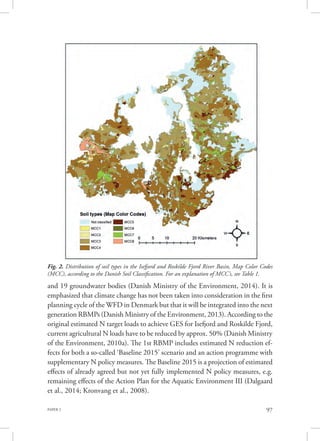
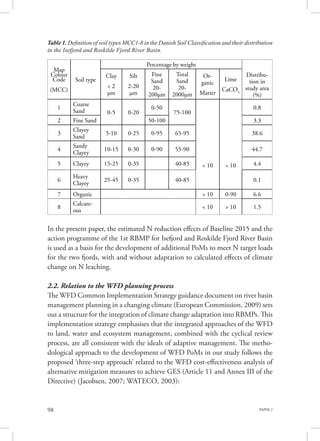
  • 153.
    PAPER 4. MÅLRETTEDEVANDPLANER – HVORDAN? [DANISH VERSION] 151 138 • Vand & Jord indførsel samt en anslået periode for dets fulde effekt, hvilket er nyttigt og nødvendigt i et mangeårigt forløb omkring vandplanernes implementering. Det vil sige, at den bereg- nede effekt for et opland indeholder en tidsdi- mension, der dels kan bruges til at belyse, hvornår tiltag i en prioriteret rækkefølge reali- stisk kan gennemføres, og hvor langt man kan forvente at nå i eksempelvis 2015 og 2021. Opfølgende monitering til at kontrollere pla- nernes effekt skal ligeledes evalueres i forhold hertil. Graden af målopfyldelse illustreres på kort og med flere detaljer i en automatisk gener- eret rapport over virkemiddelanalysens resul- tater. Et nøgleresultat er de enkelte virkemid- lers omkostningseffektivitet udregnet i vandmiljøet ved de definerede miljømåls- punkter. Der dannes en sorteret liste for en udvalgt lokalitet i oplandet, eksempelvis med en tilknyttet målsætning, hvor prisen og effek- ten af alle opstrøms virkemidler fremgår. Det giver et direkte mål for omkostningseffektivi- teten og en klar indikation af virkemidler med lav omkostningseffektivitet, der med fordel kan erstattes af mere målrettede tiltag, såfremt de kan tages i anvendelse for det pågældende område. Omkostningseffektiviteten beregnes samtidig for kvælstof (kr/kg N/år), fosfor (kr/ kg P/år) og organisk stof (kr/kg BOD/år), hvil- ket åbner mulighed for bedre at vurdere de mange virkemidler, der har effekt på flere stoffer samtidig. Der holdes regnskab med tilknyttede virkemidler med loft for eksempel- vis stoffjernelse i forhold til den aktuelle be- lastning af lokaliteten. Der indgår en række forudsætninger og an- tagelser i vandplaner, og der er betydelig usik- kerhed på effekter af virkemidler ved kilden, i vandmiljøet og dermed også akkumuleret in- den for oplande. Usikkerheden udfordrer planlægning og forvaltning, og der er åbnet mulighed for at kvantificere usikkerheden på hvert enkelt virkemiddel ved at angive usik- kerhedsbånd, der efterfølgende anvendes til at beregne usikkerhed på den samlede effekt. Virkemiddelscenariet kan gemmes, editeres og videreudbygges via en internetbaseret, en- kel brugerflade af eksempelvis flere kommu- ner i et tværkommunalt oplandssamarbejde og fungere i et længerevarende, flerårigt pro- gram, hvor allerede indførte og planlagte virkemidler løbende opdateres i takt med, at enkelte projekters gennemførlighed afdæk- kes. Udskydelse af indsatser imellem planpe- rioder og etapevis opfyldelse af delmål kan ligeledes evalueres. I det efterfølgende er anvendelsen af virke- middelværktøj beskrevet for Isefjord og Ro- skilde Fjord hovedvandopland med fokus på kvælstofindsatsen i første vandplanperiode og virkemidler til næste generation vandplaner. Casestudie – hovedvandopland Isefjord og Roskilde Fjord I vandplanen for hovedvandopland Isefjord og Roskilde Fjord er indsatskravene opgjort for de to fjorde, 52 søer (heriblandt Danmarks største sø Arresø), 682 km vandløb samt 19 grundvandsforekomster. Næringsstofbe- lastning udpeges som central årsag til, at overfladevand i oplandet ikke opfylder kravet om god økologisk tilstand. Belastningen udgøres dels af et diffust bidrag fra landbrug, naturarealer og atmosfærisk deposition dels bidrag fra punktkilder som renseanlæg, spredt bebyggelse, regnvandsbetingede udløb og virksomheder. I vandplanen er den nuværende landbaserede N-tilførsel opgjort til 853 t N/år til Isefjord og 905 t N/år til Roskilde Figur 2. Kort over beregnet kvælstofretention i oplandet til Isefjord og Roskilde Fjord fra bunden af rodzonen til overfladevand inddelt i forhold til N­reduktionens størrelse. Kvælstofbelastning af hovedvand- opland Isefjord og Roskilde Fjord Kilde Isefjord Roskilde Fjord Nuværende og fremskreven påvirkning Nuværende N-belastning land (2005-2009) Vandplan 2011 853 t N/år 905 t N/år N-belastning efter Baseline 2015 Virkemiddelværktøj 780 t N/år 881 t N/år Mål for opfyldelse af EU’s vandrammedirektiv og indsatsbehov Målsat N-belastning land Forhøring 2010 499 t N/år 533 t N/år Indsatsbehov for målopfyldelse efter baseline Virkemiddelværktøj 281 t N/år 348 t N/år Effekt af vandplanens indsatsprogram for 1. vandplanperiode Beregnet effekt af indsats i 1. planperiode Virkemiddelværktøj 133 t N/år 139 t N/år Resterende indsatsbehov for fuld målopfyldelse Yderligere indsatsbehov efter 1. planperiode Virkemiddelværktøj 148 t N/år 209 t N/år Tabel 1. Oversigt over den landbaserede kvælstofbelastning af Isefjord og Roskilde Fjord, målsætninger for oplandets opfyldelse af EU’s vandrammedirektiv samt beregnede effekter af den planlagte indsats og yderligere indsatsbehov efter 1. vandplanperiode. Egne bereg­ ninger og /2,5/ Målrettede vandplaner
  • 154.
    PAPER 4. MÅLRETTEDEVANDPLANER – HVORDAN? [DANISH VERSION]152 20. årgang nr. 4, december 2013 • 139 Fjord (Tabel 1). Ifølge vandplanen bidrager landbruget med 77 % af den samlede land- baserede kvælstoftilførsel, baggrundsbidraget udgør 12 %, og den resterende N-tilførsel kommer fra punktkilder. For fosfor udgør bidraget fra åbent land (landbrug, baggrundsbidrag og spredt bebyg- gelse) 45 % af den samlede P-tilførsel i oplan- det, mens renseanlæg og regnbetingede ud- ledninger tegner sig for henholdsvis 38 % og 17 %. Opfyldelsen af miljømålene i oplandet van- skeliggøres desuden af en intern frigivelse af næringsstoffer som følge af tidligere tiders be- lastning. Effekten af de såkaldte baselineforan- staltninger (baseline 2015) – dvs. allerede be- sluttede tiltag såsom spildevandsindsats, VMP III-resteffekt, naturgenopretningsprojekter mv. – er beregnet for hovedvandoplandet ved brug af virkemiddelværktøjet. Beregningerne viser, at den samlede landbaserede N-belast- ning ved fremskrivning til 2015 reduceres til 780 t N/år til Isefjord og 881 t N/år til Roskilde Fjord (Tabel 1). Der er således god overens- stemmelse med vandplanens opgørelse af ba- seline 2015, hvor N-belastningen reduceres til 782 t N/år til Isefjord og 887 t N/år til Roskilde Fjord /2/. Dette belastningsniveau kan ses i forhold til de beregnede oprindelige reduk- tionsmål for opfyldelse af vandrammedirekti- vet, hvor den landbaserede N-tilførsel skal re- duceres til 499 t N/år til Isefjord og 533 t N/år til Roskilde Fjord for at sikre god økologisk til- stand /5/ (Tabel 1). Der er således en væsent- lig afstand til målet for N-belastningen i ho- vedvandoplandet, og kun en mindre del af dette reduktionsbehov opfyldes med indsat- sen i første vandplanperiode. Indsatsen i 1. vandplanperiode På baggrund af baselinen er det muligt at kvantificere ”afstanden til målet” i forhold til opfyldelse af vandrammedirektivet og dermed fastlægge behovet for yderligere indsats. Ifølge de oprindelige reduktionsmål er der behov for at reducere N-belastningen med yderligere 281 t N/år til Isefjord og 348 t N/år til Roskilde Fjord for at opfylde vandrammedi- rektivet (Tabel 1). I første vandplanperiode er der med vandplanerne fastlagt indsatser, som frem mod 2015 skal reducere N-udledningen på landsplan med 9.000 tons, og det har re- sulteret i et krav om N-reduktion til Isefjord på 124 t N/år og til Roskilde Fjord på 144 t N/ år udover baseline /2/. Ifølge vandplanens indsatsprogram skal 99 % af disse reduktioner nås via indsatser rettet mod landbrugets tab af kvælstof. Effekten af flere af de anvendte virkemidler i oplandet, bl.a. randzoner, er estimeret på baggrund af opgjorte effekter på nationalt niveau. Der er således ikke foretaget nogen specifik vurdering af disse virkemidlers placering eller potentiale på hovedvandop- landsniveau. Denne fremgangsmåde er pro- blematisk, fordi der kun i begrænset omfang tages hensyn til virkemidlernes effekt og omkostningseffektivitet under konkrete lokale forhold. Et eksempel herpå er randzo- nernes effekt i Isefjord og Roskilde Fjord oplandet. Langt hovedparten af oplandets vandløb og søer – hvor randzonerne skal placeres – findes i deloplande, der afstrøm- mer til Roskilde Fjord. Det tager vandplanens beregningsmetode ikke højde for, og dermed bliver randzonernes effekt og fordelingen af N-reduktioner til de to fjorde upræcis. Analyser foretaget med virkemiddelværk- tøjet viser, at vandplanens foreslåede indsat- sprogram for Isefjord og Roskilde Fjord giver en samlet N-reduktion til kystvande på 272 t N/år. Effekten er fordelt således, at N-belast- ningen reduceres med 133 t N/år til Isefjord og 139 t N/år til Roskilde Fjord udover base- line. Opgørelsen af effekter dækker imidlertid over en meget stor variation i de enkelte vir- kemidlers omkostningseffektivitet afhængig af deres specifikke placering i hovedvandoplan- det, hvilket illustreres ved beregningseksem- pler i det nedenstående. En målrettet indsats I det følgende gennemgås to illustrative eksempler på, hvordan en mere målrettet indsats med henholdsvis efterafgrøder og randzoner i hovedvandoplandet kan øge ef- fekten og nedbringe omkostningerne forbun- det med anvendelsen af landbrugsvirkemidler. I det første eksempel vurderes anvendelsen af efterafgrøder til reduktion af N-udledning til Isefjord, og i det andet eksempel analyseres randzoners effekt og økonomi i et delopland til Roskilde Fjord. Ifølge vandplanen skal arealet med efteraf- grøder udvides med 2853 ha nedstrøms søer i oplandet til Isefjord, og de årlige omkostnin- ger forbundet hermed kan opgøres til 1,4 mio. kr. /6/. Ved uspecificeret placering af efterafgrøderne nedstrøms søer viser scenarie- beregninger foretaget med virkemiddelværk- tøjet, at der vil ske en reduktion i N-udlednin- gen til Isefjord på 37 t N/år. Omkostningsef- fektiviteten bliver herved 38 kr. pr. reduceret kg N til Isefjord. Placeres de 2853 ha efteraf- grøder i stedet målrettet områder med meget lav retention, kan der opnås en reduktion i N- udledningen til Isefjord på ca. 63 t N/år, hvor- ved omkostningseffektiviteten bliver 22 kr. pr. reduceret kg N til Isefjord. Analyserne viser, at der ved målrettet placering af efterafgrøder kun skal bruges ca. 60 % af det fastlagte areal for uspecificeret placering nedstrøms søer for at opnå den samme effekt på kvælstofudled- ningen til Isefjord. Det er et krav i vandplanen, at der skal pla- ceres 10 m randzoner omkring alle vandløb og større søer. Særligt i oplandet til Roskilde Figur 3. Kortlægning af husdyrgødningsressourcer fra store husdyrbedrifter i oplandet fordelt på postnumre med angivelse af radius 15 km for transportafstand af husdyrgødning til biogasanlæg. Målrettede vandplaner
  • 155.
    PAPER 4. MÅLRETTEDEVANDPLANER – HVORDAN? [DANISH VERSION] 153 140 • Vand & Jord Fjord, hvor retentionen i overfladevand i nogle deloplande er stor, betyder det, at vir- kemidlet disse steder kun vil have minimal ef- fekt på kvælstofudledningen til kystvand. Ved brug af virkemiddelværktøjet har vi analyseret effekten af randzoner i deloplande opstrøms Arresø. Beregningerne viser, at en udlægning af 175 ha randzoner i dette område kun vil re- ducere N-udledningen til Roskilde Fjord med ca. 1,1 t N/år, fordi N-retentionen i søer ned- sætter effekten af virkemidlet signifikant. De årlige omkostninger for de 175 ha randzoner udgør ca. 336.000 kr. /6/ og det giver en om- kostningseffektivitet på 316 kr. pr. reduceret kg N til Roskilde Fjord. Samme N-reduktion vurderes at kunne opnås til kun 1/8 af disse omkostninger ved at udvide arealet med randzoner nedstrøms Arresø med ca. 22 ha. Dette vil ligeledes give en reduktion i N-tilfør- slen til Roskilde Fjord på ca. 1,1 t N/år, men omkostningseffektiviteten er her 40 kr. pr. re- duceret kg N til Roskilde Fjord. Det skal dog bemærkes, at randzonerne har en række an- dre positive effekter såsom reduktion af fos- fortab og ny natur, der kan berettige en an- den placering. Virkemiddelberegninger viser således, at den forventede reduktion af P-tab som følge af de 175 ha randzoner opstrøms søer kan erstattes med en udlægning af 8 ha P-ådale, og de samlede omkostninger for den målrettede indsats til næringsstofreduktion i dette delområde vil således udgøre ca. 1/5 af omkostningerne forbundet med de planlagte randzoner opstrøms Arresø Virkemidler til næste generation vandplaner Der er i stigende grad fokus på, at virkemidler til indsats i næste generation vandplaner skal understøtte udviklingen af helhedsoriente- rede løsninger, som udnytter synergieffekter bedre /7/. Et eksempel på dette er anvendel- sen af virkemidler, der både kan reducere tabet af næringsstoffer og udledningen af drivhusgasser fra landbruget. En oplandsori- enteret planlægning styrker mulighederne for at udvikle denne type integrerede løsninger, fordi de typisk afhænger af konkrete lokale forhold. En sammenligning af de mest omkostnings- effektive vandplanvirkemidler /8,9/ med de mest omkostningseffektive virkemidler til re- duktion af landbrugets udledning af drivhus- gasser /10,11/ viser, at særligt tre virkemidler har et stort potentiale for synergieffekter. Det er 1) biogas produktion baseret på husdyr- gødning, 2) dyrkning af flerårige energiafgrø- der og 3) udtagning af opdyrkede lavbunds- arealer (Tabel 2). To af disse tre virkemidler, biogas og dyrkning af flerårige energiafgrø- der, er af virkemiddeludvalget /9/ vurderet til ligefrem at være forbundet med en samfunds- økonomisk gevinst, når CO2 ækv. effekter ind- går i omkostningsopgørelsen. Virkemiddelværktøjet er anvendt til at vur- dere potentialet for kvælstofreduktion ved an- vendelse af disse tre virkemidler i hovedvand- opland Isefjord og Roskilde Fjord set i forhold til det resterende indsatsbehov for fuld mål- opfyldelse (Tabel 1). Biogaspotentialet i op- landet er bestemt ved en kortlægning af hus- dyrgødningsressourcer via Centralt Husdyr- brugsRegister og viser en koncentration af tilgængelig husdyrgødning fra store husdyr- bedrifter i den vestlige og sydlige del af oplandet i størrelsesordenen 310.000 tons i Holbæk-området og 220.000 tons i Lejre/ Roskilde-området (Figur 3). En økonomisk og teknisk forudsætning for at kunne anvende husdyrgødningen i biogasanlæg er, at der tilføres supplerende organisk materiale, som kan øge gasproduktionen. Det kan f.eks. ske i form af energiafgrøder. For at opfylde gældende tilskudsregler for biogasproduk- tion regnes der med en maksimal tilførsel af energiafgrøder på ca. 175.000 tons, svarende til dyrkning af flerårig græs på ca. 5.300 ha (5 % af oplandets dyrkede areal). Under forudsætning af, at den øgede udnyttelse af kvælstof i den biogasbehandlede gylle medfører en tilsvarende reduktion i gødnings- forbruget, og at dyrkningen af de flerårige energiafgrøder så vidt muligt placeres på jorde med lav retention, så er det samlede potentiale for kvælstofreduktion i scenariet beregnet til 179 t N/år. Fordelt med en reduk- tion til Isefjord på 121 t N/år og en reduktion til Roskilde Fjord på 58 t N/år. Hertil kom- mer forbedrede muligheder for at regulere fosfortildelingen til marker og en markant reduktion i udledningen af drivhusgasser i størrelsesordenen 60.000-134.000 t CO2 ækv. pr. år afhængig af valg af anlægskoncepter. Det resterende indsatsbehov for Isefjord på 27 t N/år og for Roskilde Fjord på 151 t N/år vurderes at kunne nås omkostningseffektivt ved reetablering af vådområder og ekstensi- vering af intensivt dyrkede lavbundsjorde. CO2 ækv. effekten af disse virkemidler er dog ikke entydig, og man skal derfor være forsigtig med at inddrage dem i klimastrategier /12/. Via analyser af GIS-data i virkemiddelværktøjet er potentialet for yderligere vådområder i oplandet estimeret til ca. 6000 ha, og poten- tialet for ekstensivering af intensivt dyrkede lavbundsarealer er estimeret til ca. 13.000 ha. På baggrund af kommunalt projektkatalog /13/ og scenarieberegninger foretaget med virkemiddelværktøjet vurderes det resterende indsatsbehov for Isefjord at kunne nås om- kostningseffektivt ved etablering af yderligere ca. 157 ha vådområder. For Roskilde Fjord vurderes det, at der kan etableres yderligere 350 ha vådområder /14/ med en samlet effekt på ca. 40 t N/år. Resten af indsatsbehovet for Roskilde Fjord vil kunne opfyldes ved at ek- stensivere størstedelen af de henved 5000 ha intensivt dyrkede lavbundsarealer i oplandet til fjorden. Der er altså et betydeligt potentiale for at opfylde vandrammedirektivets krav i Isefjord og Roskilde Fjord oplandet ved at an- vende virkemidler, der omkostningseffektivt kan reducere både næringsstofbelastning og udledning af drivhusgasser. Perspektivering Implementering af EU’s vandrammedirektiv vil være en mangeårig udfordring. Jo mindre målretning, synergieffekt og omkostningsef- fektivitet, jo længere tid til målopfyldelse og jo højere pris. Det bliver ikke mindre relevant med udsigt til effekt af klimaændringer. Første generation vandplaner må betegnes som en foreløbig basis med yderligere behov for lokal Figur 4. Billede af indre Isefjord. Foto: Bjarke S. Kaspersen. Målrettede vandplaner
  • 156.
    PAPER 4. MÅLRETTEDEVANDPLANER – HVORDAN? [DANISH VERSION]154 20. årgang nr. 4, december 2013 • 141 forankring, detaljering, interessent-involver- ing samt behov for trinvist forbedret grundlag i relation til bl.a. virkemidler og deres effekt. Det må forventes, at dette vil tage fart i forbin- delse med anden generation vandplaner. Analyserne foretaget for hovedvandopland Isefjord og Roskilde Fjord understreger, at den absolut mest omkostningseffektive re- duktion af kvælstofbelastningen opnås ved at målrette landbrugsvirkemidler områder med lav retention. Det fremgår ligeledes af analy- serne, at der er et stort potentiale for at opnå synergieffekter mellem reduktion af nærings- stoftab og udledning af drivhusgasser fra landbruget. For at udnytte dette potentiale kræves en tilgang til vandplanlægningen, hvor der tages udgangspunkt i konkrete lokale forhold inden for oplandet. Det udviklede virkemiddelværktøj understøtter denne type planlægning. Virkemiddelværktøjet er transparent og vel- egnet til hurtig analyse af alternativer og til løbende at holde styr på implementering og plan. Målgruppen for brugere af værktøjet er planlæggere i kommune og stat, vandselska- ber og andre med interesse i vandplaner, og den web-baserede brugerflade kræver ingen særlige tekniske forudsætninger. Dog har virkemiddelværktøjet sine begrænsninger, bl.a. i forhold til beskrivelse af målopfyldelse i vandløb, hvor metoden er relativ grov, og det kan være nødvendigt at anvende mere pro- cesbaserede oplandsmodeller for afstrømning og stoftransport for yderligere at forbedre beslutningsgrundlaget. Perspektivet i virke- middelværktøjet er, at det kan fungere i selv- stændige overordnede analyser af indsatspro- grammer i hovedvandoplande, og at det kan detaljeres i takt med, at grundlag for den øgede målretning udbygges. For øjeblikket udbygges værktøjet til ikke alene at håndtere kort- og datagrundlag fra vandplaner, men også udveksling af input og output med op- Analyse af landbrugets virkemidler til reduktion af drivhusgasser og de økonomiske konsekvenser. Fødevareministeriet. /11/Dalgaard, T., Jørgensen, U., Petersen, S.O., Petersen, B.M., Kristensen, T., Hermansen, J.E. & Hutchings, N. 2010: Landbrugets drivhusgasemissioner og bioen- ergiproduktionen i Danmark 1990-2050. Rapport til Klimakommissionen. /12/Herbst, M., Ringgaard, R., Friborg, T., & Søgaard, H. 2009: Forøger vådområder den globale opvarmning? Vand og Jord, nr. 3, 84-89, 2009. /13/Jensen, H.C. 2010: Vandoplandsplan for Isefjord og Roskilde Fjord opland 2.2. VOP-N vådområder vers. 3.0. 2010. /14/Refsgaard, A. 2007: Implementeringen af vandram- medirektivet for Roskilde Fjords opland. /15/ Conterra og Danmarks Naturfredningsforening 2011: Potentialeberegninger af ekstensivering af lavbund- sarealer for danske hovedvandoplande. /16/Christensen, J., Hjort-Gregersen, K., Uellendahl, H., Ahring, B.K., Baggesen, D.L., Stockmarr, A., Møller, H.B., Birkmose, T. 2007: Fremtidens biogasanlæg – nye anlægskoncepter og økonomisk potentiale. FOI rapport nr. 188. Fødevareøkonomisk Institut. /17/Det Jordbrugsvidenskabelige Fakultet & Danmarks Miljøundersøgelser 2011: Notat nr. 3 vedrørende effekter af forskellige tiltag i forbindelse med Grøn Vækst. Aarhus Universitet. Bjarke S. kaSperSen er PhD studerende på Institut for Miljø, Samfund og Rumlig Forandring (ENSPAC) på Ros- kilde Universitet (RUC) og DHI og arbejder med vand- og klimaplanlægning. bjstka@ruc.dk TorSTen V. jacoBSen er projektleder på DHI med erfaring i vandplaner, hydrologi, vandkvalitet, stoftransport og be- slutningsstøttesystemer fra projekter i en række danske og udenlandske oplande. tvj@dhigroup.com Michael BuTTS er innovationschef på DHI med ansvar for forsknings- og udviklingsaktiviteter inden for vandres- source- og miljøforvaltning. mib@dhigroup.com henrik G. Müller er IT (GIS/WEB/DSS) udvikler på DHI med erfaringer fra vandressource-projekter i Danmark og en lang række andre lande. hgm@dhigroup.com eVa BøGh er lektor på Institut for Miljø, Samfund og Rum- lig Forandring (ENSPAC) på Roskilde Universitet (RUC) og arbejder med økohydrologi. eboegh@ruc.dk TyGe kjær er lektor på Institut for Miljø, Samfund og Rum- lig Forandring (ENSPAC) på Roskilde Universitet (RUC) og arbejder med vedvarende energi og klimaplanlægning. tk@ruc.dk landsmodeller for strømning og stoftransport. Det åbner mulighed for, at planlægningsværk- tøj, måledata, datagrundlag og modelbase- rede analyser kan spille sammen og udnytte den stærke vandplanlægnings- og modelkom- petence udviklet over en årrække i Danmark. Referencer /1/ European Commission 2009: Common implementa- tion strategy for the EU Water Framework Directive 2000/60/EC. Technical Report – 2009 – 040. /2/ Naturstyrelsen 2011: Isefjord og Roskilde Fjord. Vandplan 2010-2015. Hovedvandopland 2.2. Vand- distrikt Sjælland. Miljøministeriet. /3/ Gertz, F., Knudsen, L. og Wiborg, I. 2012: Problema- tisk dansk implementering. Vand og Jord, nr. 3, 100- 103, 2012. /4/ Kaas, H., Jacobsen, T.V., Refsgaard, A., Møhlenberg, F., Müller, H.G., Krogsgaard, J., Jørgensen, P.E. og Poulsen, R.N. 2008: Oplandene til Suså - Karrebæk Fjord - Dybsø Fjord, Oplands- og virkemiddelværktøj. Forslag til indsatsprogram. /5/ By- og Landskabsstyrelsen 2010: Udkast til Vandplan Hovedvandopland 2.2 Isefjord og Roskilde Fjord. Miljøministeriet. /6/ Jacobsen, B.H. 2012: Landbrugets omkostninger ved vandplanerne fra 2012. Notat udarbejdet til N- udvalget. Fødevareøkonomisk Institut, Københavns Universitet. /7/ Natur- og Landbrugskommissionen 2012: Natur og landbrug – en ny start. /8/ Schou, J.S., Kronvang, B., Birr-Pedersen, K., Jensen, P.L., Rubæk, G.H., Jørgensen, U. & Jacobsen, B. 2007: Virkemidler til realisering af målene i EU’s vandram- medirektiv. Udredning for udvalg nedsat af Finans- ministeriet og Miljøministeriet: Langsigtet indsats for bedre vandmiljø. Danmarks Miljøundersøgelser & Aarhus Universitet. Faglig rapport fra DMU nr. 625. /9/ Danmarks Miljøundersøgelser, Det Jordbrugsviden- skabelige Fakultet og Fødevareøkonomisk Institut 2009: Notat vedr. virkemidler og omkostninger til implementering af vandrammedirektivet. /10/Fødevareministeriet 2008: Landbrug og Klima. Tabel 2. Udvalgte virkemidlers effekt på kvælstofudvaskning og drivhusgasudledning. Det skal bemærkes, at N­effekten af ekstensivering af intensiv drift på lavbundsjorde er ned­ justeret fra 57,9 kg N/ha i /15/ på baggrund af konkrete vurderinger, og at N­effekten af reetablering af vådområder er baseret på undersøgelser fra aktuelle vådområde­forprojekter i hovedvandoplandet. CO2 ækv. effekten af flerårige energiafgrøder baseres på reduceret lattergasudledning og en øget kulstofbinding men uden energi substitution. Egne beregnin­ ger og /8, 10, 15, 16, 17/ Virkemiddel N-effekt CO2 -ækv. effekt Biogas (husdyrgødning og energiafgrøder) 0 - 5 kg N/ha (rodzone) 68 - 164 kg CO2 -ækv./ton Flerårige energiafgrøder 40 kg N/ha (rodzone) 1.260 kg CO2 -ækv./ha Udtagning af lavbundsjord 1) Ekstensivering af intensiv drift 2) Reetablering af vådområder 48 kg N/ha (rodzone) 49 - 290 kg N/ha 10.842 kg CO2 -ækv./ha* *) CO2 ækv. effekten af udtagning af lavbundsjord er ikke entydig pga. CH4 emission, og man skal derfor være forsigtig med at inddrage virkemidlet i klimastrategier /11/. Målrettede vandplaner
  • 157.
    PAPER 4. TARGETEDWFD ACTION PROGRAMMES – HOW? [ENGLISH VERSION] 155 1 Targeted WFD action programmes – how? The next generation of Danish WFD action programmes should be spatially targeted, cost-effective and holistic. A catchment management study of the Isefjord and Roskilde Fjord River Basin demonstrates how these challenges can be tackled using a map- based assessment tool – with a focus on cost-effective reductions of N and P losses to surface waters and potential synergies with reduction of agricultural greenhouse gas emissions. Bjarke Stoltze Kaspersen, Torsten Vammen Jacobsen, Michael Brian Butts, Henrik Gioertz Müller, Eva Boegh, Tyge Kjaer The first river basin management plans (RBMPs) of the EU Water Framework Directive (WFD) in Denmark have highlighted the need for a more integrated water management strategy that sup- ports spatial targeting of measures and can be adapted to local condi- tions in the 23 river basins. This is especially true for any further reductions of nutrient pollution of lakes and fjords. The local effects and costs (facilities and operations) associated with the implementation of Programmes of Measures (PoMs), can be sig- nificantly different from average national estimates, particularly as a result of distributed losses and retention factors related to both surface waters and subsur- face conditions. This challenge is reinforced by the requirements of the 2ndWFD river basin manage- ment cycles, where climate change should be fully integrated into the RBMPs /1/ as well as the desire to better exploit synergies. This article describes the application of a map-based PoMs assessment tool (i) to evaluate the potential for spatially targeted and cost-ef- fective reduction of nitrogen (N) loads to comply with the WFD in Isefjord and Roskilde Fjord River Basin (Fig. 1.) and (ii) to investi- gate the potential for synergies be- tween reduction of nutrient losses and mitigation of greenhouse gas (GHG) emissions from agricul- turalproductioninthecatchment. While the Danish Green Growth Plan (2009) and the first genera- tion of Danish RBMPs are char- acterized by general nationally- driven assessments of effects and impacts, the map-based PoMs assessment tool is developed specifically to support and facili- tate evaluation of the effects and cost-effectiveness of any given combination of measures within a specific river basin. By assign- ing site-specific measures from a pre-defined catalogue, the user can create a complete programme Fig. 1:Web-based interface of the GIS-basedWFD PoMs assessment tool showing Isefjord and Roskilde Fjord River Basin including stream network, field-scale diffuse sources and calculation points for specified water bodies. Translation of the Danish paper "Målrettede vandplaner – hvordan?" Published in Vand & Jord [Water & Soil] 4, 2013, 136-141.
  • 158.
    PAPER 4. TARGETEDWFD ACTION PROGRAMMES – HOW? [ENGLISH VERSION]156 2 of spatially targeted measures that provides an effective and cost- effective reduction of nutrient loads to surface waters. The case study catchment, Isefjord and Roskilde Fjord River Basin, covers an area of approx. 2000 km2 and contains 20 municipali- ties. Land use in the river basin is dominated by agriculture, which covers more than 60% of the catchment area and contributing 77% of the current total land- based N loading /2/. According to the original estimates of N target loads required to achieve good ecological status (GES) for Isefjord and Roskilde Fjord, cur- rent agricultural N loads need to be reduced by about 50%, and it is the river basin in Denmark with the largest percentage of planned reduction of agricultural N loads in the first RBMPs /3/. N retention (retained or lost) is significant in some parts of the river basin, for example in lakes and where nitrate leaching through the root zone is reduced in the saturated zone before reach- ing the streams. Therefore, agri- environmental measures should be targeted where the effect is the largest. General agri-environmen- tal measures that reduce yields should also be avoided. In the PoMs assessment tool analyses, the effects and cost-effectiveness of alternative measures are evalu- ated in relation to the environ- mental objectives for Isefjord and Roskilde Fjord as well as upstream surface water bodies. Methods The map-based PoMs assessment tool is a further development of the Susaa Basin PlanningTool /4/. It is a decision support tool devel- oped specifically for integrated catchment-wide analyses of the effects and costs of various man- agement strategies, measures and programmes to improve the status of the aquatic environment. This tool makes it possible to develop scenarios of various PoMs at river basin scale using currently ap- proved measures for which effects have been estimated and then to evaluate their site specific cost-ef- fectiveness as well as the extent to which the ecological goals can be achieved. At present more than 50 distinct measures can be selected from the catalogue, and it is thus possible to compare a wide range of alternative action programme scenarios to achieve estimated nutrient load reduction targets in a river basin. This is illustrated in the next sections of this article concerning the achievement of WFD objectives for Isefjord and Roskilde Fjord River Basin. The tool is accessible via the internet and this makes it possible for users to share, edit and further develop PoMs scenarios through a web- based interface. The main purpose of the map- based tool is to support the de- velopment of a targeted and cost-effective implementation of the WFD, meeting the multiple objectives of good ecological status for rivers, lakes and coastal areas. Box 1: Cost-effectiveness The cost-effectiveness of measures is central to the development of the first generation WFD RBMPs. "The most environmental benefit for the least cost", requires a detailed description and definition of cost- effectiveness, often understood narrowly as the relationship between the estimated effects and costs of alternative measures. However, in order to determine the most cost-effective action programmes to meet the WFD objectives, it is not only about the estimated costs versus effect at the source, but also about the assessment of retention (N retained or lost) in a catchment, so that estimates of cost- effectiveness are evaluated for specific water bodies. This means that the cost-effectiveness of a measure can vary significantly depending on its location in relation to catchment characteristics (retention in groundwater, lakes etc.) and the location of water bodies where environmental targets must be met. Typically, there are multiple locations in a river basin with specified objectives for rivers, lakes and coastal waters, and the application of a particular measure to meet, for example, a nutrient reduction goal for an upstream recipient, could often provide a positive downstream effect and thus achieve an overall improved cost-effectiveness. Finally, it should be noted that when using a more specific cost-efficiency concept designed to achieve environmental objectives for individual water bodies, it is also desirable to take into account regional and local variations in the effects of measures, compared to national average estimates, through an expansion of the catalogue of measures.
  • 159.
    PAPER 4. TARGETEDWFD ACTION PROGRAMMES – HOW? [ENGLISH VERSION] 157 3 This includes objectives concern- ing nutrient and organic matter pollution, water allocation and physical and biological conditions. The PoMs assessment tool analysis is based on river basin topology and basic GIS data in the form of a hierarchical sub-catchment-, lake- and stream system. This allows for site-specific distribution of mea- sures by relating them to streams, water abstractions and point or diffuse pollution sources. Infor- mation about effects and costs for a given measure is retrieved from the catalogue of measures, while their downstream effect relies on distributed N retention maps representing flow paths through groundwater, streams, lakes and wetlands. Spatial varia- tions in N retention are obtained from the retention maps (Fig. 2). These retention maps are based on both calculated N transport in sub-basins where diffuse N-loads at sub-basin level are compared with measured N transport in stream monitoring stations and an estimated regional average (49%) representing N retention in ungauged sub-basins. The distribution of agricultural fields as either “lowland” (low lying soils in river corridors with high organic contents and high water tables) or “upland” (mostly high productive, well drained mineral soils) areas is taken into account in the calculations. The estimates of N retention are associated with considerable uncertainty. The tool calculates and accumu- lates effects from upstream to downstream including distributed losses at any number of locations along the flow path. Accumu- lated effects can be assessed for all measures at calculation points specified by the user, e.g. lakes with specified reduction targets. Calculation of loss and retention, effects and costs can be made for an entire river basin, including all streams, lakes and coastal areas. For the specified calculation points in a catchment with speci- fied environmental goals, the PoMs assessment tool calculates: • Reduction in annual nitrogen (N) load (kg yr-1 ) • Reduction in annual phospho- rous (P) load (kg yr-1 ) • Reduction in organic matter (BI5) conc. (mg l-1 ) • Danish Stream Fauna Index – physical and biological con- ditions • Reduction in annual CO2 equivalents (kg yr-1 ) • Catchment water balance – in- cluding groundwater abstrac- tions, -recharge and median minimum stream flow • Total costs of PoMs • Extent to which ecological goals have been achieved in time for each location • Cost-effectiveness of PoMs The effects of measures can be evaluated for: • Wastewater treatment plants (point source); e.g. upgrade of technology, no. of population equivalents (PE) • Storm water outfalls (point source); e.g. detention volume • Sparsely built-up areas; e.g. improved wastewater treatment • Agricultural fields (diffuse Fig. 2: Calculated N retention from the bottom of the root zone to surface water at sub-catchment level in the Isefjord and Roskilde Fjord River Basin. N retention in surface water bodies is not illustrated on the map but is included in the tool calculations.
  • 160.
    PAPER 4. TARGETEDWFD ACTION PROGRAMMES – HOW? [ENGLISH VERSION]158 4 source); e.g. measures related to farming systems, technology, fertilizer use • Streams; e.g. restorations, ri- parian buffer strips, physical conditions • Wetlands; e.g. restoration • Groundwater: e.g. relocation of abstractions PoMs scenarios can be developed by the user specifying a spatial location and a selection of one or more measures. Potential measures in the catalogue of measures include specifications of their estimated effects and costs. Spatial locations can be selected individually or in subsets on the basis of defined search criteria. Searches can be performed on in- formation and data related to the underlying map themes, so that a subset meeting particular criteria, can be selected. The catalogue of measures is subdivided according to the type of pollution source/ site the measures can be used for. The list of known measures can be expanded and the effects of existing measures can be adjusted. The effects of measures are avail- able and editable for the user and this strengthens the transparency of the analyses. If the effect of a measure is changed by the user or a new measure is introduced, the consequences for nutrient reductions and goal achievement can be rapidly and easily assessed. Therefore, the effects of possible new regulations or the degree of differentiation in WFD action programmes can be quickly evalu- ated for a river basin. For each measure, a start imple- mentation year is specified as well as an estimated period required to achieve its full effect, which is use- ful and necessary for water action planning over the course of many years. This means that the calcu- lated effects for a catchment area contains a time dimension, which can both be used to investigate when actions in order of priority can realistically be implemented, and how much can be achieved in e.g. 2015 and 2021. Follow-up monitoring to control the effects of action programmes should also be evaluated accordingly. The extent to which the envi- ronmental goals are achieved is mapped, and the results of the analysis are outlined in an auto- matically generated report. A key result is the cost-effectiveness of individual measures calculated for user-defined environmen- tal target locations e.g. specific water bodies. A sorted list is generated for the selected local- ity in the river basin, where the effect and cost-effectiveness of all upstream measures appear. This provides a standard of reference for cost-effectiveness and a clear indication of measures associated with relatively high costs that ad- vantageously can be replaced by other more targeted measures, if this is a possibility in the relevant area. The cost-effectiveness is calculated for nitrogen (€ kg N-1 yr-1 ), phosphorus (€ kg P-1 yr-1 ) and organic matter (€ kg BI5-1 yr-1 ), which allows for integrated assessments of measures affect- ing multiple management goals. The assessment tool keeps track of applied measures with e.g. a maximum for potential reduction according to the present pressures on a recipient. There are several assumptions in the Danish RBMPs, and there is considerable uncertainty associ- ated with the effects of measures at the source, in the aquatic envi- ronment and thus accumulated in the catchments. This uncertainty is a challenge in planning and management, however, under the assumption that the simple estimates of the uncertainties related to each measure can be added along the different path- ways through the catchment, the assessment tool can provide ap- proximate uncertainty bands for the downstream net effect. PoMs scenarios can be stored, edited and extended via a simple shared web-based interface that allows collaboration for example among the different munici- palities within a river basin. The system supports decision making through a long-term, multi- year programme, where already adopted and planned measures are continuously updated along with the implementation process. Postponement of actions between WFD planning cycles and step- wise achievement of subsidiary objectives can also be evaluated. In the following, the applica- tion of the PoMs assessment tool is described for Isefjord and Roskilde Fjord River Basin with a focus on actions related to N
  • 161.
    PAPER 4. TARGETEDWFD ACTION PROGRAMMES – HOW? [ENGLISH VERSION] 159 5 reductions in the first RBMP and agri-environmental meas- ures for the next generation of WFD action programmes. Case study – Isefjord and Roskilde Fjord River Basin In the 1st RBMP for Isefjord and Roskilde Fjord River Basin, the actions required to meet good ecological status were estimated for the two fjords, 52 lakes (in- cluding the largest lake in Den- mark, Arresoe), 682 km streams and 19 groundwater bodies. The future impacts of nutrient load- ing have been identified as a key pressure, when assessing the risk of not meeting the environmental objectives for the lakes and coastal waters in the river basin. Pressures are both diffuse pollution sources such as intensive agricultural pro- duction, background loading and atmospheric deposition as well as point sources such as waste water treatment plants, sparsely built- up areas, storm water outfalls and industry. The current annual land-based N loads to Isefjord and Roskilde Fjord are estimated to 853 t N yr-1 and 905 t N yr-1 , respectively (Table 1). Within the Isefjord and Roskilde Fjord River Basin, agriculture contributes 77% of the current to- tal land-based N loading, whereas background loading contributes 12% and point sources account for the remaining N loads. Of total land-based P losses, diffuse sources account for 45% and waste water treatment plants and storm-water outfalls for 38% and 17%, respectively. Achieving the WFD objectives is further com- plicated by internal nutrient load- ing sources, in particular from the bottom sediments of the streams, lakes and fjords. The effects of the so called Base- line 2015 – already agreed but not yet fully implemented measures such as remaining effects of the Third Action Plan for the Aquatic Environment – were estimated using the PoMs assessment tool. Our analysis shows that Baseline 2015 measures reduce the annual land-based N load to 780 t N yr-1 to Isefjord and 881 t N yr-1 to Roskilde Fjord (Table 1). These calculations are in good agree- ment with the first RBMP, where the Baseline 2015 measures are estimated to reduce the N loads to 782 t N yr-1 to Isefjord and 887 t N yr-1 to Roskilde Fjord /2/. This level of N loads can be compared to the estimated N load reduction targets required to achieve the WFD objective of GES, where land-based N loads should be reduced to 499 t N yr-1 to Isefjord and 533 t N yr-1 to Roskilde Fjord /5/ (Table 1). This indicates that there is a substantial gap between the existing status of the fjords and that required under the WFD, and that only a minor part of the necessary N load reductions are met with the first RBMP for the river basin. N loads Isefjord og Roskilde Fjord River Basin Source Isefjord Roskilde Fjord Present and Baseline 2015 land-based N loads Present N loads (2005-2009) 1st RBMP 2011 853 t N yr-1 905 t N yr-1 Baseline 2015 PoMs tool 780 t N yr-1 881 t N yr-1 N target loads to meet the WFD objective of GES Good ecological status Draft RBMP 2010 499 t N yr-1 533 t N yr-1 N reductions needed beyond Baseline 2015 PoMs tool 281 t N yr-1 348 t N yr-1 N reduction effect of the 1st RBMP Calculated effect of 1st RBMP PoMs tool 133 t N yr-1 139 t N yr-1 Remaining N load reductions required N reductions needed beyond the 1st RBMP PoMs tool 148 t N yr-1 209 t N yr-1 Table 1: Outline of land-based N loads to Isefjord and Roskilde Fjord, estimated N target loads to meet the good ecological status objective of the WFD and calculated N reduction effects of planned action programmes and the need for further reductions in the next generation WFD RBMPs. Calculations from this paper and /2,5/.
  • 162.
    PAPER 4. TARGETEDWFD ACTION PROGRAMMES – HOW? [ENGLISH VERSION]160 6 The first RBMP From the Baseline 2015 measures scenario, it is possible to identify the gap between this scenario and fulfilment of the WFD and thus determine the need for further N reductions. Considering esti- mated N target loads to meet the objective of GES, supplementary measures that provide reduction of further 281 t N yr-1 to Isefjord and 348 t N yr-1 to Roskilde Fjord are needed (Table 1). The first RBMPs in Denmark contains PoMs that should reduce nationwide N loads by 9,000 t in 2015, resulting in required re- ductions to Isefjord and Roskilde Fjord of 124 and 144 t N yr-1 , respectively, in addition to Base- line 2015 effects /2/. According to this action programme of the 1st RBMP, agri-environmental measures contribute to 99% of the total estimated N load reduc- tions. The effects of several of the measures used in the first RBMP, including buffer zones, are esti- mated on the basis of calculated average effects on the national level. Thus, there is no specific evalua- tion of the site-specific location of these measures or estimations of the maximum potential for a given measure at river basin level. This approach is problematic because it can only to a limited extent address the significance of local conditions in an evaluation of effect and cost-effectiveness of measures. An example is the estimated effect of buffer zones around streams and lakes in the Isefjord and Roskilde Fjord River Basin. The vast majority of the streams and lakes in the river basin are found in the Roskilde Fjord catchment. This is not taken into account in the first RBMP leading to an inaccurate estima- tion of the effects of this measure and the distribution of N reduc- tion between the two fjords. Analyses using the PoMs assess- ment tool show that the first RBMP for Isefjord and Roskilde Fjord River Basin will further reduce the total N load to coastal waters by 272 t N yr-1 . This is distributed as a reduction in the N load of 133 t N yr-1 to Isefjord and 139 t N yr-1 to Roskilde Fjord, in addition to the effects of Baseline 2015. Our calculations, however, show a large variation in the cost-effectiveness of the individual measures depending on their spatial location in the river basin. This is illustrated by the calculation examples below. Spatial targeting of measures In the following, two illustrative examples are used to show how a more targeted approach can increase the efficiency and cost-ef- fectiveness of agri-environmental measures in a WFD perspective. The measures analyzed are catch crops and buffer zones around streams and lakes. In the first example, the application of catch crops to reduce N leaching is evaluated for the Isefjord catch- ment, and in the second example effects and costs of buffer zones is assessed for the Roskilde Fjord catchment. According to the first RBMP, the area with catch crops should be expanded by 2,853 ha down- stream lakes in the Isefjord catch- ment, and the annual costs as- sociated with this is estimated to 187,000 € yr-1 /6/. A PoMs assessment tool analysis show that an unspecified spatial application of the catch crops downstream of the lakes results in a reduction in N loads to Isefjord of 37 t N yr-1 . The cost-effectiveness of the measure can then be estimated to 5 € per reduced kg N to Isef- jord. If the 2,853 ha catch crops instead are spatially targeted to agricultural areas with very low N retention, it is possible to achieve a total N load reduction to Isefjord of 63 t N yr-1 , result- ing in a cost-effectiveness of the measure around 3 € per reduced kg N to Isefjord. Our assessment indicates that a spatial targeting of catch crops towards areas with low N retention will only require about 60% of the area determined for unspecified locations of catch crops downstream of the lakes in order to achieve the same N load reduction to Isefjord. The first RBMP introduces man- datory 10 m buffer zones around all streams and lakes larger than 100 m2 . For a catchment like the Roskilde Fjord catchment, where N retention in surface waters in some sub catchments is significant, this means that buffer zones in some areas will only
  • 163.
    PAPER 4. TARGETEDWFD ACTION PROGRAMMES – HOW? [ENGLISH VERSION] 161 7 have a minimal effect on the N load to coastal waters. The PoMs assessment tool was used to ana- lyze the effect of buffer zones in a sub-basin upstream of Arresoe Lake. Our calculations show that an allocation of 175 ha of buffer zones in this area will only reduce N loadings to Roskilde Fjord by approx. 1.1 t N yr-1 because the N retention in lakes reduces the effect of this measure significantly. The annual costs associated with 175 ha buffer zones is approx. 45,000 € /6/, corresponding to a cost-effectiveness of the measure around 41 € per reduced kg N to Roskilde Fjord. From our analysis it is possible to achieve the same N reduction effect at only 1/8 of these costs by an expansion of the allocation of buffer zones downstream of Arresoe Lake by about 22 ha. This will also pro- vide a reduction in the N load to Roskilde Fjord of approx. 1.1 t N yr-1 , but the cost-effectiveness of the measure is in this case approx. 5 € per reduced kg N to Roskilde Fjord. It should, however, be stressed that buffer zones have a number of other positive effects such as reduction of P losses and recreational benefits, which could also justify different locations of this measure. The PoMs assess- ment tool calculations indicate that the expected reduction in P losses achieved by 175 ha buffer zones upstream of the lakes can be substituted by an establishment of 8 ha constructed P wetlands. The total costs associated with the spatial targeted actions will then be approx. 1/5 of the costs associated with the planned buffer zones upstream of Arresoe Lake. Measures for the next generation of WFD action programmes There is a growing interest in identifying agri-environmental measures, for the next generation WFD RBMPs that support the development of holistic solutions and exploit the potential for syn- ergies /7/. An example of this is the implementation of measures that can reduce both nutrient losses and GHG emissions from agriculture. A planning approach tailored to the particular river basin enhances the opportuni- ties for developing this kind of integrated solutions, because they typically depend on specific local conditions. A comparison of the most cost-ef- fective agri-environmental meas- ures to reduce N loads /8,9/ with the most cost-effective measures to reduce agricultural GHG emissions /10,11/ shows that three measures in particular have a substantial potential for syner- gies. It is 1) biogas production based on animal manure, 2) cultivation of perennial energy crops and 3) land use changes on cultivated lowland areas (Table 2). An assessment by the Danish Committee on WFD measures /9/ has shown that two of these three measures, biogas and culti- vation of perennial energy crops, have a socio-economic benefit when CO2 equivalent (CO2 -eq.) effects are included in the eco- nomic analysis. Measure N reduction effect CO2 -eq. effect Biogas (manure and energy crops) 0-5 kg N ha-1 (root zone) 68-164 kg CO2 -eq. t-1 Perennial energy crops 40 kg N ha-1 (root zone) 1.260 kg CO2 -eq. ha-1 Land use changes low land areas: 1. Extensification 2. Restoration of wetlands 48 kg N ha-1 (root zone) 49-290 kg N ha-1 10.842 kg CO2 -eq./ha-1 * Table 2: Estimated effects of selected agri-environmental measures on N leaching and GHG emissions. It should be noted that the N effect of extensification of intensively farmed lowland areas has been scaled down from 57.9 kg N ha-1 in /15/ due to concrete river basin assessments, and that the N effect of restoration of wetlands is based on investigations from ongoing pilot wetland restoration projects in the Isefjord and Roskilde Fjord River Basin. The CO2-eq. effect of cultivation of perennial energy crops is based on the reduction in nitrous oxide (N2O) emissions and increased carbon storage but without energy substitution. Own calculations and /8,10,15,16,17/. *) The CO2 -eq. effect of land use changes on low land areas is associated with large uncertainties because of CH4 emission, and it is important to be aware of this in relation to climate change mitigation strategies /12/.
  • 164.
    PAPER 4. TARGETEDWFD ACTION PROGRAMMES – HOW? [ENGLISH VERSION]162 8 The PoMs assessment tool was used to evaluate the potential for N load reductions associated with an implementation of these three measures in the Isefjord and Roskilde Fjord River Basin to meet the WFD GES objective (Table 1). The biogas production potential in the river basin was determined through a detailed assessment of available manure from large livestock farms using the Danish Central Livestock Register. This showed that the vast majority of available manure from large livestock farms is found in the southern and western parts of the river basin; in the order of 310,000 t in the western part and 220,000 t in the southern part of the river basin (Fig. 3). An economic and technical pre- requisite for biogas production based on manure is the supply of other organic material to increase gas production, e.g. energy crops. To meet Danish subsidy schemes for the construction of biogas plants, manure has to account for at least 75% of the total biomass input, thus, the maximum sup- ply of energy crops is estimated to 175,000 t, corresponding to a cultivation of perennial grasses on approx. 5,300 ha (5% of the arable land within the river basin). Assuming that the application of fertilizers is reduced correspond- ing to the increased utilization of N in biogas treated slurry, and the cultivation of perennial energy crops is spatially targeted towards areas with low N retention, the analysis shows a total N reduction potential for the two measures of 179 t N yr-1 . This is distributed as a reduction to Isefjord of 121 t N yr-1 and to Roskilde Fjord of 58 t N yr-1 . In addition, the implementation of these measures improves the possibilities for differentiated P regulation and reduces substantially the GHG emissions in the range of 60,000 to 134,000 t CO2-eq. yr-1 de- pending on the choice of biogas technology system concept. The most cost-effective measures to achieve the remaining required N load reductions to Isefjord of 27 t N yr-1 and to Roskilde Fjord of 151 t N yr-1 are expected to be the restoration of wetlands and extensification of intensively farmed lowland areas. The CO2 - eq. effect of these measures is, however, highly uncertain and it is important to be aware of this in relation to climate change mitiga- tion strategies /12/. Analyses of GIS data in the PoMs assessment tool estimate the potential for further restoration of wetlands in the river basin to approx. 6,000 ha, and the potential for exten- sification of intensively farmed lowland areas was estimated to approx. 13,000 ha. Based on a municipal project cata- logue /13/ and PoMs assessment tool scenario evaluations, our analyses show that the remain- ing N load reduction for Isefjord can be achieved cost-effectively by restoration of approx. 157 ha wetlands. For Roskilde Fjord catchment, it is estimated that there is a potential for restoration of additional 350 ha wetlands Fig. 3: Mapping of available manure resources from large livestock farms (>1000 t manure yr-1) in Isefjord and Roskilde Fjord River Basin divided between pigs, cattle, organic cattle and mink within postal districts. A radius of 15 km is shown for the transport distance of manure to biogas plant.
  • 165.
    PAPER 4. TARGETEDWFD ACTION PROGRAMMES – HOW? [ENGLISH VERSION] 163 9 /14/ reducing N loads by approx. 40 t N yr-1 . The remaining N load reduction to Roskilde Fjord can be achieved by an extensification of about 5,000 ha of intensively farmed lowland areas in the catchment to the fjord. Thus, there seems to be a significant potential for the implementation of agri-environmental measures to meet the WFD objectives in the Isefjord and Roskilde Fjord River Basin that can reduce both N loads and GHG emissions cost- effectively. Perspectives The implementation of the WFD is going to be a long-term process. By exploiting spatial targeting, synergies and cost-effectiveness of the PoMs, the WFD objectives can be achieved earlier and at lower cost. This is likely to be of even more relevance in the light of expected impacts of climate change. The 1st generation of Danish WFD RBMPs must be regarded as a preliminary basis for planning and that additional local analyses, improved stake- holder participation and stepwise improvement of the knowledge regarding measures and their ef- fects are required. It is anticipated that these needs will grow in the development of the next genera- tion of RBMPs. The analyses carried out for the Isefjord and Roskilde Fjord River Basin emphasize that the most cost-effective reduction of N loads is achieved by spatial targeting of agri-environmental measures to- wards areas with low N retention. It also appears from our assess- ments that there is a substantial potential for synergies between reduction of nutrient losses from agriculture and climate change mitigation. However, in order to realize this potential a planning approach tailored to the river ba- sin is necessary, so that solutions are based on specific local con- ditions at catchment level. The PoMs assessment tool supports this kind of planning approach. The map-based PoMs assess- ment tool is transparent, suitable for rapid analysis of alternative scenarios, and able to keep track continuously of WFD implemen- tation and action programmes. The web-based interface of the tool is easy to use for non-experts and is developed to assist water managers, public authorities, in- terest groups etc. in the planning and consensus building process related to the development of RBMPs. However, the tool has some limitations, for example in relation to the assessment of the achievement of environmen- tal goals in streams, where the method is relatively coarse, and it may be necessary to carry out more detailed investigations using process-based numerical models such as MIKE SHE in order to improve the basis for decision making. The perspective of this PoMs assessment tool is that it can be used for independent analyses of WFD action programmes at river basin level and that it can be refined as the scientific basis, for a targeted action planning, is improved. The tool is being further devel- oped to not only manage maps and data from the RBMP plan- ning process, but also to make it possible to exchange input and output with more advanced, dy- namic and process-based catch- ment models, such as MIKE SHE. This makes it possible for planning tool, monitoring data and model-based analyses to in- teract and capitalize on the strong water planning and modelling competence developed over a number of years in Denmark. Fig. 4: Photo of the inner Isefjord. Photo by Bjarke S. Kaspersen
  • 166.
    PAPER 4. TARGETEDWFD ACTION PROGRAMMES – HOW? [ENGLISH VERSION]164 10 References /1/European Commission, 2009. River basin management in a changing climate, Common Implementation Strategy for the Water Framework Directive, Guidance document No. 24, ISBN 978-92-79-14298-7. /2/Danish Ministry of the Environ- ment, 2011. River Basin Manage- ment Plan River Basin - Isefjord and Roskilde Fjord 2.2. In Danish: Vandplan - Hovedvandopland 2.2 Isefjord og Roskilde Fjord. 310 p. (In Danish). /3/Gertz, F., Knudsen, L. & Wiborg, I. 2012: Problematic Danish imple- mentation of the WFD. In Danish: Problematisk dansk implementer- ing. Vand og Jord, nr. 3, 100-103, 2012. (In Danish). /4/Kaas, H., Jacobsen, T.V., Refs- gaard, A., Møhlenberg, F., Müller, H.G., Krogsgaard, J., Jørgensen, P.E., Poulsen, R.N., 2008. River Basin Susaa - Karrebaek Fjord - Dybsaa Fjord, Basin Planning and PoM’s assessment Tool, WFD action programme. In Danish: Oplandene til Suså - Karrebæk Fjord - Dybsø Fjord, Oplands- og virkemiddelværktøj. Forslag til indsatsprogram. 105 p. (In Danish). /5/Danish Ministry of the Environ- ment, 2010. Draft River Basin Management Plan - Isefjord and Roskilde Fjord 2.2. In Danish: Udkast til Vandplan - Hovedvan- dopland 2.2 Isefjord og Roskilde Fjord. 234 p. (In Danish). /6/Jacobsen, B.H., 2012. Analysis of the costs related to the implementa- tion of agricultural measures in the River Basin Management Plans from 2011. Note for the N-commit- tee under the Ministry of Finance. Memo. 06/12. In Danish: Analyse af landbrugets omkostninger ved implementering af vandplanerne fra 2011. Institute of Food and Resource Economics, Copenhagen University. 54 p. (In Danish). /7/Commission on Nature and Ag- riculture, 2013. Richer nature, new environmental regulation and new growth opportunities for agriculture. Executive summary The Danish Commission on Nature andAgriculture.Available at http:// www.naturoglandbrug.dk/ /8/Schou, J.S., Kronvang, B., Birr- Pedersen, K., Jensen, P.L., Rubæk, G.H., Jørgensen, U., Jacobsen, B., 2007.Virkemidler til realisering af målene i EUs Vandrammedirektiv. Udredning forudvalg nedsat af Fi- nansministeriet og Miljøministeriet: Langsigtet indsats for bedre vand- miljø. Danmarks Miljøundersøgel- ser, Aarhus Universitet. 132 s. Faglig rapport fra DMU nr. 625. http://www.dmu.dk/Pub/FR625.pdf (In Danish). /9/Jensen, P.N., Hasler, B., Waage- petersen, J., Rubæk, G.H., Jacobsen, B.H., 2009. Note on the measures and the costs of implementation of the Water Framework Directive. In Danish: Notat vedr. virkemidler og omkostninger til implementering af vandrammedirektivet. Aarhus University. 103 p. (In Danish). /10/ Danish Ministry of Food,Agricul- ture and Fisheries, 2008. Agricul- ture and Climate. In Danish: Land- brug og klima. Analyse af landbru- gets virkemidler til reduktion af drivhusgasser og de økonomiske konsekvenser. Report. Danish Ministry of Food, Agriculture and Fisheries, Copenhagen, ISBN 978- 87-7083-291-5, 146 p. (In Danish). /11/ Dalgaard,T., Jørgensen, U., Peters- en, S.O., Petersen, B.M., Kristensen, T., Hermansen, J.E. & Hutchings, N. 2010: Agricultural GHG emis- sions and bioenergy production in Denmark 1990-2050. Report for the Danish Commission on Climate Change Policy. In Danish: Land- brugets drivhusgasemissioner og bioenergiproduktionen i Danmark 1990-2050. (In Danish). /12/ Herbst, M., Ringgaard, R., Friborg, T., & Søgaard, H. 2009: Can resto- ration of wetlands enhance global warming? In Danish: Forøger vådom- råder den globale opvarmning? Vand og Jord, nr. 3, 84-89, 2009. /13/ Jensen, H.C. 2010: Catchment management plan for Isefjord and Roskilde Fjord. Potential wetland restorations.Vers. 3.0. In Danish: Vandoplandsplan for Isefjord og Roskilde Fjord opland 2.2. VOP-N vådområder vers. 3.0. (In Danish). /14/ Refsgaard, A. 2007: Implementing the EU Water Framework Directive in Roskilde Fjord River Basin. In Danish: Implementeringen af van- drammedirektivet for Roskilde Fjords opland. 141 p. (In Danish) /15/ Conterra, 2011. N reduction potential of extensification of low- land areas in Danish river basins. In Danish: Potentialeberegninger af ekstensivering af lavbundsarealer for danske hovedvandoplande. Conterra and Danish Society for Nature Con- servation. (In Danish). /16/ Christensen, J., Hjort-Gregersen, K., Uellendahl, H., Ahring, B.K., Baggesen, D.L., Stockmarr, A., Moeller, H.B., Birkmose, T., 2007. The future centralized biogas plants. In Danish: Fremtidens biogasanlæg – nye anlægskoncepter og økonomisk potentiale. FOI report 188. Copen- hagen University. 114 p. (In Danish). /17/ Aarhus University & Danish National Environmental Research Institute 2011: Memo no. 3 con- cerning effects of measures linked to the Green Growth Plan. In Danish: Notat nr. 3 vedrørende effekter af forskellige tiltag i forbindelse med Grøn Vækst. (In Danish). Bibliography Bjarke Stoltze Kaspersen is a PhD student at Roskilde University and DHI. He works with the EU Water Framework Directive and climate change challenges.
  • 167.
    PAPER 4. TARGETEDWFD ACTION PROGRAMMES – HOW? [ENGLISH VERSION] 165 11 Torsten V. Jacobsen is a project manager at DHI with expe- rience in river basin manage- ment planning, hydrology, wa- ter quality, nutrient transport and decision support systems from projects in a number of Danish and foreign catchments. Michael B. Butts is head of in- novation at DHI responsible for research and development activities in water resources and environmental management. Henrik G. Müller is an IT sys- tems (GIS/WEB /DSS) devel- oper at DHI with experience in water resources projects in Den- mark and many other countries. Eva Boegh is an associate profes- sor in the Department of En- vironmental, Social and Spatial Change at Roskilde University and works with Ecohydrology. Tyge Kjaer is an associate profes- sor in the Department of En- vironmental, Social and Spatial Change at Roskilde University and works with renewable energy and climate change management.