Action Research in the
Kto 12 Basic Education Program
John Kelvin R. Briones
Senior Education Program Specialist
Bureau of Curriculum Development
Outline of the Presentation
DEPARTMENT OF EDUCATION 2
1. Motivations in Conducting Action Research (legal
bases, issuances, professional demand, curricular and
political response)
2. Nature of Action Research (definition and description)
3. Processes in Conducting Research (BERF)
4. Suggested Topics for Action Research
5. Open Forum
• The Department of
Education is mandated to
enact policies and
mechanisms on the basis of
“educational research and
studies.”
The
Governance
of Basic
Education
Act 2001
DEPARTMENT OF EDUCATION 3
Republic Act No. 9155
• The DepEd shall maintain
the “relevant, responsive,
and research-based” nature
and characteristic of the
curriculum.
The
Enhanced
Basic
Education
Act of 2013,
IRR Section
10.2 (b)
DEPARTMENT OF EDUCATION 4
Republic Act No. 10533
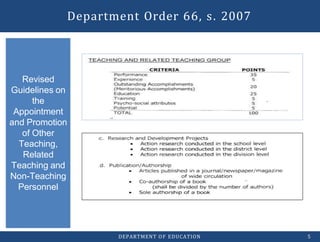
Revised
Guidelines on
the
Appointment
and Promotion
of Other
Teaching,
Related
Teaching and
Non-Teaching
Personnel
Department Order 66, s. 2007
DEPARTMENT OF EDUCATION 5
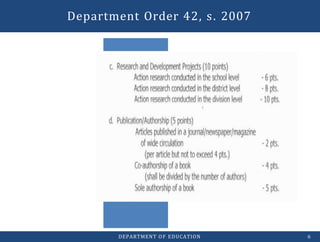
The Revised
Guidelines on
Selection,
Promotion,
and
Designation of
School Heads
Department Order 42, s. 2007
DEPARTMENT OF EDUCATION 6
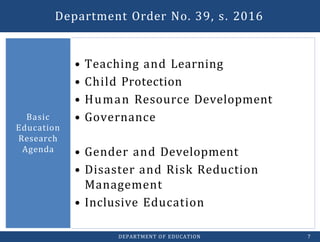
• Teaching and Learning
• Child Protection
• Human Resource Development
• Governance
• Gender and Development
• Disaster and Risk Reduction
Management
• Inclusive Education
Basic
Education
Research
Agenda
DEPARTMENT OF EDUCATION 7
Department Order No. 39, s. 2016
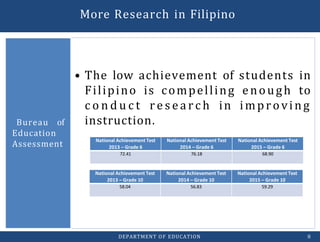
• The low achievement of students in
Filipino is compelling enough to
c o n d u c t r e s ear c h in improving
instruction.
Bureau of
Education
Assessment
More Research in Filipino
National Achievement Test
2013 – Grade 6
National Achievement Test
2014 – Grade 6
National Achievement Test
2015 – Grade 6
72.41 76.18 68.90
National Achievement Test
2013 – Grade 10
National Achievement Test
2014 – Grade 10
National Achievement Test
2015 – Grade 10
58.04 56.83 59.29
DEPARTMENT OF EDUCATION 8
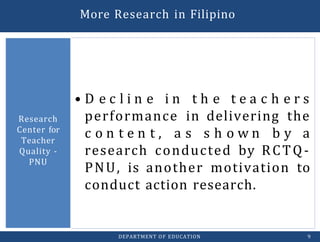
• D e c l i n e i n t h e t e a c h e r s
performance in delivering the
c o n t e n t , a s s h o w n b y a
research conducted by RCTQ-
PNU, is another motivation to
conduct action research.
Research
Center for
Teacher
Quality -
PNU
DEPARTMENT OF EDUCATION 9
More Research in Filipino
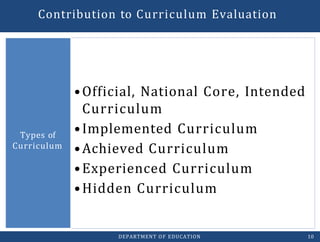
•Official, National Core, Intended
Curriculum
•Implemented Curriculum
•Achieved Curriculum
•Experienced Curriculum
•Hidden Curriculum
Types of
Curriculum
DEPARTMENT OF EDUCATION 10
Contribution to Curriculum Evaluation
• Searching ‘action research’ on
Google will give you
approximately 49,700,000
results, as of 28 Oct. 2017,
10:18am.
Google
DEPARTMENT OF EDUCATION 11
ACTION RESEARCH
• “Action research is a systematic,
reflective inquiry to improve
educational practices or resolve
problems in any operating unit
(i.e. school, classroom, office).”
DepEd
Order No.
16, s.
2017
DEPARTMENT OF EDUCATION 12
ACTION RESEARCH
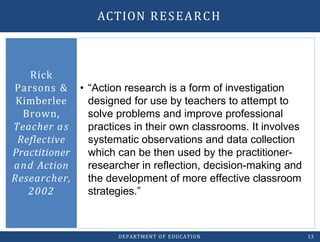
• “Action research is a form of investigation
designed for use by teachers to attempt to
solve problems and improve professional
practices in their own classrooms. It involves
systematic observations and data collection
which can be then used by the practitioner-
researcher in reflection, decision-making and
the development of more effective classroom
strategies.”
Rick
Parsons &
Kimberlee
Brown,
Teacher as
Reflective
Practitioner
and Action
Researcher,
2002
DEPARTMENT OF EDUCATION 13
ACTION RESEARCH
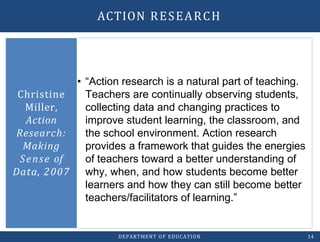
• “Action research is a natural part of teaching.
Teachers are continually observing students,
collecting data and changing practices to
improve student learning, the classroom, and
the school environment. Action research
provides a framework that guides the energies
of teachers toward a better understanding of
why, when, and how students become better
learners and how they can still become better
teachers/facilitators of learning.”
Christine
Miller,
Action
Research:
Making
Sense of
Data, 2007
DEPARTMENT OF EDUCATION 14
ACTION RESEARCH
• “Action research is about practitioners creating
new ideas about how to improve practice… [which]
is different from traditional social science, which is
about official researchers producing theory, which
[then] practitioners apply to their practice. [This
immediately puts us] in context of power and
politics around the struggle for knowledge and
recognition as knower.”
Jean McNiff
and Jack
Whitehead,
All You
Need to
Know About
Action
Research,
2006
DEPARTMENT OF EDUCATION 15
ACTION RESEARCH
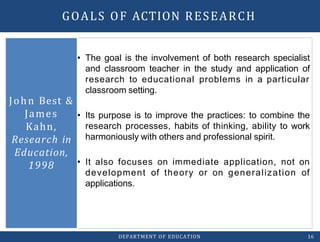
• The goal is the involvement of both research specialist
and classroom teacher in the study and application of
research to educational problems in a particular
classroom setting.
• Its purpose is to improve the practices: to combine the
research processes, habits of thinking, ability to work
harmoniously with others and professional spirit.
• It also focuses on immediate application, not on
development of theory or on generalization of
applications.
John Best &
James
Kahn,
Research in
Education,
1998
DEPARTMENT OF EDUCATION 16
GOALS OF ACTION RESEARCH
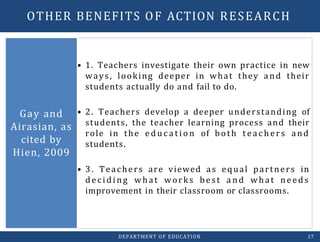
• 1. Teachers investigate their own practice in new
ways, looking deeper in what they and their
students actually do and fail to do.
• 2. Teachers develop a deeper understanding of
students, the teacher learning process and their
role in the e d u c a t i o n of both t ea c h er s and
students.
• 3. Teachers are viewed as equal partners in
d ec i d ing what works best a n d what need s
improvement in their classroom or classrooms.
Gay and
Airasian, as
cited by
Hien, 2009
DEPARTMENT OF EDUCATION 17
OTHER BENEFITS OF ACTION RESEARCH
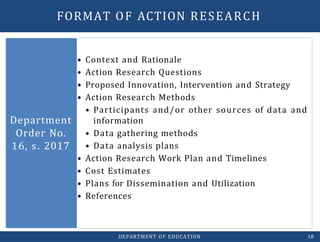
• Context and Rationale
• Action Research Questions
• Proposed Innovation, Intervention and Strategy
• Action Research Methods
• Participants and/or other sources of data and
information
• Data gathering methods
• Data analysis plans
• Action Research Work Plan and Timelines
• Cost Estimates
• Plans for Dissemination and Utilization
• References
Department
Order No.
16, s. 2017
DEPARTMENT OF EDUCATION 18
FORMAT OF ACTION RESEARCH
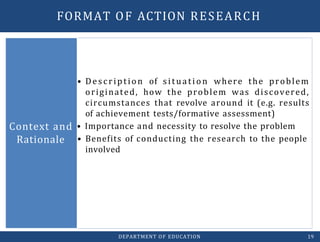
• Benefits of conducting the research to the people
involved
• Description of situation where the problem
originated, how the problem was discovered,
circumstances that revolve around it (e.g. results
of achievement tests/formative assessment)
Context and • Importance and necessity to resolve the problem
DEPARTMENT OF EDUCATION 19
Rationale
FORMAT OF ACTION RESEARCH
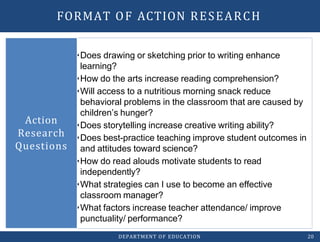
•Does drawing or sketching prior to writing enhance
learning?
•How do the arts increase reading comprehension?
•Will access to a nutritious morning snack reduce
behavioral problems in the classroom that are caused by
children’s hunger?
•Does storytelling increase creative writing ability?
•Does best-practice teaching improve student outcomes in
and attitudes toward science?
•How do read alouds motivate students to read
independently?
•What strategies can I use to become an effective
classroom manager?
•What factors increase teacher attendance/ improve
punctuality/ performance?
Action
Research
Questions
DEPARTMENT OF EDUCATION 20
FORMAT OF ACTION RESEARCH
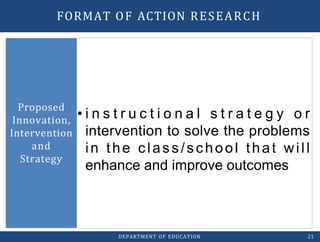
• i n s t r u c t i o n a l s t r a t e g y o r
intervention to solve the problems
in the class/school that will
enhance and improve outcomes
Proposed
Innovation,
Intervention
and
Strategy
DEPARTMENT OF EDUCATION 21
FORMAT OF ACTION RESEARCH
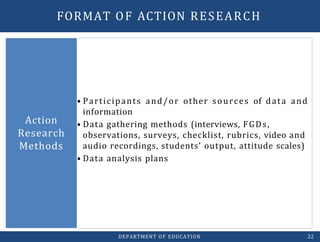
• Participants and/or other sources of data and
information
• Data gathering methods (interviews, FGDs,
observations, surveys, checklist, rubrics, video and
audio recordings, students’ output, attitude scales)
• Data analysis plans
Action
Research
Methods
DEPARTMENT OF EDUCATION 22
FORMAT OF ACTION RESEARCH
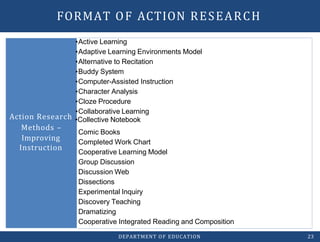
•Comic Books
•Completed Work Chart
•Cooperative Learning Model
•Group Discussion
•Discussion Web
•Dissections
•Experimental Inquiry
•Discovery Teaching
•Dramatizing
•Cooperative Integrated Reading and Composition
•Active Learning
•Adaptive Learning Environments Model
•Alternative to Recitation
•Buddy System
•Computer-Assisted Instruction
•Character Analysis
•Cloze Procedure
•Collaborative Learning
Action Research •Collective Notebook
Methods –
DEPARTMENT OF EDUCATION 23
Improving
Instruction
FORMAT OF ACTION RESEARCH
24
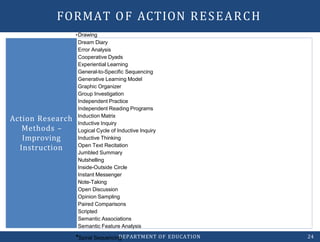
•Drawing
•Dream Diary
•Error Analysis
•Cooperative Dyads
•Experiential Learning
•General-to-Specific Sequencing
•Generative Learning Model
•Graphic Organizer
•Group Investigation
•Independent Practice
•Independent Reading Programs
•Induction Matrix
•Inductive Inquiry
•Logical Cycle of Inductive Inquiry
•Inductive Thinking
•Open Text Recitation
•Jumbled Summary
•Nutshelling
•Inside-Outside Circle
•Instant Messenger
•Note-Taking
•Open Discussion
•Opinion Sampling
•Paired Comparisons
•Scripted
•Semantic Associations
•Semantic Feature Analysis
•Spiral SequencinD
g EPARTMENT OF EDUCATION
Action Research
Methods –
Improving
Instruction
FORMAT OF ACTION RESEARCH
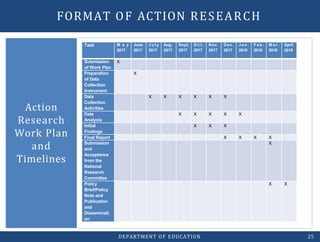
Action
Research
Work Plan
and
Timelines
FORMAT OF ACTION RESEARCH
Task M a y
2017
June
2017
J u l y
2017
Aug.
2017
Sept
2017
O c t .
2017
Nov.
2017
Dec.
2017
J a n .
2018
Fe b .
2018
M a r .
2018
April
2018
Submission
of Work Plan
X
Preparation
of Data
Collection
Instrument
X
Data
Collection
Activities
X X X X X X
Data
Analysis
X X X X X
Initial
Findings
X X X
Final Report X X X X
Submission
and
Acceptance
from the
National
Research
Committee
X
Policy
Brief/Policy
Note and
Publication
and
Disseminati
on
X X
DEPARTMENT OF EDUCATION 25
Cost
Estimates
FORMAT OF ACTION RESEARCH
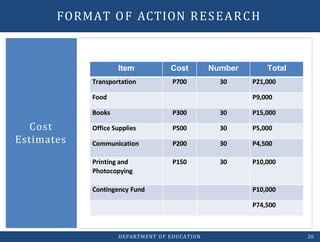
Item Cost Number Total
Transportation P700 30 P21,000
Food P9,000
Books P300 30 P15,000
Office Supplies P500 30 P5,000
Communication P200 30 P4,500
Printing and
Photocopying
P150 30 P10,000
Contingency Fund P10,000
P74,500
DEPARTMENT OF EDUCATION 26
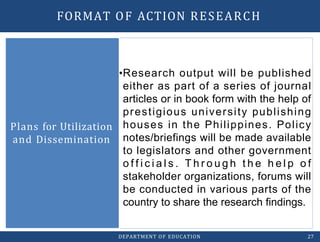
•Research output will be published
either as part of a series of journal
articles or in book form with the help of
prestigious university publishing
houses in the Philippines. Policy
notes/briefings will be made available
to legislators and other government
o f f i c i a l s . T h r o u g h t h e h e l p o f
stakeholder organizations, forums will
be conducted in various parts of the
country to share the research findings.
Plans for Utilization
and Dissemination
DEPARTMENT OF EDUCATION 27
FORMAT OF ACTION RESEARCH
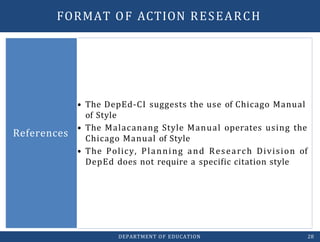
• The DepEd-CI suggests the use of Chicago Manual
of Style
• The Malacanang Style Manual operates using the
Chicago Manual of Style
• The Policy, Planning and Research Division of
DepEd does not require a specific citation style
References
DEPARTMENT OF EDUCATION 28
FORMAT OF ACTION RESEARCH
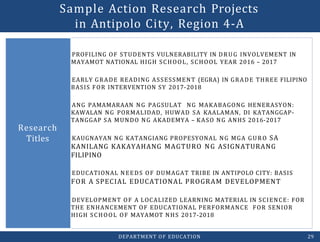
•PROFILING OF STUDENTS VULNERABILITY IN DRUG INVOLVEMENT IN
MAYAMOT NATIONAL HIGH SCHOOL, SCHOOL YEAR 2016 – 2017
•EARLY GRADE READING ASSESSMENT (EGRA) IN GRADE THREE FILIPINO
BASIS FOR INTERVENTION SY 2017-2018
•ANG PAMAMARAAN NG PAGSULAT NG MAKABAGONG HENERASYON:
KAWALAN NG PORMALIDAD, HUWAD SA KAALAMAN, DI KATANGGAP-
TANGGAP SA MUNDO NG AKADEMYA – KASO NG ANHS 2016-2017
•KAUGNAYAN NG KATANGIANG PROPESYONAL NG MGA GURO SA
KANILANG KAKAYAHANG MAGTURO NG ASIGNATURANG
FILIPINO
•EDUCATIONAL NEEDS OF DUMAGAT TRIBE IN ANTIPOLO CITY: BASIS
FOR A SPECIAL EDUCATIONAL PROGRAM DEVELOPMENT
•DEVELOPMENT OF A LOCALIZED LEARNING MATERIAL IN SCIENCE: FOR
THE ENHANCEMENT OF EDUCATIONAL PERFORMANCE FOR SENIOR
HIGH SCHOOL OF MAYAMOT NHS 2017-2018
Research
Titles
DEPARTMENT OF EDUCATION 29
Sample Action Research Projects
in Antipolo City, Region 4-A
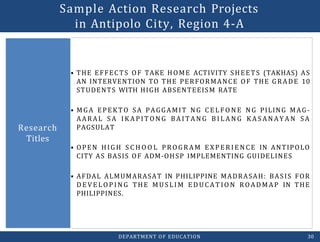
• THE EFFECTS OF TAKE HOME ACTIVITY SHEETS (TAKHAS) AS
AN INTERVENTION TO THE PERFORMANCE OF THE GRADE 10
STUDENTS WITH HIGH ABSENTEEISM RATE
• MGA EPEKTO SA PAGGAMIT NG C E L F O N E NG PILING MAG-
AARAL S A IK AP IT O N G BA I TAN G B I L A N G K A S AN AY A N SA
PAGSULAT
• OPEN HIGH S C H O O L PR OGRAM E XP E R I E N CE IN ANTIPOLO
CITY AS BASIS OF ADM-OHSP IMPLEMENTING GUIDELINES
• AFDAL ALMUMARASAT IN PHILIPPINE MADRASAH: BASIS FOR
DE V E L O P IN G THE MUSLIM E D UCAT IO N ROADMAP IN THE
PHILIPPINES.
Research
Titles
DEPARTMENT OF EDUCATION 30
Sample Action Research Projects
in Antipolo City, Region 4-A
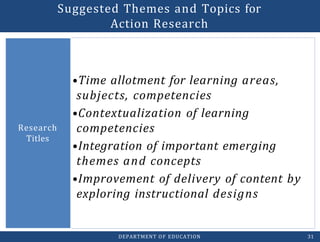
•Time allotment for learning areas,
subjects, competencies
•Contextualization of learning
competencies
•Integration of important emerging
themes and concepts
•Improvement of delivery of content by
exploring instructional designs
Research
Titles
DEPARTMENT OF EDUCATION 31
Suggested Themes and Topics for
Action Research
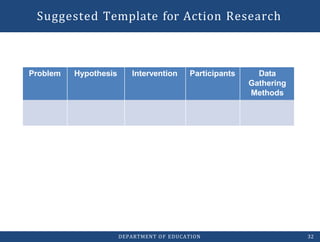
Suggested Template for Action Research
DEPARTMENT OF EDUCATION 32
Problem Hypothesis Intervention Participants Data
Gathering
Methods
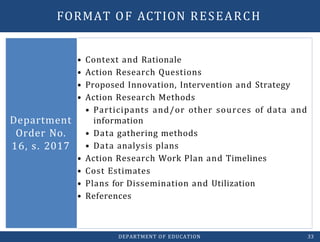
• Context and Rationale
• Action Research Questions
• Proposed Innovation, Intervention and Strategy
• Action Research Methods
• Participants and/or other sources of data and
information
• Data gathering methods
• Data analysis plans
• Action Research Work Plan and Timelines
• Cost Estimates
• Plans for Dissemination and Utilization
• References
Department
Order No.
16, s. 2017
DEPARTMENT OF EDUCATION 33
FORMAT OF ACTION RESEARCH
Thank you!
DEPARTMENT OF EDUCATION 35
FORMAT OF ACTION RESEARCH

ilide.info-presentation-psllf-action-research-pr_1bc725af2d40f25ee9e94d73adebde6c.pptx

  • 1.
    Action Research inthe Kto 12 Basic Education Program John Kelvin R. Briones Senior Education Program Specialist Bureau of Curriculum Development
  • 2.
    Outline of thePresentation DEPARTMENT OF EDUCATION 2 1. Motivations in Conducting Action Research (legal bases, issuances, professional demand, curricular and political response) 2. Nature of Action Research (definition and description) 3. Processes in Conducting Research (BERF) 4. Suggested Topics for Action Research 5. Open Forum
  • 3.
    • The Departmentof Education is mandated to enact policies and mechanisms on the basis of “educational research and studies.” The Governance of Basic Education Act 2001 DEPARTMENT OF EDUCATION 3 Republic Act No. 9155
  • 4.
    • The DepEdshall maintain the “relevant, responsive, and research-based” nature and characteristic of the curriculum. The Enhanced Basic Education Act of 2013, IRR Section 10.2 (b) DEPARTMENT OF EDUCATION 4 Republic Act No. 10533
  • 5.
    Revised Guidelines on the Appointment and Promotion ofOther Teaching, Related Teaching and Non-Teaching Personnel Department Order 66, s. 2007 DEPARTMENT OF EDUCATION 5
  • 6.
    The Revised Guidelines on Selection, Promotion, and Designationof School Heads Department Order 42, s. 2007 DEPARTMENT OF EDUCATION 6
  • 7.
    • Teaching andLearning • Child Protection • Human Resource Development • Governance • Gender and Development • Disaster and Risk Reduction Management • Inclusive Education Basic Education Research Agenda DEPARTMENT OF EDUCATION 7 Department Order No. 39, s. 2016
  • 8.
    • The lowachievement of students in Filipino is compelling enough to c o n d u c t r e s ear c h in improving instruction. Bureau of Education Assessment More Research in Filipino National Achievement Test 2013 – Grade 6 National Achievement Test 2014 – Grade 6 National Achievement Test 2015 – Grade 6 72.41 76.18 68.90 National Achievement Test 2013 – Grade 10 National Achievement Test 2014 – Grade 10 National Achievement Test 2015 – Grade 10 58.04 56.83 59.29 DEPARTMENT OF EDUCATION 8
  • 9.
    • D ec l i n e i n t h e t e a c h e r s performance in delivering the c o n t e n t , a s s h o w n b y a research conducted by RCTQ- PNU, is another motivation to conduct action research. Research Center for Teacher Quality - PNU DEPARTMENT OF EDUCATION 9 More Research in Filipino
  • 10.
    •Official, National Core,Intended Curriculum •Implemented Curriculum •Achieved Curriculum •Experienced Curriculum •Hidden Curriculum Types of Curriculum DEPARTMENT OF EDUCATION 10 Contribution to Curriculum Evaluation
  • 11.
    • Searching ‘actionresearch’ on Google will give you approximately 49,700,000 results, as of 28 Oct. 2017, 10:18am. Google DEPARTMENT OF EDUCATION 11 ACTION RESEARCH
  • 12.
    • “Action researchis a systematic, reflective inquiry to improve educational practices or resolve problems in any operating unit (i.e. school, classroom, office).” DepEd Order No. 16, s. 2017 DEPARTMENT OF EDUCATION 12 ACTION RESEARCH
  • 13.
    • “Action researchis a form of investigation designed for use by teachers to attempt to solve problems and improve professional practices in their own classrooms. It involves systematic observations and data collection which can be then used by the practitioner- researcher in reflection, decision-making and the development of more effective classroom strategies.” Rick Parsons & Kimberlee Brown, Teacher as Reflective Practitioner and Action Researcher, 2002 DEPARTMENT OF EDUCATION 13 ACTION RESEARCH
  • 14.
    • “Action researchis a natural part of teaching. Teachers are continually observing students, collecting data and changing practices to improve student learning, the classroom, and the school environment. Action research provides a framework that guides the energies of teachers toward a better understanding of why, when, and how students become better learners and how they can still become better teachers/facilitators of learning.” Christine Miller, Action Research: Making Sense of Data, 2007 DEPARTMENT OF EDUCATION 14 ACTION RESEARCH
  • 15.
    • “Action researchis about practitioners creating new ideas about how to improve practice… [which] is different from traditional social science, which is about official researchers producing theory, which [then] practitioners apply to their practice. [This immediately puts us] in context of power and politics around the struggle for knowledge and recognition as knower.” Jean McNiff and Jack Whitehead, All You Need to Know About Action Research, 2006 DEPARTMENT OF EDUCATION 15 ACTION RESEARCH
  • 16.
    • The goalis the involvement of both research specialist and classroom teacher in the study and application of research to educational problems in a particular classroom setting. • Its purpose is to improve the practices: to combine the research processes, habits of thinking, ability to work harmoniously with others and professional spirit. • It also focuses on immediate application, not on development of theory or on generalization of applications. John Best & James Kahn, Research in Education, 1998 DEPARTMENT OF EDUCATION 16 GOALS OF ACTION RESEARCH
  • 17.
    • 1. Teachersinvestigate their own practice in new ways, looking deeper in what they and their students actually do and fail to do. • 2. Teachers develop a deeper understanding of students, the teacher learning process and their role in the e d u c a t i o n of both t ea c h er s and students. • 3. Teachers are viewed as equal partners in d ec i d ing what works best a n d what need s improvement in their classroom or classrooms. Gay and Airasian, as cited by Hien, 2009 DEPARTMENT OF EDUCATION 17 OTHER BENEFITS OF ACTION RESEARCH
  • 18.
    • Context andRationale • Action Research Questions • Proposed Innovation, Intervention and Strategy • Action Research Methods • Participants and/or other sources of data and information • Data gathering methods • Data analysis plans • Action Research Work Plan and Timelines • Cost Estimates • Plans for Dissemination and Utilization • References Department Order No. 16, s. 2017 DEPARTMENT OF EDUCATION 18 FORMAT OF ACTION RESEARCH
  • 19.
    • Benefits ofconducting the research to the people involved • Description of situation where the problem originated, how the problem was discovered, circumstances that revolve around it (e.g. results of achievement tests/formative assessment) Context and • Importance and necessity to resolve the problem DEPARTMENT OF EDUCATION 19 Rationale FORMAT OF ACTION RESEARCH
  • 20.
    •Does drawing orsketching prior to writing enhance learning? •How do the arts increase reading comprehension? •Will access to a nutritious morning snack reduce behavioral problems in the classroom that are caused by children’s hunger? •Does storytelling increase creative writing ability? •Does best-practice teaching improve student outcomes in and attitudes toward science? •How do read alouds motivate students to read independently? •What strategies can I use to become an effective classroom manager? •What factors increase teacher attendance/ improve punctuality/ performance? Action Research Questions DEPARTMENT OF EDUCATION 20 FORMAT OF ACTION RESEARCH
  • 21.
    • i ns t r u c t i o n a l s t r a t e g y o r intervention to solve the problems in the class/school that will enhance and improve outcomes Proposed Innovation, Intervention and Strategy DEPARTMENT OF EDUCATION 21 FORMAT OF ACTION RESEARCH
  • 22.
    • Participants and/orother sources of data and information • Data gathering methods (interviews, FGDs, observations, surveys, checklist, rubrics, video and audio recordings, students’ output, attitude scales) • Data analysis plans Action Research Methods DEPARTMENT OF EDUCATION 22 FORMAT OF ACTION RESEARCH
  • 23.
    •Comic Books •Completed WorkChart •Cooperative Learning Model •Group Discussion •Discussion Web •Dissections •Experimental Inquiry •Discovery Teaching •Dramatizing •Cooperative Integrated Reading and Composition •Active Learning •Adaptive Learning Environments Model •Alternative to Recitation •Buddy System •Computer-Assisted Instruction •Character Analysis •Cloze Procedure •Collaborative Learning Action Research •Collective Notebook Methods – DEPARTMENT OF EDUCATION 23 Improving Instruction FORMAT OF ACTION RESEARCH
  • 24.
    24 •Drawing •Dream Diary •Error Analysis •CooperativeDyads •Experiential Learning •General-to-Specific Sequencing •Generative Learning Model •Graphic Organizer •Group Investigation •Independent Practice •Independent Reading Programs •Induction Matrix •Inductive Inquiry •Logical Cycle of Inductive Inquiry •Inductive Thinking •Open Text Recitation •Jumbled Summary •Nutshelling •Inside-Outside Circle •Instant Messenger •Note-Taking •Open Discussion •Opinion Sampling •Paired Comparisons •Scripted •Semantic Associations •Semantic Feature Analysis •Spiral SequencinD g EPARTMENT OF EDUCATION Action Research Methods – Improving Instruction FORMAT OF ACTION RESEARCH
  • 25.
    Action Research Work Plan and Timelines FORMAT OFACTION RESEARCH Task M a y 2017 June 2017 J u l y 2017 Aug. 2017 Sept 2017 O c t . 2017 Nov. 2017 Dec. 2017 J a n . 2018 Fe b . 2018 M a r . 2018 April 2018 Submission of Work Plan X Preparation of Data Collection Instrument X Data Collection Activities X X X X X X Data Analysis X X X X X Initial Findings X X X Final Report X X X X Submission and Acceptance from the National Research Committee X Policy Brief/Policy Note and Publication and Disseminati on X X DEPARTMENT OF EDUCATION 25
  • 26.
    Cost Estimates FORMAT OF ACTIONRESEARCH Item Cost Number Total Transportation P700 30 P21,000 Food P9,000 Books P300 30 P15,000 Office Supplies P500 30 P5,000 Communication P200 30 P4,500 Printing and Photocopying P150 30 P10,000 Contingency Fund P10,000 P74,500 DEPARTMENT OF EDUCATION 26
  • 27.
    •Research output willbe published either as part of a series of journal articles or in book form with the help of prestigious university publishing houses in the Philippines. Policy notes/briefings will be made available to legislators and other government o f f i c i a l s . T h r o u g h t h e h e l p o f stakeholder organizations, forums will be conducted in various parts of the country to share the research findings. Plans for Utilization and Dissemination DEPARTMENT OF EDUCATION 27 FORMAT OF ACTION RESEARCH
  • 28.
    • The DepEd-CIsuggests the use of Chicago Manual of Style • The Malacanang Style Manual operates using the Chicago Manual of Style • The Policy, Planning and Research Division of DepEd does not require a specific citation style References DEPARTMENT OF EDUCATION 28 FORMAT OF ACTION RESEARCH
  • 29.
    •PROFILING OF STUDENTSVULNERABILITY IN DRUG INVOLVEMENT IN MAYAMOT NATIONAL HIGH SCHOOL, SCHOOL YEAR 2016 – 2017 •EARLY GRADE READING ASSESSMENT (EGRA) IN GRADE THREE FILIPINO BASIS FOR INTERVENTION SY 2017-2018 •ANG PAMAMARAAN NG PAGSULAT NG MAKABAGONG HENERASYON: KAWALAN NG PORMALIDAD, HUWAD SA KAALAMAN, DI KATANGGAP- TANGGAP SA MUNDO NG AKADEMYA – KASO NG ANHS 2016-2017 •KAUGNAYAN NG KATANGIANG PROPESYONAL NG MGA GURO SA KANILANG KAKAYAHANG MAGTURO NG ASIGNATURANG FILIPINO •EDUCATIONAL NEEDS OF DUMAGAT TRIBE IN ANTIPOLO CITY: BASIS FOR A SPECIAL EDUCATIONAL PROGRAM DEVELOPMENT •DEVELOPMENT OF A LOCALIZED LEARNING MATERIAL IN SCIENCE: FOR THE ENHANCEMENT OF EDUCATIONAL PERFORMANCE FOR SENIOR HIGH SCHOOL OF MAYAMOT NHS 2017-2018 Research Titles DEPARTMENT OF EDUCATION 29 Sample Action Research Projects in Antipolo City, Region 4-A
  • 30.
    • THE EFFECTSOF TAKE HOME ACTIVITY SHEETS (TAKHAS) AS AN INTERVENTION TO THE PERFORMANCE OF THE GRADE 10 STUDENTS WITH HIGH ABSENTEEISM RATE • MGA EPEKTO SA PAGGAMIT NG C E L F O N E NG PILING MAG- AARAL S A IK AP IT O N G BA I TAN G B I L A N G K A S AN AY A N SA PAGSULAT • OPEN HIGH S C H O O L PR OGRAM E XP E R I E N CE IN ANTIPOLO CITY AS BASIS OF ADM-OHSP IMPLEMENTING GUIDELINES • AFDAL ALMUMARASAT IN PHILIPPINE MADRASAH: BASIS FOR DE V E L O P IN G THE MUSLIM E D UCAT IO N ROADMAP IN THE PHILIPPINES. Research Titles DEPARTMENT OF EDUCATION 30 Sample Action Research Projects in Antipolo City, Region 4-A
  • 31.
    •Time allotment forlearning areas, subjects, competencies •Contextualization of learning competencies •Integration of important emerging themes and concepts •Improvement of delivery of content by exploring instructional designs Research Titles DEPARTMENT OF EDUCATION 31 Suggested Themes and Topics for Action Research
  • 32.
    Suggested Template forAction Research DEPARTMENT OF EDUCATION 32 Problem Hypothesis Intervention Participants Data Gathering Methods
  • 33.
    • Context andRationale • Action Research Questions • Proposed Innovation, Intervention and Strategy • Action Research Methods • Participants and/or other sources of data and information • Data gathering methods • Data analysis plans • Action Research Work Plan and Timelines • Cost Estimates • Plans for Dissemination and Utilization • References Department Order No. 16, s. 2017 DEPARTMENT OF EDUCATION 33 FORMAT OF ACTION RESEARCH
  • 34.
  • 35.
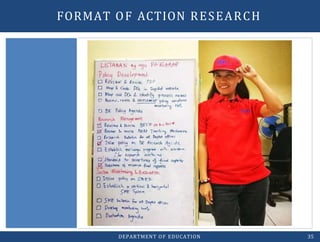
    DEPARTMENT OF EDUCATION35 FORMAT OF ACTION RESEARCH