Session Hijacking
Why web security depends on communications security and how TLS
everywhere is the only solution.
Pushpinder Joshi – http://www.Pushpindersinghjoshi.wix.com/pushpi-it-soluti
Introduction
Transport Layer Security (TLS), and its predecessor Secure Sockets Layer (SSL) as many
will know it, are cryptographic protocols used to offer communication security over the
Internet.
Hypertext Transfer Protocol Secure (HTTPS) is not actually a protocol in and of itself. It
is actually the use of Hypertext Transfer Protocol (HTTP) on top of TLS which affords the
standard HTTP communications protocol the protection of TLS.
Session Hijacking (a.k.a. Session Sidejacking) is a form of Man In The Middle (MITM)
attack in which a malicious attacker has access to the transport layer and can eavesdrop
on communications. When communications are not protected they can steal the unique
session ID and impersonate the victim on the target site. This grants the attacker access
to your account and data.
• To verify the website you are connecting to is the genuine website.
• To ensure the privacy of your data during transit.
• To ensure the integrity of your data during transit.
Why do we use TLS?
Example
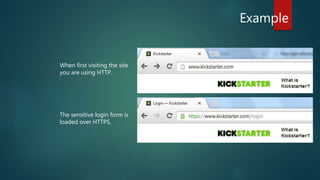
When first visiting the site
you are using HTTP.
The sensitive login form is
loaded over HTTPS.
Example
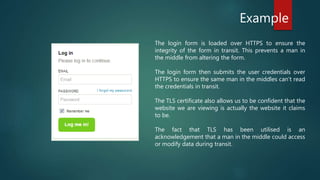
The login form is loaded over HTTPS to ensure the
integrity of the form in transit. This prevents a man in
the middle from altering the form.
The login form then submits the user credentials over
HTTPS to ensure the same man in the middles can’t read
the credentials in transit.
The TLS certificate also allows us to be confident that the
website we are viewing is actually the website it claims
to be.
The fact that TLS has been utilised is an
acknowledgement that a man in the middle could access
or modify data during transit.
Example
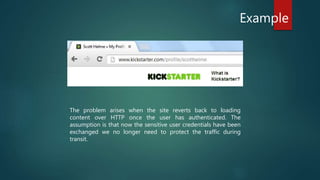
The problem arises when the site reverts back to loading
content over HTTP once the user has authenticated. The
assumption is that now the sensitive user credentials have been
exchanged we no longer need to protect the traffic during
transit.
Why does this
matter?
• Once you have logged in on the secure login page, your session ID lets the
server remember you have logged in without having to keep sending your
username and password to prove your identity.
• Once the website reverts back to HTTP your session ID still has to be sent but is
no longer afforded the protection offered by TLS.
• HTTP and HTTPS are stateless protocols. This means each time you request some
new content from the site (a page, image or any form of media) the server does
not know who you are, it does not remember you.
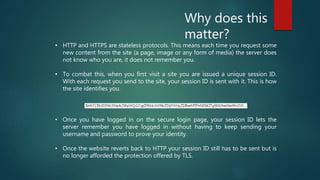
• To combat this, when you first visit a site you are issued a unique session ID.
With each request you send to the site, your session ID is sent with it. This is how
the site identifies you.
Summary
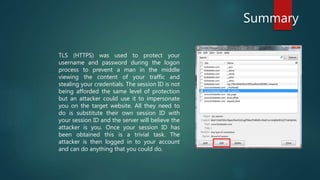
TLS (HTTPS) was used to protect your
username and password during the logon
process to prevent a man in the middle
viewing the content of your traffic and
stealing your credentials. The session ID is not
being afforded the same level of protection
but an attacker could use it to impersonate
you on the target website. All they need to
do is substitute their own session ID with
your session ID and the server will believe the
attacker is you. Once your session ID has
been obtained this is a trivial task. The
attacker is then logged in to your account
and can do anything that you could do.
Conclusion
• Whilst obtaining your session ID does not generally reveal your username or
password the attacker can still access your account as if they were logged in as you.
• This attack is possible because TLS is not used across the entire site.
• We accept an attacker could access our traffic, which is why we need TLS in the first
instance.
• Sites regularly fail to protect the session ID which can be considered an equivalent to
your user credentials on the target website.
• Forcing all traffic to the site over HTTPS would completely mitigate a session
hijacking attack.
Thanks
You can find more info covering this and other forms of attack on my blog:
http://www.pushpindersinghjoshi.wix.com/pushpin-it-solution
Please feel free to share this information generously but do provide
attribution back to my site.

Session hijacking

  • 1.
    Session Hijacking Why websecurity depends on communications security and how TLS everywhere is the only solution. Pushpinder Joshi – http://www.Pushpindersinghjoshi.wix.com/pushpi-it-soluti
  • 2.
    Introduction Transport Layer Security(TLS), and its predecessor Secure Sockets Layer (SSL) as many will know it, are cryptographic protocols used to offer communication security over the Internet. Hypertext Transfer Protocol Secure (HTTPS) is not actually a protocol in and of itself. It is actually the use of Hypertext Transfer Protocol (HTTP) on top of TLS which affords the standard HTTP communications protocol the protection of TLS. Session Hijacking (a.k.a. Session Sidejacking) is a form of Man In The Middle (MITM) attack in which a malicious attacker has access to the transport layer and can eavesdrop on communications. When communications are not protected they can steal the unique session ID and impersonate the victim on the target site. This grants the attacker access to your account and data.
  • 3.
    • To verifythe website you are connecting to is the genuine website. • To ensure the privacy of your data during transit. • To ensure the integrity of your data during transit. Why do we use TLS?
  • 4.
    Example When first visitingthe site you are using HTTP. The sensitive login form is loaded over HTTPS.
  • 5.
    Example The login formis loaded over HTTPS to ensure the integrity of the form in transit. This prevents a man in the middle from altering the form. The login form then submits the user credentials over HTTPS to ensure the same man in the middles can’t read the credentials in transit. The TLS certificate also allows us to be confident that the website we are viewing is actually the website it claims to be. The fact that TLS has been utilised is an acknowledgement that a man in the middle could access or modify data during transit.
  • 6.
    Example The problem ariseswhen the site reverts back to loading content over HTTP once the user has authenticated. The assumption is that now the sensitive user credentials have been exchanged we no longer need to protect the traffic during transit.
  • 7.
    Why does this matter? •Once you have logged in on the secure login page, your session ID lets the server remember you have logged in without having to keep sending your username and password to prove your identity. • Once the website reverts back to HTTP your session ID still has to be sent but is no longer afforded the protection offered by TLS. • HTTP and HTTPS are stateless protocols. This means each time you request some new content from the site (a page, image or any form of media) the server does not know who you are, it does not remember you. • To combat this, when you first visit a site you are issued a unique session ID. With each request you send to the site, your session ID is sent with it. This is how the site identifies you.
  • 8.
    Summary TLS (HTTPS) wasused to protect your username and password during the logon process to prevent a man in the middle viewing the content of your traffic and stealing your credentials. The session ID is not being afforded the same level of protection but an attacker could use it to impersonate you on the target website. All they need to do is substitute their own session ID with your session ID and the server will believe the attacker is you. Once your session ID has been obtained this is a trivial task. The attacker is then logged in to your account and can do anything that you could do.
  • 9.
    Conclusion • Whilst obtainingyour session ID does not generally reveal your username or password the attacker can still access your account as if they were logged in as you. • This attack is possible because TLS is not used across the entire site. • We accept an attacker could access our traffic, which is why we need TLS in the first instance. • Sites regularly fail to protect the session ID which can be considered an equivalent to your user credentials on the target website. • Forcing all traffic to the site over HTTPS would completely mitigate a session hijacking attack.
  • 10.
    Thanks You can findmore info covering this and other forms of attack on my blog: http://www.pushpindersinghjoshi.wix.com/pushpin-it-solution Please feel free to share this information generously but do provide attribution back to my site.