Power And Politics
Amit kumar
CSJM UNIVERSITY
KANPUR
What is power?
Power is the ability to …
▫ Get someone to do something you want done.
▫ Make things happen in the way you want
“Power is the opportunity to build, to create, to
nudge history in a different direction."
Richard Nixon
2
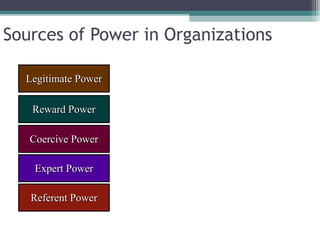
Sources of Power in Organizations
Legitimate PowerLegitimate Power
Reward PowerReward Power
Coercive PowerCoercive Power
Expert PowerExpert Power
Referent PowerReferent Power
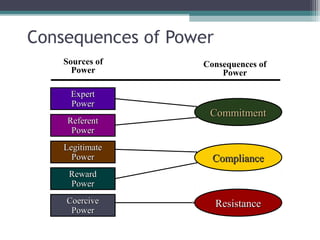
CommitmentCommitment
Consequences of Power
RewardReward
PowerPower
LegitimateLegitimate
PowerPower
CoerciveCoercive
PowerPower
ExpertExpert
PowerPower
ReferentReferent
PowerPower
ResistanceResistance
ComplianceCompliance
Sources of
Power
Consequences of
Power
Managers Acquire the power needed
for leadership by working towards
 Power-oriented behavior
 Position power and personal power
 2–C’s : Centrality and Criticality
 Building expertise
 Visibility of their job performance
 Expanding contacts with senior people.
 Seeking opportunities to increase name
recognition.
5
Empowerment
The process by which managers help
others to acquire and use the power
needed to make decisions affecting
themselves and their work.
6
Empowerment, and the way managers
empower others:
Power as an expanding pie.
▫ With empowerment, employees must be trained to
expand their power and their new influence
potential.
▫ Empowerment changes the dynamics between
supervisors and subordinates.
7
Sexual Harassment and Power
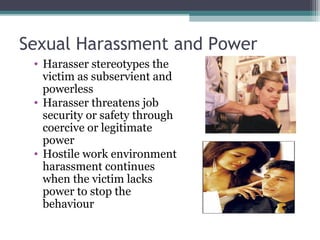
• Harasser stereotypes the
victim as subservient and
powerless
• Harasser threatens job
security or safety through
coercive or legitimate
power
• Hostile work environment
harassment continues
when the victim lacks
power to stop the
behaviour
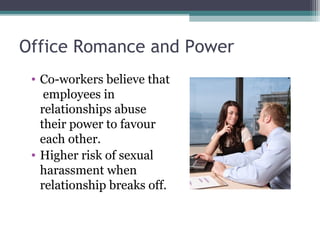
Office Romance and Power
• Co-workers believe that
employees in
relationships abuse
their power to favour
each other.
• Higher risk of sexual
harassment when
relationship breaks off.
Organizational Politics
Organizational
Politics
intentional
enhancement of
self-interest
Organizational Politics
“Organizational politics
involves those activities by
organizations to acquire,
develop, and use power and
other resources to obtain
one’s preferred outcomes in
a situation in which there is
uncertainty or dissent about
choices.”
(Pfeffer, 1981)
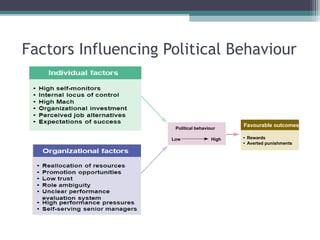
Factors Influencing Political Behaviour
Political behaviour
Low High
Favourable outcomes
• Rewards
• Averted punishments
Political Tactics
• Attacking or blaming others.
• Creating a favorable image.
• Developing a base of support.
• Inspirational appeal
• Consultation
• Exchange
• Coalition
• Pressure
How do organizational politics affect
managers and management?
Political action in the chief executive suite.
Political action and subunit power.
Managers placing themselves in the
positions of other persons involved in critical
decisions or events.
14
Can the firm use politics strategically?
Organizational governance & its implications
▫ The pattern of authority, influence, and
acceptable managerial behavior established at the
top of the organization.
▫ Significantly determined by the effective control
of key resources by members of a dominant
coalition.
15
Can the firm use politics strategically?
A person’s behavior must satisfy the following
criteria to be ethical:
▫ The behavior must produce the greatest good for
the greatest number of people.
▫ The behavior must respect the rights of all affected
parties.
▫ The behavior must respect the rules of justice.
16
Limiting the Effects of Political Behavior
• Open communication
• Provide Sufficient Resources
• Introduce Clear Rules
• Free Flowing Information
• Measure performance, not personalities
• Remove Political Norms
• Hire Low-Politics Employees
• Increase Opportunities for Dialogue
• Peer Pressure Against Politics
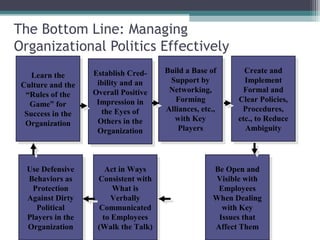
The Bottom Line: Managing
Organizational Politics Effectively
Learn the
Culture and the
“Rules of the
Game” for
Success in the
Organization
Learn the
Culture and the
“Rules of the
Game” for
Success in the
Organization
Establish Cred-
ibility and an
Overall Positive
Impression in
the Eyes of
Others in the
Organization
Establish Cred-
ibility and an
Overall Positive
Impression in
the Eyes of
Others in the
Organization
Build a Base of
Support by
Networking,
Forming
Alliances, etc.,
with Key
Players
Build a Base of
Support by
Networking,
Forming
Alliances, etc.,
with Key
Players
Create and
Implement
Formal and
Clear Policies,
Procedures,
etc., to Reduce
Ambiguity
Create and
Implement
Formal and
Clear Policies,
Procedures,
etc., to Reduce
Ambiguity
Be Open and
Visible with
Employees
When Dealing
with Key
Issues that
Affect Them
Be Open and
Visible with
Employees
When Dealing
with Key
Issues that
Affect Them
Act in Ways
Consistent with
What is
Verbally
Communicated
to Employees
(Walk the Talk)
Act in Ways
Consistent with
What is
Verbally
Communicated
to Employees
(Walk the Talk)
Use Defensive
Behaviors as
Protection
Against Dirty
Political
Players in the
Organization
Use Defensive
Behaviors as
Protection
Against Dirty
Political
Players in the
Organization
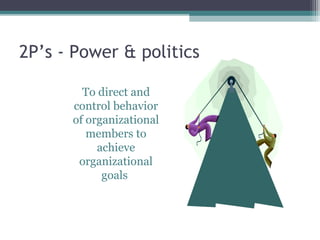
2P’s - Power & politics
To direct and
control behavior
of organizational
members to
achieve
organizational
goals
20
Thank you
Any que???

Organization power & politics

  • 1.
    Power And Politics Amitkumar CSJM UNIVERSITY KANPUR
  • 2.
    What is power? Poweris the ability to … ▫ Get someone to do something you want done. ▫ Make things happen in the way you want “Power is the opportunity to build, to create, to nudge history in a different direction." Richard Nixon 2
  • 3.
    Sources of Powerin Organizations Legitimate PowerLegitimate Power Reward PowerReward Power Coercive PowerCoercive Power Expert PowerExpert Power Referent PowerReferent Power
  • 4.
  • 5.
    Managers Acquire thepower needed for leadership by working towards  Power-oriented behavior  Position power and personal power  2–C’s : Centrality and Criticality  Building expertise  Visibility of their job performance  Expanding contacts with senior people.  Seeking opportunities to increase name recognition. 5
  • 6.
    Empowerment The process bywhich managers help others to acquire and use the power needed to make decisions affecting themselves and their work. 6
  • 7.
    Empowerment, and theway managers empower others: Power as an expanding pie. ▫ With empowerment, employees must be trained to expand their power and their new influence potential. ▫ Empowerment changes the dynamics between supervisors and subordinates. 7
  • 8.
    Sexual Harassment andPower • Harasser stereotypes the victim as subservient and powerless • Harasser threatens job security or safety through coercive or legitimate power • Hostile work environment harassment continues when the victim lacks power to stop the behaviour
  • 9.
    Office Romance andPower • Co-workers believe that employees in relationships abuse their power to favour each other. • Higher risk of sexual harassment when relationship breaks off.
  • 10.
  • 11.
    Organizational Politics “Organizational politics involvesthose activities by organizations to acquire, develop, and use power and other resources to obtain one’s preferred outcomes in a situation in which there is uncertainty or dissent about choices.” (Pfeffer, 1981)
  • 12.
    Factors Influencing PoliticalBehaviour Political behaviour Low High Favourable outcomes • Rewards • Averted punishments
  • 13.
    Political Tactics • Attackingor blaming others. • Creating a favorable image. • Developing a base of support. • Inspirational appeal • Consultation • Exchange • Coalition • Pressure
  • 14.
    How do organizationalpolitics affect managers and management? Political action in the chief executive suite. Political action and subunit power. Managers placing themselves in the positions of other persons involved in critical decisions or events. 14
  • 15.
    Can the firmuse politics strategically? Organizational governance & its implications ▫ The pattern of authority, influence, and acceptable managerial behavior established at the top of the organization. ▫ Significantly determined by the effective control of key resources by members of a dominant coalition. 15
  • 16.
    Can the firmuse politics strategically? A person’s behavior must satisfy the following criteria to be ethical: ▫ The behavior must produce the greatest good for the greatest number of people. ▫ The behavior must respect the rights of all affected parties. ▫ The behavior must respect the rules of justice. 16
  • 17.
    Limiting the Effectsof Political Behavior • Open communication • Provide Sufficient Resources • Introduce Clear Rules • Free Flowing Information • Measure performance, not personalities • Remove Political Norms • Hire Low-Politics Employees • Increase Opportunities for Dialogue • Peer Pressure Against Politics
  • 18.
    The Bottom Line:Managing Organizational Politics Effectively Learn the Culture and the “Rules of the Game” for Success in the Organization Learn the Culture and the “Rules of the Game” for Success in the Organization Establish Cred- ibility and an Overall Positive Impression in the Eyes of Others in the Organization Establish Cred- ibility and an Overall Positive Impression in the Eyes of Others in the Organization Build a Base of Support by Networking, Forming Alliances, etc., with Key Players Build a Base of Support by Networking, Forming Alliances, etc., with Key Players Create and Implement Formal and Clear Policies, Procedures, etc., to Reduce Ambiguity Create and Implement Formal and Clear Policies, Procedures, etc., to Reduce Ambiguity Be Open and Visible with Employees When Dealing with Key Issues that Affect Them Be Open and Visible with Employees When Dealing with Key Issues that Affect Them Act in Ways Consistent with What is Verbally Communicated to Employees (Walk the Talk) Act in Ways Consistent with What is Verbally Communicated to Employees (Walk the Talk) Use Defensive Behaviors as Protection Against Dirty Political Players in the Organization Use Defensive Behaviors as Protection Against Dirty Political Players in the Organization
  • 19.
    2P’s - Power& politics To direct and control behavior of organizational members to achieve organizational goals
  • 20.

Editor's Notes

  • #13 Material pertinent to this illustration is found on pages 275-277.