Learning objectives
By theend of this session, each student is expected to be able to;
• Define nutritional vulnerability and food insecurity
• Describe the most vulnerable groups to malnutrition (young children,
pregnant and lactating women, HIV/AIDS parents
• Describe the methods for nutritional support in vulnerable groups
• Describe the role of nutrition in disease prevention
• Describe methods for preventing nutritional disorders
• Describe long term strategies to prevent nutritional deficiency disease
• Provide nutritional support in vulnerable groups
3.
Definition of terms
•Nutritional vulnerability refers to a reduced physical
reserve that limits recovery in the event of an acute
health threat, as well as limited resilience and other
predisposed factors arising from a reduced dietary
intake
Cont…
• The existenceof malnutrition and other related threats
results in communities and individuals being nutritionally
vulnerable
6.
Cont…
• Food insecurityrefers to lacking regular access to
enough safe and nutritious food for normal growth and
development and active and healthy life (Food and
Agricultural Organization of the U.S.A)
7.
CONT…
• While manypeople may not be ‘hungry’, they may still
be food insecure
• People might have access to food to meet their energy
requirement yet are uncertain that it will last, or they
may be forced to reduce the quality and/or quantity of
food they eat
8.
Levels of severityof food insecurity
i. Mild food insecurity; this refers to uncertainty
regarding the ability to get food
9.
Cont…
ii. Moderate foodinsecurity;
• There is insufficient money or resources for a healthy
diet
• There is uncertainty about the ability to obtain food
• People probably skipped meals or run out of food
occasionally
Cont…
• When anindividual is severely food insecure, they have
most likely experienced hunger. In other words, this
may predisposed them into malnutrition
12.
Causes of foodinsecurity
• Inappropriate use of available food
• Poor storage methods and facilities
• Small farm size
• Low income
• Use of poor technology
• Systemic racism and racial discrimination
• Climate change and global warming
13.
Vulnerable groups tomalnutrition
The most vulnerable groups to malnutrition in the
population are;
• Young children
• Pregnant and lactating women
• People living with HIV/AIDS (PLWHIV/AIDS)
14.
• Poor growth
•Poor cognition
• Poor muscle development
• Reduced work capacity
• Poor social development
• High rates of illness
• Difficulty in school
Outcomes of inadequate diet in Children
15.
• Age
• Diseasedconditions
• Maternal conditions
• Other factors??
Factors influencing nutritional requirements in
children
16.
• Promote nutritioneducation with the focus on healthy
eating and lifestyle
• Promote eating of healthy snacks and drinks by children
• Supplementation with iron and folic acid
• Encourage health-seeking behaviours on general
health, HIV and AIDS prevention and management.
• Promote de-worming of children within and outside
schools
Nutrition recommendation for young children
17.
Importance of goodnutrition during pregnancy
• Ensures good health of the fetus and newborns
• Ensures good health of the pregnant woman
• Few complications during pregnancy
• Development of maternal organs such as uterus,
placenta and breast tissues
• Reserve to be utilized at the time of delivery and
lactation
18.
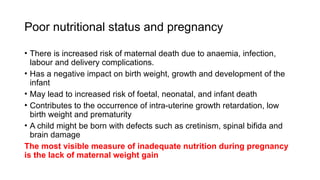
Poor nutritional statusand pregnancy
• There is increased risk of maternal death due to anaemia, infection,
labour and delivery complications.
• Has a negative impact on birth weight, growth and development of the
infant
• May lead to increased risk of foetal, neonatal, and infant death
• Contributes to the occurrence of intra-uterine growth retardation, low
birth weight and prematurity
• A child might be born with defects such as cretinism, spinal bifida and
brain damage
The most visible measure of inadequate nutrition during pregnancy
is the lack of maternal weight gain
19.
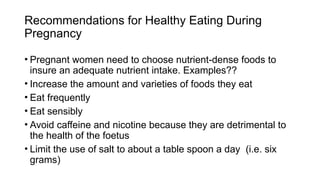
• Pregnant womenneed to choose nutrient-dense foods to
insure an adequate nutrient intake. Examples??
• Increase the amount and varieties of foods they eat
• Eat frequently
• Eat sensibly
• Avoid caffeine and nicotine because they are detrimental to
the health of the foetus
• Limit the use of salt to about a table spoon a day (i.e. six
grams)
Recommendations for Healthy Eating During
Pregnancy
20.
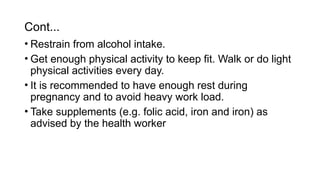
• Restrain fromalcohol intake.
• Get enough physical activity to keep fit. Walk or do light
physical activities every day.
• It is recommended to have enough rest during
pregnancy and to avoid heavy work load.
• Take supplements (e.g. folic acid, iron and iron) as
advised by the health worker
Cont...
21.
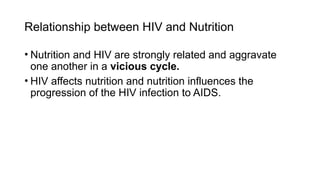
Relationship between HIVand Nutrition
• Nutrition and HIV are strongly related and aggravate
one another in a vicious cycle.
• HIV affects nutrition and nutrition influences the
progression of the HIV infection to AIDS.
23.
Factors affecting nutritionin key population
affected with HIV
• Reduced food intake
• Poor nutrient absorption
• Utilization in the body and changes in body’s
metabolism
24.
Cont…
• Other factorsare:
• Degree of disease
• Chronic infections and illnesses
• Anorexia or loss of appetite
• Diarrhoea
• Fever
• Nausea
• Frequent vomiting
• Oral thrush
25.
Nutritional support invulnerable groups
• Nutritional support is therapy for people who cannot get
enough nourishment by eating or drinking. Methods for
nutritional support are;
• Food fortification
• Supplementary enteral tube feeding
• Total enteral tube feeding
• Parenteral nutrition
26.
Role of nutritionin disease prevention
• Strengthening immunity, and thus delaying disease
progression and death
• Improving medicinal intake and utilization
• Decreases weight loss
• Provides energy
27.
Methods for preventingnutritional disorders
• Growth monitoring to children and vulnerable groups
• Healthy eating and healthy lifestyle
• Health education on breastfeeding
• Promote small household gardening
• Use available resources wisely
• Improve storage facility
• Use food preparation methods that minimize nutrient loss and
improve quality of food
• Engage in other income generating activities
28.
Long term strategiesto prevent nutritional
deficiency disease
There are two major approaches in addressing nutritional
deficiency disease;
• Nutritional planning
• Direct nutrition and health intervention
29.
Nutritional planning
The followingare some of the nutritional plans for the
government to achieve;
• Political commitment by the government
• Formulation of a nutrition policies
• Long term planning to improve production and supplies
of food, equitable distribution and increase the
purchasing power of people
• Land reforms
30.
Cont…
• Proper guidancein agriculture
• Increasing the capacity of people to buy nutritious food
in adequate quantity
• Income generating activities for the weaker sections of
the community
• Making available good quality food in affordable prices
through proper public distribution system
31.
Direct nutrition andhealth intervention
Direct nutrition and health intervention can be achieved
by;
• Improved health care system
• Nutrition education
• Early detection of malnutrition and intervention
• Nutrition supplementation
32.
Nutritional support invulnerable groups
When providing nutritional support in vulnerable groups,
it is important to consider the following;
• Aim for nutritional support
• When should nutritional support be started?
• How long should nutritional support be continued?
• Optimal substrate intake and route of administration