Comparing hospitals and health prices and 
volumes across countries: a new approach 
Francette Koechlin (OECD), Paul 
Konijn(Eurostat), Luca Lorenzoni 
(OECD) and Paul Schreyer (OECD) 
Presentation by Mary O’Mahony (KCL) to the 
IARIW 33rd General Conference 
Rotterdam, The Netherlands, August 24-30, 2014
Context 
• In the past volume of outputs of non-market 
services were estimated by volumes of inputs 
– Implies zero productivity growth 
• OECD, Eurostat and others have worked towards 
producing output-based measures of the volume 
of these services and growth over time 
• This paper looks at the spatial aspect, comparing 
across countries 
• Requires spatial price indices (PPPs) to deflate 
current price aggregates to compare the volume 
of output between countries
Context 
• Previous estimates of PPPs include one for 
health 
– But based on input prices 
• Using GDP PPPs instead is inaccurate as 
evidence suggests that medical treatment 
prices have been growing faster than other 
goods and services 
• Hence a need for new measures
Methodology: Hospital services 
• Three problems in measuring PPPs 
– Identifying products that are comparable across 
countries 
– representativeness of products 
– no meaningful market price for comparison 
• Requires implementation of an output survey of 
hospital services 
• A hospital output (case type ) refers to a hospital 
service that is similar from a clinical perspective 
and in terms of its consumption of resources.
Methodology: Hospital services 
• Distinguish two case types, medical and 
surgical 
• Use ICD to identify cases 
• Cases included were common procedures or 
diagnoses and account for a significant 
percentage of hospital expenditure. 
• International comparability of product 
classification systems is limited for Diagnosis 
Related Groups (DRG)-type systems.
Sample of Services 
• 21 in-hospital surgical cases, plus four surgical 
case types using outpatient procedures 
• 7 medical case types (no operating room 
procedure are performed) 
• Only ‘standard’ hospitalisation cases 
– Omit very long stays or transfers 
• Use ‘quasi-prices’ - costs per unit of case type 
– (unobserved) ‘prices’ that emulate a competitive 
situation where prices equal average costs per 
product
Estimating ‘quasi prices’ 
• in many OECD countries, systems have been put in place 
to approximate the monetary value of services provided 
by hospitals. 
• These provide, in theory, an indication of the 
purchasers’ willingness-to-pay (usually government or 
insurer) 
• and the providers’ willingness-to-accept these values as 
the price for hospital services. 
• Use administrative data to estimate these ‘quasi prices’ 
• Can be negotiated price or administered price but need 
to include direct costs, capital costs and overheads
Data 
• Survey collected data for 2011 on hospital activity 
and quasi-prices for a basket of 32 hospital 
products, using a standardized questionnaire. 
• 31 European and 7 non-European with PPPs for 
the remaining OECD countries estimated 
according to the input approach. 
• The number of cases were also collected and 
used to calculate values and share weights. 
• Derived (PLIs) price level indices (ratios of PPPs to 
exchange rates).
Results 
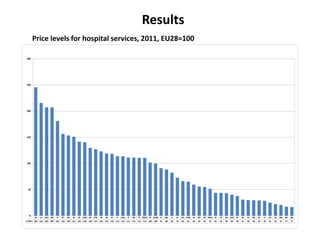
Price levels for hospital services, 2011, EU28=100 
CH LU AUS NO IE AT DK SE NL CAN BE JPN FR UK ES FI USA IT ISR IS OECD PT EU28 CY NZL SI EL CHL KOR CZ MT HR MEX EE TR BA RUS PL RS LV ME SK LT HU AL MK RO BG 
300 
250 
200 
150 
100 
50 
0 
2011 246 216 207 207 181 156 153 151 142 140 130 127 123 119 118 114 114 111 111 111 111 102 100 91 88 82 73 66 65 60 56 55 52 44 44 43 40 38 31 30 30 29 29 25 22 21 17 17
Results 
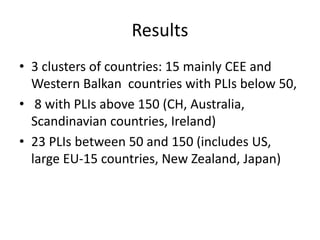
• 3 clusters of countries: 15 mainly CEE and 
Western Balkan countries with PLIs below 50, 
• 8 with PLIs above 150 (CH, Australia, 
Scandinavian countries, Ireland) 
• 23 PLIs between 50 and 150 (includes US, 
large EU-15 countries, New Zealand, Japan)
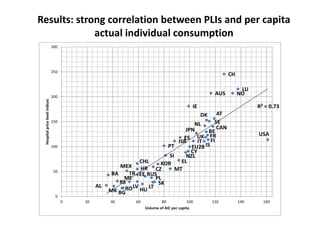
Results: strong correlation between PLIs and per capita 
actual individual consumption 
CH 
LU 
AUS NO 
IE 
DK AT 
NL SE 
CAN 
JPN BE 
ES UK FR ISR IT FI 
IS 
USA 
PT EU28 
CY 
SI NZL 
CHL KOR EL 
HR CZ MT MEX 
BA TR EE RUS 
PL 
RS 
LV 
ME 
SK 
LT 
HU 
AL 
MK RO 
BG 
R² = 0.73 
300 
250 
200 
150 
100 
50 
0 
0 20 40 60 80 100 120 140 160 
Hospital price level indices 
Volume of AIC per capita
Results 
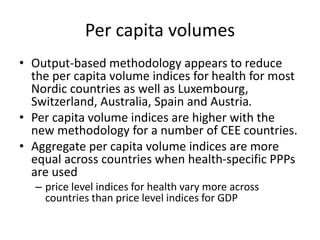
• No correlation with average length of stay 
• Not clear that quality is adequately taken into 
account 
– Some captured by stratification 
– could look at types of treatment, different 
procedures to cure same disease 
– Or overall measures such as mortality, waiting 
times etc.
Total Health Expenditures 
• Combine information from the System of Health 
Accounts (SHA) with the standard national 
accounts expenditure aggregates for health. 
• Estimates shares for each of 10 categories 
• Use hospital and other PPPs to estimate PLIs 
– spread of health PLIs is less pronounced than that of 
hospital PLIs 
– includes also health products, such as 
pharmaceuticals and therapeutic appliances which are 
tradable
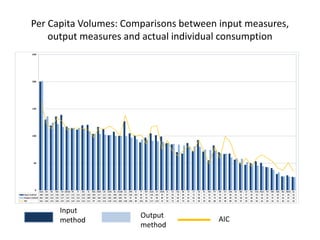
Per Capita Volumes: Comparisons between input measures, 
output measures and actual individual consumption 
USA DE BE NO CH OECD FR FI DK IS NZL SWE UK CAN NL EU28 LU JPN IE IT MT AUS AT KOR EL CZ HU SK SI LT ES PL RO PT HR CY ISR EE BG LV RS CHL RUS TR ME MK BA MEX AL 
250 
200 
150 
100 
50 
0 
Input method 200 130 119 136 139 117 115 112 120 120 104 117 112 101 108 100 127 105 101 88 97 105 101 99 87 84 70 68 87 72 93 71 55 83 70 67 68 56 51 47 50 53 50 43 41 30 25 28 25 
Output method 201 136 124 122 117 115 115 115 114 109 104 104 102 102 100 100 99 97 94 93 93 91 90 89 87 85 84 82 81 81 80 75 74 73 68 68 60 59 58 52 48 45 44 42 37 33 26 25 24 
AIC 161 123 113 134 127 110 114 114 113 111 97 115 113 118 112 100 138 105 99 103 85 117 119 75 92 72 63 73 81 71 93 70 48 80 59 99 88 59 47 59 44 59 65 59 53 41 36 51 35 
Input 
method 
Output 
method 
AIC
Per capita volumes 
• Output-based methodology appears to reduce 
the per capita volume indices for health for most 
Nordic countries as well as Luxembourg, 
Switzerland, Australia, Spain and Austria. 
• Per capita volume indices are higher with the 
new methodology for a number of CEE countries. 
• Aggregate per capita volume indices are more 
equal across countries when health-specific PPPs 
are used 
– price level indices for health vary more across 
countries than price level indices for GDP
Commentary 
• Sound methodology with plausible conclusions 
– Increases price level of health products in high income 
countries and lowers them in low income countries 
• More work needed on 
– non-hospital medical spending 
– Quality adjustments 
• Restriction to ‘standard’ conditions – is this valid? 
– Aging society, more comorbidities 
• Are the PPPs published?

Session 6 a iariw2014 session 6 a oecd eurostat

  • 1.
    Comparing hospitals andhealth prices and volumes across countries: a new approach Francette Koechlin (OECD), Paul Konijn(Eurostat), Luca Lorenzoni (OECD) and Paul Schreyer (OECD) Presentation by Mary O’Mahony (KCL) to the IARIW 33rd General Conference Rotterdam, The Netherlands, August 24-30, 2014
  • 2.
    Context • Inthe past volume of outputs of non-market services were estimated by volumes of inputs – Implies zero productivity growth • OECD, Eurostat and others have worked towards producing output-based measures of the volume of these services and growth over time • This paper looks at the spatial aspect, comparing across countries • Requires spatial price indices (PPPs) to deflate current price aggregates to compare the volume of output between countries
  • 3.
    Context • Previousestimates of PPPs include one for health – But based on input prices • Using GDP PPPs instead is inaccurate as evidence suggests that medical treatment prices have been growing faster than other goods and services • Hence a need for new measures
  • 4.
    Methodology: Hospital services • Three problems in measuring PPPs – Identifying products that are comparable across countries – representativeness of products – no meaningful market price for comparison • Requires implementation of an output survey of hospital services • A hospital output (case type ) refers to a hospital service that is similar from a clinical perspective and in terms of its consumption of resources.
  • 5.
    Methodology: Hospital services • Distinguish two case types, medical and surgical • Use ICD to identify cases • Cases included were common procedures or diagnoses and account for a significant percentage of hospital expenditure. • International comparability of product classification systems is limited for Diagnosis Related Groups (DRG)-type systems.
  • 6.
    Sample of Services • 21 in-hospital surgical cases, plus four surgical case types using outpatient procedures • 7 medical case types (no operating room procedure are performed) • Only ‘standard’ hospitalisation cases – Omit very long stays or transfers • Use ‘quasi-prices’ - costs per unit of case type – (unobserved) ‘prices’ that emulate a competitive situation where prices equal average costs per product
  • 7.
    Estimating ‘quasi prices’ • in many OECD countries, systems have been put in place to approximate the monetary value of services provided by hospitals. • These provide, in theory, an indication of the purchasers’ willingness-to-pay (usually government or insurer) • and the providers’ willingness-to-accept these values as the price for hospital services. • Use administrative data to estimate these ‘quasi prices’ • Can be negotiated price or administered price but need to include direct costs, capital costs and overheads
  • 8.
    Data • Surveycollected data for 2011 on hospital activity and quasi-prices for a basket of 32 hospital products, using a standardized questionnaire. • 31 European and 7 non-European with PPPs for the remaining OECD countries estimated according to the input approach. • The number of cases were also collected and used to calculate values and share weights. • Derived (PLIs) price level indices (ratios of PPPs to exchange rates).
  • 9.
    Results Price levelsfor hospital services, 2011, EU28=100 CH LU AUS NO IE AT DK SE NL CAN BE JPN FR UK ES FI USA IT ISR IS OECD PT EU28 CY NZL SI EL CHL KOR CZ MT HR MEX EE TR BA RUS PL RS LV ME SK LT HU AL MK RO BG 300 250 200 150 100 50 0 2011 246 216 207 207 181 156 153 151 142 140 130 127 123 119 118 114 114 111 111 111 111 102 100 91 88 82 73 66 65 60 56 55 52 44 44 43 40 38 31 30 30 29 29 25 22 21 17 17
  • 10.
    Results • 3clusters of countries: 15 mainly CEE and Western Balkan countries with PLIs below 50, • 8 with PLIs above 150 (CH, Australia, Scandinavian countries, Ireland) • 23 PLIs between 50 and 150 (includes US, large EU-15 countries, New Zealand, Japan)
  • 11.
    Results: strong correlationbetween PLIs and per capita actual individual consumption CH LU AUS NO IE DK AT NL SE CAN JPN BE ES UK FR ISR IT FI IS USA PT EU28 CY SI NZL CHL KOR EL HR CZ MT MEX BA TR EE RUS PL RS LV ME SK LT HU AL MK RO BG R² = 0.73 300 250 200 150 100 50 0 0 20 40 60 80 100 120 140 160 Hospital price level indices Volume of AIC per capita
  • 12.
    Results • Nocorrelation with average length of stay • Not clear that quality is adequately taken into account – Some captured by stratification – could look at types of treatment, different procedures to cure same disease – Or overall measures such as mortality, waiting times etc.
  • 13.
    Total Health Expenditures • Combine information from the System of Health Accounts (SHA) with the standard national accounts expenditure aggregates for health. • Estimates shares for each of 10 categories • Use hospital and other PPPs to estimate PLIs – spread of health PLIs is less pronounced than that of hospital PLIs – includes also health products, such as pharmaceuticals and therapeutic appliances which are tradable
  • 14.
    Per Capita Volumes:Comparisons between input measures, output measures and actual individual consumption USA DE BE NO CH OECD FR FI DK IS NZL SWE UK CAN NL EU28 LU JPN IE IT MT AUS AT KOR EL CZ HU SK SI LT ES PL RO PT HR CY ISR EE BG LV RS CHL RUS TR ME MK BA MEX AL 250 200 150 100 50 0 Input method 200 130 119 136 139 117 115 112 120 120 104 117 112 101 108 100 127 105 101 88 97 105 101 99 87 84 70 68 87 72 93 71 55 83 70 67 68 56 51 47 50 53 50 43 41 30 25 28 25 Output method 201 136 124 122 117 115 115 115 114 109 104 104 102 102 100 100 99 97 94 93 93 91 90 89 87 85 84 82 81 81 80 75 74 73 68 68 60 59 58 52 48 45 44 42 37 33 26 25 24 AIC 161 123 113 134 127 110 114 114 113 111 97 115 113 118 112 100 138 105 99 103 85 117 119 75 92 72 63 73 81 71 93 70 48 80 59 99 88 59 47 59 44 59 65 59 53 41 36 51 35 Input method Output method AIC
  • 15.
    Per capita volumes • Output-based methodology appears to reduce the per capita volume indices for health for most Nordic countries as well as Luxembourg, Switzerland, Australia, Spain and Austria. • Per capita volume indices are higher with the new methodology for a number of CEE countries. • Aggregate per capita volume indices are more equal across countries when health-specific PPPs are used – price level indices for health vary more across countries than price level indices for GDP
  • 16.
    Commentary • Soundmethodology with plausible conclusions – Increases price level of health products in high income countries and lowers them in low income countries • More work needed on – non-hospital medical spending – Quality adjustments • Restriction to ‘standard’ conditions – is this valid? – Aging society, more comorbidities • Are the PPPs published?