
Adrian Towse
Director of the Office of Health Economics
Visiting Professor London School of Economics
ISPOR Washington DC, May 2016
“Multi-indication Pricing: Do we
want it? Can we operationalize it?”
ISPOR Washington DC, May 2016
Agenda and running order …..
1. Adrian Towse, OHE
• will moderate and briefly present a European
perspective including opinions from an OHE supported
stakeholder forum
2. Bill Dreitlein, ICER
• Will provide US perspective including opinions from an
ICER supported stakeholder forum
3. Ansgar Hebborn, Roche
• will give an innovator’s perspective
4. Sean Karbowicz, OmedaRx,
• will give a payer perspective
ISPOR Washington DC, May 2016
The case for …a single, uniform, price across
indications has negative consequences
• Single price based on higher-valued indications
• higher than optimal for one or more lower-value
uses/indications, leading to restricted access
• Single price based on lower value indications
• discourage development of further potentially
higher-value indications
• Both consequences are sub-optimal from
society’s point of view.
• Multiple indication (or patient sub-group)
pricing increases the numbers of patients
receiving treatment
ISPOR Washington DC, May 2016
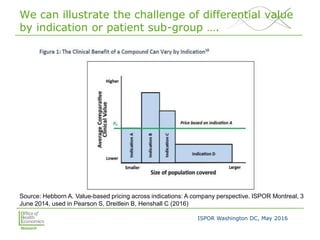
We can illustrate the challenge of differential value
by indication or patient sub-group ….
Source: Hebborn A. Value-based pricing across indications: A company perspective. ISPOR Montreal, 3
June 2014, used in Pearson S, Dreitlein B, Henshall C (2016)
ISPOR Washington DC, May 2016
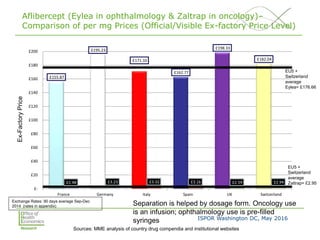
Aflibercept (Eylea in ophthalmology & Zaltrap in oncology)–
Comparison of per mg Prices (Official/Visible Ex-factory Price Level)
EU5 +
Switzerland
average
Zaltrap= £2.95
EU5 +
Switzerland
average
Eylea= £176.66
£155.87
£195.23
£171.10
£162.77
£198.33
£182.04
£2.48 £3.23 £3.32 £3.16 £2.59 £2.94
£-
£20
£40
£60
£80
£100
£120
£140
£160
£180
£200
France Germany Italy Spain UK Switzerland
Exchange Rates: 90 days average Sep-Dec
2014 (rates in appendix)
Sources: MME analysis of country drug compendia and institutional websites
Ex-FactoryPrice
Separation is helped by dosage form. Oncology use
is an infusion; ophthalmology use is pre-filled
syringes
ISPOR Washington DC, May 2016
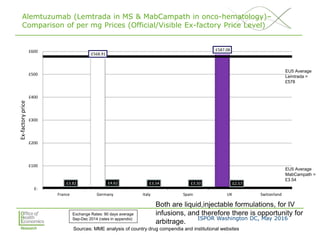
Alemtuzumab (Lemtrada in MS & MabCampath in onco-hematology)–
Comparison of per mg Prices (Official/Visible Ex-factory Price Level)
EU5 Average
MabCampath =
£3.54
EU5 Average
Lemtrada =
£578
£568.91
£587.08
£3.82 £4.62 £3.54 £3.50 £2.57
£-
£100
£200
£300
£400
£500
£600
France Germany Italy Spain UK Switzerland
Ex-factoryprice
Sources: MME analysis of country drug compendia and institutional websites
Exchange Rates: 90 days average
Sep-Dec 2014 (rates in appendix)
Both are liquid,injectable formulations, for IV
infusions, and therefore there is opportunity for
arbitrage.
ISPOR Washington DC, May 2016
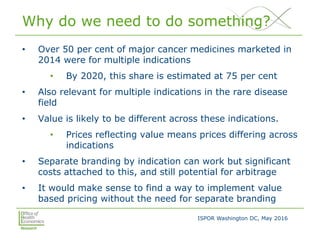
Why do we need to do something?
• Over 50 per cent of major cancer medicines marketed in
2014 were for multiple indications
• By 2020, this share is estimated at 75 per cent
• Also relevant for multiple indications in the rare disease
field
• Value is likely to be different across these indications.
• Prices reflecting value means prices differing across
indications
• Separate branding by indication can work but significant
costs attached to this, and still potential for arbitrage
• It would make sense to find a way to implement value
based pricing without the need for separate branding
ISPOR Washington DC, May 2016
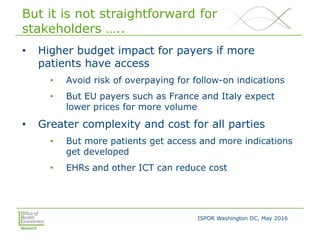
But it is not straightforward for
stakeholders …..
• Higher budget impact for payers if more
patients have access
• Avoid risk of overpaying for follow-on indications
• But EU payers such as France and Italy expect
lower prices for more volume
• Greater complexity and cost for all parties
• But more patients get access and more indications
get developed
• EHRs and other ICT can reduce cost
ISPOR Washington DC, May 2016
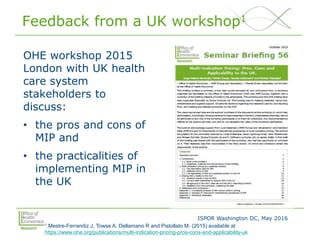
Feedback from a UK workshop1
OHE workshop 2015
London with UK health
care system
stakeholders to
discuss:
• the pros and cons of
MIP and
• the practicalities of
implementing MIP in
the UK
1.Mestre-Ferrandiz J, Towse A, Dellamano R and Pistollato M. (2015) available at
https://www.ohe.org/publications/multi-indication-pricing-pros-cons-and-applicability-uk
ISPOR Washington DC, May 2016
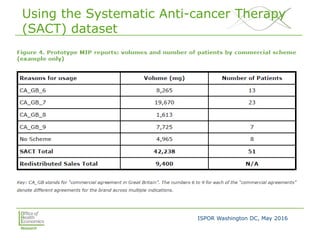
Using the Systematic Anti-cancer Therapy
(SACT) dataset
ISPOR Washington DC, May 2016
Reflections from the Workshop
• All stakeholders were interested in the potential use of MIP but
many sceptical of the ability of the NHS to get good value
• General support for relative prices reflecting relative value, but
important that price did not exceed value in any indication
• Need to ensure collaboration across all stakeholders (NHS,
industry, patients, doctors, nurses and other health care
professionals) if the NHS were to benefit from any future
pricing scheme(s)
• If MIP were pursued, there was interest in both (i) “blended”
pricing (at list level) or (ii) schemes generating variable “net”
selling prices (i.e. differential discounts)
• SACT data can in principle support MIP implementation. Current
UK collaborations will help understand whether the SACT
dataset could in practice underpin such pricing systems.
ISPOR Washington DC, May 2016
References
• Mestre-Ferrandiz J, Towse A, Dellamano R and Pistollato
M. (2015) Multi-indication Pricing: Pros, Cons and
Applicability to the UK. Office of Health Economics
Seminar Briefing 56. Available at:
https://www.ohe.org/publications/multi-indication-pricing-
pros-cons-and-applicability-uk
• Pearson S, Dreitlein B, Henshall C (2016). Indication-
specific Pricing Of Pharmaceuticals In The United States
Health Care System. A Report from the 2015 ICER
Membership Policy Summit. Institute for Clinical and
Economic Review. Available at: http://icer-
review.org/wp-content/uploads/2015/03/Final-Report-
2015-ICER-Policy-Summit-on-Indication-specific-Pricing-
March-2016_revised-icons-002.pdf
Adrian Towse
The Office of Health Economics
Registered address Southside, 7th Floor, 105 Victoria Street,
London SW1E 6QT
Website: www.ohe.org Blog: http://news.ohe.org
Email: atowse@ohe.org
THANK YOU FOR YOUR ATTENTION

“Multi-indication Pricing: Do we want it? Can we operationalize it?”

  • 1.
    Adrian Towse Director ofthe Office of Health Economics Visiting Professor London School of Economics ISPOR Washington DC, May 2016 “Multi-indication Pricing: Do we want it? Can we operationalize it?”
  • 2.
    ISPOR Washington DC,May 2016 Agenda and running order ….. 1. Adrian Towse, OHE • will moderate and briefly present a European perspective including opinions from an OHE supported stakeholder forum 2. Bill Dreitlein, ICER • Will provide US perspective including opinions from an ICER supported stakeholder forum 3. Ansgar Hebborn, Roche • will give an innovator’s perspective 4. Sean Karbowicz, OmedaRx, • will give a payer perspective
  • 3.
    ISPOR Washington DC,May 2016 The case for …a single, uniform, price across indications has negative consequences • Single price based on higher-valued indications • higher than optimal for one or more lower-value uses/indications, leading to restricted access • Single price based on lower value indications • discourage development of further potentially higher-value indications • Both consequences are sub-optimal from society’s point of view. • Multiple indication (or patient sub-group) pricing increases the numbers of patients receiving treatment
  • 4.
    ISPOR Washington DC,May 2016 We can illustrate the challenge of differential value by indication or patient sub-group …. Source: Hebborn A. Value-based pricing across indications: A company perspective. ISPOR Montreal, 3 June 2014, used in Pearson S, Dreitlein B, Henshall C (2016)
  • 5.
    ISPOR Washington DC,May 2016 Aflibercept (Eylea in ophthalmology & Zaltrap in oncology)– Comparison of per mg Prices (Official/Visible Ex-factory Price Level) EU5 + Switzerland average Zaltrap= £2.95 EU5 + Switzerland average Eylea= £176.66 £155.87 £195.23 £171.10 £162.77 £198.33 £182.04 £2.48 £3.23 £3.32 £3.16 £2.59 £2.94 £- £20 £40 £60 £80 £100 £120 £140 £160 £180 £200 France Germany Italy Spain UK Switzerland Exchange Rates: 90 days average Sep-Dec 2014 (rates in appendix) Sources: MME analysis of country drug compendia and institutional websites Ex-FactoryPrice Separation is helped by dosage form. Oncology use is an infusion; ophthalmology use is pre-filled syringes
  • 6.
    ISPOR Washington DC,May 2016 Alemtuzumab (Lemtrada in MS & MabCampath in onco-hematology)– Comparison of per mg Prices (Official/Visible Ex-factory Price Level) EU5 Average MabCampath = £3.54 EU5 Average Lemtrada = £578 £568.91 £587.08 £3.82 £4.62 £3.54 £3.50 £2.57 £- £100 £200 £300 £400 £500 £600 France Germany Italy Spain UK Switzerland Ex-factoryprice Sources: MME analysis of country drug compendia and institutional websites Exchange Rates: 90 days average Sep-Dec 2014 (rates in appendix) Both are liquid,injectable formulations, for IV infusions, and therefore there is opportunity for arbitrage.
  • 7.
    ISPOR Washington DC,May 2016 Why do we need to do something? • Over 50 per cent of major cancer medicines marketed in 2014 were for multiple indications • By 2020, this share is estimated at 75 per cent • Also relevant for multiple indications in the rare disease field • Value is likely to be different across these indications. • Prices reflecting value means prices differing across indications • Separate branding by indication can work but significant costs attached to this, and still potential for arbitrage • It would make sense to find a way to implement value based pricing without the need for separate branding
  • 8.
    ISPOR Washington DC,May 2016 But it is not straightforward for stakeholders ….. • Higher budget impact for payers if more patients have access • Avoid risk of overpaying for follow-on indications • But EU payers such as France and Italy expect lower prices for more volume • Greater complexity and cost for all parties • But more patients get access and more indications get developed • EHRs and other ICT can reduce cost
  • 9.
    ISPOR Washington DC,May 2016 Feedback from a UK workshop1 OHE workshop 2015 London with UK health care system stakeholders to discuss: • the pros and cons of MIP and • the practicalities of implementing MIP in the UK 1.Mestre-Ferrandiz J, Towse A, Dellamano R and Pistollato M. (2015) available at https://www.ohe.org/publications/multi-indication-pricing-pros-cons-and-applicability-uk
  • 10.
    ISPOR Washington DC,May 2016 Using the Systematic Anti-cancer Therapy (SACT) dataset
  • 11.
    ISPOR Washington DC,May 2016 Reflections from the Workshop • All stakeholders were interested in the potential use of MIP but many sceptical of the ability of the NHS to get good value • General support for relative prices reflecting relative value, but important that price did not exceed value in any indication • Need to ensure collaboration across all stakeholders (NHS, industry, patients, doctors, nurses and other health care professionals) if the NHS were to benefit from any future pricing scheme(s) • If MIP were pursued, there was interest in both (i) “blended” pricing (at list level) or (ii) schemes generating variable “net” selling prices (i.e. differential discounts) • SACT data can in principle support MIP implementation. Current UK collaborations will help understand whether the SACT dataset could in practice underpin such pricing systems.
  • 12.
    ISPOR Washington DC,May 2016 References • Mestre-Ferrandiz J, Towse A, Dellamano R and Pistollato M. (2015) Multi-indication Pricing: Pros, Cons and Applicability to the UK. Office of Health Economics Seminar Briefing 56. Available at: https://www.ohe.org/publications/multi-indication-pricing- pros-cons-and-applicability-uk • Pearson S, Dreitlein B, Henshall C (2016). Indication- specific Pricing Of Pharmaceuticals In The United States Health Care System. A Report from the 2015 ICER Membership Policy Summit. Institute for Clinical and Economic Review. Available at: http://icer- review.org/wp-content/uploads/2015/03/Final-Report- 2015-ICER-Policy-Summit-on-Indication-specific-Pricing- March-2016_revised-icons-002.pdf
  • 13.
    Adrian Towse The Officeof Health Economics Registered address Southside, 7th Floor, 105 Victoria Street, London SW1E 6QT Website: www.ohe.org Blog: http://news.ohe.org Email: atowse@ohe.org THANK YOU FOR YOUR ATTENTION