Advanced Therapy Medicinal
Products: Are Current HTA
Methods Suitable?
Grace Hampson & Adrian Towse
20 June 2017
20/06/2017 2
Acknowledgements
Acknowledgements: This work
was funded by Pfizer.
The authors are grateful to
members of the Pfizer team who
provided comments on the
report.
Full report available free of
charge at ohe.org.
20/06/2017 3
Advanced Therapy Medicinal Products
• European Medicines Agency definition:
“A medicine for human use that is based on genes, cells
or tissue engineering.”
• Referred to as ATMPs
• Related terms:
• Regenerative medicine
• Cell therapy
• Gene therapy
20/06/2017 4
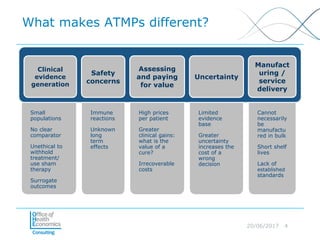
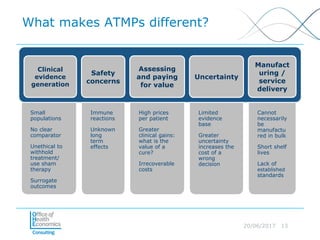
What makes ATMPs different?
Clinical
evidence
generation
Small
populations
No clear
comparator
Unethical to
withhold
treatment/
use sham
therapy
Surrogate
outcomes
Safety
concerns
Immune
reactions
Unknown
long
term
effects
Assessing
and paying
for value
High prices
per patient
Greater
clinical gains:
what is the
value of a
cure?
Irrecoverable
costs
Uncertainty
Limited
evidence
base
Greater
uncertainty
increases the
cost of a
wrong
decision
Manufact
uring /
service
delivery
Cannot
necessarily
be
manufactu
red in bulk
Short shelf
lives
Lack of
established
standards
20/06/2017 5
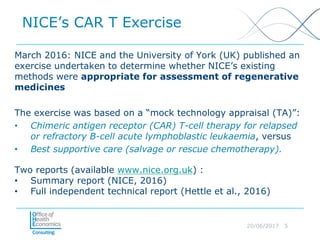
NICE’s CAR T Exercise
March 2016: NICE and the University of York (UK) published an
exercise undertaken to determine whether NICE’s existing
methods were appropriate for assessment of regenerative
medicines
The exercise was based on a “mock technology appraisal (TA)”:
• Chimeric antigen receptor (CAR) T-cell therapy for relapsed
or refractory B-cell acute lymphoblastic leukaemia, versus
• Best supportive care (salvage or rescue chemotherapy).
Two reports (available www.nice.org.uk) :
• Summary report (NICE, 2016)
• Full independent technical report (Hettle et al., 2016)
20/06/2017 6
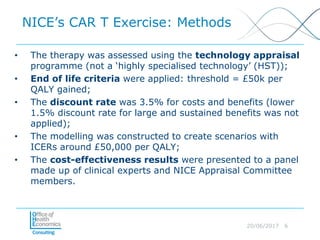
NICE’s CAR T Exercise: Methods
• The therapy was assessed using the technology appraisal
programme (not a ‘highly specialised technology’ (HST));
• End of life criteria were applied: threshold = £50k per
QALY gained;
• The discount rate was 3.5% for costs and benefits (lower
1.5% discount rate for large and sustained benefits was not
applied);
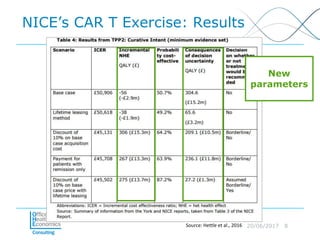
• The modelling was constructed to create scenarios with
ICERs around £50,000 per QALY;
• The cost-effectiveness results were presented to a panel
made up of clinical experts and NICE Appraisal Committee
members.
20/06/2017 7
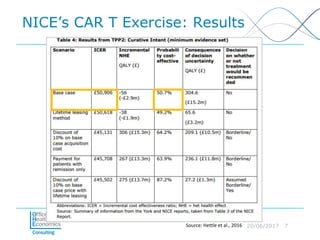
NICE’s CAR T Exercise: Results
Source: Hettle et al., 2016
20/06/2017 8
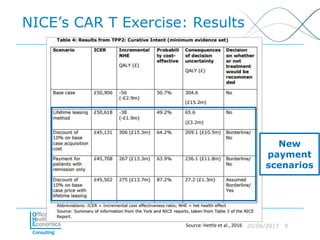
NICE’s CAR T Exercise: Results
Source: Hettle et al., 2016
New
parameters
20/06/2017 9
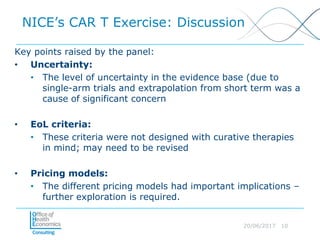
NICE’s CAR T Exercise: Results
Source: Hettle et al., 2016
New
payment
scenarios
20/06/2017 10
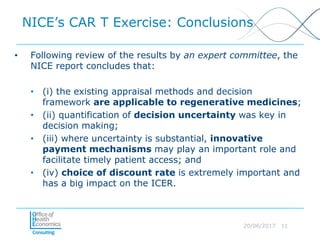
NICE’s CAR T Exercise: Discussion
Key points raised by the panel:
• Uncertainty:
• The level of uncertainty in the evidence base (due to
single-arm trials and extrapolation from short term was a
cause of significant concern
• EoL criteria:
• These criteria were not designed with curative therapies
in mind; may need to be revised
• Pricing models:
• The different pricing models had important implications –
further exploration is required.
20/06/2017 11
NICE’s CAR T Exercise: Conclusions
• Following review of the results by an expert committee, the
NICE report concludes that:
• (i) the existing appraisal methods and decision
framework are applicable to regenerative medicines;
• (ii) quantification of decision uncertainty was key in
decision making;
• (iii) where uncertainty is substantial, innovative
payment mechanisms may play an important role and
facilitate timely patient access; and
• (iv) choice of discount rate is extremely important and
has a big impact on the ICER.
20/06/2017 12
OHE’s review: remit & technology
NICE’s exercise did not attempt to:
• Investigate any new methods
• Explore the most appropriate assessment pathway for
regenerative medicines
Choice of technology:
• Choice of technology was critical: the purpose was to
review the process for regenerative medicines generally;
• Not all possible issues for regenerative medicines were
considered in the context of the CAR T-cell exercise: rare
disease, unmet need (no comparator in the UK NHS),
variability due to surgical protocol, ethical issues…
20/06/2017 13
What makes ATMPs different?
Clinical
evidence
generation
Small
populations
No clear
comparator
Unethical to
withhold
treatment/
use sham
therapy
Surrogate
outcomes
Safety
concerns
Immune
reactions
Unknown
long
term
effects
Assessing
and paying
for value
High prices
per patient
Greater
clinical gains:
what is the
value of a
cure?
Irrecoverable
costs
Uncertainty
Limited
evidence
base
Greater
uncertainty
increases the
cost of a
wrong
decision
Manufact
uring /
service
delivery
Cannot
necessarily
be
manufactu
red in bulk
Short shelf
lives
Lack of
established
standards
20/06/2017 14
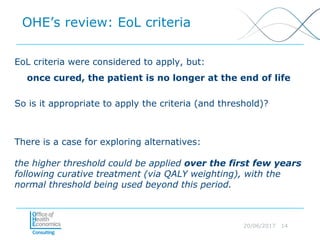
EoL criteria were considered to apply, but:
once cured, the patient is no longer at the end of life
So is it appropriate to apply the criteria (and threshold)?
There is a case for exploring alternatives:
the higher threshold could be applied over the first few years
following curative treatment (via QALY weighting), with the
normal threshold being used beyond this period.
OHE’s review: EoL criteria
20/06/2017 15
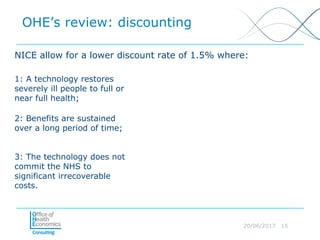
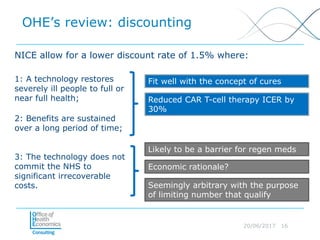
OHE’s review: discounting
NICE allow for a lower discount rate of 1.5% where:
1: A technology restores
severely ill people to full or
near full health;
2: Benefits are sustained
over a long period of time;
3: The technology does not
commit the NHS to
significant irrecoverable
costs.
20/06/2017 16
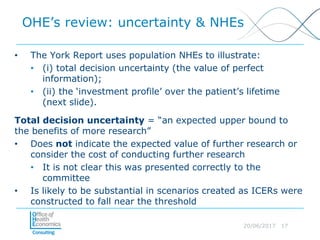
OHE’s review: discounting
NICE allow for a lower discount rate of 1.5% where:
1: A technology restores
severely ill people to full or
near full health;
2: Benefits are sustained
over a long period of time;
3: The technology does not
commit the NHS to
significant irrecoverable
costs.
Fit well with the concept of cures
Reduced CAR T-cell therapy ICER by
30%
Likely to be a barrier for regen meds
Economic rationale?
Seemingly arbitrary with the purpose
of limiting number that qualify
20/06/2017 17
OHE’s review: uncertainty & NHEs
• The York Report uses population NHEs to illustrate:
• (i) total decision uncertainty (the value of perfect
information);
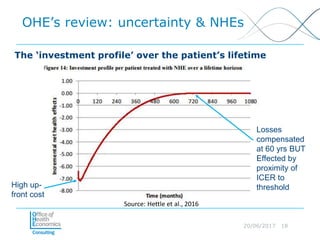
• (ii) the ‘investment profile’ over the patient’s lifetime
(next slide).
Total decision uncertainty = “an expected upper bound to
the benefits of more research”
• Does not indicate the expected value of further research or
consider the cost of conducting further research
• It is not clear this was presented correctly to the
committee
• Is likely to be substantial in scenarios created as ICERs were
constructed to fall near the threshold
20/06/2017 18
OHE’s review: uncertainty & NHEs
The ‘investment profile’ over the patient’s lifetime
Losses
compensated
at 60 yrs BUT
Effected by
proximity of
ICER to
thresholdHigh up-
front cost
Source: Hettle et al., 2016
20/06/2017 19
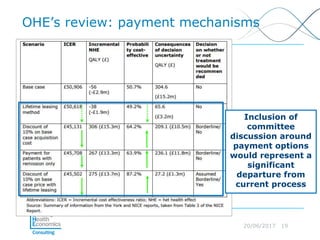
OHE’s review: payment mechanisms
Inclusion of
committee
discussion around
payment options
would represent a
significant
departure from
current process
20/06/2017 20
Areas for further research
• Further analyses which explore possible issues for
regenerative medicines that were not explored through the
CAR T exercise
• Exploration of the value of a cure (societal preferences)
• The question around whether EoL criteria should apply to
curative therapies – need to revisit conceptual basis
• Appropriate characterisation and handling of
uncertainty – NICE have some separate work underway
• Concept of population NHEs – what do they add?
• The rationale for the ‘irreversibilities’ clause for use of the
1.5% discount rate.
20/06/2017 21
Summary
• NICE’s exercise was a thorough and informative mock
appraisal of CAR T-cell therapy
• However:
• It did not explore all issues that will be faced by
regenerative medicines
• It did not explore the most appropriate referral pathway
for regenerative medicines
• Presentation of uncertainty may have been misleading for
the committee
• We have proposed a series of areas where additional
research would be helpful in clarifying the issues raised.
20/06/2017 22
Contacts
To enquire about additional information and analyses, please contact
Grace Hampson at ghampson@ohe.org
To keep up with the latest news and research, subscribe to our blog, OHE News
Follow us on Twitter @OHENews, LinkedIn and SlideShare
OHE Consulting Ltd
Southside, 7th Floor
105 Victoria Street
London SW1E 6QT
United Kingdom
+44 20 7747 8850
www.ohe.org
OHE’s publications may be downloaded free of charge in our website.

Advanced Therapy Medicinal Products: Are Current HTA Methods Suitable?

  • 1.
    Advanced Therapy Medicinal Products:Are Current HTA Methods Suitable? Grace Hampson & Adrian Towse 20 June 2017
  • 2.
    20/06/2017 2 Acknowledgements Acknowledgements: Thiswork was funded by Pfizer. The authors are grateful to members of the Pfizer team who provided comments on the report. Full report available free of charge at ohe.org.
  • 3.
    20/06/2017 3 Advanced TherapyMedicinal Products • European Medicines Agency definition: “A medicine for human use that is based on genes, cells or tissue engineering.” • Referred to as ATMPs • Related terms: • Regenerative medicine • Cell therapy • Gene therapy
  • 4.
    20/06/2017 4 What makesATMPs different? Clinical evidence generation Small populations No clear comparator Unethical to withhold treatment/ use sham therapy Surrogate outcomes Safety concerns Immune reactions Unknown long term effects Assessing and paying for value High prices per patient Greater clinical gains: what is the value of a cure? Irrecoverable costs Uncertainty Limited evidence base Greater uncertainty increases the cost of a wrong decision Manufact uring / service delivery Cannot necessarily be manufactu red in bulk Short shelf lives Lack of established standards
  • 5.
    20/06/2017 5 NICE’s CART Exercise March 2016: NICE and the University of York (UK) published an exercise undertaken to determine whether NICE’s existing methods were appropriate for assessment of regenerative medicines The exercise was based on a “mock technology appraisal (TA)”: • Chimeric antigen receptor (CAR) T-cell therapy for relapsed or refractory B-cell acute lymphoblastic leukaemia, versus • Best supportive care (salvage or rescue chemotherapy). Two reports (available www.nice.org.uk) : • Summary report (NICE, 2016) • Full independent technical report (Hettle et al., 2016)
  • 6.
    20/06/2017 6 NICE’s CART Exercise: Methods • The therapy was assessed using the technology appraisal programme (not a ‘highly specialised technology’ (HST)); • End of life criteria were applied: threshold = £50k per QALY gained; • The discount rate was 3.5% for costs and benefits (lower 1.5% discount rate for large and sustained benefits was not applied); • The modelling was constructed to create scenarios with ICERs around £50,000 per QALY; • The cost-effectiveness results were presented to a panel made up of clinical experts and NICE Appraisal Committee members.
  • 7.
    20/06/2017 7 NICE’s CART Exercise: Results Source: Hettle et al., 2016
  • 8.
    20/06/2017 8 NICE’s CART Exercise: Results Source: Hettle et al., 2016 New parameters
  • 9.
    20/06/2017 9 NICE’s CART Exercise: Results Source: Hettle et al., 2016 New payment scenarios
  • 10.
    20/06/2017 10 NICE’s CART Exercise: Discussion Key points raised by the panel: • Uncertainty: • The level of uncertainty in the evidence base (due to single-arm trials and extrapolation from short term was a cause of significant concern • EoL criteria: • These criteria were not designed with curative therapies in mind; may need to be revised • Pricing models: • The different pricing models had important implications – further exploration is required.
  • 11.
    20/06/2017 11 NICE’s CART Exercise: Conclusions • Following review of the results by an expert committee, the NICE report concludes that: • (i) the existing appraisal methods and decision framework are applicable to regenerative medicines; • (ii) quantification of decision uncertainty was key in decision making; • (iii) where uncertainty is substantial, innovative payment mechanisms may play an important role and facilitate timely patient access; and • (iv) choice of discount rate is extremely important and has a big impact on the ICER.
  • 12.
    20/06/2017 12 OHE’s review:remit & technology NICE’s exercise did not attempt to: • Investigate any new methods • Explore the most appropriate assessment pathway for regenerative medicines Choice of technology: • Choice of technology was critical: the purpose was to review the process for regenerative medicines generally; • Not all possible issues for regenerative medicines were considered in the context of the CAR T-cell exercise: rare disease, unmet need (no comparator in the UK NHS), variability due to surgical protocol, ethical issues…
  • 13.
    20/06/2017 13 What makesATMPs different? Clinical evidence generation Small populations No clear comparator Unethical to withhold treatment/ use sham therapy Surrogate outcomes Safety concerns Immune reactions Unknown long term effects Assessing and paying for value High prices per patient Greater clinical gains: what is the value of a cure? Irrecoverable costs Uncertainty Limited evidence base Greater uncertainty increases the cost of a wrong decision Manufact uring / service delivery Cannot necessarily be manufactu red in bulk Short shelf lives Lack of established standards
  • 14.
    20/06/2017 14 EoL criteriawere considered to apply, but: once cured, the patient is no longer at the end of life So is it appropriate to apply the criteria (and threshold)? There is a case for exploring alternatives: the higher threshold could be applied over the first few years following curative treatment (via QALY weighting), with the normal threshold being used beyond this period. OHE’s review: EoL criteria
  • 15.
    20/06/2017 15 OHE’s review:discounting NICE allow for a lower discount rate of 1.5% where: 1: A technology restores severely ill people to full or near full health; 2: Benefits are sustained over a long period of time; 3: The technology does not commit the NHS to significant irrecoverable costs.
  • 16.
    20/06/2017 16 OHE’s review:discounting NICE allow for a lower discount rate of 1.5% where: 1: A technology restores severely ill people to full or near full health; 2: Benefits are sustained over a long period of time; 3: The technology does not commit the NHS to significant irrecoverable costs. Fit well with the concept of cures Reduced CAR T-cell therapy ICER by 30% Likely to be a barrier for regen meds Economic rationale? Seemingly arbitrary with the purpose of limiting number that qualify
  • 17.
    20/06/2017 17 OHE’s review:uncertainty & NHEs • The York Report uses population NHEs to illustrate: • (i) total decision uncertainty (the value of perfect information); • (ii) the ‘investment profile’ over the patient’s lifetime (next slide). Total decision uncertainty = “an expected upper bound to the benefits of more research” • Does not indicate the expected value of further research or consider the cost of conducting further research • It is not clear this was presented correctly to the committee • Is likely to be substantial in scenarios created as ICERs were constructed to fall near the threshold
  • 18.
    20/06/2017 18 OHE’s review:uncertainty & NHEs The ‘investment profile’ over the patient’s lifetime Losses compensated at 60 yrs BUT Effected by proximity of ICER to thresholdHigh up- front cost Source: Hettle et al., 2016
  • 19.
    20/06/2017 19 OHE’s review:payment mechanisms Inclusion of committee discussion around payment options would represent a significant departure from current process
  • 20.
    20/06/2017 20 Areas forfurther research • Further analyses which explore possible issues for regenerative medicines that were not explored through the CAR T exercise • Exploration of the value of a cure (societal preferences) • The question around whether EoL criteria should apply to curative therapies – need to revisit conceptual basis • Appropriate characterisation and handling of uncertainty – NICE have some separate work underway • Concept of population NHEs – what do they add? • The rationale for the ‘irreversibilities’ clause for use of the 1.5% discount rate.
  • 21.
    20/06/2017 21 Summary • NICE’sexercise was a thorough and informative mock appraisal of CAR T-cell therapy • However: • It did not explore all issues that will be faced by regenerative medicines • It did not explore the most appropriate referral pathway for regenerative medicines • Presentation of uncertainty may have been misleading for the committee • We have proposed a series of areas where additional research would be helpful in clarifying the issues raised.
  • 22.
    20/06/2017 22 Contacts To enquireabout additional information and analyses, please contact Grace Hampson at ghampson@ohe.org To keep up with the latest news and research, subscribe to our blog, OHE News Follow us on Twitter @OHENews, LinkedIn and SlideShare OHE Consulting Ltd Southside, 7th Floor 105 Victoria Street London SW1E 6QT United Kingdom +44 20 7747 8850 www.ohe.org OHE’s publications may be downloaded free of charge in our website.