MG 220 Marketing Management
BBA 09 – Sec C
Fall 2010
Muhammad Talha Salam, Asst. Professor
talha.salam@nu.edu.pk
Access it online: www.slideshare.net/talhasalam
Part 6:
Delivering Value
> Marketing Channels and Value Networks
> The Role of Marketing Channels: SKIM
> Channel-Design decisions
> Channel-Management decisions: SKIM
Class Presentation | Session 25 | 10 Nov 2010
Access it online: www.slideshare.net/talhasalam
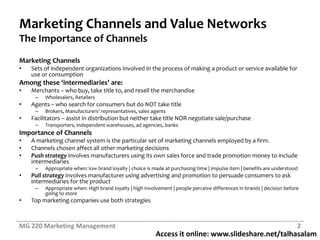
Marketing Channels and Value Networks
The Importance of Channels
Marketing Channels
• Sets of independent organizations involved in the process of making a product or service available for
use or consumption
Among these ‘intermediaries’ are:
• Merchants – who buy, take title to, and resell the merchandise
– Wholesalers, Retailers
• Agents – who search for consumers but do NOT take title
– Brokers, Manufacturers’ representatives, sales agents
• Facilitators – assist in distribution but neither take title NOR negotiate sale/purchase
– Transporters, independent warehouses, ad agencies, banks
Importance of Channels
• A marketing channel system is the particular set of marketing channels employed by a firm.
• Channels chosen affect all other marketing decisions
• Push strategy involves manufacturers using its own sales force and trade promotion money to include
intermediaries
– Appropriate when: low brand loyalty | choice is made at purchasing time | impulse item | benefits are understood
• Pull strategy involves manufacturer using advertising and promotion to persuade consumers to ask
intermediaries for the product
– Appr0priate when: High brand loyalty | high involvement | people perceive differences in brands | decision before
going to store
• Top marketing companies use both strategies
MG 220 Marketing Management 2
Access it online: www.slideshare.net/talhasalam
Marketing Channels and Value Networks
Channel Development
• A new firm typically is a local/limited operation selling in a limited market
• As it grows, it moves in new markets and that is where it needs new partners to sell for it
• Channel system evolves in response to local opportunities
Hybrid channels
• Consider IBM, Dell, Microsoft
• Selling online (self), through retailers (intermediaries) – CONSUMERS
• Selling using sales force (own) – INSTITUTIONAL SELLING
• All operate parallel and in one market
• Ensuring Channel Integration – consumers would want channels to be working together
• Also understanding different needs of customers:
• Habitual shoppers | High value deal seekers | Variety-loving shoppers | High-involvement shoppers
MG 220 Marketing Management 3
Access it online: www.slideshare.net/talhasalam
Marketing Channels and Value Networks
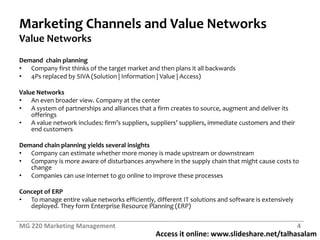
Value Networks
Demand chain planning
• Company first thinks of the target market and then plans it all backwards
• 4Ps replaced by SIVA (Solution | Information | Value | Access)
Value Networks
• An even broader view. Company at the center
• A system of partnerships and alliances that a firm creates to source, augment and deliver its
offerings
• A value network includes: firm’s suppliers, suppliers’ suppliers, immediate customers and their
end customers
Demand chain planning yields several insights
• Company can estimate whether more money is made upstream or downstream
• Company is more aware of disturbances anywhere in the supply chain that might cause costs to
change
• Companies can use internet to go online to improve these processes
Concept of ERP
• To manage entire value networks efficiently, different IT solutions and software is extensively
deployed. They form Enterprise Resource Planning (ERP)
MG 220 Marketing Management 4
Access it online: www.slideshare.net/talhasalam
The Role of Marketing Channels
Concept
Why delegate the ‘selling job’?
• Many producers lack the financial resources to carry out direct marketing
• Producers who do establish their own channels can often earn a greater return
by increasing investment in their own business (EXAMPLE)
• In some cases direct marketing simply is not feasible
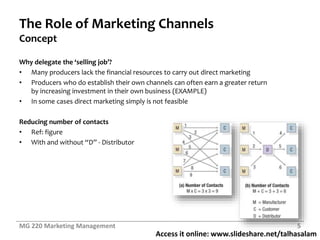
Reducing number of contacts
• Ref: figure
• With and without “D” - Distributor
MG 220 Marketing Management 5
Access it online: www.slideshare.net/talhasalam
The Role of Marketing Channels
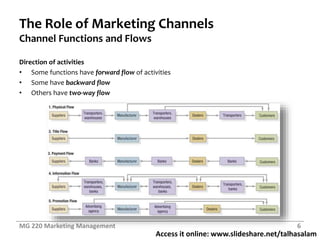
Channel Functions and Flows
Direction of activities
• Some functions have forward flow of activities
• Some have backward flow
• Others have two-way flow
MG 220 Marketing Management 6
Access it online: www.slideshare.net/talhasalam
The Role of Marketing Channels
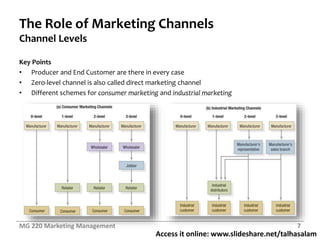
Channel Levels
Key Points
• Producer and End Customer are there in every case
• Zero-level channel is also called direct marketing channel
• Different schemes for consumer marketing and industrial marketing
MG 220 Marketing Management 7
Access it online: www.slideshare.net/talhasalam
Channel-Design Decisions
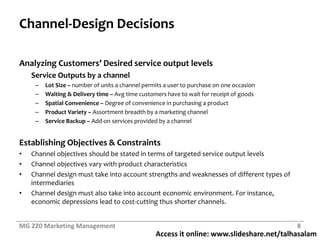
Analyzing Customers’ Desired service output levels
Service Outputs by a channel
– Lot Size – number of units a channel permits a user to purchase on one occasion
– Waiting & Delivery time – Avg time customers have to wait for receipt of goods
– Spatial Convenience – Degree of convenience in purchasing a product
– Product Variety – Assortment breadth by a marketing channel
– Service Backup – Add-on services provided by a channel
Establishing Objectives & Constraints
• Channel objectives should be stated in terms of targeted service output levels
• Channel objectives vary with product characteristics
• Channel design must take into account strengths and weaknesses of different types of
intermediaries
• Channel design must also take into account economic environment. For instance,
economic depressions lead to cost-cutting thus shorter channels.
MG 220 Marketing Management 8
Access it online: www.slideshare.net/talhasalam
Channel-Design Decisions
Identifying Major Channel Alternatives
Decisions of choosing from a wide variety of channels for reaching customers
Elements for describing channel alternative:
• Type of Intermediaries
– Decisions regarding what type of intermediaries shall be used
– Retailers or OEMs
• Number of Intermediaries
– Exclusive Distribution
– Selective Distribution
– Intensive Distribution
• Terms and responsibilities of each channel member
– Price Policy calls
– Conditions of sale
– Distributors’ territorial rights
– Mutual services and responsibilities
MG 220 Marketing Management 9
Access it online: www.slideshare.net/talhasalam
Channel-Management Decisions
After choosing, individual intermediaries need to be trained, motivated and
evaluated
• Selecting Channel Members
• Training Channel Members
• Motivating Channel Members
– Channel Power – ability to alter channel members’ behavior
– Coercive Power
– Reward Power
– Legitimate Power
– Expert Power
– Referent Power – how strongly members would like to be associated with the partner
MG 220 Marketing Management 10
MG 220 Marketing Management
BBA 09 – Sec C
Fall 2010
Muhammad Talha Salam, Asst. Professor
talha.salam@nu.edu.pk
Access it online: www.slideshare.net/talhasalam
Part 6:
Delivering Value
> Channel integration and systems: SKIM
> E-Commerce Marketing Practices: SKIM
> Retailing
> Private Labels
> Wholesaling
> Market Logistics: SKIM
Class Presentation | Session 26 | 15 Nov 2010

Session 25 MG 220 BBA - 10 Nov 10

  • 1.
    MG 220 MarketingManagement BBA 09 – Sec C Fall 2010 Muhammad Talha Salam, Asst. Professor talha.salam@nu.edu.pk Access it online: www.slideshare.net/talhasalam Part 6: Delivering Value > Marketing Channels and Value Networks > The Role of Marketing Channels: SKIM > Channel-Design decisions > Channel-Management decisions: SKIM Class Presentation | Session 25 | 10 Nov 2010
  • 2.
    Access it online:www.slideshare.net/talhasalam Marketing Channels and Value Networks The Importance of Channels Marketing Channels • Sets of independent organizations involved in the process of making a product or service available for use or consumption Among these ‘intermediaries’ are: • Merchants – who buy, take title to, and resell the merchandise – Wholesalers, Retailers • Agents – who search for consumers but do NOT take title – Brokers, Manufacturers’ representatives, sales agents • Facilitators – assist in distribution but neither take title NOR negotiate sale/purchase – Transporters, independent warehouses, ad agencies, banks Importance of Channels • A marketing channel system is the particular set of marketing channels employed by a firm. • Channels chosen affect all other marketing decisions • Push strategy involves manufacturers using its own sales force and trade promotion money to include intermediaries – Appropriate when: low brand loyalty | choice is made at purchasing time | impulse item | benefits are understood • Pull strategy involves manufacturer using advertising and promotion to persuade consumers to ask intermediaries for the product – Appr0priate when: High brand loyalty | high involvement | people perceive differences in brands | decision before going to store • Top marketing companies use both strategies MG 220 Marketing Management 2
  • 3.
    Access it online:www.slideshare.net/talhasalam Marketing Channels and Value Networks Channel Development • A new firm typically is a local/limited operation selling in a limited market • As it grows, it moves in new markets and that is where it needs new partners to sell for it • Channel system evolves in response to local opportunities Hybrid channels • Consider IBM, Dell, Microsoft • Selling online (self), through retailers (intermediaries) – CONSUMERS • Selling using sales force (own) – INSTITUTIONAL SELLING • All operate parallel and in one market • Ensuring Channel Integration – consumers would want channels to be working together • Also understanding different needs of customers: • Habitual shoppers | High value deal seekers | Variety-loving shoppers | High-involvement shoppers MG 220 Marketing Management 3
  • 4.
    Access it online:www.slideshare.net/talhasalam Marketing Channels and Value Networks Value Networks Demand chain planning • Company first thinks of the target market and then plans it all backwards • 4Ps replaced by SIVA (Solution | Information | Value | Access) Value Networks • An even broader view. Company at the center • A system of partnerships and alliances that a firm creates to source, augment and deliver its offerings • A value network includes: firm’s suppliers, suppliers’ suppliers, immediate customers and their end customers Demand chain planning yields several insights • Company can estimate whether more money is made upstream or downstream • Company is more aware of disturbances anywhere in the supply chain that might cause costs to change • Companies can use internet to go online to improve these processes Concept of ERP • To manage entire value networks efficiently, different IT solutions and software is extensively deployed. They form Enterprise Resource Planning (ERP) MG 220 Marketing Management 4
  • 5.
    Access it online:www.slideshare.net/talhasalam The Role of Marketing Channels Concept Why delegate the ‘selling job’? • Many producers lack the financial resources to carry out direct marketing • Producers who do establish their own channels can often earn a greater return by increasing investment in their own business (EXAMPLE) • In some cases direct marketing simply is not feasible Reducing number of contacts • Ref: figure • With and without “D” - Distributor MG 220 Marketing Management 5
  • 6.
    Access it online:www.slideshare.net/talhasalam The Role of Marketing Channels Channel Functions and Flows Direction of activities • Some functions have forward flow of activities • Some have backward flow • Others have two-way flow MG 220 Marketing Management 6
  • 7.
    Access it online:www.slideshare.net/talhasalam The Role of Marketing Channels Channel Levels Key Points • Producer and End Customer are there in every case • Zero-level channel is also called direct marketing channel • Different schemes for consumer marketing and industrial marketing MG 220 Marketing Management 7
  • 8.
    Access it online:www.slideshare.net/talhasalam Channel-Design Decisions Analyzing Customers’ Desired service output levels Service Outputs by a channel – Lot Size – number of units a channel permits a user to purchase on one occasion – Waiting & Delivery time – Avg time customers have to wait for receipt of goods – Spatial Convenience – Degree of convenience in purchasing a product – Product Variety – Assortment breadth by a marketing channel – Service Backup – Add-on services provided by a channel Establishing Objectives & Constraints • Channel objectives should be stated in terms of targeted service output levels • Channel objectives vary with product characteristics • Channel design must take into account strengths and weaknesses of different types of intermediaries • Channel design must also take into account economic environment. For instance, economic depressions lead to cost-cutting thus shorter channels. MG 220 Marketing Management 8
  • 9.
    Access it online:www.slideshare.net/talhasalam Channel-Design Decisions Identifying Major Channel Alternatives Decisions of choosing from a wide variety of channels for reaching customers Elements for describing channel alternative: • Type of Intermediaries – Decisions regarding what type of intermediaries shall be used – Retailers or OEMs • Number of Intermediaries – Exclusive Distribution – Selective Distribution – Intensive Distribution • Terms and responsibilities of each channel member – Price Policy calls – Conditions of sale – Distributors’ territorial rights – Mutual services and responsibilities MG 220 Marketing Management 9
  • 10.
    Access it online:www.slideshare.net/talhasalam Channel-Management Decisions After choosing, individual intermediaries need to be trained, motivated and evaluated • Selecting Channel Members • Training Channel Members • Motivating Channel Members – Channel Power – ability to alter channel members’ behavior – Coercive Power – Reward Power – Legitimate Power – Expert Power – Referent Power – how strongly members would like to be associated with the partner MG 220 Marketing Management 10
  • 11.
    MG 220 MarketingManagement BBA 09 – Sec C Fall 2010 Muhammad Talha Salam, Asst. Professor talha.salam@nu.edu.pk Access it online: www.slideshare.net/talhasalam Part 6: Delivering Value > Channel integration and systems: SKIM > E-Commerce Marketing Practices: SKIM > Retailing > Private Labels > Wholesaling > Market Logistics: SKIM Class Presentation | Session 26 | 15 Nov 2010