Social Media Marketing Ref: 		CHAP 5 		Online Marketing Inside Out by SitePoint		CHAP 8 & 9	Textbook on E-Marketing by Quirk Biz> Rules of Engagement for Social Media[Types of social media]> Blogging> Social Networking sitesClass Presentation | Session 27 | 26 Nov 2010
Rules of Engagement for Social MediaMarketing to Content CreatorsContent creators e.g. bloggers are part of PR team for the company because they are promoting the company/brandTheir influence helps in creating right kind of PRFacilitating bloggers by providing them info and toolsMarketing to Content ConsumersBoth companies and content consumers have same tools availableSelection of media is dependent on where consumers areE-Marketing2
Rules of Engagement for Social MediaMarketing to Content SharersMaking it easy for users to share contentUsing simple, unique URLs, links etc to make it easy sharingNew trends…Advertising on Social platformsSocial Media networks gather users’ personal informationIt can be used for better targeting in advertisingAlso creativity required to reach demographic which is already ad fatiguedE-Marketing3
Rules of Engagement for Social MediaUnderstand the benefits[ Review of points earlier discussed: Self-Read from Quirk/Textbook on E-Marketing]E-Marketing4
Rules of Engagement for Social MediaAgency’s role is Social Media[Class Discussion]How does a typical ad agency works? (in Pakistan and also elsewhere)How and why it is different in case of Social Media?Who can do it? What is required? Everyone?E-Marketing5
BloggingBlogging definedOriginated from Web LogA blog is a web site where entries (blog posts) are typically displayed in reverse chronological order. Technorati, a blog and social media tracking engine, defines a blog as a “regularly updated journal published on the web.” Blogs usually allow for comments on blog posts. A typical blog will feature text, images and links to other blogs and web sites related to the topic of the blog.POWER?ANYONE CAN DO IT….E-Marketing6
BloggingBasic Elements of BlogAuthor – the person who wrote the blog post.Blog post title – the title of the blog post, which is usually used to create a unique URL, or permalink, for the blog post.Tag – tags are the categories used to describe the blog post, and aid services in categorizing blog posts.Comment – comments left by readers of the blog are shown with the blog post.TrackBack– a notification of other blogs linking to a post, often displayed below blog post.RSS feed – an RSS feed allows for readers to subscribe easily to the blog.Categories – blog posts can be allocated categories.Blogroll– a collection of links to other blogs or web sites commonly read or used by the blogger.Archives – previous posts remain available for visitors to search through. Archives are usually categorized by date.E-Marketing7
BloggingBlogging and SEO Typical features blogging software have to facilitate SEOEach blog post should be assigned a unique page which can be easily accessed and indexed by the search engines. This is called a permalink.Pages should be able to be tagged with keywords relevant to your SEO strategy.Each post should be able to have its own unique meta data (title, description and key phrases).Social bookmarking functionality should be built in.E-Marketing8
BloggingBlogging for Business – Corporate BloggingTypical tasksWriting postsReplying to comments from readersMonitoring other blogs within the industryKeeping up to date with the latest industry newsBuilding relationships with other bloggers in the communityCommenting on other blogsCorporate Blog content should be:Industry relevantAppealing to target marketTransparent and honestPersonal and entertainingRelated to what’s going on in the blogospherePosted regularlyE-Marketing9
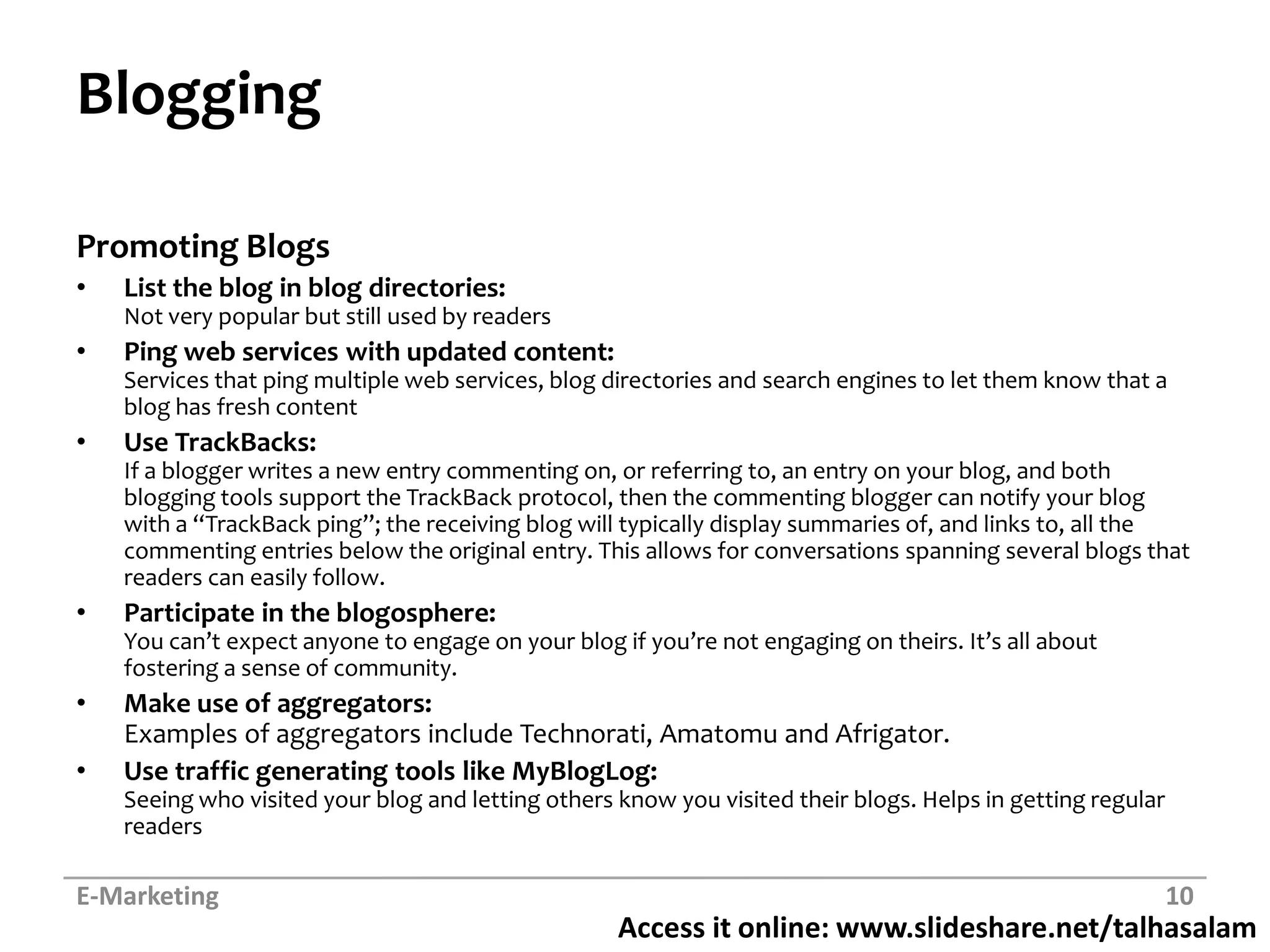
BloggingPromoting BlogsList the blog in blog directories: Not very popular but still used by readersPing web services with updated content: Services that ping multiple web services, blog directories and search engines to let them know that a blog has fresh contentUse TrackBacks: If a blogger writes a new entry commenting on, or referring to, an entry on your blog, and both blogging tools support the TrackBackprotocol, then the commenting blogger can notify your blog with a “TrackBackping”; the receiving blog will typically display summaries of, and links to, all the commenting entries below the original entry. This allows for conversations spanning several blogs that readers can easily follow.Participate in the blogosphere: You can’t expect anyone to engage on your blog if you’re not engaging on theirs. It’s all about fostering a sense of community.Make use of aggregators: Examples of aggregators include Technorati, Amatomuand Afrigator.Use traffic generating tools like MyBlogLog: Seeing who visited your blog and letting others know you visited their blogs. Helps in getting regular readersE-Marketing10
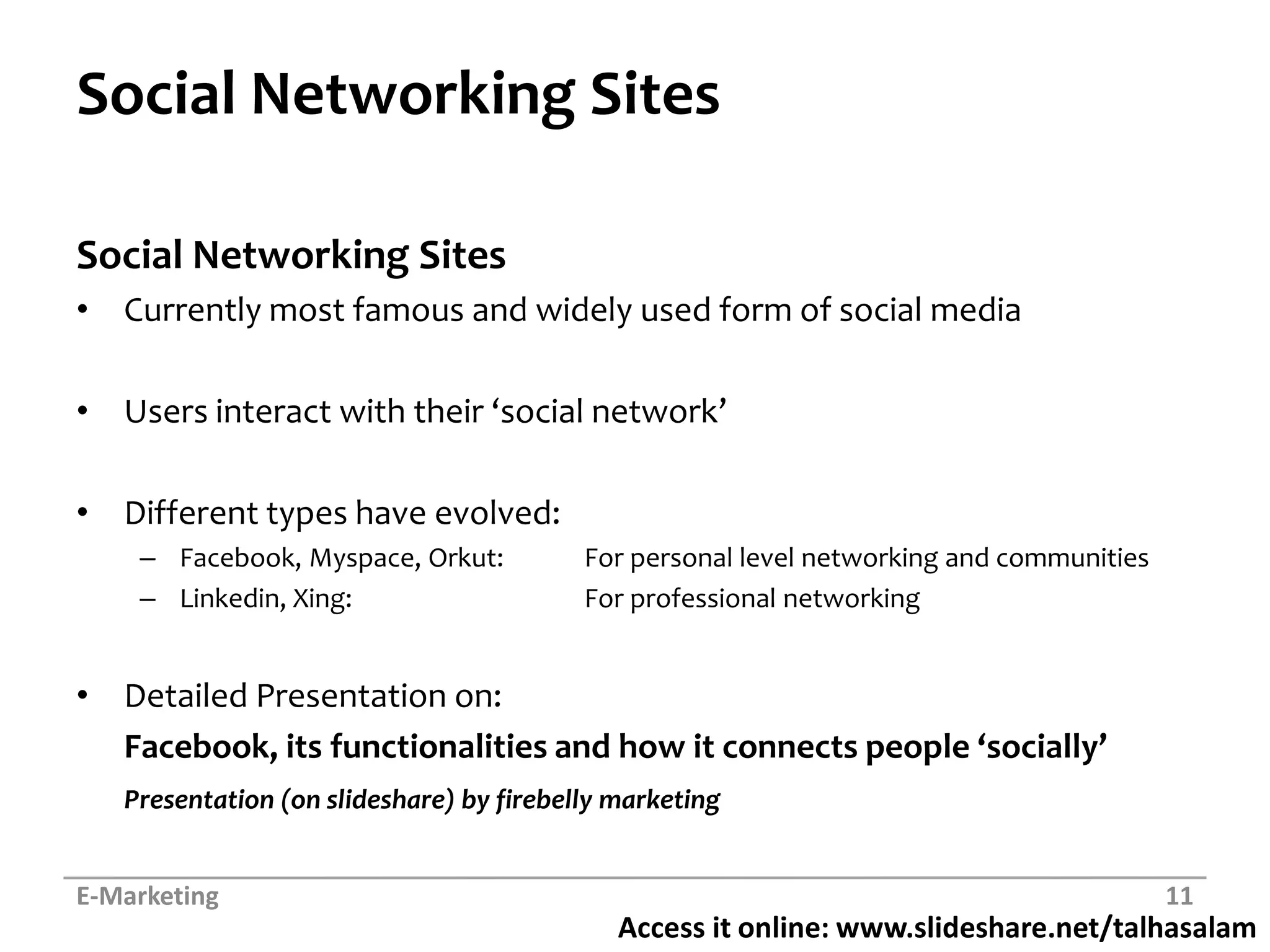
Social Networking SitesSocial Networking SitesCurrently most famous and widely used form of social mediaUsers interact with their ‘social network’Different types have evolved:Facebook, Myspace, Orkut:	For personal level networking and communitiesLinkedin, Xing:		For professional networkingDetailed Presentation on:Facebook, its functionalities and how it connects people ‘socially’Presentation (on slideshare) by firebelly marketingE-Marketing11
Make-Up Session> MAKEUP SESSION> 6x Indl. Presentations> Guest Speaker SessionMedia Mind: Ad Networks & Rich Media Ads> Quiz 5 (Social Media)MKUP SESSIONClass Presentation | Session 28 | 29 Nov 2010

Session 27 emarketing - 26 nov 10

  • 1.
    Social Media MarketingRef: CHAP 5 Online Marketing Inside Out by SitePoint CHAP 8 & 9 Textbook on E-Marketing by Quirk Biz> Rules of Engagement for Social Media[Types of social media]> Blogging> Social Networking sitesClass Presentation | Session 27 | 26 Nov 2010
  • 2.
    Rules of Engagementfor Social MediaMarketing to Content CreatorsContent creators e.g. bloggers are part of PR team for the company because they are promoting the company/brandTheir influence helps in creating right kind of PRFacilitating bloggers by providing them info and toolsMarketing to Content ConsumersBoth companies and content consumers have same tools availableSelection of media is dependent on where consumers areE-Marketing2
  • 3.
    Rules of Engagementfor Social MediaMarketing to Content SharersMaking it easy for users to share contentUsing simple, unique URLs, links etc to make it easy sharingNew trends…Advertising on Social platformsSocial Media networks gather users’ personal informationIt can be used for better targeting in advertisingAlso creativity required to reach demographic which is already ad fatiguedE-Marketing3
  • 4.
    Rules of Engagementfor Social MediaUnderstand the benefits[ Review of points earlier discussed: Self-Read from Quirk/Textbook on E-Marketing]E-Marketing4
  • 5.
    Rules of Engagementfor Social MediaAgency’s role is Social Media[Class Discussion]How does a typical ad agency works? (in Pakistan and also elsewhere)How and why it is different in case of Social Media?Who can do it? What is required? Everyone?E-Marketing5
  • 6.
    BloggingBlogging definedOriginated fromWeb LogA blog is a web site where entries (blog posts) are typically displayed in reverse chronological order. Technorati, a blog and social media tracking engine, defines a blog as a “regularly updated journal published on the web.” Blogs usually allow for comments on blog posts. A typical blog will feature text, images and links to other blogs and web sites related to the topic of the blog.POWER?ANYONE CAN DO IT….E-Marketing6
  • 7.
    BloggingBasic Elements ofBlogAuthor – the person who wrote the blog post.Blog post title – the title of the blog post, which is usually used to create a unique URL, or permalink, for the blog post.Tag – tags are the categories used to describe the blog post, and aid services in categorizing blog posts.Comment – comments left by readers of the blog are shown with the blog post.TrackBack– a notification of other blogs linking to a post, often displayed below blog post.RSS feed – an RSS feed allows for readers to subscribe easily to the blog.Categories – blog posts can be allocated categories.Blogroll– a collection of links to other blogs or web sites commonly read or used by the blogger.Archives – previous posts remain available for visitors to search through. Archives are usually categorized by date.E-Marketing7
  • 8.
    BloggingBlogging and SEOTypical features blogging software have to facilitate SEOEach blog post should be assigned a unique page which can be easily accessed and indexed by the search engines. This is called a permalink.Pages should be able to be tagged with keywords relevant to your SEO strategy.Each post should be able to have its own unique meta data (title, description and key phrases).Social bookmarking functionality should be built in.E-Marketing8
  • 9.
    BloggingBlogging for Business– Corporate BloggingTypical tasksWriting postsReplying to comments from readersMonitoring other blogs within the industryKeeping up to date with the latest industry newsBuilding relationships with other bloggers in the communityCommenting on other blogsCorporate Blog content should be:Industry relevantAppealing to target marketTransparent and honestPersonal and entertainingRelated to what’s going on in the blogospherePosted regularlyE-Marketing9
  • 10.
    BloggingPromoting BlogsList theblog in blog directories: Not very popular but still used by readersPing web services with updated content: Services that ping multiple web services, blog directories and search engines to let them know that a blog has fresh contentUse TrackBacks: If a blogger writes a new entry commenting on, or referring to, an entry on your blog, and both blogging tools support the TrackBackprotocol, then the commenting blogger can notify your blog with a “TrackBackping”; the receiving blog will typically display summaries of, and links to, all the commenting entries below the original entry. This allows for conversations spanning several blogs that readers can easily follow.Participate in the blogosphere: You can’t expect anyone to engage on your blog if you’re not engaging on theirs. It’s all about fostering a sense of community.Make use of aggregators: Examples of aggregators include Technorati, Amatomuand Afrigator.Use traffic generating tools like MyBlogLog: Seeing who visited your blog and letting others know you visited their blogs. Helps in getting regular readersE-Marketing10
  • 11.
    Social Networking SitesSocialNetworking SitesCurrently most famous and widely used form of social mediaUsers interact with their ‘social network’Different types have evolved:Facebook, Myspace, Orkut: For personal level networking and communitiesLinkedin, Xing: For professional networkingDetailed Presentation on:Facebook, its functionalities and how it connects people ‘socially’Presentation (on slideshare) by firebelly marketingE-Marketing11
  • 12.
    Make-Up Session> MAKEUPSESSION> 6x Indl. Presentations> Guest Speaker SessionMedia Mind: Ad Networks & Rich Media Ads> Quiz 5 (Social Media)MKUP SESSIONClass Presentation | Session 28 | 29 Nov 2010