What is International
Integrated Marketing
Communication and
    Advertising?
4


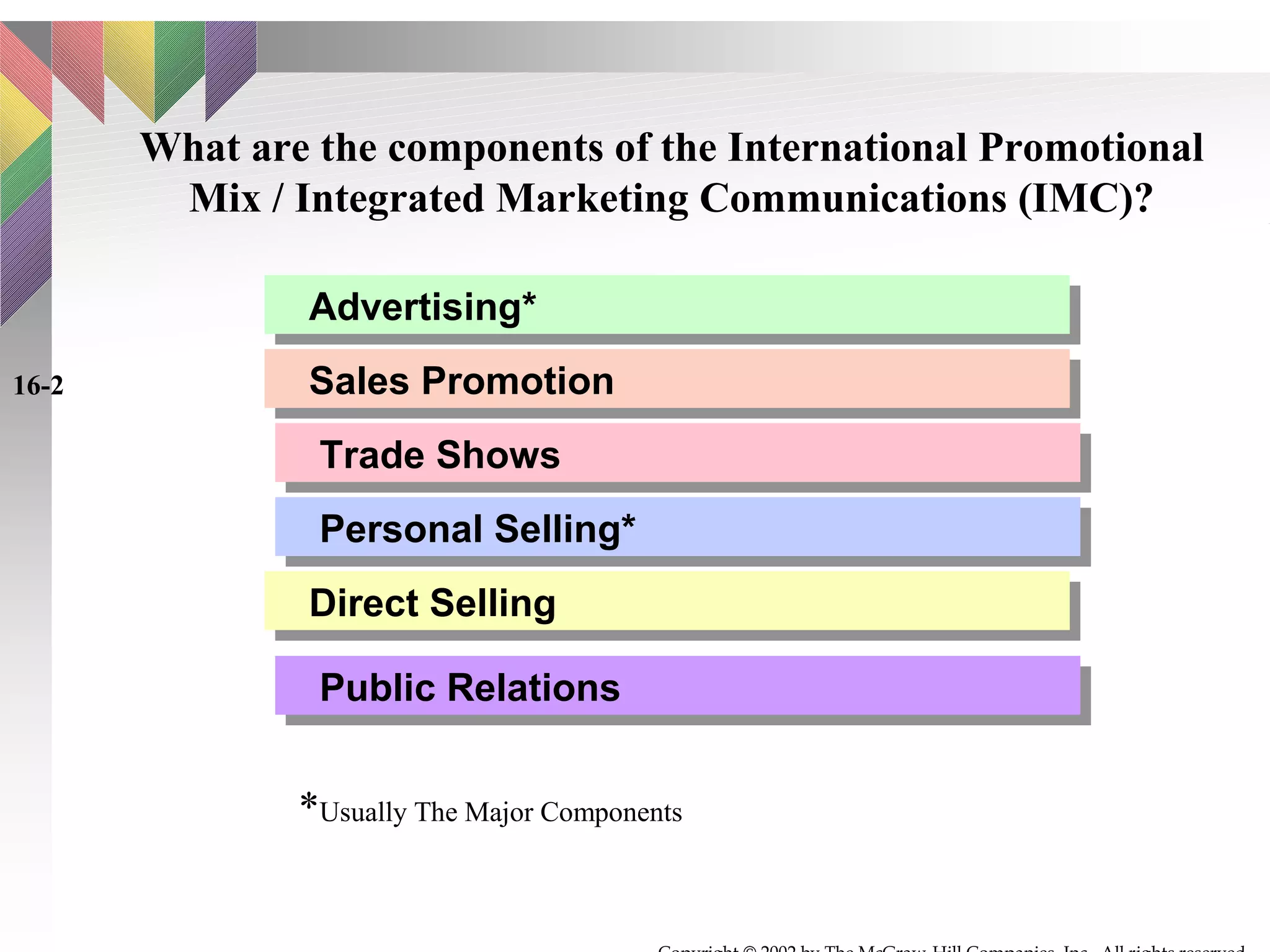
       What are the components of the International Promotional
        Mix / Integrated Marketing Communications (IMC)?

               Advertising*
               Advertising*
16-2           Sales Promotion
               Sales Promotion
                Trade Shows
                Trade Shows
                Personal Selling*
                Personal Selling*
               Direct Selling
               Direct Selling
                Public Relations
                Public Relations

               *Usually The Major Components
Advertising
• Any paid message placed in a medium.
• Nonpersonal communication by an
  identified sponsor across international
  borders, using broadcast, print, and/or
  interactive media
Consumer Sales Promotion
 • Sponsored communications to the
   target consumer or trade segment
   that stimulate purchases or improve
   relationships with middlemen
 • Examples:
   – Point-of-Sale Displays
   – Free Samples
   – Coupons
   – Gifts
   – Sweepstakes
   – Contests
Sales Promotion
• Sales promotions could be a vital tool when introducing a
  product internationally. Sampling or couponing, among
  other promotion strategies, could be a great way to
  introduce the product to an international market. E.g.
  Worked for Tang, General Mill's pre-sweetened orange
  juice mix, in Latin America.
• One barrier to sales promotion is that it requires support
  from local retailers and distributors. Eg, grocery stores
  must be able to cash in coupons that its customers
  redeemed. This entails sending the coupons and
  paperwork to the accounting department of the company
  offering the promotion. This strategy did not work for A.C.
  Neilson in Chile. The Chilean supermarket union
  opposed the coupon incentive and the promotion failed.
International Publicity
A communication about a company
and/or the company’s products that
the company does not pay for.

Can be negative or positive.
International Publicity Examples
  •Due to its independent nature, it is
considered more credible than any other
  component of the promotional mix.
  •The company can influence publicity
through public relations.
  •Publicity includes:
  – Print articles
  – Broadcast messages
  – Word-of-mouth communication about the
    company and/or its products
  – Internet increases publicity venues.
International Public Relations
A concerted effort on the part of a company to
generate good will among publics (community,
government, consumers, employees, and among
others) that are essential to the company.
International Public Relations
          Examples
• News Releases/Letters/Company
  Publications:
  – Companies must regularly communicate with
    their publics.
  – When new products are introduced, companies
    should offer news releases, press releases,
    and/or company publications promoting the new
    product or service.
• Event Sponsorship and Presence:
  – Growing venue for international marketing
    communications.
  – Important tool for shaping public opinion.
International Advertising
            Decisions
1. Decide whether to standardize or
   adapt advertising.
2. Develop the most effective
   message(s) for the market segments
   selected.
3. Select effective media.
4. Compose and secure a budget.
Is this example
of
Standardized
or Adapted
Advertising?


In Italy, where
James Bond is
considered too
uptight, ads
ignored star
and featured a
convict with the
line: “You
better have a
good reason to
miss the next
James Bond
film.”
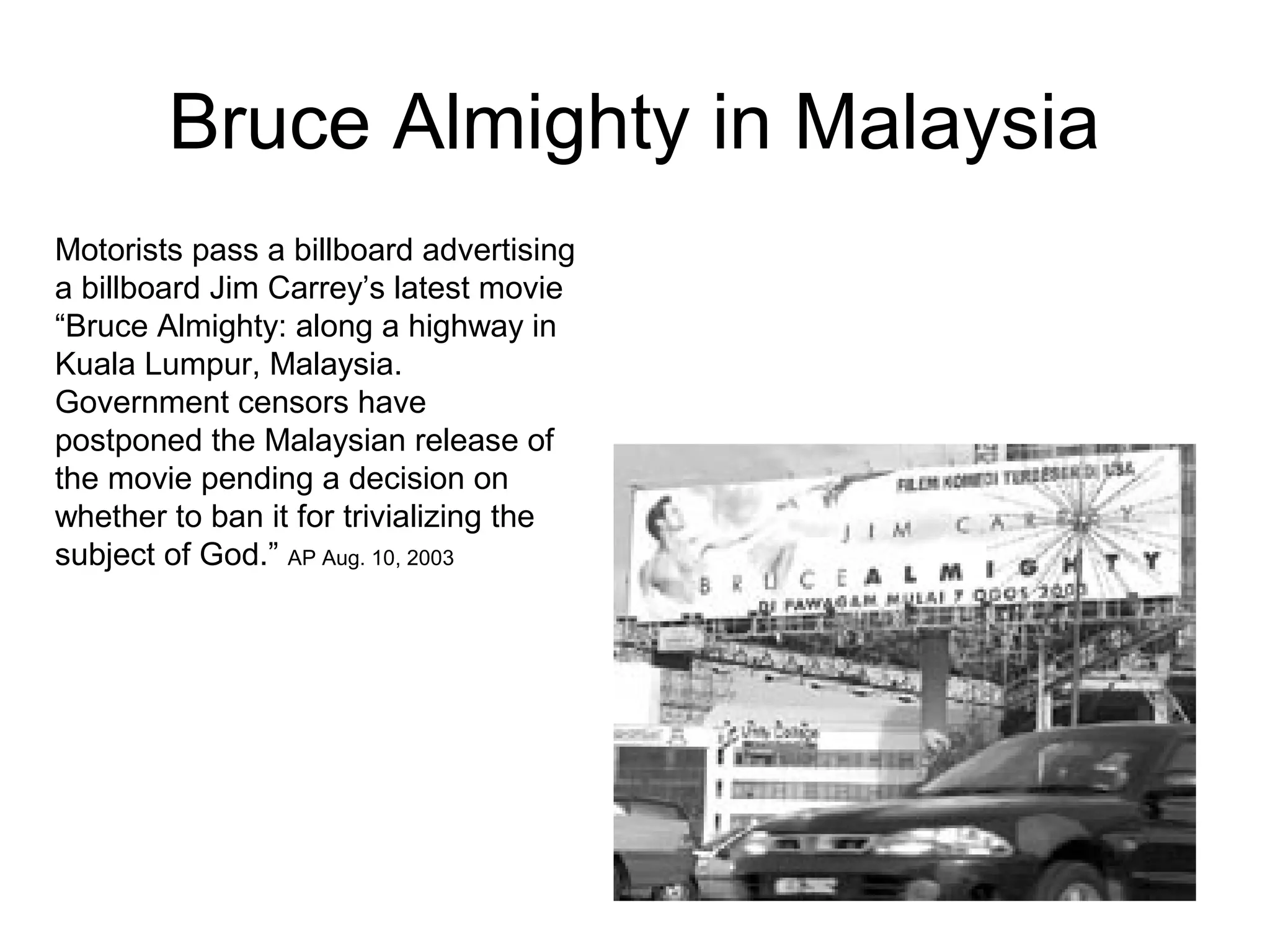
Bruce Almighty in Malaysia
Motorists pass a billboard advertising
a billboard Jim Carrey’s latest movie
“Bruce Almighty: along a highway in
Kuala Lumpur, Malaysia.
Government censors have
postponed the Malaysian release of
the movie pending a decision on
whether to ban it for trivializing the
subject of God.” AP Aug. 10, 2003
Standardize or adapt
            advertising?
• Standardize?
  – Reduce costs
  – Accelerates product launches
  – Consumers preferences and product
    references may becoming more similar
  – Increases control, especially where local
    resources are questionable
Barriers To Standardization
• Communication infrastructure
• Agencies might not serve a particular market
• Consumer literacy
• Attitudes toward product country of origin
• Differing culture, values and purchase
  motivations
• Differing language
• Legal restrictions and self-regulation
Message
              Standardize or Adapt?

“Cavity reducing fluoride toothpaste sells
  well in the U.S. where healthy teeth care
  perceived as important, but has limited
  appeal in markets such as Great Britain
  and France where the reason for buying
  toothpaste is breath control.”
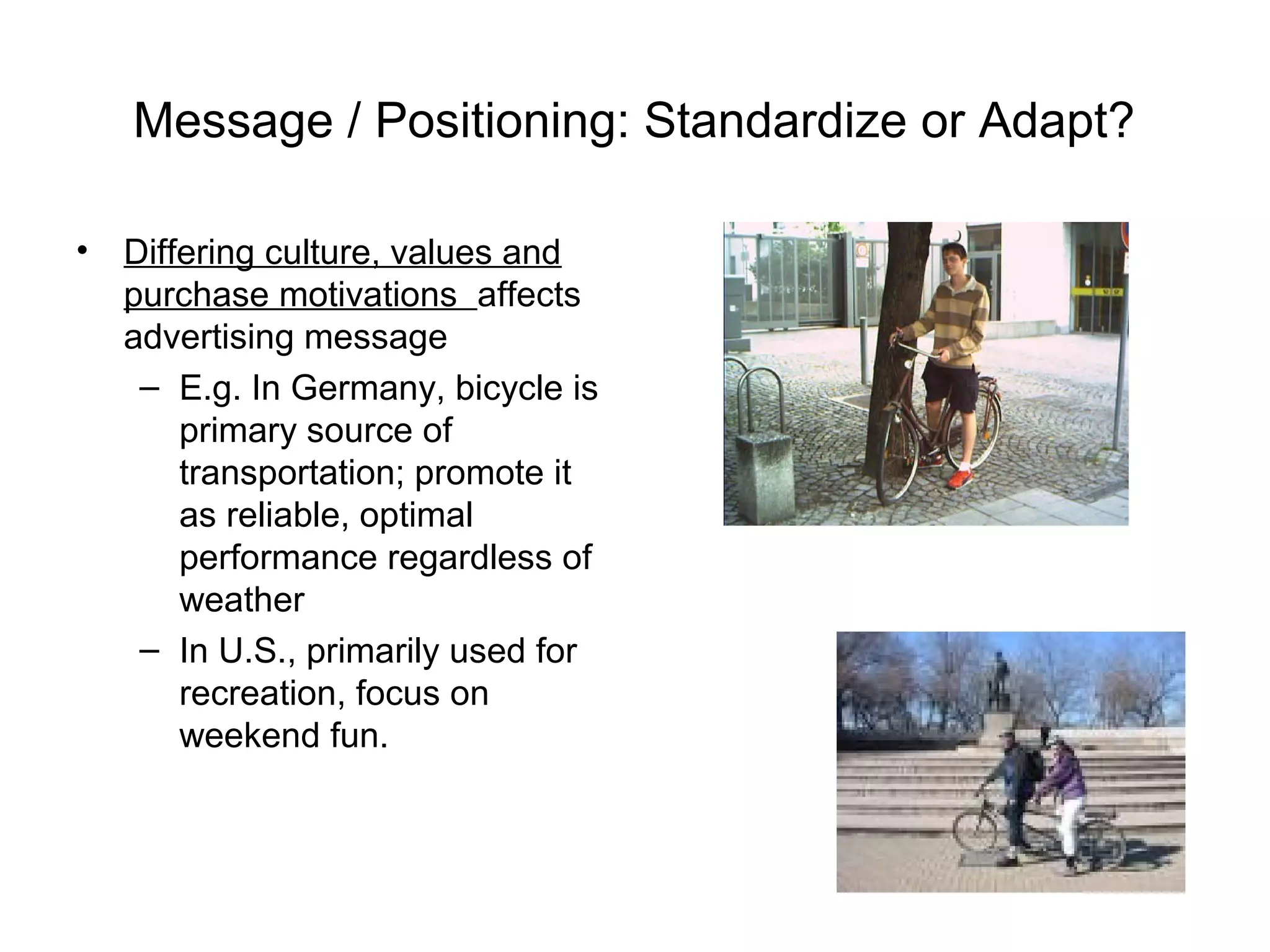
Message / Positioning: Standardize or Adapt?

• Differing culture, values and
  purchase motivations affects
  advertising message
   – E.g. In Germany, bicycle is
      primary source of
      transportation; promote it
      as reliable, optimal
      performance regardless of
      weather
   – In U.S., primarily used for
      recreation, focus on
      weekend fun.
Language?
        Standardize or Adapt
• Problems with translation, pronunciation
• Idioms
• Multiple languages in country
Misfires in Advertising
• Phonetic Problems with Brand Names
  -  Bardok (Sounds like Brothel in Russian)
  -  Coca Cola (Sounds like bite the Wax Tadpole)
  -  Misair (Sounds like Misery in French)
•  Translations
•    Intent              Translation
  -  Stepping Stone            -     Stumbling Block
  -  Car Wash                  -     Car Enema
  -  Highly Rated              -     Over Rated
•    Symbols
  -  Owl                       -     Bad Luck in India
•  Other Countries make mistakes too
  -  Zit    (Chocolate from Germany)
  -  Koff (Beer)
Using English In Local
             Advertisements
• English:
     Requires less space in print and broadcasting
      time
     Conveys a cosmopolitan attitude
     Endows a product or service with status
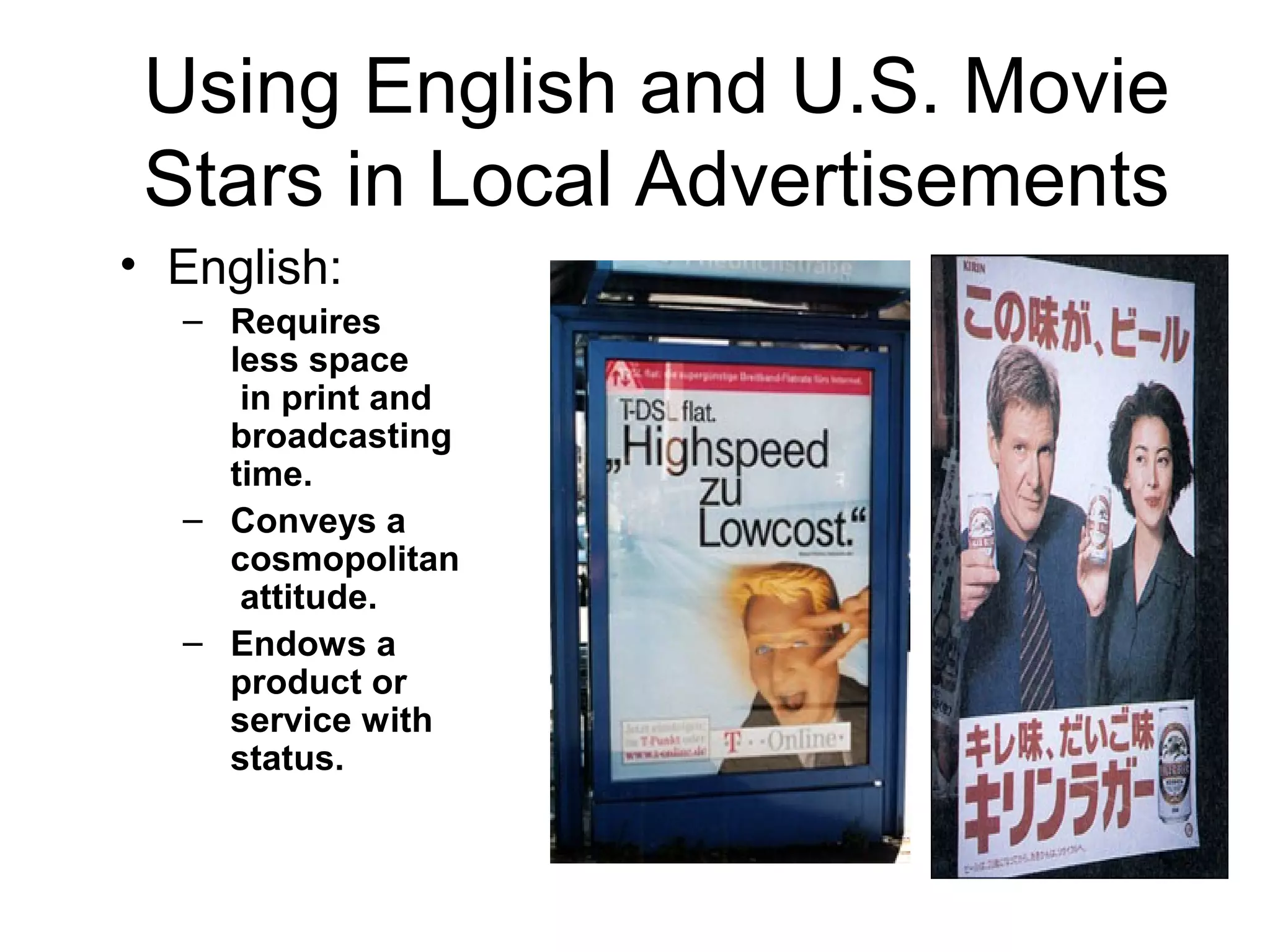
Using English and U.S. Movie
 Stars in Local Advertisements
• English:
  – Requires
    less space
     in print and
    broadcasting
    time.
  – Conveys a
    cosmopolitan
     attitude.
  – Endows a
    product or
    service with
    status.
Areas of Advertising Legislation
• Mandatory Use of Language (Belgium, Canada,
  France, Mexico only).
• Price Advertising
• Sales
• Prohibition of Misleading Advertising.
• Comparative Advertising
• Advertising Using Product Tests.
• Environmental Claims
• Protection of Children
Advertising Legislation
   Varies by country; examples:
     - France: Requirement to keep the French language pure
     - Islamic countries: Ban the use of sex in advertising
     - European Union Directive does not permit advertising that directly
       exhorts minors to buy a product; that directly encourages minors
       to persuade their parents to purchase the goods advertised, show
       minors in dangerous situations
     - European Union Directive prohibits television advertising for
       tobacco products and prescription drugs
     - European Union is attempting to harmonize broadcasting laws
     - The Italian government limits television advertising to 12 percent
       of airtime per hour and four percent over a week on state
       channels, and 18 percent per hour and 15 percent per week on
       commercial stations.

       In addition, the top Italian television stations do not guarantee that
       advertising shown on their stations will reach the target audience.
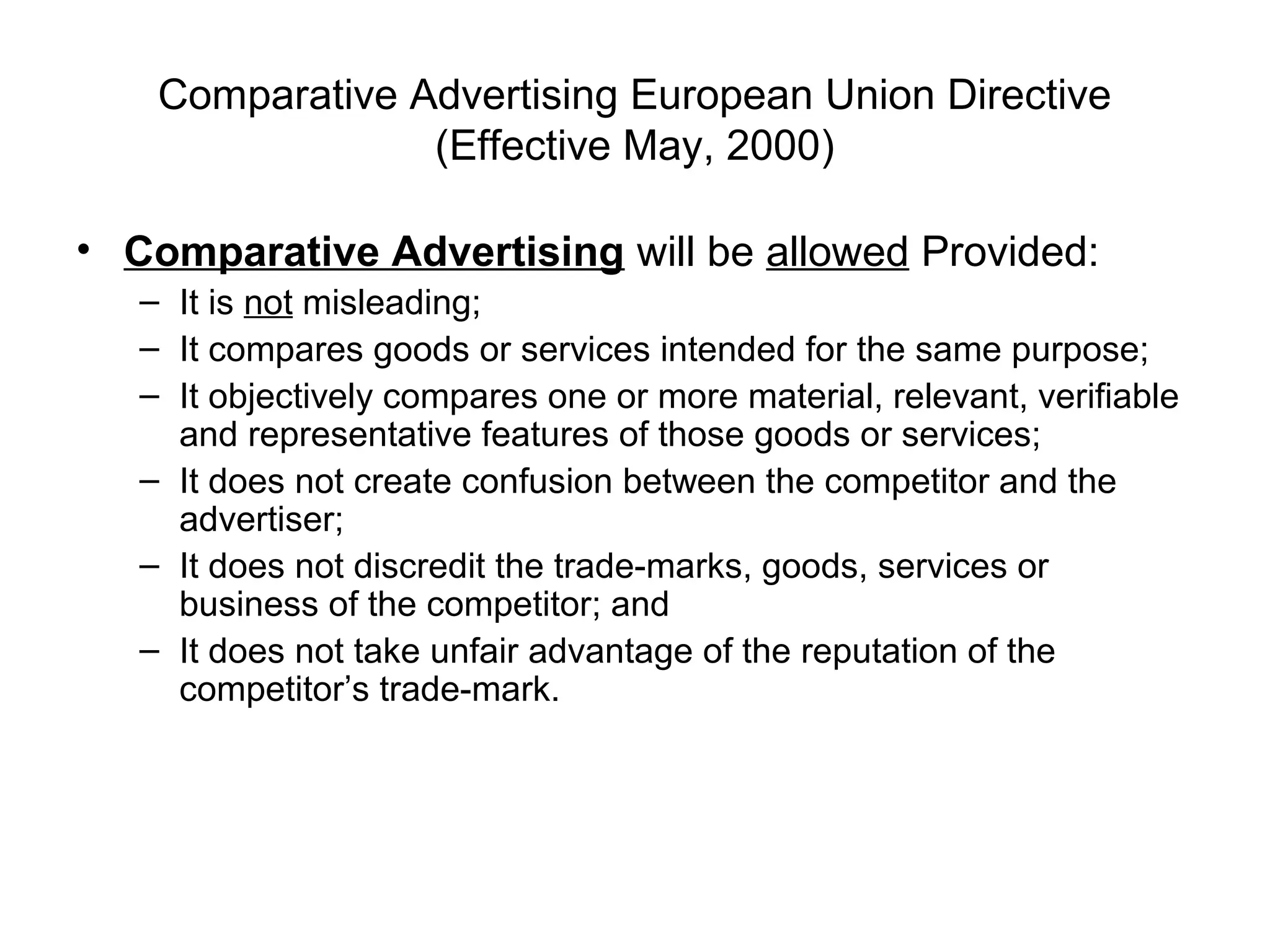
Comparative Advertising European Union Directive
                 (Effective May, 2000)

• Comparative Advertising will be allowed Provided:
   – It is not misleading;
   – It compares goods or services intended for the same purpose;
   – It objectively compares one or more material, relevant, verifiable
     and representative features of those goods or services;
   – It does not create confusion between the competitor and the
     advertiser;
   – It does not discredit the trade-marks, goods, services or
     business of the competitor; and
   – It does not take unfair advantage of the reputation of the
     competitor’s trade-mark.
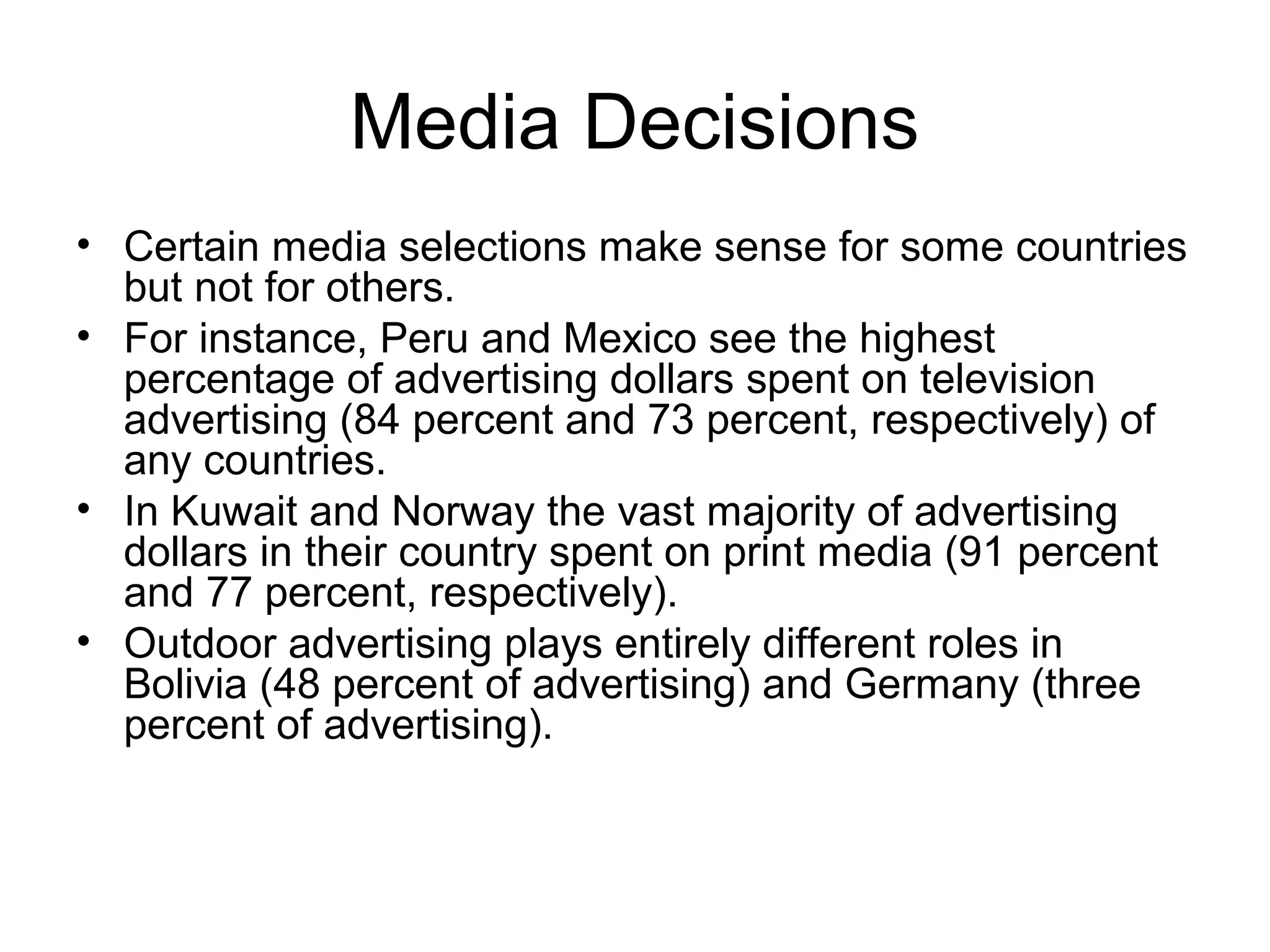
Media Decisions
• Certain media selections make sense for some countries
  but not for others.
• For instance, Peru and Mexico see the highest
  percentage of advertising dollars spent on television
  advertising (84 percent and 73 percent, respectively) of
  any countries.
• In Kuwait and Norway the vast majority of advertising
  dollars in their country spent on print media (91 percent
  and 77 percent, respectively).
• Outdoor advertising plays entirely different roles in
  Bolivia (48 percent of advertising) and Germany (three
  percent of advertising).
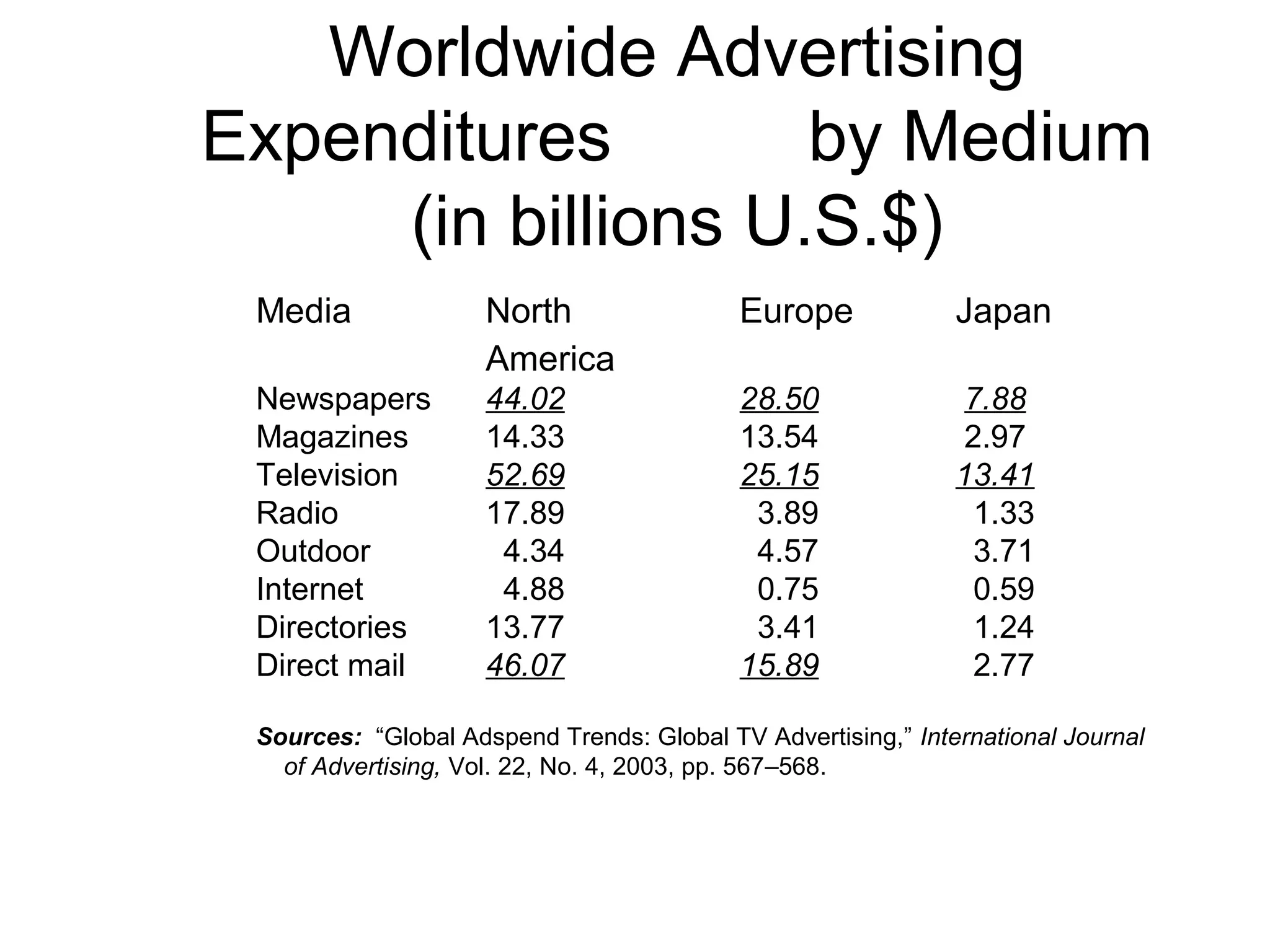
Worldwide Advertising
Expenditures        by Medium
     (in billions U.S.$)
 Media               North                 Europe             Japan
                     America
 Newspapers          44.02                 28.50              7.88
 Magazines           14.33                 13.54              2.97
 Television          52.69                 25.15              13.41
 Radio               17.89                  3.89               1.33
 Outdoor              4.34                  4.57               3.71
 Internet             4.88                  0.75               0.59
 Directories         13.77                  3.41               1.24
 Direct mail         46.07                 15.89               2.77

 Sources: “Global Adspend Trends: Global TV Advertising,” International Journal
   of Advertising, Vol. 22, No. 4, 2003, pp. 567–568.
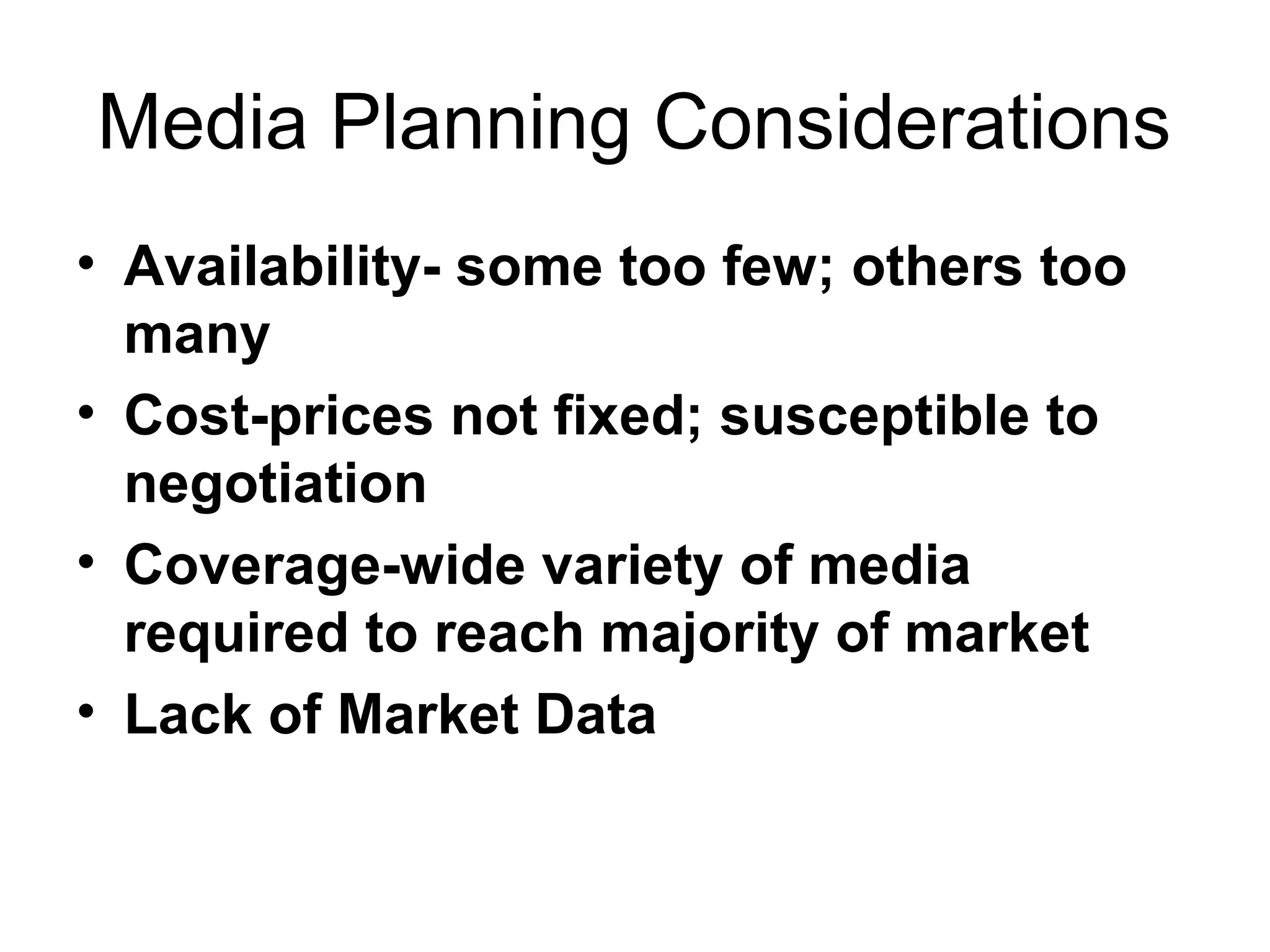
Media Planning Considerations
• Availability- some too few; others too
  many
• Cost-prices not fixed; susceptible to
  negotiation
• Coverage-wide variety of media
  required to reach majority of market
• Lack of Market Data
Media Selection
•   Newspapers
•   Magazines
•   Radio & Television
•   Satellite and Cable Television
•   Direct Mail
•   Internet
•   Other Media
Newspapers
• Too many (Uruguay (pop. 3 million) 21
  newspapers with combined circulation of
  553,000)
• Too few (Japan only 5 national daily
  newspapers with page limits of 16 -20)
• Advertising may not be distinguishable
  from editorial
Magazines
• Have small circulation and unreliable
  circulation figures
• May have to rely on international edition of
  U.S. magazines
• See Ad Age International for circulation
  and rates
Radio and Television
• Major communications media in most
  nations; TV out pulls radio
• Legislation varies, e.g.
  – France, 12 minutes per hour per TV channel
  – South Korea, Both government owned
    stations broadcast only a few hours per day
  – Most likely to be forbidden by government
    edict to accept certain advertising
Satellite and Cable TV
• Satellite TV broadcasting growing
  importance, e.g. Sky Channel
  – Potentially lead to greater standardization &
    wider coverage
  – Challenges advertising creativity
Media Formats
•   Advertising on Kiosks and Fences
•   Outdoor Umbrellas
•   Billboards
•   Plastic Shopping Bags
Various International Formats,
    Features, and Trends
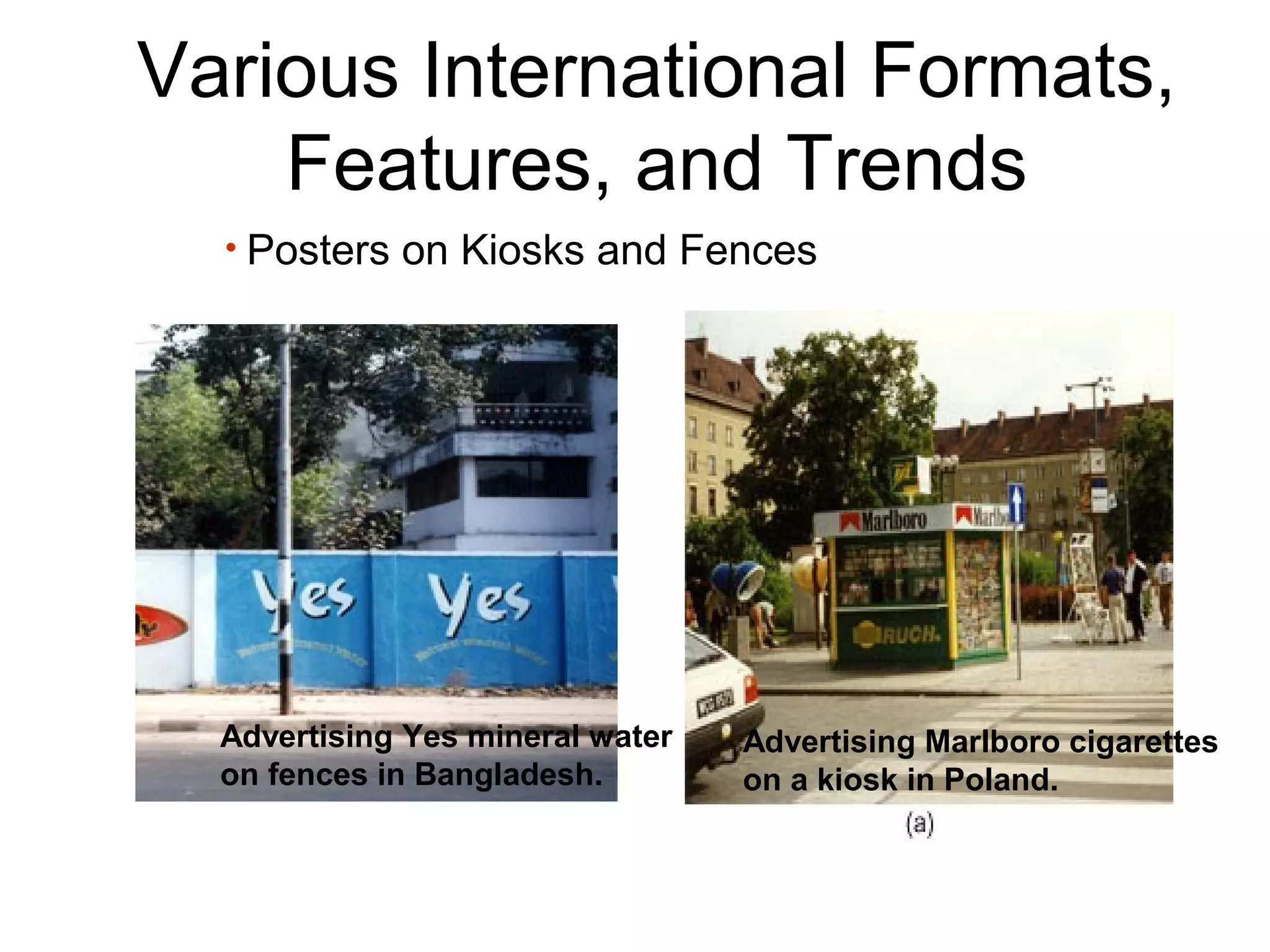
  • Posters on Kiosks and Fences


  Advertising Yes mineral water   Advertising Marlboro cigarettes
  on fences in Bangladesh.        on a kiosk in Poland.
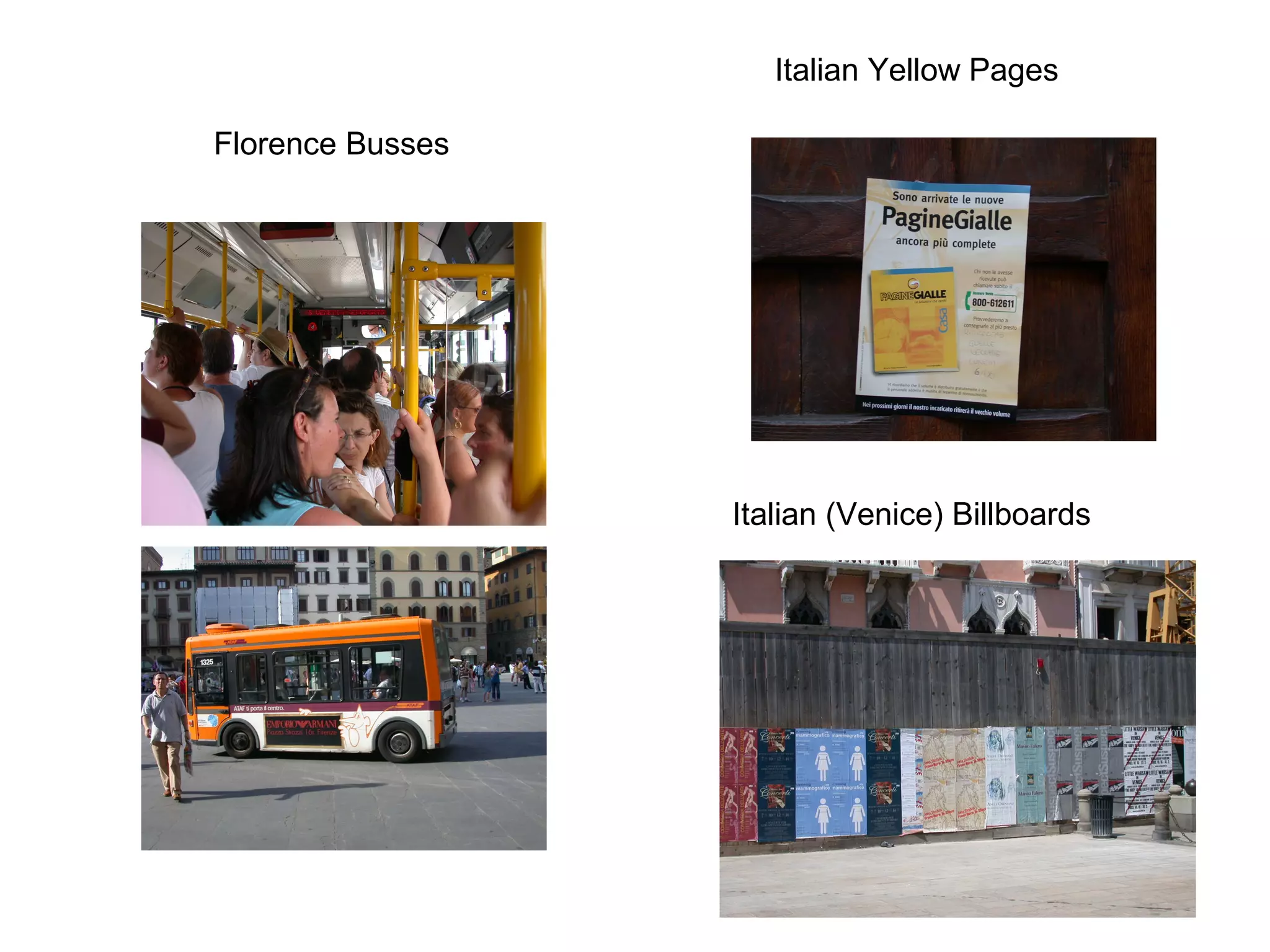
Italian Yellow Pages

Florence Busses


                  Italian (Venice) Billboards
What is global vs. local in these
             ads?
Budgeting Decisions
• Objective-and-Task Method:
  – Identify advertising goals.
  – Conduct research
  – Determine cost of achieving goals.

  – Allocate the necessary sum.

• Percent-of-Sales Method
  – Base budget on past or projected sales.
Budgeting Decisions (contd.)
 • Historical Method
   – Base budget on past expenditures giving more
     weight to recent expenditures.

 • Competitive Parity
   – Use international competitors’ budgets as
     benchmark.

 • Executive-judgment method
   – Use collective executive opinion.

 • All-You-Can-Afford

Session 12 supporting

  • 1.
    What is International IntegratedMarketing Communication and Advertising?
  • 2.
    4 What are the components of the International Promotional Mix / Integrated Marketing Communications (IMC)? Advertising* Advertising* 16-2 Sales Promotion Sales Promotion Trade Shows Trade Shows Personal Selling* Personal Selling* Direct Selling Direct Selling Public Relations Public Relations *Usually The Major Components
  • 3.
    Advertising • Any paidmessage placed in a medium. • Nonpersonal communication by an identified sponsor across international borders, using broadcast, print, and/or interactive media
  • 4.
    Consumer Sales Promotion • Sponsored communications to the target consumer or trade segment that stimulate purchases or improve relationships with middlemen • Examples: – Point-of-Sale Displays – Free Samples – Coupons – Gifts – Sweepstakes – Contests
  • 5.
    Sales Promotion • Salespromotions could be a vital tool when introducing a product internationally. Sampling or couponing, among other promotion strategies, could be a great way to introduce the product to an international market. E.g. Worked for Tang, General Mill's pre-sweetened orange juice mix, in Latin America. • One barrier to sales promotion is that it requires support from local retailers and distributors. Eg, grocery stores must be able to cash in coupons that its customers redeemed. This entails sending the coupons and paperwork to the accounting department of the company offering the promotion. This strategy did not work for A.C. Neilson in Chile. The Chilean supermarket union opposed the coupon incentive and the promotion failed.

  • 6.
    International Publicity A communicationabout a company and/or the company’s products that the company does not pay for. Can be negative or positive.
  • 7.
    International Publicity Examples •Due to its independent nature, it is considered more credible than any other component of the promotional mix. •The company can influence publicity through public relations. •Publicity includes: – Print articles – Broadcast messages – Word-of-mouth communication about the company and/or its products – Internet increases publicity venues.
  • 8.
    International Public Relations Aconcerted effort on the part of a company to generate good will among publics (community, government, consumers, employees, and among others) that are essential to the company.
  • 9.
    International Public Relations Examples • News Releases/Letters/Company Publications: – Companies must regularly communicate with their publics. – When new products are introduced, companies should offer news releases, press releases, and/or company publications promoting the new product or service. • Event Sponsorship and Presence: – Growing venue for international marketing communications. – Important tool for shaping public opinion.
  • 10.
    International Advertising Decisions 1. Decide whether to standardize or adapt advertising. 2. Develop the most effective message(s) for the market segments selected. 3. Select effective media. 4. Compose and secure a budget.
  • 11.
    Is this example of Standardized orAdapted Advertising? In Italy, where James Bond is considered too uptight, ads ignored star and featured a convict with the line: “You better have a good reason to miss the next James Bond film.”
  • 13.
    Bruce Almighty inMalaysia Motorists pass a billboard advertising a billboard Jim Carrey’s latest movie “Bruce Almighty: along a highway in Kuala Lumpur, Malaysia. Government censors have postponed the Malaysian release of the movie pending a decision on whether to ban it for trivializing the subject of God.” AP Aug. 10, 2003
  • 14.
    Standardize or adapt advertising? • Standardize? – Reduce costs – Accelerates product launches – Consumers preferences and product references may becoming more similar – Increases control, especially where local resources are questionable
  • 15.
    Barriers To Standardization •Communication infrastructure • Agencies might not serve a particular market • Consumer literacy • Attitudes toward product country of origin • Differing culture, values and purchase motivations • Differing language • Legal restrictions and self-regulation
  • 16.
    Message Standardize or Adapt? “Cavity reducing fluoride toothpaste sells well in the U.S. where healthy teeth care perceived as important, but has limited appeal in markets such as Great Britain and France where the reason for buying toothpaste is breath control.”
  • 17.
    Message / Positioning:Standardize or Adapt? • Differing culture, values and purchase motivations affects advertising message – E.g. In Germany, bicycle is primary source of transportation; promote it as reliable, optimal performance regardless of weather – In U.S., primarily used for recreation, focus on weekend fun.
  • 18.
    Language? Standardize or Adapt • Problems with translation, pronunciation • Idioms • Multiple languages in country
  • 19.
    Misfires in Advertising •Phonetic Problems with Brand Names - Bardok (Sounds like Brothel in Russian) - Coca Cola (Sounds like bite the Wax Tadpole) - Misair (Sounds like Misery in French) •  Translations • Intent Translation - Stepping Stone - Stumbling Block - Car Wash - Car Enema - Highly Rated - Over Rated • Symbols - Owl - Bad Luck in India •  Other Countries make mistakes too - Zit (Chocolate from Germany) - Koff (Beer)
  • 20.
    Using English InLocal Advertisements • English:  Requires less space in print and broadcasting time  Conveys a cosmopolitan attitude  Endows a product or service with status
  • 21.
    Using English andU.S. Movie Stars in Local Advertisements • English: – Requires less space in print and broadcasting time. – Conveys a cosmopolitan attitude. – Endows a product or service with status.
  • 22.
    Areas of AdvertisingLegislation • Mandatory Use of Language (Belgium, Canada, France, Mexico only). • Price Advertising • Sales • Prohibition of Misleading Advertising. • Comparative Advertising • Advertising Using Product Tests. • Environmental Claims • Protection of Children
  • 23.
    Advertising Legislation  Varies by country; examples: - France: Requirement to keep the French language pure - Islamic countries: Ban the use of sex in advertising - European Union Directive does not permit advertising that directly exhorts minors to buy a product; that directly encourages minors to persuade their parents to purchase the goods advertised, show minors in dangerous situations - European Union Directive prohibits television advertising for tobacco products and prescription drugs - European Union is attempting to harmonize broadcasting laws - The Italian government limits television advertising to 12 percent of airtime per hour and four percent over a week on state channels, and 18 percent per hour and 15 percent per week on commercial stations. In addition, the top Italian television stations do not guarantee that advertising shown on their stations will reach the target audience.
  • 24.
    Comparative Advertising EuropeanUnion Directive (Effective May, 2000) • Comparative Advertising will be allowed Provided: – It is not misleading; – It compares goods or services intended for the same purpose; – It objectively compares one or more material, relevant, verifiable and representative features of those goods or services; – It does not create confusion between the competitor and the advertiser; – It does not discredit the trade-marks, goods, services or business of the competitor; and – It does not take unfair advantage of the reputation of the competitor’s trade-mark.
  • 25.
    Media Decisions • Certainmedia selections make sense for some countries but not for others. • For instance, Peru and Mexico see the highest percentage of advertising dollars spent on television advertising (84 percent and 73 percent, respectively) of any countries. • In Kuwait and Norway the vast majority of advertising dollars in their country spent on print media (91 percent and 77 percent, respectively). • Outdoor advertising plays entirely different roles in Bolivia (48 percent of advertising) and Germany (three percent of advertising).
  • 26.
    Worldwide Advertising Expenditures by Medium (in billions U.S.$) Media North Europe Japan America Newspapers 44.02 28.50 7.88 Magazines 14.33 13.54 2.97 Television 52.69 25.15 13.41 Radio 17.89 3.89 1.33 Outdoor 4.34 4.57 3.71 Internet 4.88 0.75 0.59 Directories 13.77 3.41 1.24 Direct mail 46.07 15.89 2.77 Sources: “Global Adspend Trends: Global TV Advertising,” International Journal of Advertising, Vol. 22, No. 4, 2003, pp. 567–568.
  • 27.
    Media Planning Considerations •Availability- some too few; others too many • Cost-prices not fixed; susceptible to negotiation • Coverage-wide variety of media required to reach majority of market • Lack of Market Data
  • 28.
    Media Selection • Newspapers • Magazines • Radio & Television • Satellite and Cable Television • Direct Mail • Internet • Other Media
  • 29.
    Newspapers • Too many(Uruguay (pop. 3 million) 21 newspapers with combined circulation of 553,000) • Too few (Japan only 5 national daily newspapers with page limits of 16 -20) • Advertising may not be distinguishable from editorial
  • 30.
    Magazines • Have smallcirculation and unreliable circulation figures • May have to rely on international edition of U.S. magazines • See Ad Age International for circulation and rates
  • 31.
    Radio and Television •Major communications media in most nations; TV out pulls radio • Legislation varies, e.g. – France, 12 minutes per hour per TV channel – South Korea, Both government owned stations broadcast only a few hours per day – Most likely to be forbidden by government edict to accept certain advertising
  • 32.
    Satellite and CableTV • Satellite TV broadcasting growing importance, e.g. Sky Channel – Potentially lead to greater standardization & wider coverage – Challenges advertising creativity
  • 33.
    Media Formats • Advertising on Kiosks and Fences • Outdoor Umbrellas • Billboards • Plastic Shopping Bags
  • 34.
    Various International Formats, Features, and Trends • Posters on Kiosks and Fences Advertising Yes mineral water Advertising Marlboro cigarettes on fences in Bangladesh. on a kiosk in Poland.
  • 35.
    Italian Yellow Pages FlorenceBusses Italian (Venice) Billboards
  • 36.
    What is globalvs. local in these ads?
  • 39.
    Budgeting Decisions • Objective-and-TaskMethod: – Identify advertising goals. – Conduct research – Determine cost of achieving goals. – Allocate the necessary sum. • Percent-of-Sales Method – Base budget on past or projected sales.
  • 40.
    Budgeting Decisions (contd.) • Historical Method – Base budget on past expenditures giving more weight to recent expenditures. • Competitive Parity – Use international competitors’ budgets as benchmark. • Executive-judgment method – Use collective executive opinion. • All-You-Can-Afford