Immunobiology of  chronic lymphocytic leukemia Nicholas Chiorazzi Departments of Cell Biology and of Medicine   Albert Einstein College of Medicine and The Feinstein Institute for Medical Research North Shore – LIJ Health System
Ig V gene sequencing Rajendra Damle Joy Yan Bradley T. Messmer Emilia Albesiano Angelo Valetto Fabio Ghiotto Franco Fais Collaborators Kanti R. Rai Steven L. Allen Jonathan E. Kolitz Matthew Kaufman Manlio Ferrarini Autoantigen reactivity Charles Chu Rosa Catera Manuela Woelfle Katerina Hatzi Zev Sthoeger Eric Meffre   Maxime Herve Gregg Silverman
Chronic Lymphocytic Leukemia   Most prevalent adult leukemia of the Western world 15,340 new cases and 4,500 deaths in 2007 Disease of aging individuals (>50) with incidence  increasing with each subsequent decade Usually affects men > women; Caucasian > African > Asian
Clinical courses of patients are heterogeneous and that of an individual patient is unpredictable Some patients follow very benign courses living  decades and dying with the disease, not from it Other patients follow more malignant courses  living only a few years after diagnosis, despite  therapy  Clinical dilemma CLL remains an incurable disease Therefore, “wait and watch” / “wait and worry”  approaches are taken by clinician and patient
Chronic Lymphocytic Leukemia   Lymphocytosis seen in blood, but most leukemic cells are in non-vascular areas including bone marrow, lymph nodes, and spleen Usually detected upon routine blood workup as an elevated white cell or lymphocyte count (~3x10 10  total in blood) Clonal expansion of a CD5 +  B lymphocyte with low surface immunoglobulin (Ig) Most clones express predominantly IgM isotype surface Ig, but ~7% are predominantly IgG or IgA, though in those cases IgM clonal relatives can be found
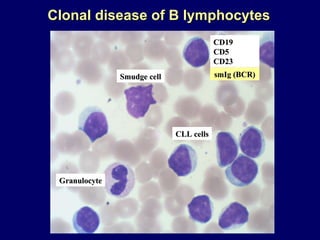
Smudge cell Granulocyte CLL cells CD19 CD5 CD23 Clonal disease of B lymphocytes smIg (BCR)
Take home messages 1.  CLL results from the non-random selection and transformation of B lymphocytes expressing B-cell antigen receptors (BCRs) of restricted amino acid structure 2.  These BCRs can be poly- and auto-reactive, binding natural as well as novel autoantigens generated by apoptosis and other catabolic processes 3.  The clinically-distinct subgroups differ in the retention or loss of poly- and auto-reactivity, with the retention of polyreactivity being associated with worse clinical disease
Take home messages 1.  CLL results from the non-random selection and transformation of B lymphocytes expressing B-cell antigen receptors (BCRs) of restricted amino acid structure
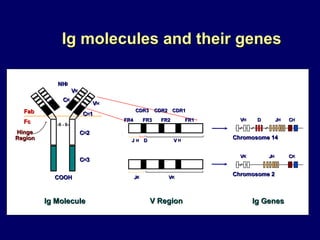
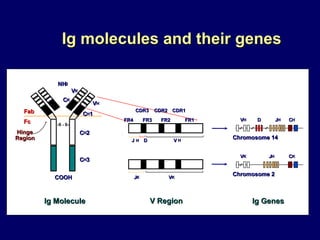
Ig molecules and their genes V H D J H C H Chromosome 14 Chromosome 2 V K J H C K Ig Genes Ig Molecule V Region Hinge Region C K COOH NH 2 -S - S- Fab Fc V K C H 1 V H C H 2 C H 3 V K J K V H D J H CDR3 CDR1 CDR2 FR4 FR3 FR2 FR1
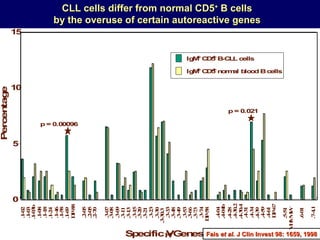
CLL cells differ from normal CD5 +  B cells  by the overuse of certain autoreactive genes  Fais  et al.  J Clin Invest 98: 1659, 1998
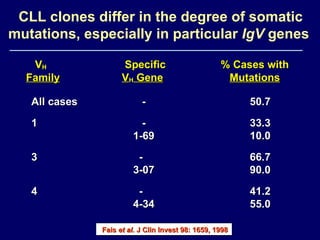
CLL clones differ in the degree of somatic mutations, especially in particular  IgV  genes   V H    Specific   % Cases with Family V H  Gene   Mutations All cases   -   50.7 1   -   33.3   1-69   10.0 3   -   66.7   3-07   90.0 4   -   41.2   4-34   55.0 Fais  et al.  J Clin Invest 98: 1659, 1998
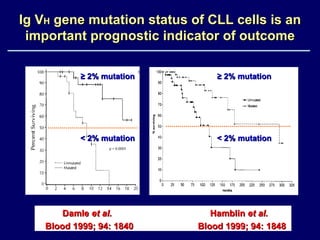
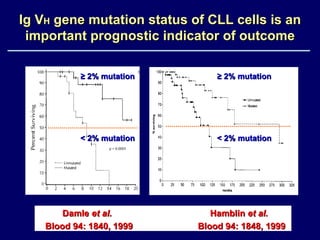
Ig V H  gene mutation status of CLL cells is an important prognostic indicator of outcome Damle  et al.    Hamblin  et al.  Blood 94: 1840, 1999  Blood 94: 1848, 1999 ≥  2% mutation < 2% mutation ≥  2% mutation < 2% mutation
Ig molecules and their genes V H D J H C H Chromosome 14 Chromosome 2 V K J H C K Ig Genes Ig Molecule V Region Hinge Region C K COOH NH 2 -S - S- Fab Fc V K C H 1 V H C H 2 C H 3 V K J K V H D J H CDR3 CDR1 CDR2 FR4 FR3 FR2 FR1
CLL clones are culled from the normal B-cell repertoire based on structural constraints of the B-cell antigen receptor
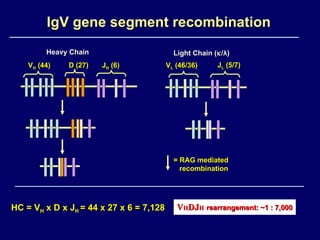
IgV gene segment recombination Heavy Chain Light Chain (  / λ ) V H  (44) HC = V H  x D x J H  = 44 x 27 x 6 = 7,128 D (27) J H  (6) J L  (5/7) V L  (46/36) V H DJ H   rearrangement: ~1 : 7,000 = RAG mediated  recombination
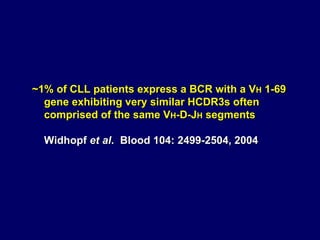
~1% of CLL patients express a BCR with a V H  1-69 gene exhibiting very similar HCDR3s often comprised of the same V H -D-J H  segments Widhopf  et al .  Blood 104: 2499-2504, 2004
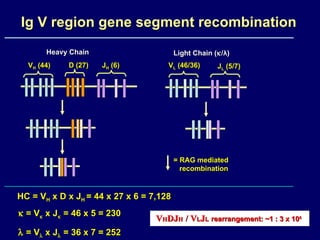
Ig V region gene segment recombination Heavy Chain Light Chain (  / λ ) V H  (44) HC = V H  x D x J H  = 44 x 27 x 6 = 7,128    = V   x J   = 46 x 5 = 230    = V   x J   = 36 x 7 = 252 D (27) J H  (6) J L  (5/7) V L  (46/36) V H DJ H   / V L J L  rearrangement: ~1 : 3 x 10 6   = RAG mediated  recombination
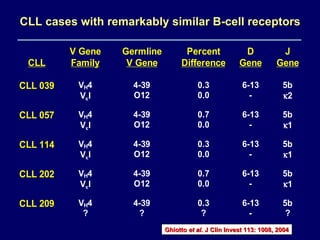
CLL cases with remarkably similar B-cell receptors Ghiotto  et al . J Clin Invest  113: 1008 , 2004
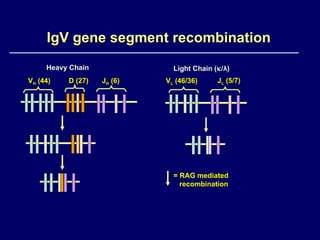
IgV gene segment recombination Heavy Chain Light Chain (  / λ ) V H  (44) D (27) J H  (6) J L  (5/7) V L  (46/36) = RAG mediated  recombination
Because of the differences that occur at the junctions when gene segments combine, the likelihood that the same V H DJ H - V L J L  rearrangement with the same junctional characteristic would occur in two different B cells is even much more remote   ≈  1 / 1x10 8  – 1 :   1x10 12 Therefore, if the gene structure of the Ig variable region found in B-CLL cells from different patients is very similar or identical, then this must indicate a selective process of leukemogenesis that targets B cells with a given type of Ig V region.
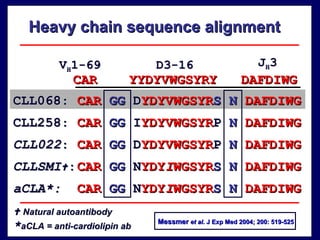
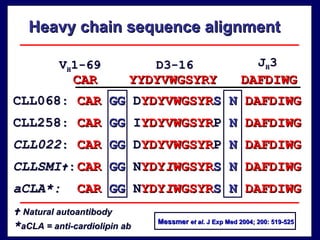
CLL068 : CAR  GG   D YDYVWGSYR S N   DAFDIWG CLLSMI  : CAR  GG   N YDY I WGSYR S   N   DAFDIWG CLL258 : CAR  GG   I YDYVWGSYR P   N  DAFDIWG aCLA*: CAR  GG   N YDY I WGSYR S   N   DAFDIWG CAR  YYDYVWGSYRY  DAFDIWG D3-16 J H 3 V H 1-69 Heavy chain sequence alignment CLL022 : CAR  GG   D YDYVWGSYR P   N   DAFDIWG    Natural autoantibody * aCLA = anti-cardiolipin ab Messmer   et al . J Exp Med 2004; 200: 519-525
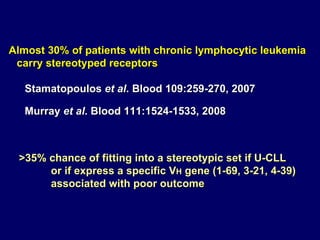
Almost 30% of patients with chronic lymphocytic leukemia  carry stereotyped receptors Stamatopoulos  et al . Blood 109:259-270, 2007 Murray  et al .  Blood 111:1524- 15 33 ,   2008 >35% chance of fitting into a stereotypic set if U-CLL or if express a specific V H  gene (1-69, 3-21, 4-39)  associated with poor outcome
Take home messages 2.  These BCRs can be poly- and auto-reactive, binding natural as well as novel autoantigens generated by apoptosis and other catabolic processes
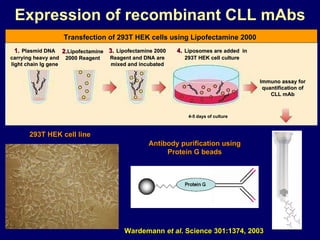
Expression of recombinant CLL mAbs 293T HEK cell line Antibody purification using Protein G beads Wardemann  et al . Science 301:1374, 2003  Immuno assay for quantification of CLL mAb 4-5 days of culture 1.   Plasmid DNA carrying heavy and light chain Ig gene 2. Lipofectamine 2000 Reagent 3.   Lipofectamine 2000 Reagent and DNA are mixed and incubated 4.   Liposomes are added  in 293T HEK cell culture Transfection of 293T HEK cells using Lipofectamine 2000
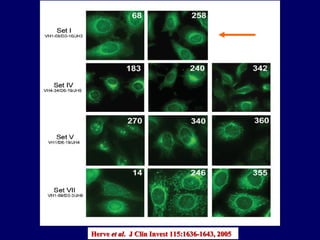
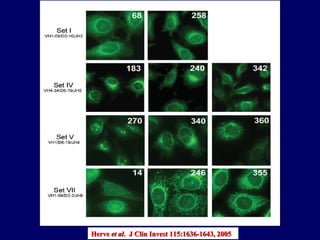
Herve  et al .  J Clin Invest  115:1636-1643, 2005
~20% of mAbs from CD5 +  B cells from normal subjects  ~75% of mAbs from CLL cells ~90% from unmutated CLL ~60% from mutated CLL Reactivity of recombinant mAbs with viable HEp-2 cells that were permeabilized to allow Ab entry [“Anti-cell antibodies”] Reactivity mainly with cytoplasmic structures and  occasionally with nucleoli.  Only one mAb from M-CLL patient reacted with nucleus in a  homogeneous pattern Herve  et al .  J Clin Invest  115:1636-1643, 2005
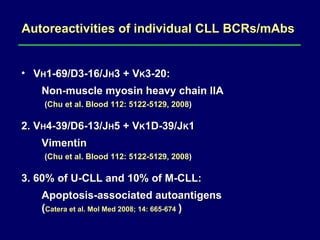
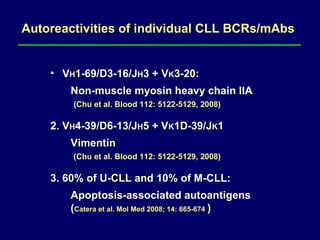
Autoreactivities of individual CLL BCRs/mAbs V H 1-69/D3-16/J H 3 + V K 3-20:  Non-muscle myosin heavy chain IIA    ( Chu et al. Blood 112: 5122-5129, 2008 ) 2. V H 4-39/D6-13/J H 5 + V K 1D-39/J K 1 Vimentin   ( Chu et al. Blood 112: 5122-5129, 2008 ) 3. 60% of U-CLL and 10% of M-CLL:  Apoptosis-associated autoantigens  ( Catera et al. Mol Med 2008; 14: 665-674   )
Herve  et al .  J Clin Invest  115:1636-1643, 2005
CLL068 : CAR  GG   D YDYVWGSYR S N   DAFDIWG CLLSMI  : CAR  GG   N YDY I WGSYR S   N   DAFDIWG CLL258 : CAR  GG   I YDYVWGSYR P   N  DAFDIWG aCLA*: CAR  GG   N YDY I WGSYR S   N   DAFDIWG CAR  YYDYVWGSYRY  DAFDIWG D3-16 J H 3 V H 1-69 Heavy chain sequence alignment CLL022 : CAR  GG   D YDYVWGSYR P   N   DAFDIWG    Natural autoantibody * aCLA = anti-cardiolipin ab Messmer   et al . J Exp Med 2004; 200: 519-525
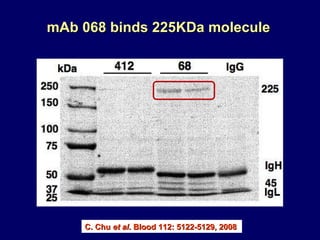
mAb 068 binds 225KDa molecule C. Chu  et al . Blood 112: 5122-5129, 2008
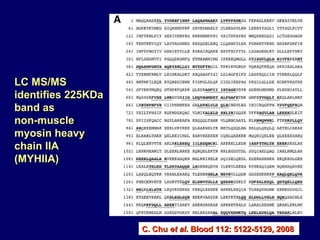
LC MS/MS identifies 225KDa band as  non-muscle  myosin heavy  chain IIA  (MYHIIA) C. Chu  et al . Blood 112: 5122-5129, 2008
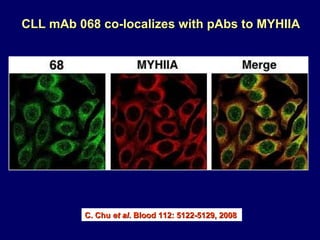
CLL mAb   068 co-localizes with pAbs to MYHIIA C. Chu  et al . Blood 112: 5122-5129, 2008
Autoreactivities of individual CLL BCRs/mAbs V H 1-69/D3-16/J H 3 + V K 3-20:  Non-muscle myosin heavy chain IIA    ( Chu et al. Blood 112: 5122-5129, 2008 ) 2. V H 4-39/D6-13/J H 5 + V K 1D-39/J K 1 Vimentin   ( Chu et al. Blood 112: 5122-5129, 2008 ) 3. 60% of U-CLL and 10% of M-CLL:  Apoptosis-associated autoantigens  ( Catera et al. Mol Med 2008; 14: 665-674   )
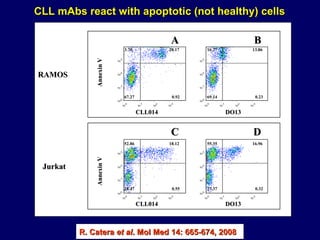
CLL mAbs react with apoptotic (not healthy) cells R. Catera  et al . Mol Med 14: 665-674, 2008   Jurkat RAMOS Annexin V CLL014 DO13 C D Annexin V CLL014 DO13 A B 28.17 0.92 3.70 67.27 13.86 0.23 69.14 16.77 52.86 18.12 0.55 28.47 55.35 16.96 0.32 27.37
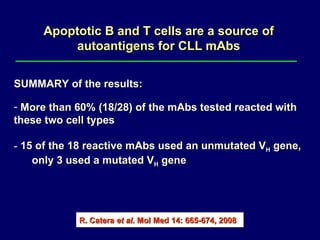
Apoptotic B and T cells are a source of autoantigens for CLL mAbs SUMMARY of the results: More than 60% (18/28) of the mAbs tested reacted with  these two cell types 15 of the 18 reactive mAbs used an unmutated V H  gene,  only 3 used a mutated V H  gene R. Catera  et al . Mol Med 14: 665-674, 2008
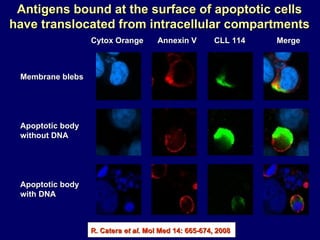
Antigens bound at the surface of apoptotic cells have translocated from intracellular compartments Cytox Orange Annexin V CLL 114 Merge Membrane blebs Apoptotic body  without DNA Apoptotic body  with DNA R. Catera  et al . Mol Med 14: 665-674, 2008
MYHIIA   is one of the intracellular antigens that translocates to the surface and is bound by CLL mAbs
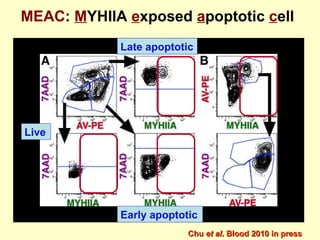
Live Late apoptotic Early apoptotic Chu  et al . Blood 2010 in press MEAC :  M YHIIA  e xposed  a poptotic  c ell
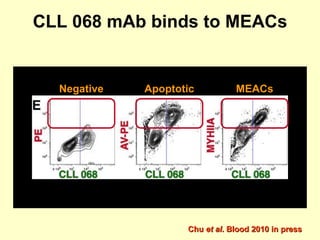
CLL 068 mAb binds to MEACs Chu  et al . Blood 2010 in press Negative Apoptotic MEACs
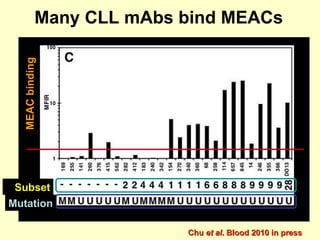
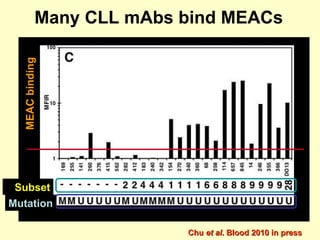
Many CLL mAbs bind MEACs MEAC binding Subset Mutation Chu  et al . Blood 2010 in press
Take home messages 3.  The clinically-distinct subgroups differ in the retention or loss of poly- and auto-reactivity, with the retention of polyreactivity being associated with worse clinical disease
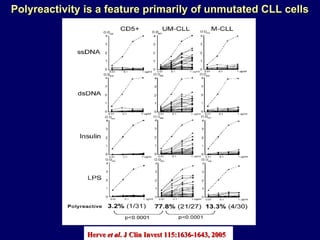
Herve  et al . J Clin Invest  115:1636-1643, 2005   Polyreactivity is a feature primarily of unmutated CLL cells
Ig V H  gene mutation status of CLL cells is an important prognostic indicator of outcome Damle  et al.    Hamblin  et al.  Blood 1999; 94: 1840  Blood 1999; 94: 1848 ≥  2% mutation < 2% mutation ≥  2% mutation < 2% mutation
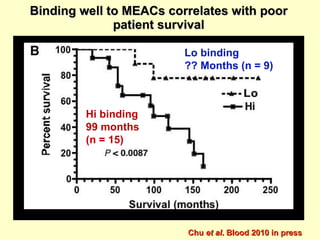
Binding well to MEACs correlates with poor patient survival Hi binding 99 months (n = 15) Lo binding ?? Months (n = 9) Chu  et al . Blood 2010 in press
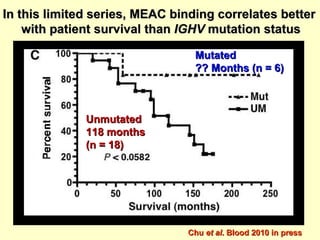
Unmutated 118 months (n = 18) Mutated ?? Months (n = 6) In this limited series, MEAC binding correlates better  with patient survival than  IGHV  mutation status Chu  et al . Blood 2010 in press
Many CLL mAbs bind MEACs MEAC binding Subset Mutation Chu  et al . Blood 2010 in press
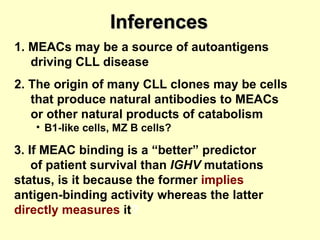
Inferences 1. MEACs may be a source of autoantigens  driving CLL disease 2. The origin of many CLL clones may be cells that produce natural antibodies to MEACs or other natural products of catabolism B1-like cells, MZ B cells? 3. If MEAC binding is a “better” predictor  of patient survival than  IGHV  mutations  status, is it because the former   implies  antigen-binding activity whereas the latter   directly measures   it ?
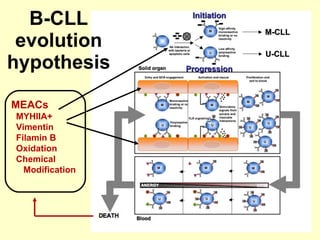
B-CLL evolution hypothesis MEACs  MYHIIA+ Vimentin Filamin B Oxidation Chemical Modification M-CLL U-CLL Initiation   Progression

Session 1.2 Chiorazzi

  • 1.
    Immunobiology of chronic lymphocytic leukemia Nicholas Chiorazzi Departments of Cell Biology and of Medicine Albert Einstein College of Medicine and The Feinstein Institute for Medical Research North Shore – LIJ Health System
  • 2.
    Ig V genesequencing Rajendra Damle Joy Yan Bradley T. Messmer Emilia Albesiano Angelo Valetto Fabio Ghiotto Franco Fais Collaborators Kanti R. Rai Steven L. Allen Jonathan E. Kolitz Matthew Kaufman Manlio Ferrarini Autoantigen reactivity Charles Chu Rosa Catera Manuela Woelfle Katerina Hatzi Zev Sthoeger Eric Meffre Maxime Herve Gregg Silverman
  • 3.
    Chronic Lymphocytic Leukemia Most prevalent adult leukemia of the Western world 15,340 new cases and 4,500 deaths in 2007 Disease of aging individuals (>50) with incidence increasing with each subsequent decade Usually affects men > women; Caucasian > African > Asian
  • 4.
    Clinical courses ofpatients are heterogeneous and that of an individual patient is unpredictable Some patients follow very benign courses living decades and dying with the disease, not from it Other patients follow more malignant courses living only a few years after diagnosis, despite therapy Clinical dilemma CLL remains an incurable disease Therefore, “wait and watch” / “wait and worry” approaches are taken by clinician and patient
  • 5.
    Chronic Lymphocytic Leukemia Lymphocytosis seen in blood, but most leukemic cells are in non-vascular areas including bone marrow, lymph nodes, and spleen Usually detected upon routine blood workup as an elevated white cell or lymphocyte count (~3x10 10 total in blood) Clonal expansion of a CD5 + B lymphocyte with low surface immunoglobulin (Ig) Most clones express predominantly IgM isotype surface Ig, but ~7% are predominantly IgG or IgA, though in those cases IgM clonal relatives can be found
  • 6.
    Smudge cell GranulocyteCLL cells CD19 CD5 CD23 Clonal disease of B lymphocytes smIg (BCR)
  • 7.
    Take home messages1. CLL results from the non-random selection and transformation of B lymphocytes expressing B-cell antigen receptors (BCRs) of restricted amino acid structure 2. These BCRs can be poly- and auto-reactive, binding natural as well as novel autoantigens generated by apoptosis and other catabolic processes 3. The clinically-distinct subgroups differ in the retention or loss of poly- and auto-reactivity, with the retention of polyreactivity being associated with worse clinical disease
  • 8.
    Take home messages1. CLL results from the non-random selection and transformation of B lymphocytes expressing B-cell antigen receptors (BCRs) of restricted amino acid structure
  • 9.
    Ig molecules andtheir genes V H D J H C H Chromosome 14 Chromosome 2 V K J H C K Ig Genes Ig Molecule V Region Hinge Region C K COOH NH 2 -S - S- Fab Fc V K C H 1 V H C H 2 C H 3 V K J K V H D J H CDR3 CDR1 CDR2 FR4 FR3 FR2 FR1
  • 10.
    CLL cells differfrom normal CD5 + B cells by the overuse of certain autoreactive genes Fais et al. J Clin Invest 98: 1659, 1998
  • 11.
    CLL clones differin the degree of somatic mutations, especially in particular IgV genes V H Specific % Cases with Family V H Gene Mutations All cases - 50.7 1 - 33.3 1-69 10.0 3 - 66.7 3-07 90.0 4 - 41.2 4-34 55.0 Fais et al. J Clin Invest 98: 1659, 1998
  • 12.
    Ig V H gene mutation status of CLL cells is an important prognostic indicator of outcome Damle et al. Hamblin et al. Blood 94: 1840, 1999 Blood 94: 1848, 1999 ≥ 2% mutation < 2% mutation ≥ 2% mutation < 2% mutation
  • 13.
    Ig molecules andtheir genes V H D J H C H Chromosome 14 Chromosome 2 V K J H C K Ig Genes Ig Molecule V Region Hinge Region C K COOH NH 2 -S - S- Fab Fc V K C H 1 V H C H 2 C H 3 V K J K V H D J H CDR3 CDR1 CDR2 FR4 FR3 FR2 FR1
  • 14.
    CLL clones areculled from the normal B-cell repertoire based on structural constraints of the B-cell antigen receptor
  • 15.
    IgV gene segmentrecombination Heavy Chain Light Chain (  / λ ) V H (44) HC = V H x D x J H = 44 x 27 x 6 = 7,128 D (27) J H (6) J L (5/7) V L (46/36) V H DJ H rearrangement: ~1 : 7,000 = RAG mediated recombination
  • 16.
    ~1% of CLLpatients express a BCR with a V H 1-69 gene exhibiting very similar HCDR3s often comprised of the same V H -D-J H segments Widhopf et al . Blood 104: 2499-2504, 2004
  • 17.
    Ig V regiongene segment recombination Heavy Chain Light Chain (  / λ ) V H (44) HC = V H x D x J H = 44 x 27 x 6 = 7,128  = V  x J  = 46 x 5 = 230  = V  x J  = 36 x 7 = 252 D (27) J H (6) J L (5/7) V L (46/36) V H DJ H / V L J L  rearrangement: ~1 : 3 x 10 6 = RAG mediated recombination
  • 18.
    CLL cases withremarkably similar B-cell receptors Ghiotto et al . J Clin Invest 113: 1008 , 2004
  • 19.
    IgV gene segmentrecombination Heavy Chain Light Chain (  / λ ) V H (44) D (27) J H (6) J L (5/7) V L (46/36) = RAG mediated recombination
  • 20.
    Because of thedifferences that occur at the junctions when gene segments combine, the likelihood that the same V H DJ H - V L J L rearrangement with the same junctional characteristic would occur in two different B cells is even much more remote ≈ 1 / 1x10 8 – 1 : 1x10 12 Therefore, if the gene structure of the Ig variable region found in B-CLL cells from different patients is very similar or identical, then this must indicate a selective process of leukemogenesis that targets B cells with a given type of Ig V region.
  • 21.
    CLL068 : CAR GG D YDYVWGSYR S N DAFDIWG CLLSMI  : CAR GG N YDY I WGSYR S N DAFDIWG CLL258 : CAR GG I YDYVWGSYR P N DAFDIWG aCLA*: CAR GG N YDY I WGSYR S N DAFDIWG CAR YYDYVWGSYRY DAFDIWG D3-16 J H 3 V H 1-69 Heavy chain sequence alignment CLL022 : CAR GG D YDYVWGSYR P N DAFDIWG  Natural autoantibody * aCLA = anti-cardiolipin ab Messmer et al . J Exp Med 2004; 200: 519-525
  • 22.
    Almost 30% ofpatients with chronic lymphocytic leukemia carry stereotyped receptors Stamatopoulos et al . Blood 109:259-270, 2007 Murray et al . Blood 111:1524- 15 33 , 2008 >35% chance of fitting into a stereotypic set if U-CLL or if express a specific V H gene (1-69, 3-21, 4-39) associated with poor outcome
  • 23.
    Take home messages2. These BCRs can be poly- and auto-reactive, binding natural as well as novel autoantigens generated by apoptosis and other catabolic processes
  • 24.
    Expression of recombinantCLL mAbs 293T HEK cell line Antibody purification using Protein G beads Wardemann et al . Science 301:1374, 2003 Immuno assay for quantification of CLL mAb 4-5 days of culture 1. Plasmid DNA carrying heavy and light chain Ig gene 2. Lipofectamine 2000 Reagent 3. Lipofectamine 2000 Reagent and DNA are mixed and incubated 4. Liposomes are added in 293T HEK cell culture Transfection of 293T HEK cells using Lipofectamine 2000
  • 25.
    Herve etal . J Clin Invest 115:1636-1643, 2005
  • 26.
    ~20% of mAbsfrom CD5 + B cells from normal subjects ~75% of mAbs from CLL cells ~90% from unmutated CLL ~60% from mutated CLL Reactivity of recombinant mAbs with viable HEp-2 cells that were permeabilized to allow Ab entry [“Anti-cell antibodies”] Reactivity mainly with cytoplasmic structures and occasionally with nucleoli. Only one mAb from M-CLL patient reacted with nucleus in a homogeneous pattern Herve et al . J Clin Invest 115:1636-1643, 2005
  • 27.
    Autoreactivities of individualCLL BCRs/mAbs V H 1-69/D3-16/J H 3 + V K 3-20: Non-muscle myosin heavy chain IIA ( Chu et al. Blood 112: 5122-5129, 2008 ) 2. V H 4-39/D6-13/J H 5 + V K 1D-39/J K 1 Vimentin ( Chu et al. Blood 112: 5122-5129, 2008 ) 3. 60% of U-CLL and 10% of M-CLL: Apoptosis-associated autoantigens ( Catera et al. Mol Med 2008; 14: 665-674 )
  • 28.
    Herve etal . J Clin Invest 115:1636-1643, 2005
  • 29.
    CLL068 : CAR GG D YDYVWGSYR S N DAFDIWG CLLSMI  : CAR GG N YDY I WGSYR S N DAFDIWG CLL258 : CAR GG I YDYVWGSYR P N DAFDIWG aCLA*: CAR GG N YDY I WGSYR S N DAFDIWG CAR YYDYVWGSYRY DAFDIWG D3-16 J H 3 V H 1-69 Heavy chain sequence alignment CLL022 : CAR GG D YDYVWGSYR P N DAFDIWG  Natural autoantibody * aCLA = anti-cardiolipin ab Messmer et al . J Exp Med 2004; 200: 519-525
  • 30.
    mAb 068 binds225KDa molecule C. Chu et al . Blood 112: 5122-5129, 2008
  • 31.
    LC MS/MS identifies225KDa band as non-muscle myosin heavy chain IIA (MYHIIA) C. Chu et al . Blood 112: 5122-5129, 2008
  • 32.
    CLL mAb 068 co-localizes with pAbs to MYHIIA C. Chu et al . Blood 112: 5122-5129, 2008
  • 33.
    Autoreactivities of individualCLL BCRs/mAbs V H 1-69/D3-16/J H 3 + V K 3-20: Non-muscle myosin heavy chain IIA ( Chu et al. Blood 112: 5122-5129, 2008 ) 2. V H 4-39/D6-13/J H 5 + V K 1D-39/J K 1 Vimentin ( Chu et al. Blood 112: 5122-5129, 2008 ) 3. 60% of U-CLL and 10% of M-CLL: Apoptosis-associated autoantigens ( Catera et al. Mol Med 2008; 14: 665-674 )
  • 34.
    CLL mAbs reactwith apoptotic (not healthy) cells R. Catera et al . Mol Med 14: 665-674, 2008 Jurkat RAMOS Annexin V CLL014 DO13 C D Annexin V CLL014 DO13 A B 28.17 0.92 3.70 67.27 13.86 0.23 69.14 16.77 52.86 18.12 0.55 28.47 55.35 16.96 0.32 27.37
  • 35.
    Apoptotic B andT cells are a source of autoantigens for CLL mAbs SUMMARY of the results: More than 60% (18/28) of the mAbs tested reacted with these two cell types 15 of the 18 reactive mAbs used an unmutated V H gene, only 3 used a mutated V H gene R. Catera et al . Mol Med 14: 665-674, 2008
  • 36.
    Antigens bound atthe surface of apoptotic cells have translocated from intracellular compartments Cytox Orange Annexin V CLL 114 Merge Membrane blebs Apoptotic body without DNA Apoptotic body with DNA R. Catera et al . Mol Med 14: 665-674, 2008
  • 37.
    MYHIIA is one of the intracellular antigens that translocates to the surface and is bound by CLL mAbs
  • 38.
    Live Late apoptoticEarly apoptotic Chu et al . Blood 2010 in press MEAC : M YHIIA e xposed a poptotic c ell
  • 39.
    CLL 068 mAbbinds to MEACs Chu et al . Blood 2010 in press Negative Apoptotic MEACs
  • 40.
    Many CLL mAbsbind MEACs MEAC binding Subset Mutation Chu et al . Blood 2010 in press
  • 41.
    Take home messages3. The clinically-distinct subgroups differ in the retention or loss of poly- and auto-reactivity, with the retention of polyreactivity being associated with worse clinical disease
  • 42.
    Herve etal . J Clin Invest 115:1636-1643, 2005 Polyreactivity is a feature primarily of unmutated CLL cells
  • 43.
    Ig V H gene mutation status of CLL cells is an important prognostic indicator of outcome Damle et al. Hamblin et al. Blood 1999; 94: 1840 Blood 1999; 94: 1848 ≥ 2% mutation < 2% mutation ≥ 2% mutation < 2% mutation
  • 44.
    Binding well toMEACs correlates with poor patient survival Hi binding 99 months (n = 15) Lo binding ?? Months (n = 9) Chu et al . Blood 2010 in press
  • 45.
    Unmutated 118 months(n = 18) Mutated ?? Months (n = 6) In this limited series, MEAC binding correlates better with patient survival than IGHV mutation status Chu et al . Blood 2010 in press
  • 46.
    Many CLL mAbsbind MEACs MEAC binding Subset Mutation Chu et al . Blood 2010 in press
  • 47.
    Inferences 1. MEACsmay be a source of autoantigens driving CLL disease 2. The origin of many CLL clones may be cells that produce natural antibodies to MEACs or other natural products of catabolism B1-like cells, MZ B cells? 3. If MEAC binding is a “better” predictor of patient survival than IGHV mutations status, is it because the former implies antigen-binding activity whereas the latter directly measures it ?
  • 48.
    B-CLL evolution hypothesisMEACs MYHIIA+ Vimentin Filamin B Oxidation Chemical Modification M-CLL U-CLL Initiation Progression

Editor's Notes

  • #39 I would like to thank the organizers for giving me the opportunity to discuss our research results with you. This represents the work of not only myself but of many others including… Lu, Katerina, Rosa Steve and Kanti for clinical collaboration Nick for support, guidance and inspiration and others that I will acknowledge throughout the talk
  • #40 This is a typical example of flow cytometry data showing that CLL 068 mAb reacts to MEACs. This is a negative control. This shows that CLL 068 binds to a subset of dead cells (AV-PE positive) and not live cells. This shows that CLL 068 binds only to MEACs (MYHIIA positive). And not other cells.
  • #41 This is a graph that shows the binding of 26 CLL mAbs listed on the x-axis to MEACs… … with the cutoff of 1.5 for MEAC binding. 16 mAbs bind well/. This is a grouping of the CLL mAbs based on having a shared common “stereotyped” sequence, which I do not have time to describe, … but would just like to point out that the stereotyped groups bind in the same manner. This shows which CLL mAbs are mutated or unmutated, … U = is less than 2% mutation in the IGHV, which correlates with bad patient survival … M = is greater than 2% mutation in the IGHV, which correlates with good patient outcome. All the MEAC binding mAbs are UM, except for 1 (15/16), which binds like the same stereotype subgroup “1” and is a borderline “Mut”. Those mAbs that do not bind MEACs well are a mixture of Mut (6) and four UM (4) mAbs. Because survival correlates with IGHV mutation, perhaps MEAC binding correlates with survival and help distinguish the UM that may survive better.. .
  • #45 Indeed binding well to MEACs correlates to poor patient survival (24 patients have survival data)… Hi binding has a median survival of 99 months (n=15), Whereas Lo binding has not reached median survival (n=9). This is statistically significant P&lt;0.0087. This significance is better than that for UM versus Mut (P&lt;0.06) in this patient cohort. … this is because one mutated (CLL 154) and two unmutated (CLL 376 and 412) IGHV CLL patients having survival outcomes contrary to that expected for their IGHV mutation status.
  • #46 IGHV mutation status versus patient survival (24 patients have survival data)… UM IGHV has a median survival of 118 months (n=18), Whereas Mut IGHV has not reached median survival (n=6). This is not quite statistically significant P&lt;0.06. This significance is not as good as MEAC binding. … this is because one mutated (CLL 154) and two unmutated (CLL 376 and 412) IGHV CLL patients having survival outcomes contrary to that expected for their IGHV mutation status.
  • #47 This is a graph that shows the binding of 26 CLL mAbs listed on the x-axis to MEACs… … with the cutoff of 1.5 for MEAC binding. 16 mAbs bind well/. This is a grouping of the CLL mAbs based on having a shared common “stereotyped” sequence, which I do not have time to describe, … but would just like to point out that the stereotyped groups bind in the same manner. This shows which CLL mAbs are mutated or unmutated, … U = is less than 2% mutation in the IGHV, which correlates with bad patient survival … M = is greater than 2% mutation in the IGHV, which correlates with good patient outcome. All the MEAC binding mAbs are UM, except for 1 (15/16), which binds like the same stereotype subgroup “1” and is a borderline “Mut”. Those mAbs that do not bind MEACs well are a mixture of Mut (6) and four UM (4) mAbs. Because survival correlates with IGHV mutation, perhaps MEAC binding correlates with survival and help distinguish the UM that may survive better.. .
  • #48 These results lead to the following inferences…
  • #49 Just to end with a MODEL cell death (CLL or other) leading to MEAC formation and exposure of MYHIIA and other epitopes observed by Rosa This could be important for the initiation of CLL or the ongoing stimulation that may be required for CLL growth and development.