Juvenile
Offenders


    Chapter
12

Outline

1.    History

2.    Assessment
of
Young
Offenders

3.    Theories
of
An@social
Behaviour

4.    Risk
and
Protec@ve
Factors

5.    Preven@on
and
Treatment

6.    Video

1.
History


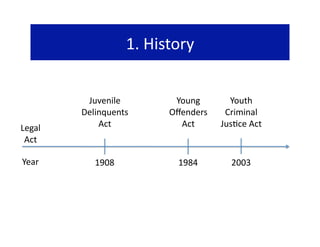
          Juvenile
        Young
       Youth

         Delinquents
     Offenders
    Criminal

Legal
       Act
           Act
      Jus@ce
Act

 Act


Year
       1908
           1984
       2003

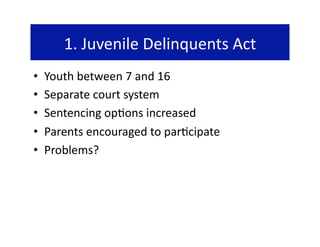
1.
Juvenile
Delinquents
Act

•    Youth
between
7
and
16

•    Separate
court
system

•    Sentencing
op@ons
increased

•    Parents
encouraged
to
par@cipate

•    Problems?

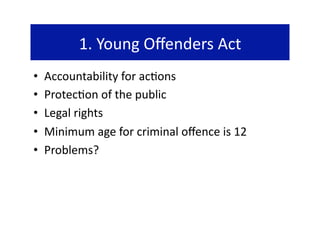
1.
Young
Offenders
Act

•    Accountability
for
ac@ons

•    Protec@on
of
the
public

•    Legal
rights

•    Minimum
age
for
criminal
offence
is
12

•    Problems?

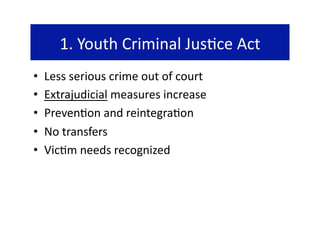
1.
Youth
Criminal
Jus@ce
Act

•    Less
serious
crime
out
of
court

•    Extrajudicial
measures
increase

•    Preven@on
and
reintegra@on


•    No
transfers

•    Vic@m
needs
recognized

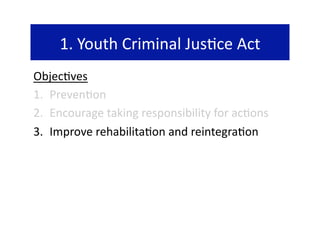
1.
Youth
Criminal
Jus@ce
Act

Objec@ves

1.  Preven@on

2.  Encourage
taking
responsibility
for
ac@ons

3.  Improve
rehabilita@on
and
reintegra@on

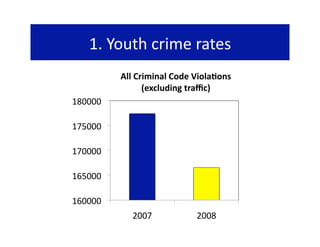
1.
Youth
crime
rates

          All
Criminal
Code
Viola.ons


                (excluding
traffic)

180000


175000


170000


165000


160000

             2007
           2008

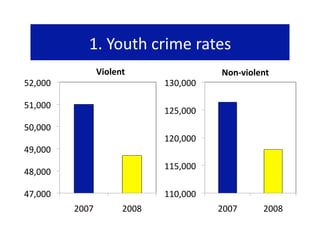
1.
Youth
crime
rates

                  Violent

                 Non‐violent


52,000
                          130,000


51,000

                                 125,000

50,000

                                 120,000

49,000

                                 115,000

48,000


47,000
                          110,000

          2007
          2008
              2007
     2008

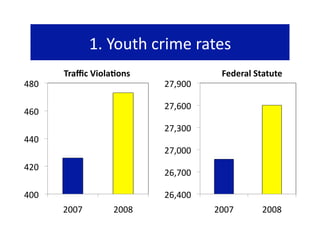
1.
Youth
crime
rates

       Traffic
Viola.ons

              Federal
Statute

480
                       27,900


                           27,600

460

                           27,300

440

                           27,000

420

                           26,700


400
                       26,400

       2007
      2008
              2007
      2008

1.
Youth
crime
rates
and
the
YCJA


      Has
the
YCJA
been
effec@ve?


2.
Assessment
of
Young
Offenders


•  Issue
of
consent

  •  Consent

  •  Assent

2.
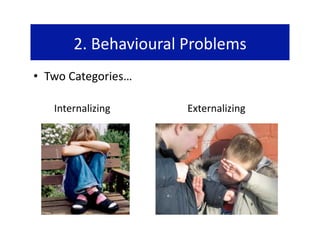
Behavioural
Problems

•  Two
Categories…


   Internalizing
     Externalizing

2.
Internalizing
problems

•    Emo@onal
problem

•    E.g.,
Anxiety,
Depression,
Obsessions

•    Easier
to
treat
than
externalizing
problems

•    More
typically
displayed
by
females

2.
Externalizing
problems

•  Behaviour
problem

•  E.g.,
Figh@ng,
Bullying,
Lying

•  More
difficult
to
treat
and
persistent
than

   internalizing

•  Symptoms
peak
in
teens

•  More
common
in
males

•  Mul@ple
informants

2.
Common
Diagnoses
in
Young

            Offenders

•  A`en@on
Deficit
Hyperac@vity
Disorder
(ADHD)

•  Opposi@onal
Defiant
Disorder
(ODD)

•  Conduct
Disorder
(CD)

2.
ADHD

•  Ina`en@on
features

  •  Lack
of
a`en@on
to
detail,
failure
to
listen,
loses

     items,
forgedul…

•  Hyperac@vity
features

  •  Fidgets,
leaves
seat,
talks
excessively…

•  Impulsivity
features

  •  Difficulty
wai@ng,
interrupts,
blurts
out
responses

2.
ODD

•    Loses
temper

•    Argues
with
adults

•    Deliberately
annoys
others

•    Angry
and
resendul

•    Vindic@ve

2.
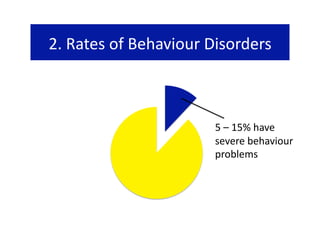
Rates
of
Behaviour
Disorders


                       5
–
15%
have

                       severe
behaviour

                       problems

2.
Rates
of
Behaviour
Disorders


                  5‐15%


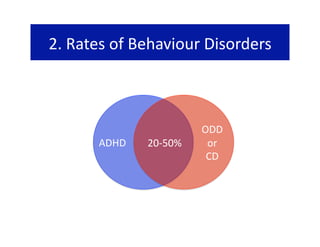
                           ODD

       ADHD
   20‐50%
      or

                            CD

2.
Rates
of
Behaviour
Disorders


                   5‐15%


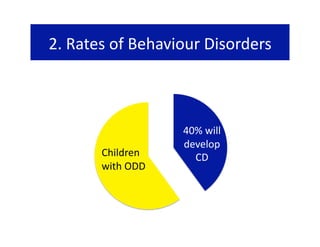
                      40%
will

                      develop

       Children
        CD

       with
ODD

2.
Rates
of
Behaviour
Disorders


                   5‐15%


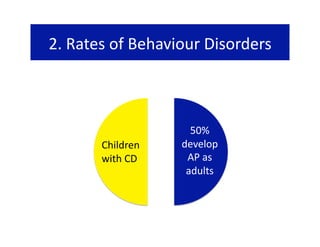
                        50%


       Children
      develop

       with
CD
        AP
as

                       adults

2.
Trajectories
of
Youth
Offenders

•  Cri@cal
factor
=
age
of
onset


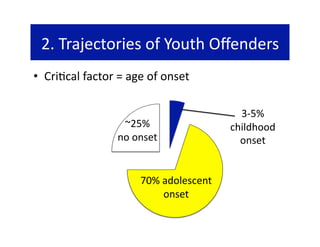
                                          3‐5%

                  ~25%

                childhood

                 no
onset
                onset


                      70%
adolescent

                          onset

2.
Child
onset
trajectory

•  More
serious
and
persistent

•  Many
other
difficul@es


  •  ADHA,
learning
disabili@es,
academic
trouble

•  Most
do
not
become
offenders

2.
Adolescent
onset
trajectory

•  Many
commit
social
transgressions

•  Most
desist
commijng
an@social
acts
in

   adulthood

  •  More
so
than
those
with
childhood
onset

2.
Brame,
Nagin
&
Tremblay
(2001)

•  Followed
boys
from
kindergarten
to
age
20

•  Measured
levels
of
aggression

•  Categorized
boys
as
low,
medium
and
high
levels

   of
aggression
(based
on
ini@al
measurement)

2.
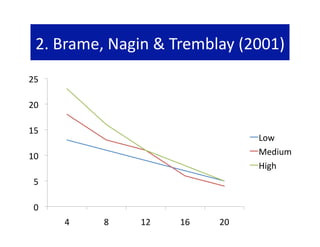
Brame,
Nagin
&
Tremblay
(2001)

25


20


15

                                  Low

10
                               Medium

                                  High

 5


 0

      4
   8
   12
   16
   20

3.
Biological
–
Neurological

•  Frontal
lobe

  •  Key
role
in
planning
and
inhibi@ng
behaviour

  •  Lower
ac@va@on
in
frontal
lobe

  •  Increased
likelihood
of
an@social
acts

3.
Biological
‐
Physiological


•  Lower
heart
rate

3.
Biological
‐
Gene@c

•  Paternal
an@social
behaviour
related
to

   offspring
an@social
behaviour

•  Twin
studies

3.
Cogni@ve

•  A`en@on
in
social
interac@ons

  1.  A`ending
to
social
cues

  2.  Use
cues/thoughts
about
cues
to
choose

       behaviour

  –  Process
fewer
cues
(environment)

  –  Misa`ribute
hos@le
intent
(thoughts)

  –  Produce
fewer
more
aggressive
solu@ons

     (thoughts/behaviour
choices)

  –  Cogni@ve
deficits

3.
Cogni@ve

•  Reac@ve
and
Proac@ve
aggression

  •  Reac@ve:
response
to
perceived
threat

     •  cogni@ve
deficiency
in
processing/a`ending
to
social

        cues

  •  Proac@ve:
directed
at
achieving
a
goal

     •  
deficiency
in
genera@ng
alterna@ve
solu@ons

•  Reac@ve
tend
to
have
earlier
onset

3.
Social

•  Social
Learning
Theory

    •  Learn
behaviour
from
others

    •  Imitate

    •  An@social
children
have
an@social
examples

4.
Individual
Risk
Factors

•  Individual

   •  Gene@c/biological
(e.g.,
ADHD)

   •  Uterine
environment
(e.g.,
fetal
alcohol
syndrome)

   •  Temperament

4.
Familial
Risk
Factors

•  Familial

   •    Neglect

   •    Family
conflict

   •    Paren@ng
style

   •    Child
abuse

4.
School
and
Social
Risk
Factors

•  School
and
Social

  •  Lower
IQ

  •  Aggressive
play
with
peers

  •  Deviant
peers

4.
Protec@ve
Factors

•  Similar
children
have
different
outcomes

  •  Resilience

•  Protec@ve
factors…

  1.  Change
the
level
of
risk
associated
with
a
risk

      factor

  2.  Change
the
nega@ve
chain
reac@on

  3.  Help
develop
and
maintain
self‐esteem

  4.  Provide
opportuni@es

4.
Individual
Protec@ve
Factors

•  Individual

   •  Resilient
temperament

4.
Familial
Protec@ve
Factors

•  Familial

   •  Posi@ve
and
suppor@ve
environment

   •  Good
parent‐child
rela@onship

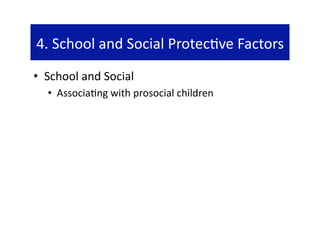
4.
School
and
Social
Protec@ve
Factors

•  School
and
Social

  •  Associa@ng
with
prosocial
children

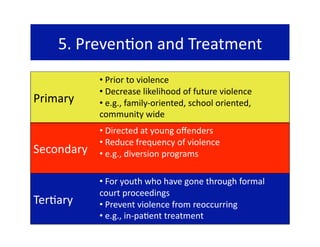
5.
Preven@on
and
Treatment

             • 
Prior
to
violence

             • 
Decrease
likelihood
of
future
violence

Primary
     • 
e.g.,
family‐oriented,
school
oriented,

             community
wide

             • 
Directed
at
young
offenders


             • 
Reduce
frequency
of
violence

Secondary
   • 
e.g.,
diversion
programs


             • 
For
youth
who
have
gone
through
formal

             court
proceedings

Ter@ary
     • 
Prevent
violence
from
reoccurring

             • 
e.g.,
in‐pa@ent
treatment


Juvenile offender