AASIF IQBAL

Financial services are the economic services provided
by the finance industry which mainly include banks.
A bank is a financial institution and a financial
intermediary that accepts deposits and channels those
deposits into lending activities, either directly or
through capital market.
 A bank connects customers with capital deficits to
customers with capital surpluses.
INTRODUCTION.

 The first bank in India was established in 1786. From 1786 till today it has
gone through three distinct phases.
 PHASE 1
Early phase from 1786 to 1969 of Indian banks.
 PHASE 2
Nationalization of Indian Banks and up to 1991 prior to Indian banking sector
Reforms.
 PHASE 3
New phase of Indian Banking system with the advent of Indian Financial &
Banking
Sector Reforms after 1991.
HISTORY OF BANKING
IN INDIA.

• The total bank deposits increased from Rs. 9.1 billion($960
million) in 1970-71 to Rs. 8309.22 billion ($620 billion) in
2009-10. Current deposit is Rs. 67504.54 billion($1.1 trillion).
• There are total 151 commercial banks in India by 2014 with total
of 1,09,811 number of branches.
• It contributes INR 243294 Cr. to India’s GDP.
• Service sector contribution is 57.3% to India's economy. And out
of this 57.3%, banking sector contributes 80%.
CONTRIBUTION TOWARDS
GDP OF INDIA.

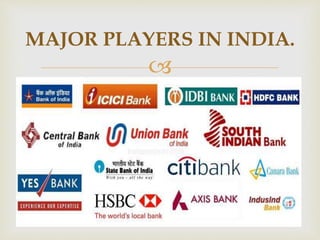
MAJOR PLAYERS IN INDIA.


• Founded on 2nd July 1806 as Bank of Calcutta. Bank of
Madras merged into the other two "presidency banks" in
British India, Bank of Calcutta and Bank of Bombay, to form
the Imperial Bank of India, which in turn became the State
Bank of India.
• Government of India owned the Imperial Bank of India in
1955, with Reserve
Bank of India (India's Central Bank) taking a 60% stake,
and renamed it the
State Bank of India.

• State Bank of India (SBI) is an Indian multinational,
Public Sector banking, and
financial services company. It is a government-owned
corporation with its headquarters in Mumbai, Maharashtra.
• As of December 2014, it had assets of US$388 billion and
17,000 branches, including 190 foreign offices, making it
the largest banking and financial services company in India

 Domestic Treasury.
 Broking services.
 ATM services.
 Internet Banking.
 E-Pay
 E-Rail
 Safe Deposit Locker.
Major Services offered.

 LIEN MARKING FACILITY.
I. It is a unique facility by which you can block funds in
your own savings account.
II. The funds will be actually transferred to the brokers
account at the end of the day only if the transactions
placed are executed.
III. Instant & automated net payout of funds & securities.
 MULTIPLE PRODUCT OFFERINGS.
 DEDICATED CUSTOMER CARE:
Avail services 24*7 through a dedicated customer care
telephone number
CHARACTERISTICS

 Single screen order trade entry without going through
the hassles of giving transfer instruction, writing cheques.
 Instant order confirmation gives you similar trading
experience as exchange based software without the
burden of overhead & maintenance cost.
 Advanced technology offers you seamless execution of
transactions which gives you a feel of real time experience
& enables you to encash on every possible opportunity.
CONTD:

STP MODEL OF STATE
BANK OF INDIA.

 Geographic : tier-1,tier-2,tier-3,rural & semi urban
branches.
 Age:-10-59,60 & above.
 Income:-Marginal , Low ,Middle , High.
 Occupation:- Unskilled workers , Skilled workers,
Shop owners , Businessmen.
SEGMENTATION.

 Main Targets markets are:
 Retail banking market:
this segment is for retail investors & provide them
with short term financial credit for their
personal,household needs.
 Large businesses:-Provide capital to the already
established businesses.
TARGETTING.

 According to Belch & Belch (2009, p.56), positioning
is defined as “the art and science of fitting the
product or service to one or more segments of the
broad market in such way as to set it meaningfully
apart from competition”.
 Positioning is also defined as the way by which the
marketers create an impression in the customers
mind.
POSITIONING.

 SBI has positioned itself as a bank which gives
higher standard of services through product
innovation for the diverse needs of individual &
corporate clients. So there are following points in
their positioning segment:-
 Customer centric.
 Place oriented.
 Service oriented.
 Product innovation.

 PRODUCT
 PRICE
 PLACE
 PROMOTION
 PEOPLE
 PROCESS
 PHYSICAL EVIDENCE
MARKETTING MIX.
 SBI offers its corporate & retail customers numerous
range of products through its various branches. The
banking products include:-
 CARDS:- The products under this categories include
travelling cards, debit cards & credit cards.
 CONSUMER BANKING:- Special accounts for
teenagers, senior citizens, recurring accounts,saving
accounts & fixed deposit account.
 INVESTMENT BANKING:- Foreign exchange servioces
tax saving bonds,investments related to pure gold &
mutual funds.
PRODUCT.

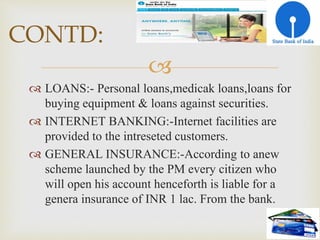
 LOANS:- Personal loans,medicak loans,loans for
buying equipment & loans against securities.
 INTERNET BANKING:-Internet facilities are
provided to the intreseted customers.
 GENERAL INSURANCE:-According to anew
scheme launched by the PM every citizen who
will open his account henceforth is liable for a
genera insurance of INR 1 lac. From the bank.
CONTD:

 INTEREST RATES
 CONSULTING FEES
 COMMISSION
Parameters for determining Price:
 Bank product group price specification
 Bank product price specification
 Business partner price arrangement
 Business partner price agreement.
PRICING.

 Competitive pricing
 The pricing policy is very customer friendly.
 The pricing policies are based on the rate of interest
that is regulated by the RBI.
 Liability & assets also have their say on pricing
factors.
CONTD:-

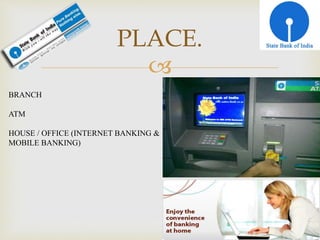
PLACE.
BRANCH
ATM
HOUSE / OFFICE (INTERNET BANKING &
MOBILE BANKING)

 14 regional hubs & 57 offices in zones that are
located throughout india at all the important cities.
 66% of its branches are located in rural areas where
as the rest 33% are located in urban areas.
 190 overseas offices that extend over nearly 34
countries in cities like
Dhaka,Tehran,Moscow,London, Dubai etc.


 ADVERTISING - Television, radio, movies, theatres.
 PRINT MEDIA- Hoardings, newspaper, magazines.
 PUBLICITY- Road shows, campus visits, sponsorship.
 SALES PROMOTION- Gifts, discount and commission, incentives,
etc.
 PERSONAL SELLING- Cross-sale (selling at competitors place),
personalized service.
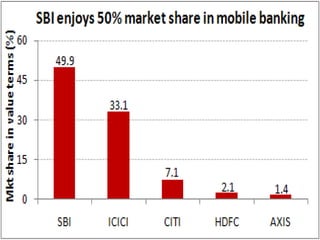
The tagline of SBI is very apt,the banker to every indian”
PROMOTION.


 The company’s employees are important in
marketting because they are the one’s who deliver
the service.It is important to hire and train the right
people to deliver superior service to the
clients,whether they run a support desk,customer
service,copywriters,programmers etc.
PEOPLE.

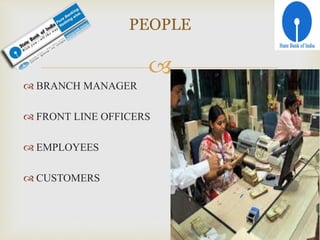
 BRANCH MANAGER
 FRONT LINE OFFICERS
 EMPLOYEES
 CUSTOMERS
28
PEOPLE

All the major activities of SBI bank follow RBI guidelines.
The activities can be segregated into various deparments
accordingly:-
 Standardization:-it saves a lot of time behind individual
transaction.
 Customization:-There are speciality counters at each
branch to deal with customers of a particular scheme.
 Number of steps are usually specified.
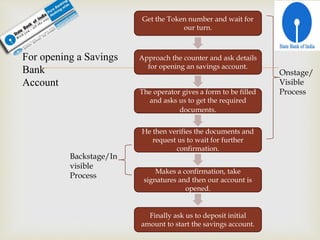
PROCESS.

 Simplicity:- Separate counters exist with clear
indication.
 Customer Involvement:-ATM does not involve any
bank employees.
CONTD:-

For opening a Savings
Bank
Account
Get the Token number and wait for
our turn.
Approach the counter and ask details
for opening an savings account.
The operator gives a form to be filled
and asks us to get the required
documents.
He then verifies the documents and
request us to wait for further
confirmation.
Makes a confirmation, take
signatures and then our account is
opened.
Backstage/In
visible
Process
Finally ask us to deposit initial
amount to start the savings account.
Onstage/
Visible
Process

 Booms and Bitner defined a servicescape as "the
environment in which the service is assembled and
in which the seller and customer interact, combined
with tangible commodities that facilitate
performance or communication of the service“
 The servicescape includes the facility's exterior
(landscape, exterior design, signage, parking,
surrounding environment) and interior (interior
design and decor, equipment, signage, layout, air
quality, temperature and ambiance).
PHYSICAL
EVIDENCE/SERVICESCAPE

33
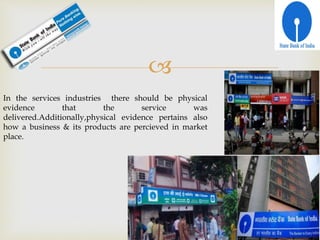
In the services industries there should be physical
evidence that the service was
delivered.Additionally,physical evidence pertains also
how a business & its products are percieved in market
place.

PHYSICAL EVIDENCE OF SBI.
 Signage
 Financial Reports- The Company’s financial reports issued
to the customers.
 Tangibles- Pens, Writing Pads to the internal customers.
Passbook and Cheque books to the customers.
 Employee’s Dress Code
 Punch lines.

THANK YOU.

Financial services

  • 1.
  • 2.
     Financial services arethe economic services provided by the finance industry which mainly include banks. A bank is a financial institution and a financial intermediary that accepts deposits and channels those deposits into lending activities, either directly or through capital market.  A bank connects customers with capital deficits to customers with capital surpluses. INTRODUCTION.
  • 3.
      The firstbank in India was established in 1786. From 1786 till today it has gone through three distinct phases.  PHASE 1 Early phase from 1786 to 1969 of Indian banks.  PHASE 2 Nationalization of Indian Banks and up to 1991 prior to Indian banking sector Reforms.  PHASE 3 New phase of Indian Banking system with the advent of Indian Financial & Banking Sector Reforms after 1991. HISTORY OF BANKING IN INDIA.
  • 4.
     • The totalbank deposits increased from Rs. 9.1 billion($960 million) in 1970-71 to Rs. 8309.22 billion ($620 billion) in 2009-10. Current deposit is Rs. 67504.54 billion($1.1 trillion). • There are total 151 commercial banks in India by 2014 with total of 1,09,811 number of branches. • It contributes INR 243294 Cr. to India’s GDP. • Service sector contribution is 57.3% to India's economy. And out of this 57.3%, banking sector contributes 80%. CONTRIBUTION TOWARDS GDP OF INDIA.
  • 5.
  • 6.
  • 7.
     • Founded on2nd July 1806 as Bank of Calcutta. Bank of Madras merged into the other two "presidency banks" in British India, Bank of Calcutta and Bank of Bombay, to form the Imperial Bank of India, which in turn became the State Bank of India. • Government of India owned the Imperial Bank of India in 1955, with Reserve Bank of India (India's Central Bank) taking a 60% stake, and renamed it the State Bank of India.
  • 8.
     • State Bankof India (SBI) is an Indian multinational, Public Sector banking, and financial services company. It is a government-owned corporation with its headquarters in Mumbai, Maharashtra. • As of December 2014, it had assets of US$388 billion and 17,000 branches, including 190 foreign offices, making it the largest banking and financial services company in India
  • 9.
      Domestic Treasury. Broking services.  ATM services.  Internet Banking.  E-Pay  E-Rail  Safe Deposit Locker. Major Services offered.
  • 10.
      LIEN MARKINGFACILITY. I. It is a unique facility by which you can block funds in your own savings account. II. The funds will be actually transferred to the brokers account at the end of the day only if the transactions placed are executed. III. Instant & automated net payout of funds & securities.  MULTIPLE PRODUCT OFFERINGS.  DEDICATED CUSTOMER CARE: Avail services 24*7 through a dedicated customer care telephone number CHARACTERISTICS
  • 11.
      Single screenorder trade entry without going through the hassles of giving transfer instruction, writing cheques.  Instant order confirmation gives you similar trading experience as exchange based software without the burden of overhead & maintenance cost.  Advanced technology offers you seamless execution of transactions which gives you a feel of real time experience & enables you to encash on every possible opportunity. CONTD:
  • 12.
     STP MODEL OFSTATE BANK OF INDIA.
  • 13.
      Geographic :tier-1,tier-2,tier-3,rural & semi urban branches.  Age:-10-59,60 & above.  Income:-Marginal , Low ,Middle , High.  Occupation:- Unskilled workers , Skilled workers, Shop owners , Businessmen. SEGMENTATION.
  • 14.
      Main Targetsmarkets are:  Retail banking market: this segment is for retail investors & provide them with short term financial credit for their personal,household needs.  Large businesses:-Provide capital to the already established businesses. TARGETTING.
  • 15.
      According toBelch & Belch (2009, p.56), positioning is defined as “the art and science of fitting the product or service to one or more segments of the broad market in such way as to set it meaningfully apart from competition”.  Positioning is also defined as the way by which the marketers create an impression in the customers mind. POSITIONING.
  • 16.
      SBI haspositioned itself as a bank which gives higher standard of services through product innovation for the diverse needs of individual & corporate clients. So there are following points in their positioning segment:-  Customer centric.  Place oriented.  Service oriented.  Product innovation.
  • 17.
      PRODUCT  PRICE PLACE  PROMOTION  PEOPLE  PROCESS  PHYSICAL EVIDENCE MARKETTING MIX.
  • 18.
     SBI offersits corporate & retail customers numerous range of products through its various branches. The banking products include:-  CARDS:- The products under this categories include travelling cards, debit cards & credit cards.  CONSUMER BANKING:- Special accounts for teenagers, senior citizens, recurring accounts,saving accounts & fixed deposit account.  INVESTMENT BANKING:- Foreign exchange servioces tax saving bonds,investments related to pure gold & mutual funds. PRODUCT.
  • 19.
      LOANS:- Personalloans,medicak loans,loans for buying equipment & loans against securities.  INTERNET BANKING:-Internet facilities are provided to the intreseted customers.  GENERAL INSURANCE:-According to anew scheme launched by the PM every citizen who will open his account henceforth is liable for a genera insurance of INR 1 lac. From the bank. CONTD:
  • 20.
      INTEREST RATES CONSULTING FEES  COMMISSION Parameters for determining Price:  Bank product group price specification  Bank product price specification  Business partner price arrangement  Business partner price agreement. PRICING.
  • 21.
      Competitive pricing The pricing policy is very customer friendly.  The pricing policies are based on the rate of interest that is regulated by the RBI.  Liability & assets also have their say on pricing factors. CONTD:-
  • 22.
     PLACE. BRANCH ATM HOUSE / OFFICE(INTERNET BANKING & MOBILE BANKING)
  • 23.
      14 regionalhubs & 57 offices in zones that are located throughout india at all the important cities.  66% of its branches are located in rural areas where as the rest 33% are located in urban areas.  190 overseas offices that extend over nearly 34 countries in cities like Dhaka,Tehran,Moscow,London, Dubai etc.
  • 24.
  • 25.
      ADVERTISING -Television, radio, movies, theatres.  PRINT MEDIA- Hoardings, newspaper, magazines.  PUBLICITY- Road shows, campus visits, sponsorship.  SALES PROMOTION- Gifts, discount and commission, incentives, etc.  PERSONAL SELLING- Cross-sale (selling at competitors place), personalized service. The tagline of SBI is very apt,the banker to every indian” PROMOTION.
  • 26.
  • 27.
      The company’semployees are important in marketting because they are the one’s who deliver the service.It is important to hire and train the right people to deliver superior service to the clients,whether they run a support desk,customer service,copywriters,programmers etc. PEOPLE.
  • 28.
      BRANCH MANAGER FRONT LINE OFFICERS  EMPLOYEES  CUSTOMERS 28 PEOPLE
  • 29.
     All the majoractivities of SBI bank follow RBI guidelines. The activities can be segregated into various deparments accordingly:-  Standardization:-it saves a lot of time behind individual transaction.  Customization:-There are speciality counters at each branch to deal with customers of a particular scheme.  Number of steps are usually specified. PROCESS.
  • 30.
      Simplicity:- Separatecounters exist with clear indication.  Customer Involvement:-ATM does not involve any bank employees. CONTD:-
  • 31.
     For opening aSavings Bank Account Get the Token number and wait for our turn. Approach the counter and ask details for opening an savings account. The operator gives a form to be filled and asks us to get the required documents. He then verifies the documents and request us to wait for further confirmation. Makes a confirmation, take signatures and then our account is opened. Backstage/In visible Process Finally ask us to deposit initial amount to start the savings account. Onstage/ Visible Process
  • 32.
      Booms andBitner defined a servicescape as "the environment in which the service is assembled and in which the seller and customer interact, combined with tangible commodities that facilitate performance or communication of the service“  The servicescape includes the facility's exterior (landscape, exterior design, signage, parking, surrounding environment) and interior (interior design and decor, equipment, signage, layout, air quality, temperature and ambiance). PHYSICAL EVIDENCE/SERVICESCAPE
  • 33.
     33 In the servicesindustries there should be physical evidence that the service was delivered.Additionally,physical evidence pertains also how a business & its products are percieved in market place.
  • 34.
     PHYSICAL EVIDENCE OFSBI.  Signage  Financial Reports- The Company’s financial reports issued to the customers.  Tangibles- Pens, Writing Pads to the internal customers. Passbook and Cheque books to the customers.  Employee’s Dress Code  Punch lines.
  • 35.