SUBJECT: SERVICE MANAGEMENT
SUBMITTED TO: Dr. shital padhiyar
Submitted by: jagruti Mahadik(11)
dolly Agrawal(35)
hemisha Kapadia(45)
mahernaz karanjia(46)
Topic: services in banking sector
Submission date: 26/03/2021
Class: tybba
INTRODUCTION
 The term bank is either derived from old Italian word BANCA
or from a French word BANQUE both mean a Bench or
Money Exchange Table.
DEFINITION
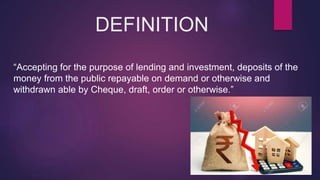
“Accepting for the purpose of lending and investment, deposits of the
money from the public repayable on demand or otherwise and
withdrawn able by Cheque, draft, order or otherwise.”
HISTORY Of BANKING IN INDIA
 The first bank in India was established in 1786. From 1786 till today it has gone
through three distinct phases.
 Phase 1
Early phase from 1786 to 1969 of Indian Banks.
 Phase 2
Nationalization of Indian Banks and up to 1991 prior to Indian banking sector
reforms.
 Phase 3
New phase of Indian banking system with the advent of Indian financial and
banking sector reforms after 1991.
CONTRIBUTION
 With the potential to become the fifth largest banking industry in the
world by 2022 and third largest by 2025, India’s banking and financial
sector is expanding rapidly. The Indian Banking industry is currently
worth Rs. 81 trillion (US $ 1.31 trillion).The Indian banking sector
consists of 26 public sector banks, 20 private sector banks and 43
foreign banks along with 61 regional rural banks (RRBs) and more
than 90,000 credit cooperatives. Roughly, the Contribution of the
banking sector to GDP is about 7.7% of GDP. Banking sector has
generated employment in the economy for about 1.5 million people.
PUBLIC SECTOR BANKS
 The Major part of stake or equity is held by the government.
 The Government controls the bank.
 The main motive is the benefit of the people and providing
services.
 The decisions are generally in the interests of the public.
 They provide services to all sections of the society.
PRIVATE SECTOR BANKS
 The greater part of stake or equity lies in the hands of private
stakeholders.
 The interest rates of private banks are generally slightly costly as
compared to public sector banks.
 They are known for better customer services and investment
opportunities.
 A private bank mainly focuses on short term interest.
MAJOR PLAYERS IN INDIA
MARKETING MIX
 Definition:
“The marketing mix refers to the set of actions, or tactics, that a company
uses to promote its brand or product in the market.”
 Product
 Price
 Place
 Promotion
 People
 Process
 Physical Evidence
PRODUCT
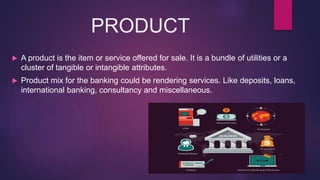
 A product is the item or service offered for sale. It is a bundle of utilities or a
cluster of tangible or intangible attributes.
 Product mix for the banking could be rendering services. Like deposits, loans,
international banking, consultancy and miscellaneous.
PRICE
 Price is the value that is put to a product or service.
 Price mix for banking is interest rate charged by different banks.
 Bank decide their pricing on the basis of following:
1. Value Pricing- based on customer loyalty and the products.
2. Going Rate Pricing- based on competitor's price.
 The process of moving products from the producer to the intended user is
called place.
 Place mix is the location for branches.
 Factors affecting the location of branch banks:
 The trade area
 Population characteristics
 Commercial structure
 Banking structure
 Real estate rates
 Proximity to public transportation
 Visibility
 Access
PLACE
PROMOTION
 Promotion refers to the entire set of activities, which communicates the product, brand or a
service to the user. The idea is to make people aware, attract and induce to buy the product or
services, in preference over others.
 Promotion in banking is to make customer more and more aware of services and benefits
provided by them.
 Different ways of promotion:
 Public relations
 Personal selling
 Sales promotion
 Word-of-mouth
 Telemarketing
 internet
PEOPLE
 In people, it includes everyone who is involved in the product or
service whether directly or indirectly. These people have their own
roles to play.
 In a banking sector service provider plays a determinant role in
providing the customers a good service.
 Behaviour of employees play an important role in satisfaction of
customer.
PROCESS
 Process refers to the flow of activities or mechanism that take place
when there is an interaction between the customers and businesses.
 Process should be customer friendly, easy to understand and follow.
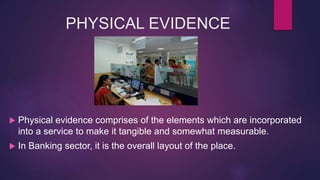
PHYSICAL EVIDENCE
 Physical evidence comprises of the elements which are incorporated
into a service to make it tangible and somewhat measurable.
 In Banking sector, it is the overall layout of the place.
CASE STUDY
STATE BANK OF INDIA
 Founded on 2nd July 1806 as Bank of Calcutta. Bank of Madras merged into the
other to “presidency banks” in British India, Bank of Calcutta and Bank of
Bombay, to form the Imperial Bank of India, which in turn became the STATE
BANK OF INDIA(SBI).
 GOI owned the Imperial Bank of India in 1955, with RBI(India’s Central Bank)
taking a 60% stake, and renamed it the State Bank of India.
• SBI is an Indian multinational, Public Sector banking, and
financial services company. It is a Government-owned
corporation with its headquarters in Mumbai, Maharashtra.
• As of December 2013, it had assets of US $ 388 Billion
and 17000 branches, including 190 foreign offices, making
it the largest banking and financial services company in
India.
PRODUCT
 Deposits
 Advances and loans
 Consultancy
 Investments
 International Banking
 Cards, credit cards, ATM card, travelers card
 Demat services
 Online money transfer
 Mobile banking, Internet banking
 Agriculture banking, Micro credit, etc
PRICE
 Interest rates
 Consulting fees
 Commission
Parameters for determining Price:
 Bank product group price specification
 Bank product price specification
 Business partner price arrangement
 Business partner price agreement
PLACE
 Branch
 ATM
 House/Office (Internet Banking and Mobile Banking)
PROMOTION
 Advertising-TV, Radio, Movies, Theatres.
 Print Media-Hoardings, Newspapers, Magazines
 Publicity-Road, Shows, Campus visits, Sponsorship
 Sales Promotion-Gifts, Discounts and commissions, Incentives etc.
 Personal Selling-Cross sale(selling at competitor’s
place),Personalized service
PEOPLE
 Branch Manager
 Front Line Officers
 Employees
 Customers
PROCESS
Finally ask us to deposit initial amount to start the savings account.
Makes a confirmation, take signatures and then our account is opened.
He then verifies the documents and request us to wait for further confirmation.
The operator gives a form to be filled and asks us to get the required documents.
Approach the counter and ask details for opening a savings account.
Get the token number and wait for your turn.
For opening a
bank account
Backstage
/Invisible
process
Onstage
/Visible
process
PHYSICAL EVIDENCE
 Signage
 Billboards and Hoardings
 Financial Reports- The company’s financial reports issued to customers.
 Tangibles- Pens, Writing Pads to the internal customers, Passbooks and
Cheque books to the customers.
 Punch Lines of SBI- “With You All The Way”, “The Banker to every Indian”
 Employees dress code
THANK YOU
ANY QUESTIONS?

Banking sector services

  • 1.
    SUBJECT: SERVICE MANAGEMENT SUBMITTEDTO: Dr. shital padhiyar Submitted by: jagruti Mahadik(11) dolly Agrawal(35) hemisha Kapadia(45) mahernaz karanjia(46) Topic: services in banking sector Submission date: 26/03/2021 Class: tybba
  • 3.
    INTRODUCTION  The termbank is either derived from old Italian word BANCA or from a French word BANQUE both mean a Bench or Money Exchange Table.
  • 4.
    DEFINITION “Accepting for thepurpose of lending and investment, deposits of the money from the public repayable on demand or otherwise and withdrawn able by Cheque, draft, order or otherwise.”
  • 5.
    HISTORY Of BANKINGIN INDIA  The first bank in India was established in 1786. From 1786 till today it has gone through three distinct phases.  Phase 1 Early phase from 1786 to 1969 of Indian Banks.  Phase 2 Nationalization of Indian Banks and up to 1991 prior to Indian banking sector reforms.  Phase 3 New phase of Indian banking system with the advent of Indian financial and banking sector reforms after 1991.
  • 6.
    CONTRIBUTION  With thepotential to become the fifth largest banking industry in the world by 2022 and third largest by 2025, India’s banking and financial sector is expanding rapidly. The Indian Banking industry is currently worth Rs. 81 trillion (US $ 1.31 trillion).The Indian banking sector consists of 26 public sector banks, 20 private sector banks and 43 foreign banks along with 61 regional rural banks (RRBs) and more than 90,000 credit cooperatives. Roughly, the Contribution of the banking sector to GDP is about 7.7% of GDP. Banking sector has generated employment in the economy for about 1.5 million people.
  • 7.
    PUBLIC SECTOR BANKS The Major part of stake or equity is held by the government.  The Government controls the bank.  The main motive is the benefit of the people and providing services.  The decisions are generally in the interests of the public.  They provide services to all sections of the society.
  • 8.
    PRIVATE SECTOR BANKS The greater part of stake or equity lies in the hands of private stakeholders.  The interest rates of private banks are generally slightly costly as compared to public sector banks.  They are known for better customer services and investment opportunities.  A private bank mainly focuses on short term interest.
  • 9.
  • 10.
    MARKETING MIX  Definition: “Themarketing mix refers to the set of actions, or tactics, that a company uses to promote its brand or product in the market.”  Product  Price  Place  Promotion  People  Process  Physical Evidence
  • 11.
    PRODUCT  A productis the item or service offered for sale. It is a bundle of utilities or a cluster of tangible or intangible attributes.  Product mix for the banking could be rendering services. Like deposits, loans, international banking, consultancy and miscellaneous.
  • 12.
    PRICE  Price isthe value that is put to a product or service.  Price mix for banking is interest rate charged by different banks.  Bank decide their pricing on the basis of following: 1. Value Pricing- based on customer loyalty and the products. 2. Going Rate Pricing- based on competitor's price.
  • 13.
     The processof moving products from the producer to the intended user is called place.  Place mix is the location for branches.  Factors affecting the location of branch banks:  The trade area  Population characteristics  Commercial structure  Banking structure  Real estate rates  Proximity to public transportation  Visibility  Access PLACE
  • 14.
    PROMOTION  Promotion refersto the entire set of activities, which communicates the product, brand or a service to the user. The idea is to make people aware, attract and induce to buy the product or services, in preference over others.  Promotion in banking is to make customer more and more aware of services and benefits provided by them.  Different ways of promotion:  Public relations  Personal selling  Sales promotion  Word-of-mouth  Telemarketing  internet
  • 15.
    PEOPLE  In people,it includes everyone who is involved in the product or service whether directly or indirectly. These people have their own roles to play.  In a banking sector service provider plays a determinant role in providing the customers a good service.  Behaviour of employees play an important role in satisfaction of customer.
  • 16.
    PROCESS  Process refersto the flow of activities or mechanism that take place when there is an interaction between the customers and businesses.  Process should be customer friendly, easy to understand and follow.
  • 17.
    PHYSICAL EVIDENCE  Physicalevidence comprises of the elements which are incorporated into a service to make it tangible and somewhat measurable.  In Banking sector, it is the overall layout of the place.
  • 18.
  • 19.
    STATE BANK OFINDIA  Founded on 2nd July 1806 as Bank of Calcutta. Bank of Madras merged into the other to “presidency banks” in British India, Bank of Calcutta and Bank of Bombay, to form the Imperial Bank of India, which in turn became the STATE BANK OF INDIA(SBI).  GOI owned the Imperial Bank of India in 1955, with RBI(India’s Central Bank) taking a 60% stake, and renamed it the State Bank of India.
  • 20.
    • SBI isan Indian multinational, Public Sector banking, and financial services company. It is a Government-owned corporation with its headquarters in Mumbai, Maharashtra. • As of December 2013, it had assets of US $ 388 Billion and 17000 branches, including 190 foreign offices, making it the largest banking and financial services company in India.
  • 21.
    PRODUCT  Deposits  Advancesand loans  Consultancy  Investments  International Banking  Cards, credit cards, ATM card, travelers card  Demat services  Online money transfer  Mobile banking, Internet banking  Agriculture banking, Micro credit, etc
  • 23.
    PRICE  Interest rates Consulting fees  Commission Parameters for determining Price:  Bank product group price specification  Bank product price specification  Business partner price arrangement  Business partner price agreement
  • 24.
    PLACE  Branch  ATM House/Office (Internet Banking and Mobile Banking)
  • 25.
    PROMOTION  Advertising-TV, Radio,Movies, Theatres.  Print Media-Hoardings, Newspapers, Magazines  Publicity-Road, Shows, Campus visits, Sponsorship  Sales Promotion-Gifts, Discounts and commissions, Incentives etc.  Personal Selling-Cross sale(selling at competitor’s place),Personalized service
  • 26.
    PEOPLE  Branch Manager Front Line Officers  Employees  Customers
  • 27.
    PROCESS Finally ask usto deposit initial amount to start the savings account. Makes a confirmation, take signatures and then our account is opened. He then verifies the documents and request us to wait for further confirmation. The operator gives a form to be filled and asks us to get the required documents. Approach the counter and ask details for opening a savings account. Get the token number and wait for your turn. For opening a bank account Backstage /Invisible process Onstage /Visible process
  • 28.
    PHYSICAL EVIDENCE  Signage Billboards and Hoardings  Financial Reports- The company’s financial reports issued to customers.  Tangibles- Pens, Writing Pads to the internal customers, Passbooks and Cheque books to the customers.  Punch Lines of SBI- “With You All The Way”, “The Banker to every Indian”  Employees dress code
  • 30.
  • 31.