Service Innovation  - Introductory Session Ian Miles [email_address] 
Mission for today Introduce the course (and each other) Explore what we mean by “Service” Explore what we mean by “Service innovation” Examine some cases Introduce notions and statistics of the “Service Economy” Think about what we want to get out of the course
Course Outline - note there may need to be some shifting of dates due to service contracts Service Innovation Policy and the Service Science Initiatives 10 26/4 Knowledge Intensive Business Services and Innovation Systems 9 19/4 Digital Convergence and Innovation in Media 8 22/3 Case Studies 3: Creative Industries (e.g. videogames, advertising) 7 15/3 Internationalisation and Innovation 6 8/3 Case Studies 2: Public Services (e.g. health informatics and medical innovation) 5 1/3 Service Work and Occupations- professional and service classes 4 22/2 Case Studies 1: IT-based innovation in services (e.g. videotex, ecommerce, IT in banks) 3 15/2 Service Innovation: main features and dynamics - reverse product cycle model and other approaches 2 8/2 Introduction –  The rise of the Service Economy -“peculiarities” of services 1 1/2
What are your interests in this course? Do you – or do you hope to: Work for a service industry? Work on policies for services? Have a new service to develop? Want to do academic research in this field? Think that “service” is a very important issue whatever line of work you’re in? Have some other interests and objectives?
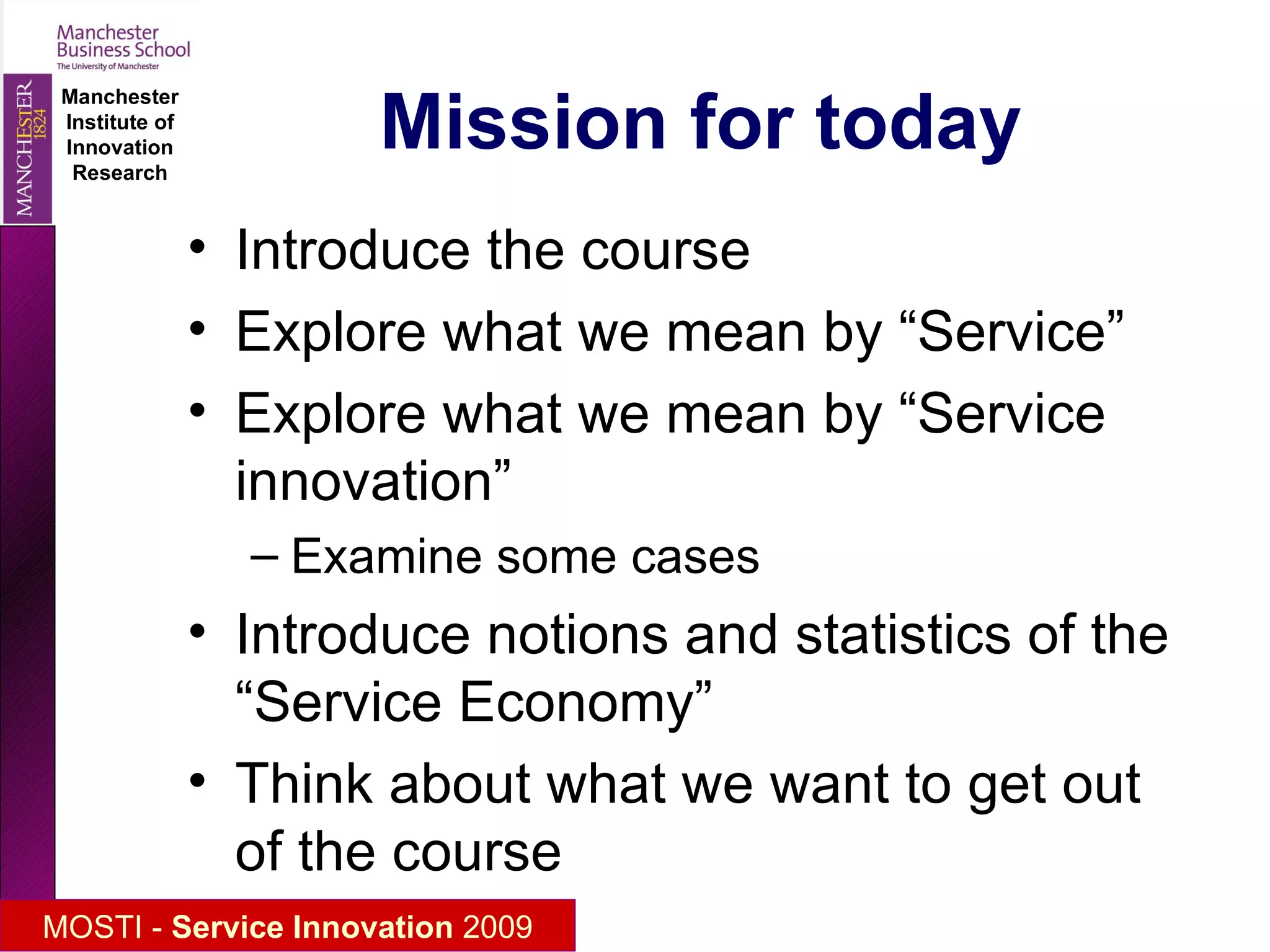
What are Services? 1 “Things you can buy or sell, but can’t drop on your foot”  (note: this definition deals with service  products ) But some services are very tangible – having a false tooth fitted; having a broken laptop repaired; having eco-friendly insulation installed in your attic.  There is a physical product that you can drop on your foot – though the service supplier  often  does not make this good.  A classic essay on services vs. intangibles is Terence P Hill 1977, “On goods and services”,  Review of Income and Wealth ,  vol 23, pp. 315-338.
What are Services? 2 DOING THINGS: not primarily MAKING THINGS. Manufacturing  sectors  make goods.  Manufactured  products   Service  sectors  make services.  Service  products So do most other sectors.  Service sectors  specialise  in service products as their primary outputs. Potential ambiguity: when we talk about services, do we mean the sector or the product (or something else) These points indicate a challenge to analysis and practice: things that we make are easier to see and count, to compare and contrast, than are things that we do.
Some examples of Service Products – and Innovation? “Intangible” Information – Entertainment Service
Have we innovated since C15th? C19th C20th What’s new about this? “ Tangible” Human – Meidcal Service
Quality of service – in the eye of the customer? “Tangible” Physical – “Restaurant” Service – Or less tangible experience service
Experience service with high cost technology infrastructure
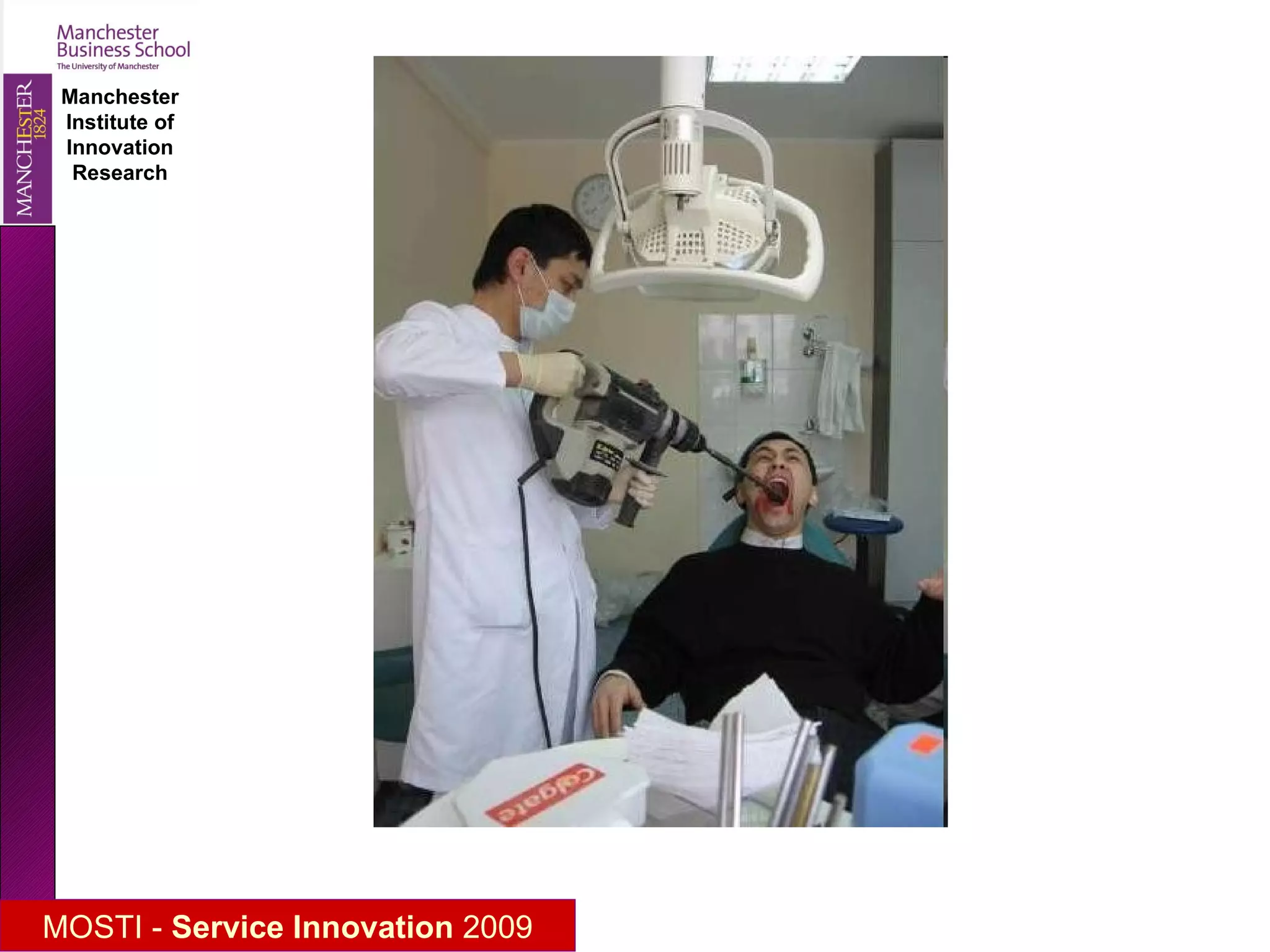
Transport of Things as well as people
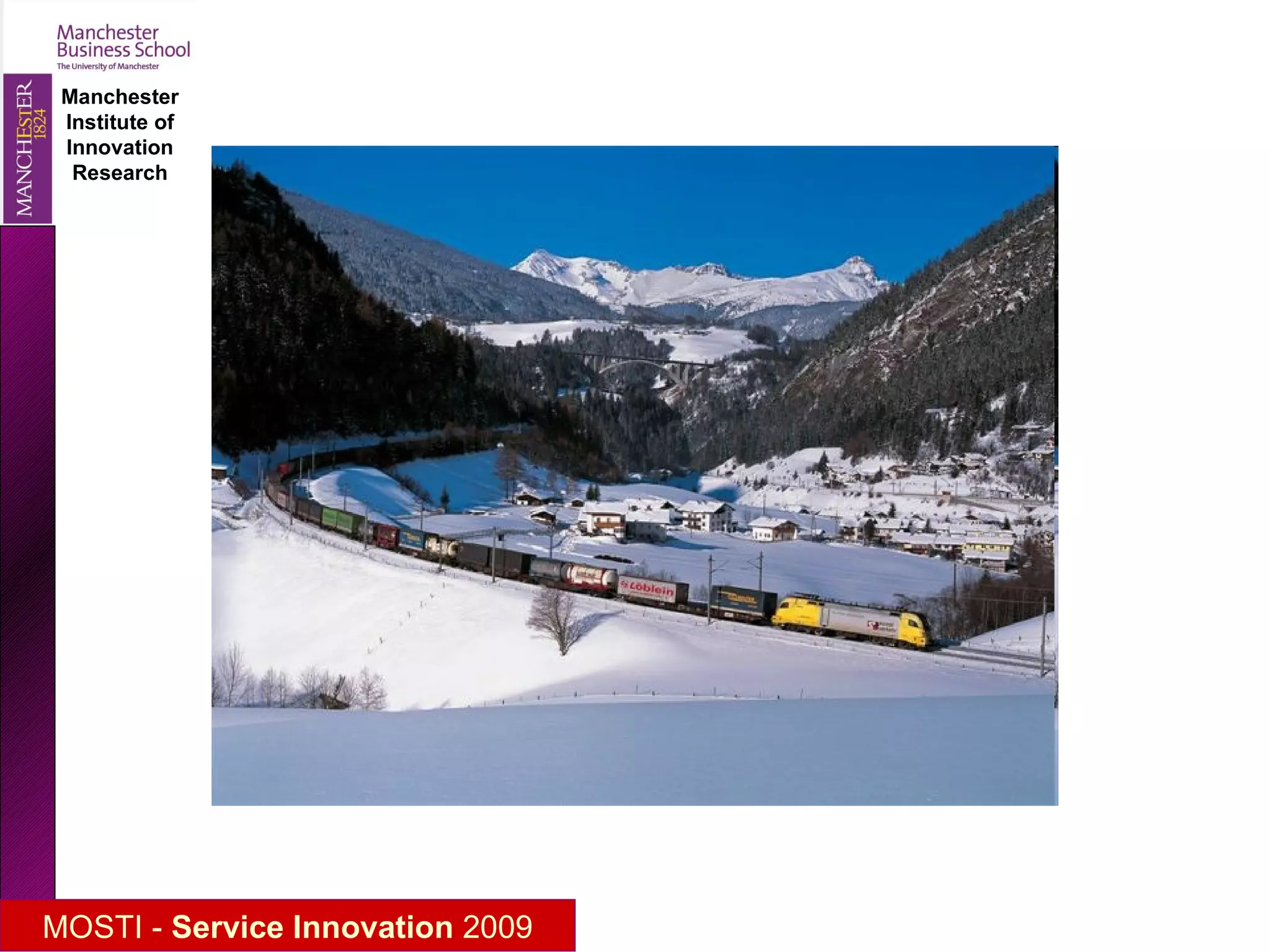
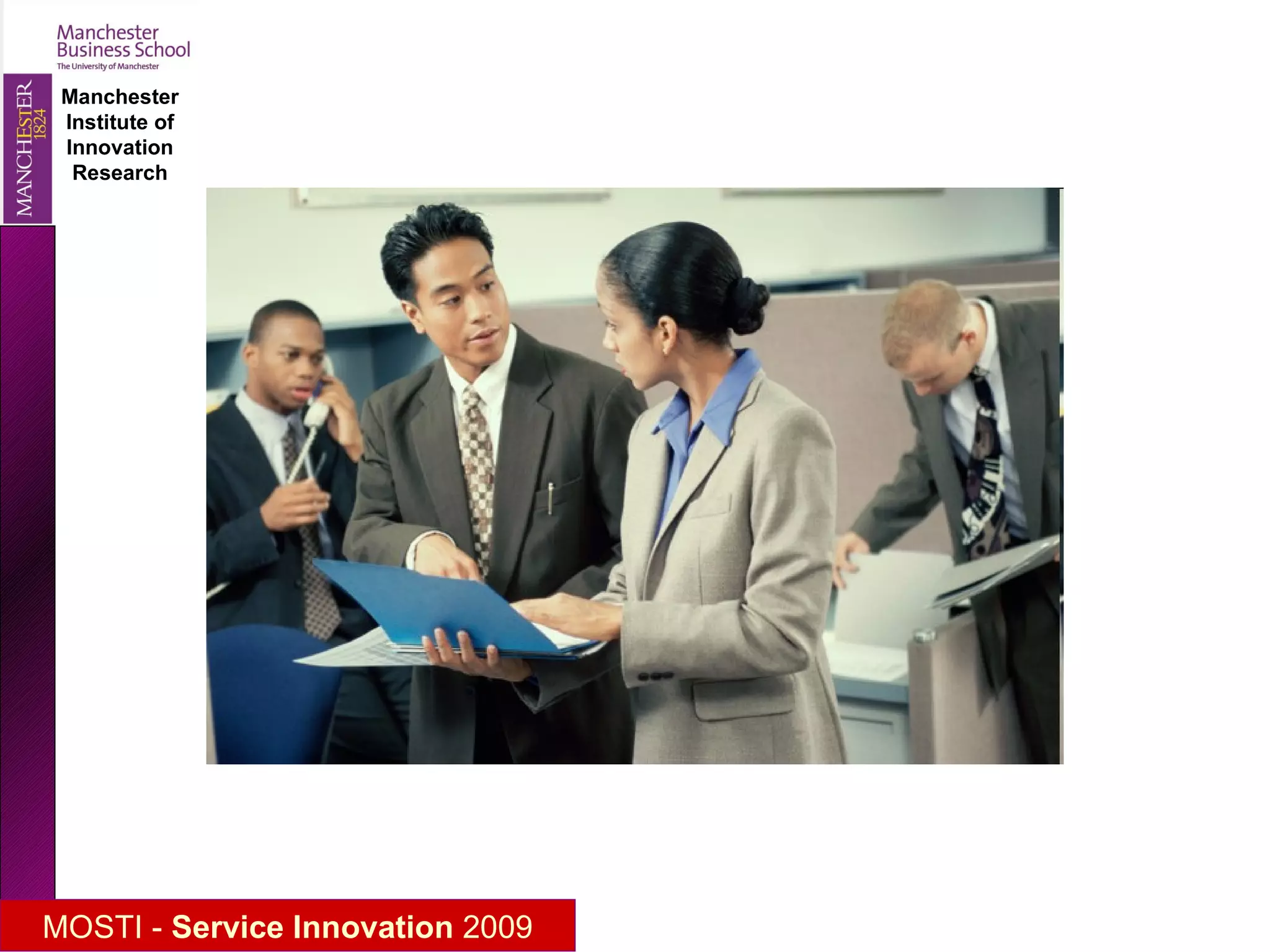
Human interaction – knowledge work or emotional labour?
Hospitality services
What are Services? Hotels… or doormen? Cinemas and delivery of movies (entertainment… experience economy) Dentists – false teeth, dental health Transport – moving freight and people Consultancy – advice, problem diagnosis, what else? Reflections
Videos http://uk.youtube.com/watch?v=GEvcii1vsy4&feature=related  Customer service http://uk.youtube.com/watch?v=KXcw3f2Snh4  consultancy http://uk.youtube.com/watch?v=TswE7WcCzDA&feature=related  consultancy/ continuity http://uk.youtube.com/watch?v=DMOS0T8spcQ&feature=related  McJobs
What are Services? Reflections
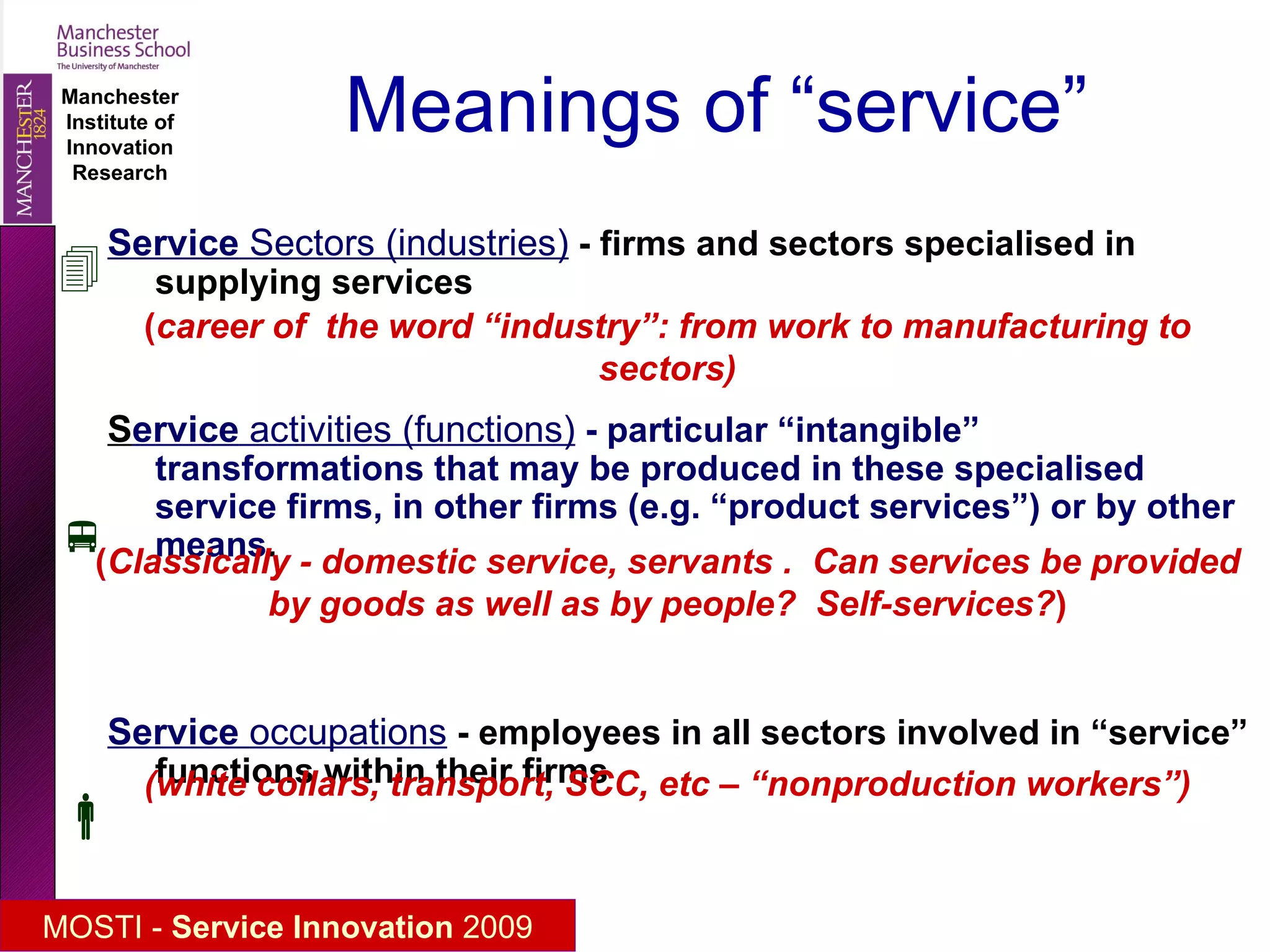
Meanings of “service” Service  Sectors (industries)   - firms and sectors specialised in supplying services   S ervice  activities (functions)   - particular “intangible” transformations that may be produced in these specialised service firms, in other firms (e.g. “product services”) or by other means . Service  occupations   - employees in all sectors involved in “service” functions within their firms Service relationships   – the interaction between service providers and clients (during the service  journey , in the  servicescape) ( career of  the word “industry”: from work to manufacturing to sectors) ( Classically - domestic service, servants .  Can services be provided by goods as well as by people?  Self-services? ) (white collars, transport, SCC, etc – “nonproduction workers”)    
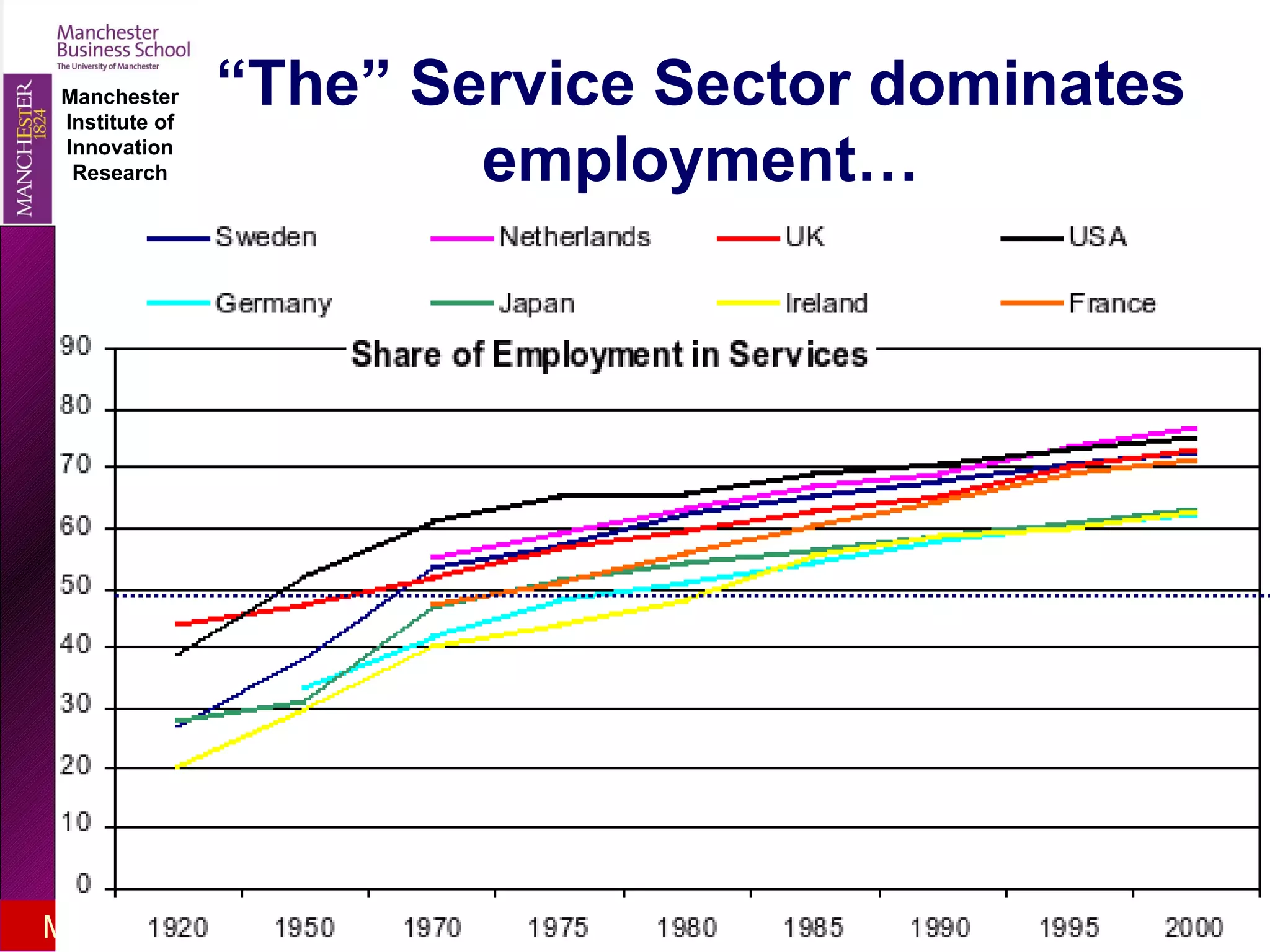
“ The” Service Sector dominates employment…
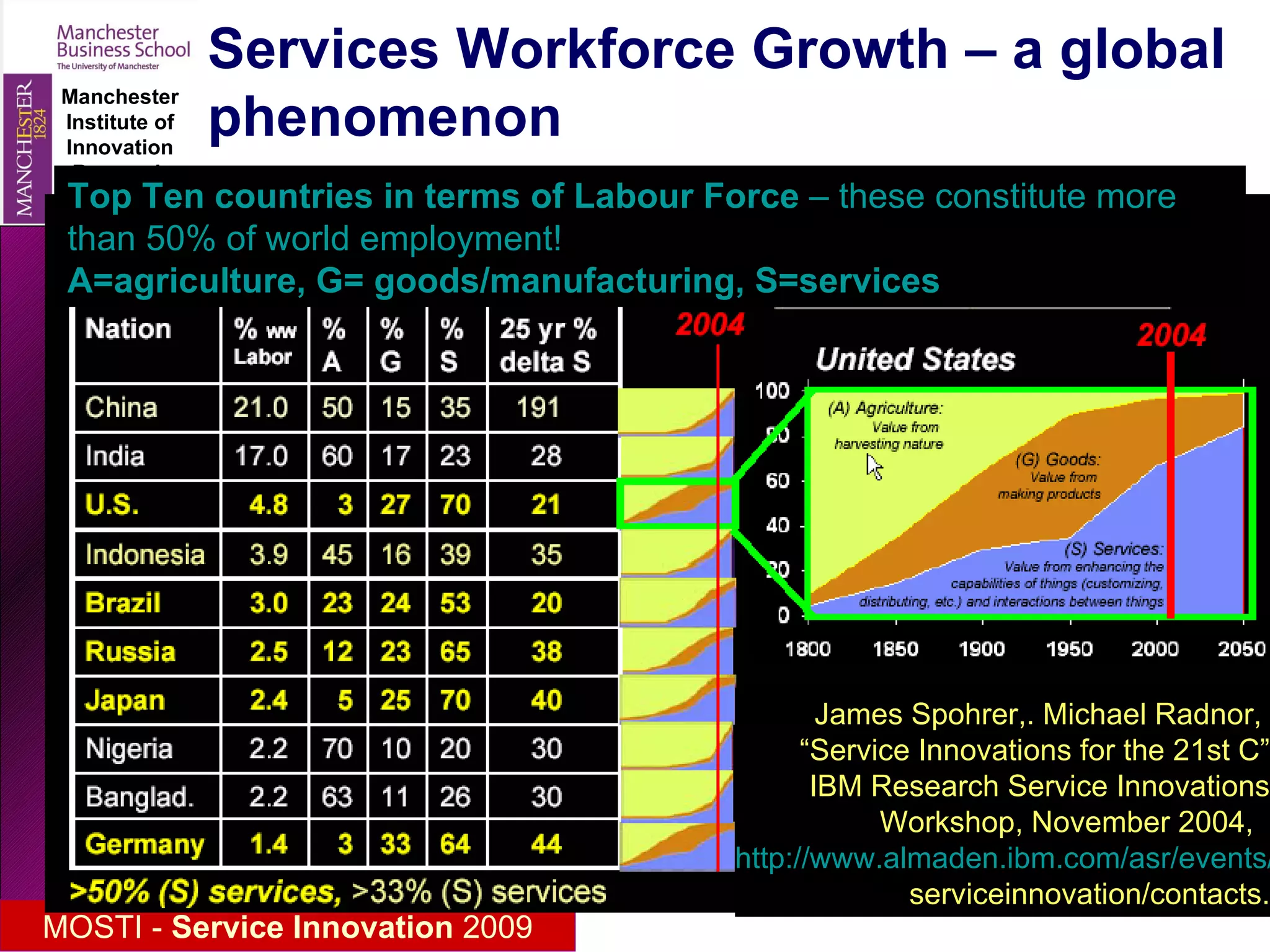
Service Sector Workforce Growth is a global phenomenon James Spohrer,. Michael Radnor,  “ Service Innovations for the 21st C” IBM Research Service Innovations Workshop, November 2004,  http://www.almaden.ibm.com/asr/events/  serviceinnovation/contacts. Top Ten countries in terms of Labour Force  – these constitute more than 50% of world employment!  A= agriculture, G=  goods/manufacturing, S= services Source: Paul Maglio, Jim Spohrer, IBM A  G  S
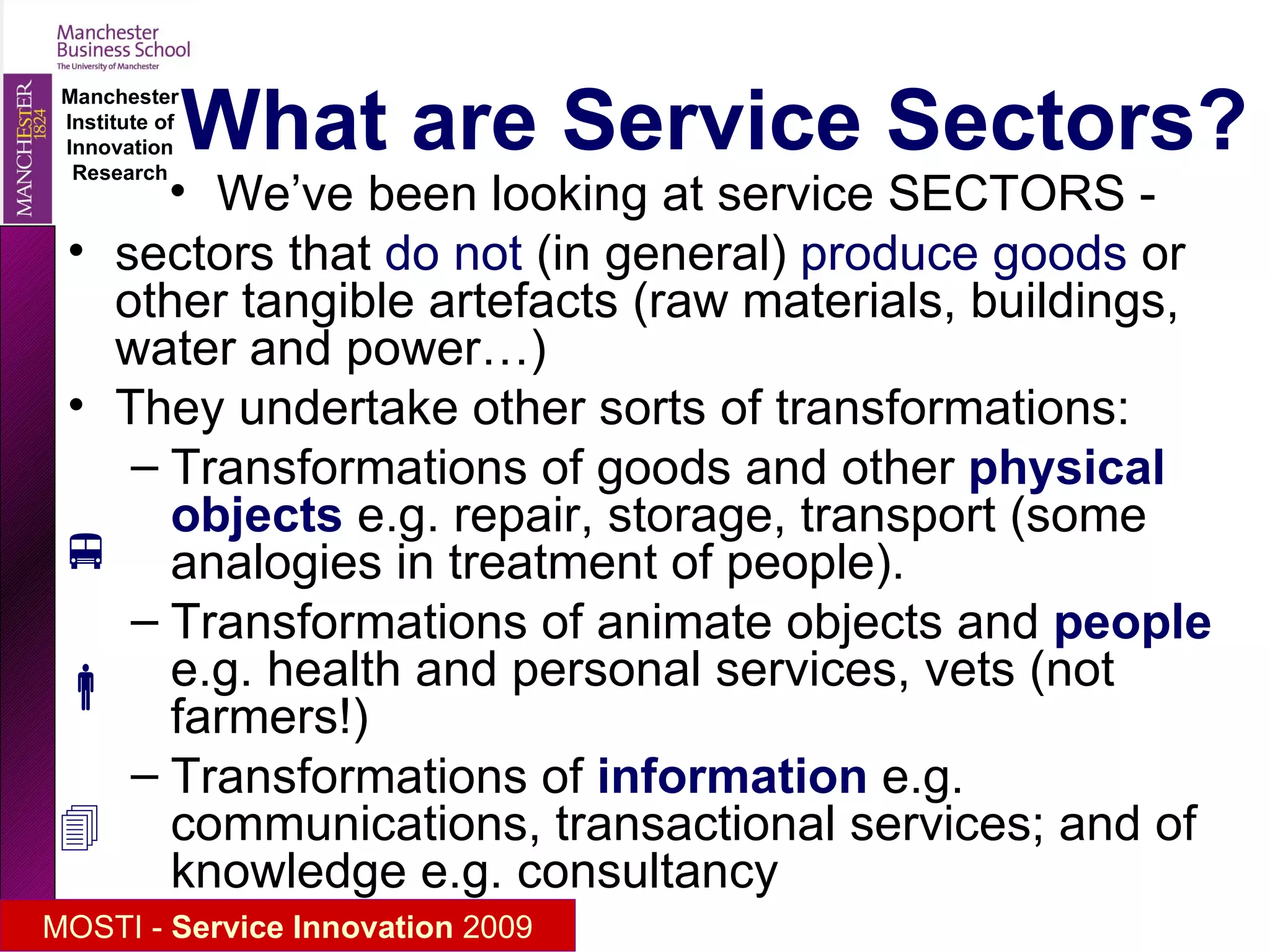
What are Service Sectors? These data concern service SECTORS - sectors that  do not  (in general)  produce goods  or other tangible artefacts (raw materials, buildings, water and power…)  they don’t MAKE THINGS (much) They undertake other sorts of transformations: Transformations of goods and other  physical objects  e.g. repair, storage, transport (some analogies in treatment of people). Transformations of animate objects and  people  e.g. health and personal services, vets (not farmers!) Transformations of  information  e.g. communications, transactional services; and of knowledge e.g. consultancy with  things; and  to  things and/or people and/or info. They DO THINGS     
How are these statistics collected? Statisticians have defined a large number of specific service categories These represent something of a compromise between different ideas, and have evolved over time We have much better service sector statistics now, but they still lag behind those for manufacturing
UK official service (sector) statistics http://www.statistics.gov.uk/elmr/06_09/downloads/ELMR_Jun09_Brook.pdf
Services in NACE Hotels and Restaurants ( HORECA )  Transport, Storage  Financial Intermediation ( FI ...  Real estate, Renting (… RE ), Business Activities  Wholesale & Retail  Trade ; Repair of Motor Vehicles, Motorcycles and Personal & Household Goods  Public Administration and Defence; Compulsory Social Security Education Health and Social Work Other Community, Social and Personal Service Activities Includes  KIBS Processing Material Artefacts Personal care & Material Comforts Both people and things  Mainly informational Informational, material, plus diverse BUSINESS services, inc KIBS PUBLIC (inc knowledge activities) and PERSONAL plus some entertainment and creative industries
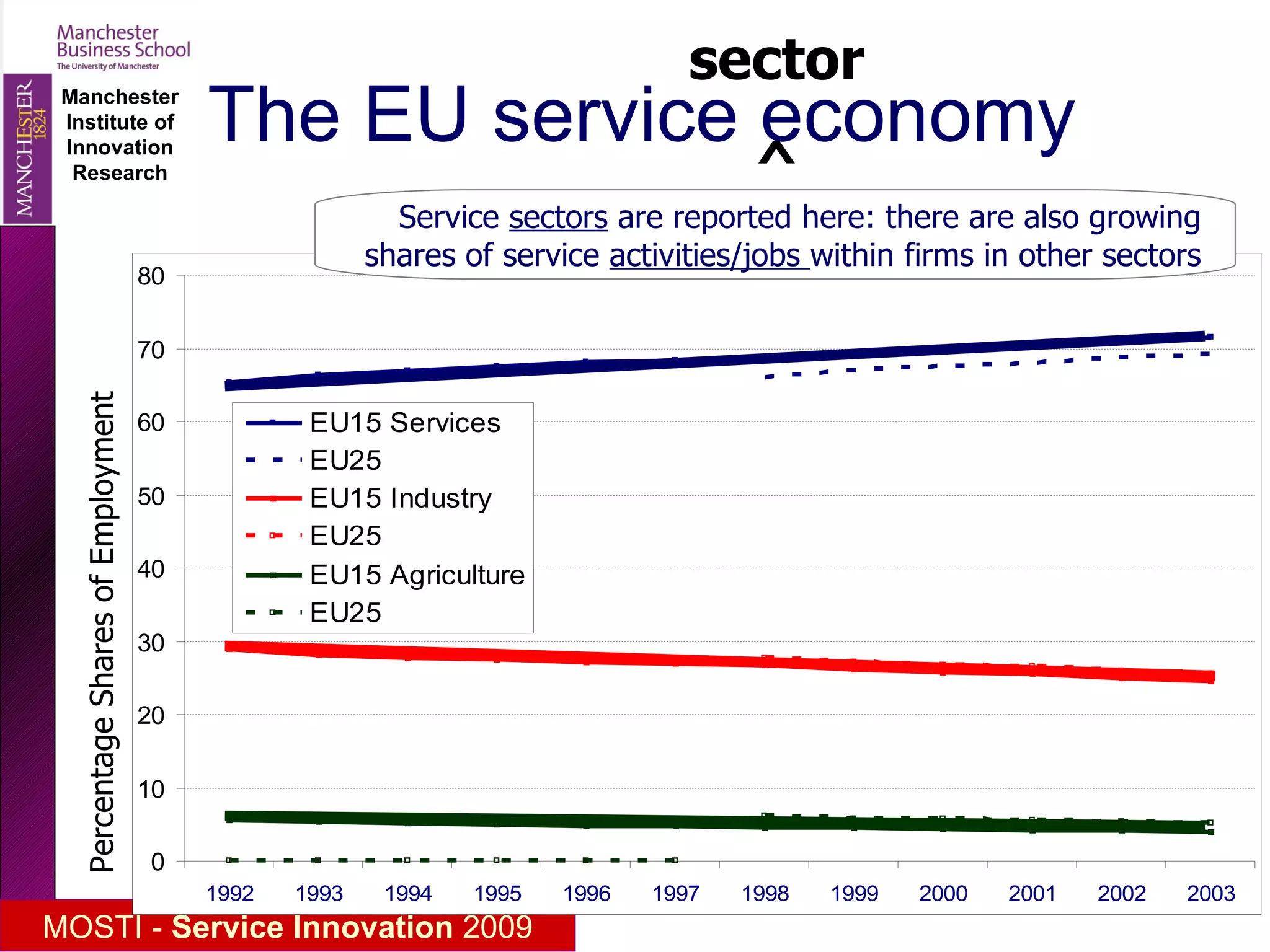
Percentage Shares of Employment The EU service economy sector ^ Service  sectors  are reported here: there are also growing shares of service  activities/jobs  within firms in other sectors
Service Economy as “New Thing” Daniel Bell (and others) 1960s, 1970s: “ The Coming of Post-Industrial Society ” – relative growth of services sectors Bell also stressed increasing role of  knowledge  – industries based on new knowledge, workers requiring more knowledge as compared to deskilling trend in Taylorism/Fordism In late C20th, rise of knowledge-intensive services – esp. KIBS – seen as key to Knowledge-Based Economy
Gender Structure and  Employment Trends Male dominated (except Japan) - Decline in all categories Male dominated - Decline in all categories Female dominated –growth 1980 ?  1998?  1980    1998     1980    1998  Agriculture   “Industry”  Services Proportion of workforce
But different service sectors differ widely in what they do, how they do it, who does it… Transforming things, people, information Consumer services, business services, public services “knowledge-intensive” and other services
Different Services – Different Trends 1960  1973  1984  1997 1960  1973  1984  1997 Singelmann categories – Elfring Data Analysis Distributive Services Personal Services Producer Services Social Services
Reading Triangular Plots Element A Element   B Element   C High A, low B and C A, B, C roughly equal Moderate A, low B, moderate C Fairly high B, fairly low A and low C Can be used where three elements add up to 100% We can often capture features of services in terms of three dimensions: so we can use triangular plots to capture and explore diversity
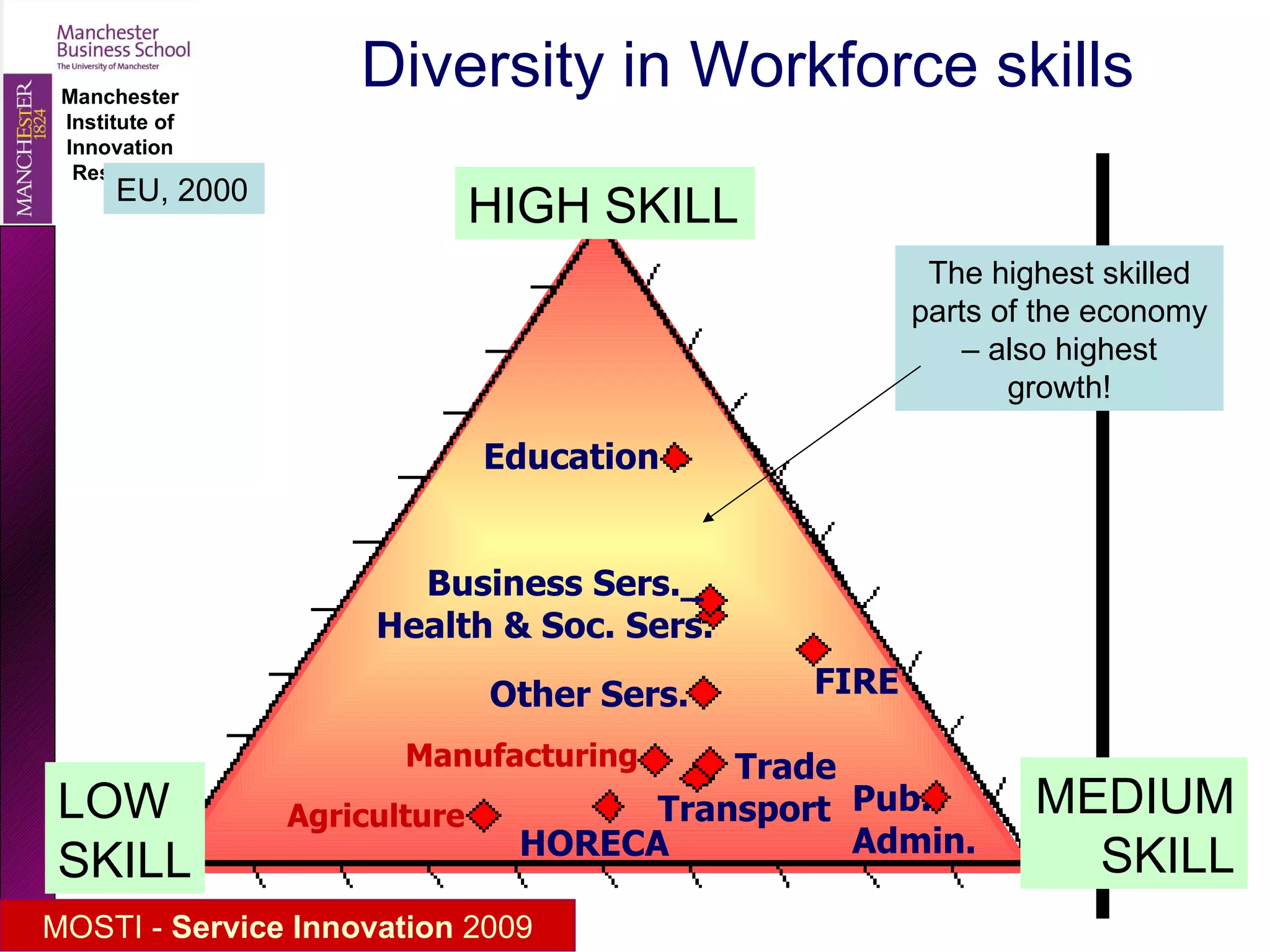
Diversity in Workforce skills Agriculture Manufacturing HORECA Trade Transport Pub. Admin. Other Sers. FIRE Education Business Sers._  Health & Soc. Sers. HIGH SKILL LOW SKILL MEDIUM  SKILL The highest skilled parts of the economy – also highest growth! EU, 2000
Diversity in  inputs   (transformations) PHYSICAL SOCIAL INFORMATIONAL Trade Recreational Other Sers. HORECA Public Sers. FIRE Comms. KIBS Other Bus. Sers. Transport Construction Manufacturing Agr. Fish. Forestry Utilities Services undertake a HUGE range of transformations – as previous graphic indicated, some are more knowledge-intensive than others
Diversity in  Markets Businesses NON-MARKET Consumers Public Sers. HORECA Recreational KIBS Extractive Construction Other Bus. Sers. Other Sers. Trade FIRE Manufacturing Agr. Fish. Forestry Transport Comms. Utilities
What lies behind services growth? Post-industrial argument (Bell and many others) Seen as mainly a matter of consumer demand Engel’s law: as you get richer, you spend proportionally less of your income on potatoes Shift to “superior goods” (i.e. services): people tire of material consumption and pursue more sophisticated needs ( à la Maslow “hierarchy of needs”) Some acknowledgement of business services growth (knowledge); public services seen as another expression of consumer demand
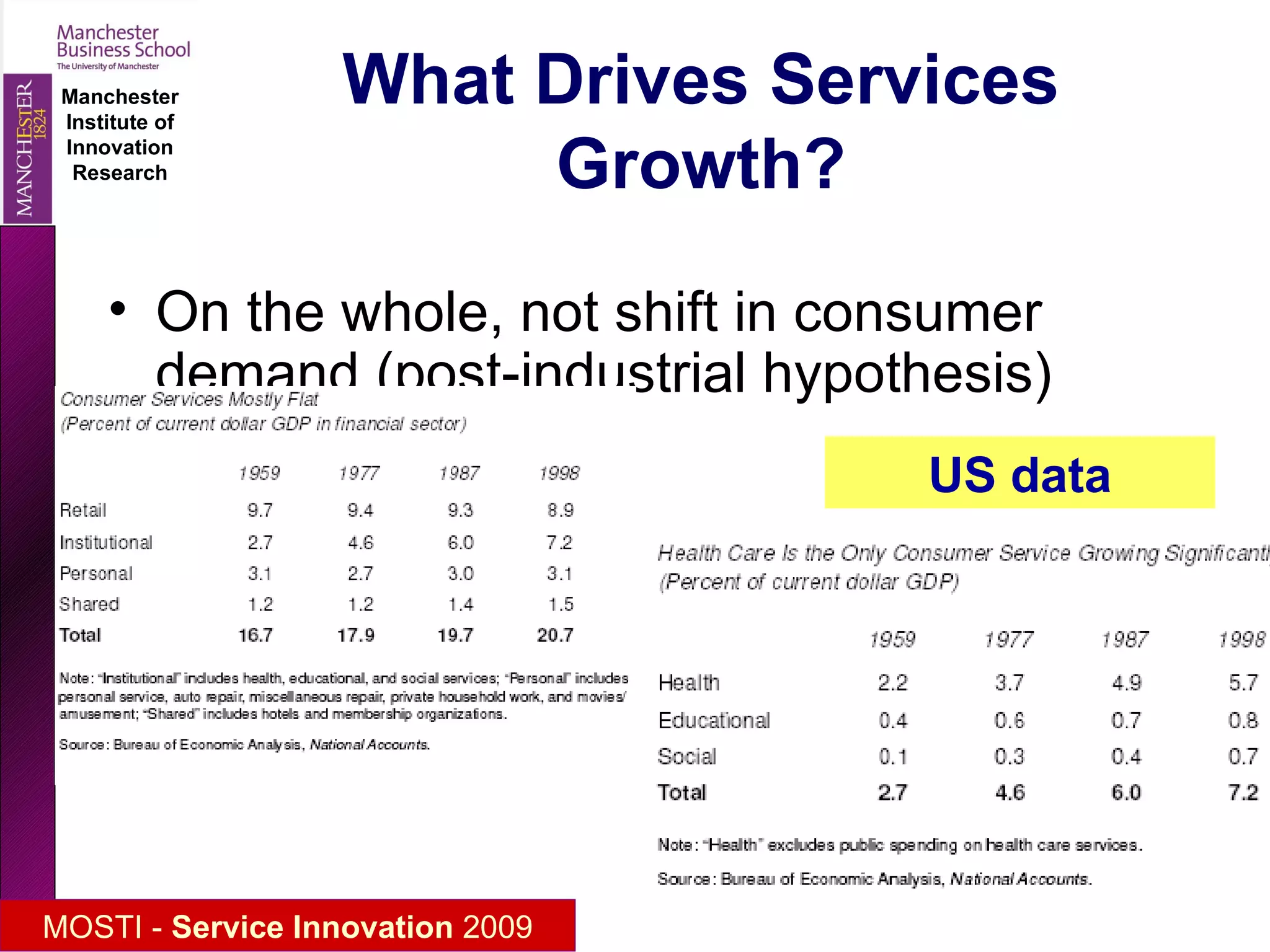
On the whole, not shift in consumer demand (post-industrial hypothesis) What Drives Services Growth? Consumer expenditure does shift across categories – thus away from “basic needs” towards “higher needs” But this does not simply equate to shift from goods to services This much less clear in the data Gershuny: within categories, consumer demand often shifts from services to goods (“self-services” through goods). Gershuny and Miles, 1983,  The New Service Economy  (Pinter)
What Drives Services Growth? On the whole, not shift in consumer demand (post-industrial hypothesis) US data
What Drives Services Growth? On the whole, not shift in consumer demand (post-industrial hypothesis) Public sector growth (in many countries) – political drivers and limits? BUSINESS SERVICES
What Drives Services Growth? On the whole, not shift in consumer demand (post-industrial hypothesis) Public sector growth (in many countries) – political drivers and limits? BUSINESS SERVICES SERVICES SERVICES
With all this diversity… … is it reasonable to talk about services in general? … maybe there are some broad groups, but across these groups, is all they have in common simply that they do not make THINGS as their main characteristic? Or are there common features – even if these are a shared neglect?
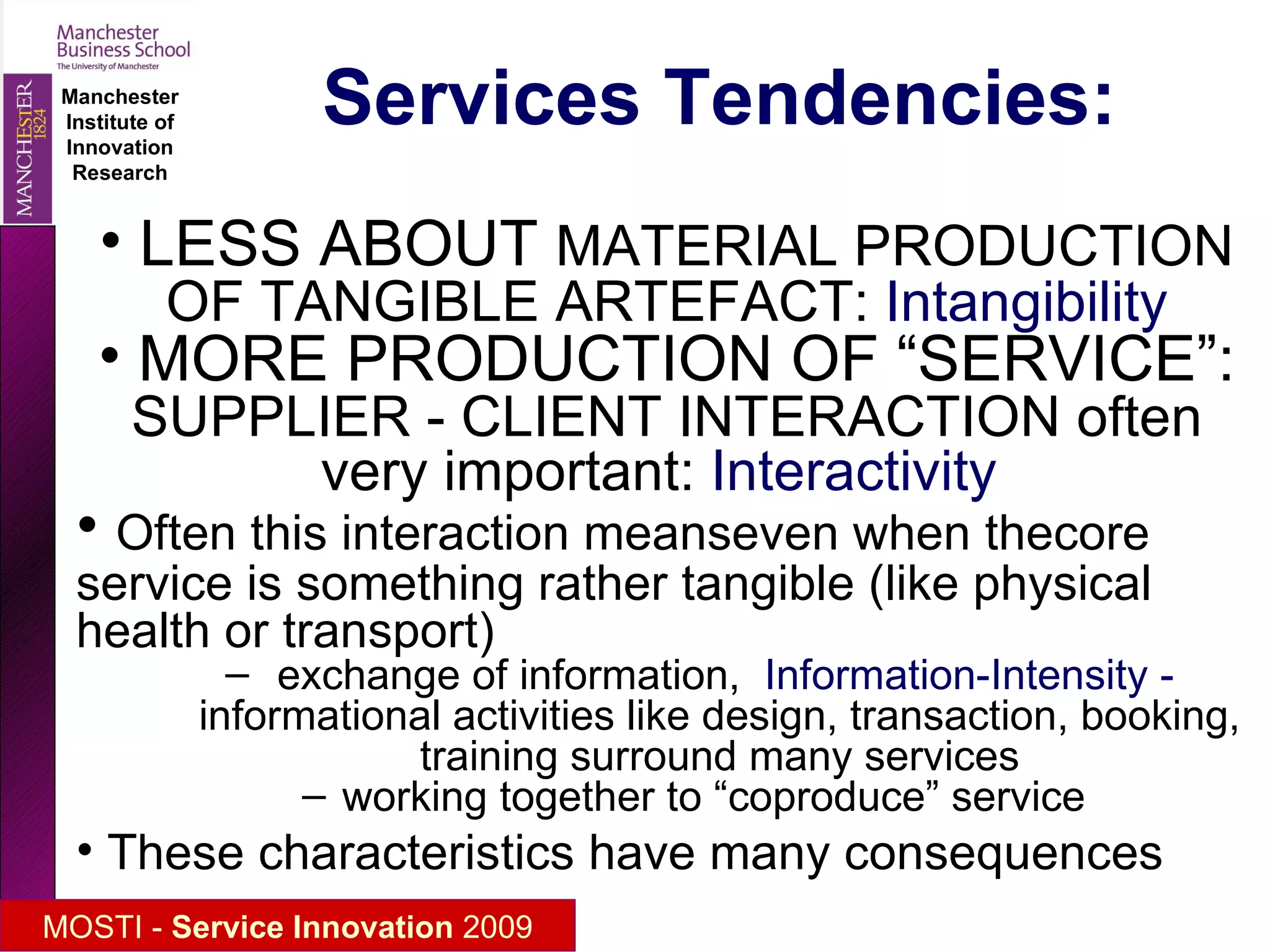
Services Tendencies:  Less about  material production of tangible artefact:   intangibility More production of “service”:  supplier - client interaction often very important:   interactivity   Often this interaction means that even when the core service is something rather tangible (like physical health or transport) exchange of information,  Information-Intensity -  informational activities like design, transaction, booking, training surround many services working together to “coproduce” service  These characteristics have many consequences
So we need to think about: Meaning of service in context Implications of Intangibility – effects on demonstrability, storability, tradability, appropriability…. Implications of Interactivity – interdependence with client, assessment of value Implications of Information-Intensity – what sorts of technological solution to what sorts of service issue (customisation, standardisation, 24hourisation, etc…) See: I Miles, 1993, “Services in the New Industrial Economy”  Futures  vol 25 no 6 July/August pp653-672 Is this an Innovation agenda?
Next Week: Focus on Service Innovation Read, at a minimum: Miles, 1993 (preceding slide) DTI (2007) ‘ Innovation in services ’ DTI Occasional paper No 9, June 2007, online at:  http://www.dti.gov.uk/fi les/fi le39965.pdf   OECD  Promoting Innovation in Services   at  http://www.oecd.org/dataoecd/21/55/35509923.pdf
End of presentation

2010 IME seminar series Service Innovation - Introduction to Services

  • 1.
    Service Innovation - Introductory Session Ian Miles [email_address] 
  • 2.
    Mission for todayIntroduce the course (and each other) Explore what we mean by “Service” Explore what we mean by “Service innovation” Examine some cases Introduce notions and statistics of the “Service Economy” Think about what we want to get out of the course
  • 3.
    Course Outline -note there may need to be some shifting of dates due to service contracts Service Innovation Policy and the Service Science Initiatives 10 26/4 Knowledge Intensive Business Services and Innovation Systems 9 19/4 Digital Convergence and Innovation in Media 8 22/3 Case Studies 3: Creative Industries (e.g. videogames, advertising) 7 15/3 Internationalisation and Innovation 6 8/3 Case Studies 2: Public Services (e.g. health informatics and medical innovation) 5 1/3 Service Work and Occupations- professional and service classes 4 22/2 Case Studies 1: IT-based innovation in services (e.g. videotex, ecommerce, IT in banks) 3 15/2 Service Innovation: main features and dynamics - reverse product cycle model and other approaches 2 8/2 Introduction – The rise of the Service Economy -“peculiarities” of services 1 1/2
  • 4.
    What are yourinterests in this course? Do you – or do you hope to: Work for a service industry? Work on policies for services? Have a new service to develop? Want to do academic research in this field? Think that “service” is a very important issue whatever line of work you’re in? Have some other interests and objectives?
  • 5.
    What are Services?1 “Things you can buy or sell, but can’t drop on your foot” (note: this definition deals with service products ) But some services are very tangible – having a false tooth fitted; having a broken laptop repaired; having eco-friendly insulation installed in your attic. There is a physical product that you can drop on your foot – though the service supplier often does not make this good. A classic essay on services vs. intangibles is Terence P Hill 1977, “On goods and services”, Review of Income and Wealth , vol 23, pp. 315-338.
  • 6.
    What are Services?2 DOING THINGS: not primarily MAKING THINGS. Manufacturing sectors make goods. Manufactured products Service sectors make services. Service products So do most other sectors. Service sectors specialise in service products as their primary outputs. Potential ambiguity: when we talk about services, do we mean the sector or the product (or something else) These points indicate a challenge to analysis and practice: things that we make are easier to see and count, to compare and contrast, than are things that we do.
  • 7.
    Some examples ofService Products – and Innovation? “Intangible” Information – Entertainment Service
  • 8.
    Have we innovatedsince C15th? C19th C20th What’s new about this? “ Tangible” Human – Meidcal Service
  • 9.
    Quality of service– in the eye of the customer? “Tangible” Physical – “Restaurant” Service – Or less tangible experience service
  • 10.
    Experience service withhigh cost technology infrastructure
  • 11.
    Transport of Thingsas well as people
  • 12.
    Human interaction –knowledge work or emotional labour?
  • 13.
  • 14.
    What are Services?Hotels… or doormen? Cinemas and delivery of movies (entertainment… experience economy) Dentists – false teeth, dental health Transport – moving freight and people Consultancy – advice, problem diagnosis, what else? Reflections
  • 15.
    Videos http://uk.youtube.com/watch?v=GEvcii1vsy4&feature=related Customer service http://uk.youtube.com/watch?v=KXcw3f2Snh4 consultancy http://uk.youtube.com/watch?v=TswE7WcCzDA&feature=related consultancy/ continuity http://uk.youtube.com/watch?v=DMOS0T8spcQ&feature=related McJobs
  • 16.
    What are Services?Reflections
  • 17.
    Meanings of “service”Service Sectors (industries) - firms and sectors specialised in supplying services S ervice activities (functions) - particular “intangible” transformations that may be produced in these specialised service firms, in other firms (e.g. “product services”) or by other means . Service occupations - employees in all sectors involved in “service” functions within their firms Service relationships – the interaction between service providers and clients (during the service journey , in the servicescape) ( career of the word “industry”: from work to manufacturing to sectors) ( Classically - domestic service, servants . Can services be provided by goods as well as by people? Self-services? ) (white collars, transport, SCC, etc – “nonproduction workers”)    
  • 18.
    “ The” ServiceSector dominates employment…
  • 19.
    Service Sector WorkforceGrowth is a global phenomenon James Spohrer,. Michael Radnor, “ Service Innovations for the 21st C” IBM Research Service Innovations Workshop, November 2004, http://www.almaden.ibm.com/asr/events/ serviceinnovation/contacts. Top Ten countries in terms of Labour Force – these constitute more than 50% of world employment! A= agriculture, G= goods/manufacturing, S= services Source: Paul Maglio, Jim Spohrer, IBM A G S
  • 20.
    What are ServiceSectors? These data concern service SECTORS - sectors that do not (in general) produce goods or other tangible artefacts (raw materials, buildings, water and power…) they don’t MAKE THINGS (much) They undertake other sorts of transformations: Transformations of goods and other physical objects e.g. repair, storage, transport (some analogies in treatment of people). Transformations of animate objects and people e.g. health and personal services, vets (not farmers!) Transformations of information e.g. communications, transactional services; and of knowledge e.g. consultancy with things; and to things and/or people and/or info. They DO THINGS   
  • 21.
    How are thesestatistics collected? Statisticians have defined a large number of specific service categories These represent something of a compromise between different ideas, and have evolved over time We have much better service sector statistics now, but they still lag behind those for manufacturing
  • 22.
    UK official service(sector) statistics http://www.statistics.gov.uk/elmr/06_09/downloads/ELMR_Jun09_Brook.pdf
  • 23.
    Services in NACEHotels and Restaurants ( HORECA ) Transport, Storage Financial Intermediation ( FI ... Real estate, Renting (… RE ), Business Activities Wholesale & Retail Trade ; Repair of Motor Vehicles, Motorcycles and Personal & Household Goods Public Administration and Defence; Compulsory Social Security Education Health and Social Work Other Community, Social and Personal Service Activities Includes KIBS Processing Material Artefacts Personal care & Material Comforts Both people and things Mainly informational Informational, material, plus diverse BUSINESS services, inc KIBS PUBLIC (inc knowledge activities) and PERSONAL plus some entertainment and creative industries
  • 24.
    Percentage Shares ofEmployment The EU service economy sector ^ Service sectors are reported here: there are also growing shares of service activities/jobs within firms in other sectors
  • 25.
    Service Economy as“New Thing” Daniel Bell (and others) 1960s, 1970s: “ The Coming of Post-Industrial Society ” – relative growth of services sectors Bell also stressed increasing role of knowledge – industries based on new knowledge, workers requiring more knowledge as compared to deskilling trend in Taylorism/Fordism In late C20th, rise of knowledge-intensive services – esp. KIBS – seen as key to Knowledge-Based Economy
  • 26.
    Gender Structure and Employment Trends Male dominated (except Japan) - Decline in all categories Male dominated - Decline in all categories Female dominated –growth 1980 ? 1998? 1980  1998  1980  1998  Agriculture “Industry” Services Proportion of workforce
  • 27.
    But different servicesectors differ widely in what they do, how they do it, who does it… Transforming things, people, information Consumer services, business services, public services “knowledge-intensive” and other services
  • 28.
    Different Services –Different Trends 1960 1973 1984 1997 1960 1973 1984 1997 Singelmann categories – Elfring Data Analysis Distributive Services Personal Services Producer Services Social Services
  • 29.
    Reading Triangular PlotsElement A Element B Element C High A, low B and C A, B, C roughly equal Moderate A, low B, moderate C Fairly high B, fairly low A and low C Can be used where three elements add up to 100% We can often capture features of services in terms of three dimensions: so we can use triangular plots to capture and explore diversity
  • 30.
    Diversity in Workforceskills Agriculture Manufacturing HORECA Trade Transport Pub. Admin. Other Sers. FIRE Education Business Sers._ Health & Soc. Sers. HIGH SKILL LOW SKILL MEDIUM SKILL The highest skilled parts of the economy – also highest growth! EU, 2000
  • 31.
    Diversity in inputs (transformations) PHYSICAL SOCIAL INFORMATIONAL Trade Recreational Other Sers. HORECA Public Sers. FIRE Comms. KIBS Other Bus. Sers. Transport Construction Manufacturing Agr. Fish. Forestry Utilities Services undertake a HUGE range of transformations – as previous graphic indicated, some are more knowledge-intensive than others
  • 32.
    Diversity in Markets Businesses NON-MARKET Consumers Public Sers. HORECA Recreational KIBS Extractive Construction Other Bus. Sers. Other Sers. Trade FIRE Manufacturing Agr. Fish. Forestry Transport Comms. Utilities
  • 33.
    What lies behindservices growth? Post-industrial argument (Bell and many others) Seen as mainly a matter of consumer demand Engel’s law: as you get richer, you spend proportionally less of your income on potatoes Shift to “superior goods” (i.e. services): people tire of material consumption and pursue more sophisticated needs ( à la Maslow “hierarchy of needs”) Some acknowledgement of business services growth (knowledge); public services seen as another expression of consumer demand
  • 34.
    On the whole,not shift in consumer demand (post-industrial hypothesis) What Drives Services Growth? Consumer expenditure does shift across categories – thus away from “basic needs” towards “higher needs” But this does not simply equate to shift from goods to services This much less clear in the data Gershuny: within categories, consumer demand often shifts from services to goods (“self-services” through goods). Gershuny and Miles, 1983, The New Service Economy (Pinter)
  • 35.
    What Drives ServicesGrowth? On the whole, not shift in consumer demand (post-industrial hypothesis) US data
  • 36.
    What Drives ServicesGrowth? On the whole, not shift in consumer demand (post-industrial hypothesis) Public sector growth (in many countries) – political drivers and limits? BUSINESS SERVICES
  • 37.
    What Drives ServicesGrowth? On the whole, not shift in consumer demand (post-industrial hypothesis) Public sector growth (in many countries) – political drivers and limits? BUSINESS SERVICES SERVICES SERVICES
  • 38.
    With all thisdiversity… … is it reasonable to talk about services in general? … maybe there are some broad groups, but across these groups, is all they have in common simply that they do not make THINGS as their main characteristic? Or are there common features – even if these are a shared neglect?
  • 39.
    Services Tendencies: Less about material production of tangible artefact:  intangibility More production of “service”: supplier - client interaction often very important:  interactivity Often this interaction means that even when the core service is something rather tangible (like physical health or transport) exchange of information, Information-Intensity - informational activities like design, transaction, booking, training surround many services working together to “coproduce” service These characteristics have many consequences
  • 40.
    So we needto think about: Meaning of service in context Implications of Intangibility – effects on demonstrability, storability, tradability, appropriability…. Implications of Interactivity – interdependence with client, assessment of value Implications of Information-Intensity – what sorts of technological solution to what sorts of service issue (customisation, standardisation, 24hourisation, etc…) See: I Miles, 1993, “Services in the New Industrial Economy” Futures vol 25 no 6 July/August pp653-672 Is this an Innovation agenda?
  • 41.
    Next Week: Focuson Service Innovation Read, at a minimum: Miles, 1993 (preceding slide) DTI (2007) ‘ Innovation in services ’ DTI Occasional paper No 9, June 2007, online at: http://www.dti.gov.uk/fi les/fi le39965.pdf OECD Promoting Innovation in Services at http://www.oecd.org/dataoecd/21/55/35509923.pdf
  • 42.