Dr Nihal Ahmed
Apollo Cancer Centre
Teynampet, Chennai
 Spondyloarthropathies (SpA), are a group of
musculoskeletal syndromes linked by common clinical
features and immunopathologic mechanisms.
 Diagnostic criteria:
1) Absence of RF
2) Sacroiliitis with/without AS
3) Peripheral arthropathy
4) Clinical overlap including 2 or more of following:-
 Psoriatic skin or nail lesion
 Conjuctivitis/GUT infection
 Ulceration of mouth, intestine or genitals
 Eryhtema nodosum
 Five subgroups of spondyloarthritis are
distinguished:
 Ankylosing spondylitis: ~90% HLAB27 positive
 Psoriatic arthritis: ~60%
 Reactive arthritis: ~85%
 Enteropathic arthritis (i.e. extraintestinal
manifestation of IBD)
 Undifferentiated spondyloarthritis
 A chronic, progressive inflammatory disease resulting in fusion
(ankylosis) of the spine and sacroiliac (SI) joints.
 Mostly affects young adults(3rd decade), Male predilection of
3:1.
 The axial skeleton is predominantly affected, although in
~20% of cases the peripheral joints are also involved.
 Associations
 Anterior uveitis (25-40%)
 Cardiovascular disease, Aortic valve disease
 Apical/upper lobe predominant interstitial lung disease with small
cystic spaces (in ~1% of patients)
 Arachnoiditis
SACRUM
Sacroiliitis is usually the first manifestation
– Bilateral, symmetrical
 Subchondral demineralization - equivalent of
subchondral bone marrow hyperintensity seen on MRI.
 Subchondral erosions, sclerosis (>5mm) on the iliac side
of the SI joints.
 At end-stage, total ankylosis/complete obliteration of joint
space.
SPINE
 Begins in the thoracolumbar spine and progresses cranially.
 Small erosions at the corners of vertebral bodies with reactive
sclerosis: Romanus lesions (shiny corner sign)
 Vertebral body squaring
 Noninfectious spondylodiscitis: Andersson lesion
 Diffuse syndesmophytic ankylosis -Bamboo spine (Lat)
 Interspinous ligament ossification - Dagger spine (AP)
 Ossification of facet joint – Tram track sign
 Enthesophyte
 Complications – carrot stick fractures
Hips
 Bilateral and symmetric, uniform joint space narrowing, axial
migration of the femoral head, protrusio acetabuli, and a collar
of osteophytes at the femoral head-neck junction.
Pelvis
 Whiskering of the pelvic bones primarily affects the ischial
tuberosities/iliac crest.
 Bridging or fusion of the pubic symphysis.
Knees
 Knees demonstrate uniform joint space narrowing with bony
proliferation.
Shoulders
 Large erosion of the anterolateral aspect of the humeral head
- 'hatchet' deformity, glenohumeral joint involvement is not
uncommon
 Inflammatory arthritis seen in ~30% of patients with
psoriasis.
 In contrast to many other arthropathies, there is no
gender predilection, mean age: 20-40 years.
 Dermatological features of psoriasis precede arthritis in
70-75% of cases.
 Strong association with nail involvement, particularly for
distal interphalangeal joint arthritis.
 Pathogenesis – Chronic synovitis – joint destruction
Five subtypes :
Symmetric polyarthritis (similar in
appearance to RA)
Asymmetric mono- or oligoarthritis
Spinal column involvement (spondylitis)
Distal interphalangeal arthritis of the hands
and feet
Arthritis mutilans
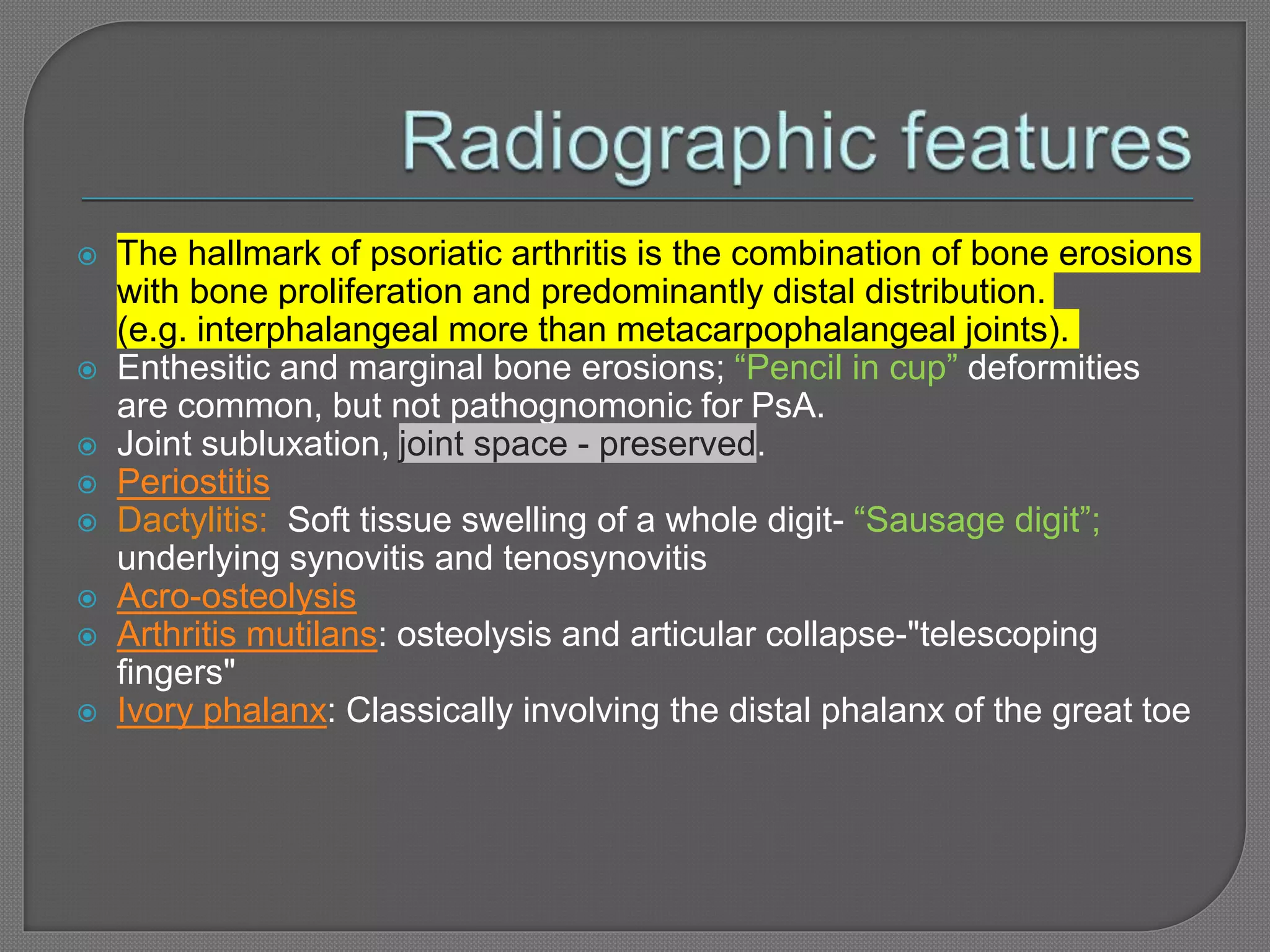
 The hallmark of psoriatic arthritis is the combination of bone erosions
with bone proliferation and predominantly distal distribution.
(e.g. interphalangeal more than metacarpophalangeal joints).
 Enthesitic and marginal bone erosions; “Pencil in cup” deformities
are common, but not pathognomonic for PsA.
 Joint subluxation, joint space - preserved.
 Periostitis
 Dactylitis: Soft tissue swelling of a whole digit- “Sausage digit”;
underlying synovitis and tenosynovitis
 Acro-osteolysis
 Arthritis mutilans: osteolysis and articular collapse-"telescoping
fingers"
 Ivory phalanx: Classically involving the distal phalanx of the great toe
 Sacroiliitis: often
asymmetrical
 Spondylitis:
 Osteophytes – coarse,
asymmetric, non marginal
 Parasyndesmophytes
 Sterile inflammatory monoarticular or
oligoarticular arthritis that follows an infection
at a different site, commonly enteric or
urogenital.
 Reiter syndrome -Urethritis, arthritis and
conjunctivitis.
 Similar appearance to psoriatic arthritis -
ill-defined erosions, enthesopathy, bone
proliferation and fusiform soft tissue
swelling.
 Lower extremity involvement - MTP joint, DIP
rarely involved*
 Enthesitis -Calcaneus at the sites of Achilles
tendon and plantar fascia attachment.
 Large bulky paravertebral ossification
"floating osteophyte"
 Sacroiliitis -usually unilateral,asymmetric
 Knee > Ankle > Sacroiliac joint) is more
prevalent than upper extremity.
Enteropathic arthritis (EA) is a form of
chronic, inflammatory arthritis associated
with IBD(Crohns,UC), Whipples disease.
Location – 3 patterns
1) Peripheral joint arthritis
2) Sacroiliitis
3) Spondylitis identical to AS – can precede
bowel disease*
Non-specific mono or polyarthropathy.
Early presentation of a more well-known
form of arthritis.
A specific diagnosis is usually reached
within three months – commonly RA
(30%), AS
HLA B-27 positive in ~75% cases
SERONEGATIVE SPONDYLOARTHROPATHY.pptx

SERONEGATIVE SPONDYLOARTHROPATHY.pptx

  • 1.
    Dr Nihal Ahmed ApolloCancer Centre Teynampet, Chennai
  • 2.
     Spondyloarthropathies (SpA),are a group of musculoskeletal syndromes linked by common clinical features and immunopathologic mechanisms.  Diagnostic criteria: 1) Absence of RF 2) Sacroiliitis with/without AS 3) Peripheral arthropathy 4) Clinical overlap including 2 or more of following:-  Psoriatic skin or nail lesion  Conjuctivitis/GUT infection  Ulceration of mouth, intestine or genitals  Eryhtema nodosum
  • 3.
     Five subgroupsof spondyloarthritis are distinguished:  Ankylosing spondylitis: ~90% HLAB27 positive  Psoriatic arthritis: ~60%  Reactive arthritis: ~85%  Enteropathic arthritis (i.e. extraintestinal manifestation of IBD)  Undifferentiated spondyloarthritis
  • 4.
     A chronic,progressive inflammatory disease resulting in fusion (ankylosis) of the spine and sacroiliac (SI) joints.  Mostly affects young adults(3rd decade), Male predilection of 3:1.  The axial skeleton is predominantly affected, although in ~20% of cases the peripheral joints are also involved.  Associations  Anterior uveitis (25-40%)  Cardiovascular disease, Aortic valve disease  Apical/upper lobe predominant interstitial lung disease with small cystic spaces (in ~1% of patients)  Arachnoiditis
  • 6.
    SACRUM Sacroiliitis is usuallythe first manifestation – Bilateral, symmetrical  Subchondral demineralization - equivalent of subchondral bone marrow hyperintensity seen on MRI.  Subchondral erosions, sclerosis (>5mm) on the iliac side of the SI joints.  At end-stage, total ankylosis/complete obliteration of joint space.
  • 8.
    SPINE  Begins inthe thoracolumbar spine and progresses cranially.  Small erosions at the corners of vertebral bodies with reactive sclerosis: Romanus lesions (shiny corner sign)  Vertebral body squaring  Noninfectious spondylodiscitis: Andersson lesion  Diffuse syndesmophytic ankylosis -Bamboo spine (Lat)  Interspinous ligament ossification - Dagger spine (AP)  Ossification of facet joint – Tram track sign  Enthesophyte  Complications – carrot stick fractures
  • 11.
    Hips  Bilateral andsymmetric, uniform joint space narrowing, axial migration of the femoral head, protrusio acetabuli, and a collar of osteophytes at the femoral head-neck junction. Pelvis  Whiskering of the pelvic bones primarily affects the ischial tuberosities/iliac crest.  Bridging or fusion of the pubic symphysis. Knees  Knees demonstrate uniform joint space narrowing with bony proliferation. Shoulders  Large erosion of the anterolateral aspect of the humeral head - 'hatchet' deformity, glenohumeral joint involvement is not uncommon
  • 14.
     Inflammatory arthritisseen in ~30% of patients with psoriasis.  In contrast to many other arthropathies, there is no gender predilection, mean age: 20-40 years.  Dermatological features of psoriasis precede arthritis in 70-75% of cases.  Strong association with nail involvement, particularly for distal interphalangeal joint arthritis.  Pathogenesis – Chronic synovitis – joint destruction
  • 15.
    Five subtypes : Symmetricpolyarthritis (similar in appearance to RA) Asymmetric mono- or oligoarthritis Spinal column involvement (spondylitis) Distal interphalangeal arthritis of the hands and feet Arthritis mutilans
  • 16.
     The hallmarkof psoriatic arthritis is the combination of bone erosions with bone proliferation and predominantly distal distribution. (e.g. interphalangeal more than metacarpophalangeal joints).  Enthesitic and marginal bone erosions; “Pencil in cup” deformities are common, but not pathognomonic for PsA.  Joint subluxation, joint space - preserved.  Periostitis  Dactylitis: Soft tissue swelling of a whole digit- “Sausage digit”; underlying synovitis and tenosynovitis  Acro-osteolysis  Arthritis mutilans: osteolysis and articular collapse-"telescoping fingers"  Ivory phalanx: Classically involving the distal phalanx of the great toe
  • 19.
     Sacroiliitis: often asymmetrical Spondylitis:  Osteophytes – coarse, asymmetric, non marginal  Parasyndesmophytes
  • 20.
     Sterile inflammatorymonoarticular or oligoarticular arthritis that follows an infection at a different site, commonly enteric or urogenital.  Reiter syndrome -Urethritis, arthritis and conjunctivitis.  Similar appearance to psoriatic arthritis - ill-defined erosions, enthesopathy, bone proliferation and fusiform soft tissue swelling.
  • 21.
     Lower extremityinvolvement - MTP joint, DIP rarely involved*  Enthesitis -Calcaneus at the sites of Achilles tendon and plantar fascia attachment.  Large bulky paravertebral ossification "floating osteophyte"  Sacroiliitis -usually unilateral,asymmetric  Knee > Ankle > Sacroiliac joint) is more prevalent than upper extremity.
  • 23.
    Enteropathic arthritis (EA)is a form of chronic, inflammatory arthritis associated with IBD(Crohns,UC), Whipples disease. Location – 3 patterns 1) Peripheral joint arthritis 2) Sacroiliitis 3) Spondylitis identical to AS – can precede bowel disease*
  • 25.
    Non-specific mono orpolyarthropathy. Early presentation of a more well-known form of arthritis. A specific diagnosis is usually reached within three months – commonly RA (30%), AS HLA B-27 positive in ~75% cases