Sequencing
Batch Reactor
(SBR)
Sewage Treatment Plant
Characteristics of Sequencing Batch
Reactors (SBR’s)
SBR are used all over the world and have been around since the
1920s. With their growing popularity in Europe and China as well
as the United States including the Philippines, they are being used
successfully to treat both municipal and industrial wastewaters,
particularly in areas characterized by low and varying flow
patterns. Municipalities, resorts, casinos, and a number of
industries, including dairy, pulp and paper, tanneries and textiles,
are using SBR as practical wastewater treatment alternatives.
Improvement in equipment and technology, especially in aeration
devices and automation controller, that made SBR a viable choice
over conventional activated sludge system.
Practical Reasons to choose SBR
• In areas where there is a limited amount of space, treatment
takes place in a single basin, allowing a smaller footprint.
• The treatment cycle can be adjusted to undergo aerobic,
anaerobic, and anoxic conditions in order to achieve nutrient
removal. Biological Oxygen Demand levels of less than 30 ppm
can be achieved consistently
• Older wastewater treatment facilities can be retrofitted to an
SBR because the basins are already present
• Wastewater discharge permit are becoming more stringent and
SBRs offer a cost effective way to achieve lower effluent limits
Common SBR Characteristics
SBR’s are a variation of the activated sludge process. They differ
from activated sludge plants because they combine all the
treatment steps and processes into a single basin, or tank,
whereas conventional facilities rely on multiple basins. According
to a 1999 US EPA report, an SBR is no more than an activated-
sludge plant that operated in time rather than space.
BASIC TREATMENT PROCESS
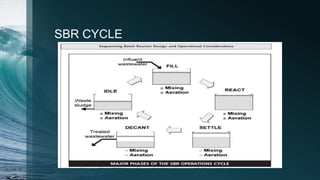
The operation of an SBR is based on a fill and draw principle.
Which consists of five steps – fill, react, settle, decant, and idle.
The steps can be altered for different operational applications.
• FILL
During the fill phase, the basin receives influent wastewater.
The Influent brings food to the microbes in the activated sludge,
creating an environment for biochemical reactions to take place.
• REACT
This phase allows for further reduction or polishing of
wastewater parameters. During this phase, no wastewater enters
the basin and the mechanical mixing and aeration units are on.
Because there are no volume of organic loadings, the rate of
organic removal increases dramatically. Most of the
carbonaceous BOD removal occurs in the react phase.
• SETTLE
During this phase, activated sludge is allowed to settle
under quiescent conditions – no flow enters the basin and no
aeration and mixing takes place.
The activated sludge tends to settle as a flocculent mass, forming
a distinctive interfere with the clear supernatant, forming a
distinctive interface with the clear supernatant. The sludge mass
is called the sludge blanket. This phase is a critical part of the
cycle, because if the solids do not settle rapidly, some sludge can
be drawn off during the subsequent decant phase and thereby
degrade the effluent quality.
• DECANT
During this phase, a decanter is used to removed the clear
supernatant effluent. Once the settle phase is complete, a signal
is sent to the decanter to initiate the opening of an effluent
discharge valve. There are floating and fixed arm decanter.
• IDLE
This step occurs between the decant and the fill phase.
The time varies based on the influent flow rate and the operating
strategy. During this phase a small amount of activated sludge at
the bottom of the SBR basin is pumped out – a process called
wasting
SBR CYCLE
PRELIMINARY TREATMENT
• SCREENING INFLUENT WASTEWATER
Bar screen or mechanical screens should be used instead
of grinders or shedders. Screening is a positive means of
removing rags, sticks and other debris before they can enter the
treatment process. Grinders and shedders pass this material into
the SBR where it can be woven together, making it difficult to
remove. Screens also provide protection for the pumps.
• INFLUENT FLOW EQUALIZATION
Flow equalization is critical where significant variations in flow
rates and organic loading are expected.
Benefits of Equalization tank to SBR
• Allows for a smaller SBR Basin size because it allows for storage until
the process cycle is complete
• Allows for one basin to be taken off line for maintenance or for
seasonal variations. Routine maintenance is necessary for all tanks.
• Allows for scum and grease removal at a single point before it enters
the SBR tank.
• Allows for an equal flow volume into the basin, keeping the
microorganism ratio (F/M) fairly stable.
Post Basin Effluent or Chlorine Contact
Chamber
• By providing a storage the disinfection process will be more
effective.
OPERATIONAL SUGGESTION/THINGS
TO MONITOR
• The management of both pH and alkalinity are critical to the
effective operation of SBR. The pH must be maintained in a
manner to prevent it from falling below 7.0 in the reactor basin.
• Proper Sampling Points
As with all wastewater treatment plants, SBR samples are
collected and analyzed for both process control and compliance
reporting.
PARAMETERS TO MONITOR (DENR/LLDA
STANDARD)
PARAMETER VALUE
BOD 50 ppm
COD 100 ppm
TSS 70 ppm
COLOR 150 pcu
OIL AND GREASE 5 ppm
COLIFORM 10000 mpn
A GUIDE TO OUR SEWAGE TREATMENT
PLANT
• WHAT IS A SEWAGE
Sewage is made up not of just the organic waste from
toilets but also the chemicals and waste water from everyday
activities such as washing, cleaning, cooking and washing
clothes and dishes.
OWNERS RESPONSIBILITY
• Users of treatment systems have a responsibility under the
relevant water related legislation to ensure that the systems
meet the standards set by the regulators. A correctly designed
and installed system will provide a final effluent for discharging
that meets these requirements. Once the system is
commissioned and operating efficiently the environmental
regulator may sample the discharge from the system to check
that it meets the agreed standards. The environmental regulator
also has the right to review and vary the discharge requirements
that it sets . It is therefore essential to regularly maintain and
service the system to make sure it is running efficiently.
DO’s and DON’T’s in the STP
• DO’s
Think before putting anything down the sink, toilet or drains
Tell guests/visitors/staff that the drains do not flow into mains
drainage but into specialist sewage treatment system and tell
them how to avoid harming it.
Read the label and use the manufacturer’s recommended
doses for all household cleaning products.
Use cleaning products little and often so the system isn’t
overload
Use the same washing and dishwasher detergents and other
cleaning products as being consistent will help the bacteria in
the system to work more efficiently, if the products in the
sewage do not vary widely the bacteria can adapt to remove a
wide range of products but as this can take a while the
operation of the treatment system will be more consistent if
the variability of the sewage minimized.
Use liquid cleaners for clothes washing and for dishwasher
Separately dispose of sanitary towels,tampons,disposable
nappies, baby wipes, cotton wool, incontinence pads, etc. and
not down the toilet.
Take out a maintenance and service contract
DONT’s
• spring clean and use large amounts of cleaners and chemicals
in one day
• have a “washing day” – spread the washing throughout the week
• use household bleach and other strong chemicals
indiscriminately
• keep changing the brands of household cleaners and washing
powders
• put sanitary towels, tampons, disposable nappies, baby wipes,
cotton wool incontinence pads etc. down the toilet.
• over flush the toilet unnecessarily – use a water saving flush if
it’s fitted
• pour fat or grease from cooking or oil from the chip pan down
the sink or drains
• use the waste disposal unit like a rubbish bin, use it sparingly if
at all
• pour garden chemicals or car engine oil down the drains.
PRODUCTS TO BE AVOIDED TO
ENTER/FLOW IN THE STP
The following products can all significantly and adversely
affect the operation and efficiency of sewage treatment
systems and so putting them down the sink , toilets or drains
should be avoided if at all possible:
• external cleaning agents and disinfectants
• cooking oil or method fat e.g. from a grill tray or chip pan
• medicines
• dairy waste
• motor oils, antifreeze or other car products
• garden chemicals such as pesticides, preservatives, weed killers
or fertilizers
• DIY products such as paints, white spirit, paint thinners and
other
• glue
• swimming pool water
This list cannot be totally comprehensive or exhaustive – just be
careful and cautious before discarding any chemicals into the
system – if in any doubt always responsibility dispose of it
elsewhere.
HEALTH & SAFETY
• Before beginning any work on the plant ensure familiarity with
all of the Health & Safety advice given in the Operation &
Maintenance must be carried out by suitably trained and
qualified personnel. In particular note the following:
• Gases given off by sewage are potentially toxic and explosive.
Do not enter any below ground compartments of a sewage
treatment system.
• When the lid or cover is removed from the system there is a
danger of deep water and the unit should not be left
unattended. Put up temporary barriers and warning signs
around any open covers or manholes and try to keep the
amount of time the cover is removed to a minimum.
Remember small children may not read or read understand
the signs, pets certainly will not.
• The equipment must be electrically isolated before any
maintenance work is carried out.

Sequencing Batch Reactor (SBR) presentation1.pptx

  • 1.
  • 2.
    Characteristics of SequencingBatch Reactors (SBR’s) SBR are used all over the world and have been around since the 1920s. With their growing popularity in Europe and China as well as the United States including the Philippines, they are being used successfully to treat both municipal and industrial wastewaters, particularly in areas characterized by low and varying flow patterns. Municipalities, resorts, casinos, and a number of industries, including dairy, pulp and paper, tanneries and textiles, are using SBR as practical wastewater treatment alternatives. Improvement in equipment and technology, especially in aeration devices and automation controller, that made SBR a viable choice over conventional activated sludge system.
  • 3.
    Practical Reasons tochoose SBR • In areas where there is a limited amount of space, treatment takes place in a single basin, allowing a smaller footprint. • The treatment cycle can be adjusted to undergo aerobic, anaerobic, and anoxic conditions in order to achieve nutrient removal. Biological Oxygen Demand levels of less than 30 ppm can be achieved consistently • Older wastewater treatment facilities can be retrofitted to an SBR because the basins are already present • Wastewater discharge permit are becoming more stringent and SBRs offer a cost effective way to achieve lower effluent limits
  • 4.
    Common SBR Characteristics SBR’sare a variation of the activated sludge process. They differ from activated sludge plants because they combine all the treatment steps and processes into a single basin, or tank, whereas conventional facilities rely on multiple basins. According to a 1999 US EPA report, an SBR is no more than an activated- sludge plant that operated in time rather than space.
  • 5.
    BASIC TREATMENT PROCESS Theoperation of an SBR is based on a fill and draw principle. Which consists of five steps – fill, react, settle, decant, and idle. The steps can be altered for different operational applications. • FILL During the fill phase, the basin receives influent wastewater. The Influent brings food to the microbes in the activated sludge, creating an environment for biochemical reactions to take place.
  • 6.
    • REACT This phaseallows for further reduction or polishing of wastewater parameters. During this phase, no wastewater enters the basin and the mechanical mixing and aeration units are on. Because there are no volume of organic loadings, the rate of organic removal increases dramatically. Most of the carbonaceous BOD removal occurs in the react phase. • SETTLE During this phase, activated sludge is allowed to settle under quiescent conditions – no flow enters the basin and no aeration and mixing takes place.
  • 7.
    The activated sludgetends to settle as a flocculent mass, forming a distinctive interfere with the clear supernatant, forming a distinctive interface with the clear supernatant. The sludge mass is called the sludge blanket. This phase is a critical part of the cycle, because if the solids do not settle rapidly, some sludge can be drawn off during the subsequent decant phase and thereby degrade the effluent quality. • DECANT During this phase, a decanter is used to removed the clear supernatant effluent. Once the settle phase is complete, a signal is sent to the decanter to initiate the opening of an effluent discharge valve. There are floating and fixed arm decanter.
  • 8.
    • IDLE This stepoccurs between the decant and the fill phase. The time varies based on the influent flow rate and the operating strategy. During this phase a small amount of activated sludge at the bottom of the SBR basin is pumped out – a process called wasting
  • 9.
  • 10.
    PRELIMINARY TREATMENT • SCREENINGINFLUENT WASTEWATER Bar screen or mechanical screens should be used instead of grinders or shedders. Screening is a positive means of removing rags, sticks and other debris before they can enter the treatment process. Grinders and shedders pass this material into the SBR where it can be woven together, making it difficult to remove. Screens also provide protection for the pumps.
  • 11.
    • INFLUENT FLOWEQUALIZATION Flow equalization is critical where significant variations in flow rates and organic loading are expected. Benefits of Equalization tank to SBR • Allows for a smaller SBR Basin size because it allows for storage until the process cycle is complete • Allows for one basin to be taken off line for maintenance or for seasonal variations. Routine maintenance is necessary for all tanks. • Allows for scum and grease removal at a single point before it enters the SBR tank. • Allows for an equal flow volume into the basin, keeping the microorganism ratio (F/M) fairly stable.
  • 12.
    Post Basin Effluentor Chlorine Contact Chamber • By providing a storage the disinfection process will be more effective.
  • 13.
    OPERATIONAL SUGGESTION/THINGS TO MONITOR •The management of both pH and alkalinity are critical to the effective operation of SBR. The pH must be maintained in a manner to prevent it from falling below 7.0 in the reactor basin. • Proper Sampling Points As with all wastewater treatment plants, SBR samples are collected and analyzed for both process control and compliance reporting.
  • 14.
    PARAMETERS TO MONITOR(DENR/LLDA STANDARD) PARAMETER VALUE BOD 50 ppm COD 100 ppm TSS 70 ppm COLOR 150 pcu OIL AND GREASE 5 ppm COLIFORM 10000 mpn
  • 15.
    A GUIDE TOOUR SEWAGE TREATMENT PLANT • WHAT IS A SEWAGE Sewage is made up not of just the organic waste from toilets but also the chemicals and waste water from everyday activities such as washing, cleaning, cooking and washing clothes and dishes.
  • 16.
    OWNERS RESPONSIBILITY • Usersof treatment systems have a responsibility under the relevant water related legislation to ensure that the systems meet the standards set by the regulators. A correctly designed and installed system will provide a final effluent for discharging that meets these requirements. Once the system is commissioned and operating efficiently the environmental regulator may sample the discharge from the system to check that it meets the agreed standards. The environmental regulator also has the right to review and vary the discharge requirements that it sets . It is therefore essential to regularly maintain and service the system to make sure it is running efficiently.
  • 17.
    DO’s and DON’T’sin the STP • DO’s Think before putting anything down the sink, toilet or drains Tell guests/visitors/staff that the drains do not flow into mains drainage but into specialist sewage treatment system and tell them how to avoid harming it. Read the label and use the manufacturer’s recommended doses for all household cleaning products. Use cleaning products little and often so the system isn’t overload
  • 18.
    Use the samewashing and dishwasher detergents and other cleaning products as being consistent will help the bacteria in the system to work more efficiently, if the products in the sewage do not vary widely the bacteria can adapt to remove a wide range of products but as this can take a while the operation of the treatment system will be more consistent if the variability of the sewage minimized. Use liquid cleaners for clothes washing and for dishwasher Separately dispose of sanitary towels,tampons,disposable nappies, baby wipes, cotton wool, incontinence pads, etc. and not down the toilet. Take out a maintenance and service contract
  • 19.
    DONT’s • spring cleanand use large amounts of cleaners and chemicals in one day • have a “washing day” – spread the washing throughout the week • use household bleach and other strong chemicals indiscriminately • keep changing the brands of household cleaners and washing powders • put sanitary towels, tampons, disposable nappies, baby wipes, cotton wool incontinence pads etc. down the toilet.
  • 20.
    • over flushthe toilet unnecessarily – use a water saving flush if it’s fitted • pour fat or grease from cooking or oil from the chip pan down the sink or drains • use the waste disposal unit like a rubbish bin, use it sparingly if at all • pour garden chemicals or car engine oil down the drains.
  • 21.
    PRODUCTS TO BEAVOIDED TO ENTER/FLOW IN THE STP The following products can all significantly and adversely affect the operation and efficiency of sewage treatment systems and so putting them down the sink , toilets or drains should be avoided if at all possible: • external cleaning agents and disinfectants • cooking oil or method fat e.g. from a grill tray or chip pan • medicines
  • 22.
    • dairy waste •motor oils, antifreeze or other car products • garden chemicals such as pesticides, preservatives, weed killers or fertilizers • DIY products such as paints, white spirit, paint thinners and other • glue • swimming pool water This list cannot be totally comprehensive or exhaustive – just be careful and cautious before discarding any chemicals into the system – if in any doubt always responsibility dispose of it elsewhere.
  • 23.
    HEALTH & SAFETY •Before beginning any work on the plant ensure familiarity with all of the Health & Safety advice given in the Operation & Maintenance must be carried out by suitably trained and qualified personnel. In particular note the following: • Gases given off by sewage are potentially toxic and explosive. Do not enter any below ground compartments of a sewage treatment system. • When the lid or cover is removed from the system there is a danger of deep water and the unit should not be left unattended. Put up temporary barriers and warning signs around any open covers or manholes and try to keep the amount of time the cover is removed to a minimum. Remember small children may not read or read understand the signs, pets certainly will not. • The equipment must be electrically isolated before any maintenance work is carried out.