Separation of
MixtureS
By- MohaMMad
aBedin
ClaSS:- 9 – Q
SChool :- hiS ,
Separation of MixtureS
 Identify the different ways of separating
mixtures.
 Determine how the different ways are
used to separate mixtures.
 Identify the ways in which magnetic
attraction, filtration, evaporation,
distillation and paper chromatography
can be used in daily life.
Separation of MixtureS
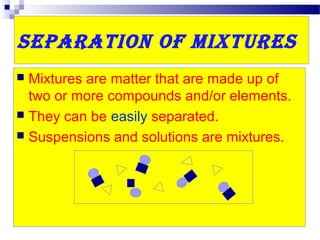
 Mixtures are matter that are made up of
two or more compounds and/or elements.
 They can be easily separated.
 Suspensions and solutions are mixtures.
Separation of MixtureS
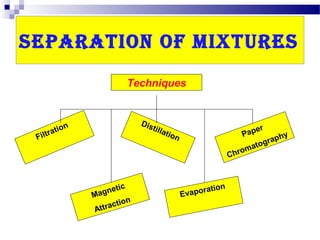
Techniques
Magnetic
Attraction
Filtration
Paper
Chromatography
Distillation
Evaporation
Separation of Mixtures
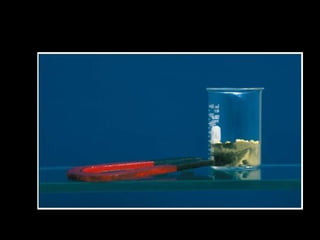
Magnetic Attraction
Separating mixtures containing magnetic
material like iron, cobalt and nickel.
Separation of MixtureS
Evaporation
Separating mixture of dissolved solids
from a liquid.
Heat is applied to quicken evaporation
but NOT to cause decomposition.
Separation of MixtureS
Filtration
Separating mixture of un-dissolved
solids from a liquid.
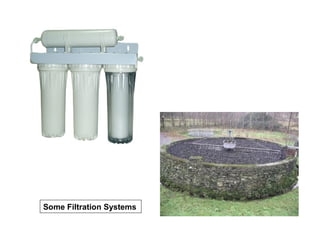
Some Filtration Systems
Separation of MixtureS
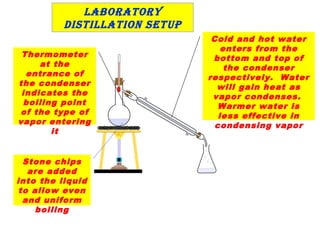
Distillation
Separating liquid-liquid mixtures of
different boiling points.
Temperature tells the type of vapor that
is entering the condenser.
Laboratory
DiStiLLation Setup
Stone chips
are added
into the liquid
to allow even
and uniform
boiling
Cold and hot water
enters from the
bottom and top of
the condenser
respectively. Water
will gain heat as
vapor condenses.
Warmer water is
less effective in
condensing vapor
Thermometer
at the
entrance of
the condenser
indicates the
boiling point
of the type of
vapor entering
it
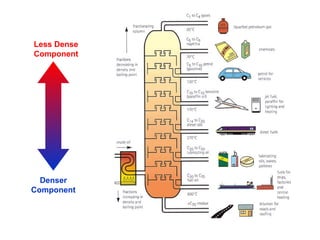
Less Dense
Component
Denser
Component
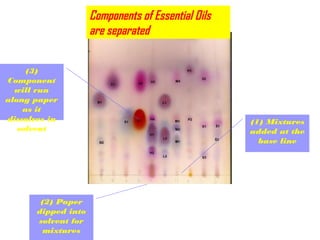
(1) Mixtures
added at the
base line
(2) Paper
dipped into
solvent for
mixtures
(3)
Component
will run
along paper
as it
dissolves in
solvent
Components of Essential Oils
are separated
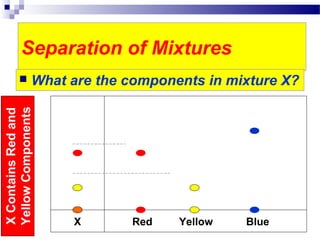
Separation of Mixtures
 What are the components in mixture X?
RedX Yellow Blue
XContainsRedand
YellowComponents
Separation of Mixtures
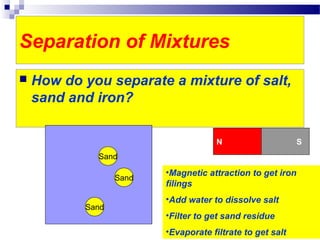
 How do you separate a mixture of salt,
sand and iron?
Salt
Salt
Salt
Iron
IronIron
N S
Sand
Sand
Sand
•Magnetic attraction to get iron
filings
•Add water to dissolve salt
•Filter to get sand residue
•Evaporate filtrate to get salt
Separation of Mixtures
Conclusion
 5 simple methods of separating mixtures.
 Different methods for components of
mixtures with different properties.
 Separating mixtures produces better
understanding of mixture.
 Man can produce useful
mixtures/components from raw
components/mixtures.

Separationofmixtures 100825041637-phpapp01