METHODS OF
SEPARATING MIXTURES
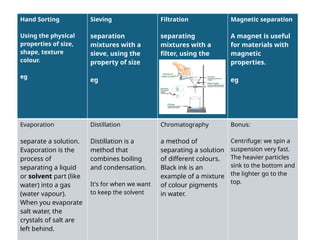
Hand Sorting
Using the physical
properties of size,
shape, texture
colour.
eg
Sieving
separation
mixtures with a
sieve, using the
property of size
eg
Filtration
separating
mixtures with a
filter, using the
property of size
Magnetic separation
A magnet is useful
for materials with
magnetic
properties.
eg
Evaporation
separate a solution.
Evaporation is the
process of
separating a liquid
or solvent part (like
water) into a gas
(water vapour).
When you evaporate
salt water, the
crystals of salt are
left behind.
Distillation
Distillation is a
method that
combines boiling
and condensation.
It's for when we want
to keep the solvent
Chromatography
a method of
separating a solution
of different colours.
Black ink is an
example of a mixture
of colour pigments
in water.
Bonus:
Centrifuge: we spin a
suspension very fast.
The heavier particles
sink to the bottom and
the lighter go to the
top.
Topic :
What are we going
to learn?
• Methods of separating
substances in a mixture (based
on different physical properties)
• Hand sorting
• Sieving
• Filtration
• Using a magnet
• Evaporation
• Distillation
• Chromatography
What we already know
• A mixture consists of at least two different
substances of material mixed together.
• A solution is a mixture of a dissolved solid and a
liquid.
• When a gas cools and becomes a liquid, we call
this change condensation.
New words
• Sieving: separation mixtures with a sieve, using
the property of size
• Filtration: separating mixtures with a filter, using
the property of size
Mixtures and methods of physical
separation
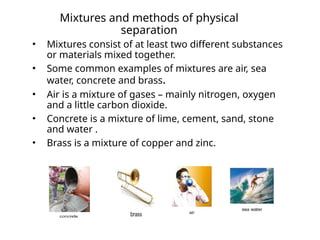
• Mixtures consist of at least two different substances
or materials mixed together.
• Some common examples of mixtures are air, sea
water, concrete and brass.
• Air is a mixture of gases – mainly nitrogen, oxygen
and a little carbon dioxide.
• Concrete is a mixture of lime, cement, sand, stone
and water .
• Brass is a mixture of copper and zinc.
Methods of physical separation
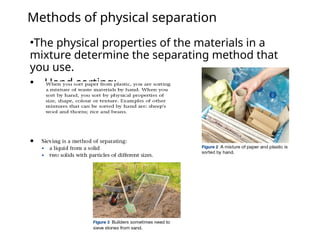
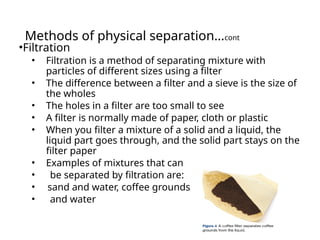
•The physical properties of the materials in a
mixture determine the separating method that
you use.
• Hand sorting:
• Sieving
Methods of physical separation…cont
•Filtration
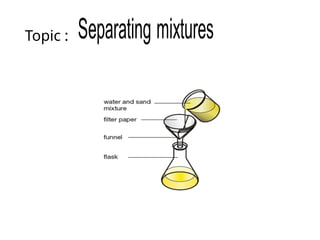
• Filtration is a method of separating mixture with
particles of different sizes using a filter
• The difference between a filter and a sieve is the size of
the wholes
• The holes in a filter are too small to see
• A filter is normally made of paper, cloth or plastic
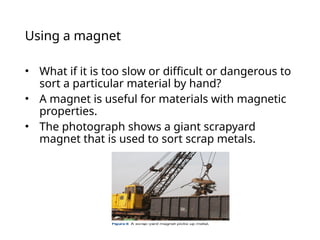
• When you filter a mixture of a solid and a liquid, the
liquid part goes through, and the solid part stays on the
filter paper
• Examples of mixtures that can
• be separated by filtration are:
• sand and water, coffee grounds
• and water
Using a magnet
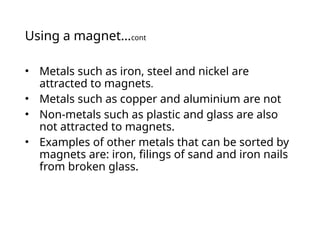
• What if it is too slow or difficult or dangerous to
sort a particular material by hand?
• A magnet is useful for materials with magnetic
properties.
• The photograph shows a giant scrapyard
magnet that is used to sort scrap metals.
Using a magnet…cont
• Metals such as iron, steel and nickel are
attracted to magnets.
• Metals such as copper and aluminium are not
• Non-metals such as plastic and glass are also
not attracted to magnets.
• Examples of other metals that can be sorted by
magnets are: iron, filings of sand and iron nails
from broken glass.
Evaporation
• We’ve seen how to separate solids.
• How do we separate a solution?
• How do we get salt out of water?
• We do it by evaporation.
• Evaporation is the process of separating a liquid
or solvent part (like water) into a gas (water
vapour).
• When you evaporate salt water, the crystals of salt
are left behind.
• This is called a solute.
Evaporation…cont
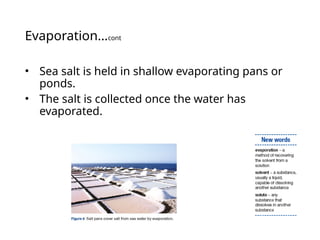
• Sea salt is held in shallow evaporating pans or
ponds.
• The salt is collected once the water has
evaporated.
Distillation
• What if, instead of salt you want to get pure water from
sea water?
• You could do it by distillation.
• Distillation is a method that combines boiling and
condensation.
• It separates substances with different boiling points.
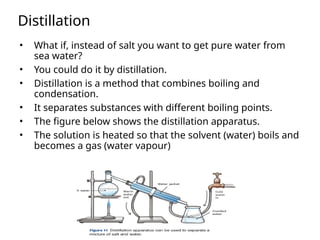
• The figure below shows the distillation apparatus.
• The solution is heated so that the solvent (water) boils and
becomes a gas (water vapour)
Distillation
• The gas is collected in a long tube called a Liebig
condenser
• The jacket is cooled by a jacket of cold water, which cools
down the gas.
• The gas condenses back to a liquid (pure water) and it is
collected in the flask
• The solute (salt) is left behind.
Chromatography
• Chromatography is a method of separating a
solution of different colours.
• Black ink is an example of a mixture of colour
pigments in water.
• Chromatography involves spotting of a mixture of
colours onto filter paper.
• The colour sticks to the paper and then spread out
on the paper, carried by a solvent.
• Some colours stick to the paper more strongly than
other ‘s.
Chromatography
• The more strongly the colour sticks, the slower
and less further it travels.
• The less strongly a colour sticks, the faster and
further it travels.
Let’s revise
1. What does a mixture consist of?
• Answer: At least two different substances of material mixed
together
•2. Explain what a solution is.
• Answer: A mixture of a dissolved solid and a liquid
•3. What happens when a gas cools?
• Answer: It becomes a liquid, we call this change condensation
•4. Explain the mixture of air.
• Answer: It is a mixture of gases, mainly nitrogen, oxygen and a
• little carbon dioxide.
•
•
Let’s revise
• 5. Name the different method of separation.
• Answer: hand sorting, sieving, using a magnet,
evaporation, distillation chromatography
• 6. When will you use hand sorting as a method of
physical separation
• Answer: When we sort plastic from paper
• 7. Explain what filtration is
• Answer: A method of separating a mixture with particles
of different sizes using a filter
• 8. Where and why will a magnet be used for
sorting?
• Answer: In a giant scrapyard when it is too slow or too
dangerous to sort a particular material by hand
Let’s revise
• 9. Explain what evaporation is?
• Answer: It is the process of separating a liquid or solvent
(like water) into a gas (water vapour).
• 10.Explain what a solute is.
• Answer: When we evaporate salt water, the crystals of salt
that are left behind is called a solute.
• 11. When will we use distillation as a method of
separating mixtures?
• Answer: When we want to get pure water from sea water.
Questions

Separating Mixtures Year 7 Science ACARA

  • 1.
  • 2.
    Hand Sorting Using thephysical properties of size, shape, texture colour. eg Sieving separation mixtures with a sieve, using the property of size eg Filtration separating mixtures with a filter, using the property of size Magnetic separation A magnet is useful for materials with magnetic properties. eg Evaporation separate a solution. Evaporation is the process of separating a liquid or solvent part (like water) into a gas (water vapour). When you evaporate salt water, the crystals of salt are left behind. Distillation Distillation is a method that combines boiling and condensation. It's for when we want to keep the solvent Chromatography a method of separating a solution of different colours. Black ink is an example of a mixture of colour pigments in water. Bonus: Centrifuge: we spin a suspension very fast. The heavier particles sink to the bottom and the lighter go to the top.
  • 3.
  • 4.
    What are wegoing to learn? • Methods of separating substances in a mixture (based on different physical properties) • Hand sorting • Sieving • Filtration • Using a magnet • Evaporation • Distillation • Chromatography
  • 5.
    What we alreadyknow • A mixture consists of at least two different substances of material mixed together. • A solution is a mixture of a dissolved solid and a liquid. • When a gas cools and becomes a liquid, we call this change condensation.
  • 6.
    New words • Sieving:separation mixtures with a sieve, using the property of size • Filtration: separating mixtures with a filter, using the property of size
  • 7.
    Mixtures and methodsof physical separation • Mixtures consist of at least two different substances or materials mixed together. • Some common examples of mixtures are air, sea water, concrete and brass. • Air is a mixture of gases – mainly nitrogen, oxygen and a little carbon dioxide. • Concrete is a mixture of lime, cement, sand, stone and water . • Brass is a mixture of copper and zinc.
  • 8.
    Methods of physicalseparation •The physical properties of the materials in a mixture determine the separating method that you use. • Hand sorting: • Sieving
  • 9.
    Methods of physicalseparation…cont •Filtration • Filtration is a method of separating mixture with particles of different sizes using a filter • The difference between a filter and a sieve is the size of the wholes • The holes in a filter are too small to see • A filter is normally made of paper, cloth or plastic • When you filter a mixture of a solid and a liquid, the liquid part goes through, and the solid part stays on the filter paper • Examples of mixtures that can • be separated by filtration are: • sand and water, coffee grounds • and water
  • 10.
    Using a magnet •What if it is too slow or difficult or dangerous to sort a particular material by hand? • A magnet is useful for materials with magnetic properties. • The photograph shows a giant scrapyard magnet that is used to sort scrap metals.
  • 11.
    Using a magnet…cont •Metals such as iron, steel and nickel are attracted to magnets. • Metals such as copper and aluminium are not • Non-metals such as plastic and glass are also not attracted to magnets. • Examples of other metals that can be sorted by magnets are: iron, filings of sand and iron nails from broken glass.
  • 12.
    Evaporation • We’ve seenhow to separate solids. • How do we separate a solution? • How do we get salt out of water? • We do it by evaporation. • Evaporation is the process of separating a liquid or solvent part (like water) into a gas (water vapour). • When you evaporate salt water, the crystals of salt are left behind. • This is called a solute.
  • 13.
    Evaporation…cont • Sea saltis held in shallow evaporating pans or ponds. • The salt is collected once the water has evaporated.
  • 14.
    Distillation • What if,instead of salt you want to get pure water from sea water? • You could do it by distillation. • Distillation is a method that combines boiling and condensation. • It separates substances with different boiling points. • The figure below shows the distillation apparatus. • The solution is heated so that the solvent (water) boils and becomes a gas (water vapour)
  • 15.
    Distillation • The gasis collected in a long tube called a Liebig condenser • The jacket is cooled by a jacket of cold water, which cools down the gas. • The gas condenses back to a liquid (pure water) and it is collected in the flask • The solute (salt) is left behind.
  • 16.
    Chromatography • Chromatography isa method of separating a solution of different colours. • Black ink is an example of a mixture of colour pigments in water. • Chromatography involves spotting of a mixture of colours onto filter paper. • The colour sticks to the paper and then spread out on the paper, carried by a solvent. • Some colours stick to the paper more strongly than other ‘s.
  • 17.
    Chromatography • The morestrongly the colour sticks, the slower and less further it travels. • The less strongly a colour sticks, the faster and further it travels.
  • 18.
    Let’s revise 1. Whatdoes a mixture consist of? • Answer: At least two different substances of material mixed together •2. Explain what a solution is. • Answer: A mixture of a dissolved solid and a liquid •3. What happens when a gas cools? • Answer: It becomes a liquid, we call this change condensation •4. Explain the mixture of air. • Answer: It is a mixture of gases, mainly nitrogen, oxygen and a • little carbon dioxide. • •
  • 19.
    Let’s revise • 5.Name the different method of separation. • Answer: hand sorting, sieving, using a magnet, evaporation, distillation chromatography • 6. When will you use hand sorting as a method of physical separation • Answer: When we sort plastic from paper • 7. Explain what filtration is • Answer: A method of separating a mixture with particles of different sizes using a filter • 8. Where and why will a magnet be used for sorting? • Answer: In a giant scrapyard when it is too slow or too dangerous to sort a particular material by hand
  • 20.
    Let’s revise • 9.Explain what evaporation is? • Answer: It is the process of separating a liquid or solvent (like water) into a gas (water vapour). • 10.Explain what a solute is. • Answer: When we evaporate salt water, the crystals of salt that are left behind is called a solute. • 11. When will we use distillation as a method of separating mixtures? • Answer: When we want to get pure water from sea water.
  • 21.