Dr. Yeap Ban Har
                                                      Marshall Cavendish Institute
                                                                        Singapore
                                                         yeapbanhar@gmail.com


  SINGAPORE
  M AT H
  Beyond the Basics

    Day One
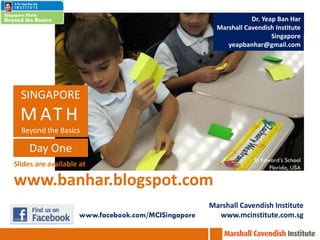
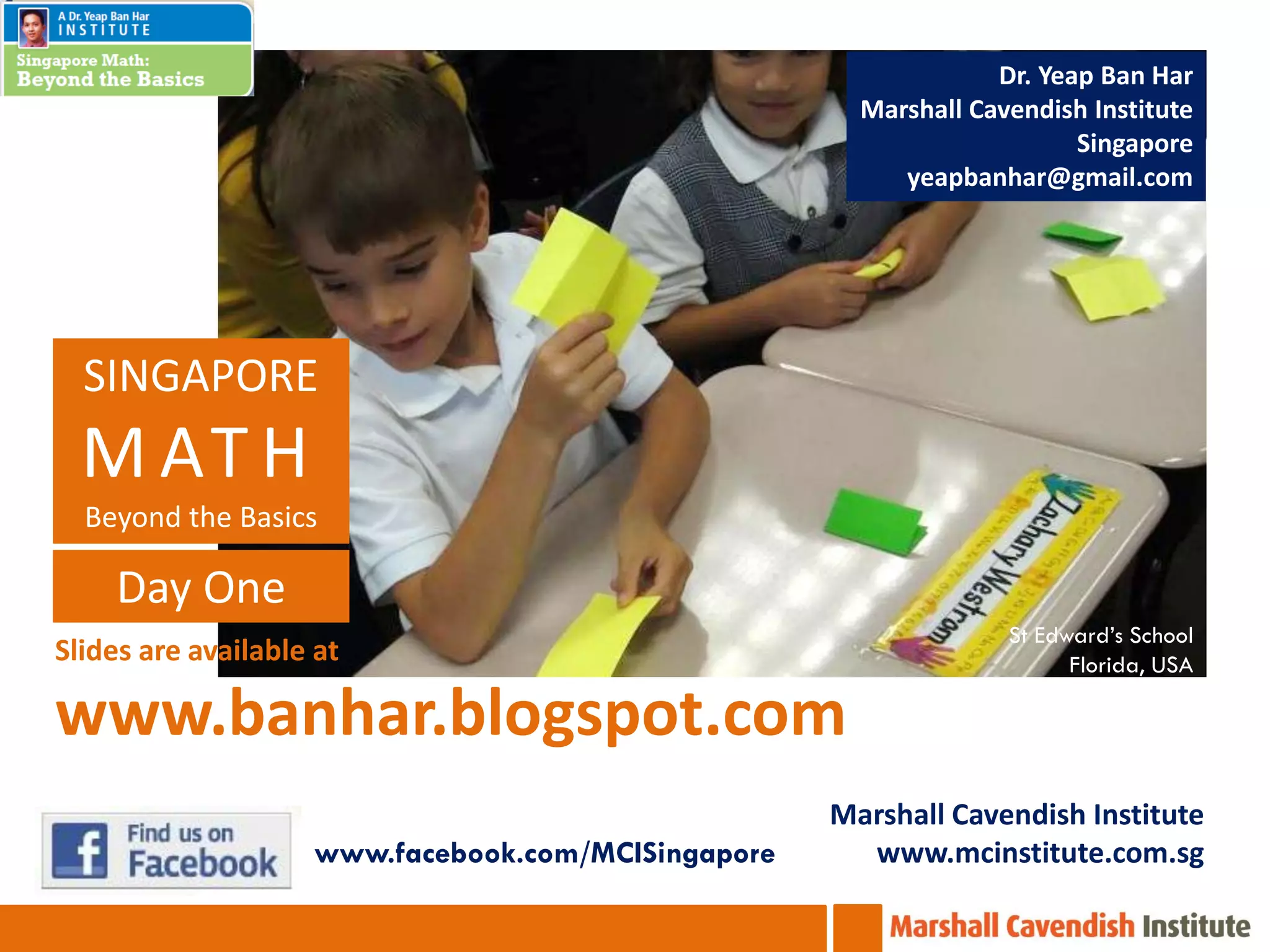
                                                                  St Edward’s School
Slides are available at                                                 Florida, USA

www.banhar.blogspot.com
                                                    Marshall Cavendish Institute
                    www.facebook.com/MCISingapore     www.mcinstitute.com.sg
Dr. Yeap Ban Har
   CONTACT                      Marshall Cavendish Institute
   INFO                    yeapbanhar@gmail.com
Slides are available at

www.banhar.blogspot.com Marshall Cavendish Institute
                                  www.mcinstitute.com.sg
www.facebook.com/     MCISingapore
Introduction
We start the day with an overview of
Singapore Math.
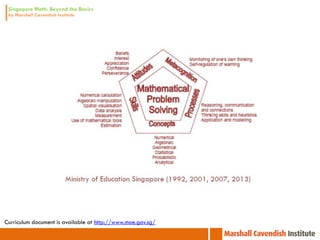
Curriculum document is available at http://www.moe.gov.sg/
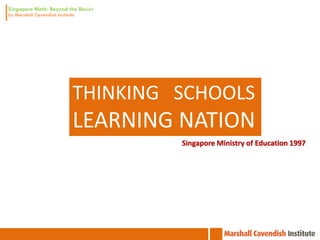
THINKING SCHOOLS
LEARNING NATION
         Singapore Ministry of Education 1997
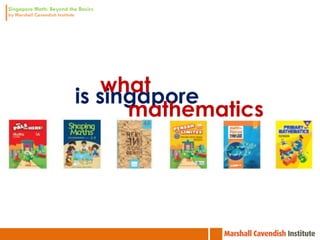
what
is singapore
      mathematics
key focus
  of singapore
mathematics
problem
   solving
thinking
an
excellent
       vehicle
  for the development
   &improvement of
        a person’s intellectual
          competencies
               Ministry of Education Singapore 2006
conceptual
understanding
Fundamentals of Singapore Math – Review & Extend
 Thinking: It’s the Big Idea!
 Problem Solving, Visualization, Patterning, and
  Number Sense
 The Concrete-Pictorial-Abstract Approach
Lesson 1
We do a case study on multiplication
facts. We will see the use of an anchor
task to engage students for an
extended period of time.
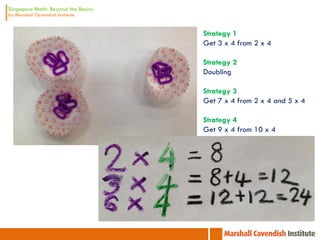
Strategy 1
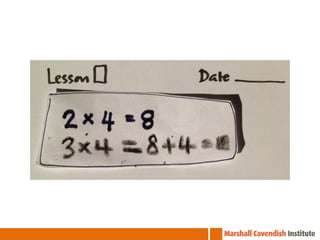
Get 3 x 4 from 2 x 4

Strategy 2
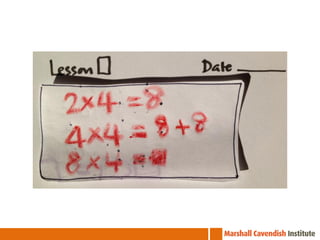
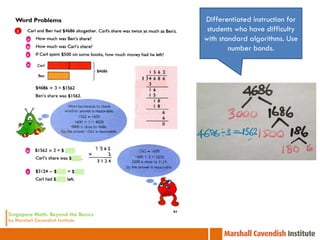
Doubling

Strategy 3
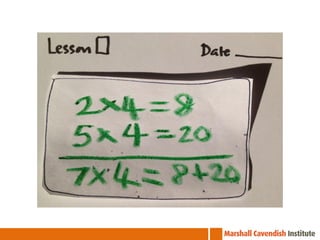
Get 7 x 4 from 2 x 4 and 5 x 4

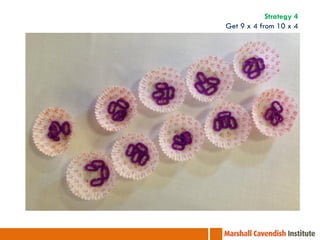
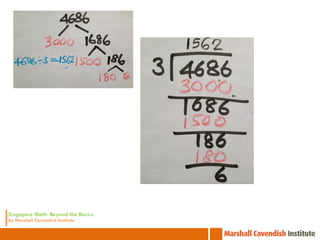
Strategy 4
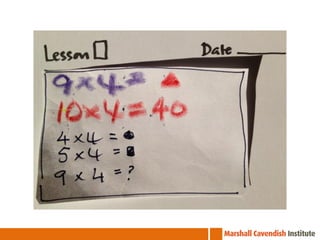
Get 9 x 4 from 10 x 4
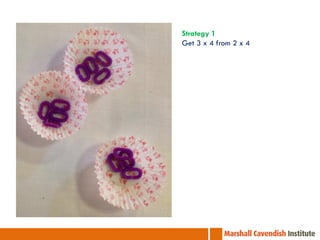
Strategy 1
Get 3 x 4 from 2 x 4
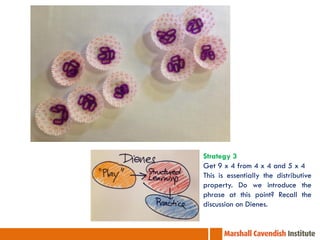
Strategy 3
Get 9 x 4 from 4 x 4 and 5 x 4
This is essentially the distributive
property. Do we introduce the
phrase at this point? Recall the
discussion on Dienes.
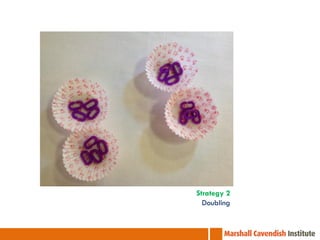
Strategy 2
  Doubling
Strategy 4
Get 9 x 4 from 10 x 4
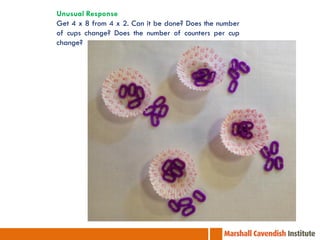
Unusual Response
Get 4 x 8 from 4 x 2. Can it be done? Does the number
of cups change? Does the number of counters per cup
change?
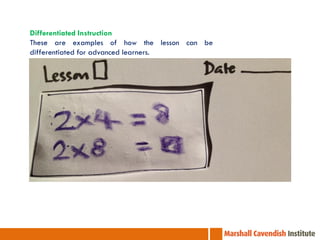
Differentiated Instruction
These are examples of how the lesson can be
differentiated for advanced learners.
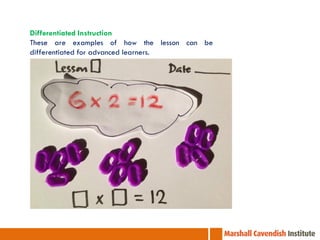
Differentiated Instruction
These are examples of how the lesson can be
differentiated for advanced learners.
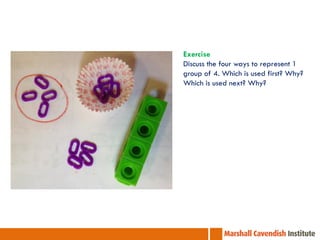
Exercise
Discuss the four ways to represent 1
group of 4. Which is used first? Why?
Which is used next? Why?
Textbook Study
Observe the various meanings of
multiplication from Grade 1 to Grade
3.
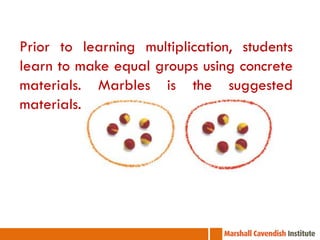
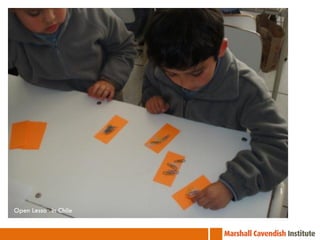
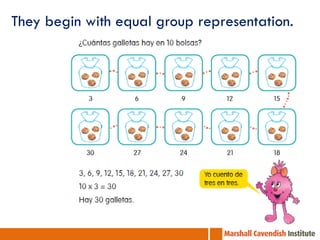
Prior to learning multiplication, students
learn to make equal groups using concrete
materials. Marbles is the suggested
materials.
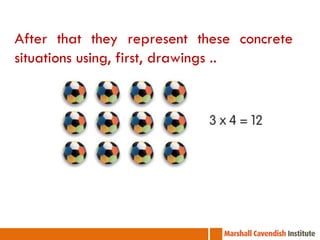
After that they represent these concrete
situations using, first, drawings ..
Open Lesson in Chile
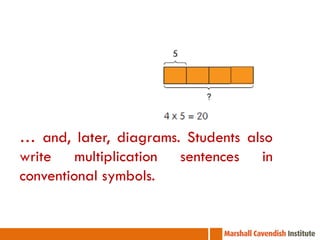
… and, later, diagrams. Students also
write multiplication sentences in
conventional symbols.
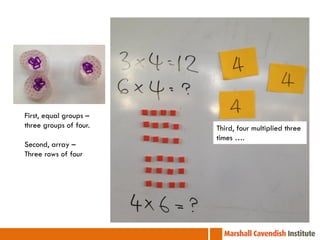
First, equal groups –
three groups of four.   Third, four multiplied three
                        times ….
Second, array –
Three rows of four
Textbook Study
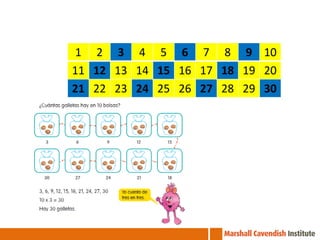
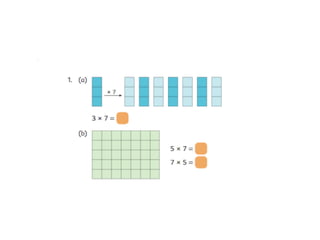
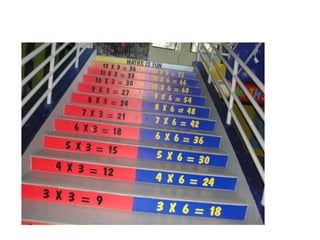
Observe        how      equal     group
representation evolves into array and
area models. Also observe how the
multiplication tables of 3 and 6 are
related on the flights of stairs.
They begin with equal group representation.
1 2 3 4 5 6 7 8 9 10
11 12 13 14 15 16 17 18 19 20
21 22 23 24 25 26 27 28 29 30
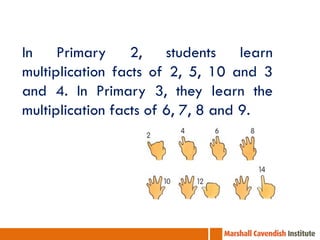
In Primary 2, students learn
multiplication facts of 2, 5, 10 and 3
and 4. In Primary 3, they learn the
multiplication facts of 6, 7, 8 and 9.
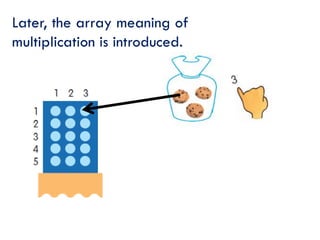
Later, the array meaning of
multiplication is introduced.
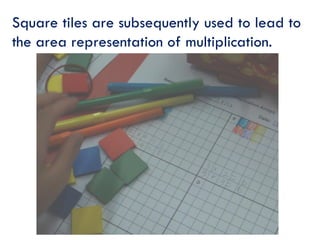
Square tiles are subsequently used to lead to
the area representation of multiplication.
Lesson 2
Multiplication of multi-digit numbers
taught in a problem-solving approach.
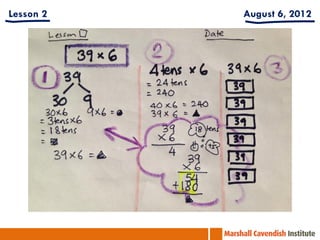
Lesson 2   August 6, 2012
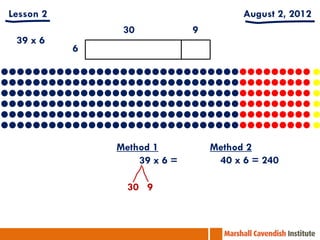
Lesson 2                                August 2, 2012
                 30            9
  39 x 6
            6

 
 
 
 
 
 

                Method 1           Method 2
                    39 x 6 =        40 x 6 = 240

                  30 9
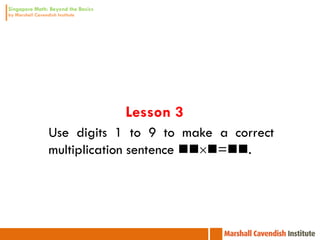
Lesson 3
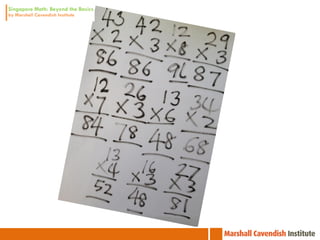
Use digits 1 to 9 to make a correct
multiplication sentence =.
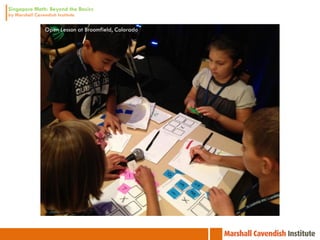
Open Lesson at Broomfield, Colorado
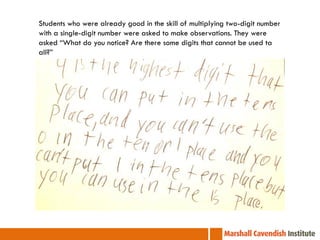
Students who were already good in the skill of multiplying two-digit number
with a single-digit number were asked to make observations. They were
asked “What do you notice? Are there some digits that cannot be used ta
all?”
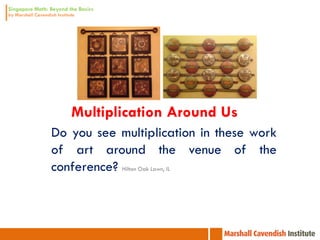
Multiplication Around Us
Do you see multiplication in these work
of art around the venue of the
conference? Hilton Oak Lawn, IL
Lesson 4
We studied the strategies to help
struggling readers as well as those
weak       in representing  problem
situations.
Lesson 4   August 6, 2012
Lesson 5                                      August 2, 2012


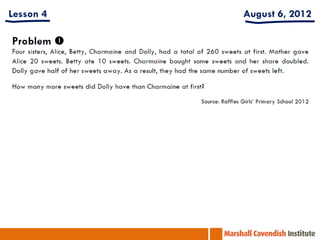
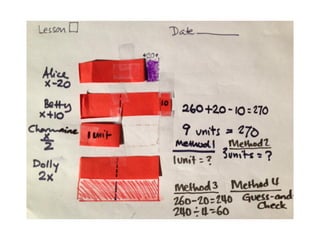
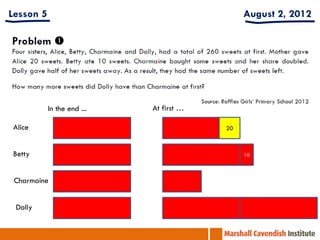
           In the end ...   At first …

Alice                                    20


Betty                                         10


 Charmaine


 Dolly
Lesson 5
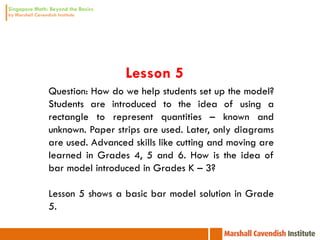
Question: How do we help students set up the model?
Students are introduced to the idea of using a
rectangle to represent quantities – known and
unknown. Paper strips are used. Later, only diagrams
are used. Advanced skills like cutting and moving are
learned in Grades 4, 5 and 6. How is the idea of
bar model introduced in Grades K – 3?

Lesson 5 shows a basic bar model solution in Grade
5.
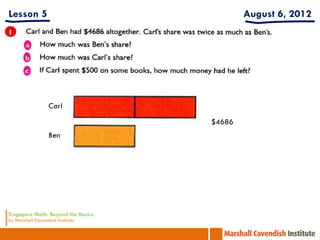
Lesson 5                  August 6, 2012


           Carl

                  $4686
           Ben
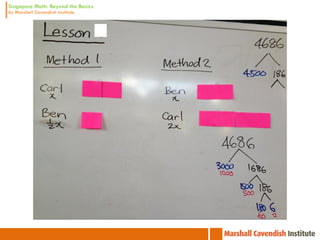
Differentiated instruction for
 students who have difficulty
with standard algorithms. Use
        number bonds.
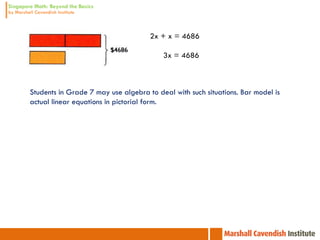
2x + x = 4686

                                         3x = 4686


Students in Grade 7 may use algebra to deal with such situations. Bar model is
actual linear equations in pictorial form.
Lesson 6
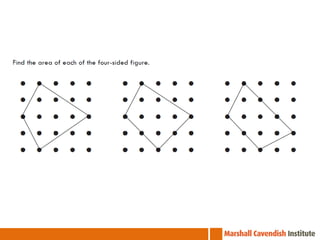
Let’s look at the emphasis on visualization and
generalization in a task from a different topic –
area of polygons.
Differentiated Instruction
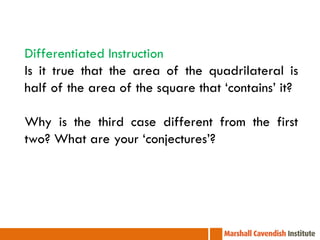
Is it true that the area of the quadrilateral is
half of the area of the square that ‘contains’ it?

Why is the third case different from the first
two? What are your ‘conjectures’?
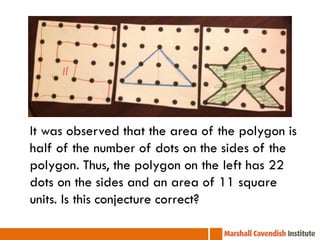
It was observed that the area of the polygon is
half of the number of dots on the sides of the
polygon. Thus, the polygon on the left has 22
dots on the sides and an area of 11 square
units. Is this conjecture correct?
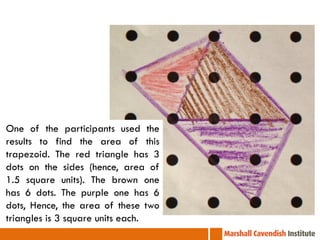
One of the participants used the
results to find the area of this
trapezoid. The red triangle has 3
dots on the sides (hence, area of
1.5 square units). The brown one
has 6 dots. The purple one has 6
dots, Hence, the area of these two
triangles is 3 square units each.
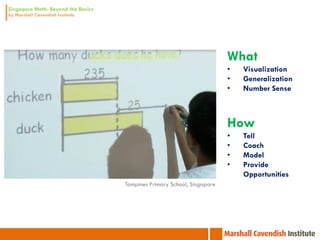
What
                                     •   Visualization
                                     •   Generalization
                                     •   Number Sense


                                     How
                                     •   Tell
                                     •   Coach
                                     •   Model
                                     •   Provide
                                         Opportunities
Tampines Primary School, Singapore

Oak Lawn Beyond the Basics 01

  • 1.
    Dr. Yeap BanHar Marshall Cavendish Institute Singapore yeapbanhar@gmail.com SINGAPORE M AT H Beyond the Basics Day One St Edward’s School Slides are available at Florida, USA www.banhar.blogspot.com Marshall Cavendish Institute www.facebook.com/MCISingapore www.mcinstitute.com.sg
  • 2.
    Dr. Yeap BanHar CONTACT Marshall Cavendish Institute INFO yeapbanhar@gmail.com Slides are available at www.banhar.blogspot.com Marshall Cavendish Institute www.mcinstitute.com.sg www.facebook.com/ MCISingapore
  • 4.
    Introduction We start theday with an overview of Singapore Math.
  • 6.
    Curriculum document isavailable at http://www.moe.gov.sg/
  • 7.
    THINKING SCHOOLS LEARNING NATION Singapore Ministry of Education 1997
  • 8.
    what is singapore mathematics
  • 10.
    key focus of singapore mathematics
  • 11.
    problem solving
  • 12.
  • 13.
    an excellent vehicle for the development &improvement of a person’s intellectual competencies Ministry of Education Singapore 2006
  • 14.
  • 16.
    Fundamentals of SingaporeMath – Review & Extend  Thinking: It’s the Big Idea!  Problem Solving, Visualization, Patterning, and Number Sense  The Concrete-Pictorial-Abstract Approach
  • 17.
    Lesson 1 We doa case study on multiplication facts. We will see the use of an anchor task to engage students for an extended period of time.
  • 22.
    Strategy 1 Get 3x 4 from 2 x 4 Strategy 2 Doubling Strategy 3 Get 7 x 4 from 2 x 4 and 5 x 4 Strategy 4 Get 9 x 4 from 10 x 4
  • 23.
    Strategy 1 Get 3x 4 from 2 x 4
  • 24.
    Strategy 3 Get 9x 4 from 4 x 4 and 5 x 4 This is essentially the distributive property. Do we introduce the phrase at this point? Recall the discussion on Dienes.
  • 25.
    Strategy 2 Doubling
  • 26.
    Strategy 4 Get 9x 4 from 10 x 4
  • 27.
    Unusual Response Get 4x 8 from 4 x 2. Can it be done? Does the number of cups change? Does the number of counters per cup change?
  • 28.
    Differentiated Instruction These areexamples of how the lesson can be differentiated for advanced learners.
  • 29.
    Differentiated Instruction These areexamples of how the lesson can be differentiated for advanced learners.
  • 30.
    Exercise Discuss the fourways to represent 1 group of 4. Which is used first? Why? Which is used next? Why?
  • 31.
    Textbook Study Observe thevarious meanings of multiplication from Grade 1 to Grade 3.
  • 32.
    Prior to learningmultiplication, students learn to make equal groups using concrete materials. Marbles is the suggested materials.
  • 33.
    After that theyrepresent these concrete situations using, first, drawings ..
  • 34.
  • 35.
    … and, later,diagrams. Students also write multiplication sentences in conventional symbols.
  • 36.
    First, equal groups– three groups of four. Third, four multiplied three times …. Second, array – Three rows of four
  • 37.
    Textbook Study Observe how equal group representation evolves into array and area models. Also observe how the multiplication tables of 3 and 6 are related on the flights of stairs.
  • 38.
    They begin withequal group representation.
  • 39.
    1 2 34 5 6 7 8 9 10 11 12 13 14 15 16 17 18 19 20 21 22 23 24 25 26 27 28 29 30
  • 40.
    In Primary 2,students learn multiplication facts of 2, 5, 10 and 3 and 4. In Primary 3, they learn the multiplication facts of 6, 7, 8 and 9.
  • 41.
    Later, the arraymeaning of multiplication is introduced.
  • 42.
    Square tiles aresubsequently used to lead to the area representation of multiplication.
  • 46.
    Lesson 2 Multiplication ofmulti-digit numbers taught in a problem-solving approach.
  • 47.
    Lesson 2 August 6, 2012
  • 48.
    Lesson 2 August 2, 2012 30 9 39 x 6 6             Method 1 Method 2 39 x 6 = 40 x 6 = 240 30 9
  • 49.
    Lesson 3 Use digits1 to 9 to make a correct multiplication sentence =.
  • 50.
    Open Lesson atBroomfield, Colorado
  • 52.
    Students who werealready good in the skill of multiplying two-digit number with a single-digit number were asked to make observations. They were asked “What do you notice? Are there some digits that cannot be used ta all?”
  • 53.
    Multiplication Around Us Doyou see multiplication in these work of art around the venue of the conference? Hilton Oak Lawn, IL
  • 55.
    Lesson 4 We studiedthe strategies to help struggling readers as well as those weak in representing problem situations.
  • 56.
    Lesson 4 August 6, 2012
  • 58.
    Lesson 5 August 2, 2012 In the end ... At first … Alice 20 Betty 10 Charmaine Dolly
  • 59.
    Lesson 5 Question: Howdo we help students set up the model? Students are introduced to the idea of using a rectangle to represent quantities – known and unknown. Paper strips are used. Later, only diagrams are used. Advanced skills like cutting and moving are learned in Grades 4, 5 and 6. How is the idea of bar model introduced in Grades K – 3? Lesson 5 shows a basic bar model solution in Grade 5.
  • 60.
    Lesson 5 August 6, 2012 Carl $4686 Ben
  • 62.
    Differentiated instruction for students who have difficulty with standard algorithms. Use number bonds.
  • 64.
    2x + x= 4686 3x = 4686 Students in Grade 7 may use algebra to deal with such situations. Bar model is actual linear equations in pictorial form.
  • 65.
    Lesson 6 Let’s lookat the emphasis on visualization and generalization in a task from a different topic – area of polygons.
  • 67.
    Differentiated Instruction Is ittrue that the area of the quadrilateral is half of the area of the square that ‘contains’ it? Why is the third case different from the first two? What are your ‘conjectures’?
  • 68.
    It was observedthat the area of the polygon is half of the number of dots on the sides of the polygon. Thus, the polygon on the left has 22 dots on the sides and an area of 11 square units. Is this conjecture correct?
  • 69.
    One of theparticipants used the results to find the area of this trapezoid. The red triangle has 3 dots on the sides (hence, area of 1.5 square units). The brown one has 6 dots. The purple one has 6 dots, Hence, the area of these two triangles is 3 square units each.
  • 70.
    What • Visualization • Generalization • Number Sense How • Tell • Coach • Model • Provide Opportunities Tampines Primary School, Singapore