PANDA, PENGUIN+
OTHER SEO ANIMALS
2


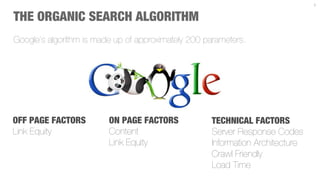
THE ORGANIC SEARCH ALGORITHM
Google’s algorithm is made up of approximately 200 parameters.


OFF PAGE FACTORS         ON PAGE FACTORS            TECHNICAL FACTORS
Link Equity              Content                    Server Response Codes
                         Link Equity                Information Architecture
                                                    Crawl Friendly
                                                    Load Time
3


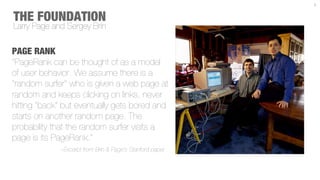
THE FOUNDATION
Larry Page and Sergey Brin

PAGE RANK
“PageRank can be thought of as a model
of user behavior. We assume there is a
"random surfer" who is given a web page at
random and keeps clicking on links, never
hitting "back" but eventually gets bored and
starts on another random page. The
probability that the random surfer visits a
page is its PageRank.”
             ~Excerpt from Brin & Page’s Stanford paper.
4


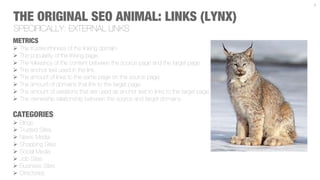
THE ORIGINAL SEO ANIMAL: LINKS (LYNX)
SPECIFICALLY: EXTERNAL LINKS
METRICS
Ø  The trustworthiness of the linking domain.
Ø  The popularity of the linking page.
Ø  The relevancy of the content between the source page and the target page.
Ø  The anchor text used in the link.
Ø  The amount of links to the same page on the source page.
Ø  The amount of domains that link to the target page.
Ø  The amount of variations that are used as anchor text to links to the target page.
Ø  The ownership relationship between the source and target domains.

CATEGORIES
Ø  Blogs
Ø  Trusted Sites
Ø  News Media
Ø  Shopping Sites
Ø  Social Media
Ø  Job Sites
Ø  Business Sites
Ø  Directories
5


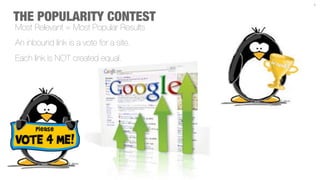
THE POPULARITY CONTEST
Most Relevant = Most Popular Results
An inbound link is a vote for a site.
Each link is NOT created equal.
6


ON-PAGE AND TECHNICAL FACTORS
LEVELWING’S PRIMARY FOCUS

Keyword Analysis

Content and Messaging

Utilizing Available Landing Page Opportunities

Identifying New Opportunities

Improving Usability

Resolving Technical Problems
7


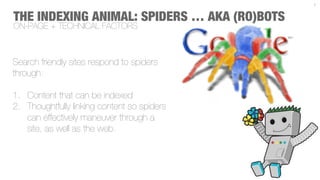
THE INDEXING ANIMAL: SPIDERS … AKA (RO)BOTS
ON-PAGE + TECHNICAL FACTORS


Search friendly sites respond to spiders
through:

1.  Content that can be indexed
2.  Thoughtfully linking content so spiders
    can effectively maneuver through a
    site, as well as the web.
8


SOURCE CODE
CONTENT THAT CAN BE INDEXED
9


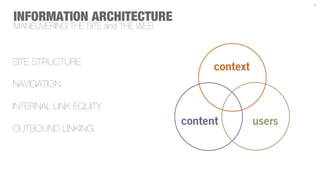
INFORMATION ARCHITECTURE
MANEUVERING THE SITE and THE WEB


SITE STRUCTURE

NAVIGATION

INTERNAL LINK EQUITY

OUTBOUND LINKING
10


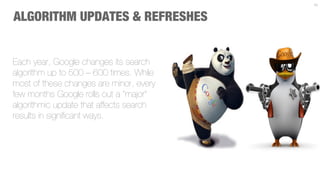
ALGORITHM UPDATES & REFRESHES


Each year, Google changes its search
algorithm up to 500 – 600 times. While
most of these changes are minor, every
few months Google rolls out a “major”
algorithmic update that affects search
results in significant ways.
11


GOOGLE’S GUIDELINES – BASIC PRINCIPLES
From WEBMASTER TOOLS
Make pages primarily for users, not for
search engines.
 
Avoid tricks intended to improve search
engine rankings. A useful test is to ask,
"Does this help my users? Would I do this if
search engines didn't exist?"

Don't participate in link schemes designed to
                                                  Matt Cutts – Head of
increase your site's ranking or PageRank.       Google’s Web Spam Team
12


GOOGLE’S DESIGN AND CONTENT GUIDELINES
From WEBMASTER TOOLS
Make a site with a clear hierarchy.

Try to use text instead of images to display important names,
content, or links. The Google crawler doesn't recognize text
contained in images. If you must use images for textual content,
consider using the "ALT" attribute to include a few words of
descriptive text.
Create a useful, information-rich site, and write pages that clearly and accurately describe
your content.

Think about the words users would type to find your pages, and make sure that your site
actually includes those words within it.

Make sure that your <title> elements and ALT attributes are descriptive and accurate.
13


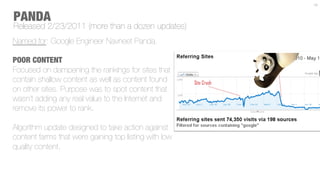
PANDA
Released 2/23/2011 (more than a dozen updates)
Named for: Google Engineer Navneet Panda.

POOR CONTENT
Focused on dampening the rankings for sites that
contain shallow content as well as content found
on other sites. Purpose was to spot content that
wasn’t adding any real value to the Internet and
remove its power to rank.

Algorithm update designed to take action against
content farms that were gaining top listing with low
quality content.
14


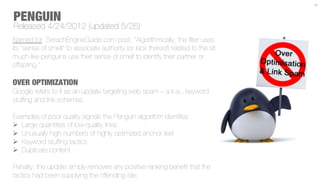
PENGUIN
Released 4/24/2012 (updated 5/26)
Named for: SerachEngineGuide.com post, “Algorithmically, the filter uses
its "sense of smell" to associate authority (or lack thereof) related to the site
much like penguins use their sense of smell to identify their partner or
offspring.”

OVER OPTIMIZATION
Google refers to it as an update targeting web spam – a.k.a., keyword
stuffing and link schemes.

Examples of poor quality signals the Penguin algorithm identifies:
Ø  Large quantities of low-quality links
Ø  Unusually high numbers of highly optimized anchor text
Ø  Keyword stuffing tactics
Ø  Duplicate content

Penalty: the update simply removes any positive ranking benefit that the
tactics had been supplying the offending site.
15


GETTING LINK LOVE
Publish quality content on a user-friendly
website that makes users want to stick
around.

Ø  Improve the visitors user experience
Ø  Add value for your customers
Ø  Acquire an audience/customer base
    and keep them coming back for more

It is that value creation through broader
content marketing that will inevitably build
links to relevant sites.
16


FITTING IN


How does organic search fit in with
your digital strategy?
17


USER FRIENDLY


Organic traffic is often the best data
resource for how visitors use a
website.

SEO Animals

  • 1.
  • 2.
    2 THE ORGANIC SEARCHALGORITHM Google’s algorithm is made up of approximately 200 parameters. OFF PAGE FACTORS ON PAGE FACTORS TECHNICAL FACTORS Link Equity Content Server Response Codes Link Equity Information Architecture Crawl Friendly Load Time
  • 3.
    3 THE FOUNDATION Larry Pageand Sergey Brin PAGE RANK “PageRank can be thought of as a model of user behavior. We assume there is a "random surfer" who is given a web page at random and keeps clicking on links, never hitting "back" but eventually gets bored and starts on another random page. The probability that the random surfer visits a page is its PageRank.” ~Excerpt from Brin & Page’s Stanford paper.
  • 4.
    4 THE ORIGINAL SEOANIMAL: LINKS (LYNX) SPECIFICALLY: EXTERNAL LINKS METRICS Ø  The trustworthiness of the linking domain. Ø  The popularity of the linking page. Ø  The relevancy of the content between the source page and the target page. Ø  The anchor text used in the link. Ø  The amount of links to the same page on the source page. Ø  The amount of domains that link to the target page. Ø  The amount of variations that are used as anchor text to links to the target page. Ø  The ownership relationship between the source and target domains. CATEGORIES Ø  Blogs Ø  Trusted Sites Ø  News Media Ø  Shopping Sites Ø  Social Media Ø  Job Sites Ø  Business Sites Ø  Directories
  • 5.
    5 THE POPULARITY CONTEST MostRelevant = Most Popular Results An inbound link is a vote for a site. Each link is NOT created equal.
  • 6.
    6 ON-PAGE AND TECHNICALFACTORS LEVELWING’S PRIMARY FOCUS Keyword Analysis Content and Messaging Utilizing Available Landing Page Opportunities Identifying New Opportunities Improving Usability Resolving Technical Problems
  • 7.
    7 THE INDEXING ANIMAL:SPIDERS … AKA (RO)BOTS ON-PAGE + TECHNICAL FACTORS Search friendly sites respond to spiders through: 1.  Content that can be indexed 2.  Thoughtfully linking content so spiders can effectively maneuver through a site, as well as the web.
  • 8.
  • 9.
    9 INFORMATION ARCHITECTURE MANEUVERING THESITE and THE WEB SITE STRUCTURE NAVIGATION INTERNAL LINK EQUITY OUTBOUND LINKING
  • 10.
    10 ALGORITHM UPDATES &REFRESHES Each year, Google changes its search algorithm up to 500 – 600 times. While most of these changes are minor, every few months Google rolls out a “major” algorithmic update that affects search results in significant ways.
  • 11.
    11 GOOGLE’S GUIDELINES –BASIC PRINCIPLES From WEBMASTER TOOLS Make pages primarily for users, not for search engines.   Avoid tricks intended to improve search engine rankings. A useful test is to ask, "Does this help my users? Would I do this if search engines didn't exist?" Don't participate in link schemes designed to Matt Cutts – Head of increase your site's ranking or PageRank. Google’s Web Spam Team
  • 12.
    12 GOOGLE’S DESIGN ANDCONTENT GUIDELINES From WEBMASTER TOOLS Make a site with a clear hierarchy. Try to use text instead of images to display important names, content, or links. The Google crawler doesn't recognize text contained in images. If you must use images for textual content, consider using the "ALT" attribute to include a few words of descriptive text. Create a useful, information-rich site, and write pages that clearly and accurately describe your content. Think about the words users would type to find your pages, and make sure that your site actually includes those words within it. Make sure that your <title> elements and ALT attributes are descriptive and accurate.
  • 13.
    13 PANDA Released 2/23/2011 (morethan a dozen updates) Named for: Google Engineer Navneet Panda. POOR CONTENT Focused on dampening the rankings for sites that contain shallow content as well as content found on other sites. Purpose was to spot content that wasn’t adding any real value to the Internet and remove its power to rank. Algorithm update designed to take action against content farms that were gaining top listing with low quality content.
  • 14.
    14 PENGUIN Released 4/24/2012 (updated5/26) Named for: SerachEngineGuide.com post, “Algorithmically, the filter uses its "sense of smell" to associate authority (or lack thereof) related to the site much like penguins use their sense of smell to identify their partner or offspring.” OVER OPTIMIZATION Google refers to it as an update targeting web spam – a.k.a., keyword stuffing and link schemes. Examples of poor quality signals the Penguin algorithm identifies: Ø  Large quantities of low-quality links Ø  Unusually high numbers of highly optimized anchor text Ø  Keyword stuffing tactics Ø  Duplicate content Penalty: the update simply removes any positive ranking benefit that the tactics had been supplying the offending site.
  • 15.
    15 GETTING LINK LOVE Publishquality content on a user-friendly website that makes users want to stick around. Ø  Improve the visitors user experience Ø  Add value for your customers Ø  Acquire an audience/customer base and keep them coming back for more It is that value creation through broader content marketing that will inevitably build links to relevant sites.
  • 16.
    16 FITTING IN How doesorganic search fit in with your digital strategy?
  • 17.
    17 USER FRIENDLY Organic trafficis often the best data resource for how visitors use a website.