Team Name: Trishul
Date: 05/06/2023
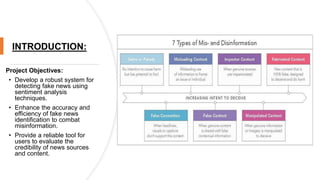
INTRODUCTION:
Project Objectives:
• Develop a robust system for
detecting fake news using
sentiment analysis
techniques.
• Enhance the accuracy and
efficiency of fake news
identification to combat
misinformation.
• Provide a reliable tool for
users to evaluate the
credibility of news sources
and content.
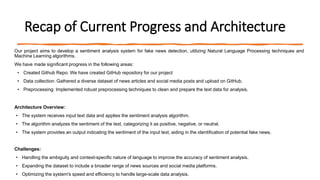
Recap of Current Progress and Architecture
Our project aims to develop a sentiment analysis system for fake news detection, utilizing Natural Language Processing techniques and
Machine Learning algorithms.
We have made significant progress in the following areas:
• Created Github Repo: We have created GitHub repository for our project
• Data collection: Gathered a diverse dataset of news articles and social media posts and upload on GitHub.
• Preprocessing: Implemented robust preprocessing techniques to clean and prepare the text data for analysis.
Architecture Overview:
• The system receives input text data and applies the sentiment analysis algorithm.
• The algorithm analyzes the sentiment of the text, categorizing it as positive, negative, or neutral.
• The system provides an output indicating the sentiment of the input text, aiding in the identification of potential fake news.
Challenges:
• Handling the ambiguity and context-specific nature of language to improve the accuracy of sentiment analysis.
• Expanding the dataset to include a broader range of news sources and social media platforms.
• Optimizing the system's speed and efficiency to handle large-scale data analysis.
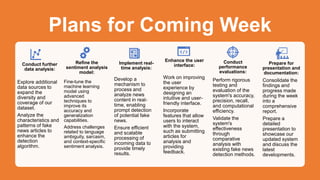
Plans for Coming Week
Conduct further
data analysis:
Explore additional
data sources to
expand the
diversity and
coverage of our
dataset.
Analyze the
characteristics and
patterns of fake
news articles to
enhance the
detection
algorithm.
Refine the
sentiment analysis
model:
Fine-tune the
machine learning
model using
advanced
techniques to
improve its
accuracy and
generalization
capabilities.
Address challenges
related to language
ambiguity, sarcasm,
and context-specific
sentiment analysis.
Implement real-
time analysis:
Develop a
mechanism to
process and
analyze news
content in real-
time, enabling
prompt detection
of potential fake
news.
Ensure efficient
and scalable
processing of
incoming data to
provide timely
results.
Enhance the user
interface:
Work on improving
the user
experience by
designing an
intuitive and user-
friendly interface.
Incorporate
features that allow
users to interact
with the system,
such as submitting
articles for
analysis and
providing
feedback.
Conduct
performance
evaluations:
Perform rigorous
testing and
evaluation of the
system's accuracy,
precision, recall,
and computational
efficiency.
Validate the
system's
effectiveness
through
comparative
analysis with
existing fake news
detection methods.
Prepare for
presentation and
documentation:
Consolidate the
findings and
progress made
during the week
into a
comprehensive
report.
Prepare a
detailed
presentation to
showcase our
updated system
and discuss the
latest
developments.
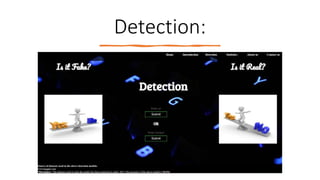
Short Demo of
Current System / Key
Aspects
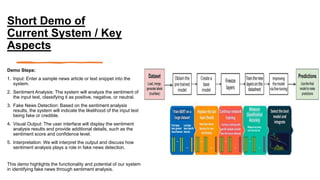
Demo Steps:
1. Input: Enter a sample news article or text snippet into the
system.
2. Sentiment Analysis: The system will analyze the sentiment of
the input text, classifying it as positive, negative, or neutral.
3. Fake News Detection: Based on the sentiment analysis
results, the system will indicate the likelihood of the input text
being fake or credible.
4. Visual Output: The user interface will display the sentiment
analysis results and provide additional details, such as the
sentiment score and confidence level.
5. Interpretation: We will interpret the output and discuss how
sentiment analysis plays a role in fake news detection.
This demo highlights the functionality and potential of our system
in identifying fake news through sentiment analysis.
Detection:
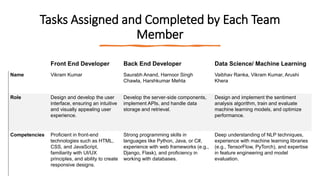
Tasks Assigned and Completed by Each Team
Member
Front End Developer Back End Developer Data Science/ Machine Learning
Name Vikram Kumar Saurabh Anand, Harnoor Singh
Chawla, Harshkumar Mehta
Vaibhav Ranka, Vikram Kumar, Arushi
Khera
Role Design and develop the user
interface, ensuring an intuitive
and visually appealing user
experience.
Develop the server-side components,
implement APIs, and handle data
storage and retrieval.
Design and implement the sentiment
analysis algorithm, train and evaluate
machine learning models, and optimize
performance.
Competencies Proficient in front-end
technologies such as HTML,
CSS, and JavaScript,
familiarity with UI/UX
principles, and ability to create
responsive designs.
Strong programming skills in
languages like Python, Java, or C#,
experience with web frameworks (e.g.,
Django, Flask), and proficiency in
working with databases.
Deep understanding of NLP techniques,
experience with machine learning libraries
(e.g., TensorFlow, PyTorch), and expertise
in feature engineering and model
evaluation.
Tasks Assigned and Completed by Each Team
Member
Testing Integration and Middleware UX Lead
Name Saurabh Anand, Harnoor Singh Chawla,
Harshkumar Mehta
Saurabh Anand, Harshkumar
Mehta
Vikram Kumar, Arushi Khera,
Vaibhav Ranka
Role Conduct comprehensive testing to ensure
the functionality, accuracy, and reliability of
the software solution.
Manage the integration of various
system components, handle data
flow, and ensure seamless
communication between different
modules.
Conduct user research, design user
workflows, and create wireframes
and prototypes to ensure a user-
centric approach.
Competencies Proficiency in various testing
methodologies (e.g., unit testing,
integration testing, regression testing),
knowledge of testing frameworks, and
ability to identify and report bugs
effectively.
Experience with system
integration, knowledge of
middleware technologies (e.g.,
RESTful APIs, message queues),
and ability to troubleshoot
integration issues.
Strong understanding of user
experience principles, proficiency in
UX design tools (e.g., Sketch,
Adobe XD), and ability to translate
user requirements into intuitive
designs.

Sentiment Analysis for Fake News Detection.pptx

  • 1.
  • 2.
    INTRODUCTION: Project Objectives: • Developa robust system for detecting fake news using sentiment analysis techniques. • Enhance the accuracy and efficiency of fake news identification to combat misinformation. • Provide a reliable tool for users to evaluate the credibility of news sources and content.
  • 3.
    Recap of CurrentProgress and Architecture Our project aims to develop a sentiment analysis system for fake news detection, utilizing Natural Language Processing techniques and Machine Learning algorithms. We have made significant progress in the following areas: • Created Github Repo: We have created GitHub repository for our project • Data collection: Gathered a diverse dataset of news articles and social media posts and upload on GitHub. • Preprocessing: Implemented robust preprocessing techniques to clean and prepare the text data for analysis. Architecture Overview: • The system receives input text data and applies the sentiment analysis algorithm. • The algorithm analyzes the sentiment of the text, categorizing it as positive, negative, or neutral. • The system provides an output indicating the sentiment of the input text, aiding in the identification of potential fake news. Challenges: • Handling the ambiguity and context-specific nature of language to improve the accuracy of sentiment analysis. • Expanding the dataset to include a broader range of news sources and social media platforms. • Optimizing the system's speed and efficiency to handle large-scale data analysis.
  • 4.
    Plans for ComingWeek Conduct further data analysis: Explore additional data sources to expand the diversity and coverage of our dataset. Analyze the characteristics and patterns of fake news articles to enhance the detection algorithm. Refine the sentiment analysis model: Fine-tune the machine learning model using advanced techniques to improve its accuracy and generalization capabilities. Address challenges related to language ambiguity, sarcasm, and context-specific sentiment analysis. Implement real- time analysis: Develop a mechanism to process and analyze news content in real- time, enabling prompt detection of potential fake news. Ensure efficient and scalable processing of incoming data to provide timely results. Enhance the user interface: Work on improving the user experience by designing an intuitive and user- friendly interface. Incorporate features that allow users to interact with the system, such as submitting articles for analysis and providing feedback. Conduct performance evaluations: Perform rigorous testing and evaluation of the system's accuracy, precision, recall, and computational efficiency. Validate the system's effectiveness through comparative analysis with existing fake news detection methods. Prepare for presentation and documentation: Consolidate the findings and progress made during the week into a comprehensive report. Prepare a detailed presentation to showcase our updated system and discuss the latest developments.
  • 5.
    Short Demo of CurrentSystem / Key Aspects Demo Steps: 1. Input: Enter a sample news article or text snippet into the system. 2. Sentiment Analysis: The system will analyze the sentiment of the input text, classifying it as positive, negative, or neutral. 3. Fake News Detection: Based on the sentiment analysis results, the system will indicate the likelihood of the input text being fake or credible. 4. Visual Output: The user interface will display the sentiment analysis results and provide additional details, such as the sentiment score and confidence level. 5. Interpretation: We will interpret the output and discuss how sentiment analysis plays a role in fake news detection. This demo highlights the functionality and potential of our system in identifying fake news through sentiment analysis.
  • 6.
  • 7.
    Tasks Assigned andCompleted by Each Team Member Front End Developer Back End Developer Data Science/ Machine Learning Name Vikram Kumar Saurabh Anand, Harnoor Singh Chawla, Harshkumar Mehta Vaibhav Ranka, Vikram Kumar, Arushi Khera Role Design and develop the user interface, ensuring an intuitive and visually appealing user experience. Develop the server-side components, implement APIs, and handle data storage and retrieval. Design and implement the sentiment analysis algorithm, train and evaluate machine learning models, and optimize performance. Competencies Proficient in front-end technologies such as HTML, CSS, and JavaScript, familiarity with UI/UX principles, and ability to create responsive designs. Strong programming skills in languages like Python, Java, or C#, experience with web frameworks (e.g., Django, Flask), and proficiency in working with databases. Deep understanding of NLP techniques, experience with machine learning libraries (e.g., TensorFlow, PyTorch), and expertise in feature engineering and model evaluation.
  • 8.
    Tasks Assigned andCompleted by Each Team Member Testing Integration and Middleware UX Lead Name Saurabh Anand, Harnoor Singh Chawla, Harshkumar Mehta Saurabh Anand, Harshkumar Mehta Vikram Kumar, Arushi Khera, Vaibhav Ranka Role Conduct comprehensive testing to ensure the functionality, accuracy, and reliability of the software solution. Manage the integration of various system components, handle data flow, and ensure seamless communication between different modules. Conduct user research, design user workflows, and create wireframes and prototypes to ensure a user- centric approach. Competencies Proficiency in various testing methodologies (e.g., unit testing, integration testing, regression testing), knowledge of testing frameworks, and ability to identify and report bugs effectively. Experience with system integration, knowledge of middleware technologies (e.g., RESTful APIs, message queues), and ability to troubleshoot integration issues. Strong understanding of user experience principles, proficiency in UX design tools (e.g., Sketch, Adobe XD), and ability to translate user requirements into intuitive designs.

Editor's Notes

  • #3 In an era where fake news has become an increasingly significant issue, sentiment analysis has emerged as a powerful tool to identify misleading or biased information. By examining the emotional tone in news articles and social media posts, sentiment analysis algorithms can help differentiate between real and fake news. In this article, we will discuss how sentiment analysis is uncovering the truth behind the fake news epidemic. Sentiment Analysis is a subfield of Natural Language Processing (NLP) which aims to identify, extract and classify opinions expressed in a given text. It evaluates sentiment through the use of algorithms that identify patterns and words associated with sentiment. The goal is to interpret the sentiment of a text accurately, in order to better understand and respond to its content. Nowadays, Fake News is a growing problem which can undermine public trust and mislead society. Sentiment analysis is increasingly used for the automatic detection of Fake News by studying the opinions of the authors involved. It can be used to identify patterns in words that are associated with sentiment, to predict the sentiment of a text, and to differentiate between neutral, positive, or negative sentiment.
  • #4 The sentiment analysis of a text helps to not only identify the facts about an event but also to people's opinion about it. It can help to determine the author's trustworthiness and credibility. Sentiment analysis helps to detect and classify the Fake News, identify the motive behind some content and also understand public opinion regarding the opinion expressed. It also helps to alert readers about the Fake News and provides them with reliable and accurate information.