Paragraphs & Sentences
Session Aims
• Are there different types?
• Identify and explain different types and structures of
sentences.
• What do they do?
• Explore the effects of different paragraphs and
sentences.
• What does it look like?
• Examine exemplar text and identify how paragraphs,
sentences and structure have been used effectively.
Activity
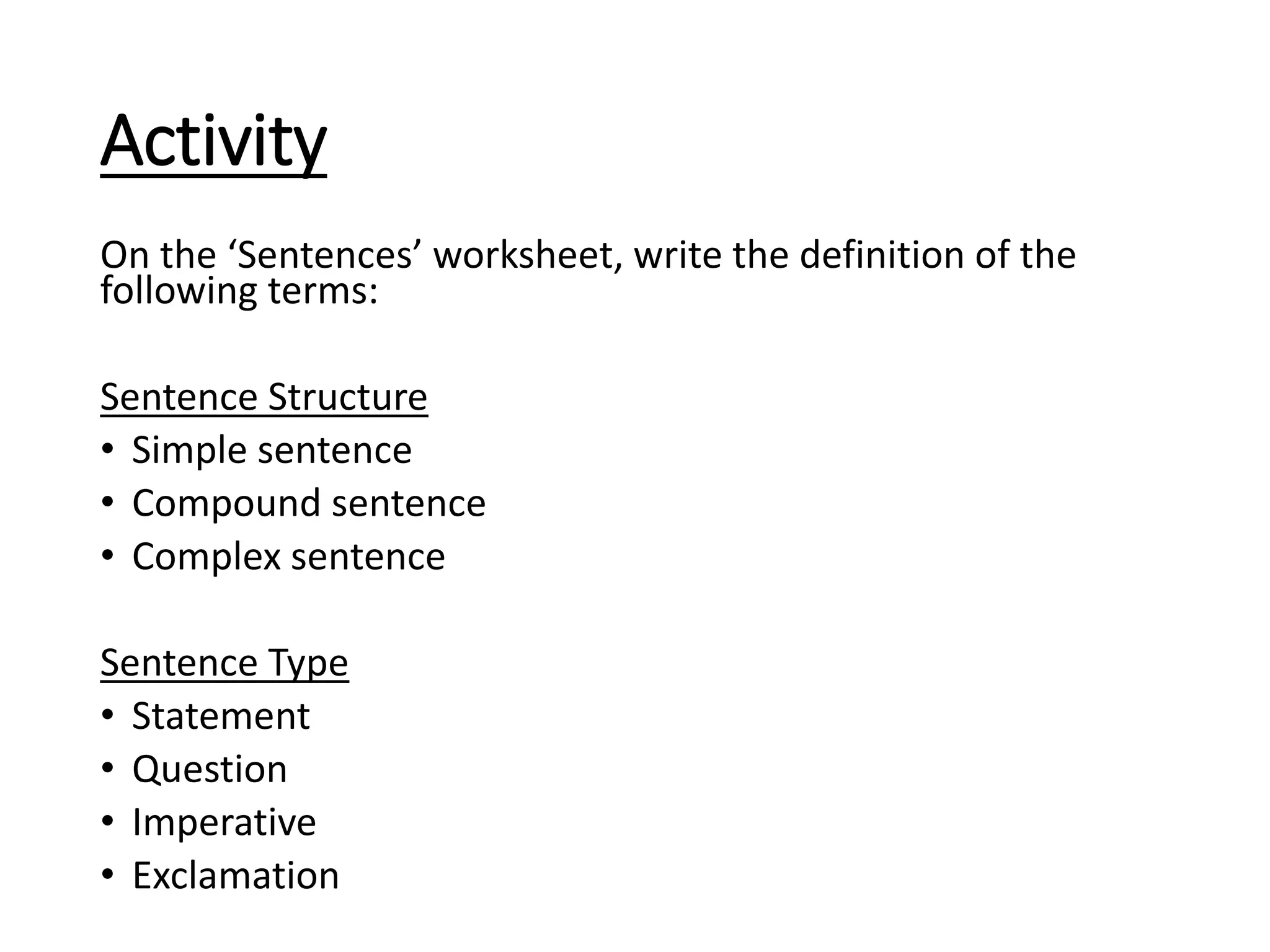
On the ‘Sentences’ worksheet, write the definition of the
following terms:
Sentence Structure
• Simple sentence
• Compound sentence
• Complex sentence
Sentence Type
• Statement
• Question
• Imperative
• Exclamation
Sentence Structures
Activity
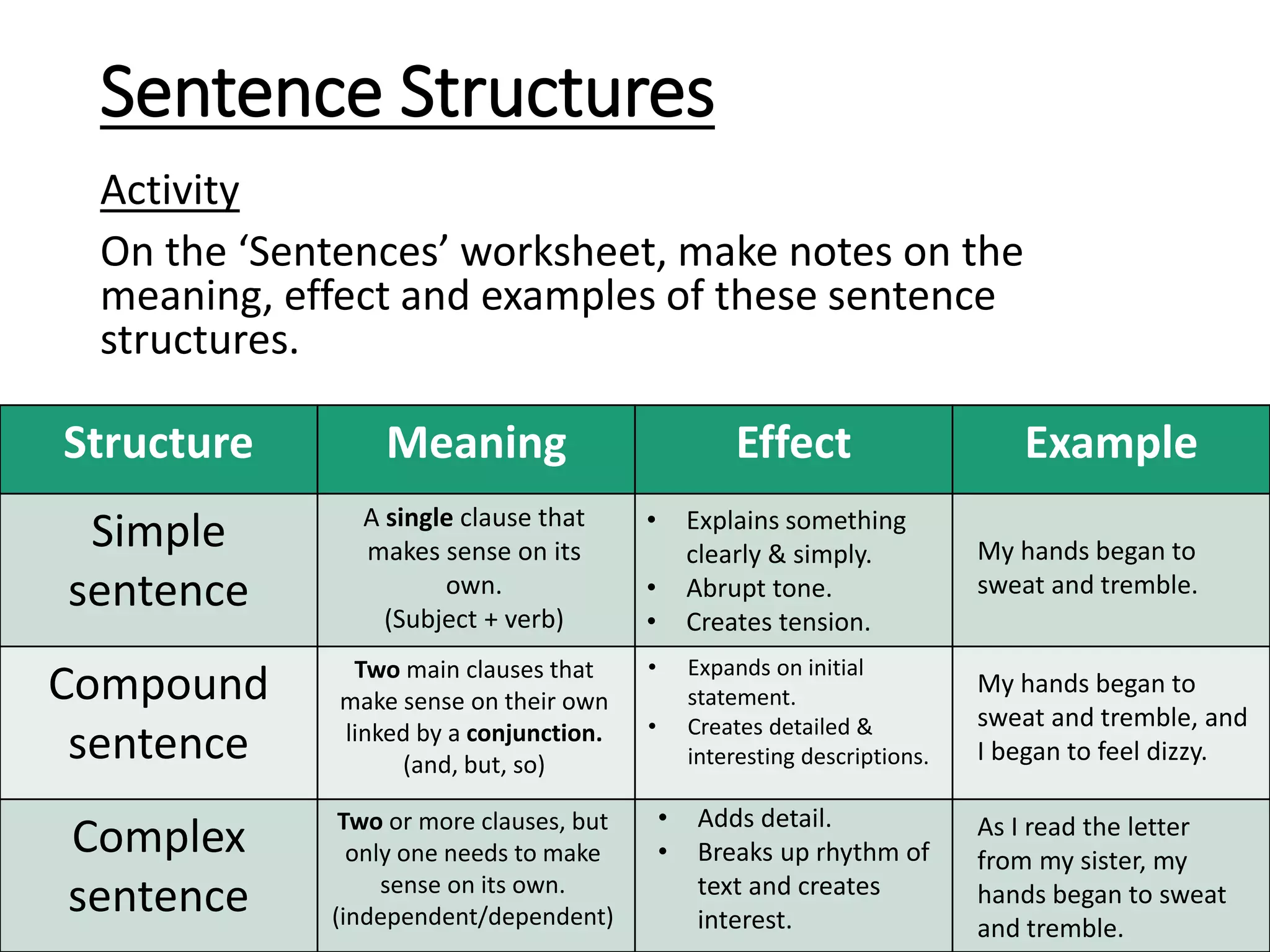
On the ‘Sentences’ worksheet, make notes on the
meaning, effect and examples of these sentence
structures.
Structure Meaning Effect Example
Simple
sentence
Compound
sentence
Complex
sentence
A single clause that
makes sense on its
own.
(Subject + verb)
Two main clauses that
make sense on their own
linked by a conjunction.
(and, but, so)
Two or more clauses, but
only one needs to make
sense on its own.
(independent/dependent)
• Explains something
clearly & simply.
• Abrupt tone.
• Creates tension.
• Expands on initial
statement.
• Creates detailed &
interesting descriptions.
• Adds detail.
• Breaks up rhythm of
text and creates
interest.
My hands began to
sweat and tremble.
My hands began to
sweat and tremble, and
I began to feel dizzy.
As I read the letter
from my sister, my
hands began to sweat
and tremble.
Sentence Types
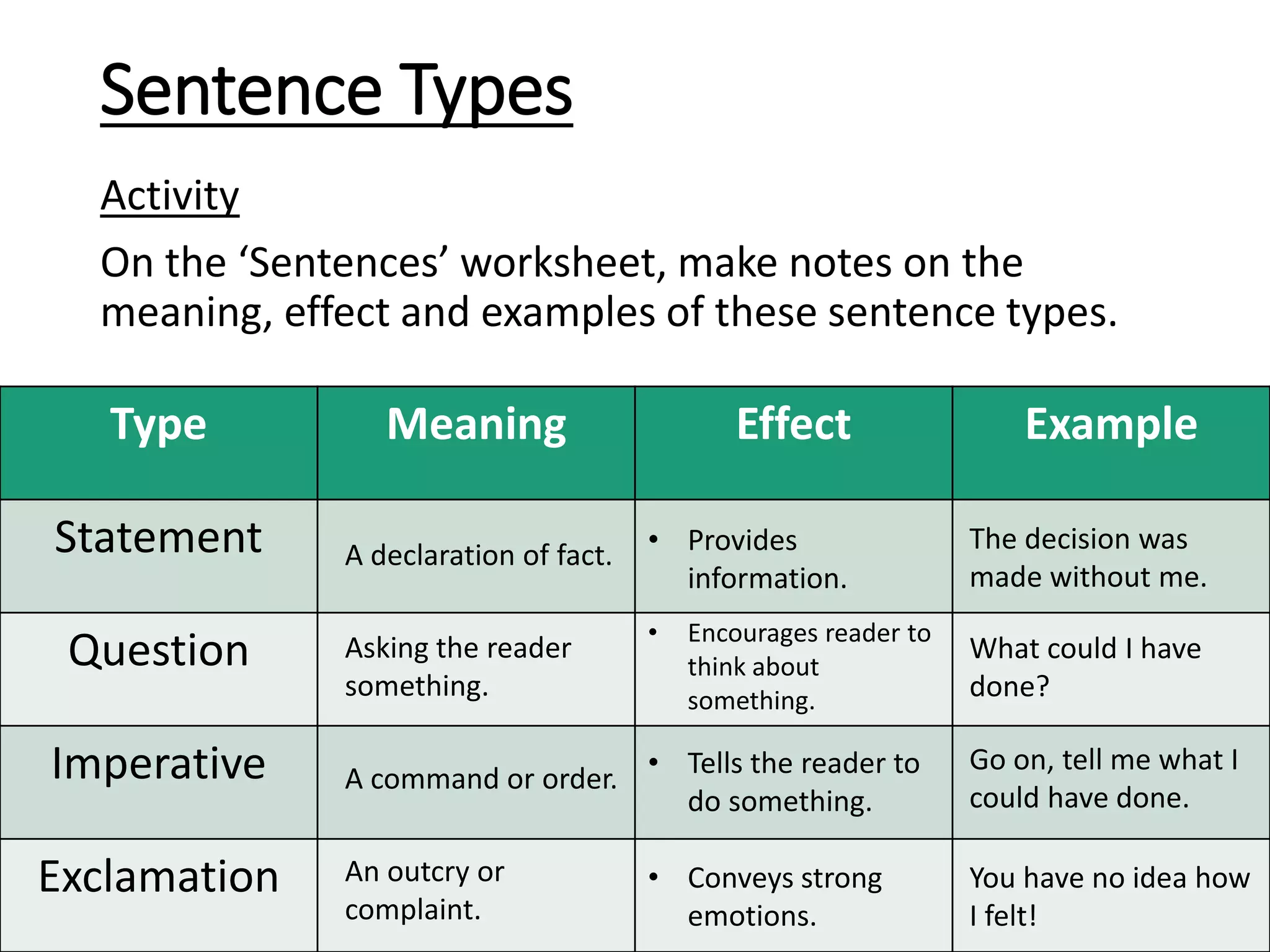
Type Meaning Effect Example
Statement
Question
Imperative
Exclamation
Activity
On the ‘Sentences’ worksheet, make notes on the
meaning, effect and examples of these sentence types.
A declaration of fact.
Asking the reader
something.
A command or order.
An outcry or
complaint.
• Provides
information.
• Encourages reader to
think about
something.
• Tells the reader to
do something.
• Conveys strong
emotions.
The decision was
made without me.
What could I have
done?
Go on, tell me what I
could have done.
You have no idea how
I felt!
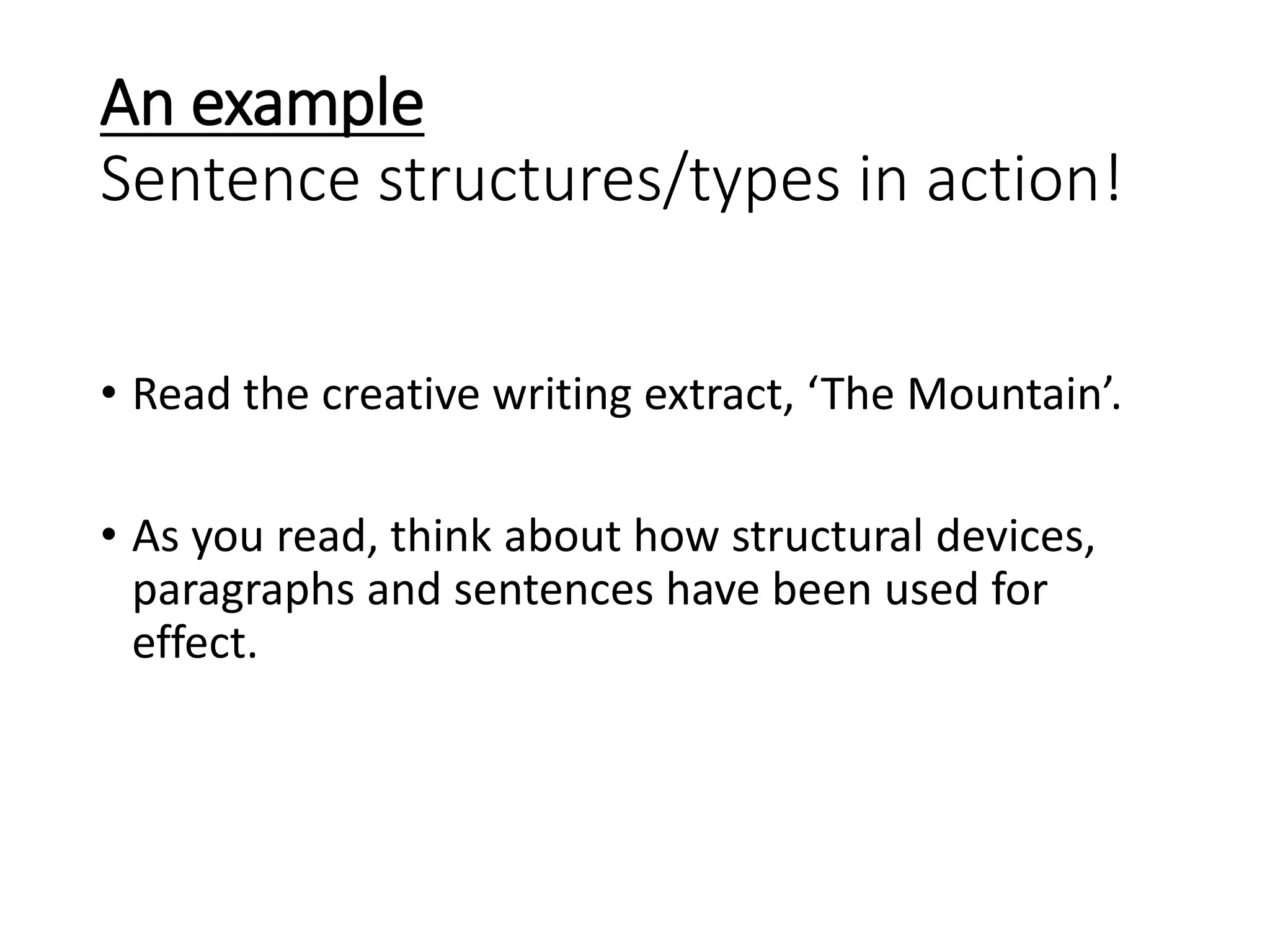
An example
Sentence structures/types in action!
• Read the creative writing extract, ‘The Mountain’.
• As you read, think about how structural devices,
paragraphs and sentences have been used for
effect.
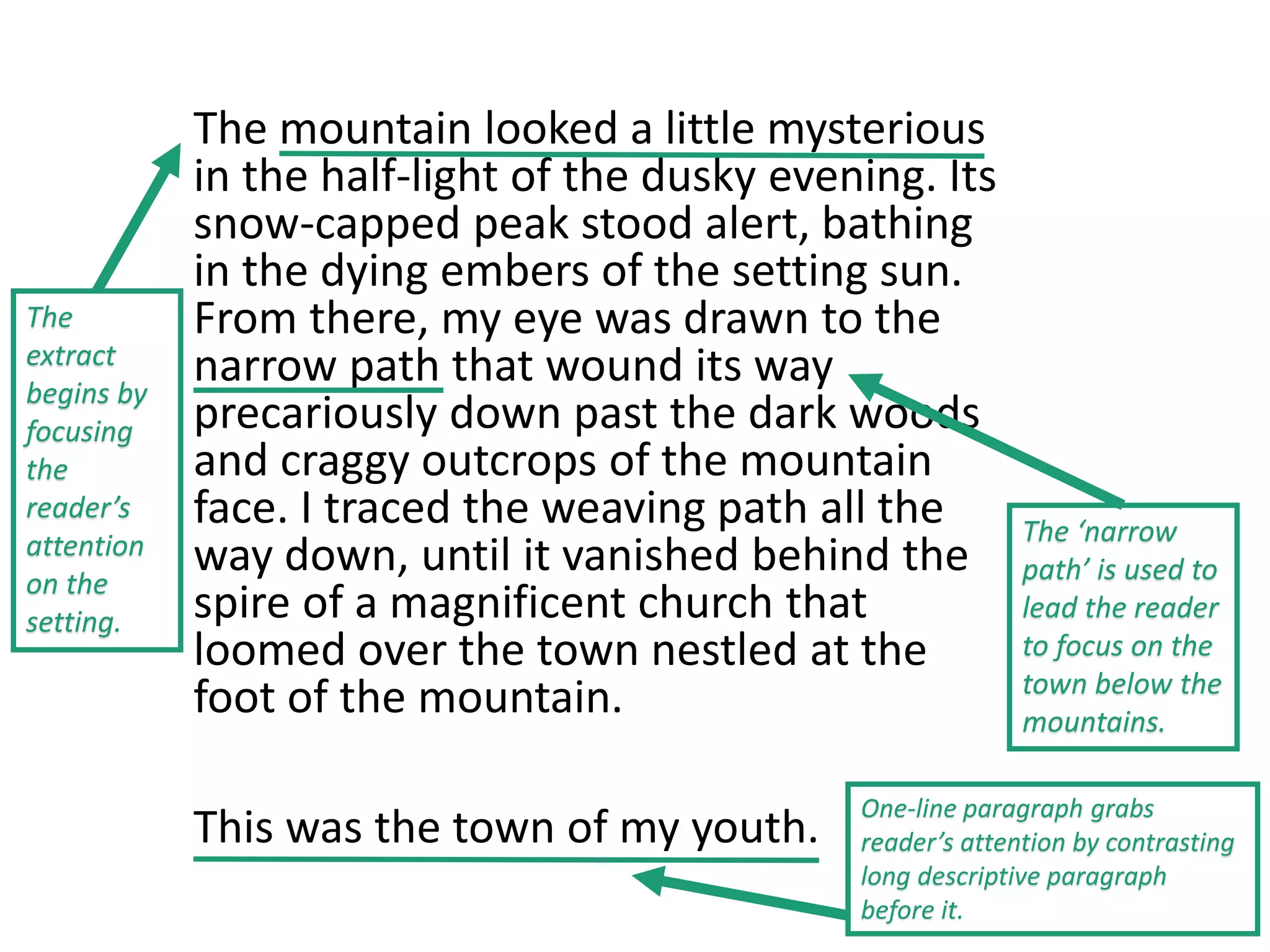
The mountain looked a little mysterious
in the half-light of the dusky evening. Its
snow-capped peak stood alert, bathing
in the dying embers of the setting sun.
From there, my eye was drawn to the
narrow path that wound its way
precariously down past the dark woods
and craggy outcrops of the mountain
face. I traced the weaving path all the
way down, until it vanished behind the
spire of a magnificent church that
loomed over the town nestled at the
foot of the mountain.
This was the town of my youth.
The
extract
begins by
focusing
the
reader’s
attention
on the
setting.
The ‘narrow
path’ is used to
lead the reader
to focus on the
town below the
mountains.
One-line paragraph grabs
reader’s attention by contrasting
long descriptive paragraph
before it.
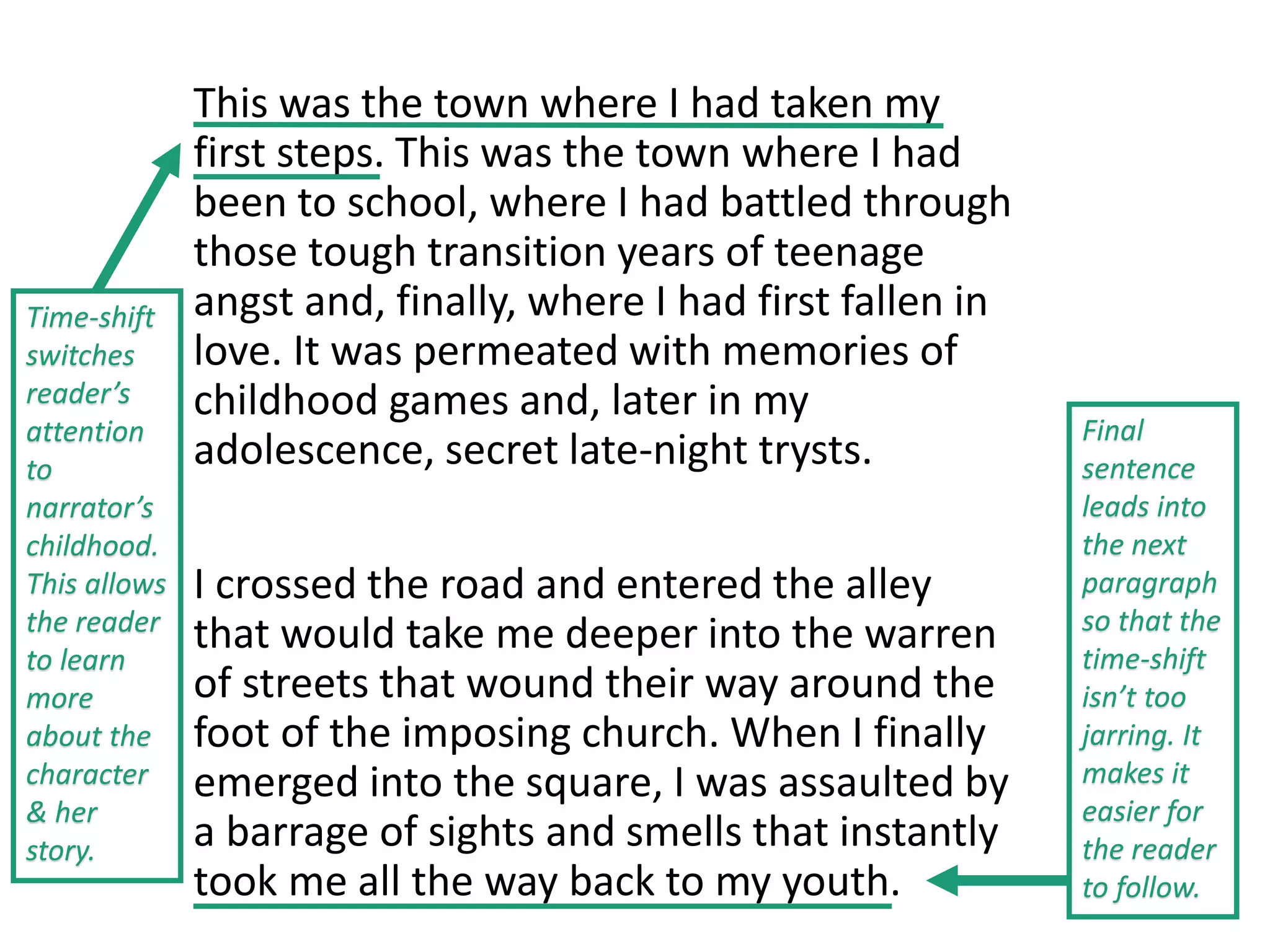
This was the town where I had taken my
first steps. This was the town where I had
been to school, where I had battled through
those tough transition years of teenage
angst and, finally, where I had first fallen in
love. It was permeated with memories of
childhood games and, later in my
adolescence, secret late-night trysts.
I crossed the road and entered the alley
that would take me deeper into the warren
of streets that wound their way around the
foot of the imposing church. When I finally
emerged into the square, I was assaulted by
a barrage of sights and smells that instantly
took me all the way back to my youth.
Time-shift
switches
reader’s
attention
to
narrator’s
childhood.
This allows
the reader
to learn
more
about the
character
& her
story.
Final
sentence
leads into
the next
paragraph
so that the
time-shift
isn’t too
jarring. It
makes it
easier for
the reader
to follow.
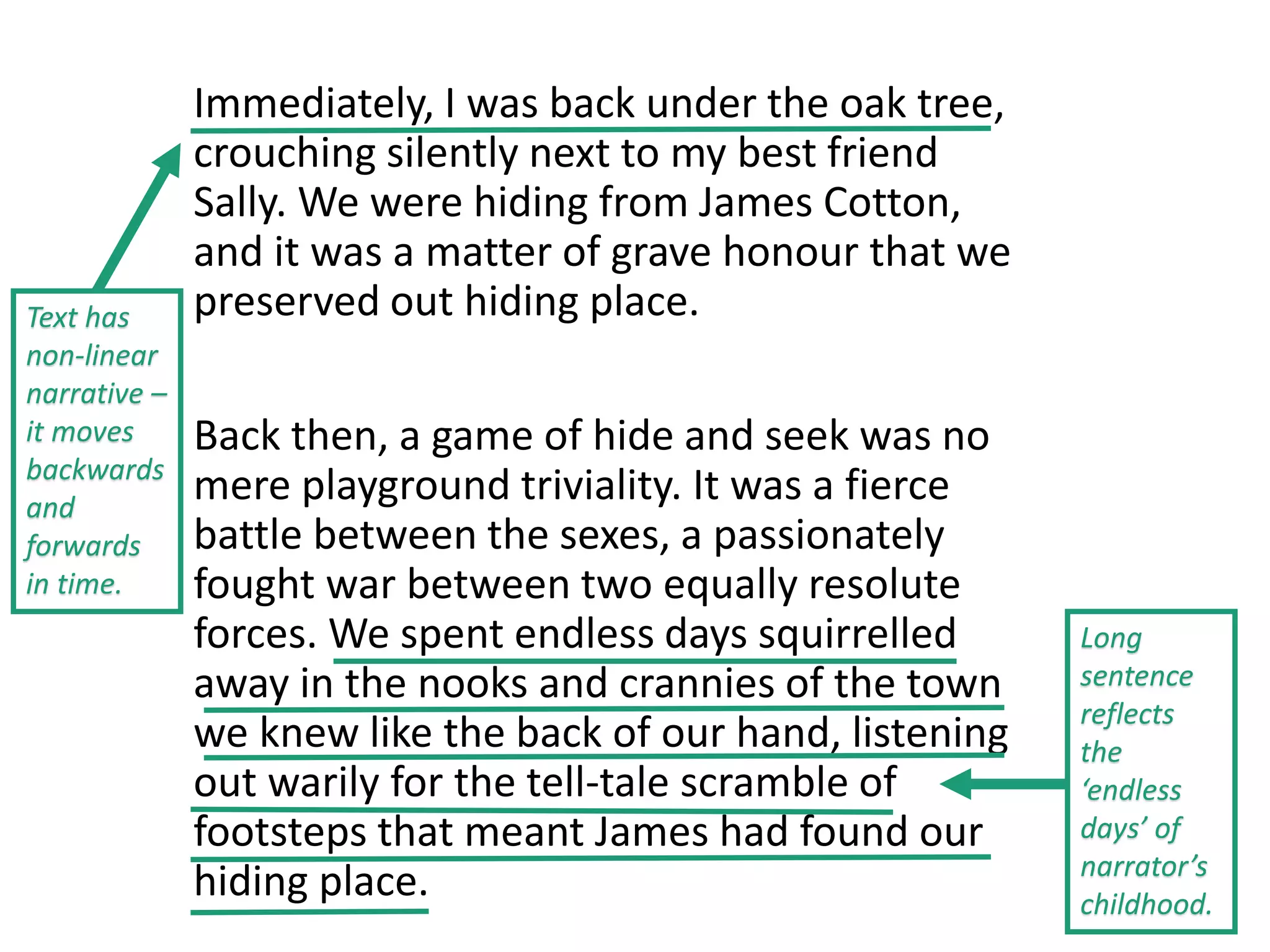
Immediately, I was back under the oak tree,
crouching silently next to my best friend
Sally. We were hiding from James Cotton,
and it was a matter of grave honour that we
preserved out hiding place.
Back then, a game of hide and seek was no
mere playground triviality. It was a fierce
battle between the sexes, a passionately
fought war between two equally resolute
forces. We spent endless days squirrelled
away in the nooks and crannies of the town
we knew like the back of our hand, listening
out warily for the tell-tale scramble of
footsteps that meant James had found our
hiding place.
Text has
non-linear
narrative –
it moves
backwards
and
forwards
in time.
Long
sentence
reflects
the
‘endless
days’ of
narrator’s
childhood.
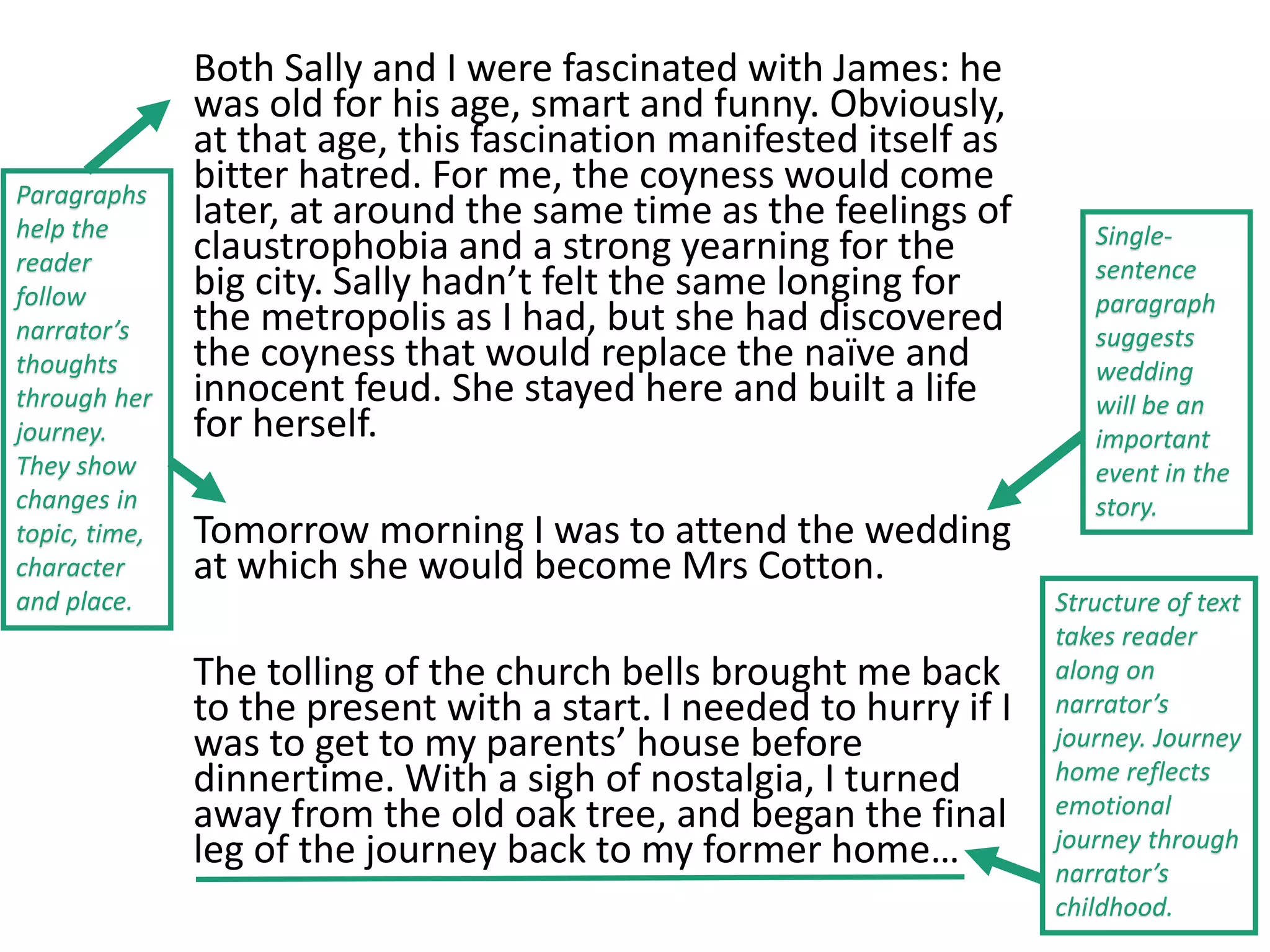
Both Sally and I were fascinated with James: he
was old for his age, smart and funny. Obviously,
at that age, this fascination manifested itself as
bitter hatred. For me, the coyness would come
later, at around the same time as the feelings of
claustrophobia and a strong yearning for the
big city. Sally hadn’t felt the same longing for
the metropolis as I had, but she had discovered
the coyness that would replace the naïve and
innocent feud. She stayed here and built a life
for herself.
Tomorrow morning I was to attend the wedding
at which she would become Mrs Cotton.
The tolling of the church bells brought me back
to the present with a start. I needed to hurry if I
was to get to my parents’ house before
dinnertime. With a sigh of nostalgia, I turned
away from the old oak tree, and began the final
leg of the journey back to my former home…
Paragraphs
help the
reader
follow
narrator’s
thoughts
through her
journey.
They show
changes in
topic, time,
character
and place.
Single-
sentence
paragraph
suggests
wedding
will be an
important
event in the
story.
Structure of text
takes reader
along on
narrator’s
journey. Journey
home reflects
emotional
journey through
narrator’s
childhood.
Activity
• Make a list of all the structural devices, sentence
structures, sentence types in the extract ‘The
Mountain’.
• Select a short story from the folder below.
• Identify as many structural devices & sentence
structures as you can.
• Make sure you think about the impact and effect of
these!

Sentences & structure

  • 1.
  • 2.
    Session Aims • Arethere different types? • Identify and explain different types and structures of sentences. • What do they do? • Explore the effects of different paragraphs and sentences. • What does it look like? • Examine exemplar text and identify how paragraphs, sentences and structure have been used effectively.
  • 3.
    Activity On the ‘Sentences’worksheet, write the definition of the following terms: Sentence Structure • Simple sentence • Compound sentence • Complex sentence Sentence Type • Statement • Question • Imperative • Exclamation
  • 4.
    Sentence Structures Activity On the‘Sentences’ worksheet, make notes on the meaning, effect and examples of these sentence structures. Structure Meaning Effect Example Simple sentence Compound sentence Complex sentence A single clause that makes sense on its own. (Subject + verb) Two main clauses that make sense on their own linked by a conjunction. (and, but, so) Two or more clauses, but only one needs to make sense on its own. (independent/dependent) • Explains something clearly & simply. • Abrupt tone. • Creates tension. • Expands on initial statement. • Creates detailed & interesting descriptions. • Adds detail. • Breaks up rhythm of text and creates interest. My hands began to sweat and tremble. My hands began to sweat and tremble, and I began to feel dizzy. As I read the letter from my sister, my hands began to sweat and tremble.
  • 5.
    Sentence Types Type MeaningEffect Example Statement Question Imperative Exclamation Activity On the ‘Sentences’ worksheet, make notes on the meaning, effect and examples of these sentence types. A declaration of fact. Asking the reader something. A command or order. An outcry or complaint. • Provides information. • Encourages reader to think about something. • Tells the reader to do something. • Conveys strong emotions. The decision was made without me. What could I have done? Go on, tell me what I could have done. You have no idea how I felt!
  • 6.
    An example Sentence structures/typesin action! • Read the creative writing extract, ‘The Mountain’. • As you read, think about how structural devices, paragraphs and sentences have been used for effect.
  • 7.
    The mountain lookeda little mysterious in the half-light of the dusky evening. Its snow-capped peak stood alert, bathing in the dying embers of the setting sun. From there, my eye was drawn to the narrow path that wound its way precariously down past the dark woods and craggy outcrops of the mountain face. I traced the weaving path all the way down, until it vanished behind the spire of a magnificent church that loomed over the town nestled at the foot of the mountain. This was the town of my youth. The extract begins by focusing the reader’s attention on the setting. The ‘narrow path’ is used to lead the reader to focus on the town below the mountains. One-line paragraph grabs reader’s attention by contrasting long descriptive paragraph before it.
  • 8.
    This was thetown where I had taken my first steps. This was the town where I had been to school, where I had battled through those tough transition years of teenage angst and, finally, where I had first fallen in love. It was permeated with memories of childhood games and, later in my adolescence, secret late-night trysts. I crossed the road and entered the alley that would take me deeper into the warren of streets that wound their way around the foot of the imposing church. When I finally emerged into the square, I was assaulted by a barrage of sights and smells that instantly took me all the way back to my youth. Time-shift switches reader’s attention to narrator’s childhood. This allows the reader to learn more about the character & her story. Final sentence leads into the next paragraph so that the time-shift isn’t too jarring. It makes it easier for the reader to follow.
  • 9.
    Immediately, I wasback under the oak tree, crouching silently next to my best friend Sally. We were hiding from James Cotton, and it was a matter of grave honour that we preserved out hiding place. Back then, a game of hide and seek was no mere playground triviality. It was a fierce battle between the sexes, a passionately fought war between two equally resolute forces. We spent endless days squirrelled away in the nooks and crannies of the town we knew like the back of our hand, listening out warily for the tell-tale scramble of footsteps that meant James had found our hiding place. Text has non-linear narrative – it moves backwards and forwards in time. Long sentence reflects the ‘endless days’ of narrator’s childhood.
  • 10.
    Both Sally andI were fascinated with James: he was old for his age, smart and funny. Obviously, at that age, this fascination manifested itself as bitter hatred. For me, the coyness would come later, at around the same time as the feelings of claustrophobia and a strong yearning for the big city. Sally hadn’t felt the same longing for the metropolis as I had, but she had discovered the coyness that would replace the naïve and innocent feud. She stayed here and built a life for herself. Tomorrow morning I was to attend the wedding at which she would become Mrs Cotton. The tolling of the church bells brought me back to the present with a start. I needed to hurry if I was to get to my parents’ house before dinnertime. With a sigh of nostalgia, I turned away from the old oak tree, and began the final leg of the journey back to my former home… Paragraphs help the reader follow narrator’s thoughts through her journey. They show changes in topic, time, character and place. Single- sentence paragraph suggests wedding will be an important event in the story. Structure of text takes reader along on narrator’s journey. Journey home reflects emotional journey through narrator’s childhood.
  • 11.
    Activity • Make alist of all the structural devices, sentence structures, sentence types in the extract ‘The Mountain’. • Select a short story from the folder below. • Identify as many structural devices & sentence structures as you can. • Make sure you think about the impact and effect of these!