05
Your school or college is asking students to
contribute some creative writing for its website.
Describe a seaside scene on a sunny day
(24 marks for content and organisation and
16 marks for technical accuracy)
[40 marks]
PAPER 1
QUESTION 5
Write a description
Question 5 of Paper 1 tests
your creative writing skills.
You will be given a choice of
writing a story or a
description. You will need to
demonstrate that you can use
structure and language
effectively.
This resources guides you
through a descriptive piece
step by step.
Timing 1hour
Self-assessment: Save to your folder
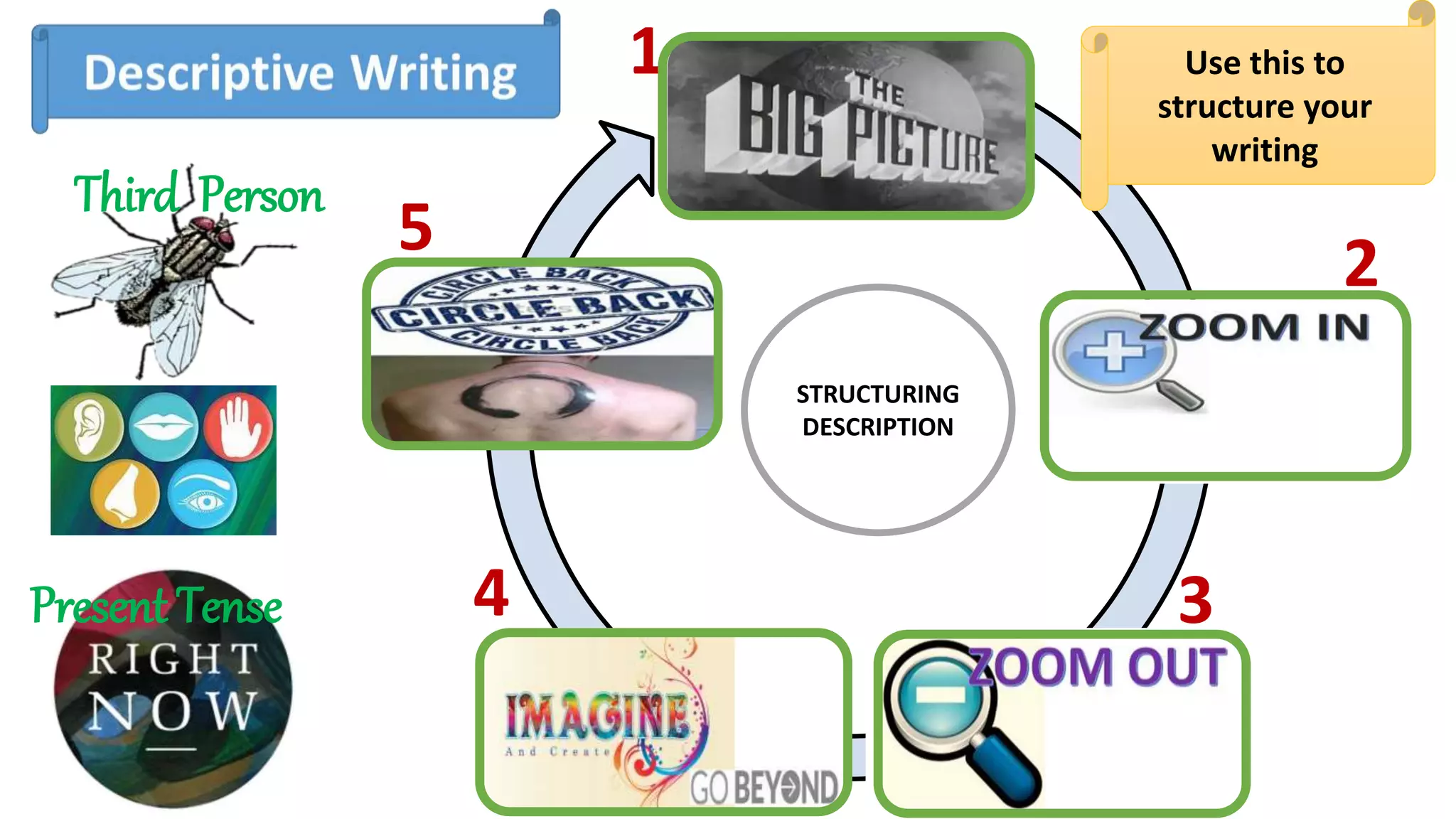
1
4 3
2
5
Third Person
Present Tense
STRUCTURING
DESCRIPTION
Use this to
structure your
writing
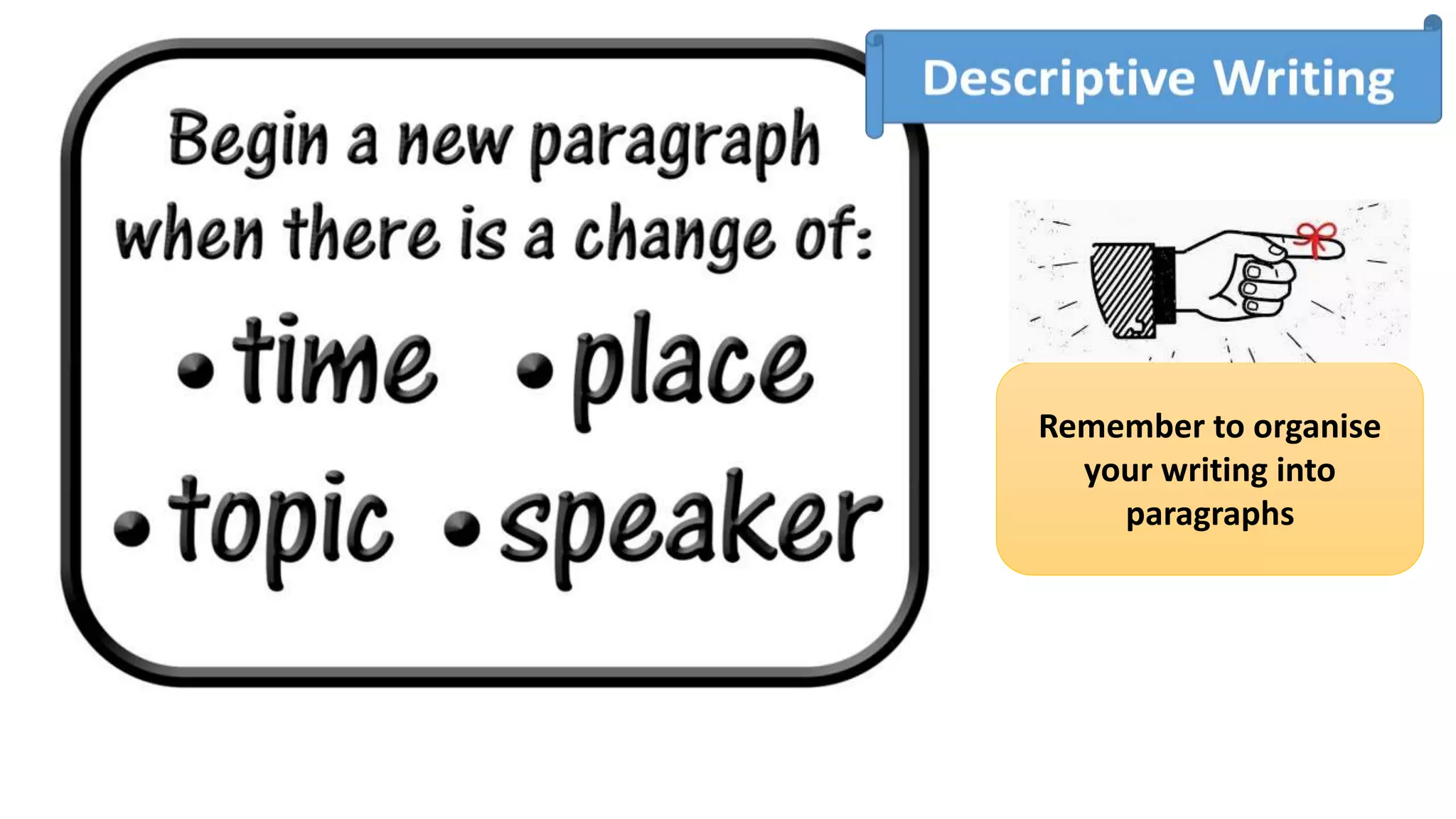
Remember to organise
your writing into
paragraphs
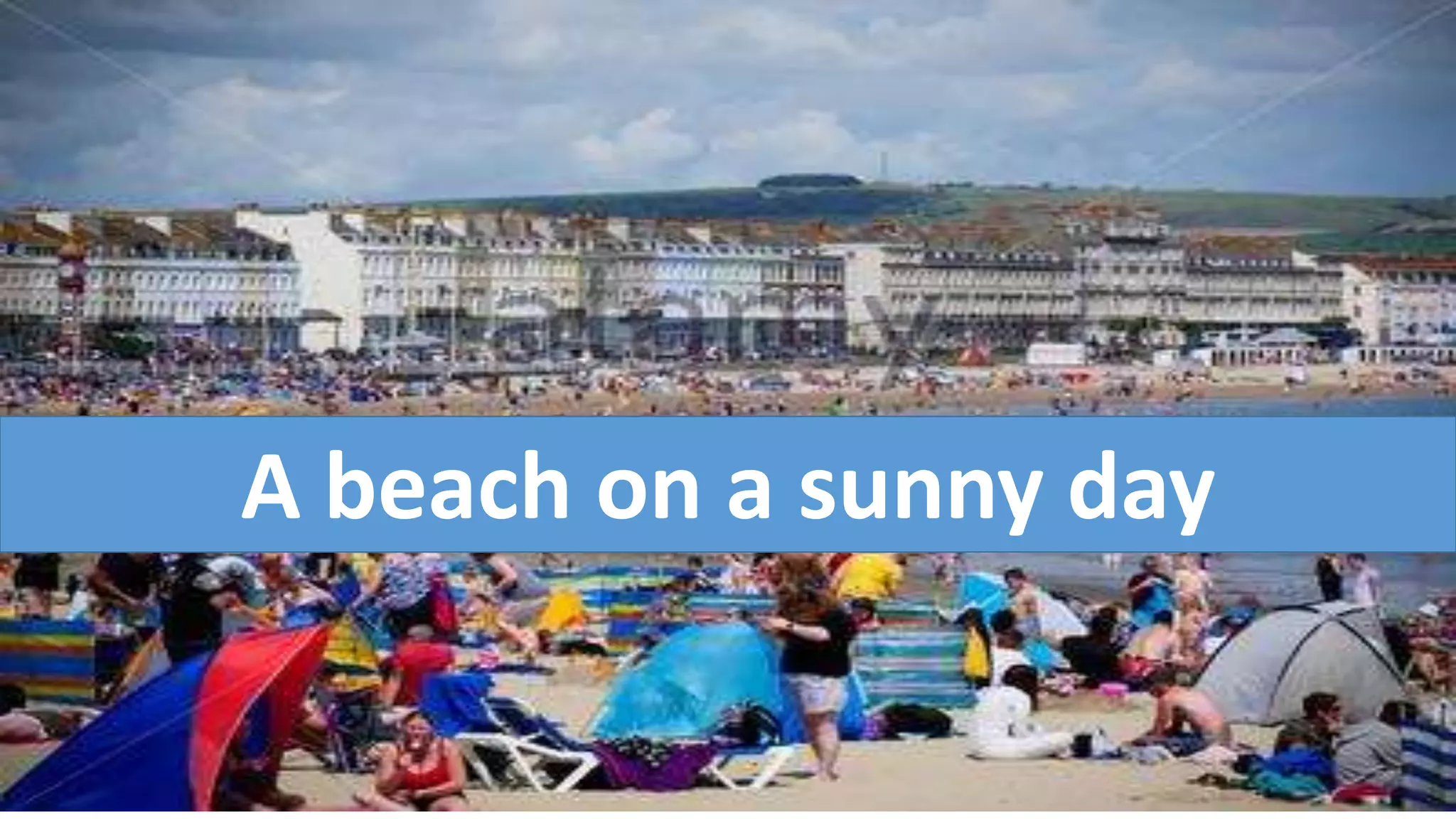
A beach on a sunny day
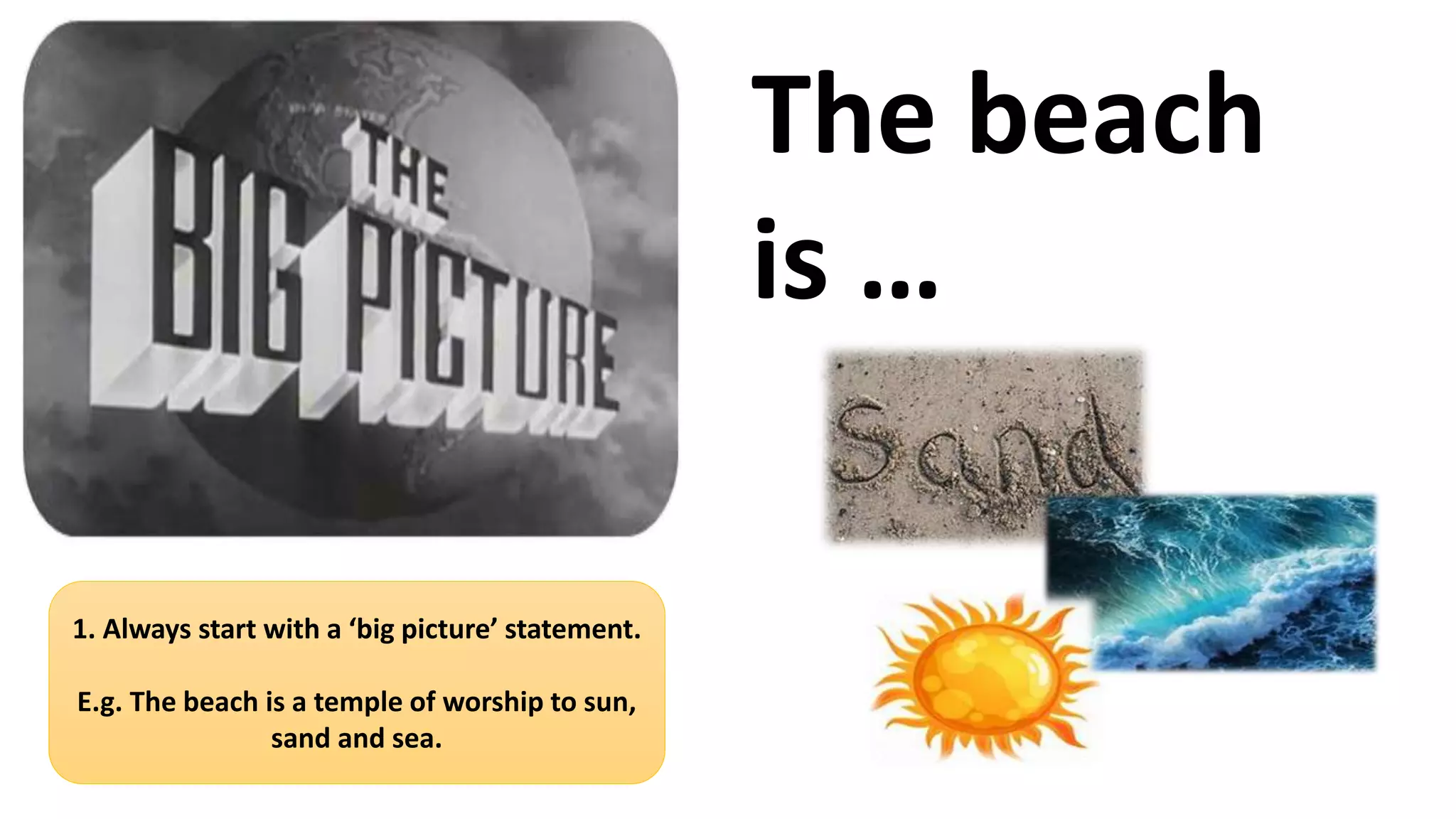
The beach
is …
1. Always start with a ‘big picture’ statement.
E.g. The beach is a temple of worship to sun,
sand and sea.
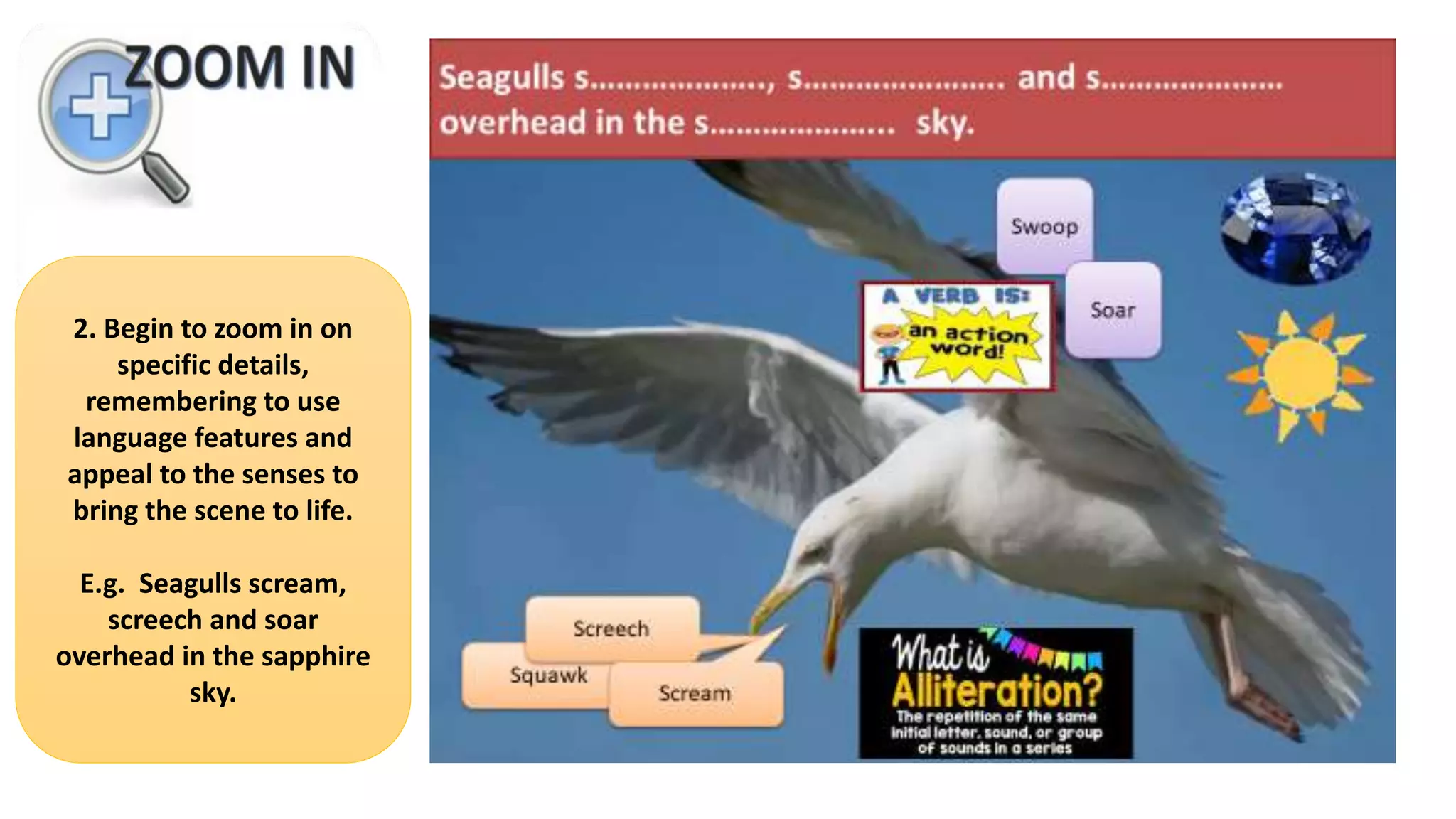
2. Begin to zoom in on
specific details,
remembering to use
language features and
appeal to the senses to
bring the scene to life.
E.g. Seagulls scream,
screech and soar
overhead in the sapphire
sky.
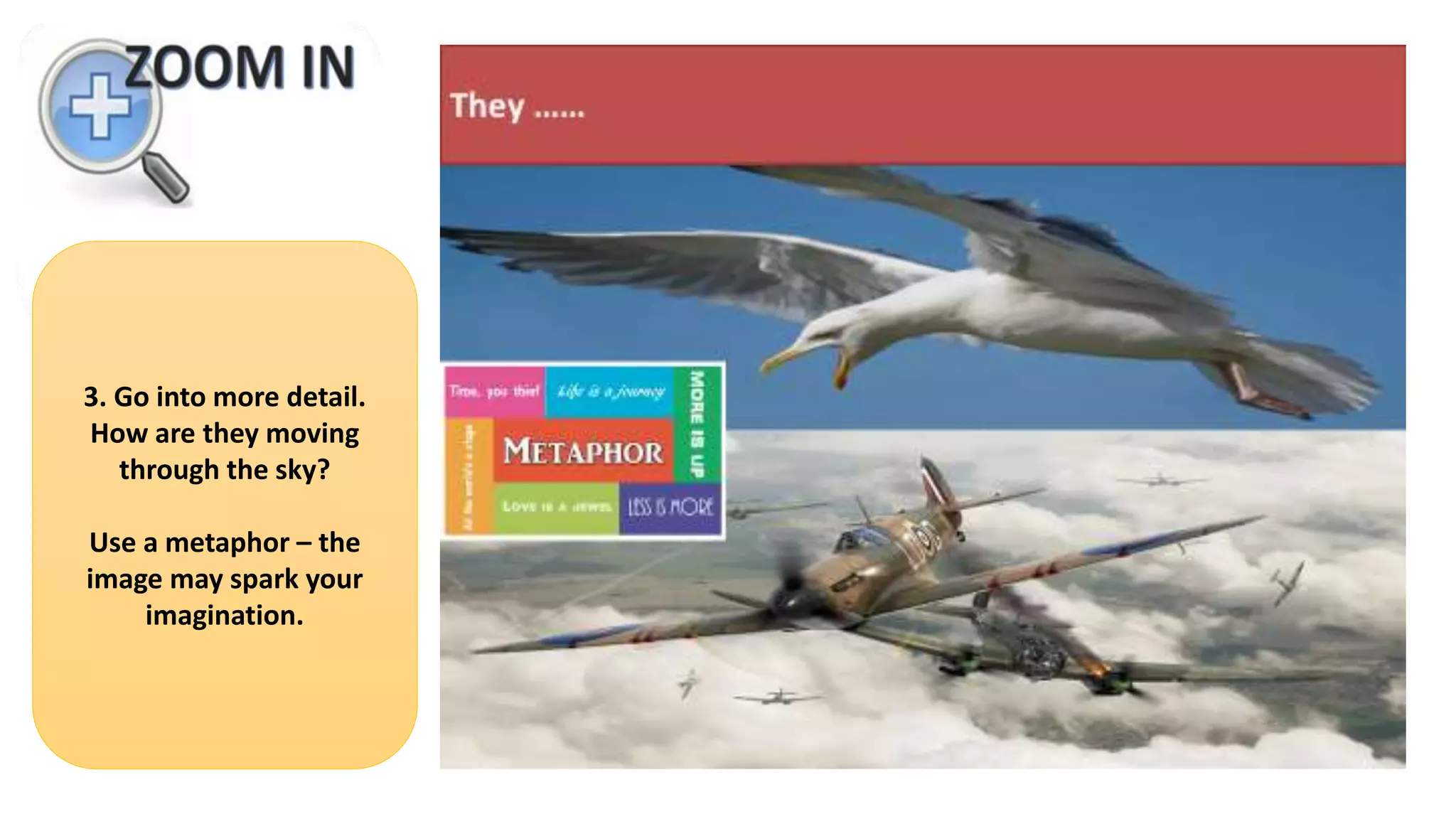
3. Go into more detail.
How are they moving
through the sky?
Use a metaphor – the
image may spark your
imagination.
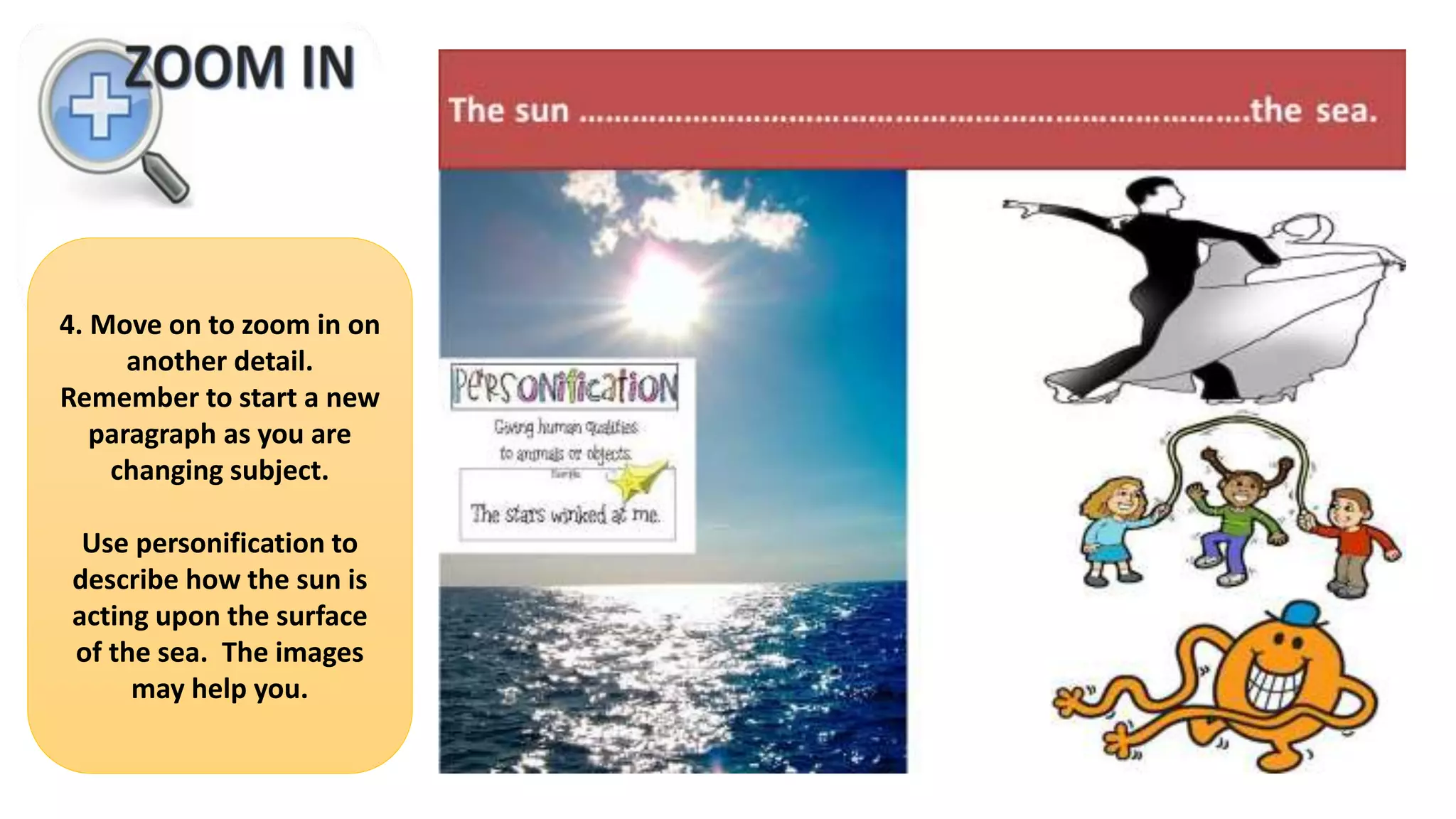
4. Move on to zoom in on
another detail.
Remember to start a new
paragraph as you are
changing subject.
Use personification to
describe how the sun is
acting upon the surface
of the sea. The images
may help you.
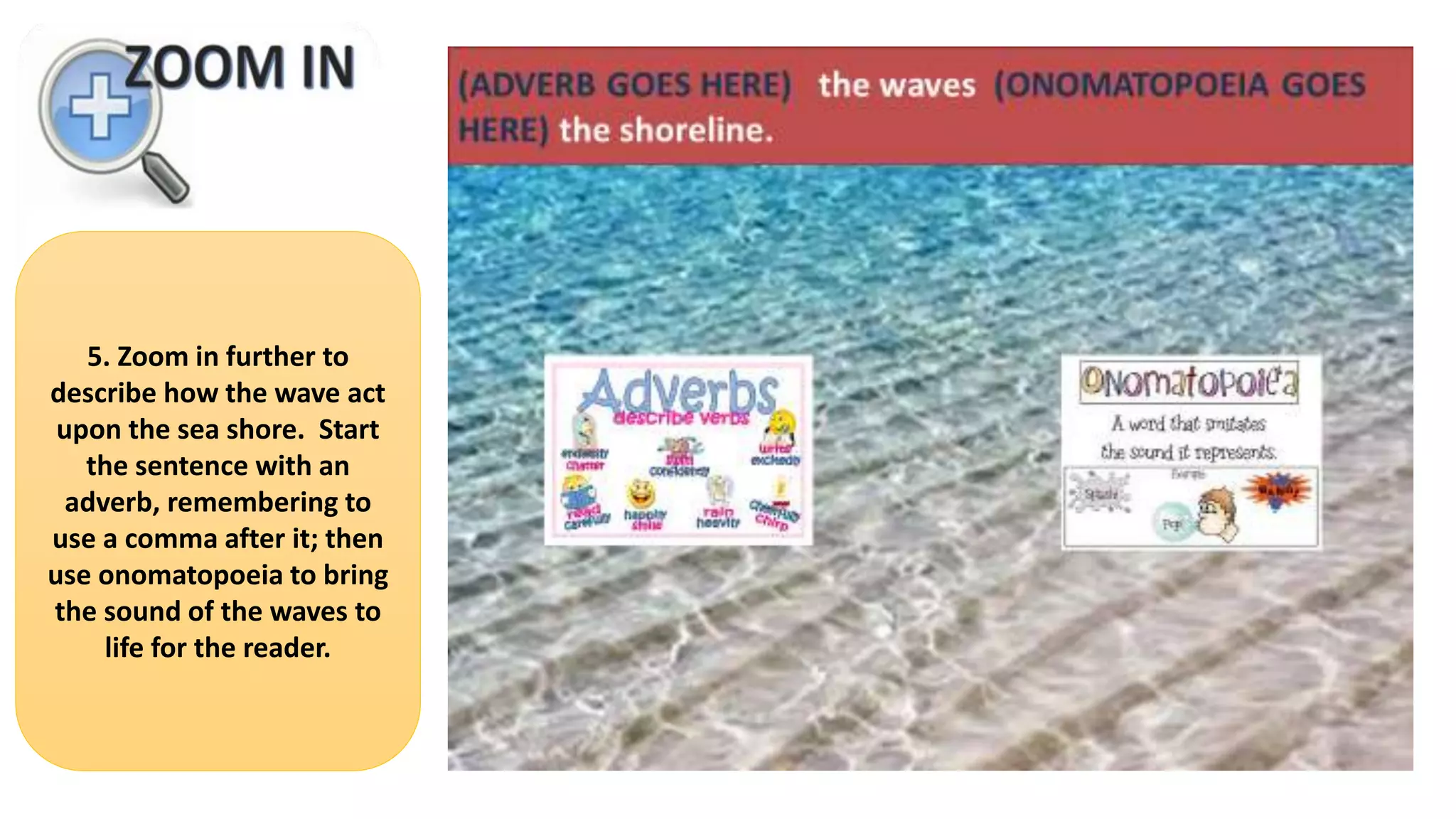
5. Zoom in further to
describe how the wave act
upon the sea shore. Start
the sentence with an
adverb, remembering to
use a comma after it; then
use onomatopoeia to bring
the sound of the waves to
life for the reader.
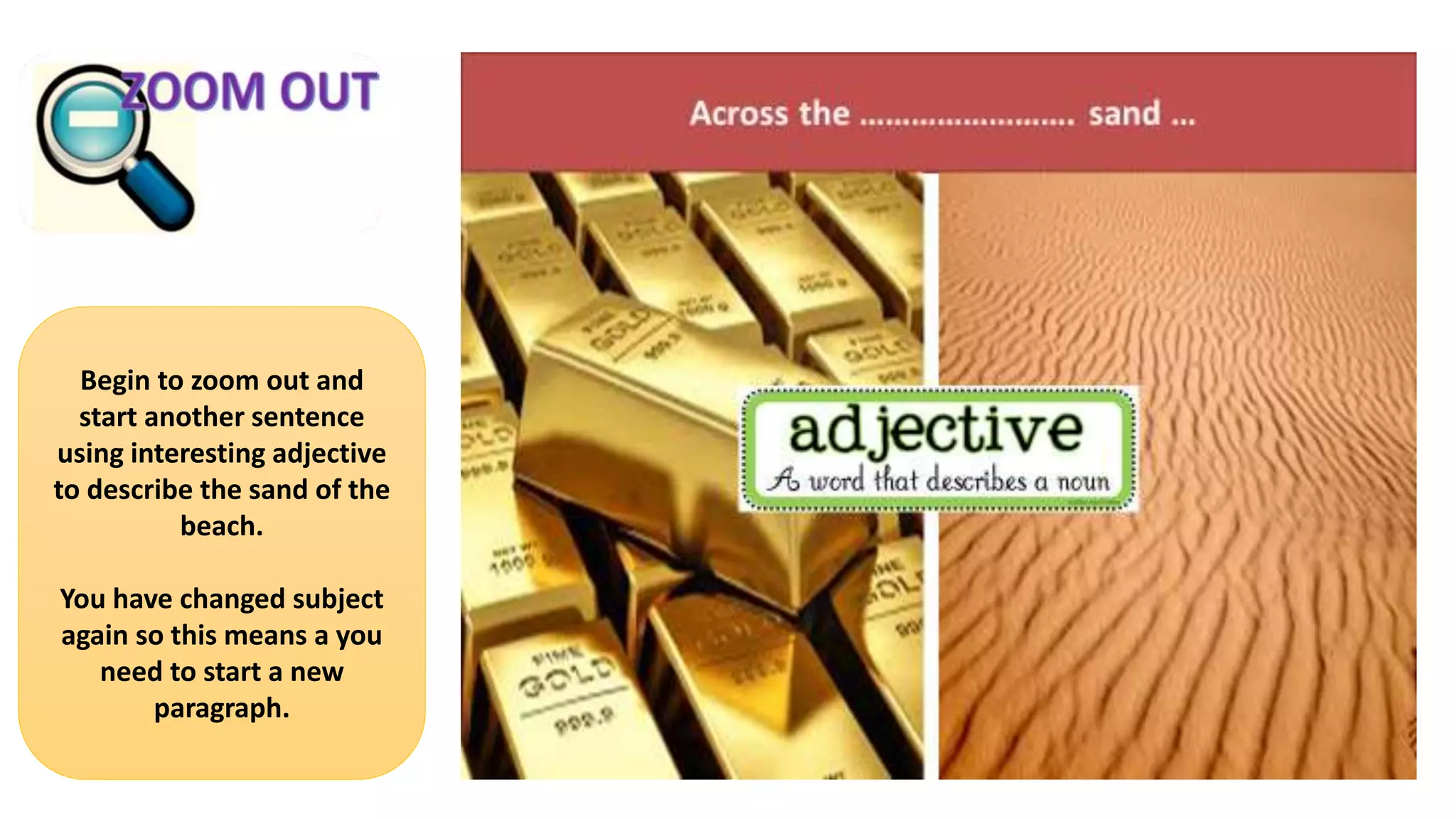
Begin to zoom out and
start another sentence
using interesting adjective
to describe the sand of the
beach.
You have changed subject
again so this means a you
need to start a new
paragraph.
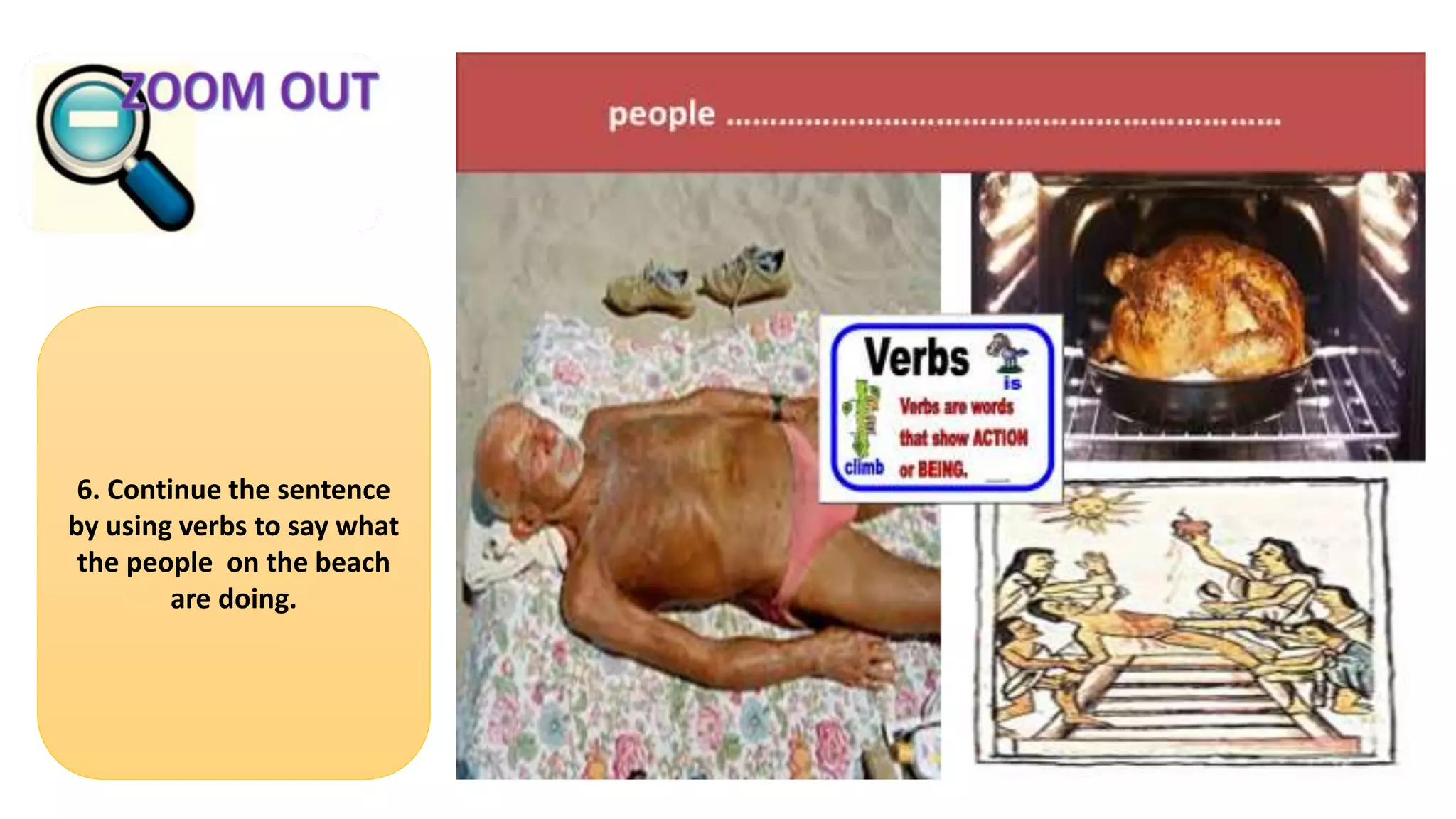
6. Continue the sentence
by using verbs to say what
the people on the beach
are doing.
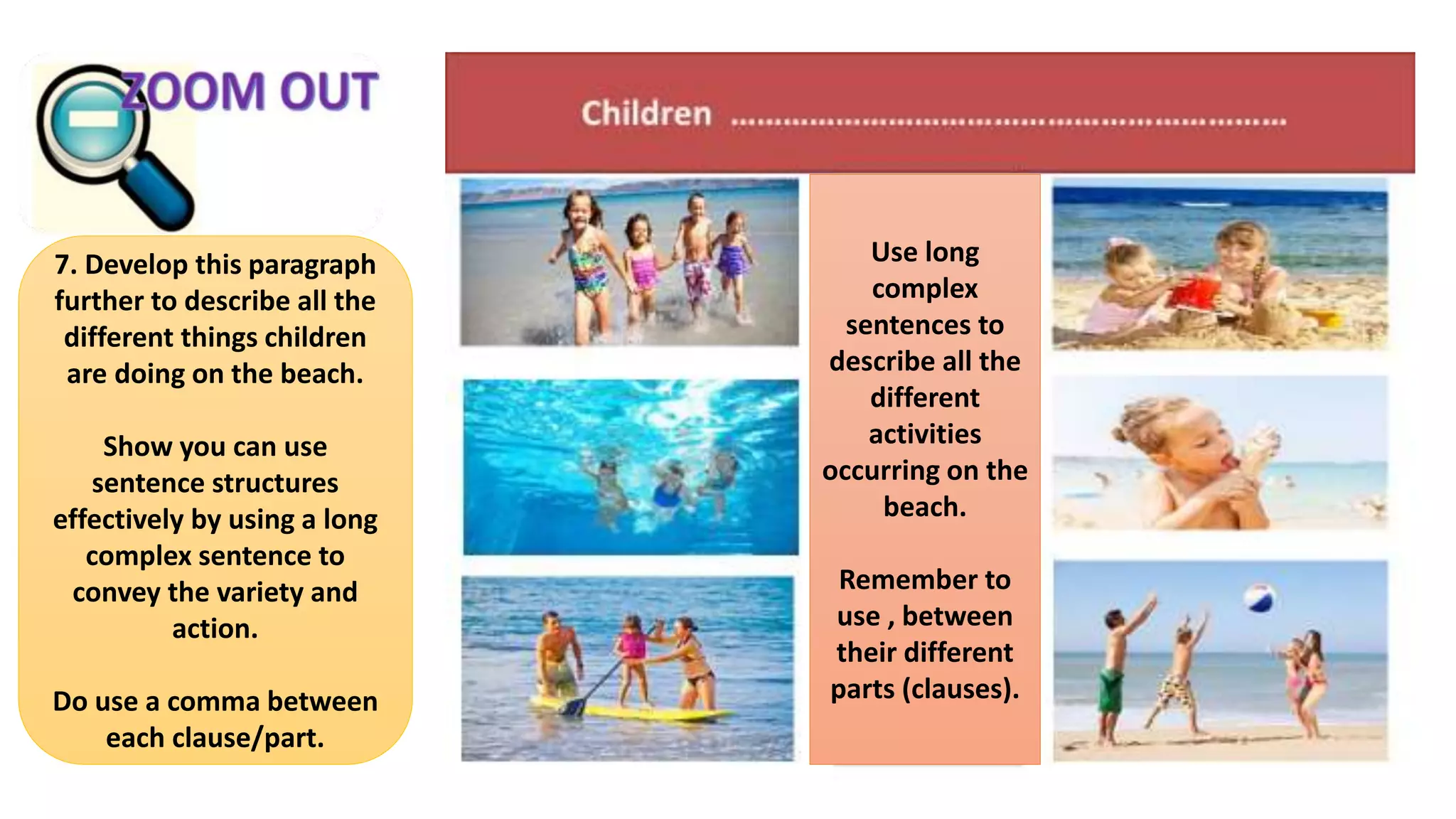
Use long
complex
sentences to
describe all the
different
activities
occurring on the
beach.
Remember to
use , between
their different
parts (clauses).
7. Develop this paragraph
further to describe all the
different things children
are doing on the beach.
Show you can use
sentence structures
effectively by using a long
complex sentence to
convey the variety and
action.
Do use a comma between
each clause/part.
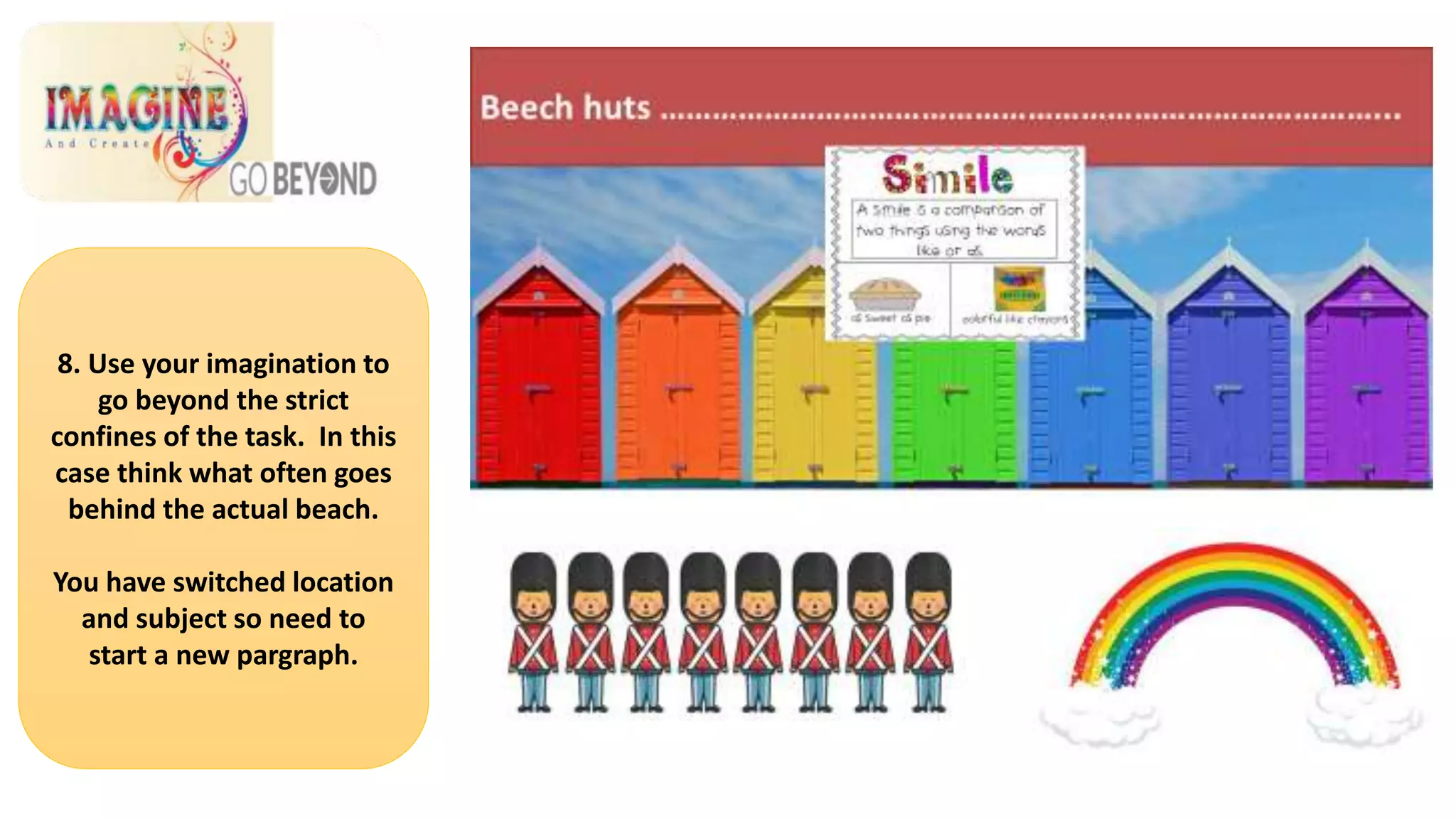
8. Use your imagination to
go beyond the strict
confines of the task. In this
case think what often goes
behind the actual beach.
You have switched location
and subject so need to
start a new pargraph.
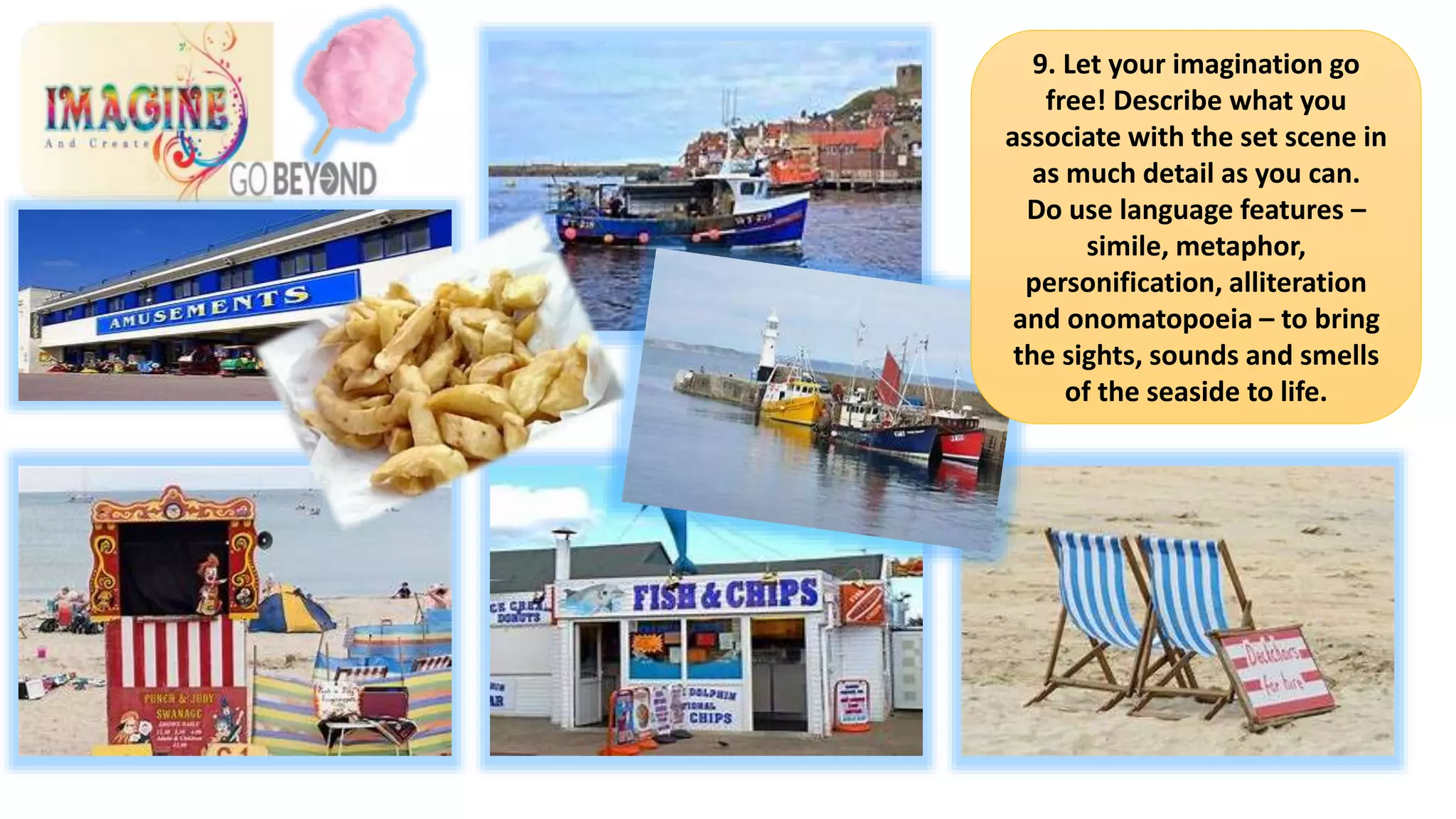
9. Let your imagination go
free! Describe what you
associate with the set scene in
as much detail as you can.
Do use language features –
simile, metaphor,
personification, alliteration
and onomatopoeia – to bring
the sights, sounds and smells
of the seaside to life.
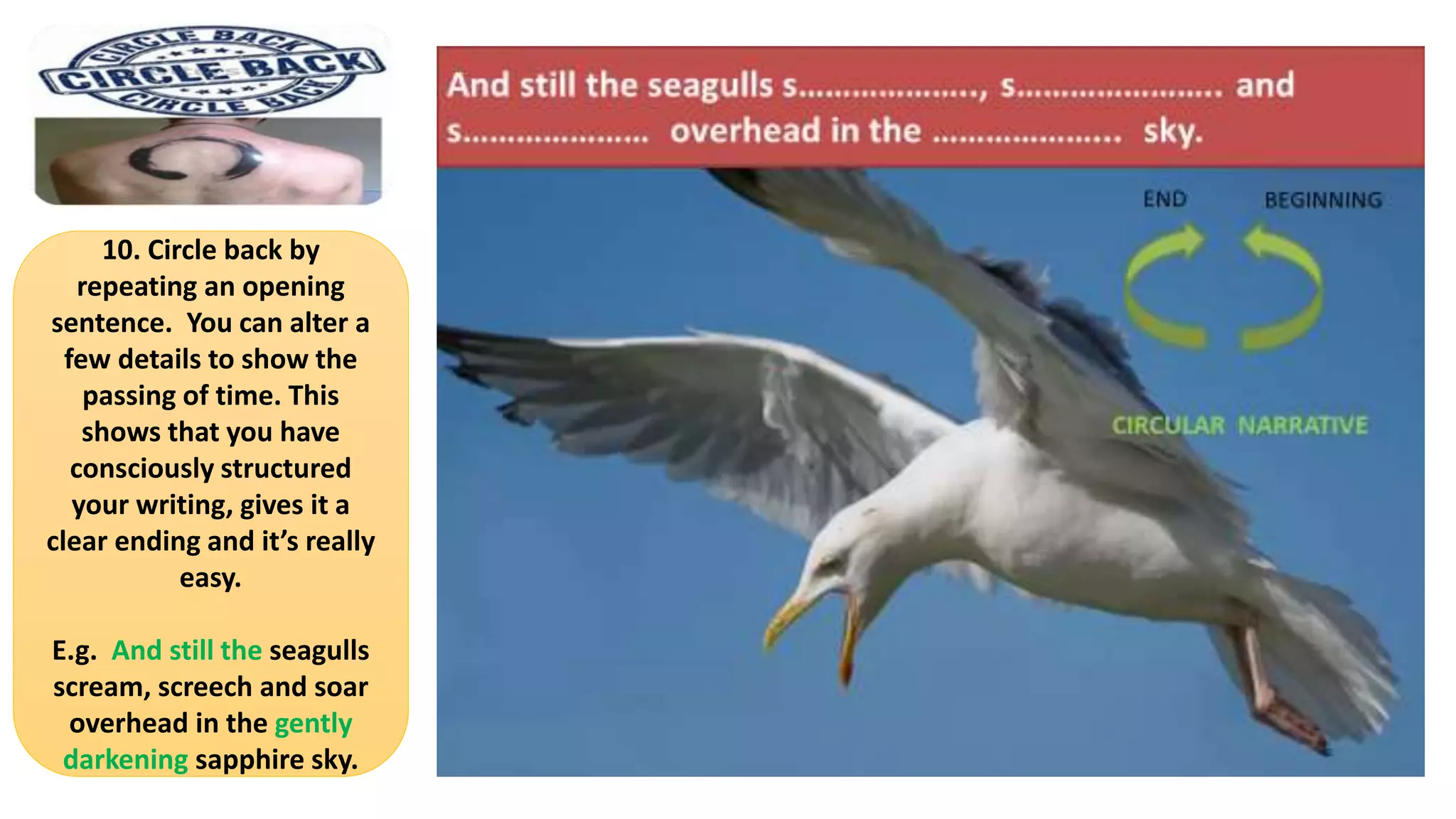
10. Circle back by
repeating an opening
sentence. You can alter a
few details to show the
passing of time. This
shows that you have
consciously structured
your writing, gives it a
clear ending and it’s really
easy.
E.g. And still the seagulls
scream, screech and soar
overhead in the gently
darkening sapphire sky.
A beach on a sunny day
Use the mark scheme on the next slide to self assess
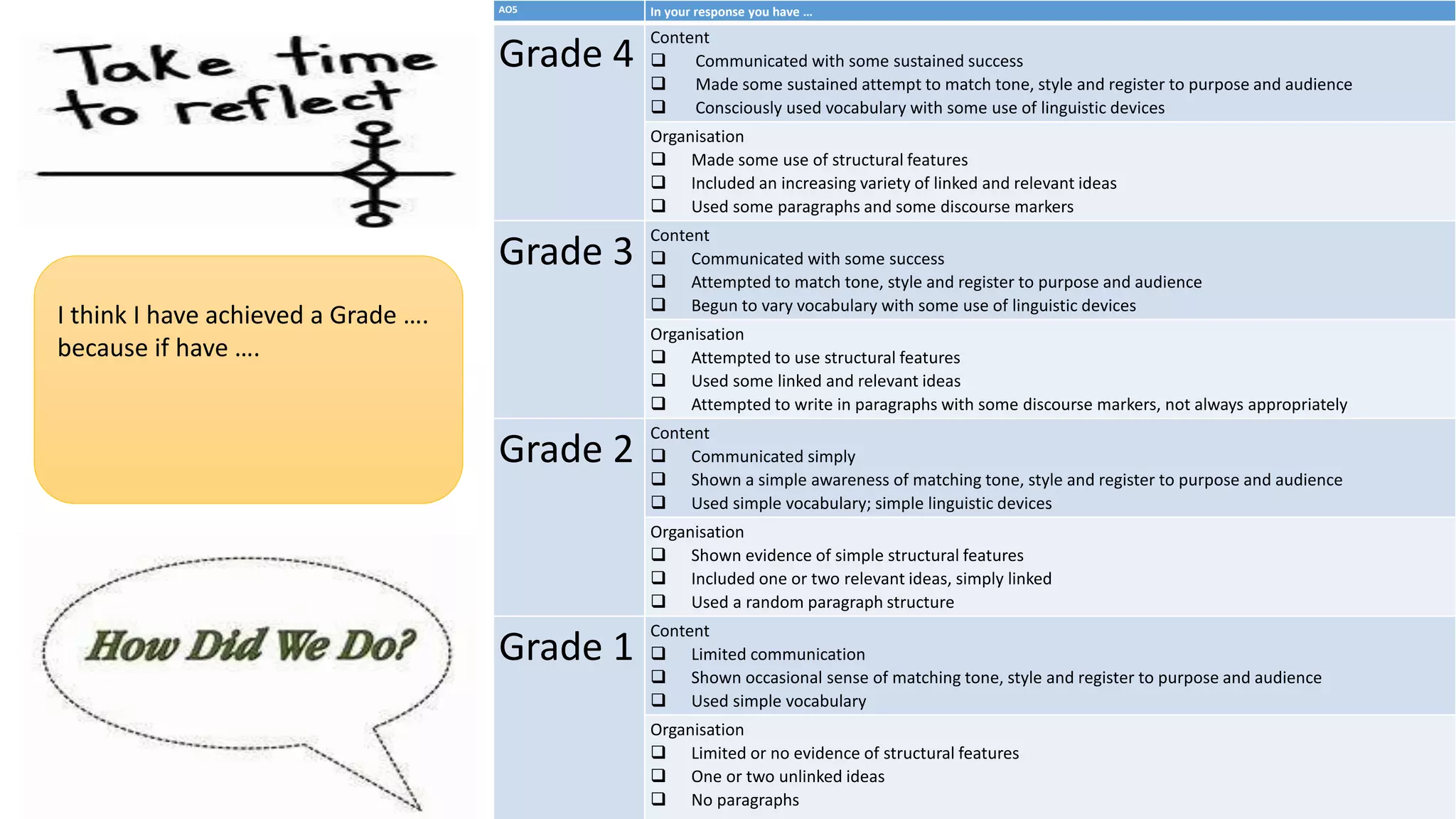
AO5 In your response you have …
Grade 4
Content
 Communicated with some sustained success
 Made some sustained attempt to match tone, style and register to purpose and audience
 Consciously used vocabulary with some use of linguistic devices
Organisation
 Made some use of structural features
 Included an increasing variety of linked and relevant ideas
 Used some paragraphs and some discourse markers
Grade 3
Content
 Communicated with some success
 Attempted to match tone, style and register to purpose and audience
 Begun to vary vocabulary with some use of linguistic devices
Organisation
 Attempted to use structural features
 Used some linked and relevant ideas
 Attempted to write in paragraphs with some discourse markers, not always appropriately
Grade 2
Content
 Communicated simply
 Shown a simple awareness of matching tone, style and register to purpose and audience
 Used simple vocabulary; simple linguistic devices
Organisation
 Shown evidence of simple structural features
 Included one or two relevant ideas, simply linked
 Used a random paragraph structure
Grade 1
Content
 Limited communication
 Shown occasional sense of matching tone, style and register to purpose and audience
 Used simple vocabulary
Organisation
 Limited or no evidence of structural features
 One or two unlinked ideas
 No paragraphs
I think I have achieved a Grade ….
because if have ….

Descriptive writing beach step by step ds

  • 1.
    05 Your school orcollege is asking students to contribute some creative writing for its website. Describe a seaside scene on a sunny day (24 marks for content and organisation and 16 marks for technical accuracy) [40 marks] PAPER 1 QUESTION 5 Write a description Question 5 of Paper 1 tests your creative writing skills. You will be given a choice of writing a story or a description. You will need to demonstrate that you can use structure and language effectively. This resources guides you through a descriptive piece step by step. Timing 1hour Self-assessment: Save to your folder
  • 2.
    1 4 3 2 5 Third Person PresentTense STRUCTURING DESCRIPTION Use this to structure your writing
  • 3.
    Remember to organise yourwriting into paragraphs
  • 4.
    A beach ona sunny day
  • 5.
    The beach is … 1.Always start with a ‘big picture’ statement. E.g. The beach is a temple of worship to sun, sand and sea.
  • 6.
    2. Begin tozoom in on specific details, remembering to use language features and appeal to the senses to bring the scene to life. E.g. Seagulls scream, screech and soar overhead in the sapphire sky.
  • 7.
    3. Go intomore detail. How are they moving through the sky? Use a metaphor – the image may spark your imagination.
  • 8.
    4. Move onto zoom in on another detail. Remember to start a new paragraph as you are changing subject. Use personification to describe how the sun is acting upon the surface of the sea. The images may help you.
  • 9.
    5. Zoom infurther to describe how the wave act upon the sea shore. Start the sentence with an adverb, remembering to use a comma after it; then use onomatopoeia to bring the sound of the waves to life for the reader.
  • 10.
    Begin to zoomout and start another sentence using interesting adjective to describe the sand of the beach. You have changed subject again so this means a you need to start a new paragraph.
  • 11.
    6. Continue thesentence by using verbs to say what the people on the beach are doing.
  • 12.
    Use long complex sentences to describeall the different activities occurring on the beach. Remember to use , between their different parts (clauses). 7. Develop this paragraph further to describe all the different things children are doing on the beach. Show you can use sentence structures effectively by using a long complex sentence to convey the variety and action. Do use a comma between each clause/part.
  • 13.
    8. Use yourimagination to go beyond the strict confines of the task. In this case think what often goes behind the actual beach. You have switched location and subject so need to start a new pargraph.
  • 14.
    9. Let yourimagination go free! Describe what you associate with the set scene in as much detail as you can. Do use language features – simile, metaphor, personification, alliteration and onomatopoeia – to bring the sights, sounds and smells of the seaside to life.
  • 15.
    10. Circle backby repeating an opening sentence. You can alter a few details to show the passing of time. This shows that you have consciously structured your writing, gives it a clear ending and it’s really easy. E.g. And still the seagulls scream, screech and soar overhead in the gently darkening sapphire sky.
  • 16.
    A beach ona sunny day Use the mark scheme on the next slide to self assess
  • 17.
    AO5 In yourresponse you have … Grade 4 Content  Communicated with some sustained success  Made some sustained attempt to match tone, style and register to purpose and audience  Consciously used vocabulary with some use of linguistic devices Organisation  Made some use of structural features  Included an increasing variety of linked and relevant ideas  Used some paragraphs and some discourse markers Grade 3 Content  Communicated with some success  Attempted to match tone, style and register to purpose and audience  Begun to vary vocabulary with some use of linguistic devices Organisation  Attempted to use structural features  Used some linked and relevant ideas  Attempted to write in paragraphs with some discourse markers, not always appropriately Grade 2 Content  Communicated simply  Shown a simple awareness of matching tone, style and register to purpose and audience  Used simple vocabulary; simple linguistic devices Organisation  Shown evidence of simple structural features  Included one or two relevant ideas, simply linked  Used a random paragraph structure Grade 1 Content  Limited communication  Shown occasional sense of matching tone, style and register to purpose and audience  Used simple vocabulary Organisation  Limited or no evidence of structural features  One or two unlinked ideas  No paragraphs I think I have achieved a Grade …. because if have ….