SVOQ S ubject  –  V erb  –  O bject  -  Q ualifier Sentence Builder Click on the links to use this presentation Created by Randy Robert June 2006 Copyright - Credenda Virtual High School
Subject – V – O - Q Subjects are usually: nouns ,  pronouns  or  noun phrases .   Subjects answers the questions: Who? or What? They tell who or what the sentence is about. Who?-  Men ….  or -  She ….  or -  An old man… What?-  Trucks ….  or -  It ….   or -  The blue truck…
S – Verb – O - Q S  V Sharona  runs. A  verb  or  verb phrase  is the action part of the sentence.  It answers the questions:  Does or did what? It describes the action of the subject.  In other words the subject  does or did what ? As described: The subject does or did what? The truck  rolled. In some cases the verb does not show action and is a linking verb. The subject (is or was) (followed by a completer)
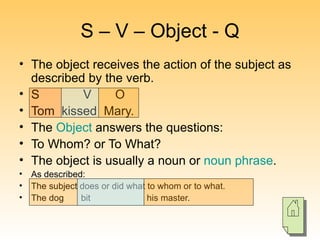
S – V – Object - Q The object receives the action of the subject as described by the verb. S V O Tom  kissed  Mary. The  Object  answers the questions:  To Whom? or To What? The object is usually a noun or  noun phrase . As described: The subject does or did what to whom or to what. The dog  bit  his master.
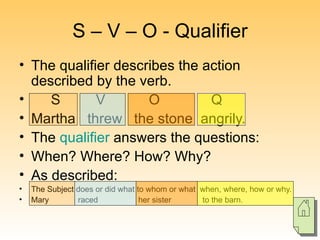
S – V – O - Qualifier The qualifier describes the action described by the verb. S  V  O  Q Martha  threw  the stone  angrily. The  qualifier  answers the questions: When? Where? How? Why? As described: The Subject does or did what to whom or what  when, where, how or why. Mary  raced  her sister  to the barn.
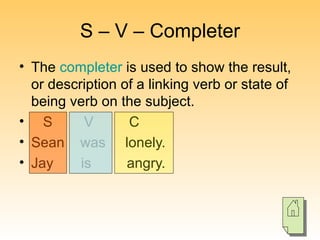
S – V – Completer The  completer  is used to show the result, or description of a linking verb or state of being verb on the subject. S  V  C Sean  was  lonely. Jay  is  angry.
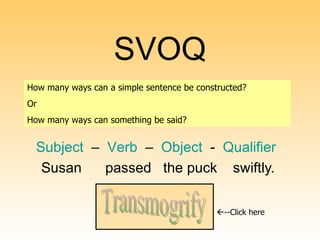
SVOQ S ubject   –  V erb   –  O bject   -  Q ualifier Susan  passed  the puck  swiftly. How many ways can a simple sentence be constructed?  Or  How many ways can something be said? Transmogrify  --Click here
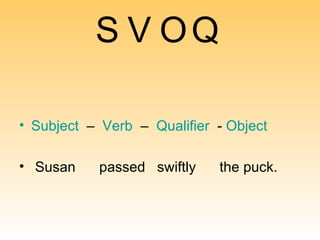
S V O Q S ubject   –  V erb   –  Q ualifier   -  O bject   Susan  passed  swiftly  the puck.
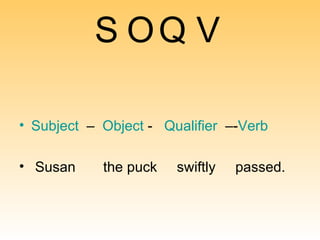
S O Q V S ubject   –  O bject  -  Q ualifier   –- V erb Susan  the puck  swiftly  passed.
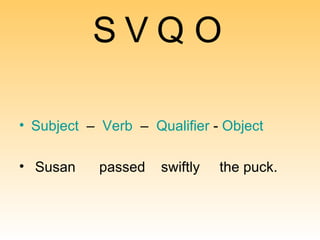
S V Q O S ubject   –  V erb   –  Q ualifier  -  O bject Susan  passed  swiftly  the puck.
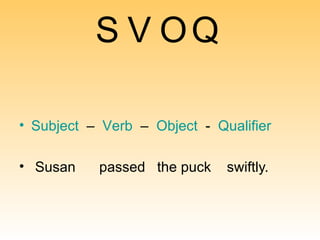
S V O Q S ubject   –  V erb   –  O bject   -  Q ualifier Susan  passed  the puck  swiftly.
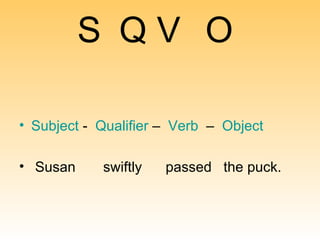
S  Q V O S ubject  -  Q ualifier  –  V erb   –  O bject Susan  swiftly  passed  the puck.
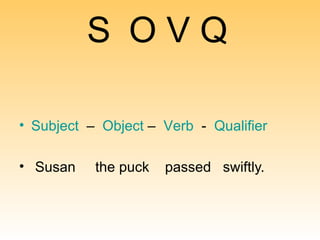
S  O V Q S ubject   –  O bject  –  V erb   -  Q ualifier Susan  the puck  passed  swiftly.
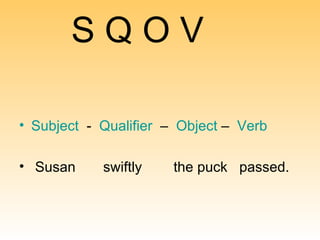
S Q O V S ubject   -  Q ualifier   –  O bject  –  V erb Susan  swiftly  the puck  passed.
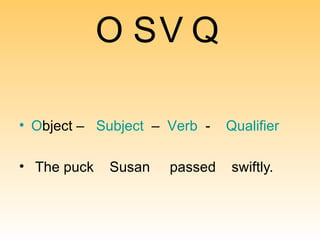
O S V Q O bject   –  S ubject   –  V erb   -  Q ualifier The puck  Susan  passed  swiftly.
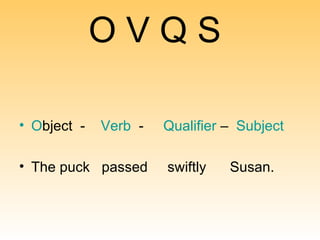
O V Q S O bject   -  V erb   -  Q ualifier  –  S ubject   The puck  passed  swiftly  Susan.
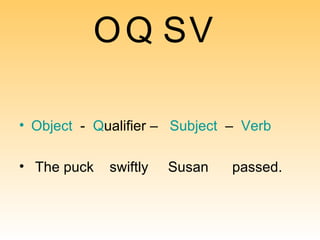
O Q S V O bject   -  Q ualifier   –   S ubject   –  V erb The puck  swiftly  Susan  passed.
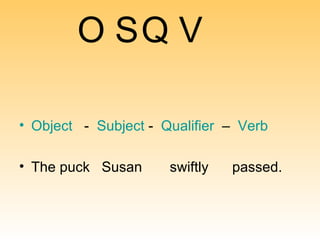
O S Q V O bject   -  S ubject  -  Q ualifier   –  V erb The puck  Susan  swiftly  passed.
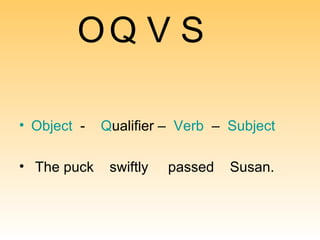
O Q V S  O bject   -  Q ualifier   –  V erb   –  S ubject The puck  swiftly  passed  Susan.
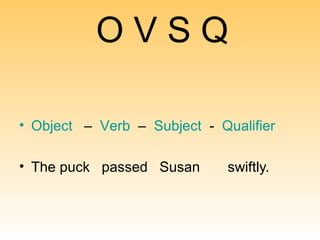
O V S Q O bject   –  V erb   –  S ubject   -  Q ualifier The puck  passed  Susan  swiftly.
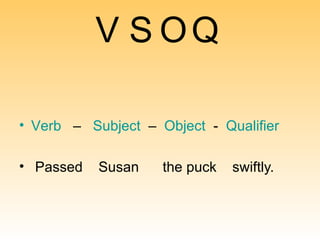
V S O Q V erb   –  S ubject   –  O bject   -  Q ualifier Passed  Susan  the puck  swiftly.
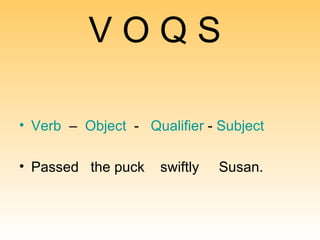
V O Q S V erb   –  O bject   -  Q ualifier  -  S ubject Passed  the puck  swiftly  Susan.
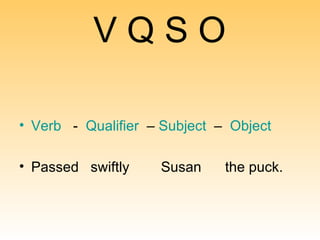
V Q S O  V erb   -  Q ualifier   –  S ubject   –  O bject Passed  swiftly  Susan  the puck.
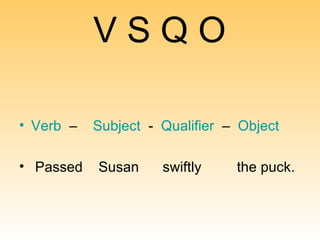
V S Q O V erb   –  S ubject   -  Q ualifier   –  O bject Passed  Susan  swiftly  the puck.
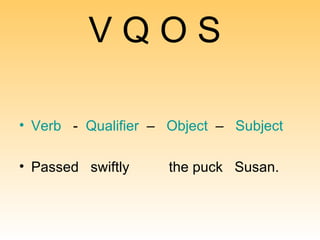
V Q O S V erb   -  Q ualifier   –  O bject   –  S ubject Passed  swiftly  the puck  Susan.
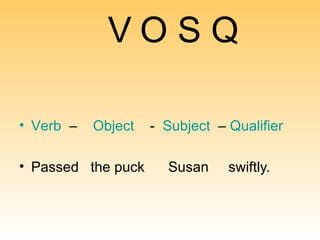
V O S Q V erb   –  O bject   -  S ubject   –  Q ualifier Passed  the puck  Susan  swiftly.
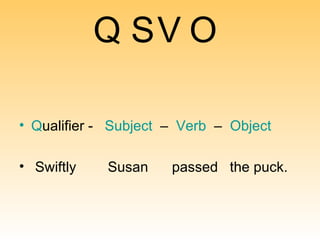
Q S V O Q ualifier   -   S ubject   –  V erb   –  O bject Swiftly  Susan  passed  the puck.
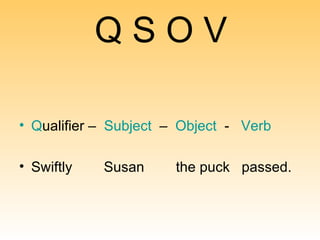
Q S O V Q ualifier   –   S ubject   –  O bject   -  V erb Swiftly  Susan  the puck  passed.
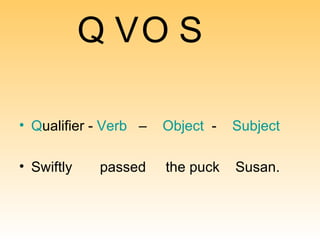
Q V O S  Q ualifier  -   V erb   –  O bject   -  S ubject Swiftly  passed  the puck  Susan.
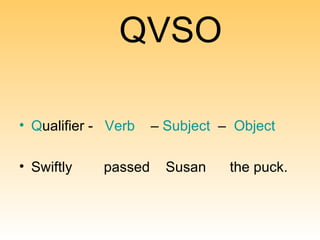
  QVSO Q ualifier   -  V erb   –  S ubject   –  O bject Swiftly  passed  Susan  the puck.
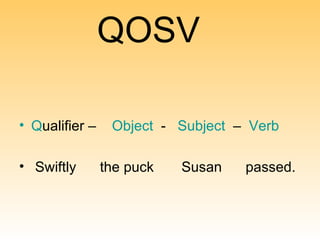
QOSV Q ualifier   –   O bject   -   S ubject   –  V erb Swiftly  the puck  Susan  passed.
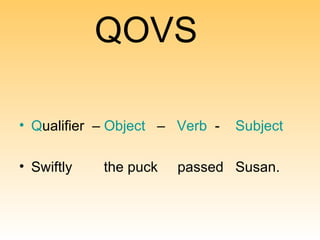
QOVS Q ualifier   –  O bject   –  V erb   -   S ubject Swiftly  the puck  passed  Susan.
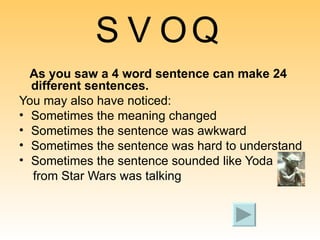
S V O Q As you saw a 4 word sentence can make 24 different sentences.   You may also have noticed: Sometimes the meaning changed Sometimes the sentence was awkward Sometimes the sentence was hard to understand Sometimes the sentence sounded like Yoda  from Star Wars was talking
S V O Q Although some of the sentences were not acceptable, many were. Your ear will tell you if a sentence is correct or not. As a writer, you can make your writing more interesting by varying your sentence structure. If you can make 24 sentences from just 4 words, IMAGINE, what variety of sentences you can create with 8-10 words.
S V O Q Don’t be afraid to experiment. Writing is a process of exploration. Writing – editing – rewriting is a process. Get used to doing it! Write about things you know. Home Improve Your Writing Document Link to Hypergrammar
Noun Phrase Often the noun is accompanied by other words –  articles  like (the, a) Or with  adjectives  like (old, lonely) These are called  noun phrases . Examples are:  ( The old man, A sweet puppy, Lonely people) Lonely people seek friends.
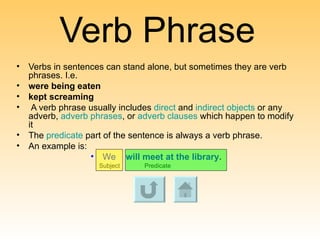
Verb Phrase Verbs in sentences can stand alone, but sometimes they are verb phrases. I.e. were being eaten   kept screaming   A verb phrase usually includes  direct  and  indirect objects  or any adverb,  adverb phrases , or  adverb clauses  which happen to modify it  The  predicate  part of the sentence is always a verb phrase.  An example is: We  will meet at the library .     Subject Predicate
Qualifiers Qualifiers can take many forms: Adverb Phrases  (a prepositional adverb phrase in the example) (She bought some spinach when she went  to the corner store . ) adverb   The premier gave a speech  here .  adverb clause   The premier gave a speech  where the workers were striking .
Completers   (Subject Compliments) There is a third kind of verb called a  linking verb . The word (or  phrase ) which follows a linking verb is called not an object, but a  subject complement .  The most common linking verb is "be." Other linking verbs are "become," "seem," "appear," "feel," "grow," "look," "smell," "taste," and "sound," among others.  Linking verb with subject complement   He  was  a radiologist before he  became  a full-time yoga instructor.  Linking verb with subject complement   Your homemade chili  smells  delicious.

Sentence Building

  • 1.
    SVOQ S ubject – V erb – O bject - Q ualifier Sentence Builder Click on the links to use this presentation Created by Randy Robert June 2006 Copyright - Credenda Virtual High School
  • 2.
    Subject – V– O - Q Subjects are usually: nouns , pronouns or noun phrases . Subjects answers the questions: Who? or What? They tell who or what the sentence is about. Who?- Men …. or - She …. or - An old man… What?- Trucks …. or - It …. or - The blue truck…
  • 3.
    S – Verb– O - Q S V Sharona runs. A verb or verb phrase is the action part of the sentence. It answers the questions: Does or did what? It describes the action of the subject. In other words the subject does or did what ? As described: The subject does or did what? The truck rolled. In some cases the verb does not show action and is a linking verb. The subject (is or was) (followed by a completer)
  • 4.
    S – V– Object - Q The object receives the action of the subject as described by the verb. S V O Tom kissed Mary. The Object answers the questions: To Whom? or To What? The object is usually a noun or noun phrase . As described: The subject does or did what to whom or to what. The dog bit his master.
  • 5.
    S – V– O - Qualifier The qualifier describes the action described by the verb. S V O Q Martha threw the stone angrily. The qualifier answers the questions: When? Where? How? Why? As described: The Subject does or did what to whom or what when, where, how or why. Mary raced her sister to the barn.
  • 6.
    S – V– Completer The completer is used to show the result, or description of a linking verb or state of being verb on the subject. S V C Sean was lonely. Jay is angry.
  • 7.
    SVOQ S ubject – V erb – O bject - Q ualifier Susan passed the puck swiftly. How many ways can a simple sentence be constructed? Or How many ways can something be said? Transmogrify  --Click here
  • 8.
    S V OQ S ubject – V erb – Q ualifier - O bject Susan passed swiftly the puck.
  • 9.
    S O QV S ubject – O bject - Q ualifier –- V erb Susan the puck swiftly passed.
  • 10.
    S V QO S ubject – V erb – Q ualifier - O bject Susan passed swiftly the puck.
  • 11.
    S V OQ S ubject – V erb – O bject - Q ualifier Susan passed the puck swiftly.
  • 12.
    S QV O S ubject - Q ualifier – V erb – O bject Susan swiftly passed the puck.
  • 13.
    S OV Q S ubject – O bject – V erb - Q ualifier Susan the puck passed swiftly.
  • 14.
    S Q OV S ubject - Q ualifier – O bject – V erb Susan swiftly the puck passed.
  • 15.
    O S VQ O bject – S ubject – V erb - Q ualifier The puck Susan passed swiftly.
  • 16.
    O V QS O bject - V erb - Q ualifier – S ubject The puck passed swiftly Susan.
  • 17.
    O Q SV O bject - Q ualifier – S ubject – V erb The puck swiftly Susan passed.
  • 18.
    O S QV O bject - S ubject - Q ualifier – V erb The puck Susan swiftly passed.
  • 19.
    O Q VS O bject - Q ualifier – V erb – S ubject The puck swiftly passed Susan.
  • 20.
    O V SQ O bject – V erb – S ubject - Q ualifier The puck passed Susan swiftly.
  • 21.
    V S OQ V erb – S ubject – O bject - Q ualifier Passed Susan the puck swiftly.
  • 22.
    V O QS V erb – O bject - Q ualifier - S ubject Passed the puck swiftly Susan.
  • 23.
    V Q SO V erb - Q ualifier – S ubject – O bject Passed swiftly Susan the puck.
  • 24.
    V S QO V erb – S ubject - Q ualifier – O bject Passed Susan swiftly the puck.
  • 25.
    V Q OS V erb - Q ualifier – O bject – S ubject Passed swiftly the puck Susan.
  • 26.
    V O SQ V erb – O bject - S ubject – Q ualifier Passed the puck Susan swiftly.
  • 27.
    Q S VO Q ualifier - S ubject – V erb – O bject Swiftly Susan passed the puck.
  • 28.
    Q S OV Q ualifier – S ubject – O bject - V erb Swiftly Susan the puck passed.
  • 29.
    Q V OS Q ualifier - V erb – O bject - S ubject Swiftly passed the puck Susan.
  • 30.
    QVSOQ ualifier - V erb – S ubject – O bject Swiftly passed Susan the puck.
  • 31.
    QOSV Q ualifier – O bject - S ubject – V erb Swiftly the puck Susan passed.
  • 32.
    QOVS Q ualifier – O bject – V erb - S ubject Swiftly the puck passed Susan.
  • 33.
    S V OQ As you saw a 4 word sentence can make 24 different sentences. You may also have noticed: Sometimes the meaning changed Sometimes the sentence was awkward Sometimes the sentence was hard to understand Sometimes the sentence sounded like Yoda from Star Wars was talking
  • 34.
    S V OQ Although some of the sentences were not acceptable, many were. Your ear will tell you if a sentence is correct or not. As a writer, you can make your writing more interesting by varying your sentence structure. If you can make 24 sentences from just 4 words, IMAGINE, what variety of sentences you can create with 8-10 words.
  • 35.
    S V OQ Don’t be afraid to experiment. Writing is a process of exploration. Writing – editing – rewriting is a process. Get used to doing it! Write about things you know. Home Improve Your Writing Document Link to Hypergrammar
  • 36.
    Noun Phrase Oftenthe noun is accompanied by other words – articles like (the, a) Or with adjectives like (old, lonely) These are called noun phrases . Examples are: ( The old man, A sweet puppy, Lonely people) Lonely people seek friends.
  • 37.
    Verb Phrase Verbsin sentences can stand alone, but sometimes they are verb phrases. I.e. were being eaten kept screaming A verb phrase usually includes direct and indirect objects or any adverb, adverb phrases , or adverb clauses which happen to modify it The predicate part of the sentence is always a verb phrase. An example is: We will meet at the library . Subject Predicate
  • 38.
    Qualifiers Qualifiers cantake many forms: Adverb Phrases (a prepositional adverb phrase in the example) (She bought some spinach when she went to the corner store . ) adverb The premier gave a speech here . adverb clause The premier gave a speech where the workers were striking .
  • 39.
    Completers (Subject Compliments) There is a third kind of verb called a linking verb . The word (or phrase ) which follows a linking verb is called not an object, but a subject complement . The most common linking verb is "be." Other linking verbs are "become," "seem," "appear," "feel," "grow," "look," "smell," "taste," and "sound," among others. Linking verb with subject complement He was a radiologist before he became a full-time yoga instructor. Linking verb with subject complement Your homemade chili smells delicious.