OVERVIEW OFOVERVIEW OF
OUR SENSORSOUR SENSORS
FORFOR
ROBOTICSROBOTICS
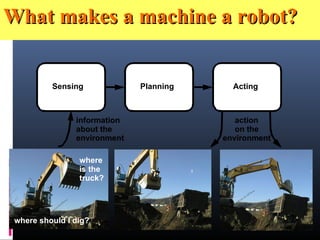
What makes a machine a robot?What makes a machine a robot?
where should I dig?
where
is the
truck?
Sensing Planning Acting
information
about the
environment
action
on the
environment
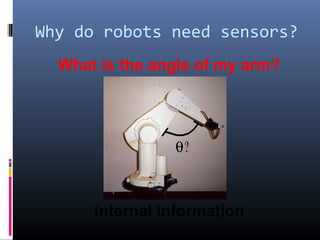
Why do robots need sensors?
θ?
internal information
What is the angle of my arm?
What is Sensing ?
 Collect information about the world
 Sensor - an electrical/mechanical/chemical device that
maps an environmental attribute to a quantitative
measurement
 attribute mixtures - often no one to one map
 hidden state in environment
 Each sensor is based on a transduction principle -
conversion of energy from one form to another
 Also known as transducers
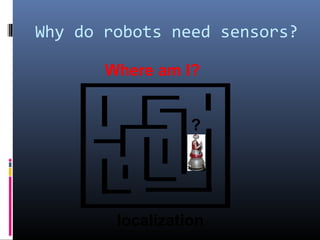
Why do robots need sensors?
Where am I?
localization
?
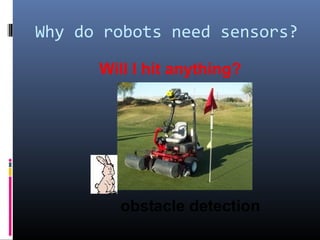
Why do robots need sensors?
Will I hit anything?
obstacle detection
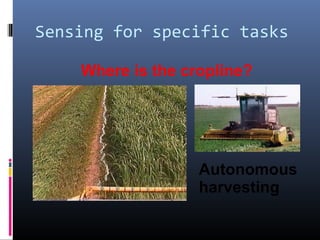
Sensing for specific tasks
Where is the cropline?
Autonomous
harvesting
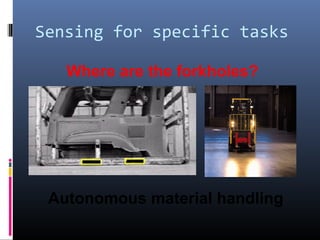
Sensing for specific tasks
Autonomous material handling
Where are the forkholes?
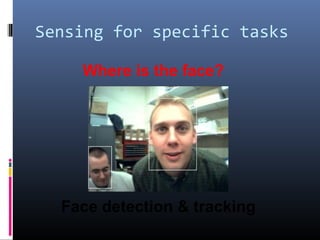
Sensing for specific tasks
Where is the face?
Face detection & tracking
Types of SensorsTypes of Sensors
 Active
 send signal into environment and measure
interaction of signal w/ environment
 e.g. radar, sonar
 Passive
 record signals already present in environment
 e.g. video cameras
Types of Sensors
 Classification by medium used
 based on electromagnetic radiation of various
wavelengths
 vibrations in a medium
 concentration of chemicals in environment
 by physical contact
Types of Sensors
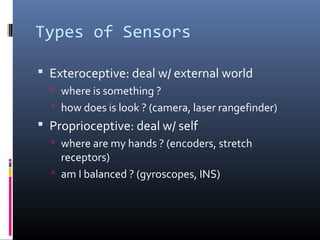
 Exteroceptive: deal w/ external world
 where is something ?
 how does is look ? (camera, laser rangefinder)
 Proprioceptive: deal w/ self
 where are my hands ? (encoders, stretch
receptors)
 am I balanced ? (gyroscopes, INS)
Types of Sensors
 Interoceptive
 what is my thirst level ? (biochemical)
 what is my battery charge ? (voltmeter)
 For the most part we’ll ignore these in this
class
Simple Practical SensorsSimple Practical Sensors
that we can purchasethat we can purchase
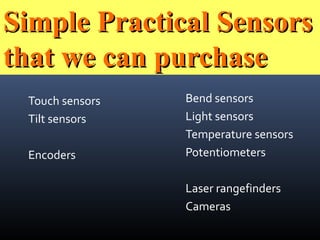
Touch sensors
Tilt sensors
Encoders
Bend sensors
Light sensors
Temperature sensors
Potentiometers
Laser rangefinders
Cameras
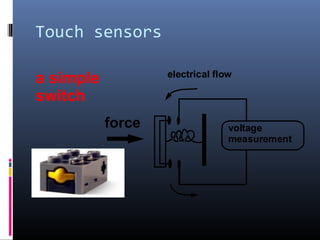
Touch sensors
force voltage
measurement
electrical flow
a simple
switch
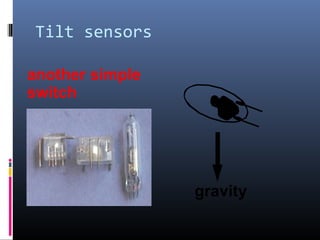
Tilt sensors
another simple
switch
gravity
EncodersEncoders
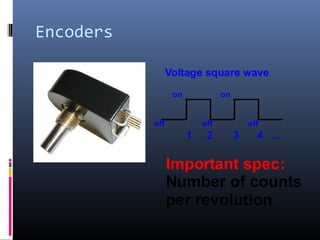
Encoders measure rotational motion.
They can be used to measure the rotation of a
wheel.
Servo motors: Used in conjunction with an
electric motor to measure the motor’s
position and, in turn, control its position.
Encoders
Important spec:
Number of counts
per revolution
Voltage square wave
on on
offoffoff
1 2 3 4 ...
Sample problems
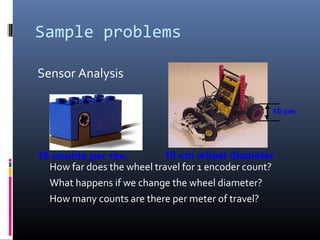
Sensor Analysis
How far does the wheel travel for 1 encoder count?
What happens if we change the wheel diameter?
How many counts are there per meter of travel?
16 counts per rev. 10 cm wheel diameter
10 cm
Sample problems
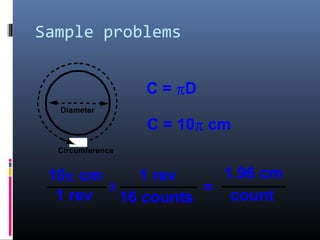
Diameter
Circumference
C = πD
C = 10π cm
10π cm
1 rev
=
1 rev
16 counts
x
1.96 cm
count
Sample problems
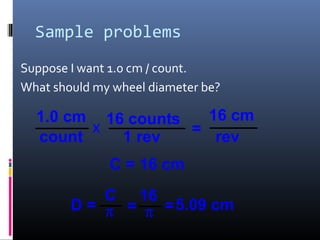
Suppose I want 1.0 cm / count.
What should my wheel diameter be?
1.0 cm
count =1 rev
16 counts
x
16 cm
rev
C = 16 cm
D =
C
π =
16
π =5.09 cm
Sample problems
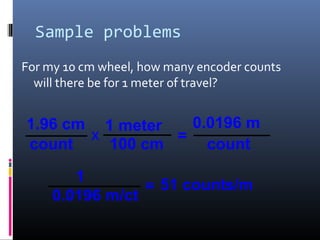
For my 10 cm wheel, how many encoder counts
will there be for 1 meter of travel?
1.96 cm
count
=
100 cm
1 meter
x
0.0196 m
count
=
0.0196 m/ct
1
51 counts/m
Physics 101
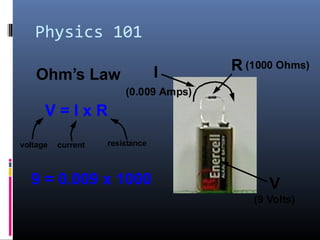
Ohm’s Law
V = I x R
V
RI
voltage resistancecurrent
9 = 0.009 x 1000
(9 Volts)
(1000 Ohms)
(0.009 Amps)
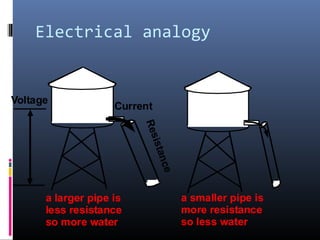
Electrical analogy
Voltage
Current
Resistance
a larger pipe is
less resistance
so more water
a smaller pipe is
more resistance
so less water
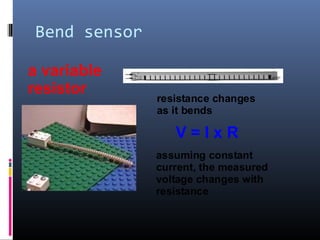
Bend sensor
a variable
resistor
resistance changes
as it bends
V = I x R
assuming constant
current, the measured
voltage changes with
resistance
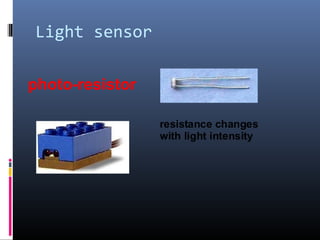
Light sensor
photo-resistor
resistance changes
with light intensity
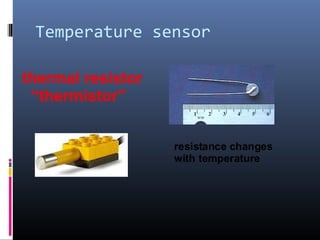
Temperature sensor
thermal resistor
“thermistor”
resistance changes
with temperature
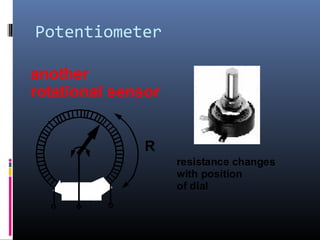
Potentiometer
another
rotational sensor
resistance changes
with position
of dial
R
Sample problem
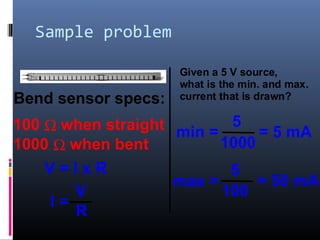
Bend sensor specs:
100 Ω when straight
1000 Ω when bent
Given a 5 V source,
what is the min. and max.
current that is drawn?
V = I x R
I =
V
R
min =
5
1000
= 5 mA
max =
5
100
= 50 mA
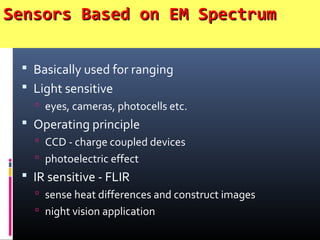
Sensors Based on EM SpectrumSensors Based on EM Spectrum
 Basically used for ranging
 Light sensitive
 eyes, cameras, photocells etc.
 Operating principle
 CCD - charge coupled devices
 photoelectric effect
 IR sensitive - FLIR
 sense heat differences and construct images
 night vision application
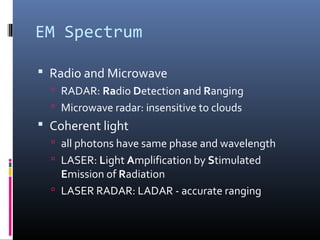
EM Spectrum
 Radio and Microwave
 RADAR: Radio Detection and Ranging
 Microwave radar: insensitive to clouds
 Coherent light
 all photons have same phase and wavelength
 LASER: Light Amplification by Stimulated
Emission of Radiation
 LASER RADAR: LADAR - accurate ranging
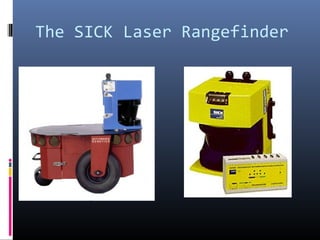
The SICK Laser Rangefinder
EM Spectrum
 Nuclear Magnetic Resonance (NMR)
 heavy duty magnetic field lines up lines up atoms
in a body
 now expose body to radio signals
 different nuclei resonate at different frequencies
which can be measured leading to an image
Local Proximity Sensing in
EM
 Infrared LEDs
 cheap, active sensing
 usually low resolution - normally used for
presence/absence of obstacles rather than ranging
 operate over small range
Sensors Based on SoundSensors Based on Sound
 SONAR: Sound Navigation and Ranging
 bounce sound off of something
 measure time for reflection to be heard - gives a range
measurement
 measure change in frequency - gives the relative speed of
the object (Doppler effect)
 bats and dolphins use it with amazing results
 robots use it w/ less than amazing results
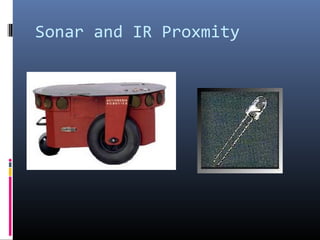
Sonar and IR Proxmity
Odor SensorsOdor Sensors
 Detection of chemical compounds and their
density in an area
 spectroscopy - mostly lab restricted
 fibre-optic techniques - recently developed
 chemical detection - sniffers aand electronic noses
via “wet chemistry on a chip”
 No major penetration in robotics yet
applications are vast (e.g. mine detection)
Touch SensorsTouch Sensors
 Whiskers, bumpers etc.
 mechanical contact leads to
 closing/opening of a switch
 change in resistance of some element
 change in capacitance of some element
 change in spring tension
 ...
Proprioceptive SensorsProprioceptive Sensors
 Encoders, Potentiometers
 measure angle of turn via change in resistance or by
counting optical pulses
 Gyroscopes
 measure rate of change of angles
 fiber-optic (newer, better), magnetic (older)
 Compass
 measure which way is north
 GPS: measure location relative to globe
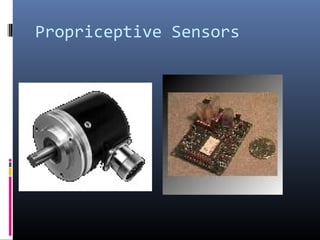
Propriceptive Sensors
Problem: SensorProblem: Sensor
ChoiceChoice
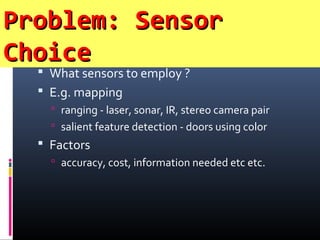
 What sensors to employ ?
 E.g. mapping
 ranging - laser, sonar, IR, stereo camera pair
 salient feature detection - doors using color
 Factors
 accuracy, cost, information needed etc etc.
Problem: SensorProblem: Sensor
PlacementPlacement
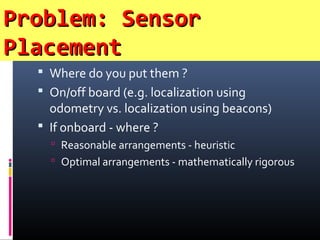
 Where do you put them ?
 On/off board (e.g. localization using
odometry vs. localization using beacons)
 If onboard - where ?
 Reasonable arrangements - heuristic
 Optimal arrangements - mathematically rigorous
References
 Photo’s ,Text and Schematics Information
 www.acroname.com
 www.lynxmotion.com
 www.drrobot.com
 Alan Stewart
• Dr. Gaurav Sukhatme
• Thomas Braunl
• Students 2002, class 479
Questions to students
1. How would you apply Tilt Sensors in a walking robot?
2. List and explain all applications of Encoders
3. Light sensors in a mobile robot. Describe fusion, mapping and how
to control motors.
4. Temperature sensors in robotics.
5. List sensors based on electromagnetic spectrum.
6. Laser rangers
7. Odor sensors in mobile robots. Show one good application. In each
of the above problems think about sensor placement, how many
of them, fusion, mapping and how used to control.
8. Sonars
9. Gyroscopes and compases in a mobile robot.
10. Describe your idea of using a GPS sensor in a mobile robot. Discuss
accuracy, how connected. What application of the robot?

Sensing

  • 1.
    OVERVIEW OFOVERVIEW OF OURSENSORSOUR SENSORS FORFOR ROBOTICSROBOTICS
  • 2.
    What makes amachine a robot?What makes a machine a robot? where should I dig? where is the truck? Sensing Planning Acting information about the environment action on the environment
  • 3.
    Why do robotsneed sensors? θ? internal information What is the angle of my arm?
  • 4.
    What is Sensing?  Collect information about the world  Sensor - an electrical/mechanical/chemical device that maps an environmental attribute to a quantitative measurement  attribute mixtures - often no one to one map  hidden state in environment  Each sensor is based on a transduction principle - conversion of energy from one form to another  Also known as transducers
  • 5.
    Why do robotsneed sensors? Where am I? localization ?
  • 6.
    Why do robotsneed sensors? Will I hit anything? obstacle detection
  • 7.
    Sensing for specifictasks Where is the cropline? Autonomous harvesting
  • 8.
    Sensing for specifictasks Autonomous material handling Where are the forkholes?
  • 9.
    Sensing for specifictasks Where is the face? Face detection & tracking
  • 10.
    Types of SensorsTypesof Sensors  Active  send signal into environment and measure interaction of signal w/ environment  e.g. radar, sonar  Passive  record signals already present in environment  e.g. video cameras
  • 11.
    Types of Sensors Classification by medium used  based on electromagnetic radiation of various wavelengths  vibrations in a medium  concentration of chemicals in environment  by physical contact
  • 12.
    Types of Sensors Exteroceptive: deal w/ external world  where is something ?  how does is look ? (camera, laser rangefinder)  Proprioceptive: deal w/ self  where are my hands ? (encoders, stretch receptors)  am I balanced ? (gyroscopes, INS)
  • 13.
    Types of Sensors Interoceptive  what is my thirst level ? (biochemical)  what is my battery charge ? (voltmeter)  For the most part we’ll ignore these in this class
  • 14.
    Simple Practical SensorsSimplePractical Sensors that we can purchasethat we can purchase Touch sensors Tilt sensors Encoders Bend sensors Light sensors Temperature sensors Potentiometers Laser rangefinders Cameras
  • 15.
  • 16.
  • 17.
    EncodersEncoders Encoders measure rotationalmotion. They can be used to measure the rotation of a wheel. Servo motors: Used in conjunction with an electric motor to measure the motor’s position and, in turn, control its position.
  • 18.
    Encoders Important spec: Number ofcounts per revolution Voltage square wave on on offoffoff 1 2 3 4 ...
  • 19.
    Sample problems Sensor Analysis Howfar does the wheel travel for 1 encoder count? What happens if we change the wheel diameter? How many counts are there per meter of travel? 16 counts per rev. 10 cm wheel diameter 10 cm
  • 20.
    Sample problems Diameter Circumference C =πD C = 10π cm 10π cm 1 rev = 1 rev 16 counts x 1.96 cm count
  • 21.
    Sample problems Suppose Iwant 1.0 cm / count. What should my wheel diameter be? 1.0 cm count =1 rev 16 counts x 16 cm rev C = 16 cm D = C π = 16 π =5.09 cm
  • 22.
    Sample problems For my10 cm wheel, how many encoder counts will there be for 1 meter of travel? 1.96 cm count = 100 cm 1 meter x 0.0196 m count = 0.0196 m/ct 1 51 counts/m
  • 23.
    Physics 101 Ohm’s Law V= I x R V RI voltage resistancecurrent 9 = 0.009 x 1000 (9 Volts) (1000 Ohms) (0.009 Amps)
  • 24.
    Electrical analogy Voltage Current Resistance a largerpipe is less resistance so more water a smaller pipe is more resistance so less water
  • 25.
    Bend sensor a variable resistor resistancechanges as it bends V = I x R assuming constant current, the measured voltage changes with resistance
  • 26.
  • 27.
  • 28.
  • 29.
    Sample problem Bend sensorspecs: 100 Ω when straight 1000 Ω when bent Given a 5 V source, what is the min. and max. current that is drawn? V = I x R I = V R min = 5 1000 = 5 mA max = 5 100 = 50 mA
  • 30.
    Sensors Based onEM SpectrumSensors Based on EM Spectrum  Basically used for ranging  Light sensitive  eyes, cameras, photocells etc.  Operating principle  CCD - charge coupled devices  photoelectric effect  IR sensitive - FLIR  sense heat differences and construct images  night vision application
  • 31.
    EM Spectrum  Radioand Microwave  RADAR: Radio Detection and Ranging  Microwave radar: insensitive to clouds  Coherent light  all photons have same phase and wavelength  LASER: Light Amplification by Stimulated Emission of Radiation  LASER RADAR: LADAR - accurate ranging
  • 32.
    The SICK LaserRangefinder
  • 33.
    EM Spectrum  NuclearMagnetic Resonance (NMR)  heavy duty magnetic field lines up lines up atoms in a body  now expose body to radio signals  different nuclei resonate at different frequencies which can be measured leading to an image
  • 34.
    Local Proximity Sensingin EM  Infrared LEDs  cheap, active sensing  usually low resolution - normally used for presence/absence of obstacles rather than ranging  operate over small range
  • 35.
    Sensors Based onSoundSensors Based on Sound  SONAR: Sound Navigation and Ranging  bounce sound off of something  measure time for reflection to be heard - gives a range measurement  measure change in frequency - gives the relative speed of the object (Doppler effect)  bats and dolphins use it with amazing results  robots use it w/ less than amazing results
  • 36.
    Sonar and IRProxmity
  • 37.
    Odor SensorsOdor Sensors Detection of chemical compounds and their density in an area  spectroscopy - mostly lab restricted  fibre-optic techniques - recently developed  chemical detection - sniffers aand electronic noses via “wet chemistry on a chip”  No major penetration in robotics yet applications are vast (e.g. mine detection)
  • 38.
    Touch SensorsTouch Sensors Whiskers, bumpers etc.  mechanical contact leads to  closing/opening of a switch  change in resistance of some element  change in capacitance of some element  change in spring tension  ...
  • 39.
    Proprioceptive SensorsProprioceptive Sensors Encoders, Potentiometers  measure angle of turn via change in resistance or by counting optical pulses  Gyroscopes  measure rate of change of angles  fiber-optic (newer, better), magnetic (older)  Compass  measure which way is north  GPS: measure location relative to globe
  • 40.
  • 41.
    Problem: SensorProblem: Sensor ChoiceChoice What sensors to employ ?  E.g. mapping  ranging - laser, sonar, IR, stereo camera pair  salient feature detection - doors using color  Factors  accuracy, cost, information needed etc etc.
  • 42.
    Problem: SensorProblem: Sensor PlacementPlacement Where do you put them ?  On/off board (e.g. localization using odometry vs. localization using beacons)  If onboard - where ?  Reasonable arrangements - heuristic  Optimal arrangements - mathematically rigorous
  • 43.
    References  Photo’s ,Textand Schematics Information  www.acroname.com  www.lynxmotion.com  www.drrobot.com  Alan Stewart • Dr. Gaurav Sukhatme • Thomas Braunl • Students 2002, class 479
  • 44.
    Questions to students 1.How would you apply Tilt Sensors in a walking robot? 2. List and explain all applications of Encoders 3. Light sensors in a mobile robot. Describe fusion, mapping and how to control motors. 4. Temperature sensors in robotics. 5. List sensors based on electromagnetic spectrum. 6. Laser rangers 7. Odor sensors in mobile robots. Show one good application. In each of the above problems think about sensor placement, how many of them, fusion, mapping and how used to control. 8. Sonars 9. Gyroscopes and compases in a mobile robot. 10. Describe your idea of using a GPS sensor in a mobile robot. Discuss accuracy, how connected. What application of the robot?