PERFORMANCE APPRAISAL
INTRODUCTION
 Performance appraisal is the process of obtaining, analyzing
and recording information about the relative worth of an
employee.
 The focus of the performance appraisal is measuring and
improving the actual performance of the employee and also
the future potential of the employee.
 Its aim is to measure what an employee does
INTRODUCTION
 Performance appraisal is the systematic, periodic
and an impartial rating of an employee’s excellence
in the matters pertaining to his present job and his
potential for a better job.
 It is a systematic way of reviewing and assessing the
performance of an employee during a given period of
time and planning for his future.
INTRODUCTION
It is a powerful tool to calibrate, refine
and reward the performance of the
employee, to analyze his achievements
and evaluate his contribution towards the
achievements of the overall organizational
goals.
INTRODUCTION
 By focusing the attention on performance,
performance appraisal goes to the heart of personnel
management and reflects the management’s interest
in the progress of the employees.
INTRODUCTION
An appraisal is a formal meeting between an
immediate supervisor and the employee where a
performance evaluation can be made with the
comments and opinions of both.
The complexity and depth of evaluation depends on
what the manager is trying to achieve from the
appraisal.
INTRODUCTION
 Formal performance appraisals are generally
conducted annually for all staff in the organization.
 Each staff member is appraised by their line
manager.
 Directors are appraised by the CEO, who is
appraised by the chairman or company owners,
depending on the size and structure of the
organization
OBJECTIVES OF PERFORMANCE
APPRAISAL
 To review the performance of the employees over a
given period of time.
 To judge the gap between the actual and the desired
performance.
 To help the management in exercising organizational
control.

OBJECTIVES OF PERFORMANCE
APPRAISAL
 Helps to strengthen the relationship and
communication between superior – subordinates and
management – employees.
 To diagnose the strengths and weaknesses of the
individuals so as to identify the training and
development needs for the future.
APPRAISAL
 To provide feedback to the employees regarding their past
performance.
 Provide information to assist in the other personal
decisions in the organization.
 Provide clarity of the expectations and responsibilities of
the functions to be performed by the employees.
OBJECTIVES OF PERFORMANCE
APPRAISAL
 To judge the effectiveness of the other human
resource functions of the organization such as
recruitment, selection, training and development.
 To reduce the grievances of the employees.
 The evaluation is recorded and a copy is kept by the
supervisor and the employee who will use it as feed-
back to act on anything that has been suggested or
commented on.
 The evaluation that has been recorded will further
be used in the next formal appraisal to determine
the level of improvement by the employee during
that period.

BENEFITS OF PERFORMANCE
APPRAISAL
 Enables management and monitoring of standards, agreeing
expectations and objectives, and delegation of responsibilities
and tasks.
 Establishes individual training needs and enable
organizational training needs analysis and planning.
BENEFITS OF PERFORMANCE
APPRAISAL
 Feeds into organizational annual pay and grading reviews,
which coincides with the business planning for the next
trading year.
 Reviews each individual's performance against objectives and
standards for the trading year, agreed at the previous
appraisal meeting.
BENEFITS OF PERFORMANCE
APPRAISAL
 Essential for career and succession planning - for
individuals, crucial jobs, and for the organization as
a whole.
 Important for staff motivation, attitude and
behaviour development, communicating and aligning
individual and organizational aims, and fostering
positive relationships between management and
staff.
BENEFITS OF PERFORMANCE
APPRAISAL
 Provide a formal, recorded, regular review of an
individual's performance, and a plan for future
development.
 Job performance appraisals, in whatever form they
take, are therefore vital for managing the
performance of people and organizations.
BENEFITS FOR USING AN
APPRAISAL SYSTEM -MANAGER
 Gives you an idea of what you should expect from
your employees
 Develops further yourself as a manager (or superior)
 Employees are given feed-back that can be acted
upon to increase their productivity and ability by
eliminating their weaknesses and identifying
strengths
BENEFITS FOR USING AN
APPRAISAL SYSTEM
 The supervisors develop a better relationship with
the employees by getting to know them better and
what their job consists of more precisely
 Improves communication in the business
PERFORMANCE OBJECTIVE:
 Specific-What specifically is to be achieved? what
results are to be achieved through these actions?
Keeping objectives simple ensures they are clear and
specific.
 Complex objectives should be broken into sub-
objectives. This allows individuals to focus their
efforts and guides them in marshaling the resources
necessary to achieve results.
CRITERIA OF A SUCCESSFUL
PERFORMANCE OBJECTIVE
 Measurable-Every object can be measured. Some
objectives can be measured quantitatively; others
qualitatively. What data will be used to
measure/track what is achieved? Measurements are
subject to change and should be reviewed
periodically.
CRITERIA OF A SUCCESSFUL
PERFORMANCE OBJECTIVE
 Accountable- Accountability for performance
objectives must be clear and specifically stated who
is accountable.
 Defining accountability will ensure a sense of
urgency and purpose on the part of the employee.
CRITERIA OF A SUCCESSFUL
PERFORMANCE OBJECTIVE
 Realistic -For an objective to be meaningful, it must
be realistic and reasonable. A well written
performance objective focuses on the goals and
objectives required to meet the objective.
 Objectives should challenge employees towards
continuous improvement, but should not be
unrealistic or unattainable.
CRITERIA OF A SUCCESSFUL
PERFORMANCE OBJECTIVE
 Time based-An achievable time frame must be set
for reaching the objective's goals. Consider assigning
specific target dates not only for the performance
objective itself, but also each lesser milestone linking
the entire goal. Remember to be specific towards
achieving results and guide action in a results
oriented ways towards the objective.
CRITERIA OF A SUCCESSFUL
PERFORMANCE OBJECTIVE
 Strategically Linked-Every performance objective
must always be linked to the overall organizational
plan .Well thought out performance objectives create
a link between the direction of each individual
employee which also align upstream through
departments and divisions to unify the goals of the
entire organization.
TYPES OF PERFORMANCE
AND APTITUDE ASSESSMENTS
 Formal annual performance appraisals
 Probationary reviews
 Informal one-to-one review discussions
 Counselling meetings
 Observation on the job
 Skill- or job-related tests
TYPES OF PERFORMANCE
AND APTITUDE ASSESSMENTS
 Assignment or task followed by review,
including secondments (temporary job cover or
transfer)
 Assessment centres, including observed group
exercises, tests presentations, etc.
 Survey of opinion of others who have dealings
with the individual
 Psychometric tests and other behavioural
assessments
 Graphology (handwriting analysis)
FREQUENTLY AND
INFORMALLY
 Holding regular informal one-to-one review meetings
greatly reduces the pressure and time required for
the annual formal appraisal meeting.
 The manager is better informed and more up-to-date
with his or her people's activities
 Help can be given more readily
FREQUENTLY AND
INFORMALLY
 Assignments, tasks and objectives can be
agreed completed and reviewed quickly
 Objectives, direction, and purpose is more up-
to-date - modern organizations demand more
flexibility than a single annual review allows
 Training and development actions can be
broken down into smaller more digestible
chunks, increasing success rates and
motivational effect as a result.
FREQUENTLY AND
INFORMALLY
 The 'fear factor', often associated by many, to
formal appraisals, is greatly reduced because
people become more comfortable with the
review process.
 Relationships and mutual understanding
develops more quickly with greater frequency
of meetings between manager and staff
member.
 Staff members can be better prepared for the
formal appraisal, giving better results, and
saving management time.
BENEFITS OF REVIEWING
FREQUENTLY AND INFORMALLY
 Much of the review has already been covered
throughout the year by the time comes for the formal
appraisal.
 Frequent review meetings increase the reliability of
notes and performance data, and reduces the chances
of overlooking things at the formal appraisal.
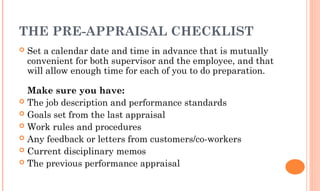
THE PRE-APPRAISAL CHECKLIST
 Set a calendar date and time in advance that is mutually
convenient for both supervisor and the employee, and that
will allow enough time for each of you to do preparation.
Make sure you have:
 The job description and performance standards
 Goals set from the last appraisal
 Work rules and procedures
 Any feedback or letters from customers/co-workers
 Current disciplinary memos
 The previous performance appraisal
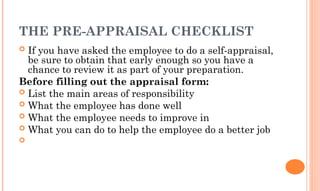
THE PRE-APPRAISAL CHECKLIST
 If you have asked the employee to do a self-appraisal,
be sure to obtain that early enough so you have a
chance to review it as part of your preparation.
Before filling out the appraisal form:
 List the main areas of responsibility
 What the employee has done well
 What the employee needs to improve in
 What you can do to help the employee do a better job

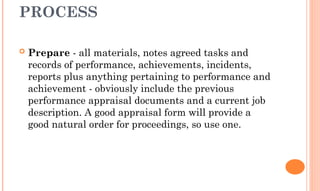
PROCESS
 Prepare - all materials, notes agreed tasks and
records of performance, achievements, incidents,
reports plus anything pertaining to performance and
achievement - obviously include the previous
performance appraisal documents and a current job
description. A good appraisal form will provide a
good natural order for proceedings, so use one.
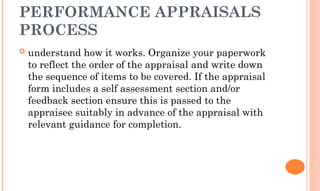
PERFORMANCE APPRAISALS
PROCESS
 understand how it works. Organize your paperwork
to reflect the order of the appraisal and write down
the sequence of items to be covered. If the appraisal
form includes a self assessment section and/or
feedback section ensure this is passed to the
appraisee suitably in advance of the appraisal with
relevant guidance for completion.
PERFORMANCE APPRAISALS
PROCESS
 Ensure the appraisee is informed of a suitable time
and place (change it if necessary), and clarify
purpose and type of appraisal - give the appraisee
the chance to assemble data and relevant
performance and achievement records and materials.
PERFORMANCE APPRAISALS
PROCESS
 Venue - ensure a suitable venue is planned and
available - private and free from interruptions -
observe the same rules as with recruitment
interviewing –
 Privacy is absolutely essential
PERFORMANCE APPRAISALS
PROCESS
 Layout - room layout and and seating are important
elements to prepare.Layout has a huge influence on
atmosphere and mood - the atmosphere and mood
must be relaxed and informal. Remove barriers -
create a relaxed situation, preferably at a meeting
table or in easy chairs - sit at an angle to each other,
90 degrees ideally - avoid face to face, it's
confrontational.
PERFORMANCE APPRAISALS
PROCESS
 Introduction - relax the appraisee - open with a
positive statement, smile, be warm and friendly .Set
the scene - simply explain what will happen -
encourage a discussion and as much input as
possible from the appraisee.
 Confirm the timings, especially finishing time.
PERFORMANCE APPRAISALS
PROCESS
 If helpful and appropriate begin with some general
discussion about how things have been going, but
avoid getting into specifics,
 Ask if there are any additional points to cover and
note them down so as to include them when
appropriate.
PERFORMANCE APPRAISALS
PROCESS
 Review and measure - review the activities, tasks,
objectives and achievements one by one. Resist
judging the appraisee in your own image, according
to your own style and approach - facts and figures
are the acid test and provide a good neutral basis for
the discussion, free of bias and personal views.
PERFORMANCE APPRAISALS
PROCESS
 For each item agree a measure of competence or
achievement as relevant, and according to whatever
measure or scoring system is built into the appraisal
system.
 If a point of dispute arises, you must get the facts
straightened out before making an important
decision or judgement, and if necessary defer to a
later date.
PERFORMANCE APPRAISALS
PROCESS
 Agree an action plan - An overall plan should be
agreed with the appraisee, which should take
account of the job responsibilities, the appraisee's
career aspirations, the departmental and whole
organization's priorities, and the reviewed strengths
and weaknesses.
PERFORMANCE APPRAISALS
PROCESS
 Agree specific objectives - These are the specific
actions and targets that together form the action
plan. As with any delegated task or agreed objective
these must adhere to the SMARTER rules - specific,
measurable, agreed, realistic, time-bound, enjoyable,
recorded. If not, don't bother.
PERFORMANCE APPRAISALS
PROCESS
 Agree necessary support - This is the support
required for the appraisee to achieve the objectives,
and can include training of various sorts
PERFORMANCE APPRAISALS
PROCESS
 Invite any other points or questions -
make sure you capture any other concerns.
 Close positively - Thank the appraisee for
their contribution to the meeting and their
effort through the year
 Record main points, agreed actions and
follow-up - follow-up the meeting with all
necessary copies and confirmations, and
ensure documents are filed and copied to
relevant departments
PERFORMANCE INDICATORS
 Key Performance Indicators are quantifiable
measurements, agreed to beforehand, that reflect the
critical success factors of an organization.
 They will differ depending on the organization.
PERFORMANCE INDICATORS
 A organization may have as one of its Key
Performance Indicators the percentage of its income
that comes from return customers.
 A Key Performance Indicator for a social service
organization might be number of clients assisted
during the year

PERFORMANCE APPRAISAL.ppt

  • 1.
  • 2.
    INTRODUCTION  Performance appraisalis the process of obtaining, analyzing and recording information about the relative worth of an employee.  The focus of the performance appraisal is measuring and improving the actual performance of the employee and also the future potential of the employee.  Its aim is to measure what an employee does
  • 3.
    INTRODUCTION  Performance appraisalis the systematic, periodic and an impartial rating of an employee’s excellence in the matters pertaining to his present job and his potential for a better job.  It is a systematic way of reviewing and assessing the performance of an employee during a given period of time and planning for his future.
  • 4.
    INTRODUCTION It is apowerful tool to calibrate, refine and reward the performance of the employee, to analyze his achievements and evaluate his contribution towards the achievements of the overall organizational goals.
  • 5.
    INTRODUCTION  By focusingthe attention on performance, performance appraisal goes to the heart of personnel management and reflects the management’s interest in the progress of the employees.
  • 6.
    INTRODUCTION An appraisal isa formal meeting between an immediate supervisor and the employee where a performance evaluation can be made with the comments and opinions of both. The complexity and depth of evaluation depends on what the manager is trying to achieve from the appraisal.
  • 7.
    INTRODUCTION  Formal performanceappraisals are generally conducted annually for all staff in the organization.  Each staff member is appraised by their line manager.  Directors are appraised by the CEO, who is appraised by the chairman or company owners, depending on the size and structure of the organization
  • 8.
    OBJECTIVES OF PERFORMANCE APPRAISAL To review the performance of the employees over a given period of time.  To judge the gap between the actual and the desired performance.  To help the management in exercising organizational control. 
  • 9.
    OBJECTIVES OF PERFORMANCE APPRAISAL Helps to strengthen the relationship and communication between superior – subordinates and management – employees.  To diagnose the strengths and weaknesses of the individuals so as to identify the training and development needs for the future.
  • 10.
    APPRAISAL  To providefeedback to the employees regarding their past performance.  Provide information to assist in the other personal decisions in the organization.  Provide clarity of the expectations and responsibilities of the functions to be performed by the employees.
  • 11.
    OBJECTIVES OF PERFORMANCE APPRAISAL To judge the effectiveness of the other human resource functions of the organization such as recruitment, selection, training and development.  To reduce the grievances of the employees.
  • 12.
     The evaluationis recorded and a copy is kept by the supervisor and the employee who will use it as feed- back to act on anything that has been suggested or commented on.  The evaluation that has been recorded will further be used in the next formal appraisal to determine the level of improvement by the employee during that period. 
  • 13.
    BENEFITS OF PERFORMANCE APPRAISAL Enables management and monitoring of standards, agreeing expectations and objectives, and delegation of responsibilities and tasks.  Establishes individual training needs and enable organizational training needs analysis and planning.
  • 14.
    BENEFITS OF PERFORMANCE APPRAISAL Feeds into organizational annual pay and grading reviews, which coincides with the business planning for the next trading year.  Reviews each individual's performance against objectives and standards for the trading year, agreed at the previous appraisal meeting.
  • 15.
    BENEFITS OF PERFORMANCE APPRAISAL Essential for career and succession planning - for individuals, crucial jobs, and for the organization as a whole.  Important for staff motivation, attitude and behaviour development, communicating and aligning individual and organizational aims, and fostering positive relationships between management and staff.
  • 16.
    BENEFITS OF PERFORMANCE APPRAISAL Provide a formal, recorded, regular review of an individual's performance, and a plan for future development.  Job performance appraisals, in whatever form they take, are therefore vital for managing the performance of people and organizations.
  • 17.
    BENEFITS FOR USINGAN APPRAISAL SYSTEM -MANAGER  Gives you an idea of what you should expect from your employees  Develops further yourself as a manager (or superior)  Employees are given feed-back that can be acted upon to increase their productivity and ability by eliminating their weaknesses and identifying strengths
  • 18.
    BENEFITS FOR USINGAN APPRAISAL SYSTEM  The supervisors develop a better relationship with the employees by getting to know them better and what their job consists of more precisely  Improves communication in the business
  • 19.
    PERFORMANCE OBJECTIVE:  Specific-Whatspecifically is to be achieved? what results are to be achieved through these actions? Keeping objectives simple ensures they are clear and specific.  Complex objectives should be broken into sub- objectives. This allows individuals to focus their efforts and guides them in marshaling the resources necessary to achieve results.
  • 20.
    CRITERIA OF ASUCCESSFUL PERFORMANCE OBJECTIVE  Measurable-Every object can be measured. Some objectives can be measured quantitatively; others qualitatively. What data will be used to measure/track what is achieved? Measurements are subject to change and should be reviewed periodically.
  • 21.
    CRITERIA OF ASUCCESSFUL PERFORMANCE OBJECTIVE  Accountable- Accountability for performance objectives must be clear and specifically stated who is accountable.  Defining accountability will ensure a sense of urgency and purpose on the part of the employee.
  • 22.
    CRITERIA OF ASUCCESSFUL PERFORMANCE OBJECTIVE  Realistic -For an objective to be meaningful, it must be realistic and reasonable. A well written performance objective focuses on the goals and objectives required to meet the objective.  Objectives should challenge employees towards continuous improvement, but should not be unrealistic or unattainable.
  • 23.
    CRITERIA OF ASUCCESSFUL PERFORMANCE OBJECTIVE  Time based-An achievable time frame must be set for reaching the objective's goals. Consider assigning specific target dates not only for the performance objective itself, but also each lesser milestone linking the entire goal. Remember to be specific towards achieving results and guide action in a results oriented ways towards the objective.
  • 24.
    CRITERIA OF ASUCCESSFUL PERFORMANCE OBJECTIVE  Strategically Linked-Every performance objective must always be linked to the overall organizational plan .Well thought out performance objectives create a link between the direction of each individual employee which also align upstream through departments and divisions to unify the goals of the entire organization.
  • 25.
    TYPES OF PERFORMANCE ANDAPTITUDE ASSESSMENTS  Formal annual performance appraisals  Probationary reviews  Informal one-to-one review discussions  Counselling meetings  Observation on the job  Skill- or job-related tests
  • 26.
    TYPES OF PERFORMANCE ANDAPTITUDE ASSESSMENTS  Assignment or task followed by review, including secondments (temporary job cover or transfer)  Assessment centres, including observed group exercises, tests presentations, etc.  Survey of opinion of others who have dealings with the individual  Psychometric tests and other behavioural assessments  Graphology (handwriting analysis)
  • 27.
    FREQUENTLY AND INFORMALLY  Holdingregular informal one-to-one review meetings greatly reduces the pressure and time required for the annual formal appraisal meeting.  The manager is better informed and more up-to-date with his or her people's activities  Help can be given more readily
  • 28.
    FREQUENTLY AND INFORMALLY  Assignments,tasks and objectives can be agreed completed and reviewed quickly  Objectives, direction, and purpose is more up- to-date - modern organizations demand more flexibility than a single annual review allows  Training and development actions can be broken down into smaller more digestible chunks, increasing success rates and motivational effect as a result.
  • 29.
    FREQUENTLY AND INFORMALLY  The'fear factor', often associated by many, to formal appraisals, is greatly reduced because people become more comfortable with the review process.  Relationships and mutual understanding develops more quickly with greater frequency of meetings between manager and staff member.  Staff members can be better prepared for the formal appraisal, giving better results, and saving management time.
  • 30.
    BENEFITS OF REVIEWING FREQUENTLYAND INFORMALLY  Much of the review has already been covered throughout the year by the time comes for the formal appraisal.  Frequent review meetings increase the reliability of notes and performance data, and reduces the chances of overlooking things at the formal appraisal.
  • 31.
    THE PRE-APPRAISAL CHECKLIST Set a calendar date and time in advance that is mutually convenient for both supervisor and the employee, and that will allow enough time for each of you to do preparation. Make sure you have:  The job description and performance standards  Goals set from the last appraisal  Work rules and procedures  Any feedback or letters from customers/co-workers  Current disciplinary memos  The previous performance appraisal
  • 32.
    THE PRE-APPRAISAL CHECKLIST If you have asked the employee to do a self-appraisal, be sure to obtain that early enough so you have a chance to review it as part of your preparation. Before filling out the appraisal form:  List the main areas of responsibility  What the employee has done well  What the employee needs to improve in  What you can do to help the employee do a better job 
  • 33.
    PROCESS  Prepare -all materials, notes agreed tasks and records of performance, achievements, incidents, reports plus anything pertaining to performance and achievement - obviously include the previous performance appraisal documents and a current job description. A good appraisal form will provide a good natural order for proceedings, so use one.
  • 34.
    PERFORMANCE APPRAISALS PROCESS  understandhow it works. Organize your paperwork to reflect the order of the appraisal and write down the sequence of items to be covered. If the appraisal form includes a self assessment section and/or feedback section ensure this is passed to the appraisee suitably in advance of the appraisal with relevant guidance for completion.
  • 35.
    PERFORMANCE APPRAISALS PROCESS  Ensurethe appraisee is informed of a suitable time and place (change it if necessary), and clarify purpose and type of appraisal - give the appraisee the chance to assemble data and relevant performance and achievement records and materials.
  • 36.
    PERFORMANCE APPRAISALS PROCESS  Venue- ensure a suitable venue is planned and available - private and free from interruptions - observe the same rules as with recruitment interviewing –  Privacy is absolutely essential
  • 37.
    PERFORMANCE APPRAISALS PROCESS  Layout- room layout and and seating are important elements to prepare.Layout has a huge influence on atmosphere and mood - the atmosphere and mood must be relaxed and informal. Remove barriers - create a relaxed situation, preferably at a meeting table or in easy chairs - sit at an angle to each other, 90 degrees ideally - avoid face to face, it's confrontational.
  • 38.
    PERFORMANCE APPRAISALS PROCESS  Introduction- relax the appraisee - open with a positive statement, smile, be warm and friendly .Set the scene - simply explain what will happen - encourage a discussion and as much input as possible from the appraisee.  Confirm the timings, especially finishing time.
  • 39.
    PERFORMANCE APPRAISALS PROCESS  Ifhelpful and appropriate begin with some general discussion about how things have been going, but avoid getting into specifics,  Ask if there are any additional points to cover and note them down so as to include them when appropriate.
  • 40.
    PERFORMANCE APPRAISALS PROCESS  Reviewand measure - review the activities, tasks, objectives and achievements one by one. Resist judging the appraisee in your own image, according to your own style and approach - facts and figures are the acid test and provide a good neutral basis for the discussion, free of bias and personal views.
  • 41.
    PERFORMANCE APPRAISALS PROCESS  Foreach item agree a measure of competence or achievement as relevant, and according to whatever measure or scoring system is built into the appraisal system.  If a point of dispute arises, you must get the facts straightened out before making an important decision or judgement, and if necessary defer to a later date.
  • 42.
    PERFORMANCE APPRAISALS PROCESS  Agreean action plan - An overall plan should be agreed with the appraisee, which should take account of the job responsibilities, the appraisee's career aspirations, the departmental and whole organization's priorities, and the reviewed strengths and weaknesses.
  • 43.
    PERFORMANCE APPRAISALS PROCESS  Agreespecific objectives - These are the specific actions and targets that together form the action plan. As with any delegated task or agreed objective these must adhere to the SMARTER rules - specific, measurable, agreed, realistic, time-bound, enjoyable, recorded. If not, don't bother.
  • 44.
    PERFORMANCE APPRAISALS PROCESS  Agreenecessary support - This is the support required for the appraisee to achieve the objectives, and can include training of various sorts
  • 45.
    PERFORMANCE APPRAISALS PROCESS  Inviteany other points or questions - make sure you capture any other concerns.  Close positively - Thank the appraisee for their contribution to the meeting and their effort through the year  Record main points, agreed actions and follow-up - follow-up the meeting with all necessary copies and confirmations, and ensure documents are filed and copied to relevant departments
  • 46.
    PERFORMANCE INDICATORS  KeyPerformance Indicators are quantifiable measurements, agreed to beforehand, that reflect the critical success factors of an organization.  They will differ depending on the organization.
  • 47.
    PERFORMANCE INDICATORS  Aorganization may have as one of its Key Performance Indicators the percentage of its income that comes from return customers.  A Key Performance Indicator for a social service organization might be number of clients assisted during the year