Education:
Disaggregated and
Disrupted
Maria Spies – General Manager, Navitas Learning & Teaching Services
Rob Brown – Group Manager, e-Marketing
Webinar Discussions - 3rd / 4th March 2016
Today’s Session
 Presenters & Introduction
 Rob Brown and Maria Spies
 Disruption
 The forces of change are about to hit education, starting with post-secondary
education. What are these forces and how are they disrupting other industries? (10
mins)
 Disaggregation
 What is it? Examples from other industries and from education and implications for
‘traditional’ education providers (10 mins)
 Discussion / Q&A
 Open forum for discussion and ideas; post questions in chat (15 mins)
We’re in the business
of selling information
Information
also wants
to be expensive…
 Powerful Graphic
Force for change:
Mobile
Force for change:
24
7
365
Force for change:
Bandwidth
Force for change:
Data
Disrupted
industry:
Music
Disrupted
industry:
News
Disrupted
industry:
Knowledge
Disrupted
industry:
Movies
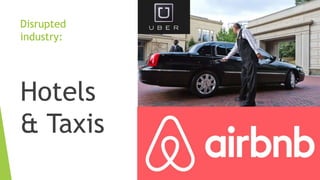
Disrupted
industry:
Hotels
& Taxis
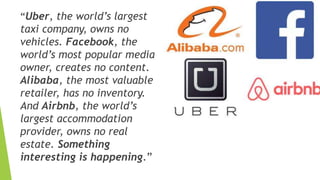
“Uber, the world’s largest
taxi company, owns no
vehicles. Facebook, the
world’s most popular media
owner, creates no content.
Alibaba, the most valuable
retailer, has no inventory.
And Airbnb, the world’s
largest accommodation
provider, owns no real
estate. Something
interesting is happening.”
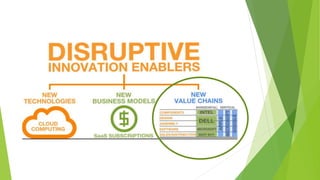
NOITAGERGGASID
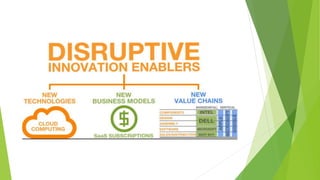
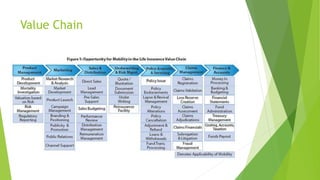
Value Chain
However, banks are not known for being fast movers. Customers are still waiting for
this new banking experience, touted as a revolutionary transformation that will bring
many new features, including anytime and anywhere banking, ultra-fast response
times, and omnipresent advisors. So why don't banks just pick up the pace?
Because it requires more fundamental changes than expected at first sight.
The industry has been in a comfortable position for decades with low customer
turnover, almost no regional competition, good personal relationships and trust as
selling points, and not much intervention from regulators. Staying ahead of the curve
was easy, and there was no pressure to change.
Now, new competitors from adjacent industries and financial technology start-ups
are flooding the market with innovative, technology-driven deviations from the
traditional banking model. And to add insult to injury, customers' attitudes have
fundamentally changed. They are making decisions much faster and have access to
a plethora of offers, leaving financial institutions struggling for customer loyalty.
https://www.atkearney.com/digital-business/ideas-insights
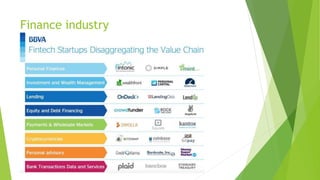
Finance industry
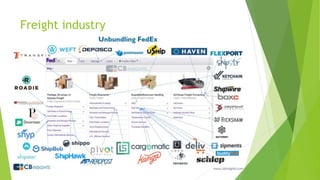
Freight industry
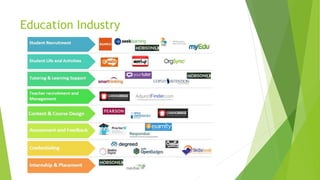
Education Industry
What can we do?
Re-examine the core…what are we really good at, what do
we have that we can use in other ways?
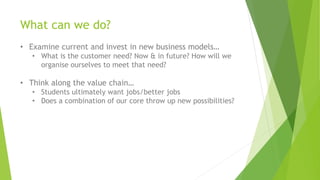
What can we do?
• Examine current and invest in new business models…
• What is the customer need? Now & in future? How will we
organise ourselves to meet that need?
• Think along the value chain…
• Students ultimately want jobs/better jobs
• Does a combination of our core throw up new possibilities?
Education:
Disaggregated and
Disrupted
Discussion / Question & Answer

Education: Disaggregated and Disrupted

  • 1.
    Education: Disaggregated and Disrupted Maria Spies– General Manager, Navitas Learning & Teaching Services Rob Brown – Group Manager, e-Marketing Webinar Discussions - 3rd / 4th March 2016
  • 2.
    Today’s Session  Presenters& Introduction  Rob Brown and Maria Spies  Disruption  The forces of change are about to hit education, starting with post-secondary education. What are these forces and how are they disrupting other industries? (10 mins)  Disaggregation  What is it? Examples from other industries and from education and implications for ‘traditional’ education providers (10 mins)  Discussion / Q&A  Open forum for discussion and ideas; post questions in chat (15 mins)
  • 4.
    We’re in thebusiness of selling information
  • 6.
  • 7.
  • 8.
  • 9.
  • 10.
  • 11.
  • 12.
  • 13.
  • 14.
  • 15.
  • 16.
  • 17.
    “Uber, the world’slargest taxi company, owns no vehicles. Facebook, the world’s most popular media owner, creates no content. Alibaba, the most valuable retailer, has no inventory. And Airbnb, the world’s largest accommodation provider, owns no real estate. Something interesting is happening.”
  • 18.
  • 20.
  • 21.
    However, banks arenot known for being fast movers. Customers are still waiting for this new banking experience, touted as a revolutionary transformation that will bring many new features, including anytime and anywhere banking, ultra-fast response times, and omnipresent advisors. So why don't banks just pick up the pace? Because it requires more fundamental changes than expected at first sight. The industry has been in a comfortable position for decades with low customer turnover, almost no regional competition, good personal relationships and trust as selling points, and not much intervention from regulators. Staying ahead of the curve was easy, and there was no pressure to change. Now, new competitors from adjacent industries and financial technology start-ups are flooding the market with innovative, technology-driven deviations from the traditional banking model. And to add insult to injury, customers' attitudes have fundamentally changed. They are making decisions much faster and have access to a plethora of offers, leaving financial institutions struggling for customer loyalty. https://www.atkearney.com/digital-business/ideas-insights
  • 22.
  • 23.
  • 24.
  • 26.
    What can wedo? Re-examine the core…what are we really good at, what do we have that we can use in other ways?
  • 27.
    What can wedo? • Examine current and invest in new business models… • What is the customer need? Now & in future? How will we organise ourselves to meet that need? • Think along the value chain… • Students ultimately want jobs/better jobs • Does a combination of our core throw up new possibilities?
  • 28.

Editor's Notes

  • #6 Stuart Broad’s aphorism: “Information wants to be free. Information also wants to be expensive.” That tension will not go away.
  • #7 Stuart Broad’s aphorism: “Information wants to be free. Information also wants to be expensive.” That tension will not go away.
  • #13 iTunes/Spotify