Abnormalities of
Spermatogenesis
Male Factor
40% of the cause for infertility 
Sperm is constantly produced by the germinal 
epithelium of the testicle
Sperm generation time 73 days 
Sperm production is thermoregulated 
1° F less than body temperature 
Both men and women can produce anti-sperm 
antibodies which interfere with the penetration
of the cervical mucus
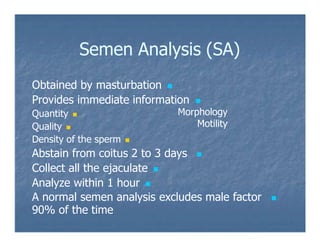
Semen Analysis (SA)
Obtained by masturbation 
Provides immediate information 
Quantity 
Quality 
Density of the sperm 
Abstain from coitus 2 to 3 days 
Collect all the ejaculate 
Analyze within 1 hour 
A normal semen analysis excludes male factor 
90% of the time
Morphology
Motility
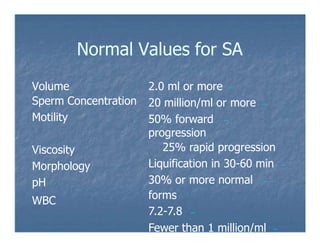
Normal Values for SA
Volume
Sperm Concentration
Motility
Viscosity
Morphology
pH
WBC
7.2-7.8 –
2.0 ml or more –
20 million/ml or more –
50% forward –
progression
25% rapid progression
Liquification in 30-60 min –
30% or more normal –
forms
Fewer than 1 million/ml –
Causes for male infertility
42% varicocele 
repair if there is a low count or decreased 
motility
22% idiopathic 
14% obstruction 
20% other (genetic abnormalities) 
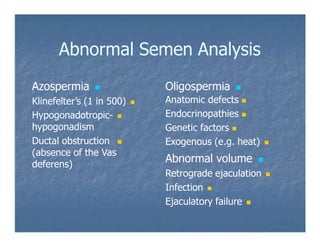
Abnormal Semen Analysis
Klinefelter’s (1 in 500) 
Hypogonadotropic- 
hypogonadism
Ductal obstruction 
(absence of the Vas
deferens)
Azospermia  Oligospermia 
Anatomic defects 
Endocrinopathies 
Genetic factors 
Exogenous (e.g. heat) 
Abnormal volume 
Retrograde ejaculation 
Infection 
Ejaculatory failure 
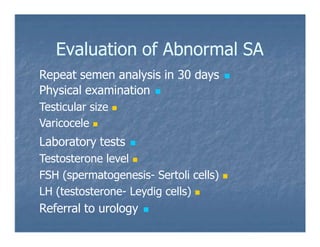
Evaluation of Abnormal SA
Repeat semen analysis in 30 days 
Physical examination 
Testicular size 
Varicocele 
Laboratory tests 
Testosterone level 
FSH (spermatogenesis- Sertoli cells) 
LH (testosterone- Leydig cells) 
Referral to urology 
8
SEMEN
ANALYSIS
Dr.Amal Baalash
Indications
 Assessment of fertility
 Forensic purposes
 Effectiveness of vasectomy - 2 samples 1
month apart negative
 Suitability for artificial insemination
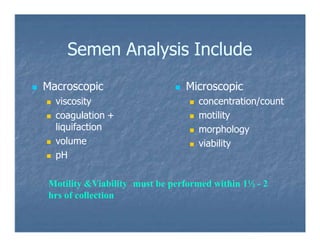
Semen Analysis Include
 Macroscopic
 viscosity
 coagulation +
liquifaction
 volume
 pH
 Microscopic
 concentration/count
 motility
 morphology
 viability
Motility &Viability must be performed within 1½ - 2
hrs of collection
REMEMBER
SEMEN IS A BODY FLUID
BIOHAZARDOUS
Semen Collection
 Name
 Period of abstinence - 2-7days
 Time of collection
 Entire ejaculate and not coitus interruptus in a
wide mouth container
 Delivered within 1 hour of collection
 Avoid temperature extremes
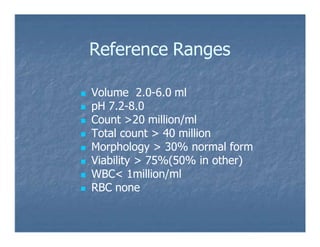
Reference Ranges
 Volume 2.0-6.0 ml
 pH 7.2-8.0
 Count >20 million/ml
 Total count > 40 million
 Morphology > 30% normal form
 Viability > 75%(50% in other)
 WBC< 1million/ml
 RBC none
Macroscopic Examination
 Semen is viscous, yellow grayish.
 Forms gel-like clot immediately.
 Liquefies completely in 5-60 minutes;
this must be complete before further
testing (mix before further testing).
 Appearance: homogenous white-gray
opalescence.
 Brown/red in hematospermia
 Dense white turbid if inflammation and high
WBC
 Volume: in graduated cylinder to the
nearest 0.1 ml or centrifuge tube free of
contamination.
 Viscosity: 5ml pipette or plastic pipette
 normal, more viscous, very viscous
 pH: important parameter of motility and
viability 7.2-8.0; measured by pH paper.
Macroscopic Examination
Motility
 While estimating count
 No stain
 Count 200 total sperm and then the motile
 Calculate the percentage of
 Progressive motile
 Sluggishly motile (<5 um/s )
 nonmotile
 >50% motile
18
Agglutination
 Reported when motile sperm stick to each
other in a definite pattern.
 Head-head
 Tail-tail
 Head-tail
 Immunological cause of infertility
 Done on several HPF
Viability
 Supravital stain:
 Eosin +/- Nigrosin
 Viable do not take up the stain
 This distinguish live nonmotile from dead;
it is important to compare viability and
motility.
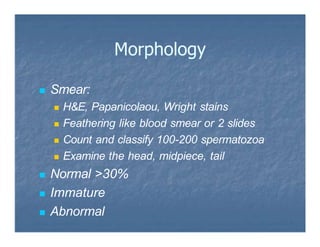
Morphology
 Smear:
 H&E, Papanicolaou, Wright stains
 Feathering like blood smear or 2 slides
 Count and classify 100-200 spermatozoa
 Examine the head, midpiece, tail
 Normal >30%
 Immature
 Abnormal
Mira1000 Semen Analyzer
(CASA)
23
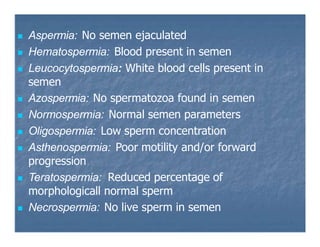
 Aspermia: No semen ejaculated
 Hematospermia: Blood present in semen
 Leucocytospermia: White blood cells present in
semen
 Azospermia: No spermatozoa found in semen
 Normospermia: Normal semen parameters
 Oligospermia: Low sperm concentration
 Asthenospermia: Poor motility and/or forward
progression
 Teratospermia: Reduced percentage of
morphologicall normal sperm
 Necrospermia: No live sperm in semen
 Head abnormalities:
 absence
 double head
 micro/megalo
Other Sperm Abnormalities
 Tail abnormalities:
 coiled
 kinked
 lengthened
27
Sperm Count
 Manual methods
 Hemocytometer or counting chamber
 Computer assisted
 Oligospermia<20 million
 If azospermia: fructose level must be
ordered to verify the integrity of the vas
and seminal vesicles
Preparation
 Manual methods
 Hemocytometer or counting chamber
 Computer assisted
1. Thoroughly mix specimen and dilute 1:10 with
diluent. (To obtain this dilution, dilute 100 uL of
liquefied semen with 900 uL of diluent)
2. Thoroughly mix diluted specimen and allow a drop
(10 - 20 uL) to into each side of the hemocytometer
covered with a coverglass.
3. Allow chamber to stand for about 5 minutes in a
humid container to prevent drying. During this
period, the cells settle and can be more easily
counted.
4. After cells have settled, place chamber under
a microscope
5.Count spermatozoa present in 5 1/25mm
squares in center square millimeter X5 or
sperms in one of the 9 large squares.
Only morphologically mature germinal cells with
tails are counted.
No of sperms per large square X dilution factor
(10) X Depth of chamber (10) X 1000 =
count in million/ ml
Preparation
31
 Decreased:
 vasectomy (should be 0 after 3-6 months)
 varicocele
 primary testicular failure (Klinefelters)
 secondary testicular failure
 congenital vas obstruction
 retrograde ejaculation
 endocrine causes (prolactinemia, low
testosterone)
Sperm Count

Semen Analysis.lab .ppt [Compatibility Mode].pptx

  • 1.
  • 2.
    Male Factor 40% ofthe cause for infertility  Sperm is constantly produced by the germinal  epithelium of the testicle Sperm generation time 73 days  Sperm production is thermoregulated  1° F less than body temperature  Both men and women can produce anti-sperm  antibodies which interfere with the penetration of the cervical mucus
  • 3.
    Semen Analysis (SA) Obtainedby masturbation  Provides immediate information  Quantity  Quality  Density of the sperm  Abstain from coitus 2 to 3 days  Collect all the ejaculate  Analyze within 1 hour  A normal semen analysis excludes male factor  90% of the time Morphology Motility
  • 4.
    Normal Values forSA Volume Sperm Concentration Motility Viscosity Morphology pH WBC 7.2-7.8 – 2.0 ml or more – 20 million/ml or more – 50% forward – progression 25% rapid progression Liquification in 30-60 min – 30% or more normal – forms Fewer than 1 million/ml –
  • 5.
    Causes for maleinfertility 42% varicocele  repair if there is a low count or decreased  motility 22% idiopathic  14% obstruction  20% other (genetic abnormalities) 
  • 6.
    Abnormal Semen Analysis Klinefelter’s(1 in 500)  Hypogonadotropic-  hypogonadism Ductal obstruction  (absence of the Vas deferens) Azospermia  Oligospermia  Anatomic defects  Endocrinopathies  Genetic factors  Exogenous (e.g. heat)  Abnormal volume  Retrograde ejaculation  Infection  Ejaculatory failure 
  • 7.
    Evaluation of AbnormalSA Repeat semen analysis in 30 days  Physical examination  Testicular size  Varicocele  Laboratory tests  Testosterone level  FSH (spermatogenesis- Sertoli cells)  LH (testosterone- Leydig cells)  Referral to urology 
  • 8.
  • 9.
    Indications  Assessment offertility  Forensic purposes  Effectiveness of vasectomy - 2 samples 1 month apart negative  Suitability for artificial insemination
  • 10.
    Semen Analysis Include Macroscopic  viscosity  coagulation + liquifaction  volume  pH  Microscopic  concentration/count  motility  morphology  viability Motility &Viability must be performed within 1½ - 2 hrs of collection
  • 11.
    REMEMBER SEMEN IS ABODY FLUID BIOHAZARDOUS
  • 12.
    Semen Collection  Name Period of abstinence - 2-7days  Time of collection  Entire ejaculate and not coitus interruptus in a wide mouth container  Delivered within 1 hour of collection  Avoid temperature extremes
  • 13.
    Reference Ranges  Volume2.0-6.0 ml  pH 7.2-8.0  Count >20 million/ml  Total count > 40 million  Morphology > 30% normal form  Viability > 75%(50% in other)  WBC< 1million/ml  RBC none
  • 14.
    Macroscopic Examination  Semenis viscous, yellow grayish.  Forms gel-like clot immediately.  Liquefies completely in 5-60 minutes; this must be complete before further testing (mix before further testing).  Appearance: homogenous white-gray opalescence.  Brown/red in hematospermia  Dense white turbid if inflammation and high WBC
  • 15.
     Volume: ingraduated cylinder to the nearest 0.1 ml or centrifuge tube free of contamination.  Viscosity: 5ml pipette or plastic pipette  normal, more viscous, very viscous  pH: important parameter of motility and viability 7.2-8.0; measured by pH paper. Macroscopic Examination
  • 16.
    Motility  While estimatingcount  No stain  Count 200 total sperm and then the motile  Calculate the percentage of  Progressive motile  Sluggishly motile (<5 um/s )  nonmotile  >50% motile
  • 18.
  • 20.
    Agglutination  Reported whenmotile sperm stick to each other in a definite pattern.  Head-head  Tail-tail  Head-tail  Immunological cause of infertility  Done on several HPF
  • 21.
    Viability  Supravital stain: Eosin +/- Nigrosin  Viable do not take up the stain  This distinguish live nonmotile from dead; it is important to compare viability and motility.
  • 22.
    Morphology  Smear:  H&E,Papanicolaou, Wright stains  Feathering like blood smear or 2 slides  Count and classify 100-200 spermatozoa  Examine the head, midpiece, tail  Normal >30%  Immature  Abnormal
  • 23.
  • 24.
     Aspermia: Nosemen ejaculated  Hematospermia: Blood present in semen  Leucocytospermia: White blood cells present in semen  Azospermia: No spermatozoa found in semen  Normospermia: Normal semen parameters  Oligospermia: Low sperm concentration  Asthenospermia: Poor motility and/or forward progression  Teratospermia: Reduced percentage of morphologicall normal sperm  Necrospermia: No live sperm in semen
  • 25.
     Head abnormalities: absence  double head  micro/megalo Other Sperm Abnormalities  Tail abnormalities:  coiled  kinked  lengthened
  • 27.
  • 28.
    Sperm Count  Manualmethods  Hemocytometer or counting chamber  Computer assisted  Oligospermia<20 million  If azospermia: fructose level must be ordered to verify the integrity of the vas and seminal vesicles
  • 29.
    Preparation  Manual methods Hemocytometer or counting chamber  Computer assisted 1. Thoroughly mix specimen and dilute 1:10 with diluent. (To obtain this dilution, dilute 100 uL of liquefied semen with 900 uL of diluent) 2. Thoroughly mix diluted specimen and allow a drop (10 - 20 uL) to into each side of the hemocytometer covered with a coverglass. 3. Allow chamber to stand for about 5 minutes in a humid container to prevent drying. During this period, the cells settle and can be more easily counted.
  • 30.
    4. After cellshave settled, place chamber under a microscope 5.Count spermatozoa present in 5 1/25mm squares in center square millimeter X5 or sperms in one of the 9 large squares. Only morphologically mature germinal cells with tails are counted. No of sperms per large square X dilution factor (10) X Depth of chamber (10) X 1000 = count in million/ ml Preparation
  • 31.
  • 32.
     Decreased:  vasectomy(should be 0 after 3-6 months)  varicocele  primary testicular failure (Klinefelters)  secondary testicular failure  congenital vas obstruction  retrograde ejaculation  endocrine causes (prolactinemia, low testosterone) Sperm Count