
Universitas 17 Augustus 1945 Semarang
An approach to
semantics of natural
language that sees
meaning (or at least the
meaning of assertions) as
being the same as, or
reducible to, their truth
conditions.
Rick has a 50 cent coin in his wallet.
• To know (semantically) what the example means is to be able to distinguish a situation in which it
is true, from one in which it is false. You clearly know how you would go about this: all you need
to do is look in my wallet and sift through the coins on the lookout for a 50c coin. Consequently,
you know what the example means, even though you don’t know whether or not it is true.
• To know the meaning of S is to know when S is true; that is, to know the conditions that make it
true: its truth-conditions.
Formal or truth-conditional semantics is sometimes called model-
theoretic semantics. The idea is that a
sentence is true or false only with respect to a particular way things are, a
particular model of what is
reality. In some state of affairs, the sentence is true, and in some others it
will be false. Such alternative
state of affairs are often called a possible world. Imagine that apart from
the world we live in, there are
many other possible worlds. Truth-values are relative to such possible
worlds.
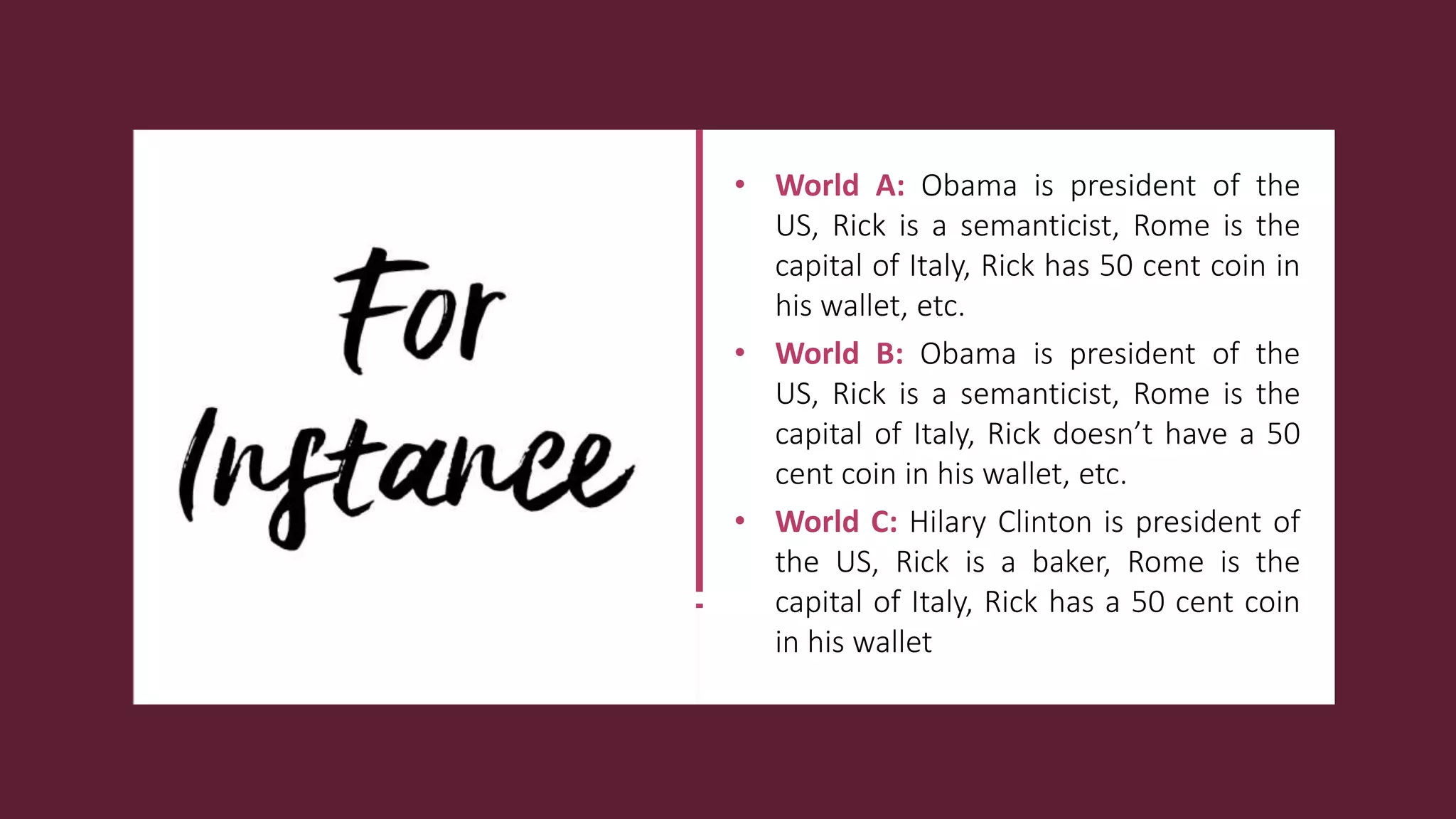
• World A: Obama is president of the
US, Rick is a semanticist, Rome is the
capital of Italy, Rick has 50 cent coin in
his wallet, etc.
• World B: Obama is president of the
US, Rick is a semanticist, Rome is the
capital of Italy, Rick doesn’t have a 50
cent coin in his wallet, etc.
• World C: Hilary Clinton is president of
the US, Rick is a baker, Rome is the
capital of Italy, Rick has a 50 cent coin
in his wallet
Paraphrase is
restatement of a text
in another form or
other words often to
simplify or clarify
meaning.
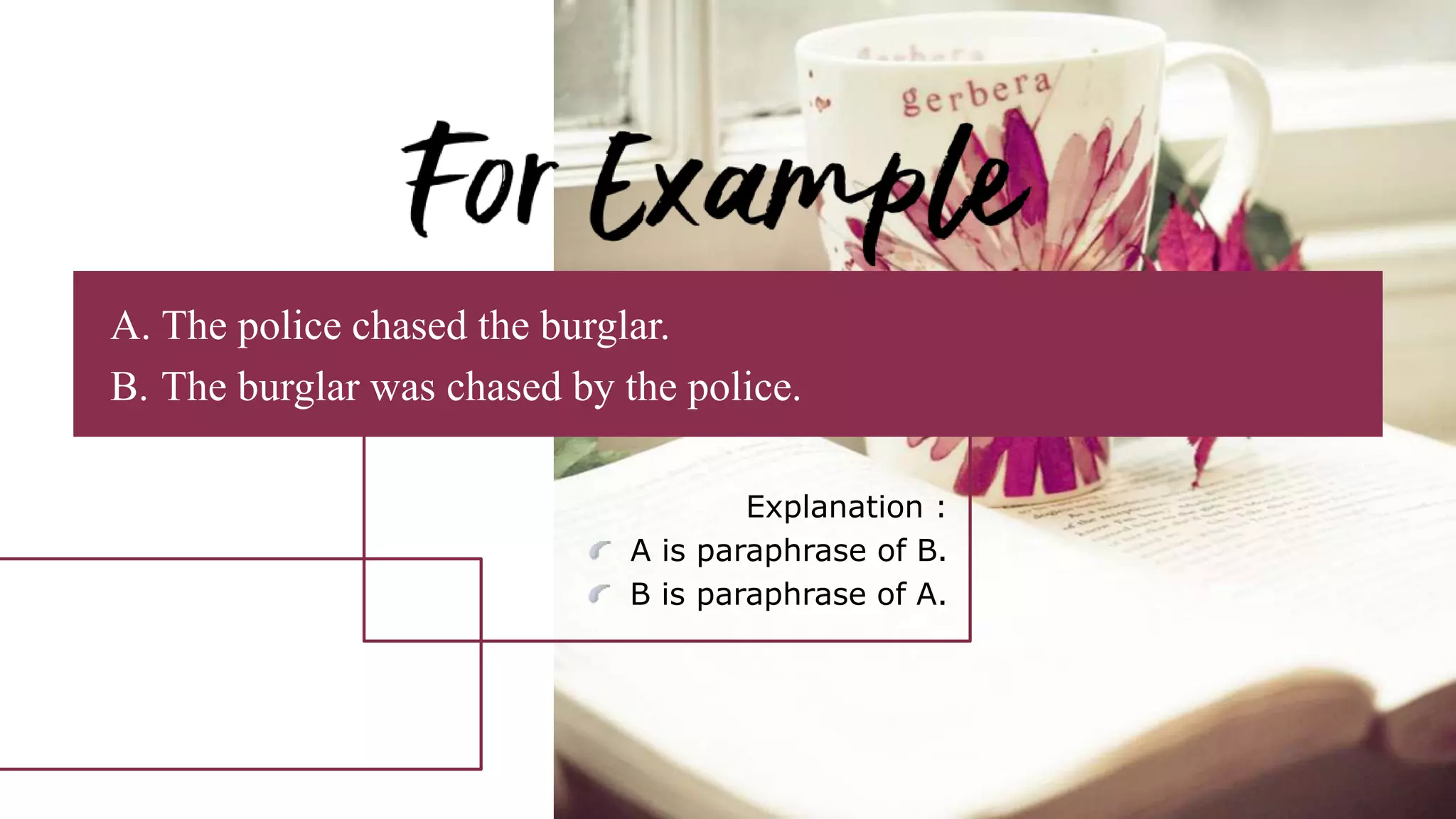
A. The police chased the burglar.
B. The burglar was chased by the police.
Explanation :
A is paraphrase of B.
B is paraphrase of A.
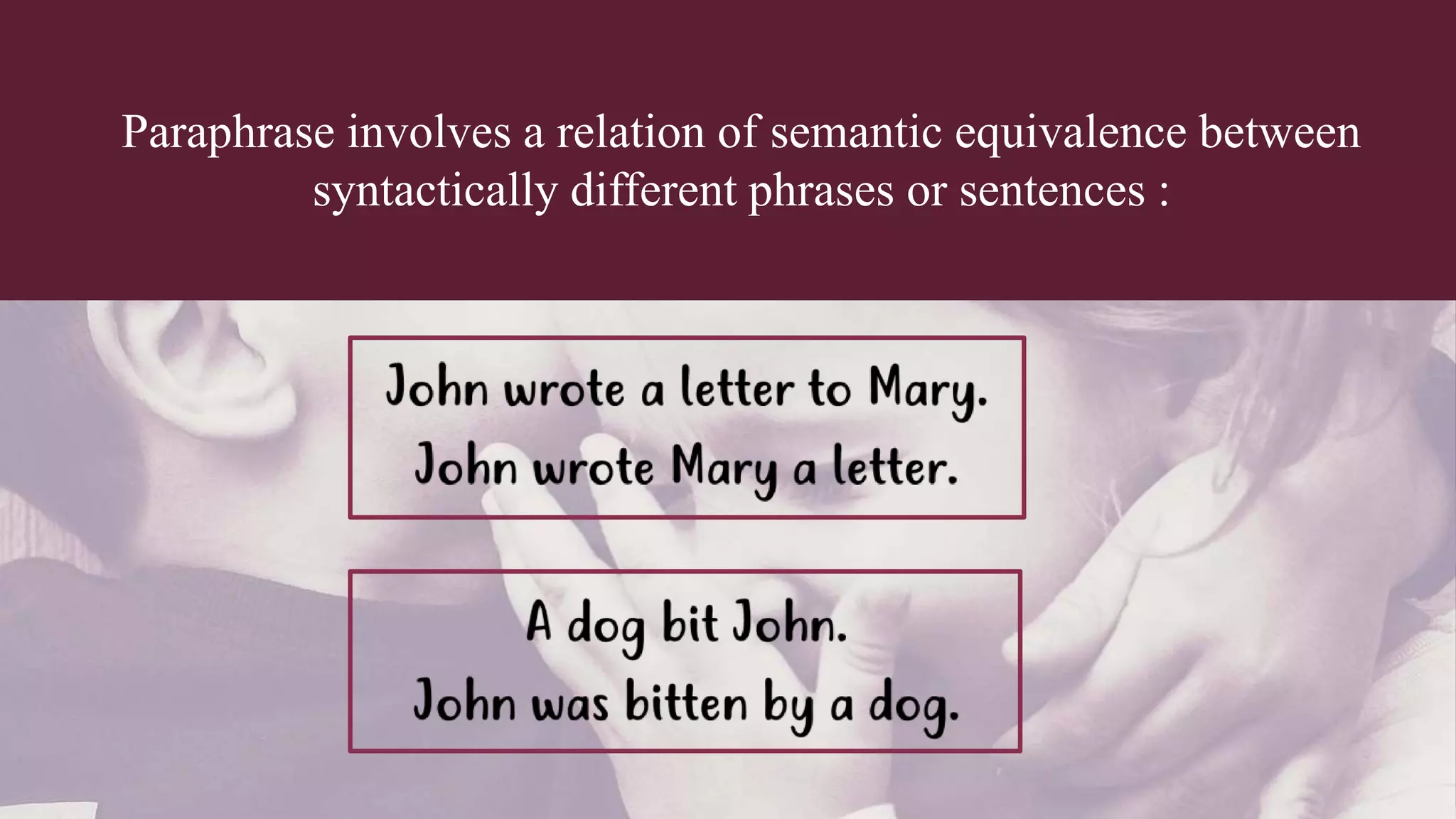
Paraphrase involves a relation of semantic equivalence between
syntactically different phrases or sentences :
Like synonym, paraphrase is never perfect there are always
differences in emphasis or focus. There are two kinds of
paraphrase :
Semantics: Truth of Sentence & Paraphrase

Semantics: Truth of Sentence & Paraphrase

  • 1.
  • 2.
    An approach to semanticsof natural language that sees meaning (or at least the meaning of assertions) as being the same as, or reducible to, their truth conditions.
  • 3.
    Rick has a50 cent coin in his wallet. • To know (semantically) what the example means is to be able to distinguish a situation in which it is true, from one in which it is false. You clearly know how you would go about this: all you need to do is look in my wallet and sift through the coins on the lookout for a 50c coin. Consequently, you know what the example means, even though you don’t know whether or not it is true. • To know the meaning of S is to know when S is true; that is, to know the conditions that make it true: its truth-conditions.
  • 4.
    Formal or truth-conditionalsemantics is sometimes called model- theoretic semantics. The idea is that a sentence is true or false only with respect to a particular way things are, a particular model of what is reality. In some state of affairs, the sentence is true, and in some others it will be false. Such alternative state of affairs are often called a possible world. Imagine that apart from the world we live in, there are many other possible worlds. Truth-values are relative to such possible worlds.
  • 5.
    • World A:Obama is president of the US, Rick is a semanticist, Rome is the capital of Italy, Rick has 50 cent coin in his wallet, etc. • World B: Obama is president of the US, Rick is a semanticist, Rome is the capital of Italy, Rick doesn’t have a 50 cent coin in his wallet, etc. • World C: Hilary Clinton is president of the US, Rick is a baker, Rome is the capital of Italy, Rick has a 50 cent coin in his wallet
  • 6.
    Paraphrase is restatement ofa text in another form or other words often to simplify or clarify meaning.
  • 7.
    A. The policechased the burglar. B. The burglar was chased by the police. Explanation : A is paraphrase of B. B is paraphrase of A.
  • 8.
    Paraphrase involves arelation of semantic equivalence between syntactically different phrases or sentences :
  • 9.
    Like synonym, paraphraseis never perfect there are always differences in emphasis or focus. There are two kinds of paraphrase :