Semantics
Semantics
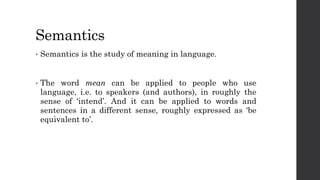
• Semantics is the study of meaning in language.
• The word mean can be applied to people who use
language, i.e. to speakers (and authors), in roughly the
sense of ‘intend’. And it can be applied to words and
sentences in a different sense, roughly expressed as ‘be
equivalent to’.
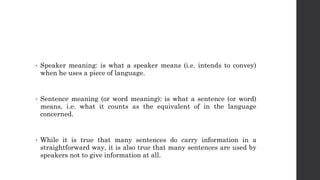
• Speaker meaning: is what a speaker means (i.e. intends to convey)
when he uses a piece of language.
• Sentence meaning (or word meaning): is what a sentence (or word)
means, i.e. what it counts as the equivalent of in the language
concerned.
• While it is true that many sentences do carry information in a
straightforward way, it is also true that many sentences are used by
speakers not to give information at all.
• The same sentences can be used by different speakers on different
occasions to mean (speaker meaning) different things.
• Speakers can convey meaning quite vividly by using sentences whose
meanings are in some sense problematical.
• It is not the business of semantics to lay down standards of semantic
correctness, to prescribe what meanings words shall have, or what
they may be used for.
• Semantics is an attempt to set up a theory of meaning.
• A theory is a precisely specified, coherent, and economical frame-
work of interdependent statements and definitions, constructed so
that as large a number as possible of particular basic facts can either
be seen to follow from it or be describable in terms of it.
Sentences vs. utterances
• Utterance: An utterance is any stretch of talk, by one person, before
and after which there is silence on the part of that person.
• A sentence is neither a physical event nor a physical object. It is,
conceived abstractly, a string of words put together by the
grammatical rules of a language. A sentence can be thought of as the
ideal string of words behind various realizations in utterances and
inscriptions.
• A given sentence always consists of the same words, and in the same
order. Any change in the words, or in their order, makes a different
sentence, for our purposes.
• Accent and voice quality belong strictly to the utterance, not to the
sentence uttered.
• A sentence is a grammatically complete string of words expressing a
complete thought.
• The abstract idea of a sentence is the basis for understanding even
those expressions which are not sentences.
Propositions
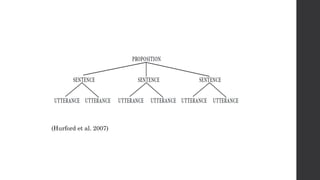
• The meanings of whole sentences involve propositions; the notion of
a proposition is central to semantics.
• A proposition is that part of the meaning of the utterance of a
declarative sentence which describes some state of affairs.
• True propositions correspond to facts, in the ordinary sense of the
word fact. False propositions do not correspond to facts.
(Hurford et al. 2007)
Reference and Sense
• In talking of sense, we deal with relationships inside the language;
in talking of reference we deal with the relationships between
language and the world.
• Reference: By means of reference, a speaker indicates which things
in the world (including persons) are being talked about.
• Variable reference vs. constant reference.
• Sense: the sense of an expression is its place in a system of semantic
relationships with other expressions in the language.
• We can talk about the sense, not only of words, but also of longer
expressions such as phrases and sentences.
• Every expression that has meaning has sense, but not every
expression has reference.
• Just as one can talk of the same sense in different languages, so one
can talk of expressions in different dialects of one language as having
the same sense.
• The relationship between reference and utterance is not so direct as
that between sense and proposition, but there is a similarity worth
pointing out. Both referring and uttering are acts performed by
particular speakers on particular occasions.
Referring expressions
• A referring expression: is any expression used in an utterance to refer to
something or someone (or a clearly delimited collection of things or people),
i.e. used with a particular referent in mind.
• Some expressions can only be used as referring expressions, some never can,
and some expressions can be used to refer or not, depending on the kind of
sentence they occur in.
• Textbook:
• Hurford. J. et al. Semantics: A Coursebook. Cambridge: Cambridge
University Press, 2007.

Semantics and the way we can use properly.pdf

  • 1.
  • 2.
    Semantics • Semantics isthe study of meaning in language. • The word mean can be applied to people who use language, i.e. to speakers (and authors), in roughly the sense of ‘intend’. And it can be applied to words and sentences in a different sense, roughly expressed as ‘be equivalent to’.
  • 3.
    • Speaker meaning:is what a speaker means (i.e. intends to convey) when he uses a piece of language. • Sentence meaning (or word meaning): is what a sentence (or word) means, i.e. what it counts as the equivalent of in the language concerned. • While it is true that many sentences do carry information in a straightforward way, it is also true that many sentences are used by speakers not to give information at all.
  • 4.
    • The samesentences can be used by different speakers on different occasions to mean (speaker meaning) different things. • Speakers can convey meaning quite vividly by using sentences whose meanings are in some sense problematical. • It is not the business of semantics to lay down standards of semantic correctness, to prescribe what meanings words shall have, or what they may be used for.
  • 5.
    • Semantics isan attempt to set up a theory of meaning. • A theory is a precisely specified, coherent, and economical frame- work of interdependent statements and definitions, constructed so that as large a number as possible of particular basic facts can either be seen to follow from it or be describable in terms of it.
  • 6.
    Sentences vs. utterances •Utterance: An utterance is any stretch of talk, by one person, before and after which there is silence on the part of that person. • A sentence is neither a physical event nor a physical object. It is, conceived abstractly, a string of words put together by the grammatical rules of a language. A sentence can be thought of as the ideal string of words behind various realizations in utterances and inscriptions.
  • 7.
    • A givensentence always consists of the same words, and in the same order. Any change in the words, or in their order, makes a different sentence, for our purposes. • Accent and voice quality belong strictly to the utterance, not to the sentence uttered. • A sentence is a grammatically complete string of words expressing a complete thought. • The abstract idea of a sentence is the basis for understanding even those expressions which are not sentences.
  • 8.
    Propositions • The meaningsof whole sentences involve propositions; the notion of a proposition is central to semantics. • A proposition is that part of the meaning of the utterance of a declarative sentence which describes some state of affairs. • True propositions correspond to facts, in the ordinary sense of the word fact. False propositions do not correspond to facts.
  • 9.
  • 10.
    Reference and Sense •In talking of sense, we deal with relationships inside the language; in talking of reference we deal with the relationships between language and the world. • Reference: By means of reference, a speaker indicates which things in the world (including persons) are being talked about. • Variable reference vs. constant reference.
  • 11.
    • Sense: thesense of an expression is its place in a system of semantic relationships with other expressions in the language. • We can talk about the sense, not only of words, but also of longer expressions such as phrases and sentences. • Every expression that has meaning has sense, but not every expression has reference.
  • 12.
    • Just asone can talk of the same sense in different languages, so one can talk of expressions in different dialects of one language as having the same sense. • The relationship between reference and utterance is not so direct as that between sense and proposition, but there is a similarity worth pointing out. Both referring and uttering are acts performed by particular speakers on particular occasions.
  • 13.
    Referring expressions • Areferring expression: is any expression used in an utterance to refer to something or someone (or a clearly delimited collection of things or people), i.e. used with a particular referent in mind. • Some expressions can only be used as referring expressions, some never can, and some expressions can be used to refer or not, depending on the kind of sentence they occur in.
  • 14.
    • Textbook: • Hurford.J. et al. Semantics: A Coursebook. Cambridge: Cambridge University Press, 2007.