0
BACHELOR OF SCIENCE (HONOURS) IN ARCHITECTURE
ARCHITECTURE DESIGN STUDIO V
(ARC60306)
FINAL PROJECT
March 2017
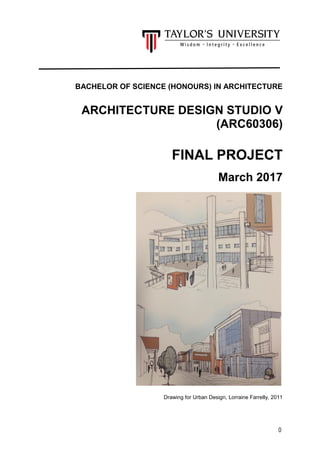
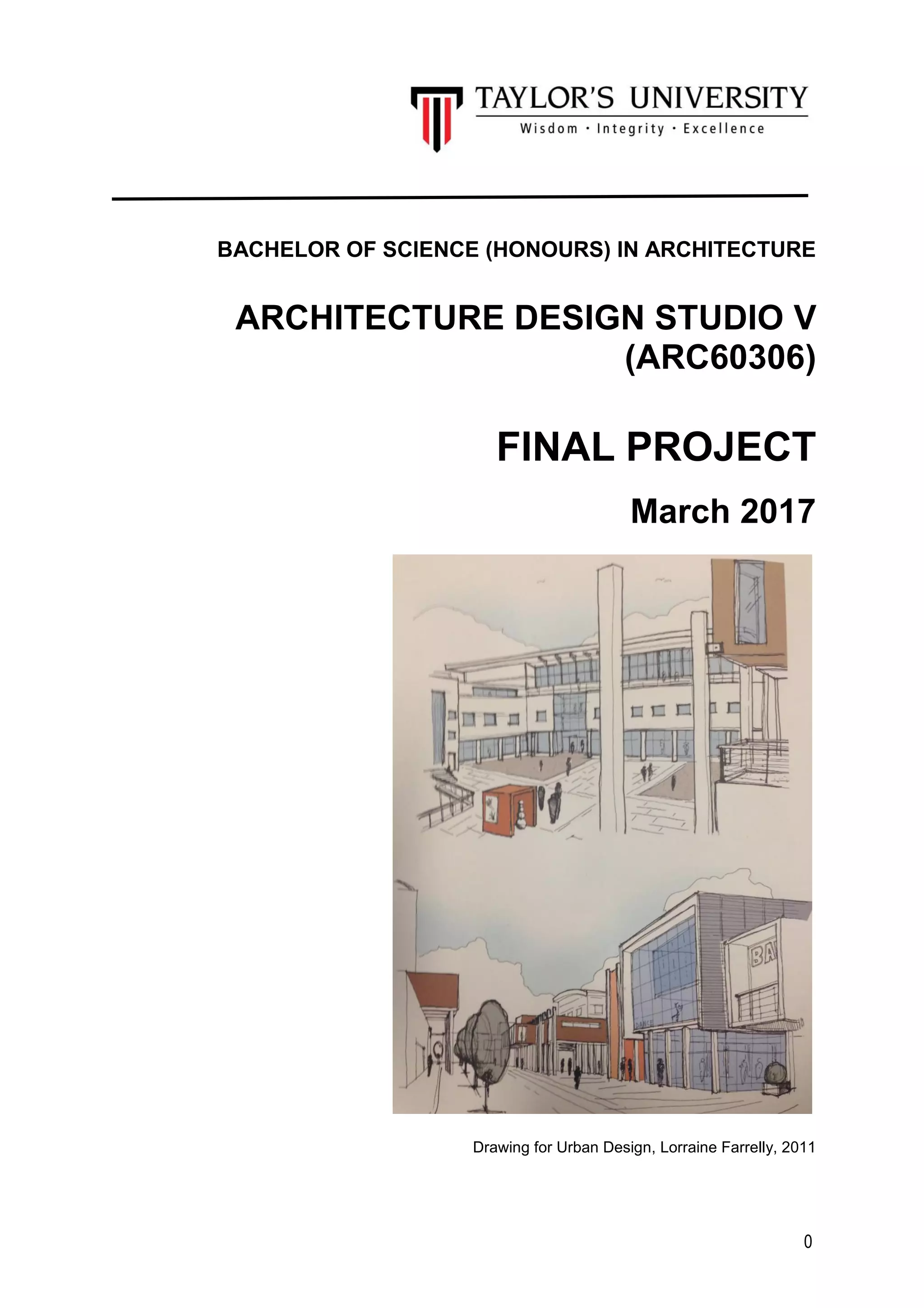
Drawing for Urban Design, Lorraine Farrelly, 2011
ARCHITECTURE DESIGN STUDIO V (ARC60306):
March2017
1
SCHOOL OF ARCHITECTURE, BUILDING & DESIGN
Centre for Modern Architecture Studies in Southeast Asia
Bachelor of Science (Honours) in Architecture
ARCHITECTURE DESIGN STUDIO V (ARC60306)
Prerequisite: Architecture Design Studio IV
Project: 2 Final Project
80% of final marks
Submission Weeks 8, 11 and 14
Introduction
From now on, students will concentrate on designing a community library within an urban infill site. The
design of the building is to consist of appropriate architectural responses that address the aspects of
the urban street context and user behavioural patterns as discerned and analysed in the Preliminary
Studies.
Apart from developing a narrative on architectural strategy in response to the relevant questions
pertaining to community and its context, the design should take into consideration a holistic application
of structural, spatial, functional and environmental requirements to address the user needs for a
community library. The design development of this project will include an introduction to the legislative
restrictions that impact an architectural scheme, the integration of lighting and acoustic design, as well
as the design exploration and detailing of the façade and building envelopes that is coherent with the
architectural language of the overall design project.
Objectives of Project
The objectives of this assignment are as follows:
1. To take into consideration key aspects of urban design and context in relation to architecture
2. To develop an awareness and basic compliance to Design Codes and Statutory Requirements
3. To emphasize the importance of elevational context and composition in developing
architectural design
4. To implement and explore the conceptual, schematic and design development phases in an
architectural design project
ARCHITECTURE DESIGN STUDIO V (ARC60306):
March2017
2
Learning Outcomes of this Project
1. Demonstrate the fundamental knowledge of Design Codes and Regulations
2. Explore plan-section and elevational studies to resolve relevant aesthetic, construction and
environmental issues in the design development phase
3. Produce a design outcome that encompasses the appropriate site-specific architectural
responses through its formal, cultural, legislative, structural and environmental design
solutions for specific urban issues.
4. Produce drawings (both 2D and 3D), models and presentations to verbally and visually
communicate architectural ideas and scheme
Brief
The studio runs through two projects: project 1: urban study on place making aspects; project 2
comprises of architectural strategy and design development. The major site issue being the fading of
cultural heritage that engages the local communities. The contemporary trend is to fade this rich cultural
heritage rather than amplifying it. The solution is in design employing critical approach to the notion of
‘content’ as a purposeful narrative to powerful questions relevant to the context (Low, 2010). To begin
with, the question is:
What are the possibilities for the community library to connect to the urban community at the street
scale?
The above question should be answered by design by exploring various possibilities of relevant sub-
questions that suits your interest and exploration from Project 1. For the rest of the semester, you will
concentrate on designing a community library within an urban infill site. The design of the building
consist of appropriate architectural responses that address the aspects of the urban street context and
user behavioural patterns as discerned and analysed in the Preliminary Studies. The final project has
two distinctive stages: a) Architectural Strategy and b) Design Development and detailing.
Task
Architectural Strategy (weeks 5 – 8)
Aim: to deduct a position for finding architecture and produce architectural strategy.
By this time of the semester, the students should be able to find their positions to develop the community
library. The students are to individually interpret the idea of ‘community library’ and come up with
architectural strategy for the same. This will be in-reflection to the issues and inspirations they found in
the Project 1. Architecture is about geometry. Exploration on form-typologies such as linear, perimeter
and diffused in terms of layering, subtraction, over-lapping etc is compulsory at this stage.
ARCHITECTURAL STRATEGY Weeks 05, 06, 07 & 08
Objectives: To explore programmatic requirements and spatial layout of the design scheme
To explore formal and structural design strategy
Deliverables-
Sketches, diagrams, massing study models, orthographic plan-section and elevation exploration
and schematic drawings, evidence of weekly readings in discussions and references
Interim Submission #1: Pin-up presentation of Ideas and Massing Strategy
ARCHITECTURE DESIGN STUDIO V (ARC60306):
March2017
3
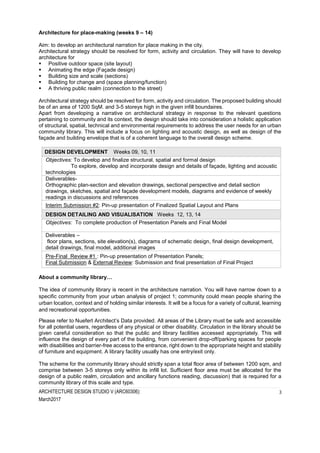
Architecture for place-making (weeks 9 – 14)
Aim: to develop an architectural narration for place making in the city.
Architectural strategy should be resolved for form, activity and circulation. They will have to develop
architecture for
 Positive outdoor space (site layout)
 Animating the edge (Façade design)
 Building size and scale (sections)
 Building for change and (space planning/function)
 A thriving public realm (connection to the street)
Architectural strategy should be resolved for form, activity and circulation. The proposed building should
be of an area of 1200 SqM. and 3-5 storeys high in the given infill boundaires.
Apart from developing a narrative on architectural strategy in response to the relevant questions
pertaining to community and its context, the design should take into consideration a holistic application
of structural, spatial, technical and environmental requirements to address the user needs for an urban
community library. This will include a focus on lighting and acoustic design, as well as design of the
façade and building envelope that is of a coherent language to the overall design scheme.
DESIGN DEVELOPMENT Weeks 09, 10, 11
Objectives: To develop and finalize structural, spatial and formal design
To explore, develop and incorporate design and details of façade, lighting and acoustic
technologies
Deliverables-
Orthographic plan-section and elevation drawings, sectional perspective and detail section
drawings, sketches, spatial and façade development models, diagrams and evidence of weekly
readings in discussions and references
Interim Submission #2: Pin-up presentation of Finalized Spatial Layout and Plans
DESIGN DETAILING AND VISUALISATION Weeks 12, 13, 14
Objectives: To complete production of Presentation Panels and Final Model
Deliverables –
floor plans, sections, site elevation(s), diagrams of schematic design, final design development,
detail drawings, final model, additional images
Pre-Final Review #1 : Pin-up presentation of Presentation Panels;
Final Submission & External Review: Submission and final presentation of Final Project
About a community library…
The idea of community library is recent in the architecture narration. You will have narrow down to a
specific community from your urban analysis of project 1; community could mean people sharing the
urban location, context and of holding similar interests. It will be a focus for a variety of cultural, learning
and recreational opportunities.
Please refer to Nuefert Architect’s Data provided. All areas of the Library must be safe and accessible
for all potential users, regardless of any physical or other disability. Circulation in the library should be
given careful consideration so that the public and library facilities accessed appropriately. This will
influence the design of every part of the building, from convenient drop-off/parking spaces for people
with disabilities and barrier-free access to the entrance, right down to the appropriate height and stability
of furniture and equipment. A library facility usually has one entry/exit only.
The scheme for the community library should strictly span a total floor area of between 1200 sqm, and
comprise between 3-5 storeys only within its infill lot. Sufficient floor area must be allocated for the
design of a public realm, circulation and ancillary functions reading, discussion) that is required for a
community library of this scale and type.
ARCHITECTURE DESIGN STUDIO V (ARC60306):
March2017
4
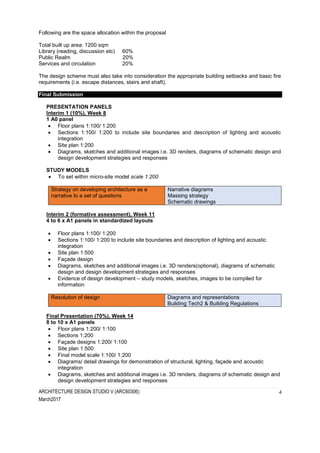
Following are the space allocation within the proposal
Total built up area: 1200 sqm
Library (reading, discussion etc) 60%
Public Realm 20%
Services and circulation 20%
The design scheme must also take into consideration the appropriate building setbacks and basic fire
requirements (i.e. escape distances, stairs and shaft).
Final Submission
PRESENTATION PANELS
Interim 1 (10%), Week 8
1 A0 panel
 Floor plans 1:100/ 1:200
 Sections 1:100/ 1:200 to include site boundaries and description of lighting and acoustic
integration
 Site plan 1:200
 Diagrams, sketches and additional images i.e. 3D renders, diagrams of schematic design and
design development strategies and responses
STUDY MODELS
 To set within micro-site model scale 1:200
Strategy on developing architecture as a
narrative to a set of questions
Narrative diagrams
Massing strategy
Schematic drawings
Interim 2 (formative assessment), Week 11
4 to 6 x A1 panels in standardized layouts
 Floor plans 1:100/ 1:200
 Sections 1:100/ 1:200 to include site boundaries and description of lighting and acoustic
integration
 Site plan 1:500
 Façade design
 Diagrams, sketches and additional images i.e. 3D renders(optional), diagrams of schematic
design and design development strategies and responses
 Evidence of design development – study models, sketches, images to be compiled for
information
Resolution of design Diagrams and representations
Building Tech2 & Building Regulations
Final Presentation (70%), Week 14
8 to 10 x A1 panels
 Floor plans 1:200/ 1:100
 Sections 1:200
 Façade designs 1:200/ 1:100
 Site plan 1:500
 Final model scale 1:100/ 1:200
 Diagrams/ detail drawings for demonstration of structural, lighting, façade and acoustic
integration
 Diagrams, sketches and additional images i.e. 3D renders, diagrams of schematic design and
design development strategies and responses
ARCHITECTURE DESIGN STUDIO V (ARC60306):
March2017
5
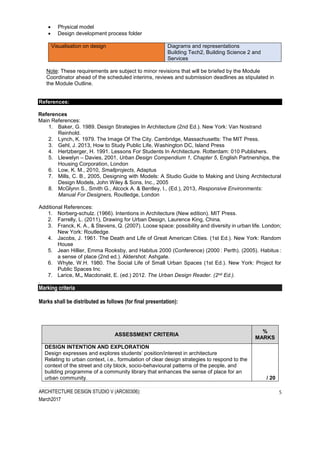
 Physical model
 Design development process folder
Visualisation on design Diagrams and representations
Building Tech2, Building Science 2 and
Services
Note: These requirements are subject to minor revisions that will be briefed by the Module
Coordinator ahead of the scheduled interims, reviews and submission deadlines as stipulated in
the Module Outline.
References:
References
Main References:
1. Baker, G. 1989. Design Strategies In Architecture (2nd Ed.). New York: Van Nostrand
Reinhold.
2. Lynch, K. 1979. The Image Of The City. Cambridge, Massachusetts: The MIT Press.
3. Gehl, J. 2013, How to Study Public Life, Washington DC, Island Press
4. Hertzberger, H. 1991. Lessons For Students In Architecture. Rotterdam: 010 Publishers.
5. Llewelyn – Davies, 2001, Urban Design Compendium 1, Chapter 5, English Partnerships, the
Housing Corporation, London
6. Low, K. M., 2010, Smallprojects, Adaptus
7. Mills, C. B., 2005, Designing with Models: A Studio Guide to Making and Using Architectural
Design Models, John Wiley & Sons, Inc., 2005
8. McGlynn S., Smith G., Alcock A. & Bentley, I., (Ed.), 2013, Responsive Environments:
Manual For Designers, Routledge, London
Additional References:
1. Norberg-schulz. (1966). Intentions in Architecture (New edition). MIT Press.
2. Farrelly, L. (2011), Drawing for Urban Design, Laurence King, China.
3. Franck, K. A., & Stevens, Q. (2007). Loose space: possibility and diversity in urban life. London;
New York: Routledge.
4. Jacobs, J. 1961. The Death and Life of Great American Cities. (1st Ed.). New York: Random
House
5. Jean Hillier, Emma Rooksby, and Habitus 2000 (Conference) (2000 : Perth). (2005). Habitus :
a sense of place (2nd ed.). Aldershot: Ashgate.
6. Whyte, W.H. 1980. The Social Life of Small Urban Spaces (1st Ed.). New York: Project for
Public Spaces Inc
7. Larice, M., Macdonald, E. (ed.) 2012. The Urban Design Reader. (2nd Ed.).
.
Marking criteria
Marks shall be distributed as follows (for final presentation):
ASSESSMENT CRITERIA
%
MARKS
DESIGN INTENTION AND EXPLORATION
Design expresses and explores students’ position/interest in architecture
Relating to urban context, i.e., formulation of clear design strategies to respond to the
context of the street and city block, socio-behavioural patterns of the people, and
building programme of a community library that enhances the sense of place for an
urban community. / 20
ARCHITECTURE DESIGN STUDIO V (ARC60306):
March2017
6
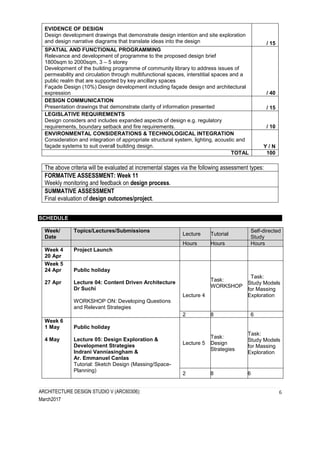
EVIDENCE OF DESIGN
Design development drawings that demonstrate design intention and site exploration
and design narrative diagrams that translate ideas into the design / 15
SPATIAL AND FUNCTIONAL PROGRAMMING
Relevance and development of programme to the proposed design brief
1800sqm to 2000sqm, 3 – 5 storey
Development of the building programme of community library to address issues of
permeability and circulation through multifunctional spaces, interstitial spaces and a
public realm that are supported by key ancillary spaces
Façade Design (10%) Design development including façade design and architectural
expression / 40
DESIGN COMMUNICATION
Presentation drawings that demonstrate clarity of information presented / 15
LEGISLATIVE REQUIREMENTS
Design considers and includes expanded aspects of design e.g. regulatory
requirements, boundary setback and fire requirements. / 10
ENVIRONMENTAL CONSIDERATIONS & TECHNOLOGICAL INTEGRATION
Consideration and integration of appropriate structural system, lighting, acoustic and
façade systems to suit overall building design. Y / N
TOTAL 100
The above criteria will be evaluated at incremental stages via the following assessment types:
FORMATIVE ASSESSMENT: Week 11
Weekly monitoring and feedback on design process.
SUMMATIVE ASSESSMENT
Final evaluation of design outcomes/project.
SCHEDULE
Week/
Date
Topics/Lectures/Submissions
Lecture Tutorial
Self-directed
Study
Hours Hours Hours
Week 4
20 Apr
Project Launch
Week 5
24 Apr
27 Apr
Public holiday
Lecture 04: Content Driven Architecture
Dr Suchi
WORKSHOP ON: Developing Questions
and Relevant Strategies
Lecture 4
Task:
WORKSHOP
Task:
Study Models
for Massing
Exploration
2 8 6
Week 6
1 May
4 May
Public holiday
Lecture 05: Design Exploration &
Development Strategies
Indrani Vanniasingham &
Ar. Emmanuel Canlas
Tutorial: Sketch Design (Massing/Space-
Planning)
Lecture 5
Task:
Design
Strategies
Task:
Study Models
for Massing
Exploration
2 8 6
ARCHITECTURE DESIGN STUDIO V (ARC60306):
March2017
7
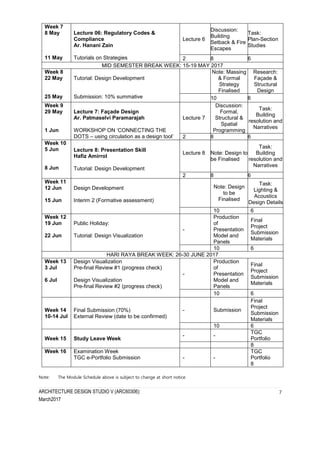
Week 7
8 May
11 May
Lecture 06: Regulatory Codes &
Compliance
Ar. Hanani Zain
Tutorials on Strategies
Lecture 6
Discussion:
Building
Setback & Fire
Escapes
Task:
Plan-Section
Studies
2 8 6
MID SEMESTER BREAK WEEK: 15-19 MAY 2017
Week 8
22 May
25 May
Tutorial: Design Development
Submission: 10% summative
Note: Massing
& Formal
Strategy
Finalised
Research:
Façade &
Structural
Design
10 6
Week 9
29 May
1 Jun
Lecture 7: Façade Design
Ar. Patmaselvi Paramarajah
WORKSHOP ON ‘CONNECTING THE
DOTS – using circulation as a design tool’
Lecture 7
Discussion:
Formal,
Structural &
Spatial
Programming
Task:
Building
resolution and
Narratives
2 8 6
Week 10
5 Jun
8 Jun
Lecture 8: Presentation Skill
Hafiz Amirrol
Tutorial: Design Development
Lecture 8 Note: Design to
be Finalised
Task:
Building
resolution and
Narratives
2 8 6
Week 11
12 Jun
15 Jun
Design Development
Interim 2 (Formative assessment)
Note: Design
to be
Finalised
Task:
Lighting &
Acoustics
Design Details
10 6
Week 12
19 Jun
22 Jun
Public Holiday:
Tutorial: Design Visualization
-
Production
of
Presentation
Model and
Panels
Final
Project
Submission
Materials
10 6
HARI RAYA BREAK WEEK: 26-30 JUNE 2017
Week 13
3 Jul
6 Jul
Design Visualization
Pre-final Review #1 (progress check)
Design Visualization
Pre-final Review #2 (progress check)
-
Production
of
Presentation
Model and
Panels
Final
Project
Submission
Materials
10 6
Week 14
10-14 Jul
Final Submission (70%)
External Review (date to be confirmed)
- Submission
Final
Project
Submission
Materials
10 6
Week 15 Study Leave Week
- -
TGC
Portfolio
8
Week 16 Examination Week
TGC e-Portfolio Submission - -
TGC
Portfolio
8
Note: The Module Schedule above is subject to change at short notice.
ARCHITECTURE DESIGN STUDIO V (ARC60306):
March2017
8
Prepared by: Checked by: Approved by:
……………………………. ……………………………. …………………………….
Date: 22 Mar 2017 Date: 22 Mar 2017 Date: 22 Mar 2017
Dr Sucharita Srirangam Ms. See Kwang Li Mr Mohd. Adib Ramli
Module Coordinator, Design Studio V Stream Coordinator Program Director
Email: Sucharita.srirangam@taylors.edu.my (Design Studies) BSc. (Hons) in Architecture
Office No.: 0356295460
Office Location: MAS2, staff room
Remarks:
1. The Project Brief is to be distributed to the students in the first week of the semester.
2. Any changes to the Project Brief shall be communicated (in writing) to the Programme Director and the
approved revised version must be communicated to the students

SEM 5 : PROJECT 2 STUDIO

  • 1.
    0 BACHELOR OF SCIENCE(HONOURS) IN ARCHITECTURE ARCHITECTURE DESIGN STUDIO V (ARC60306) FINAL PROJECT March 2017 Drawing for Urban Design, Lorraine Farrelly, 2011
  • 2.
    ARCHITECTURE DESIGN STUDIOV (ARC60306): March2017 1 SCHOOL OF ARCHITECTURE, BUILDING & DESIGN Centre for Modern Architecture Studies in Southeast Asia Bachelor of Science (Honours) in Architecture ARCHITECTURE DESIGN STUDIO V (ARC60306) Prerequisite: Architecture Design Studio IV Project: 2 Final Project 80% of final marks Submission Weeks 8, 11 and 14 Introduction From now on, students will concentrate on designing a community library within an urban infill site. The design of the building is to consist of appropriate architectural responses that address the aspects of the urban street context and user behavioural patterns as discerned and analysed in the Preliminary Studies. Apart from developing a narrative on architectural strategy in response to the relevant questions pertaining to community and its context, the design should take into consideration a holistic application of structural, spatial, functional and environmental requirements to address the user needs for a community library. The design development of this project will include an introduction to the legislative restrictions that impact an architectural scheme, the integration of lighting and acoustic design, as well as the design exploration and detailing of the façade and building envelopes that is coherent with the architectural language of the overall design project. Objectives of Project The objectives of this assignment are as follows: 1. To take into consideration key aspects of urban design and context in relation to architecture 2. To develop an awareness and basic compliance to Design Codes and Statutory Requirements 3. To emphasize the importance of elevational context and composition in developing architectural design 4. To implement and explore the conceptual, schematic and design development phases in an architectural design project
  • 3.
    ARCHITECTURE DESIGN STUDIOV (ARC60306): March2017 2 Learning Outcomes of this Project 1. Demonstrate the fundamental knowledge of Design Codes and Regulations 2. Explore plan-section and elevational studies to resolve relevant aesthetic, construction and environmental issues in the design development phase 3. Produce a design outcome that encompasses the appropriate site-specific architectural responses through its formal, cultural, legislative, structural and environmental design solutions for specific urban issues. 4. Produce drawings (both 2D and 3D), models and presentations to verbally and visually communicate architectural ideas and scheme Brief The studio runs through two projects: project 1: urban study on place making aspects; project 2 comprises of architectural strategy and design development. The major site issue being the fading of cultural heritage that engages the local communities. The contemporary trend is to fade this rich cultural heritage rather than amplifying it. The solution is in design employing critical approach to the notion of ‘content’ as a purposeful narrative to powerful questions relevant to the context (Low, 2010). To begin with, the question is: What are the possibilities for the community library to connect to the urban community at the street scale? The above question should be answered by design by exploring various possibilities of relevant sub- questions that suits your interest and exploration from Project 1. For the rest of the semester, you will concentrate on designing a community library within an urban infill site. The design of the building consist of appropriate architectural responses that address the aspects of the urban street context and user behavioural patterns as discerned and analysed in the Preliminary Studies. The final project has two distinctive stages: a) Architectural Strategy and b) Design Development and detailing. Task Architectural Strategy (weeks 5 – 8) Aim: to deduct a position for finding architecture and produce architectural strategy. By this time of the semester, the students should be able to find their positions to develop the community library. The students are to individually interpret the idea of ‘community library’ and come up with architectural strategy for the same. This will be in-reflection to the issues and inspirations they found in the Project 1. Architecture is about geometry. Exploration on form-typologies such as linear, perimeter and diffused in terms of layering, subtraction, over-lapping etc is compulsory at this stage. ARCHITECTURAL STRATEGY Weeks 05, 06, 07 & 08 Objectives: To explore programmatic requirements and spatial layout of the design scheme To explore formal and structural design strategy Deliverables- Sketches, diagrams, massing study models, orthographic plan-section and elevation exploration and schematic drawings, evidence of weekly readings in discussions and references Interim Submission #1: Pin-up presentation of Ideas and Massing Strategy
  • 4.
    ARCHITECTURE DESIGN STUDIOV (ARC60306): March2017 3 Architecture for place-making (weeks 9 – 14) Aim: to develop an architectural narration for place making in the city. Architectural strategy should be resolved for form, activity and circulation. They will have to develop architecture for  Positive outdoor space (site layout)  Animating the edge (Façade design)  Building size and scale (sections)  Building for change and (space planning/function)  A thriving public realm (connection to the street) Architectural strategy should be resolved for form, activity and circulation. The proposed building should be of an area of 1200 SqM. and 3-5 storeys high in the given infill boundaires. Apart from developing a narrative on architectural strategy in response to the relevant questions pertaining to community and its context, the design should take into consideration a holistic application of structural, spatial, technical and environmental requirements to address the user needs for an urban community library. This will include a focus on lighting and acoustic design, as well as design of the façade and building envelope that is of a coherent language to the overall design scheme. DESIGN DEVELOPMENT Weeks 09, 10, 11 Objectives: To develop and finalize structural, spatial and formal design To explore, develop and incorporate design and details of façade, lighting and acoustic technologies Deliverables- Orthographic plan-section and elevation drawings, sectional perspective and detail section drawings, sketches, spatial and façade development models, diagrams and evidence of weekly readings in discussions and references Interim Submission #2: Pin-up presentation of Finalized Spatial Layout and Plans DESIGN DETAILING AND VISUALISATION Weeks 12, 13, 14 Objectives: To complete production of Presentation Panels and Final Model Deliverables – floor plans, sections, site elevation(s), diagrams of schematic design, final design development, detail drawings, final model, additional images Pre-Final Review #1 : Pin-up presentation of Presentation Panels; Final Submission & External Review: Submission and final presentation of Final Project About a community library… The idea of community library is recent in the architecture narration. You will have narrow down to a specific community from your urban analysis of project 1; community could mean people sharing the urban location, context and of holding similar interests. It will be a focus for a variety of cultural, learning and recreational opportunities. Please refer to Nuefert Architect’s Data provided. All areas of the Library must be safe and accessible for all potential users, regardless of any physical or other disability. Circulation in the library should be given careful consideration so that the public and library facilities accessed appropriately. This will influence the design of every part of the building, from convenient drop-off/parking spaces for people with disabilities and barrier-free access to the entrance, right down to the appropriate height and stability of furniture and equipment. A library facility usually has one entry/exit only. The scheme for the community library should strictly span a total floor area of between 1200 sqm, and comprise between 3-5 storeys only within its infill lot. Sufficient floor area must be allocated for the design of a public realm, circulation and ancillary functions reading, discussion) that is required for a community library of this scale and type.
  • 5.
    ARCHITECTURE DESIGN STUDIOV (ARC60306): March2017 4 Following are the space allocation within the proposal Total built up area: 1200 sqm Library (reading, discussion etc) 60% Public Realm 20% Services and circulation 20% The design scheme must also take into consideration the appropriate building setbacks and basic fire requirements (i.e. escape distances, stairs and shaft). Final Submission PRESENTATION PANELS Interim 1 (10%), Week 8 1 A0 panel  Floor plans 1:100/ 1:200  Sections 1:100/ 1:200 to include site boundaries and description of lighting and acoustic integration  Site plan 1:200  Diagrams, sketches and additional images i.e. 3D renders, diagrams of schematic design and design development strategies and responses STUDY MODELS  To set within micro-site model scale 1:200 Strategy on developing architecture as a narrative to a set of questions Narrative diagrams Massing strategy Schematic drawings Interim 2 (formative assessment), Week 11 4 to 6 x A1 panels in standardized layouts  Floor plans 1:100/ 1:200  Sections 1:100/ 1:200 to include site boundaries and description of lighting and acoustic integration  Site plan 1:500  Façade design  Diagrams, sketches and additional images i.e. 3D renders(optional), diagrams of schematic design and design development strategies and responses  Evidence of design development – study models, sketches, images to be compiled for information Resolution of design Diagrams and representations Building Tech2 & Building Regulations Final Presentation (70%), Week 14 8 to 10 x A1 panels  Floor plans 1:200/ 1:100  Sections 1:200  Façade designs 1:200/ 1:100  Site plan 1:500  Final model scale 1:100/ 1:200  Diagrams/ detail drawings for demonstration of structural, lighting, façade and acoustic integration  Diagrams, sketches and additional images i.e. 3D renders, diagrams of schematic design and design development strategies and responses
  • 6.
    ARCHITECTURE DESIGN STUDIOV (ARC60306): March2017 5  Physical model  Design development process folder Visualisation on design Diagrams and representations Building Tech2, Building Science 2 and Services Note: These requirements are subject to minor revisions that will be briefed by the Module Coordinator ahead of the scheduled interims, reviews and submission deadlines as stipulated in the Module Outline. References: References Main References: 1. Baker, G. 1989. Design Strategies In Architecture (2nd Ed.). New York: Van Nostrand Reinhold. 2. Lynch, K. 1979. The Image Of The City. Cambridge, Massachusetts: The MIT Press. 3. Gehl, J. 2013, How to Study Public Life, Washington DC, Island Press 4. Hertzberger, H. 1991. Lessons For Students In Architecture. Rotterdam: 010 Publishers. 5. Llewelyn – Davies, 2001, Urban Design Compendium 1, Chapter 5, English Partnerships, the Housing Corporation, London 6. Low, K. M., 2010, Smallprojects, Adaptus 7. Mills, C. B., 2005, Designing with Models: A Studio Guide to Making and Using Architectural Design Models, John Wiley & Sons, Inc., 2005 8. McGlynn S., Smith G., Alcock A. & Bentley, I., (Ed.), 2013, Responsive Environments: Manual For Designers, Routledge, London Additional References: 1. Norberg-schulz. (1966). Intentions in Architecture (New edition). MIT Press. 2. Farrelly, L. (2011), Drawing for Urban Design, Laurence King, China. 3. Franck, K. A., & Stevens, Q. (2007). Loose space: possibility and diversity in urban life. London; New York: Routledge. 4. Jacobs, J. 1961. The Death and Life of Great American Cities. (1st Ed.). New York: Random House 5. Jean Hillier, Emma Rooksby, and Habitus 2000 (Conference) (2000 : Perth). (2005). Habitus : a sense of place (2nd ed.). Aldershot: Ashgate. 6. Whyte, W.H. 1980. The Social Life of Small Urban Spaces (1st Ed.). New York: Project for Public Spaces Inc 7. Larice, M., Macdonald, E. (ed.) 2012. The Urban Design Reader. (2nd Ed.). . Marking criteria Marks shall be distributed as follows (for final presentation): ASSESSMENT CRITERIA % MARKS DESIGN INTENTION AND EXPLORATION Design expresses and explores students’ position/interest in architecture Relating to urban context, i.e., formulation of clear design strategies to respond to the context of the street and city block, socio-behavioural patterns of the people, and building programme of a community library that enhances the sense of place for an urban community. / 20
  • 7.
    ARCHITECTURE DESIGN STUDIOV (ARC60306): March2017 6 EVIDENCE OF DESIGN Design development drawings that demonstrate design intention and site exploration and design narrative diagrams that translate ideas into the design / 15 SPATIAL AND FUNCTIONAL PROGRAMMING Relevance and development of programme to the proposed design brief 1800sqm to 2000sqm, 3 – 5 storey Development of the building programme of community library to address issues of permeability and circulation through multifunctional spaces, interstitial spaces and a public realm that are supported by key ancillary spaces Façade Design (10%) Design development including façade design and architectural expression / 40 DESIGN COMMUNICATION Presentation drawings that demonstrate clarity of information presented / 15 LEGISLATIVE REQUIREMENTS Design considers and includes expanded aspects of design e.g. regulatory requirements, boundary setback and fire requirements. / 10 ENVIRONMENTAL CONSIDERATIONS & TECHNOLOGICAL INTEGRATION Consideration and integration of appropriate structural system, lighting, acoustic and façade systems to suit overall building design. Y / N TOTAL 100 The above criteria will be evaluated at incremental stages via the following assessment types: FORMATIVE ASSESSMENT: Week 11 Weekly monitoring and feedback on design process. SUMMATIVE ASSESSMENT Final evaluation of design outcomes/project. SCHEDULE Week/ Date Topics/Lectures/Submissions Lecture Tutorial Self-directed Study Hours Hours Hours Week 4 20 Apr Project Launch Week 5 24 Apr 27 Apr Public holiday Lecture 04: Content Driven Architecture Dr Suchi WORKSHOP ON: Developing Questions and Relevant Strategies Lecture 4 Task: WORKSHOP Task: Study Models for Massing Exploration 2 8 6 Week 6 1 May 4 May Public holiday Lecture 05: Design Exploration & Development Strategies Indrani Vanniasingham & Ar. Emmanuel Canlas Tutorial: Sketch Design (Massing/Space- Planning) Lecture 5 Task: Design Strategies Task: Study Models for Massing Exploration 2 8 6
  • 8.
    ARCHITECTURE DESIGN STUDIOV (ARC60306): March2017 7 Week 7 8 May 11 May Lecture 06: Regulatory Codes & Compliance Ar. Hanani Zain Tutorials on Strategies Lecture 6 Discussion: Building Setback & Fire Escapes Task: Plan-Section Studies 2 8 6 MID SEMESTER BREAK WEEK: 15-19 MAY 2017 Week 8 22 May 25 May Tutorial: Design Development Submission: 10% summative Note: Massing & Formal Strategy Finalised Research: Façade & Structural Design 10 6 Week 9 29 May 1 Jun Lecture 7: Façade Design Ar. Patmaselvi Paramarajah WORKSHOP ON ‘CONNECTING THE DOTS – using circulation as a design tool’ Lecture 7 Discussion: Formal, Structural & Spatial Programming Task: Building resolution and Narratives 2 8 6 Week 10 5 Jun 8 Jun Lecture 8: Presentation Skill Hafiz Amirrol Tutorial: Design Development Lecture 8 Note: Design to be Finalised Task: Building resolution and Narratives 2 8 6 Week 11 12 Jun 15 Jun Design Development Interim 2 (Formative assessment) Note: Design to be Finalised Task: Lighting & Acoustics Design Details 10 6 Week 12 19 Jun 22 Jun Public Holiday: Tutorial: Design Visualization - Production of Presentation Model and Panels Final Project Submission Materials 10 6 HARI RAYA BREAK WEEK: 26-30 JUNE 2017 Week 13 3 Jul 6 Jul Design Visualization Pre-final Review #1 (progress check) Design Visualization Pre-final Review #2 (progress check) - Production of Presentation Model and Panels Final Project Submission Materials 10 6 Week 14 10-14 Jul Final Submission (70%) External Review (date to be confirmed) - Submission Final Project Submission Materials 10 6 Week 15 Study Leave Week - - TGC Portfolio 8 Week 16 Examination Week TGC e-Portfolio Submission - - TGC Portfolio 8 Note: The Module Schedule above is subject to change at short notice.
  • 9.
    ARCHITECTURE DESIGN STUDIOV (ARC60306): March2017 8 Prepared by: Checked by: Approved by: ……………………………. ……………………………. ……………………………. Date: 22 Mar 2017 Date: 22 Mar 2017 Date: 22 Mar 2017 Dr Sucharita Srirangam Ms. See Kwang Li Mr Mohd. Adib Ramli Module Coordinator, Design Studio V Stream Coordinator Program Director Email: Sucharita.srirangam@taylors.edu.my (Design Studies) BSc. (Hons) in Architecture Office No.: 0356295460 Office Location: MAS2, staff room Remarks: 1. The Project Brief is to be distributed to the students in the first week of the semester. 2. Any changes to the Project Brief shall be communicated (in writing) to the Programme Director and the approved revised version must be communicated to the students