Selling the War World War I Propaganda Posters
Selling the War :  WOMEN
Purpose: This document is trying to encourage young men to join the Navy, Naval Reserve  or the Coast Guard. Purpose: The Navy , Naval Reserve, and the Coast Guard is in need of more  recruits because of WWI. Purpose: This document communicates its message by suggesting that girls will admire you and find you attractive if you joined the Navy. Purpose: The girl is dressed  in patriotic colors and the writing is also patriotic; this document is meant to inspire patriotism. Audience: The audience for this document is young men eligible to join the Navy. Author: The author encourages the recruitment of young men. Evidence, Support, Outcomes: This document uses patriotism and pride to inspire young men to join the Navy, which at this point was short on recruits. Evidence, Support, Outcomes:  This document does not especially support women’s rights values. Audience: If the audience accepts this message enrollment in the navy will increase, and the U.S. will be a more powerful force in the war. Overall Impression and Conclusion: This document is persuasion, because it does not use propaganda tactics like using black and white views to distort facts and is just trying to encourage men to join the navy.
Selling the War :  African-Americans
Purpose: shows that African Americans are crucial for America’s victory in World War I (need soldiers!) Trying to promote  integration  in a segregated society because there was a disconnect between black soldiers to fight for freedom when at home where they didn’t receive rights Audience: African Americans Audience’s belief about this issue is that society should not be segregated, African Americans are part of this country too    they deserve equal rights. Possibly not sure if they want to fight in the army because of the disconnect from the army’s mission to the  issues at home.  Evidence, Support, Outcomes: The author uses the fact that the colored men were the first Americans to plant the flag on the battle line. This is true because the US needed all the soldiers they could get so colored men were entered into the army. If the audience had accepted this message then segregation may have slowed, but that was not the case. Back home, black men were still separated as a different race. African Americans   look proper and sharp; leading army.  Language    makes blacks feel that it is their duty to fight and that they would be the best at it (TRUE sons of freedom, first to plant flag on battle line). American flag and A.L.   connects them to America (shows they are an integral part of the country), A.L.’s presence provokes civil war emotions and emotions of fighting for freedom (duty to fight, make them want to fight) Overall Impression and conclusion: This illustration is definitely a persuasion, not an argument or propaganda because they are trying to show Americans that the African Americans were helpful in the US’s victory in World War I, and that segregation should end. This is not propaganda because they are not illustrating something false, but this could be considered an argument since the author is fighting against the racial segregation in American society. Propaganda   clearly plays on the emotions of African Americans, exaggeration (white men with them?)
Selling the War :  the Enemy
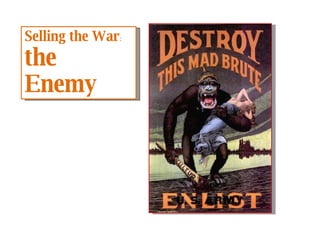
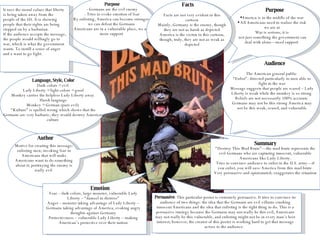
Purpose - Germans are the evil enemy - Tries to evoke emotion of fear - By enlisting, America can become stronger—we can defeat the Germans  - Americans are in a vulnerable place, we need more support  Purpose America is in the middle of the war All Americans need to realize the risk we are at War is serious; it is not just something the government can deal with alone—need support  Language, Style, Color Dark colors = evil  Lady Liberty = light colors = good Monkey carries the helpless Lady Liberty away  Harsh language Monkey = German (pure evil)  “ Kulture” is spelled wrong which shows that the Germans are very barbaric; they would destroy American culture  Audience The American general public  “ Enlist”- directed particularly to men able to fight in the war Message suggests that people are scared – Lady Liberty is weak while the monkey is so strong  Beliefs are not necessarily 100% accurate  Germans may not be this strong America may not be this weak, scared, and vulnerable Author Motive for creating this message: enlisting men; invoking fear in Americans that will make Americans want to do something about it; portraying the enemy is really evil  Facts Facts are not very evident in this cartoon Mainly, Germany is the enemy, though they are not as harsh as depicted America is the victim in this cartoon, though, truly, they are not as weak as depicted Fear – dark colors, large monster, vulnerable Lady Liberty – “damsel in distress” Anger – monster taking advantage of Lady Liberty – Germans taking advantage of America, evoking angry thoughts against Germany Protectiveness – vulnerable Lady Liberty – making American’s protective over their nation Emotion Summary “ Destroy This Mad Brute”—the mad brute represents the evil Germans who are capturing innocent, vulnerable Americans like Lady Liberty. Tries to convince audience to enlist in the U.S. army—if you enlist, you will save America from this mad brute  Very persuasive and opinionated; exaggerates the situation  Persuasive : This particular poster is extremely persuasive. It tries to convince its audience of two things: the idea that the Germans are evil villains crushing innocent Americans and the idea that enlisting is the right thing to do. This is a persuasive strategy because the Germans may not really be this evil, Americans may not really be this vulnerable, and enlisting might not be in every man’s best interest; however, the creator of this poster is working hard to get that message across to the audience.  It uses the moral values that liberty is being taken away from the people of the US. It is showing people that their rights are being stepped on by a barbarian.  If the audience accepts the message, the people would willingly go to war, which is what the government wants. To instill a sense of anger and a want to go fight.
Selling the War :  the Recruit
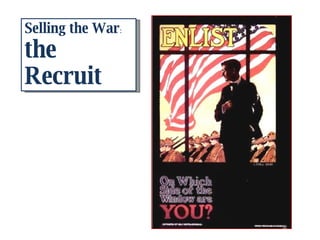
The army side of the window is light, symbolizes good, right Non-army side dark=bad, wrong Man on “wrong” side educated and elitist, rich looking You in big red letters, emphasizes audience, makes them feel special Window symbolizes  that there’s not much between, that you could change to right anytime Flag=patriotism, good, nationalism, go fight for your country The man who is dressed formerly, in a wealthy attire,  symbolizes that the people that seem like important figures are only spectator if they are not involved in enlisting in the war Enlist – pops out written in yellow – first thing that the audience sees  “ You” pops out and makes the message personal. – forces the audience to question themselves with guilt
Evidence, Support, Outcomes What facts &specific details does the document use? Are the facts verifiable? Believable? No discernable facts What emotions does the document use to communicate its message? How is the audience likely to feel? Uses alienation-if you don’t join, you are alienating yourself, you’re different man on “bad” side of window looks sad, longing to join What ethical or moral values does the document use to communicate its message? What relevant values are missing? knocks elitist values-says you’re not better than us if you don’t join army, you’re worse doesn’t use guilt to gain support What will happen if the audience accepts this message?  What about the world? you will be with brethren, be “in the light”, on the “good, right side”, be with the better majority, won’t be alone or lonely, be happy not sad, fufilled Overall Impression and Conclusion What’s your overall impression of this message? Summarize your findings. join the army and you will be rewarded with kinship and brethren you will be on the right side, good side, like everyone else, not alone or better than others (in a good way) Categorize the poster: argument, persuasion, propaganda? Explain your choice! propaganda-no fact used, simply plays emotions of alienation and of fitting in, if you join the army, you’ll be with everyone else who is good
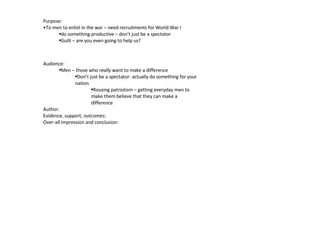
Purpose:  To men to enlist in the war – need recruitments for World War I do something productive – don’t just be a spectator  Guilt – are you even going to help us?  Audience: Men – those who  really  want to make a difference  Don’t just be a spectator- actually do something for your nation  Rousing patriotism – getting everyday men to make them believe that they can make a difference  Author:  Evidence, support, outcomes: Over-all impression and conclusion:

Selling The War

  • 1.
    Selling the WarWorld War I Propaganda Posters
  • 2.
  • 3.
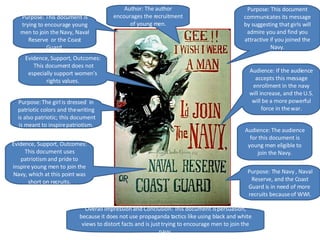
    Purpose: This documentis trying to encourage young men to join the Navy, Naval Reserve or the Coast Guard. Purpose: The Navy , Naval Reserve, and the Coast Guard is in need of more recruits because of WWI. Purpose: This document communicates its message by suggesting that girls will admire you and find you attractive if you joined the Navy. Purpose: The girl is dressed in patriotic colors and the writing is also patriotic; this document is meant to inspire patriotism. Audience: The audience for this document is young men eligible to join the Navy. Author: The author encourages the recruitment of young men. Evidence, Support, Outcomes: This document uses patriotism and pride to inspire young men to join the Navy, which at this point was short on recruits. Evidence, Support, Outcomes: This document does not especially support women’s rights values. Audience: If the audience accepts this message enrollment in the navy will increase, and the U.S. will be a more powerful force in the war. Overall Impression and Conclusion: This document is persuasion, because it does not use propaganda tactics like using black and white views to distort facts and is just trying to encourage men to join the navy.
  • 4.
    Selling the War: African-Americans
  • 5.
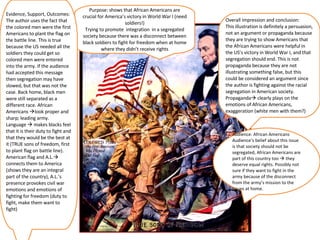
    Purpose: shows thatAfrican Americans are crucial for America’s victory in World War I (need soldiers!) Trying to promote integration in a segregated society because there was a disconnect between black soldiers to fight for freedom when at home where they didn’t receive rights Audience: African Americans Audience’s belief about this issue is that society should not be segregated, African Americans are part of this country too  they deserve equal rights. Possibly not sure if they want to fight in the army because of the disconnect from the army’s mission to the issues at home. Evidence, Support, Outcomes: The author uses the fact that the colored men were the first Americans to plant the flag on the battle line. This is true because the US needed all the soldiers they could get so colored men were entered into the army. If the audience had accepted this message then segregation may have slowed, but that was not the case. Back home, black men were still separated as a different race. African Americans  look proper and sharp; leading army. Language  makes blacks feel that it is their duty to fight and that they would be the best at it (TRUE sons of freedom, first to plant flag on battle line). American flag and A.L.  connects them to America (shows they are an integral part of the country), A.L.’s presence provokes civil war emotions and emotions of fighting for freedom (duty to fight, make them want to fight) Overall Impression and conclusion: This illustration is definitely a persuasion, not an argument or propaganda because they are trying to show Americans that the African Americans were helpful in the US’s victory in World War I, and that segregation should end. This is not propaganda because they are not illustrating something false, but this could be considered an argument since the author is fighting against the racial segregation in American society. Propaganda  clearly plays on the emotions of African Americans, exaggeration (white men with them?)
  • 6.
    Selling the War: the Enemy
  • 7.
    Purpose - Germansare the evil enemy - Tries to evoke emotion of fear - By enlisting, America can become stronger—we can defeat the Germans - Americans are in a vulnerable place, we need more support Purpose America is in the middle of the war All Americans need to realize the risk we are at War is serious; it is not just something the government can deal with alone—need support Language, Style, Color Dark colors = evil Lady Liberty = light colors = good Monkey carries the helpless Lady Liberty away Harsh language Monkey = German (pure evil) “ Kulture” is spelled wrong which shows that the Germans are very barbaric; they would destroy American culture Audience The American general public “ Enlist”- directed particularly to men able to fight in the war Message suggests that people are scared – Lady Liberty is weak while the monkey is so strong Beliefs are not necessarily 100% accurate Germans may not be this strong America may not be this weak, scared, and vulnerable Author Motive for creating this message: enlisting men; invoking fear in Americans that will make Americans want to do something about it; portraying the enemy is really evil Facts Facts are not very evident in this cartoon Mainly, Germany is the enemy, though they are not as harsh as depicted America is the victim in this cartoon, though, truly, they are not as weak as depicted Fear – dark colors, large monster, vulnerable Lady Liberty – “damsel in distress” Anger – monster taking advantage of Lady Liberty – Germans taking advantage of America, evoking angry thoughts against Germany Protectiveness – vulnerable Lady Liberty – making American’s protective over their nation Emotion Summary “ Destroy This Mad Brute”—the mad brute represents the evil Germans who are capturing innocent, vulnerable Americans like Lady Liberty. Tries to convince audience to enlist in the U.S. army—if you enlist, you will save America from this mad brute Very persuasive and opinionated; exaggerates the situation Persuasive : This particular poster is extremely persuasive. It tries to convince its audience of two things: the idea that the Germans are evil villains crushing innocent Americans and the idea that enlisting is the right thing to do. This is a persuasive strategy because the Germans may not really be this evil, Americans may not really be this vulnerable, and enlisting might not be in every man’s best interest; however, the creator of this poster is working hard to get that message across to the audience. It uses the moral values that liberty is being taken away from the people of the US. It is showing people that their rights are being stepped on by a barbarian.  If the audience accepts the message, the people would willingly go to war, which is what the government wants. To instill a sense of anger and a want to go fight.
  • 8.
    Selling the War: the Recruit
  • 9.
    The army sideof the window is light, symbolizes good, right Non-army side dark=bad, wrong Man on “wrong” side educated and elitist, rich looking You in big red letters, emphasizes audience, makes them feel special Window symbolizes that there’s not much between, that you could change to right anytime Flag=patriotism, good, nationalism, go fight for your country The man who is dressed formerly, in a wealthy attire, symbolizes that the people that seem like important figures are only spectator if they are not involved in enlisting in the war Enlist – pops out written in yellow – first thing that the audience sees “ You” pops out and makes the message personal. – forces the audience to question themselves with guilt
  • 10.
    Evidence, Support, OutcomesWhat facts &specific details does the document use? Are the facts verifiable? Believable? No discernable facts What emotions does the document use to communicate its message? How is the audience likely to feel? Uses alienation-if you don’t join, you are alienating yourself, you’re different man on “bad” side of window looks sad, longing to join What ethical or moral values does the document use to communicate its message? What relevant values are missing? knocks elitist values-says you’re not better than us if you don’t join army, you’re worse doesn’t use guilt to gain support What will happen if the audience accepts this message? What about the world? you will be with brethren, be “in the light”, on the “good, right side”, be with the better majority, won’t be alone or lonely, be happy not sad, fufilled Overall Impression and Conclusion What’s your overall impression of this message? Summarize your findings. join the army and you will be rewarded with kinship and brethren you will be on the right side, good side, like everyone else, not alone or better than others (in a good way) Categorize the poster: argument, persuasion, propaganda? Explain your choice! propaganda-no fact used, simply plays emotions of alienation and of fitting in, if you join the army, you’ll be with everyone else who is good
  • 11.
    Purpose: Tomen to enlist in the war – need recruitments for World War I do something productive – don’t just be a spectator Guilt – are you even going to help us? Audience: Men – those who really want to make a difference Don’t just be a spectator- actually do something for your nation Rousing patriotism – getting everyday men to make them believe that they can make a difference Author: Evidence, support, outcomes: Over-all impression and conclusion: