Self-learning Systems for Cyber Security1
Kim Hammar & Rolf Stadler
kimham@kth.se & stadler@kth.se
Division of Network and Systems Engineering
KTH Royal Institute of Technology
October 15, 2020
1
Kim Hammar and Rolf Stadler. “Finding Effective Security Strategies through Reinforcement Learning and
Self-Play”. In: International Conference on Network and Service Management (CNSM 2020) (CNSM 2020). Izmir,
Turkey, Nov. 2020.
Kim Hammar & Rolf Stadler (KTH) CDIS Workshop October 15, 2020 1 / 12
Game Learning Programs
Kim Hammar & Rolf Stadler (KTH) CDIS Workshop October 15, 2020 2 / 12
Challenges: Evolving and Automated Attacks
Challenges:
Evolving & automated attacks
Complex infrastructures
172.18.1.0/24
Kim Hammar & Rolf Stadler (KTH) CDIS Workshop October 15, 2020 3 / 12
Goal: Automation and Learning
Challenges
Evolving & automated attacks
Complex infrastructures
Our Goal:
Automate security tasks
Adapt to changing attack methods
Security Agent Controller
Observations Actions
172.18.1.0/24
Kim Hammar & Rolf Stadler (KTH) CDIS Workshop October 15, 2020 3 / 12
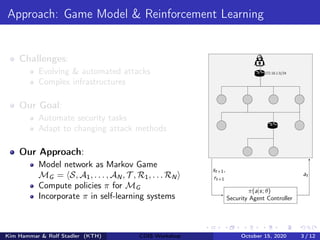
Approach: Game Model & Reinforcement Learning
Challenges:
Evolving & automated attacks
Complex infrastructures
Our Goal:
Automate security tasks
Adapt to changing attack methods
Our Approach:
Model network as Markov Game
MG = S, A1, . . . , AN , T , R1, . . . RN
Compute policies π for MG
Incorporate π in self-learning systems Security Agent Controller
st+1,
rt+1
at
π(a|s; θ)
172.18.1.0/24
Kim Hammar & Rolf Stadler (KTH) CDIS Workshop October 15, 2020 3 / 12
Related Work
Game-Learning Programs:
TD-Gammon2
, AlphaGo Zero3
, OpenAI Five etc.
=⇒ Impressive empirical results of RL and self-play
Network Security:
Automated threat modeling4
, automated intrusion detection etc.
=⇒ Need for automation and better security tooling
Game Theory:
Network Security: A Decision and Game-Theoretic Approach5
.
=⇒ Many security operations involves strategic decision making
2
Gerald Tesauro. “TD-Gammon, a Self-Teaching Backgammon Program, Achieves Master-Level Play”. In:
Neural Comput. 6.2 (Mar. 1994), 215–219. ISSN: 0899-7667. DOI: 10.1162/neco.1994.6.2.215. URL:
https://doi.org/10.1162/neco.1994.6.2.215.
3
David Silver et al. “Mastering the game of Go without human knowledge”. In: Nature 550 (Oct. 2017),
pp. 354–. URL: http://dx.doi.org/10.1038/nature24270.
4
Pontus Johnson, Robert Lagerström, and Mathias Ekstedt. “A Meta Language for Threat Modeling and Attack
Simulations”. In: Proceedings of the 13th International Conference on Availability, Reliability and Security. ARES
2018. Hamburg, Germany: Association for Computing Machinery, 2018. ISBN: 9781450364485. DOI:
10.1145/3230833.3232799. URL: https://doi.org/10.1145/3230833.3232799.
5
Tansu Alpcan and Tamer Basar. Network Security: A Decision and Game-Theoretic Approach. 1st. USA:
Cambridge University Press, 2010. ISBN: 0521119324.
Kim Hammar & Rolf Stadler (KTH) CDIS Workshop October 15, 2020 4 / 12
Outline
Use Case
Markov Game Model for Intrusion Prevention
Reinforcement Learning Problem
Method
Results
Conclusions
Kim Hammar & Rolf Stadler (KTH) CDIS Workshop October 15, 2020 5 / 12
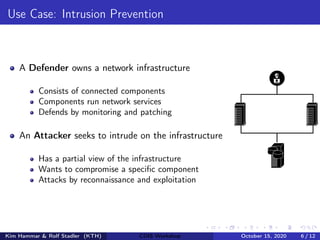
Use Case: Intrusion Prevention
A Defender owns a network infrastructure
Consists of connected components
Components run network services
Defends by monitoring and patching
An Attacker seeks to intrude on the infrastructure
Has a partial view of the infrastructure
Wants to compromise a specific component
Attacks by reconnaissance and exploitation
Kim Hammar & Rolf Stadler (KTH) CDIS Workshop October 15, 2020 6 / 12
Markov Game Model for Intrusion Prevention
(1) Network Infrastructure
Kim Hammar & Rolf Stadler (KTH) CDIS Workshop October 15, 2020 7 / 12
Markov Game Model for Intrusion Prevention
(1) Network Infrastructure (2) Graph G = N, E
Ndata
Nstart
Kim Hammar & Rolf Stadler (KTH) CDIS Workshop October 15, 2020 7 / 12
Markov Game Model for Intrusion Prevention
(1) Network Infrastructure (2) Graph G = N, E
Ndata
Nstart
(3) State space |S| = (w + 1)|N|·m·(m+1)
SA
3 = [0, 0, 0, 0]
SD
3 = [9, 1, 5, 8, 1]
SA
0 = [0, 0, 0, 0]
SD
0 = [0, 0, 0, 0, 0]
SA
1 = [0, 0, 0, 0]
SD
1 = [1, 9, 9, 8, 1]
SA
2 = [0, 0, 0, 0]
SD
2 = [9, 9, 9, 8, 1]
Kim Hammar & Rolf Stadler (KTH) CDIS Workshop October 15, 2020 7 / 12
Markov Game Model for Intrusion Prevention
(1) Network Infrastructure (2) Graph G = N, E
Ndata
Nstart
(3) State space |S| = (w + 1)|N|·m·(m+1)
SA
3 = [0, 0, 0, 0]
SD
3 = [9, 1, 5, 8, 1]
SA
0 = [0, 0, 0, 0]
SD
0 = [0, 0, 0, 0, 0]
SA
1 = [0, 0, 0, 0]
SD
1 = [1, 9, 9, 8, 1]
SA
2 = [0, 0, 0, 0]
SD
2 = [9, 9, 9, 8, 1]
(4) Action space |A| = |N| · (m + 1)
?/0 ?/0 ?/0 ?/0?/0?/0
?/0 ?/0 ?/0
Kim Hammar & Rolf Stadler (KTH) CDIS Workshop October 15, 2020 7 / 12
Markov Game Model for Intrusion Prevention
(1) Network Infrastructure (2) Graph G = N, E
Ndata
Nstart
(3) State space |S| = (w + 1)|N|·m·(m+1)
SA
3 = [0, 0, 0, 0]
SD
3 = [9, 1, 5, 8, 1]
SA
0 = [0, 0, 0, 0]
SD
0 = [0, 0, 0, 0, 0]
SA
1 = [0, 0, 0, 0]
SD
1 = [1, 9, 9, 8, 1]
SA
2 = [0, 0, 0, 0]
SD
2 = [9, 9, 9, 8, 1]
(4) Action space |A| = |N| · (m + 1)
?/0 ?/0 ?/0 ?/0?/0?/0
?/0 ?/0 ?/0
(5) Game Dynamics T , R1, R2, ρ0
4/0 0/1 8/0 ?/0?/0?/0
0/0 9/0 8/0
Kim Hammar & Rolf Stadler (KTH) CDIS Workshop October 15, 2020 7 / 12
Markov Game Model for Intrusion Prevention
(1) Network Infrastructure (2) Graph G = N, E
Ndata
Nstart
(3) State space |S| = (w + 1)|N|·m·(m+1)
SA
3 = [0, 0, 0, 0]
SD
3 = [9, 1, 5, 8, 1]
SA
0 = [0, 0, 0, 0]
SD
0 = [0, 0, 0, 0, 0]
SA
1 = [0, 0, 0, 0]
SD
1 = [1, 9, 9, 8, 1]
SA
2 = [0, 0, 0, 0]
SD
2 = [9, 9, 9, 8, 1]
(4) Action space |A| = |N| · (m + 1)
?/0 ?/0 ?/0 ?/0?/0?/0
?/0 ?/0 ?/0
(5) Game Dynamics T , R1, R2, ρ0
4/0 0/1 8/0 ?/0?/0?/0
0/0 9/0 8/0
∴
- Markov game
- Zero-sum
- 2 players
- Partially observed
- Stochastic elements
- Round-based
MG = S, A1, A2, T , R1, R2, γ, ρ0
Kim Hammar & Rolf Stadler (KTH) CDIS Workshop October 15, 2020 7 / 12
Automatic Learning of Security Strategies
1
2 2 2
q1 = 3 q2 = 4 q3 = 6
(18,18) (15,20) (9,18)
q2 = 3
q2 = 4
q2 = 6
(20,15) (15,16) (8,12)
q2 = 3
q2 = 4
q2 = 6
(18,9) (12,8) (0,0)
q2 = 3
q2 = 4
q2 = 6
Finding strategies for the Markov game model:
Evolutionary methods
Computational game theory
Self-Play Reinforcement learning
Attacker vs Defender
Strategies evolve without human intervention
Motivation for Reinforcement Learning:
Strong empirical results in related work
Can adapt to new attack methods and threats
Can be used for complex domains that are hard to model exactly
Kim Hammar & Rolf Stadler (KTH) CDIS Workshop October 15, 2020 8 / 12
The Reinforcement Learning Problem
Goal:
Approximate π∗
= arg maxπ E
T
t=0 γt
rt+1
Learning Algorithm:
Represent π by πθ
Define objective J(θ) = Eo∼ρπθ ,a∼πθ
[R]
Maximize J(θ) by stochastic gradient ascent with gradient
θJ(θ) = Eo∼ρπθ ,a∼πθ
[ θ log πθ(a|o)Aπθ
(o, a)]
Domain-Specific Challenges:
Partial observability: captured in the model
Large state space |S| = (w + 1)|N|·m·(m+1)
Large action space |A| = |N| · (m + 1)
Non-stationary Environment due to presence of adversary
Agent
Environment
at
st+1
rt+1
Kim Hammar & Rolf Stadler (KTH) CDIS Workshop October 15, 2020 9 / 12
The Reinforcement Learning Problem
Goal:
Approximate π∗
= arg maxπ E
T
t=0 γt
rt+1
Learning Algorithm:
Represent π by πθ
Define objective J(θ) = Eo∼ρπθ ,a∼πθ
[R]
Maximize J(θ) by stochastic gradient ascent with gradient
θJ(θ) = Eo∼ρπθ ,a∼πθ
[ θ log πθ(a|o)Aπθ
(o, a)]
Domain-Specific Challenges:
Partial observability: captured in the model
Large state space |S| = (w + 1)|N|·m·(m+1)
Large action space |A| = |N| · (m + 1)
Non-stationary Environment due to presence of adversary
Agent
Environment
at
st+1
rt+1
Kim Hammar & Rolf Stadler (KTH) CDIS Workshop October 15, 2020 9 / 12
The Reinforcement Learning Problem
Goal:
Approximate π∗
= arg maxπ E
T
t=0 γt
rt+1
Learning Algorithm:
Represent π by πθ
Define objective J(θ) = Eo∼ρπθ ,a∼πθ
[R]
Maximize J(θ) by stochastic gradient ascent with gradient
θJ(θ) = Eo∼ρπθ ,a∼πθ
[ θ log πθ(a|o)Aπθ
(o, a)]
Domain-Specific Challenges:
Partial observability: captured in the model
Large state space |S| = (w + 1)|N|·m·(m+1)
Large action space |A| = |N| · (m + 1)
Non-stationary Environment due to presence of adversary
Agent
Environment
at
st+1
rt+1
Kim Hammar & Rolf Stadler (KTH) CDIS Workshop October 15, 2020 9 / 12
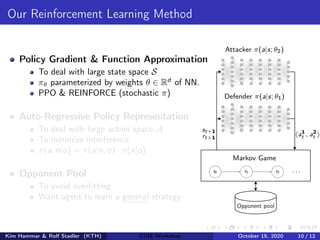
Our Reinforcement Learning Method
Policy Gradient & Function Approximation
To deal with large state space S
πθ parameterized by weights θ ∈ Rd
of NN.
PPO & REINFORCE (stochastic π)
Auto-Regressive Policy Representation
To deal with large action space A
To minimize interference
π(a, n|o) = π(a|n, o) · π(n|o)
Opponent Pool
To avoid overfitting
Want agent to learn a general strategy
Attacker π(a|s; θ2)
Defender π(a|s; θ1)
st+1
rt+1
a1
t , a2
t
Opponent pool
s0 s1 s2 . . .
Markov Game
Kim Hammar & Rolf Stadler (KTH) CDIS Workshop October 15, 2020 10 / 12
Our Reinforcement Learning Method
Policy Gradient & Function Approximation
To deal with large state space S
πθ parameterized by weights θ ∈ Rd
of NN.
PPO & REINFORCE (stochastic π)
Auto-Regressive Policy Representation
To deal with large action space A
To minimize interference
π(a, n|o) = π(a|n, o) · π(n|o)
Opponent Pool
To avoid overfitting
Want agent to learn a general strategy
Attacker π(a|s; θ2)
Defender π(a|s; θ1)
st+1
rt+1
a1
t , a2
t
Opponent pool
s0 s1 s2 . . .
Markov Game
Kim Hammar & Rolf Stadler (KTH) CDIS Workshop October 15, 2020 10 / 12
Our Reinforcement Learning Method
Policy Gradient & Function Approximation
To deal with large state space S
πθ parameterized by weights θ ∈ Rd
of NN.
PPO & REINFORCE (stochastic π)
Auto-Regressive Policy Representation
To deal with large action space A
To minimize interference
π(a, n|o) = π(a|n, o) · π(n|o)
Opponent Pool
To avoid overfitting
Want agent to learn a general strategy
Attacker π(a|s; θ2)
Defender π(a|s; θ1)
st+1
rt+1
a1
t , a2
t
Opponent pool
s0 s1 s2 . . .
Markov Game
Kim Hammar & Rolf Stadler (KTH) CDIS Workshop October 15, 2020 10 / 12
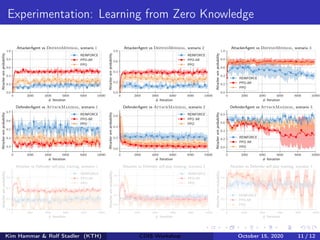
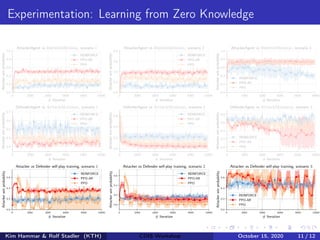
Experimentation: Learning from Zero Knowledge
0 2000 4000 6000 8000 10000
# Iteration
0.0
0.2
0.4
0.6
0.8
1.0
Attackerwinprobability
AttackerAgent vs DefendMinimal, scenario 1
REINFORCE
PPO-AR
PPO
0 2000 4000 6000 8000 10000
# Iteration
0.0
0.2
0.4
0.6
0.8
Attackerwinprobability
AttackerAgent vs DefendMinimal, scenario 2
REINFORCE
PPO-AR
PPO
0 2000 4000 6000 8000 10000
# Iteration
0.0
0.2
0.4
0.6
0.8
1.0
Attackerwinprobability
AttackerAgent vs DefendMinimal, scenario 3
REINFORCE
PPO-AR
PPO
0 2000 4000 6000 8000 10000
# Iteration
0.3
0.4
0.5
0.6
0.7
Attackerwinprobability
DefenderAgent vs AttackMaximal, scenario 1
REINFORCE
PPO-AR
PPO
0 2000 4000 6000 8000 10000
# Iteration
0.0
0.2
0.4
0.6
Attackerwinprobability
DefenderAgent vs AttackMaximal, scenario 2
REINFORCE
PPO AR
PPO
0 2000 4000 6000 8000 10000
# Iteration
0.0
0.2
0.4
0.6
0.8
Attackerwinprobability
DefenderAgent vs AttackMaximal, scenario 3
REINFORCE
PPO AR
PPO
0 2000 4000 6000 8000 10000
# Iteration
0.0
0.2
0.4
0.6
Attackerwinprobability
Attacker vs Defender self-play training, scenario 1
REINFORCE
PPO-AR
PPO
0 2000 4000 6000 8000 10000
# Iteration
0.0
0.2
0.4
0.6
Attackerwinprobability
Attacker vs Defender self-play training, scenario 2
REINFORCE
PPO-AR
PPO
0 2000 4000 6000 8000 10000
# Iteration
0.0
0.2
0.4
0.6
Attackerwinprobability
Attacker vs Defender self-play training, scenario 3
REINFORCE
PPO-AR
PPO
Kim Hammar & Rolf Stadler (KTH) CDIS Workshop October 15, 2020 11 / 12
Experimentation: Learning from Zero Knowledge
0 2000 4000 6000 8000 10000
# Iteration
0.0
0.2
0.4
0.6
0.8
1.0
Attackerwinprobability
AttackerAgent vs DefendMinimal, scenario 1
REINFORCE
PPO-AR
PPO
0 2000 4000 6000 8000 10000
# Iteration
0.0
0.2
0.4
0.6
0.8
Attackerwinprobability
AttackerAgent vs DefendMinimal, scenario 2
REINFORCE
PPO-AR
PPO
0 2000 4000 6000 8000 10000
# Iteration
0.0
0.2
0.4
0.6
0.8
1.0
Attackerwinprobability
AttackerAgent vs DefendMinimal, scenario 3
REINFORCE
PPO-AR
PPO
0 2000 4000 6000 8000 10000
# Iteration
0.3
0.4
0.5
0.6
0.7
Attackerwinprobability
DefenderAgent vs AttackMaximal, scenario 1
REINFORCE
PPO-AR
PPO
0 2000 4000 6000 8000 10000
# Iteration
0.0
0.2
0.4
0.6
Attackerwinprobability
DefenderAgent vs AttackMaximal, scenario 2
REINFORCE
PPO AR
PPO
0 2000 4000 6000 8000 10000
# Iteration
0.0
0.2
0.4
0.6
0.8
Attackerwinprobability
DefenderAgent vs AttackMaximal, scenario 3
REINFORCE
PPO AR
PPO
0 2000 4000 6000 8000 10000
# Iteration
0.0
0.2
0.4
0.6
Attackerwinprobability
Attacker vs Defender self-play training, scenario 1
REINFORCE
PPO-AR
PPO
0 2000 4000 6000 8000 10000
# Iteration
0.0
0.2
0.4
0.6
Attackerwinprobability
Attacker vs Defender self-play training, scenario 2
REINFORCE
PPO-AR
PPO
0 2000 4000 6000 8000 10000
# Iteration
0.0
0.2
0.4
0.6
Attackerwinprobability
Attacker vs Defender self-play training, scenario 3
REINFORCE
PPO-AR
PPO
Kim Hammar & Rolf Stadler (KTH) CDIS Workshop October 15, 2020 11 / 12
Conclusion & Future Work
Conclusions:
We have proposed a Method to automatically find security strategies
=⇒ Model as Markov game & evolve strategies using self-play
reinforcement learning
Addressed domain-specific challenges with Auto-regressive policy,
opponent pool, and function approximation.
Challenges of applied reinforcement learning
Stable convergence remains a challenge
Sample-efficiency is a problem
Generalization is a challenge
Current & Future Work:
Study techniques for mitigation of identified RL challenges
Learn security strategies by interacion with a cyber range
Kim Hammar & Rolf Stadler (KTH) CDIS Workshop October 15, 2020 12 / 12
Thank you
All code for reproducing the results is open source:
https://github.com/Limmen/gym-idsgame
Kim Hammar & Rolf Stadler (KTH) CDIS Workshop October 15, 2020 12 / 12

Self-Learning Systems for Cyber Security

  • 1.
    Self-learning Systems forCyber Security1 Kim Hammar & Rolf Stadler kimham@kth.se & stadler@kth.se Division of Network and Systems Engineering KTH Royal Institute of Technology October 15, 2020 1 Kim Hammar and Rolf Stadler. “Finding Effective Security Strategies through Reinforcement Learning and Self-Play”. In: International Conference on Network and Service Management (CNSM 2020) (CNSM 2020). Izmir, Turkey, Nov. 2020. Kim Hammar & Rolf Stadler (KTH) CDIS Workshop October 15, 2020 1 / 12
  • 2.
    Game Learning Programs KimHammar & Rolf Stadler (KTH) CDIS Workshop October 15, 2020 2 / 12
  • 3.
    Challenges: Evolving andAutomated Attacks Challenges: Evolving & automated attacks Complex infrastructures 172.18.1.0/24 Kim Hammar & Rolf Stadler (KTH) CDIS Workshop October 15, 2020 3 / 12
  • 4.
    Goal: Automation andLearning Challenges Evolving & automated attacks Complex infrastructures Our Goal: Automate security tasks Adapt to changing attack methods Security Agent Controller Observations Actions 172.18.1.0/24 Kim Hammar & Rolf Stadler (KTH) CDIS Workshop October 15, 2020 3 / 12
  • 5.
    Approach: Game Model& Reinforcement Learning Challenges: Evolving & automated attacks Complex infrastructures Our Goal: Automate security tasks Adapt to changing attack methods Our Approach: Model network as Markov Game MG = S, A1, . . . , AN , T , R1, . . . RN Compute policies π for MG Incorporate π in self-learning systems Security Agent Controller st+1, rt+1 at π(a|s; θ) 172.18.1.0/24 Kim Hammar & Rolf Stadler (KTH) CDIS Workshop October 15, 2020 3 / 12
  • 6.
    Related Work Game-Learning Programs: TD-Gammon2 ,AlphaGo Zero3 , OpenAI Five etc. =⇒ Impressive empirical results of RL and self-play Network Security: Automated threat modeling4 , automated intrusion detection etc. =⇒ Need for automation and better security tooling Game Theory: Network Security: A Decision and Game-Theoretic Approach5 . =⇒ Many security operations involves strategic decision making 2 Gerald Tesauro. “TD-Gammon, a Self-Teaching Backgammon Program, Achieves Master-Level Play”. In: Neural Comput. 6.2 (Mar. 1994), 215–219. ISSN: 0899-7667. DOI: 10.1162/neco.1994.6.2.215. URL: https://doi.org/10.1162/neco.1994.6.2.215. 3 David Silver et al. “Mastering the game of Go without human knowledge”. In: Nature 550 (Oct. 2017), pp. 354–. URL: http://dx.doi.org/10.1038/nature24270. 4 Pontus Johnson, Robert Lagerström, and Mathias Ekstedt. “A Meta Language for Threat Modeling and Attack Simulations”. In: Proceedings of the 13th International Conference on Availability, Reliability and Security. ARES 2018. Hamburg, Germany: Association for Computing Machinery, 2018. ISBN: 9781450364485. DOI: 10.1145/3230833.3232799. URL: https://doi.org/10.1145/3230833.3232799. 5 Tansu Alpcan and Tamer Basar. Network Security: A Decision and Game-Theoretic Approach. 1st. USA: Cambridge University Press, 2010. ISBN: 0521119324. Kim Hammar & Rolf Stadler (KTH) CDIS Workshop October 15, 2020 4 / 12
  • 7.
    Outline Use Case Markov GameModel for Intrusion Prevention Reinforcement Learning Problem Method Results Conclusions Kim Hammar & Rolf Stadler (KTH) CDIS Workshop October 15, 2020 5 / 12
  • 8.
    Use Case: IntrusionPrevention A Defender owns a network infrastructure Consists of connected components Components run network services Defends by monitoring and patching An Attacker seeks to intrude on the infrastructure Has a partial view of the infrastructure Wants to compromise a specific component Attacks by reconnaissance and exploitation Kim Hammar & Rolf Stadler (KTH) CDIS Workshop October 15, 2020 6 / 12
  • 9.
    Markov Game Modelfor Intrusion Prevention (1) Network Infrastructure Kim Hammar & Rolf Stadler (KTH) CDIS Workshop October 15, 2020 7 / 12
  • 10.
    Markov Game Modelfor Intrusion Prevention (1) Network Infrastructure (2) Graph G = N, E Ndata Nstart Kim Hammar & Rolf Stadler (KTH) CDIS Workshop October 15, 2020 7 / 12
  • 11.
    Markov Game Modelfor Intrusion Prevention (1) Network Infrastructure (2) Graph G = N, E Ndata Nstart (3) State space |S| = (w + 1)|N|·m·(m+1) SA 3 = [0, 0, 0, 0] SD 3 = [9, 1, 5, 8, 1] SA 0 = [0, 0, 0, 0] SD 0 = [0, 0, 0, 0, 0] SA 1 = [0, 0, 0, 0] SD 1 = [1, 9, 9, 8, 1] SA 2 = [0, 0, 0, 0] SD 2 = [9, 9, 9, 8, 1] Kim Hammar & Rolf Stadler (KTH) CDIS Workshop October 15, 2020 7 / 12
  • 12.
    Markov Game Modelfor Intrusion Prevention (1) Network Infrastructure (2) Graph G = N, E Ndata Nstart (3) State space |S| = (w + 1)|N|·m·(m+1) SA 3 = [0, 0, 0, 0] SD 3 = [9, 1, 5, 8, 1] SA 0 = [0, 0, 0, 0] SD 0 = [0, 0, 0, 0, 0] SA 1 = [0, 0, 0, 0] SD 1 = [1, 9, 9, 8, 1] SA 2 = [0, 0, 0, 0] SD 2 = [9, 9, 9, 8, 1] (4) Action space |A| = |N| · (m + 1) ?/0 ?/0 ?/0 ?/0?/0?/0 ?/0 ?/0 ?/0 Kim Hammar & Rolf Stadler (KTH) CDIS Workshop October 15, 2020 7 / 12
  • 13.
    Markov Game Modelfor Intrusion Prevention (1) Network Infrastructure (2) Graph G = N, E Ndata Nstart (3) State space |S| = (w + 1)|N|·m·(m+1) SA 3 = [0, 0, 0, 0] SD 3 = [9, 1, 5, 8, 1] SA 0 = [0, 0, 0, 0] SD 0 = [0, 0, 0, 0, 0] SA 1 = [0, 0, 0, 0] SD 1 = [1, 9, 9, 8, 1] SA 2 = [0, 0, 0, 0] SD 2 = [9, 9, 9, 8, 1] (4) Action space |A| = |N| · (m + 1) ?/0 ?/0 ?/0 ?/0?/0?/0 ?/0 ?/0 ?/0 (5) Game Dynamics T , R1, R2, ρ0 4/0 0/1 8/0 ?/0?/0?/0 0/0 9/0 8/0 Kim Hammar & Rolf Stadler (KTH) CDIS Workshop October 15, 2020 7 / 12
  • 14.
    Markov Game Modelfor Intrusion Prevention (1) Network Infrastructure (2) Graph G = N, E Ndata Nstart (3) State space |S| = (w + 1)|N|·m·(m+1) SA 3 = [0, 0, 0, 0] SD 3 = [9, 1, 5, 8, 1] SA 0 = [0, 0, 0, 0] SD 0 = [0, 0, 0, 0, 0] SA 1 = [0, 0, 0, 0] SD 1 = [1, 9, 9, 8, 1] SA 2 = [0, 0, 0, 0] SD 2 = [9, 9, 9, 8, 1] (4) Action space |A| = |N| · (m + 1) ?/0 ?/0 ?/0 ?/0?/0?/0 ?/0 ?/0 ?/0 (5) Game Dynamics T , R1, R2, ρ0 4/0 0/1 8/0 ?/0?/0?/0 0/0 9/0 8/0 ∴ - Markov game - Zero-sum - 2 players - Partially observed - Stochastic elements - Round-based MG = S, A1, A2, T , R1, R2, γ, ρ0 Kim Hammar & Rolf Stadler (KTH) CDIS Workshop October 15, 2020 7 / 12
  • 15.
    Automatic Learning ofSecurity Strategies 1 2 2 2 q1 = 3 q2 = 4 q3 = 6 (18,18) (15,20) (9,18) q2 = 3 q2 = 4 q2 = 6 (20,15) (15,16) (8,12) q2 = 3 q2 = 4 q2 = 6 (18,9) (12,8) (0,0) q2 = 3 q2 = 4 q2 = 6 Finding strategies for the Markov game model: Evolutionary methods Computational game theory Self-Play Reinforcement learning Attacker vs Defender Strategies evolve without human intervention Motivation for Reinforcement Learning: Strong empirical results in related work Can adapt to new attack methods and threats Can be used for complex domains that are hard to model exactly Kim Hammar & Rolf Stadler (KTH) CDIS Workshop October 15, 2020 8 / 12
  • 16.
    The Reinforcement LearningProblem Goal: Approximate π∗ = arg maxπ E T t=0 γt rt+1 Learning Algorithm: Represent π by πθ Define objective J(θ) = Eo∼ρπθ ,a∼πθ [R] Maximize J(θ) by stochastic gradient ascent with gradient θJ(θ) = Eo∼ρπθ ,a∼πθ [ θ log πθ(a|o)Aπθ (o, a)] Domain-Specific Challenges: Partial observability: captured in the model Large state space |S| = (w + 1)|N|·m·(m+1) Large action space |A| = |N| · (m + 1) Non-stationary Environment due to presence of adversary Agent Environment at st+1 rt+1 Kim Hammar & Rolf Stadler (KTH) CDIS Workshop October 15, 2020 9 / 12
  • 17.
    The Reinforcement LearningProblem Goal: Approximate π∗ = arg maxπ E T t=0 γt rt+1 Learning Algorithm: Represent π by πθ Define objective J(θ) = Eo∼ρπθ ,a∼πθ [R] Maximize J(θ) by stochastic gradient ascent with gradient θJ(θ) = Eo∼ρπθ ,a∼πθ [ θ log πθ(a|o)Aπθ (o, a)] Domain-Specific Challenges: Partial observability: captured in the model Large state space |S| = (w + 1)|N|·m·(m+1) Large action space |A| = |N| · (m + 1) Non-stationary Environment due to presence of adversary Agent Environment at st+1 rt+1 Kim Hammar & Rolf Stadler (KTH) CDIS Workshop October 15, 2020 9 / 12
  • 18.
    The Reinforcement LearningProblem Goal: Approximate π∗ = arg maxπ E T t=0 γt rt+1 Learning Algorithm: Represent π by πθ Define objective J(θ) = Eo∼ρπθ ,a∼πθ [R] Maximize J(θ) by stochastic gradient ascent with gradient θJ(θ) = Eo∼ρπθ ,a∼πθ [ θ log πθ(a|o)Aπθ (o, a)] Domain-Specific Challenges: Partial observability: captured in the model Large state space |S| = (w + 1)|N|·m·(m+1) Large action space |A| = |N| · (m + 1) Non-stationary Environment due to presence of adversary Agent Environment at st+1 rt+1 Kim Hammar & Rolf Stadler (KTH) CDIS Workshop October 15, 2020 9 / 12
  • 19.
    Our Reinforcement LearningMethod Policy Gradient & Function Approximation To deal with large state space S πθ parameterized by weights θ ∈ Rd of NN. PPO & REINFORCE (stochastic π) Auto-Regressive Policy Representation To deal with large action space A To minimize interference π(a, n|o) = π(a|n, o) · π(n|o) Opponent Pool To avoid overfitting Want agent to learn a general strategy Attacker π(a|s; θ2) Defender π(a|s; θ1) st+1 rt+1 a1 t , a2 t Opponent pool s0 s1 s2 . . . Markov Game Kim Hammar & Rolf Stadler (KTH) CDIS Workshop October 15, 2020 10 / 12
  • 20.
    Our Reinforcement LearningMethod Policy Gradient & Function Approximation To deal with large state space S πθ parameterized by weights θ ∈ Rd of NN. PPO & REINFORCE (stochastic π) Auto-Regressive Policy Representation To deal with large action space A To minimize interference π(a, n|o) = π(a|n, o) · π(n|o) Opponent Pool To avoid overfitting Want agent to learn a general strategy Attacker π(a|s; θ2) Defender π(a|s; θ1) st+1 rt+1 a1 t , a2 t Opponent pool s0 s1 s2 . . . Markov Game Kim Hammar & Rolf Stadler (KTH) CDIS Workshop October 15, 2020 10 / 12
  • 21.
    Our Reinforcement LearningMethod Policy Gradient & Function Approximation To deal with large state space S πθ parameterized by weights θ ∈ Rd of NN. PPO & REINFORCE (stochastic π) Auto-Regressive Policy Representation To deal with large action space A To minimize interference π(a, n|o) = π(a|n, o) · π(n|o) Opponent Pool To avoid overfitting Want agent to learn a general strategy Attacker π(a|s; θ2) Defender π(a|s; θ1) st+1 rt+1 a1 t , a2 t Opponent pool s0 s1 s2 . . . Markov Game Kim Hammar & Rolf Stadler (KTH) CDIS Workshop October 15, 2020 10 / 12
  • 22.
    Experimentation: Learning fromZero Knowledge 0 2000 4000 6000 8000 10000 # Iteration 0.0 0.2 0.4 0.6 0.8 1.0 Attackerwinprobability AttackerAgent vs DefendMinimal, scenario 1 REINFORCE PPO-AR PPO 0 2000 4000 6000 8000 10000 # Iteration 0.0 0.2 0.4 0.6 0.8 Attackerwinprobability AttackerAgent vs DefendMinimal, scenario 2 REINFORCE PPO-AR PPO 0 2000 4000 6000 8000 10000 # Iteration 0.0 0.2 0.4 0.6 0.8 1.0 Attackerwinprobability AttackerAgent vs DefendMinimal, scenario 3 REINFORCE PPO-AR PPO 0 2000 4000 6000 8000 10000 # Iteration 0.3 0.4 0.5 0.6 0.7 Attackerwinprobability DefenderAgent vs AttackMaximal, scenario 1 REINFORCE PPO-AR PPO 0 2000 4000 6000 8000 10000 # Iteration 0.0 0.2 0.4 0.6 Attackerwinprobability DefenderAgent vs AttackMaximal, scenario 2 REINFORCE PPO AR PPO 0 2000 4000 6000 8000 10000 # Iteration 0.0 0.2 0.4 0.6 0.8 Attackerwinprobability DefenderAgent vs AttackMaximal, scenario 3 REINFORCE PPO AR PPO 0 2000 4000 6000 8000 10000 # Iteration 0.0 0.2 0.4 0.6 Attackerwinprobability Attacker vs Defender self-play training, scenario 1 REINFORCE PPO-AR PPO 0 2000 4000 6000 8000 10000 # Iteration 0.0 0.2 0.4 0.6 Attackerwinprobability Attacker vs Defender self-play training, scenario 2 REINFORCE PPO-AR PPO 0 2000 4000 6000 8000 10000 # Iteration 0.0 0.2 0.4 0.6 Attackerwinprobability Attacker vs Defender self-play training, scenario 3 REINFORCE PPO-AR PPO Kim Hammar & Rolf Stadler (KTH) CDIS Workshop October 15, 2020 11 / 12
  • 23.
    Experimentation: Learning fromZero Knowledge 0 2000 4000 6000 8000 10000 # Iteration 0.0 0.2 0.4 0.6 0.8 1.0 Attackerwinprobability AttackerAgent vs DefendMinimal, scenario 1 REINFORCE PPO-AR PPO 0 2000 4000 6000 8000 10000 # Iteration 0.0 0.2 0.4 0.6 0.8 Attackerwinprobability AttackerAgent vs DefendMinimal, scenario 2 REINFORCE PPO-AR PPO 0 2000 4000 6000 8000 10000 # Iteration 0.0 0.2 0.4 0.6 0.8 1.0 Attackerwinprobability AttackerAgent vs DefendMinimal, scenario 3 REINFORCE PPO-AR PPO 0 2000 4000 6000 8000 10000 # Iteration 0.3 0.4 0.5 0.6 0.7 Attackerwinprobability DefenderAgent vs AttackMaximal, scenario 1 REINFORCE PPO-AR PPO 0 2000 4000 6000 8000 10000 # Iteration 0.0 0.2 0.4 0.6 Attackerwinprobability DefenderAgent vs AttackMaximal, scenario 2 REINFORCE PPO AR PPO 0 2000 4000 6000 8000 10000 # Iteration 0.0 0.2 0.4 0.6 0.8 Attackerwinprobability DefenderAgent vs AttackMaximal, scenario 3 REINFORCE PPO AR PPO 0 2000 4000 6000 8000 10000 # Iteration 0.0 0.2 0.4 0.6 Attackerwinprobability Attacker vs Defender self-play training, scenario 1 REINFORCE PPO-AR PPO 0 2000 4000 6000 8000 10000 # Iteration 0.0 0.2 0.4 0.6 Attackerwinprobability Attacker vs Defender self-play training, scenario 2 REINFORCE PPO-AR PPO 0 2000 4000 6000 8000 10000 # Iteration 0.0 0.2 0.4 0.6 Attackerwinprobability Attacker vs Defender self-play training, scenario 3 REINFORCE PPO-AR PPO Kim Hammar & Rolf Stadler (KTH) CDIS Workshop October 15, 2020 11 / 12
  • 24.
    Conclusion & FutureWork Conclusions: We have proposed a Method to automatically find security strategies =⇒ Model as Markov game & evolve strategies using self-play reinforcement learning Addressed domain-specific challenges with Auto-regressive policy, opponent pool, and function approximation. Challenges of applied reinforcement learning Stable convergence remains a challenge Sample-efficiency is a problem Generalization is a challenge Current & Future Work: Study techniques for mitigation of identified RL challenges Learn security strategies by interacion with a cyber range Kim Hammar & Rolf Stadler (KTH) CDIS Workshop October 15, 2020 12 / 12
  • 25.
    Thank you All codefor reproducing the results is open source: https://github.com/Limmen/gym-idsgame Kim Hammar & Rolf Stadler (KTH) CDIS Workshop October 15, 2020 12 / 12