Lecture 13: POLLINATION
• Remember exam is on Thursday March 18
• Review session: Wed. at 5:00 pm, 0226 HJP
• Today….
• Value of sexual reproduction
• Pollination and fertilization
• Coevolution
• Pollen
• Types of pollinators
• Rewards and attractants for pollinators
• Awesome video!
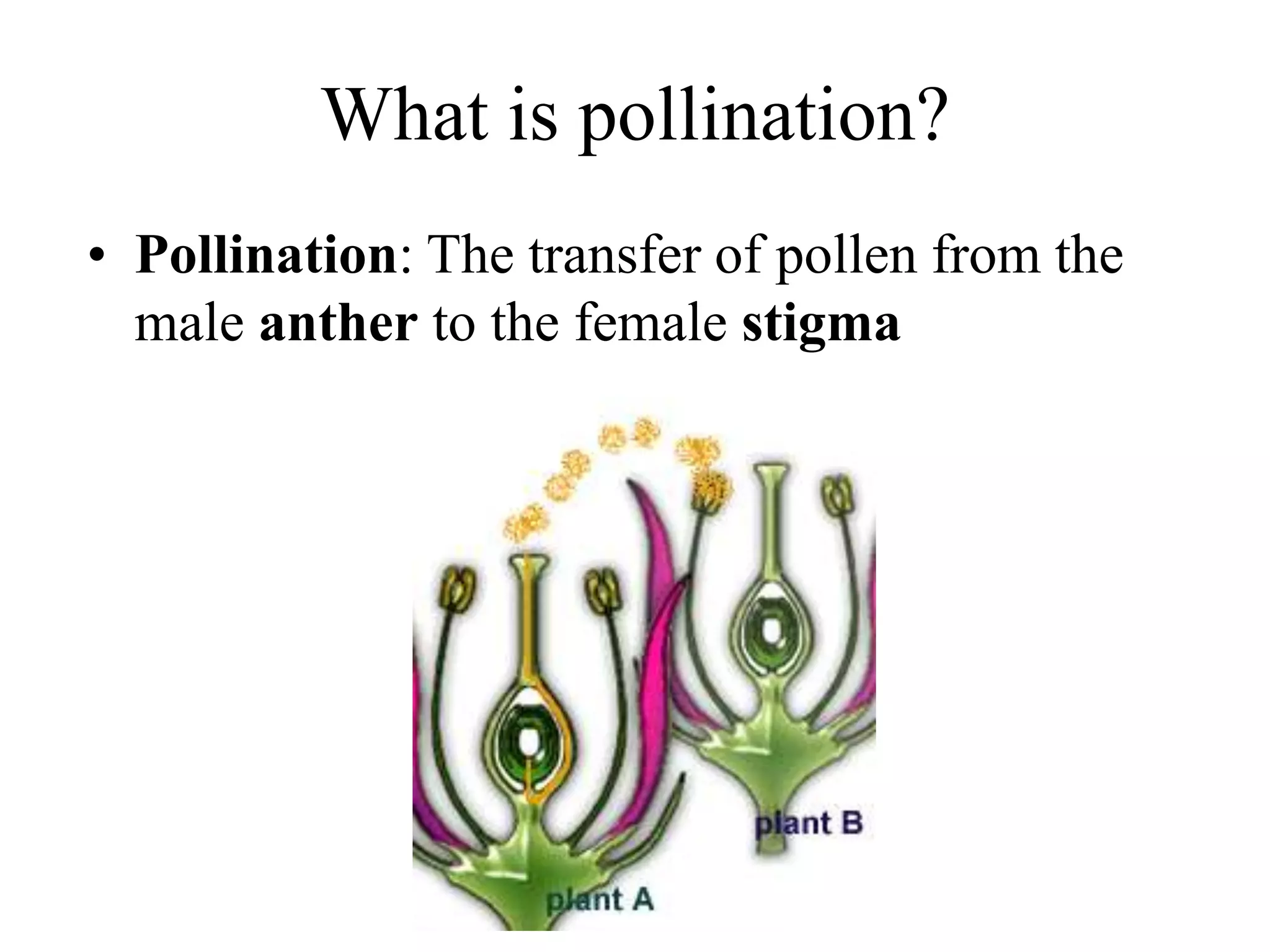
What is pollination?
• Pollination: The transfer of pollen from the
male anther to the female stigma
Why is pollination important?
• Sexual reproduction is important for
evolution:
• Sexual reproduction produces variable
offspring, creating diversity and variation
among populations (shuffling of genes)
• You need variation for Natural Selection to
occur
• Sexual reproduction is advantageous to an
organism only if it happens with someone other
than itself!
• Outbreeding = good! (inbreeding = bad…)
Sexual reproduction
• In animals: It’s easy because you have separate
male and female individuals.
• In flowering plants: Not so easy, because most
flowers have both male and female parts in them,
called perfect flowers.
• So flowering plants have evolved special ways to
insure outbreeding/outcrossing – and to prevent
inbreeding.
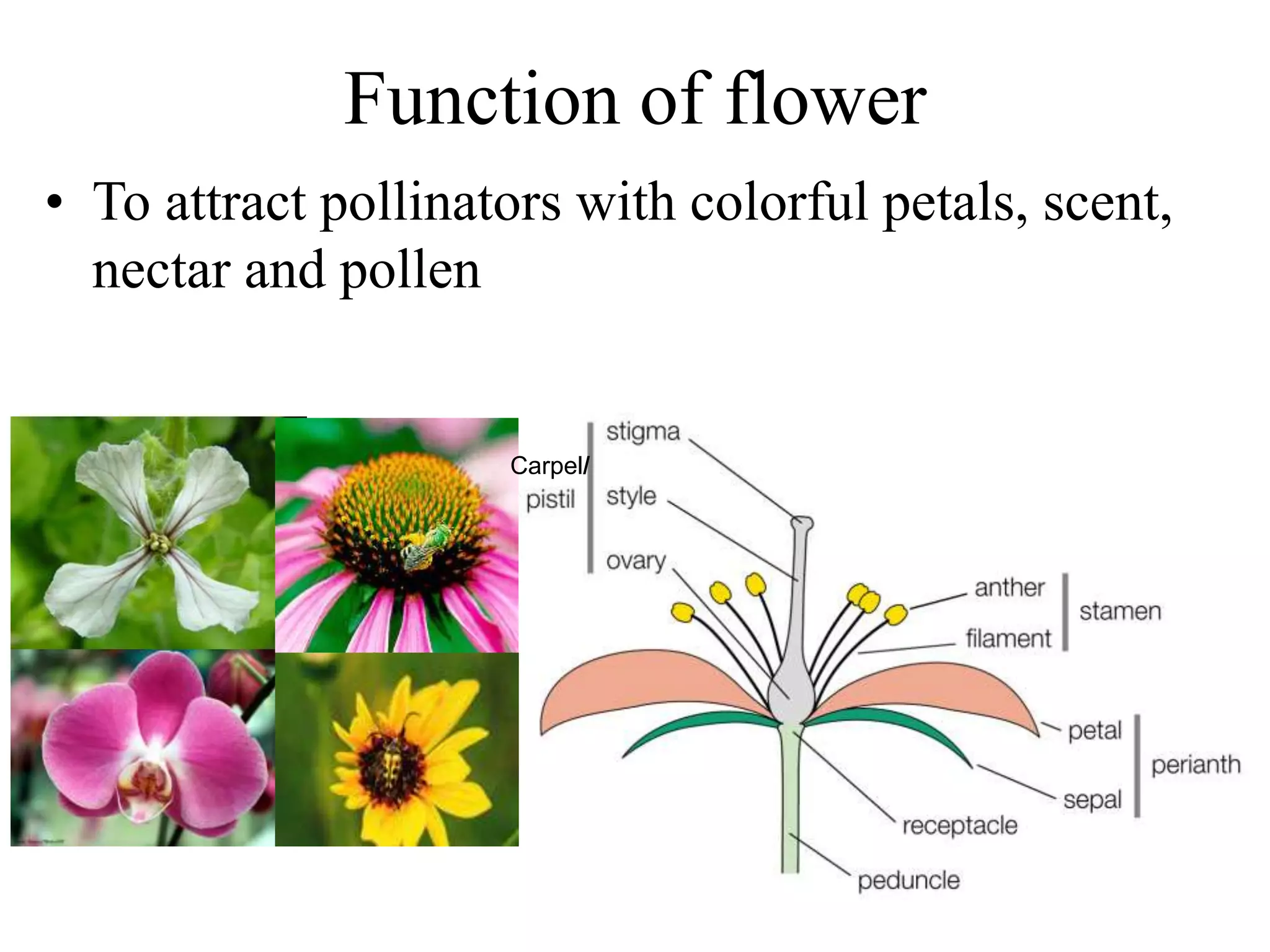
Function of flower
• To attract pollinators with colorful petals, scent,
nectar and pollen
Carpel/
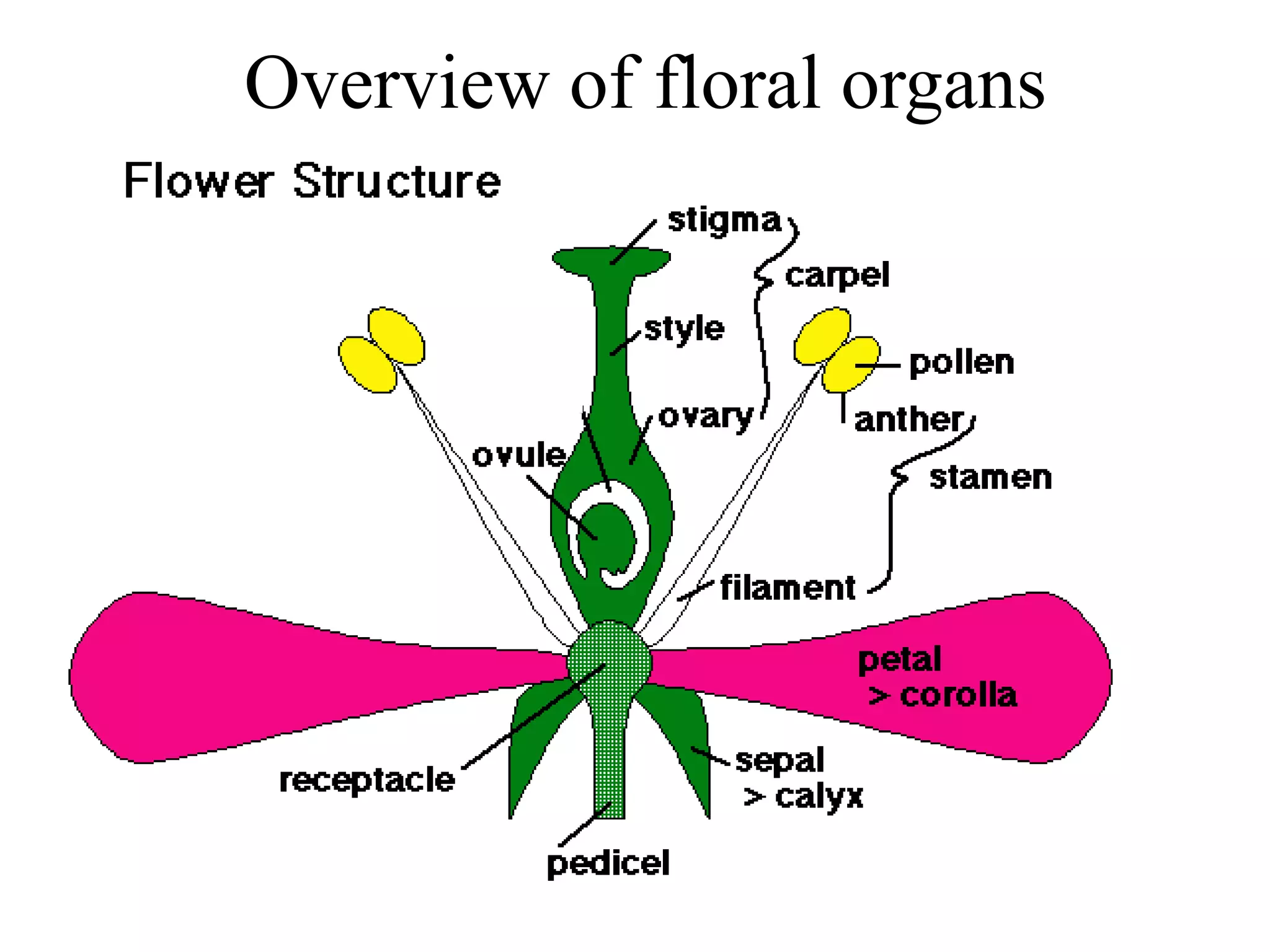
Overview of floral organs
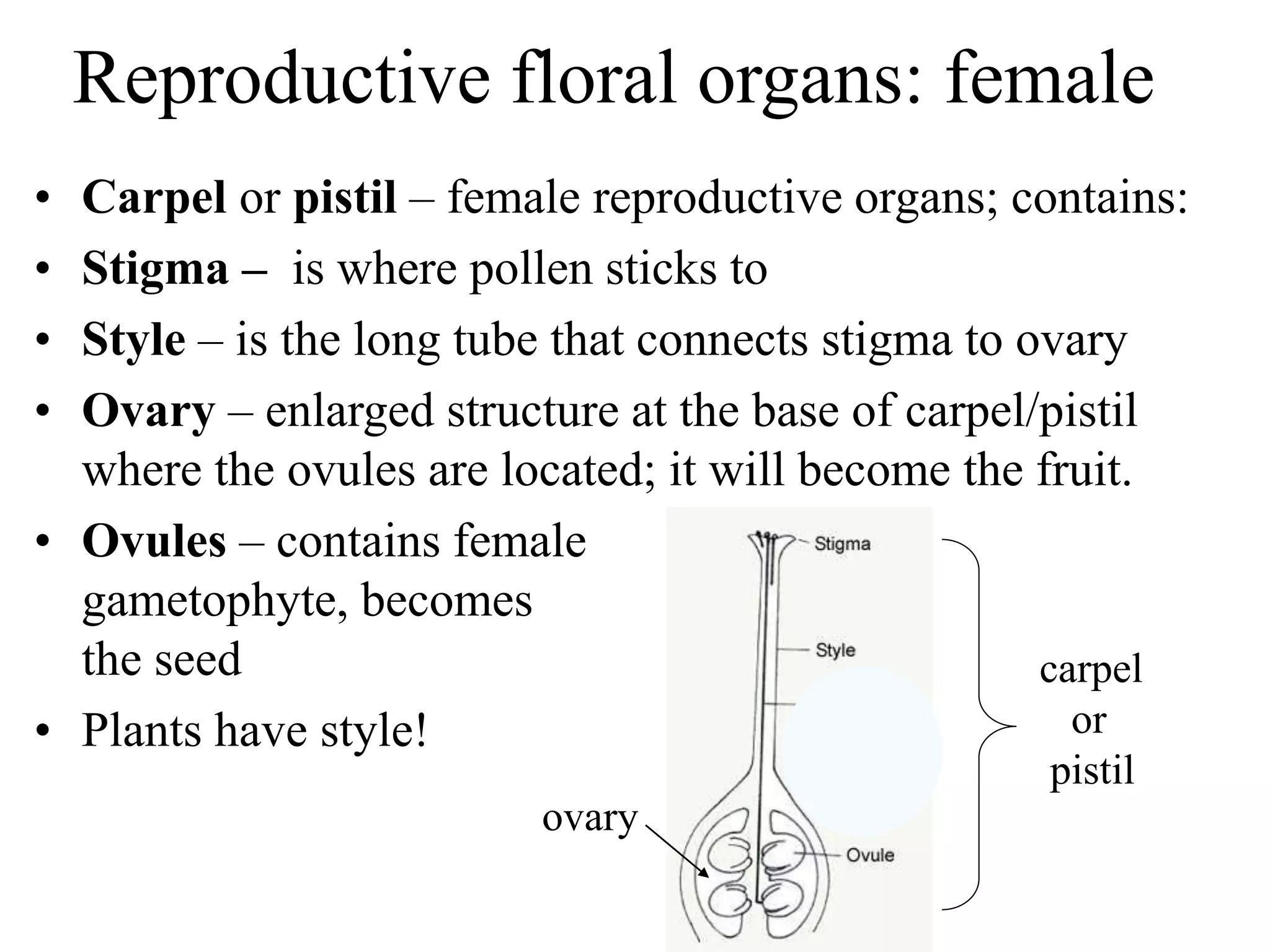
Reproductive floral organs: female
• Carpel or pistil – female reproductive organs; contains:
• Stigma – is where pollen sticks to
• Style – is the long tube that connects stigma to ovary
• Ovary – enlarged structure at the base of carpel/pistil
where the ovules are located; it will become the fruit.
• Ovules – contains female
gametophyte, becomes
the seed
• Plants have style!
carpel
or
pistil
ovary
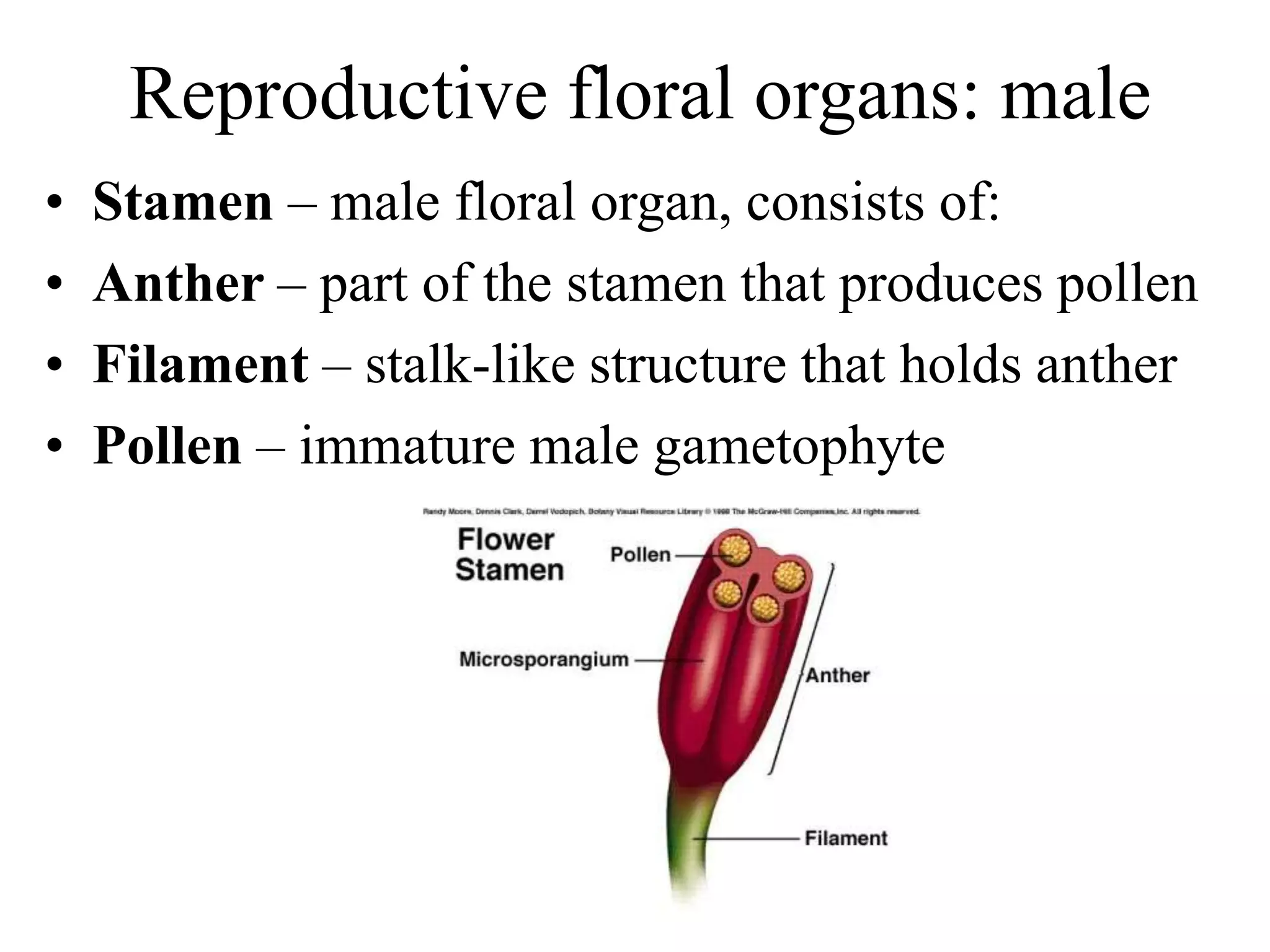
Reproductive floral organs: male
• Stamen – male floral organ, consists of:
• Anther – part of the stamen that produces pollen
• Filament – stalk-like structure that holds anther
• Pollen – immature male gametophyte
Non-reproductive floral organs
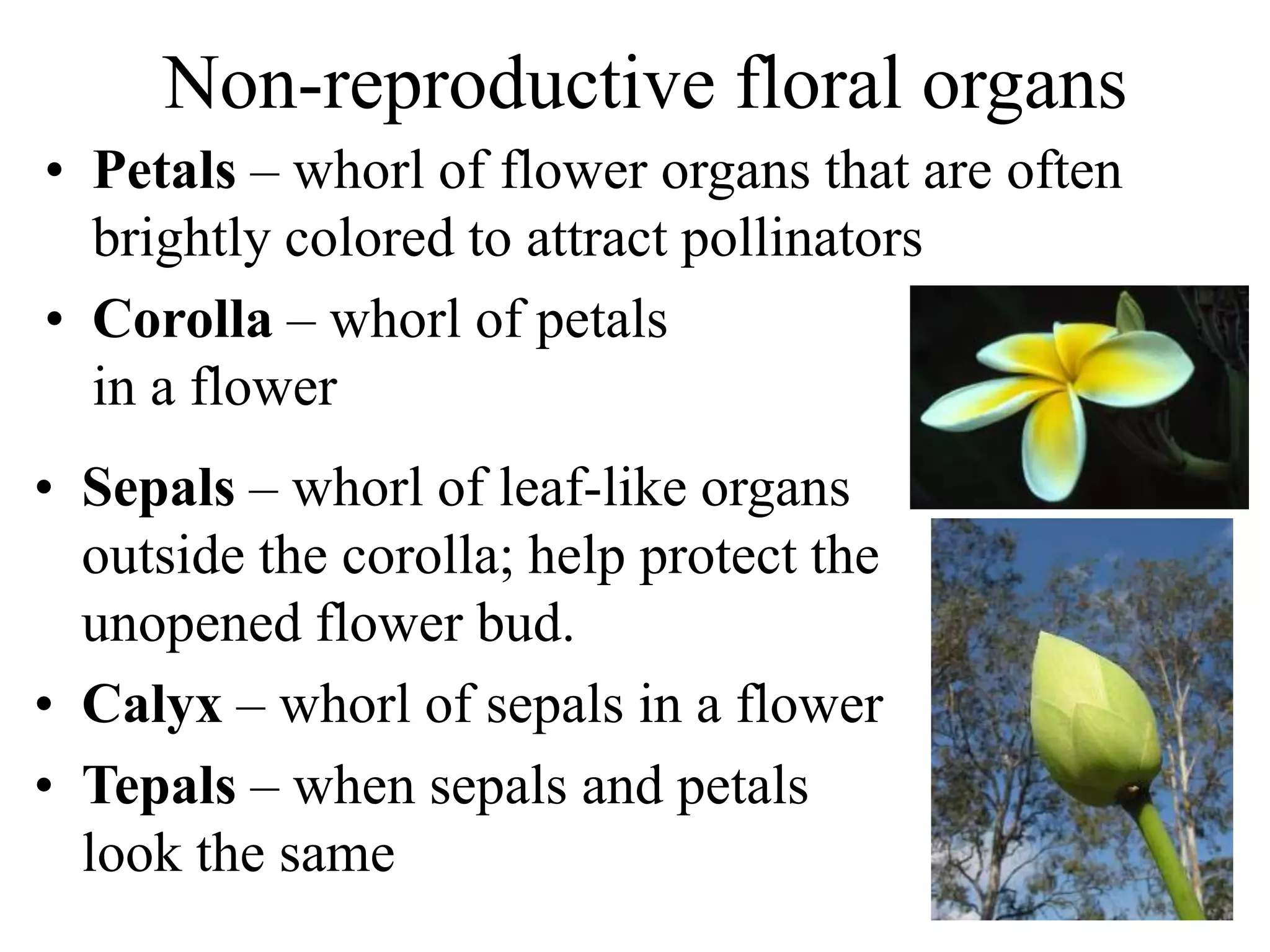
• Petals – whorl of flower organs that are often
brightly colored to attract pollinators
• Corolla – whorl of petals
in a flower
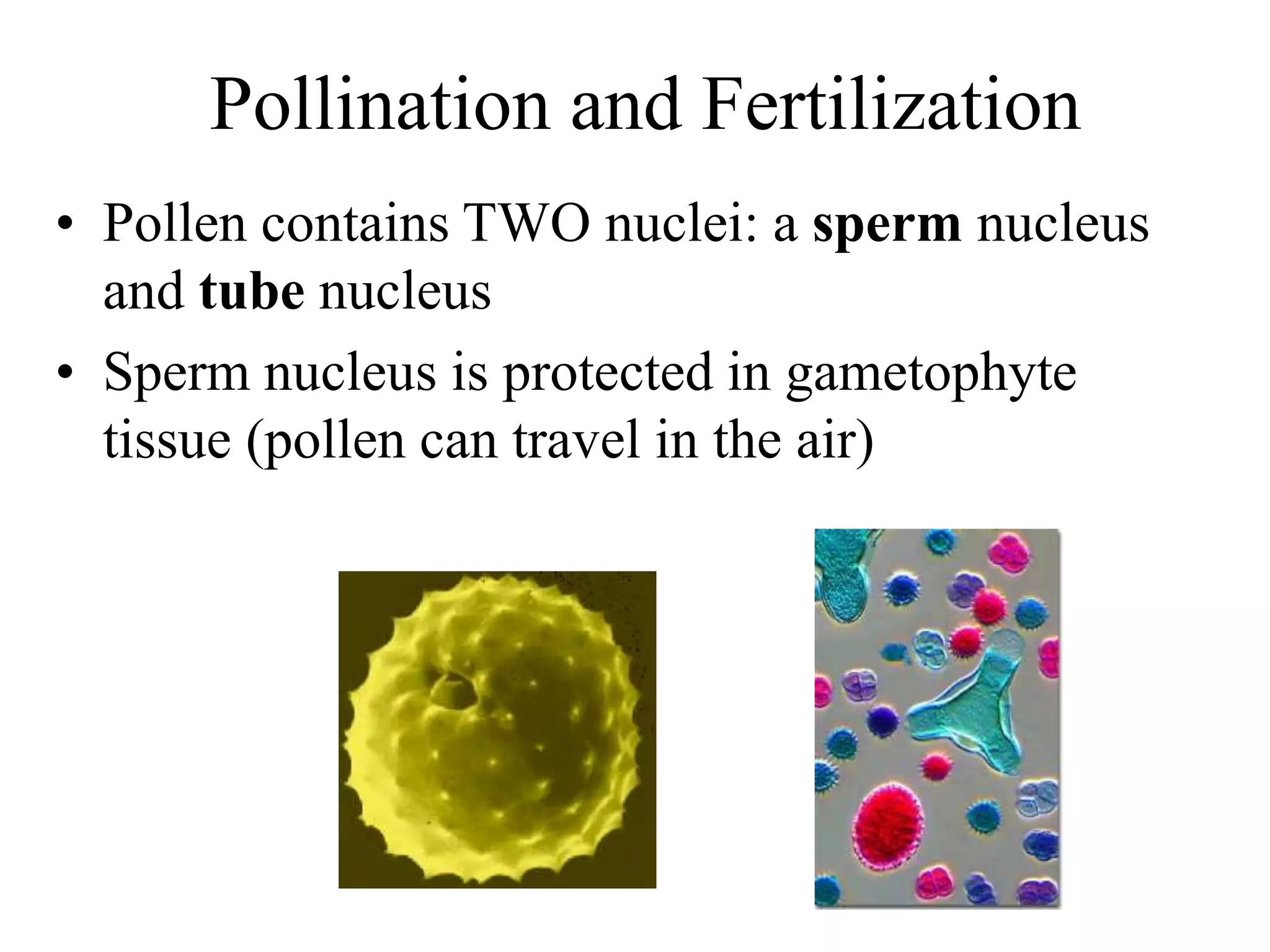
• Sepals – whorl of leaf-like organs
outside the corolla; help protect the
unopened flower bud.
• Calyx – whorl of sepals in a flower
• Tepals – when sepals and petals
look the same
Pollination and Fertilization
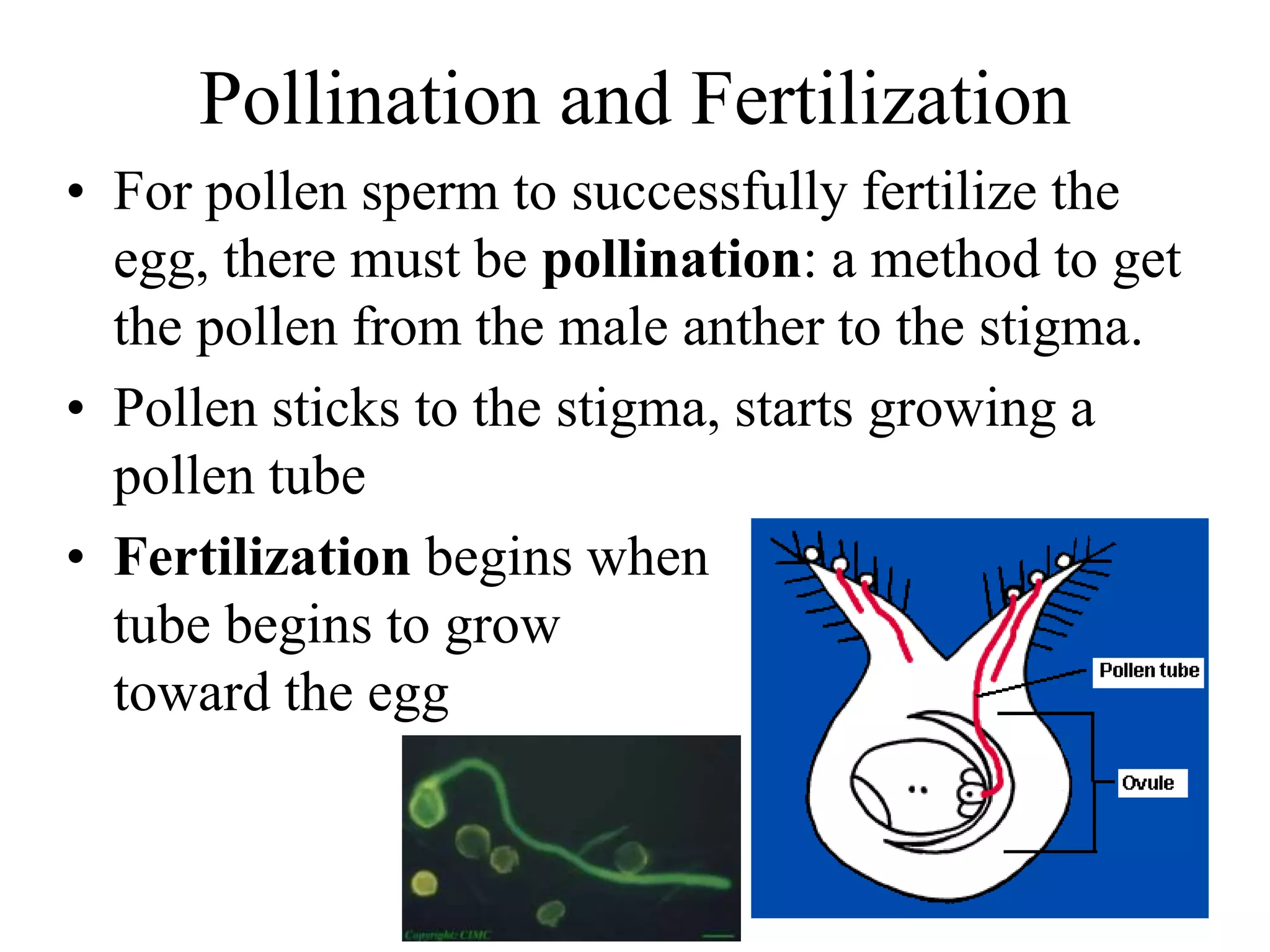
• Pollen contains TWO nuclei: a sperm nucleus
and tube nucleus
• Sperm nucleus is protected in gametophyte
tissue (pollen can travel in the air)
Pollination and Fertilization
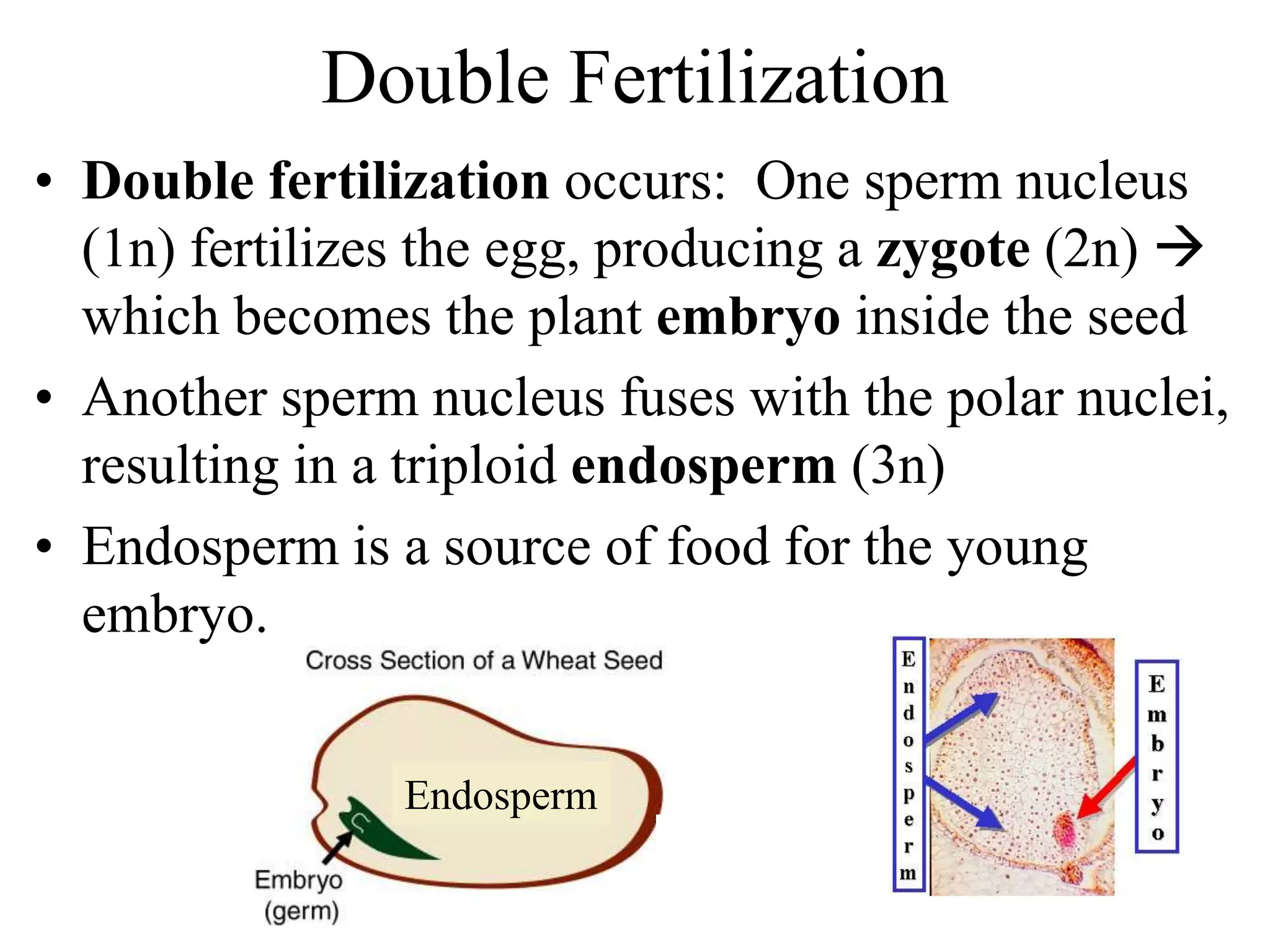
• For pollen sperm to successfully fertilize the
egg, there must be pollination: a method to get
the pollen from the male anther to the stigma.
• Pollen sticks to the stigma, starts growing a
pollen tube
• Fertilization begins when
tube begins to grow
toward the egg
Double Fertilization
• Double fertilization occurs: One sperm nucleus
(1n) fertilizes the egg, producing a zygote (2n) 
which becomes the plant embryo inside the seed
• Another sperm nucleus fuses with the polar nuclei,
resulting in a triploid endosperm (3n)
• Endosperm is a source of food for the young
embryo.
Endosperm
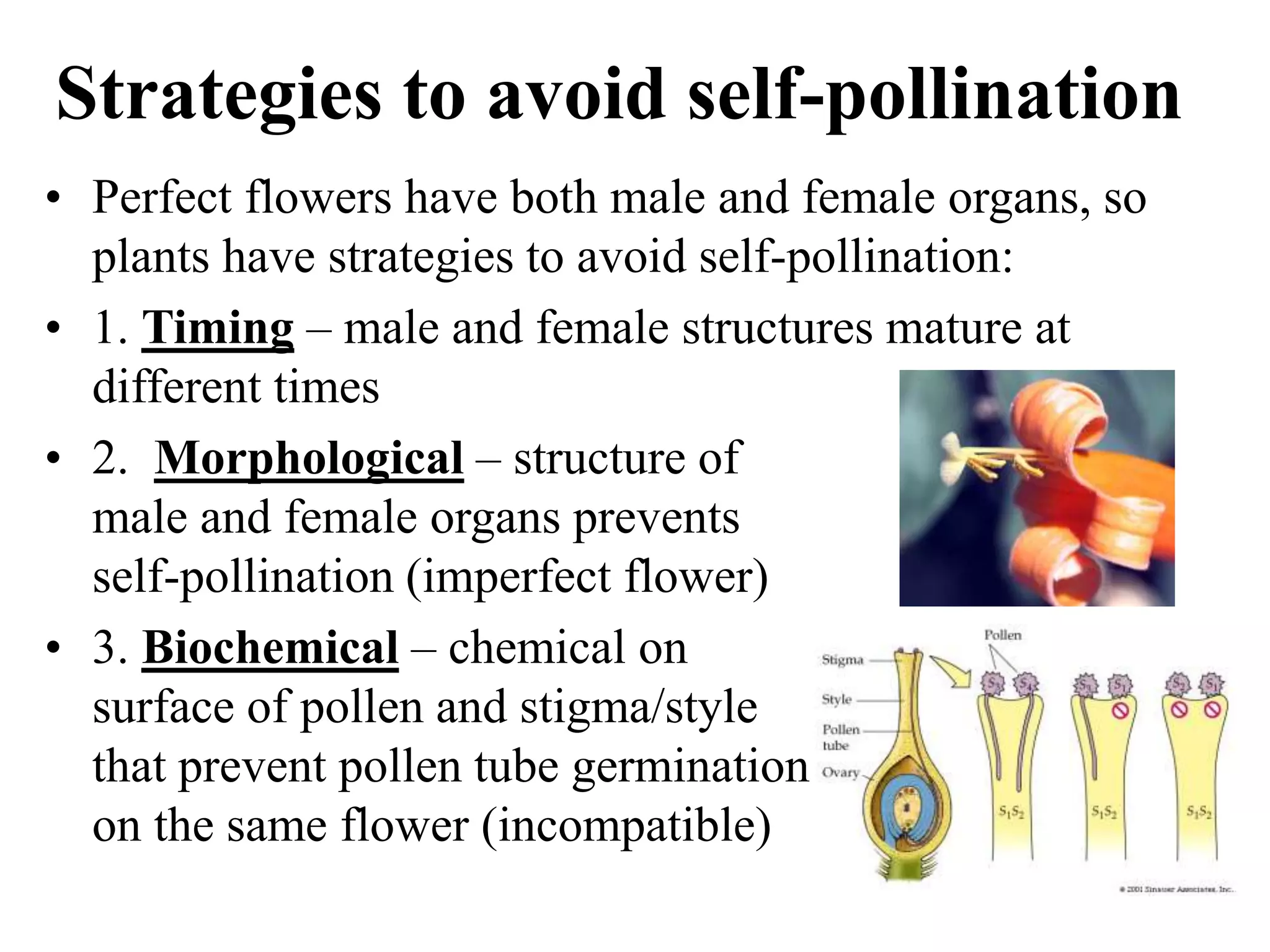
Strategies to avoid self-pollination
• Perfect flowers have both male and female organs, so
plants have strategies to avoid self-pollination:
• 1. Timing – male and female structures mature at
different times
• 2. Morphological – structure of
male and female organs prevents
self-pollination (imperfect flower)
• 3. Biochemical – chemical on
surface of pollen and stigma/style
that prevent pollen tube germination
on the same flower (incompatible)
How do plants get pollen from one
plant to another?
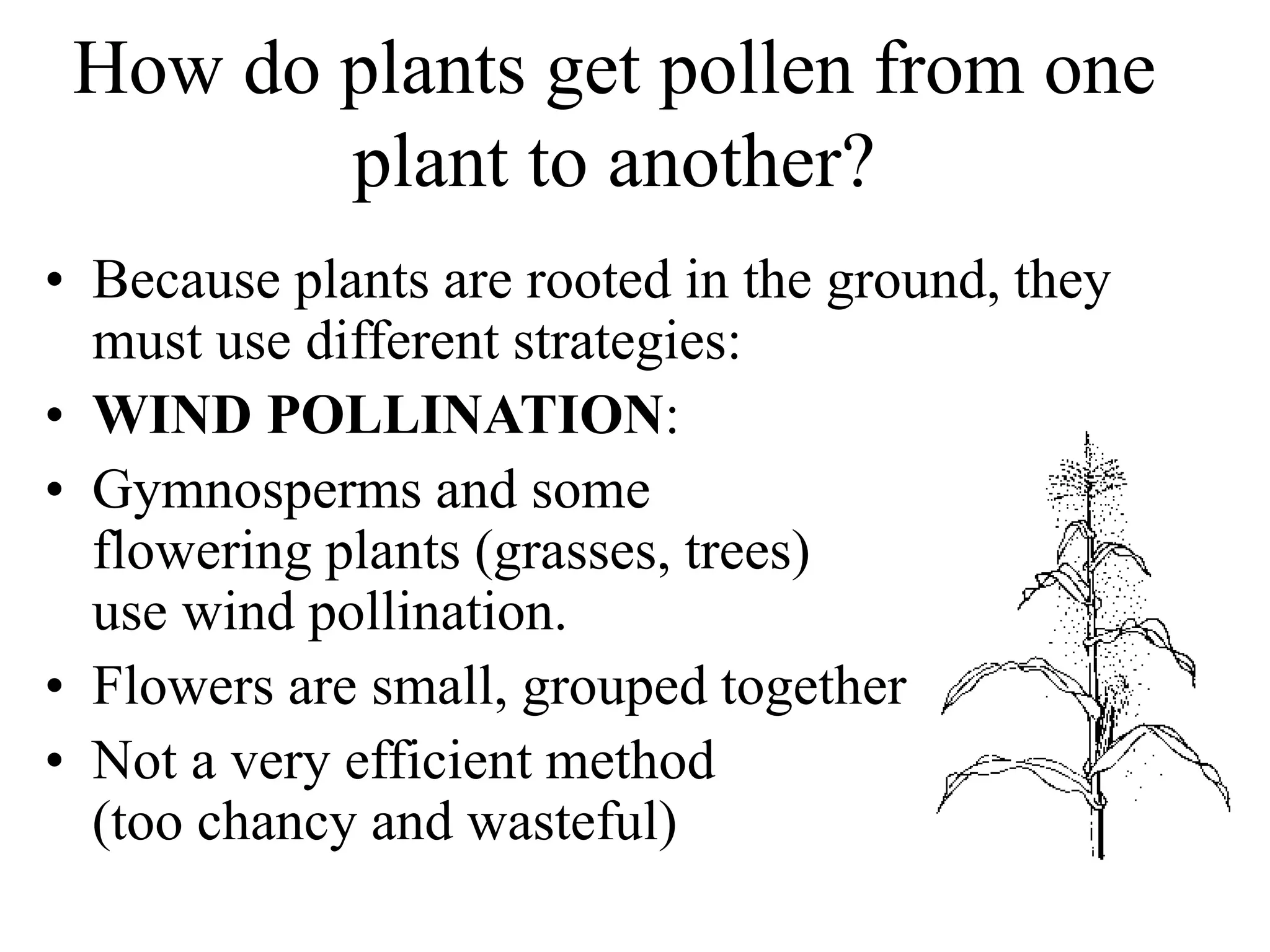
• Because plants are rooted in the ground, they
must use different strategies:
• WIND POLLINATION:
• Gymnosperms and some
flowering plants (grasses, trees)
use wind pollination.
• Flowers are small, grouped together
• Not a very efficient method
(too chancy and wasteful)
ANIMALS
• Many flowering plants rely on animals for cross-
pollination:
• Insects – bees, wasps, flies, butterflies, moths
• Birds – hummingbirds, honey creepers
• Mammals – bats, mice, monkeys
• Even some reptiles and amphibians!
Coevolution
• Coevolution – interactions between two
different species as selective forces on each
other, resulting in adaptations that increase their
interdependency.
• Animal-flowering plant interaction is a classic
example of coevolution:
• 1. Plants evolve elaborate methods to attract
animal pollinators
• 2. Animals evolved specialized body parts and
behaviors that aid plant pollination
A word about pollen…
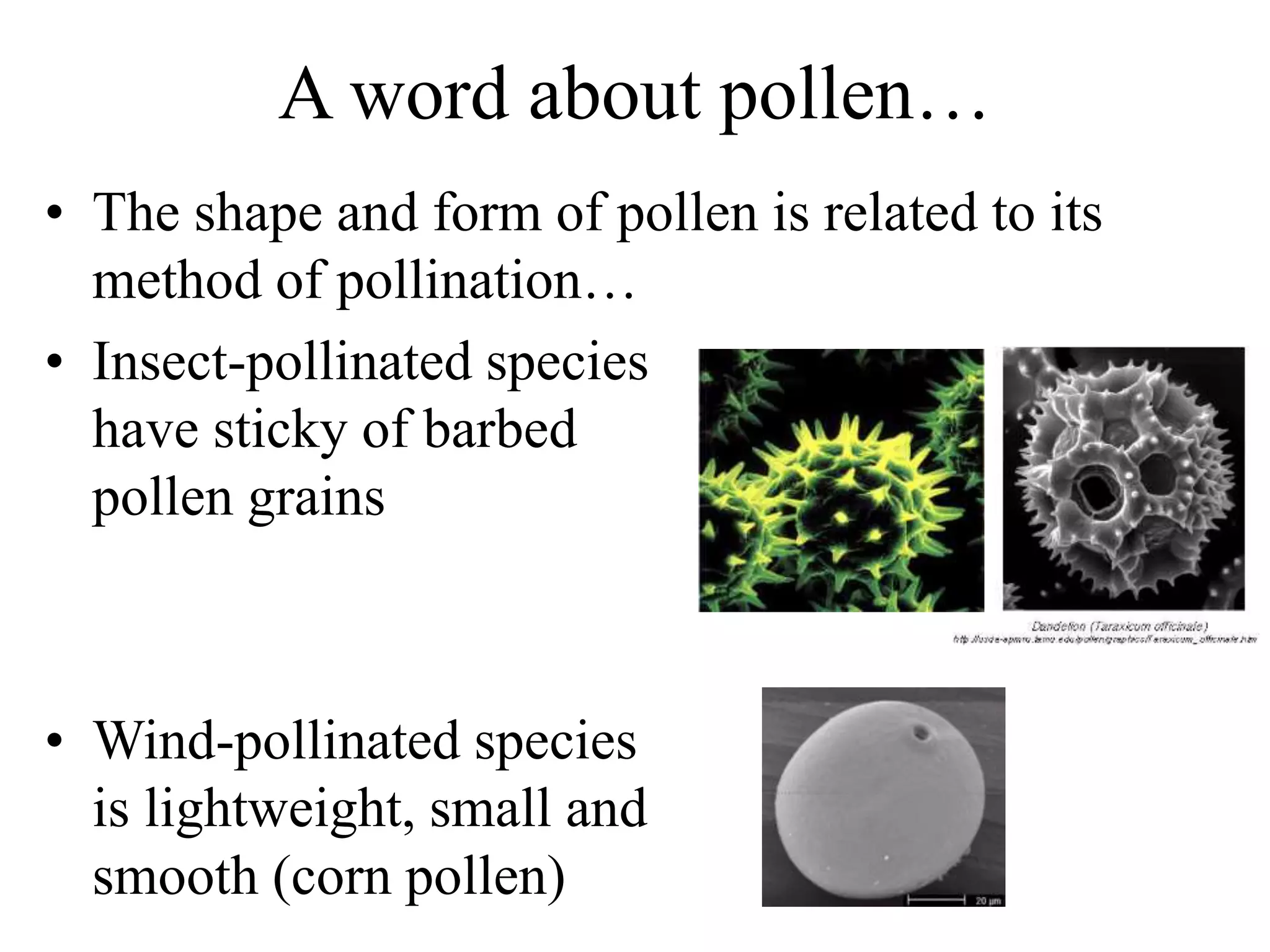
• The shape and form of pollen is related to its
method of pollination…
• Insect-pollinated species
have sticky of barbed
pollen grains
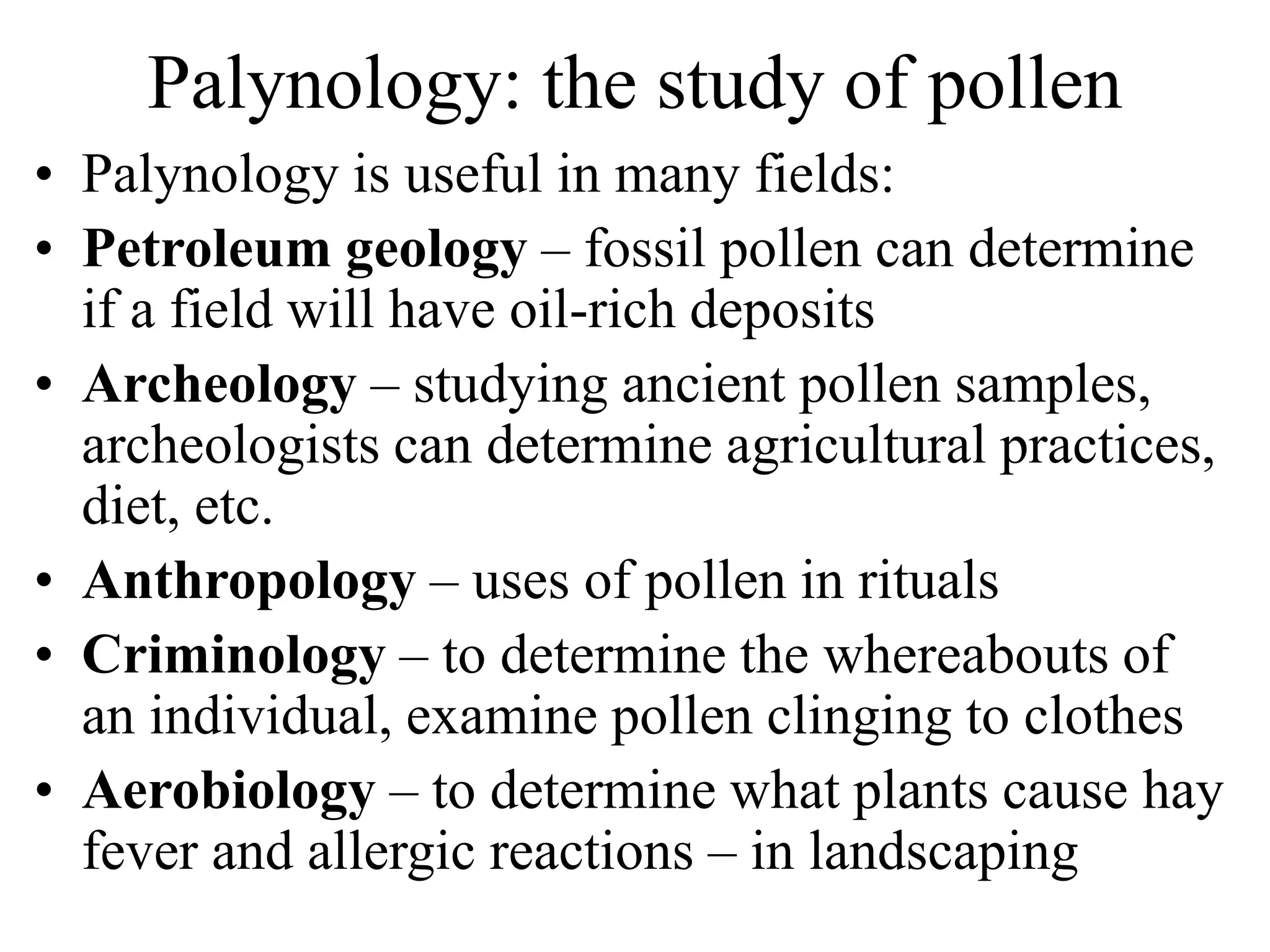
• Wind-pollinated species
is lightweight, small and
smooth (corn pollen)
Palynology: the study of pollen
• Palynology is useful in many fields:
• Petroleum geology – fossil pollen can determine
if a field will have oil-rich deposits
• Archeology – studying ancient pollen samples,
archeologists can determine agricultural practices,
diet, etc.
• Anthropology – uses of pollen in rituals
• Criminology – to determine the whereabouts of
an individual, examine pollen clinging to clothes
• Aerobiology – to determine what plants cause hay
fever and allergic reactions – in landscaping
Animal pollinators: Bees
• Bees – are the most important group of flower
pollinators
• They live on the nectar and feed
larvae, also eat the pollen.
• Bees are guided by sight and
smell
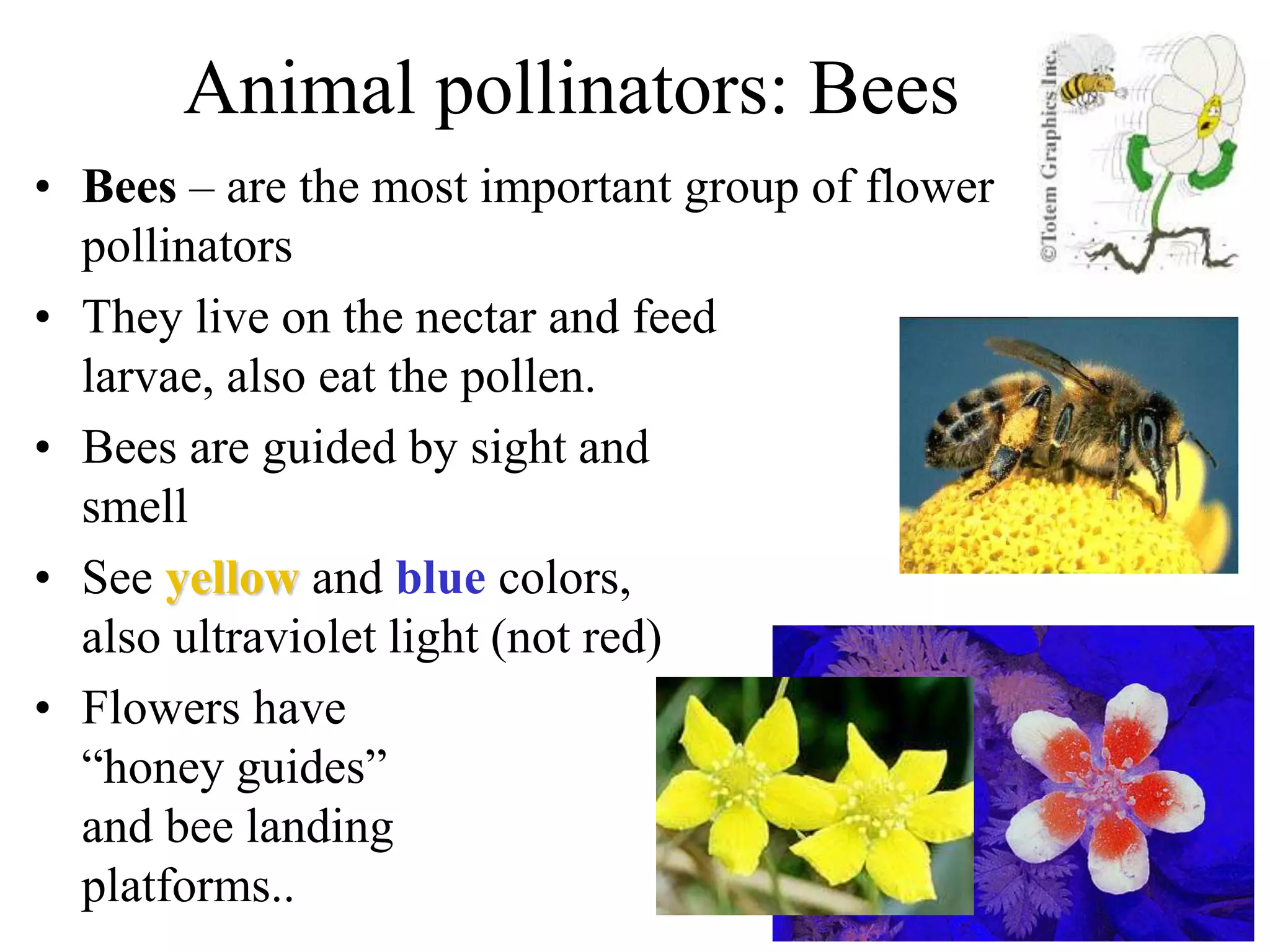
• See yellow and blue colors,
also ultraviolet light (not red)
• Flowers have
“honey guides”
and bee landing
platforms..
Butterflies and moths
• Also guided by sight and smell
• Butterflies can see red and orange
flowers
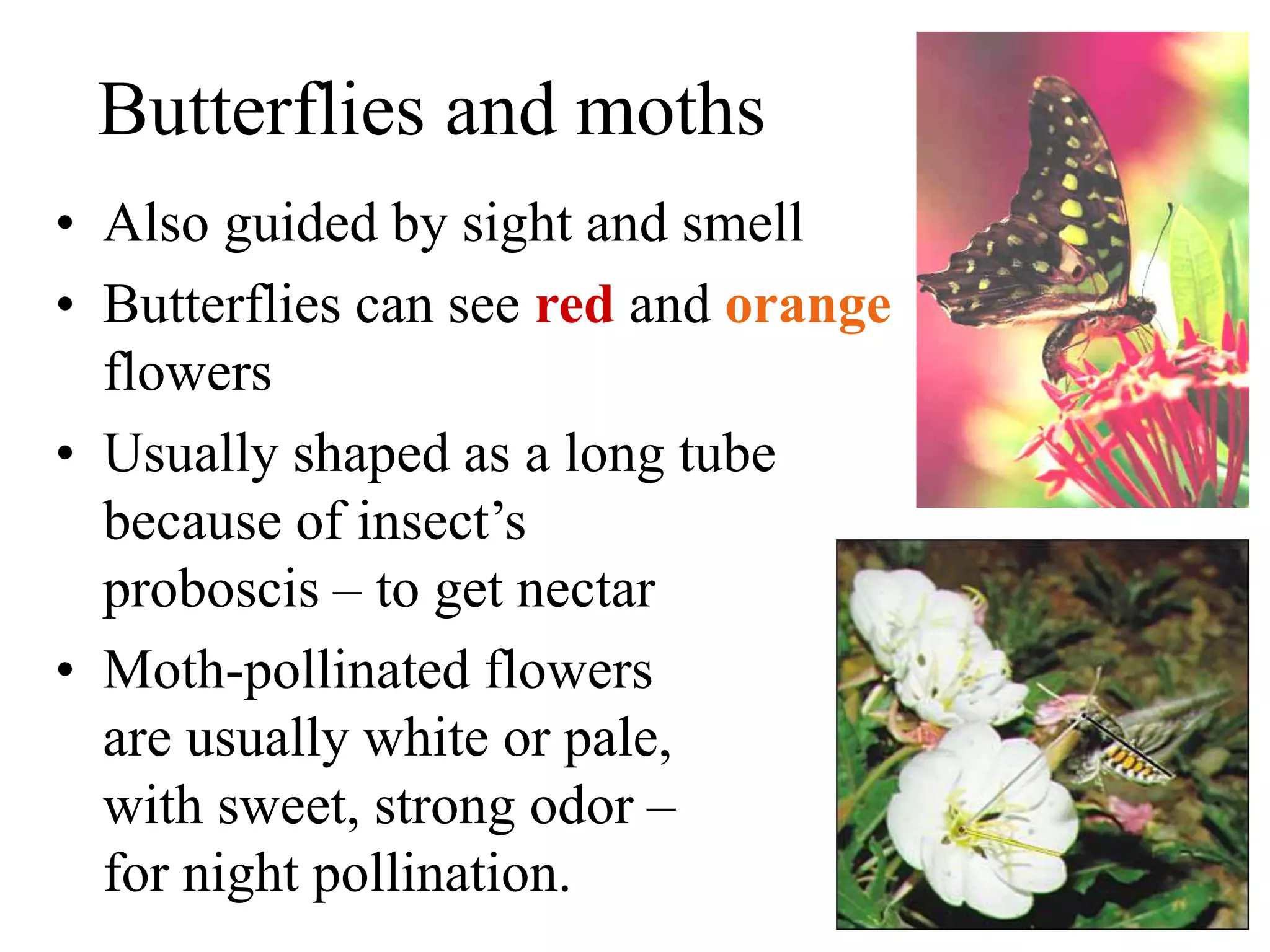
• Usually shaped as a long tube
because of insect’s
proboscis – to get nectar
• Moth-pollinated flowers
are usually white or pale,
with sweet, strong odor –
for night pollination.
Flies and beetles
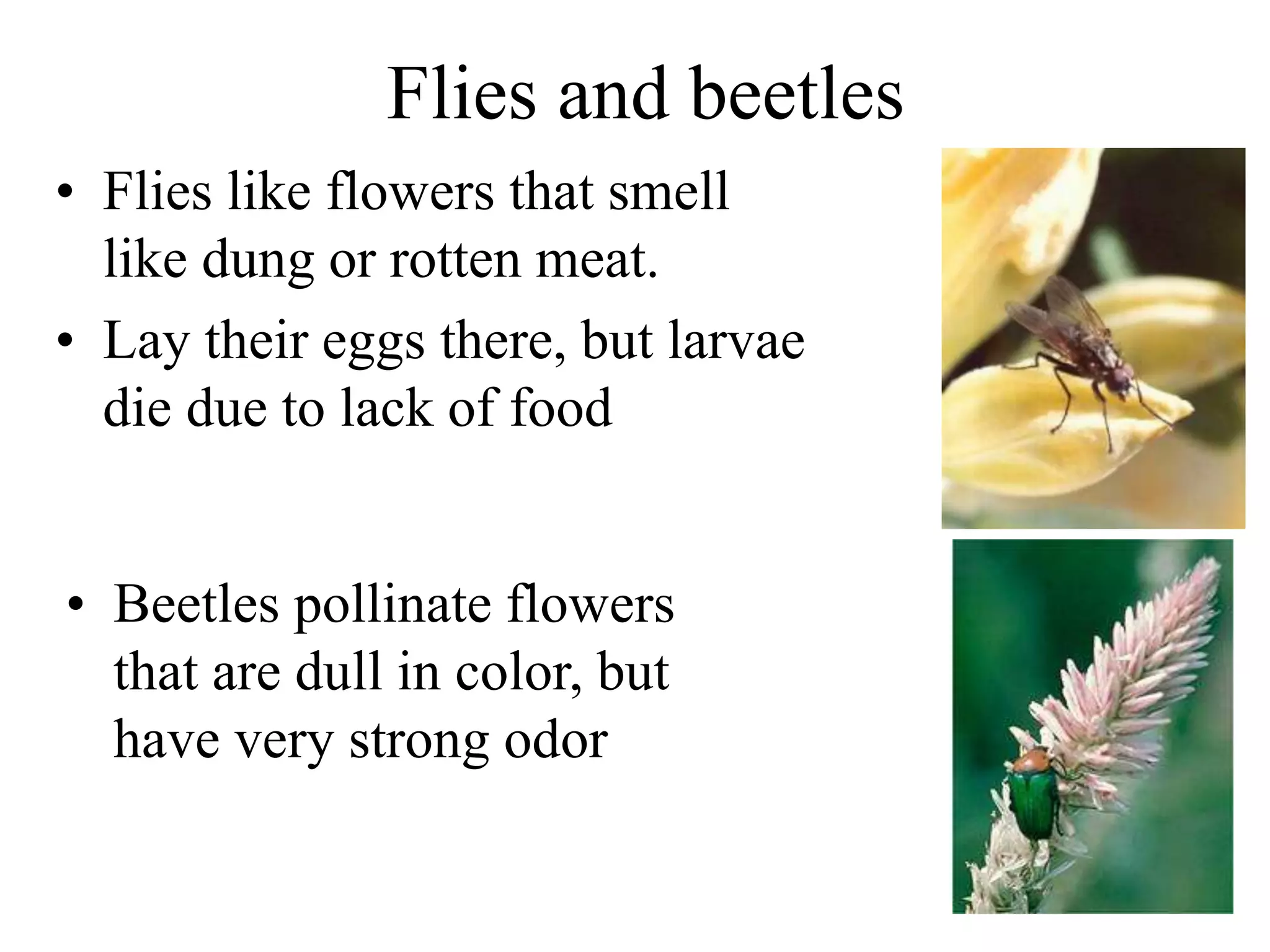
• Flies like flowers that smell
like dung or rotten meat.
• Lay their eggs there, but larvae
die due to lack of food
• Beetles pollinate flowers
that are dull in color, but
have very strong odor
Birds
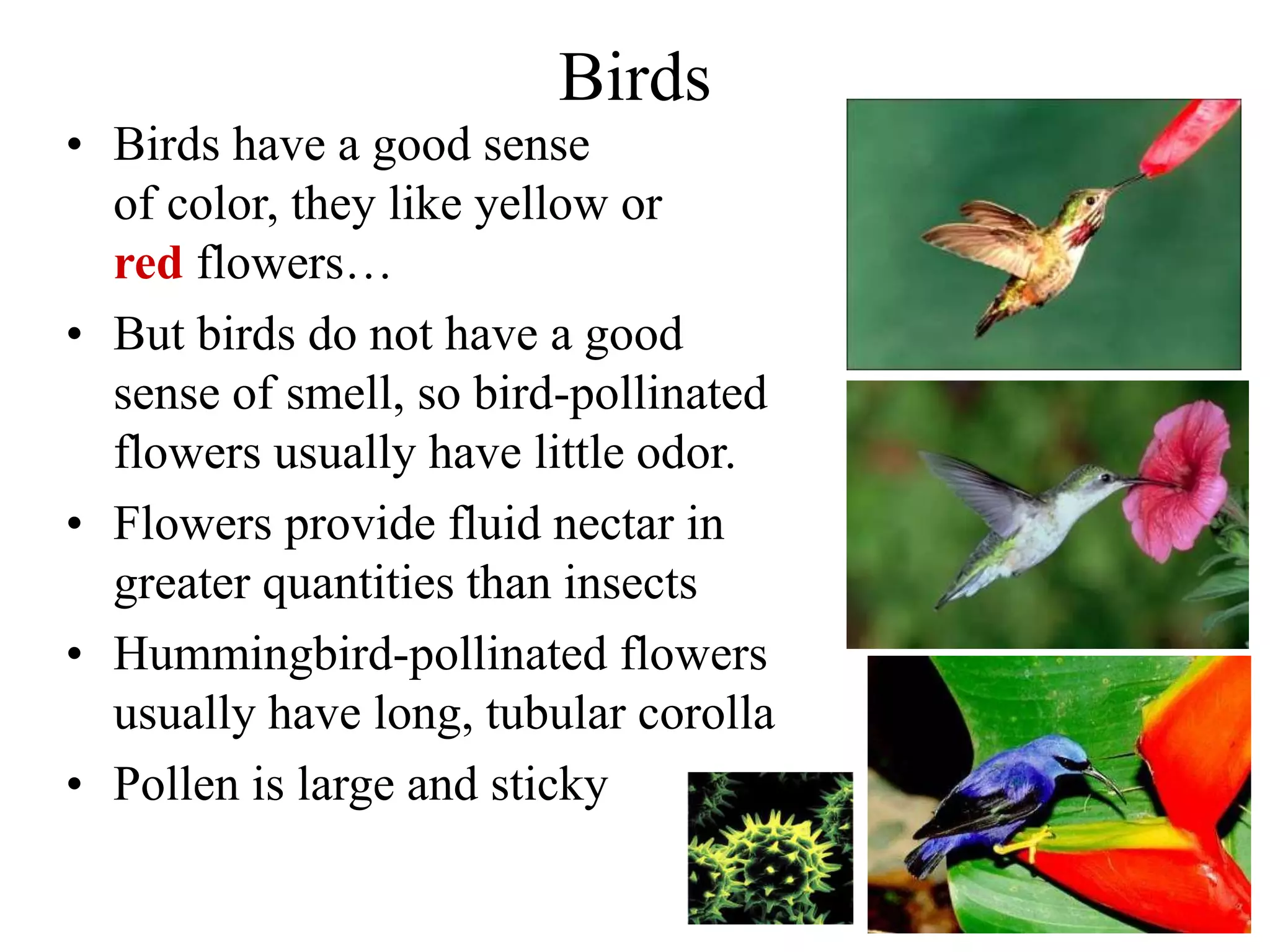
• Birds have a good sense
of color, they like yellow or
red flowers…
• But birds do not have a good
sense of smell, so bird-pollinated
flowers usually have little odor.
• Flowers provide fluid nectar in
greater quantities than insects
• Hummingbird-pollinated flowers
usually have long, tubular corolla
• Pollen is large and sticky
Mammals: bats and mice
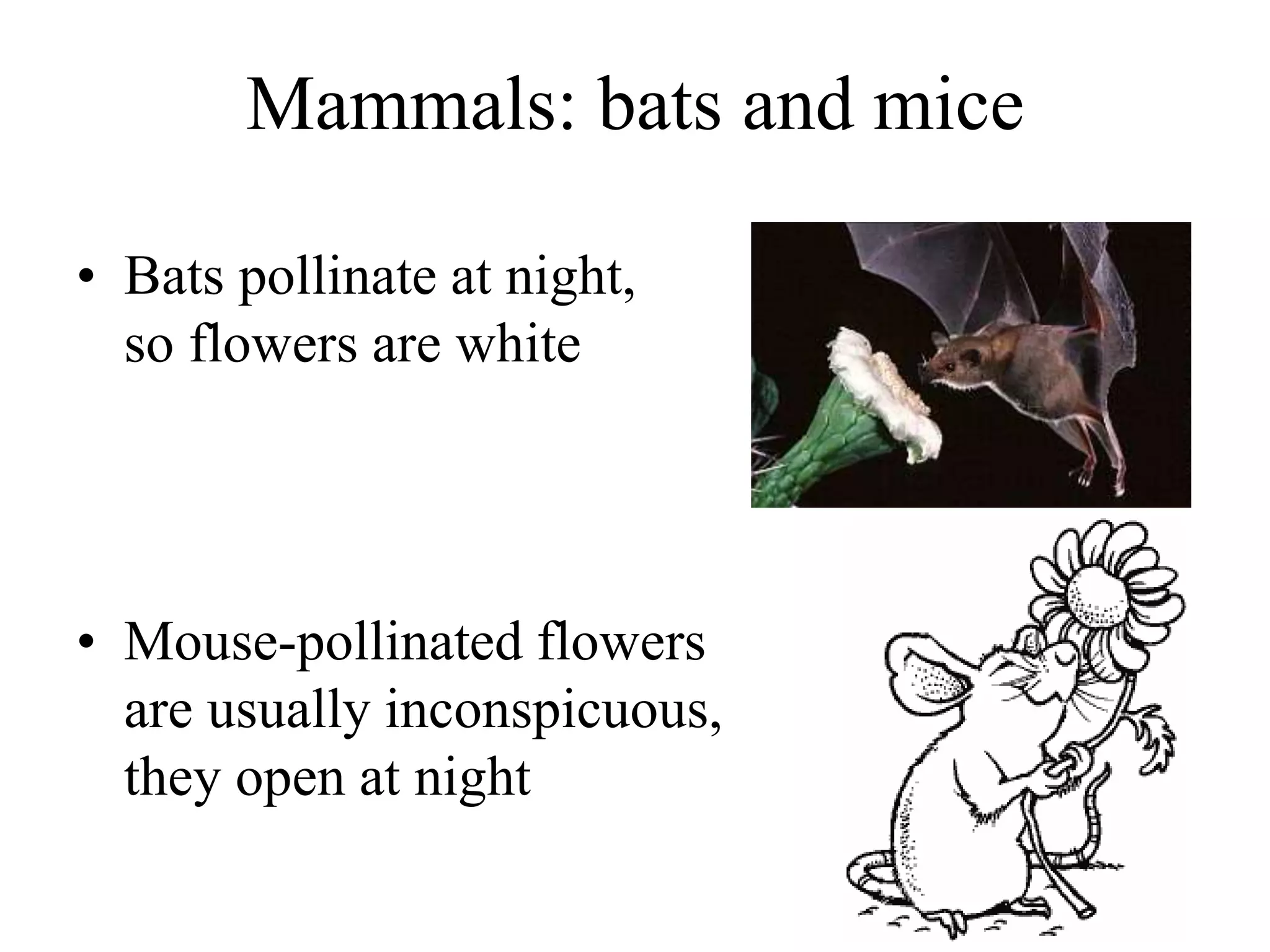
• Bats pollinate at night,
so flowers are white
• Mouse-pollinated flowers
are usually inconspicuous,
they open at night
Why do animals pollinate plants?
• They get a REWARD: food! In
exchange for moving their pollen
to another flower
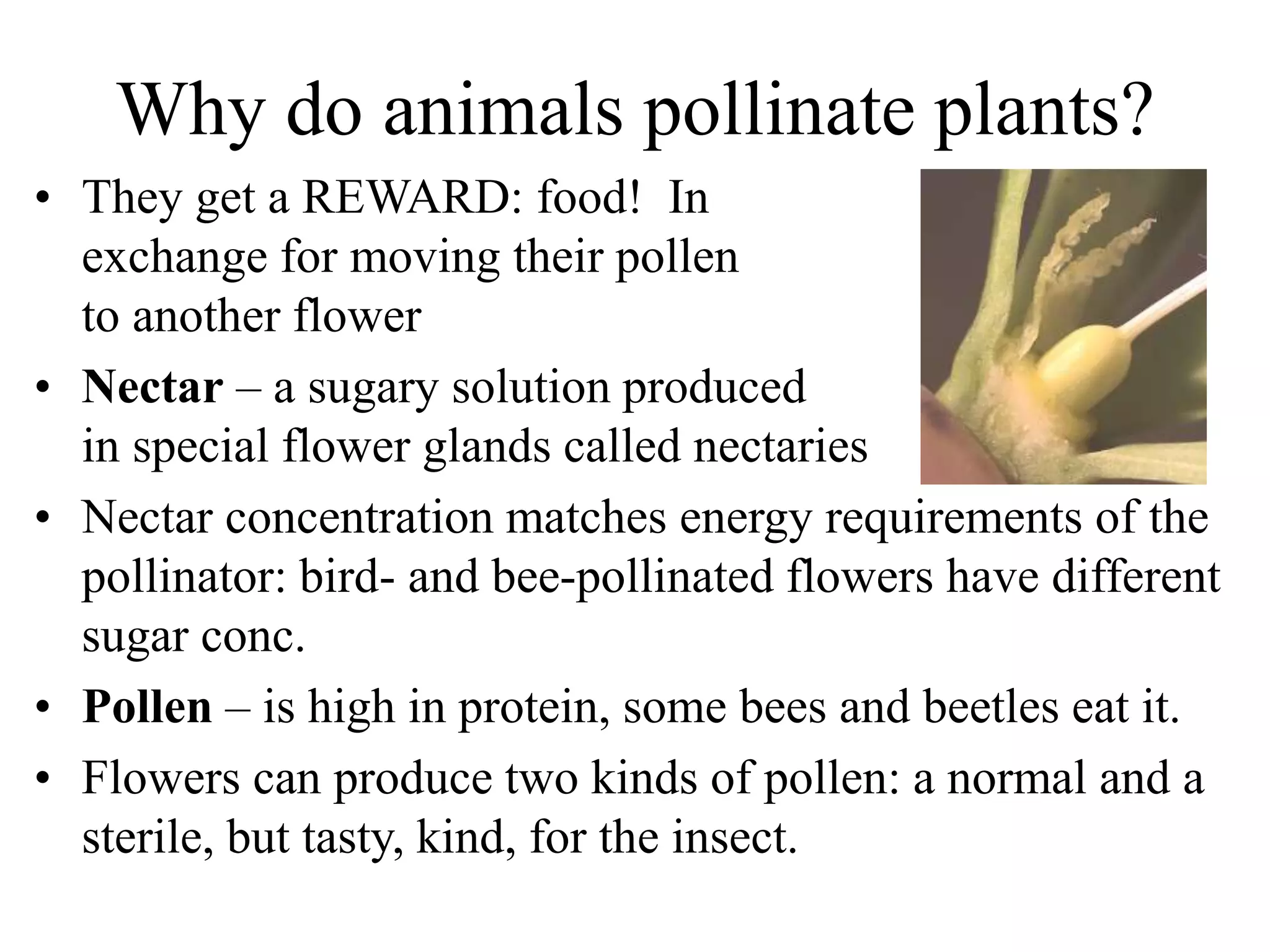
• Nectar – a sugary solution produced
in special flower glands called nectaries
• Nectar concentration matches energy requirements of the
pollinator: bird- and bee-pollinated flowers have different
sugar conc.
• Pollen – is high in protein, some bees and beetles eat it.
• Flowers can produce two kinds of pollen: a normal and a
sterile, but tasty, kind, for the insect.
Getting the pollinator’s attention
• Plants advertise their pollen and nectar rewards
with
• Colors – bees see blue, yellow, UV; while birds
see red. Bats don’t see well, so flowers are
white.
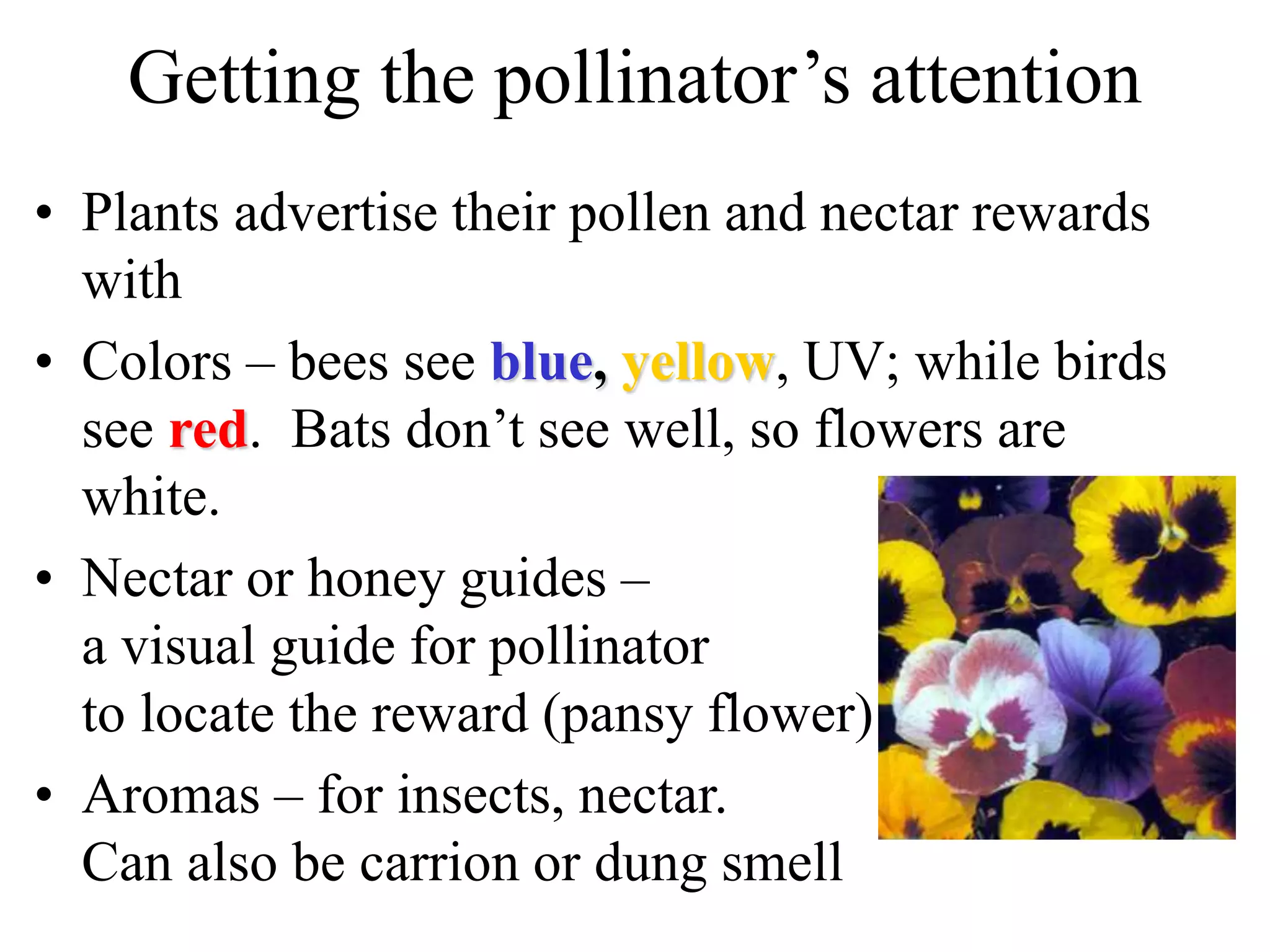
• Nectar or honey guides –
a visual guide for pollinator
to locate the reward (pansy flower)
• Aromas – for insects, nectar.
Can also be carrion or dung smell
Plant Mimicry
• Some plants take advantage of the sex drive of
certain insects…
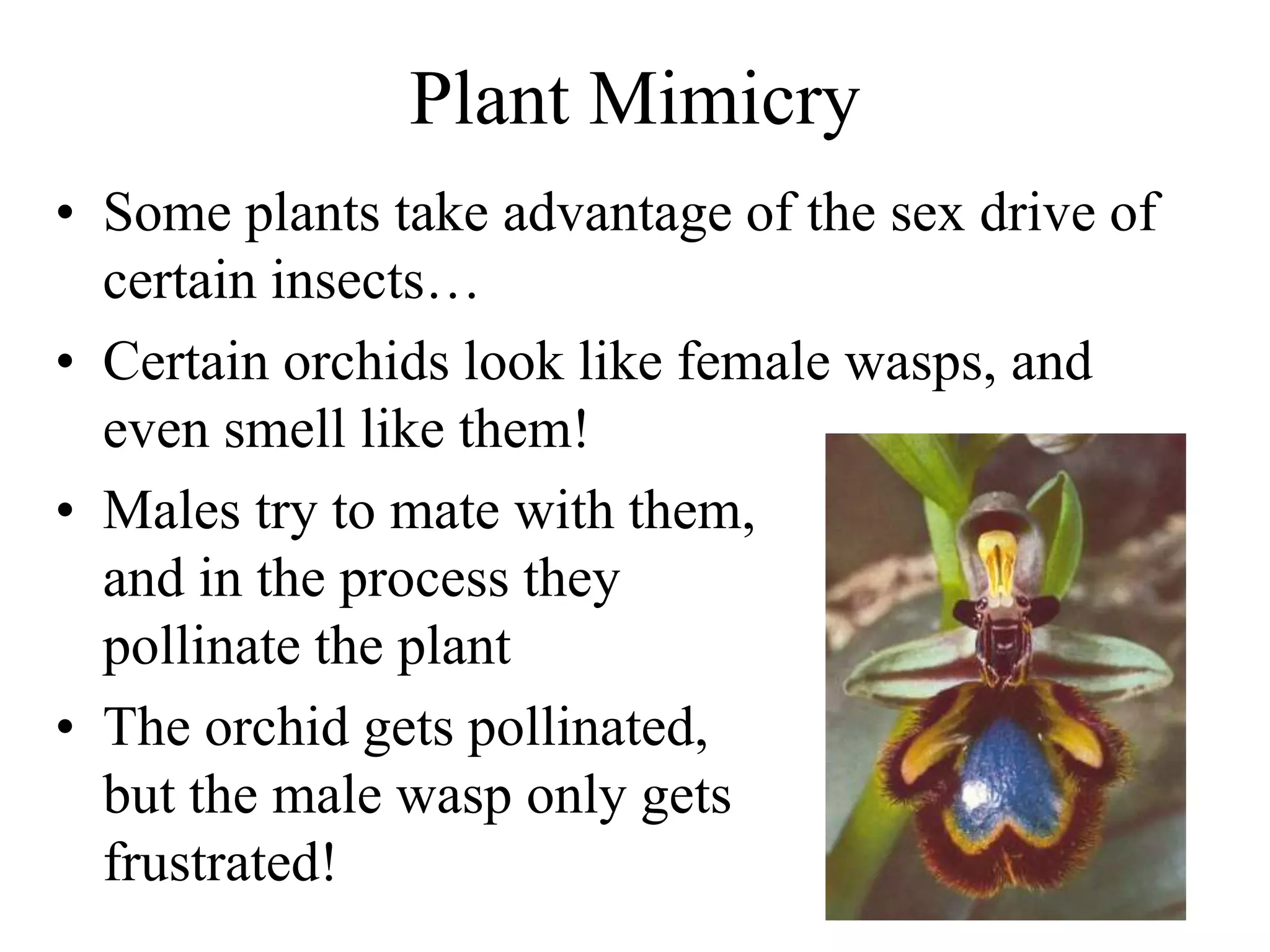
• Certain orchids look like female wasps, and
even smell like them!
• Males try to mate with them,
and in the process they
pollinate the plant
• The orchid gets pollinated,
but the male wasp only gets
frustrated!
Watch video, take notes, questions
• What causes “hay fever”? __________________
• What carries pollen released by grasses (corn)? ________
• A flower with both male/female structures is a ___flower
• What increases genetic variability in a population?____
• What color flowers do birds pollinate? Bees? Moths?
• Why are bird-pollinated flowers usually odorless?______
• What time of the day do bats pollinate?______________
• What two rewards do insects get from flowers?________
• Flies and butterflies reach the nectar using a long ______
• Flies pollinate flowers that smell like rotting __________
• Why do some orchids look and smell like wasps?______

Lec13_Pollination.ppt

  • 1.
    Lecture 13: POLLINATION •Remember exam is on Thursday March 18 • Review session: Wed. at 5:00 pm, 0226 HJP • Today…. • Value of sexual reproduction • Pollination and fertilization • Coevolution • Pollen • Types of pollinators • Rewards and attractants for pollinators • Awesome video!
  • 2.
    What is pollination? •Pollination: The transfer of pollen from the male anther to the female stigma
  • 3.
    Why is pollinationimportant? • Sexual reproduction is important for evolution: • Sexual reproduction produces variable offspring, creating diversity and variation among populations (shuffling of genes) • You need variation for Natural Selection to occur • Sexual reproduction is advantageous to an organism only if it happens with someone other than itself! • Outbreeding = good! (inbreeding = bad…)
  • 4.
    Sexual reproduction • Inanimals: It’s easy because you have separate male and female individuals. • In flowering plants: Not so easy, because most flowers have both male and female parts in them, called perfect flowers. • So flowering plants have evolved special ways to insure outbreeding/outcrossing – and to prevent inbreeding.
  • 5.
    Function of flower •To attract pollinators with colorful petals, scent, nectar and pollen Carpel/
  • 6.
  • 7.
    Reproductive floral organs:female • Carpel or pistil – female reproductive organs; contains: • Stigma – is where pollen sticks to • Style – is the long tube that connects stigma to ovary • Ovary – enlarged structure at the base of carpel/pistil where the ovules are located; it will become the fruit. • Ovules – contains female gametophyte, becomes the seed • Plants have style! carpel or pistil ovary
  • 8.
    Reproductive floral organs:male • Stamen – male floral organ, consists of: • Anther – part of the stamen that produces pollen • Filament – stalk-like structure that holds anther • Pollen – immature male gametophyte
  • 9.
    Non-reproductive floral organs •Petals – whorl of flower organs that are often brightly colored to attract pollinators • Corolla – whorl of petals in a flower • Sepals – whorl of leaf-like organs outside the corolla; help protect the unopened flower bud. • Calyx – whorl of sepals in a flower • Tepals – when sepals and petals look the same
  • 10.
    Pollination and Fertilization •Pollen contains TWO nuclei: a sperm nucleus and tube nucleus • Sperm nucleus is protected in gametophyte tissue (pollen can travel in the air)
  • 11.
    Pollination and Fertilization •For pollen sperm to successfully fertilize the egg, there must be pollination: a method to get the pollen from the male anther to the stigma. • Pollen sticks to the stigma, starts growing a pollen tube • Fertilization begins when tube begins to grow toward the egg
  • 12.
    Double Fertilization • Doublefertilization occurs: One sperm nucleus (1n) fertilizes the egg, producing a zygote (2n)  which becomes the plant embryo inside the seed • Another sperm nucleus fuses with the polar nuclei, resulting in a triploid endosperm (3n) • Endosperm is a source of food for the young embryo. Endosperm
  • 13.
    Strategies to avoidself-pollination • Perfect flowers have both male and female organs, so plants have strategies to avoid self-pollination: • 1. Timing – male and female structures mature at different times • 2. Morphological – structure of male and female organs prevents self-pollination (imperfect flower) • 3. Biochemical – chemical on surface of pollen and stigma/style that prevent pollen tube germination on the same flower (incompatible)
  • 14.
    How do plantsget pollen from one plant to another? • Because plants are rooted in the ground, they must use different strategies: • WIND POLLINATION: • Gymnosperms and some flowering plants (grasses, trees) use wind pollination. • Flowers are small, grouped together • Not a very efficient method (too chancy and wasteful)
  • 15.
    ANIMALS • Many floweringplants rely on animals for cross- pollination: • Insects – bees, wasps, flies, butterflies, moths • Birds – hummingbirds, honey creepers • Mammals – bats, mice, monkeys • Even some reptiles and amphibians!
  • 16.
    Coevolution • Coevolution –interactions between two different species as selective forces on each other, resulting in adaptations that increase their interdependency. • Animal-flowering plant interaction is a classic example of coevolution: • 1. Plants evolve elaborate methods to attract animal pollinators • 2. Animals evolved specialized body parts and behaviors that aid plant pollination
  • 17.
    A word aboutpollen… • The shape and form of pollen is related to its method of pollination… • Insect-pollinated species have sticky of barbed pollen grains • Wind-pollinated species is lightweight, small and smooth (corn pollen)
  • 18.
    Palynology: the studyof pollen • Palynology is useful in many fields: • Petroleum geology – fossil pollen can determine if a field will have oil-rich deposits • Archeology – studying ancient pollen samples, archeologists can determine agricultural practices, diet, etc. • Anthropology – uses of pollen in rituals • Criminology – to determine the whereabouts of an individual, examine pollen clinging to clothes • Aerobiology – to determine what plants cause hay fever and allergic reactions – in landscaping
  • 19.
    Animal pollinators: Bees •Bees – are the most important group of flower pollinators • They live on the nectar and feed larvae, also eat the pollen. • Bees are guided by sight and smell • See yellow and blue colors, also ultraviolet light (not red) • Flowers have “honey guides” and bee landing platforms..
  • 20.
    Butterflies and moths •Also guided by sight and smell • Butterflies can see red and orange flowers • Usually shaped as a long tube because of insect’s proboscis – to get nectar • Moth-pollinated flowers are usually white or pale, with sweet, strong odor – for night pollination.
  • 21.
    Flies and beetles •Flies like flowers that smell like dung or rotten meat. • Lay their eggs there, but larvae die due to lack of food • Beetles pollinate flowers that are dull in color, but have very strong odor
  • 22.
    Birds • Birds havea good sense of color, they like yellow or red flowers… • But birds do not have a good sense of smell, so bird-pollinated flowers usually have little odor. • Flowers provide fluid nectar in greater quantities than insects • Hummingbird-pollinated flowers usually have long, tubular corolla • Pollen is large and sticky
  • 23.
    Mammals: bats andmice • Bats pollinate at night, so flowers are white • Mouse-pollinated flowers are usually inconspicuous, they open at night
  • 24.
    Why do animalspollinate plants? • They get a REWARD: food! In exchange for moving their pollen to another flower • Nectar – a sugary solution produced in special flower glands called nectaries • Nectar concentration matches energy requirements of the pollinator: bird- and bee-pollinated flowers have different sugar conc. • Pollen – is high in protein, some bees and beetles eat it. • Flowers can produce two kinds of pollen: a normal and a sterile, but tasty, kind, for the insect.
  • 25.
    Getting the pollinator’sattention • Plants advertise their pollen and nectar rewards with • Colors – bees see blue, yellow, UV; while birds see red. Bats don’t see well, so flowers are white. • Nectar or honey guides – a visual guide for pollinator to locate the reward (pansy flower) • Aromas – for insects, nectar. Can also be carrion or dung smell
  • 26.
    Plant Mimicry • Someplants take advantage of the sex drive of certain insects… • Certain orchids look like female wasps, and even smell like them! • Males try to mate with them, and in the process they pollinate the plant • The orchid gets pollinated, but the male wasp only gets frustrated!
  • 27.
    Watch video, takenotes, questions • What causes “hay fever”? __________________ • What carries pollen released by grasses (corn)? ________ • A flower with both male/female structures is a ___flower • What increases genetic variability in a population?____ • What color flowers do birds pollinate? Bees? Moths? • Why are bird-pollinated flowers usually odorless?______ • What time of the day do bats pollinate?______________ • What two rewards do insects get from flowers?________ • Flies and butterflies reach the nectar using a long ______ • Flies pollinate flowers that smell like rotting __________ • Why do some orchids look and smell like wasps?______