Mastering the Selection Process
Presented by Reetika Sharma
Content 1. Understanding the Selection Process
2. Key Steps in the Selection Process
3. Enhancing the Selection Process
Section 1
Understanding the Selection Process
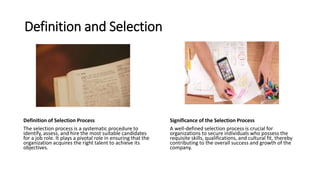
Definition and Selection
Definition of Selection Process
The selection process is a systematic procedure to
identify, assess, and hire the most suitable candidates
for a job role. It plays a pivotal role in ensuring that the
organization acquires the right talent to achieve its
objectives.
Significance of the Selection Process
A well-defined selection process is crucial for
organizations to secure individuals who possess the
requisite skills, qualifications, and cultural fit, thereby
contributing to the overall success and growth of the
company.
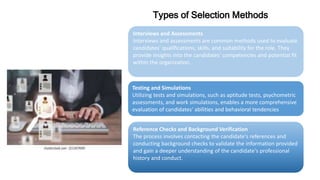
Types of Selection Methods
Interviews and Assessments
Interviews and assessments are common methods used to evaluate
candidates' qualifications, skills, and suitability for the role. They
provide insights into the candidates' competencies and potential fit
within the organization.
Testing and Simulations
Utilizing tests and simulations, such as aptitude tests, psychometric
assessments, and work simulations, enables a more comprehensive
evaluation of candidates' abilities and behavioral tendencies
Reference Checks and Background Verification
The process involves contacting the candidate's references and
conducting background checks to validate the information provided
and gain a deeper understanding of the candidate's professional
history and conduct.
Section 2
Key Steps in the Selection Process
Application and Screening
Application Submission Resume Screening Pre-selection Criteria
Candidates submit their
applications, including their
resumes and cover letters,
providing an initial overview of
their qualifications and interest in
the role.
The HR team conducts an initial
review of the resumes to
shortlist candidates who meet
the basic qualifications and
requirements for the position.
Establishing pre-selection criteria
helps in identifying the most
suitable candidates based on
specific qualifications, experience,
and skills.
Interviews and Assessments
Behavioral Interviews
Conducting behavioral interviews allows for a deeper understanding
of candidates' past behavior and their potential fit within the
organization's culture and values.
Skills Assessments
Administering skills assessments, such as technical tests or case
studies, helps in evaluating candidates' practical abilities and
problem-solving skills relevant to the role.
Cultural Fit Evaluation
Assessing the cultural fit of candidates through interviews and
interactions with potential team members provides insights into
their alignment with the organization's values and work
environment.
Section 3
Enhancing the Selection Process
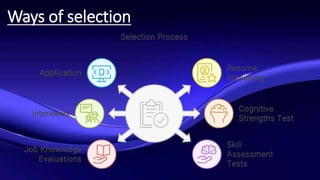
Ways of selection
Resume Screening Effectiveness
Cognitive Strength Test
Attention
Memory
Processing
Logical
Reasoning
Executive
Functions
Candidate Fit
for the Job
Background checks
Thank you

Mastering the selection process HR .pptx

  • 1.
    Mastering the SelectionProcess Presented by Reetika Sharma
  • 2.
    Content 1. Understandingthe Selection Process 2. Key Steps in the Selection Process 3. Enhancing the Selection Process
  • 3.
    Section 1 Understanding theSelection Process
  • 4.
    Definition and Selection Definitionof Selection Process The selection process is a systematic procedure to identify, assess, and hire the most suitable candidates for a job role. It plays a pivotal role in ensuring that the organization acquires the right talent to achieve its objectives. Significance of the Selection Process A well-defined selection process is crucial for organizations to secure individuals who possess the requisite skills, qualifications, and cultural fit, thereby contributing to the overall success and growth of the company.
  • 5.
    Types of SelectionMethods Interviews and Assessments Interviews and assessments are common methods used to evaluate candidates' qualifications, skills, and suitability for the role. They provide insights into the candidates' competencies and potential fit within the organization. Testing and Simulations Utilizing tests and simulations, such as aptitude tests, psychometric assessments, and work simulations, enables a more comprehensive evaluation of candidates' abilities and behavioral tendencies Reference Checks and Background Verification The process involves contacting the candidate's references and conducting background checks to validate the information provided and gain a deeper understanding of the candidate's professional history and conduct.
  • 6.
    Section 2 Key Stepsin the Selection Process
  • 7.
    Application and Screening ApplicationSubmission Resume Screening Pre-selection Criteria Candidates submit their applications, including their resumes and cover letters, providing an initial overview of their qualifications and interest in the role. The HR team conducts an initial review of the resumes to shortlist candidates who meet the basic qualifications and requirements for the position. Establishing pre-selection criteria helps in identifying the most suitable candidates based on specific qualifications, experience, and skills.
  • 8.
    Interviews and Assessments BehavioralInterviews Conducting behavioral interviews allows for a deeper understanding of candidates' past behavior and their potential fit within the organization's culture and values. Skills Assessments Administering skills assessments, such as technical tests or case studies, helps in evaluating candidates' practical abilities and problem-solving skills relevant to the role. Cultural Fit Evaluation Assessing the cultural fit of candidates through interviews and interactions with potential team members provides insights into their alignment with the organization's values and work environment.
  • 9.
    Section 3 Enhancing theSelection Process
  • 10.
  • 11.
  • 12.
  • 13.
    Candidate Fit for theJob Background checks
  • 14.