

SELECTION AND POSTING
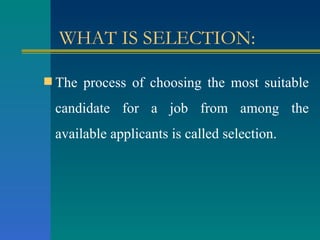
WHAT IS SELECTION: The process of choosing the most suitable candidate for a job from among the available applicants is called selection.
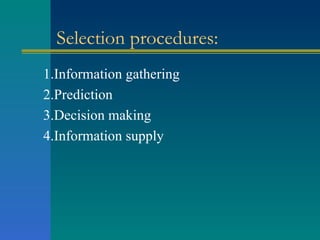
Selection procedures: 1.Information gathering 2.Prediction 3.Decision making 4.Information supply
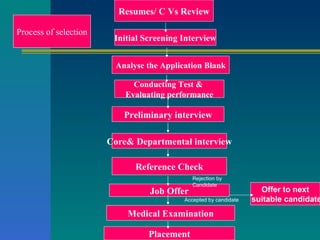
Resumes/ C Vs Review Initial Screening Interview Conducting Test &  Evaluating performance Core& Departmental interview Medical Examination Analyse the Application Blank Job Offer Preliminary interview Reference Check Placement Offer to next suitable candidate Process of selection Rejection by Candidate Accepted by candidate
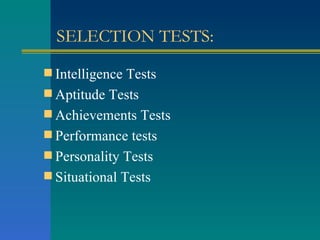
SELECTION TESTS: Intelligence Tests Aptitude Tests Achievements Tests Performance tests Personality Tests Situational Tests
Intelligence Tests Generally companies use this tests to ensure about the quick learning, alertness of the candidates. However, developing of accurate and reliable intelligent tests need professional expertise. LIMITATIONS: No general agreement amongst the psychologists about the concept of ‘intelligence’ itself.
Aptitude Tests: It measures the potential ability of the candidate to learn a new job. Developed large number of specialised aptitude tests such as clerical, mechanical and sp[atial relationship and manual dexterity abilities. Limitations: Do not measure the motivation levels and are supplemented by interest and personality tests.
Achievements Tests: This test requires the candidates who are assigned a particualr task which measures the confidence and spotanity levels towards achieveing the target.
Performance tests: The simplest and the perhaps the most obivous type of testing procedure is the performance testing in which the applicant is asked to demostrate  his ability to do the job. Ex: prospective typists are asked to type some pages and their speed and accuracy are then calculated.  limitations: Cannot be developed for each and every job.
Personality Tests These tests seek to access an individual’s motivation,adjustment to the stresses of everyday like capacity for inter-personal relations,emotional maturityand self image. Most popular personality tests is pencil and paper variety. It proceeds on the assumption that the persons respondiong have sufficient self-insight to be able to describe themsleves accurately. Most valued because the most important component of any managerial jobs is the ability to deal efficiently and effectively with the people.
Situational Tests: The aspects of both performance and personality testing are combined in situational tests to observe how job applicants react to stressful but realistic real life situations. Applied in leaderless group situations. Several candidates for managerial positions are presented with a problem that requires  ‘group collabration’. It is through such techniques men are able to exercise and gain acceptance of their leadership skills.

Selection and posting

  • 1.
  • 2.
    WHAT IS SELECTION:The process of choosing the most suitable candidate for a job from among the available applicants is called selection.
  • 3.
    Selection procedures: 1.Informationgathering 2.Prediction 3.Decision making 4.Information supply
  • 4.
    Resumes/ C VsReview Initial Screening Interview Conducting Test & Evaluating performance Core& Departmental interview Medical Examination Analyse the Application Blank Job Offer Preliminary interview Reference Check Placement Offer to next suitable candidate Process of selection Rejection by Candidate Accepted by candidate
  • 5.
    SELECTION TESTS: IntelligenceTests Aptitude Tests Achievements Tests Performance tests Personality Tests Situational Tests
  • 6.
    Intelligence Tests Generallycompanies use this tests to ensure about the quick learning, alertness of the candidates. However, developing of accurate and reliable intelligent tests need professional expertise. LIMITATIONS: No general agreement amongst the psychologists about the concept of ‘intelligence’ itself.
  • 7.
    Aptitude Tests: Itmeasures the potential ability of the candidate to learn a new job. Developed large number of specialised aptitude tests such as clerical, mechanical and sp[atial relationship and manual dexterity abilities. Limitations: Do not measure the motivation levels and are supplemented by interest and personality tests.
  • 8.
    Achievements Tests: Thistest requires the candidates who are assigned a particualr task which measures the confidence and spotanity levels towards achieveing the target.
  • 9.
    Performance tests: Thesimplest and the perhaps the most obivous type of testing procedure is the performance testing in which the applicant is asked to demostrate his ability to do the job. Ex: prospective typists are asked to type some pages and their speed and accuracy are then calculated. limitations: Cannot be developed for each and every job.
  • 10.
    Personality Tests Thesetests seek to access an individual’s motivation,adjustment to the stresses of everyday like capacity for inter-personal relations,emotional maturityand self image. Most popular personality tests is pencil and paper variety. It proceeds on the assumption that the persons respondiong have sufficient self-insight to be able to describe themsleves accurately. Most valued because the most important component of any managerial jobs is the ability to deal efficiently and effectively with the people.
  • 11.
    Situational Tests: Theaspects of both performance and personality testing are combined in situational tests to observe how job applicants react to stressful but realistic real life situations. Applied in leaderless group situations. Several candidates for managerial positions are presented with a problem that requires ‘group collabration’. It is through such techniques men are able to exercise and gain acceptance of their leadership skills.