RECRUITMENT, SELECTION, PROCESS, METHODS AND STEPS, ROLE OF RECRUITMENT CONSULTANT, ADVERTISMENT AND INDUCTION
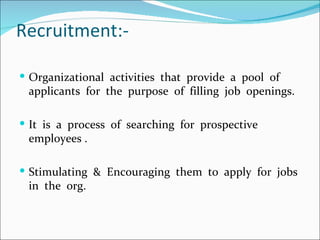
Recruitment:- Organizational  activities  that  provide  a  pool  of  applicants  for  the  purpose  of  filling  job  openings. It  is  a  process  of  searching  for  prospective  employees . Stimulating  &  Encouraging  them  to  apply  for  jobs  in  the  org.
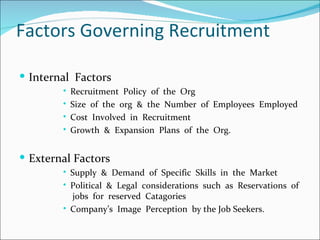
Factors Governing Recruitment Internal  Factors Recruitment  Policy  of  the  Org Size  of  the  org  &  the  Number  of  Employees  Employed Cost  Involved  in  Recruitment  Growth  &  Expansion  Plans  of  the  Org. External Factors Supply  &  Demand  of  Specific  Skills  in  the  Market Political  &  Legal  considerations  such  as  Reservations  of  jobs  for  reserved  Catagories Company’s  Image  Perception  by the Job Seekers.
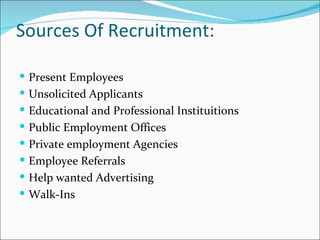
Sources Of Recruitment: Present Employees Unsolicited Applicants Educational and Professional Instituitions Public Employment Offices Private employment Agencies Employee Referrals Help wanted Advertising Walk-Ins
Selection: Is  the  process  of  discovering  the  qualifications  &  characteristics  of  the  job  applicant  in  order  to  establish  their  likely  suitability  for  the  job  position. A  good  selection  requires  a  methodical  approach  to  the  problem  of  finding  the  best  matched  person  for  the  job
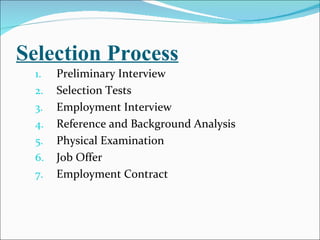
Selection Process Preliminary Interview Selection Tests Employment Interview Reference and Background Analysis Physical Examination Job Offer Employment Contract
Use of psychological test in selection
Why choose testing Objectivity – good psychological tests are standardised on a large sample and provide normative data across a wide range of demographics and age cohorts. Well selected tests will allow you to demonstrate talents that may otherwise not be evident.  Validity – psychometric tests are a more valid method of assessment than interviews, academic achievement & reference checks, and when utilised in combination (for example in an assessment centre) are highly predictive of future job performance.  Cost – the cost of selection errors is large for both the employer and the employee. Psychometric tests help to minimise costs while maximizing potential fit between the candidate and the job.
Brief history of tests Comparisons of human attributes and differences have a very long history.  Hippocrates – (400BC) attempted to theoretically define four basic temperament types: sanguine (optimistic), melancholic (depressed), choleric (irritable) and phlegmatic (listless and sluggish).  Galton - (19th century) measured human individual differences in terms of ability to discriminate between stimuli.  Binet - devised tests to measure differenced in specific human abilities. Now numerous tests measure specific abilities, strengths and competencies.
Army Alpha and Beta tests (WW1) – developed out of an urgent need to select personnel with specific aptitudes for training in specialist and strategic roles.  Today – Psychological tests widely used in selection practices.
Psychological tests (definition and dimensions) A selection procedure measure the personality characteristics of applicants that are related to future job performance. Personality tests typically measure one or more of five personality dimensions:  Extroversion,  Emotional stability,  Agreeableness,  Conscientiousness and  Openness to experience.
Types Of Psychological Tests Psychological tests fall into several categories :  Aptitude tests : It refers to potentiality that a person has to profit from certain kind of training. Achievement tests:  It helps to measure the proficiency that a person has been able to achieve.  Intelligence tests :  It attempts to measure the intelligence—that is, basic ability to understand the world around you, assimilate its functioning, and apply this knowledge to enhance the quality of your life. Or, as Alfred Whitehead said about intelligence, “it enables the individual to profit by error without being slaughtered by it.”[ 1 ] Intelligence, therefore, is a measure of a potential, not a measure of what you’ve learned (as in an achievement test), and so it is supposed to be independent of culture.  IQ=Mental Age/Actual Age*100  For example, a six year old child with a mental age of 6 would have an IQ of 100 (the “average” IQ score); a six year old child with a mental age of 9 would have an IQ of 150.  Today, intelligence is measured according to individual deviation from standardized norms, with 100 being the average.
Cont… Neuropsychological  tests : It  attempts to measure deficits in cognitive functioning (i.e., your ability to think, speak, reason, etc.) that may result from some sort of brain damage, such as a stroke or a brain injury.  Occupational tests :  It attempts to match your interests with the interests of persons in known careers. The logic here is that if the things that interest you in life match up with, say, the things that interest most school teachers, then you might make a good school teacher yourself.  Personality tests  : It attempts to measure your basic  personality  style and are most used in research or  forensic  settings to help with clinical diagnoses. Two of the most well-known personality tests are 1.  Minnesota Multiphasic Personality Inventory (MMPI), or the revised MMPI-2, composed of several hundred “yes or no” questions, and 2. Rorschach (the “inkblot test”), composed of several cards of inkblots—you simply give a description of the images and feelings you experience in looking at the blots.   Specific clinical tests  :It attempts to measure specific clinical matters, such as your current level of anxiety or depression.  
USES OF TESTS Evaluation of right candidate Proper selection of candidate Identifying the candidates personality
Places Where Psychological Testing Is Used Colleges or Educational Institutes Army,Navy etc. Bank  Airlines Companies Schools So, now a days in most of the places candidates are evaluated on the basis of the psychological test.
Advantages can result in lower turnover due if applicants are selected for traits that are highly correlated with employees who have high longevity within the organization  can reveal more information about applicant's abilities and interests  can identify interpersonal traits that may be needed for certain jobs
Disadvantages difficult to measure personality traits that may not be well defined  applicant's training and experience may have greater impact on job performance than applicant's personality  responses by applicant may may be altered by applicant's desire to respond in a way they feel would result in their selection  lack of diversity if all selected applicants have same personality traits  cost may be prohibitive for both the test and interpretation of results  lack of evidence to support validity of use of personality tests
Tips Select traits carefully :   An employer that selects applicants with high degree of 'assertiveness', 'independence', and 'self-confidence' may end up excluding females significantly more than males which would result in adverse impact.  Select tests carefully: Any tests should have been analyzed for (high) reliability and (low) adverse impact.  Not used exclusively:  Personality tests should not be the sole instrument used for selecting applicants. Rather, they should be used in conjunction with other procedures as one element of the selection process. Applicants should not be selected on the basis of personality tests alone.
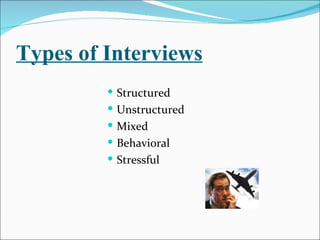
Types of Interviews Structured Unstructured Mixed Behavioral Stressful
BARRIERS TO EFFECTIVE SELECTION Perception Fairness Validity Reliability Pressure
Stages In Selection Process: Stage 1: Screening Of Application Forms. Stage 2: Tests--Intelligence, Aptitude, Technical,  Psychometric, Ability, Interest. Stage 3: Selection Interview. Stage 4: Selection Decision
RECRUITMENT PROCESS  PRACTICES BY  CAPGEMINI INDIA
Steps Of Recruitment Process
RECRUITMENT PROCESS FOR FRESHER WRITTEN /APPTITUDE. GROUP DISCUSSION. PSYCHOMETRIC TEST(CONDITIONAL). TECHNICAL INTERVIEWS(CONDITIONAL). HR INTERVIEWS.
RECRUITMENT PROCESS FOR HIGHER POST PSYCHOMETRIC TEST. BUSINESS GAME. HR INTERVIEWS.
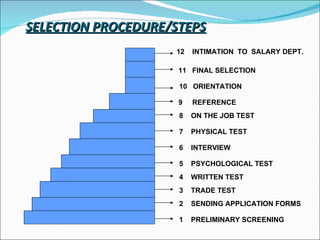
SELECTION PROCEDURE/STEPS 1  PRELIMINARY SCREENING 2  SENDING APPLICATION FORMS 3  TRADE TEST 4  WRITTEN TEST 5  PSYCHOLOGICAL TEST 6  INTERVIEW 7  PHYSICAL TEST 8  ON THE JOB TEST 9  REFERENCE 10  ORIENTATION   11  FINAL SELECTION  12  INTIMATION  TO  SALARY DEPT.
Difficulties in Recruitment process Talent  Acquistion. Expensive. Time Constraint.  Retention of employees. Managing low attrition rate. Budget.
Challenges in Recruitent & Selection: Talent Shortage Attrition Rate Reservations and other Gov. Policies Remoteness of Job Scrutinity of employee’s  credentials
Basic Diff. Between Recruitment and Selection: Recruitment- searching for and attracting applicants qualified to fill vacant positions Selection- Analyzing the qualifications of  applicants and deciding upon those who show the most potential
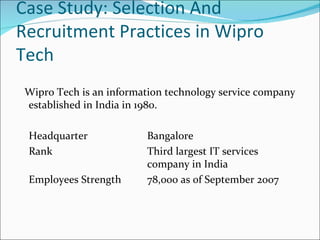
Case Study: Selection And Recruitment Practices in Wipro Tech Wipro Tech is an information technology service company established in India in 1980.  Headquarter Bangalore  Rank Third largest IT services  company in India Employees Strength  78,000 as of September 2007
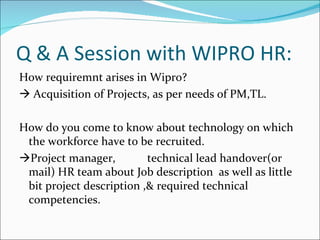
Q & A Session with WIPRO HR: How requiremnt arises in Wipro?    Acquisition of Projects, as per needs of PM,TL. How do you come to know about technology on which the workforce have to be recruited.  Project manager, technical lead handover(or mail) HR team about Job description  as well as little bit project description ,& required technical competencies.
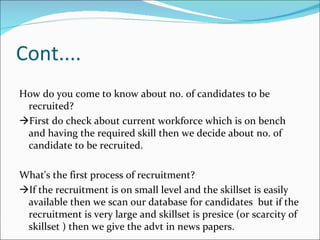
Cont.... How do you come to know about no. of candidates to be recruited?  First do check about current workforce which is on bench  and having the required skill then we decide about no. of candidate to be recruited. What's the first process of recruitment?  If the recruitment is on small level and the skillset is easily available then we scan our database for candidates  but if the recruitment is very large and skillset is presice (or scarcity of skillset ) then we give the advt in news papers.
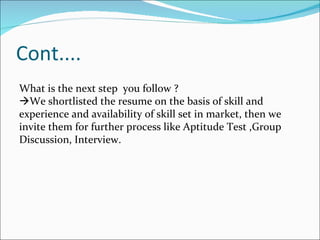
Cont.... What is the next step  you follow ?  We shortlisted the resume on the basis of skill and experience and availability of skill set in market, then we invite them for further process like Aptitude Test ,Group Discussion, Interview.
Cont.... What kind of professionals  can find job opportunities with the company?   We have a rigorous  recruitment process to ensure that we hire the best talent in the industry.  All our HR processes are competency based.  Educational qualifications are function dependent.  In addition to a good  education, we look for candidates with high potential, integrity and the ability to lead the organisation in future.  Our main focus is on `internal growth' and hence we look for candidates who are steady, interested in building a career with Wipro and who bring a new perspective to the organisation.
Cont... What kind of retention policies  do you implement to fight attrition?   Our values and culture, freedom and autonomy, exciting challenges  and opportunities for career advancement are our key retention tools.  We work in a highly charged environment with talented and successful people that motivate one and all.  We believe that apart from salaries, employees seek fast growth, exciting work environment and opportunity to make a difference through entrepreneurial ventures, amongst other things.  Each employee has a career growth plan in place. Based on the career plan we give each of them opportunity to work in various functions to get a wide and varied exposure.  We also have a compensation design, which aggressively differentiates between performers and non-performers.  We were arguably the first FMCG company in India to offer stock options to employees.  We also purge the bottom 10% on a regular basis so that they do not become a liability for others.
Role of recruitment consultants
What is Consultant A  consultant  (from the Latin  consultare  means "to discuss" ) is a professional who provides advice in a particular area of expertise such as accountancy, the environment, technology, law, human resources, marketing, medicine, finance, public affairs, communication, engineering, graphic design, or waste management. A consultant is self-employed or works for a consultancy firm, usually with multiple and changing clients.
Types of Consultant  Environmental consultants. Technology Consultant.  Human Resource Consultant Marketing Consultant Law Consultant Medicine Consultant Finance Consultant and many more….
What Is Recruitment Consultant "Recruitment consultants work with companies to help them find the right people for their positions. They also work for candidates to find a role that is suitable for them.  The key skill of a recruitment consultant is to meet the needs of both the client and the candidate to ensure the best mutual fit; this is not simply a case of skills matching but of truly understanding the business and its culture, as well as the aspirations of the candidate."
Recruitment Consultant Activities A recruitment consultant is responsible for helping employer clients to recruit staff for job vacancies. These vacancies can be permanent or temporary roles. Recruitment consultants develop an understanding of their client's requirements, then identify potential staff (candidates) through existing contacts or by advertising roles/headhunting (executive search). They assess candidates' skills through interviews, tests and background checks, then make recommendations to their client. Consultants also provide advice to both clients and candidates on salary levels, training requirements and career opportunities. Developing solid relationships with clients is integral to the role.  .
» Typical work activities A recruitment consultant's role is demanding and diverse. using marketing and business knowledge to extend company contacts. identifying and evaluating employers' recruitment needs. negotiating terms of employment. interviewing potential candidates clarifying and negotiating salary and benefits relating to the role. headhunting - identifying and approaching suitable candidates. monitoring candidates once placed. collecting feedback from employers on the performance of candidates who have previously been placed with them. maintaining current records and personal statistics for review against performance targets. documenting clients' details and vacancy requirements in a brief.
Various Players In Recruitment Consultancy  At National Level 3P Consultant Pvt. Ltd. ABC International Placement Services Active Consultant Beta Consultancy HR Services Browse Consulting Career Graph CareerIndia Dynamic Consultant Enterprise Consulting HUDDAR Human Ware India JCG Associates and many more……
At Global Level ADD Resources BLT Camron James Osiris Connections Prism Executive Recruitment
What makes a Good Recruitment Consultant  To be successful in the recruitment industry you must:  be ambitious and confident be goal orientated  have good interpersonal and communications skills  be a good team player  be able to handle multiple priorities  be tenacious  be a problem solver  be able to work to deadlines and targets  enjoy responsibility and working in a high-pressure environment  have a good sense of humour  
Opportunity as a Recruitment Consultant A chance to work with a large successful organization.  An opportunity to develop within the Recruitment Industry with one of  the most supportive and resourceful organizations.  A role that could provide you with a solid future within Recruitment.  A competitive annual salary and excellent commission packages Fantastic training and mentoring opportunities
Challenges Faced By Recruitment Consultant Develop expertise in those strategic areas, where the consultants have not developed expertise when firm is focused and the consultant is a generalist.  Reinforce and update knowledge and skills in the areas of focus of the firm when the firm is focused and the consultant is an expert. Provide the consultants exposure to areas where they do not have expertise in a non focused firm with expert consultant. Here, the long-term objectives of the consulting firm is to operate in a wide range of sections/functions.  Expose the consultants to all upcoming sectors/functions in a non-focused firm with generalist consultant .  Three key areas which every consultant should be well conversant  1)knowledge and skills related to Man-management. 2)Business development, and Quality assurance.  3) evaluation technique.
To maintain Effectiveness and Efficiency. Innovation and Quality Assurance are two key elements in the success of any consulting firm. Maintain the customer relationship.
Advantages  Fast Response Broad customer base in private and public sectors Improved attraction and recruitment strategies Identifies and prepares potential job applicants  who will be appropriate candidates. Higher succession rate of the selection process by  reducing the number of visibility under-qualified  or overqualified job applicants.
Disadvantages Non -ethical strategies. It won't always work. Cost.
What are Advertisements…..
ADVERTISEMENT What is advertisement? Advertising   is a one-way communication whose  purpose is to inform potential customers about products  and services and how to obtain them For  Recruitment –  To provide information that will attract a significant pool of qualified candidates and discourage unqualified ones from applying.
Various kinds of Advertisement Media (E.g. billboards,  printed flyers ,  radio,  web banners, web popups,  human directorial, magazines, newspapers,  posters) Above the line Media:  Press, TV, Outdoor, posters, and radio ( recognized ad agencies get commission from these media) Below-the-line Media:  Direct mail, Sale Promotion, merchandizing, exhibitions
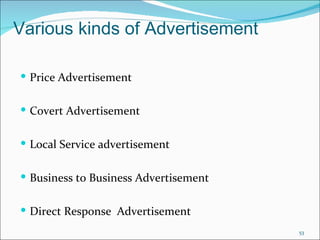
Price Advertisement  Covert Advertisement Local Service advertisement  Business to Business Advertisement  Direct Response  Advertisement  Various kinds of Advertisement
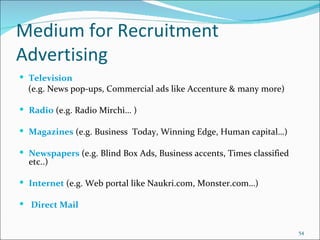
Medium for Recruitment Advertising Television  (e.g. News pop-ups, Commercial ads like Accenture & many more) Radio  (e.g. Radio Mirchi… ) Magazines  (e.g. Business  Today, Winning Edge, Human capital…) Newspapers  (e.g. Blind Box Ads, Business accents, Times classified etc..) Internet  (e.g. Web portal like Naukri.com, Monster.com…) Direct Mail
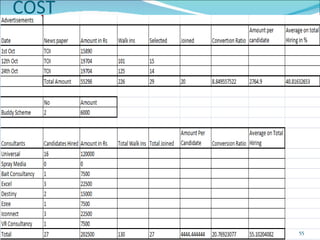
COST
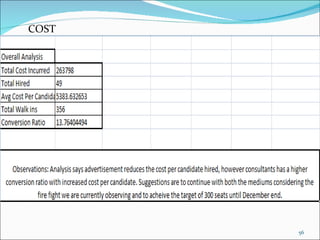
COST
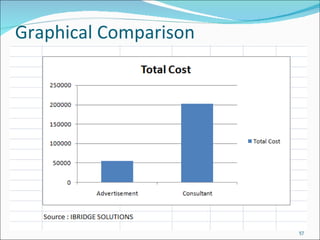
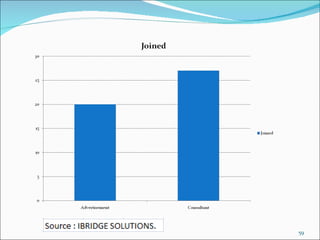
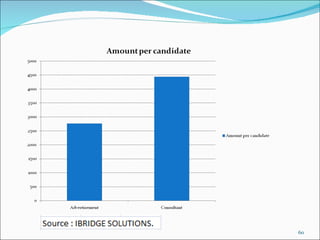
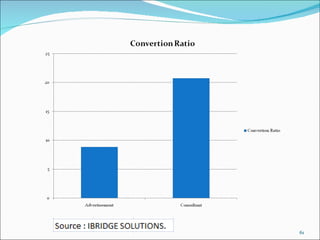
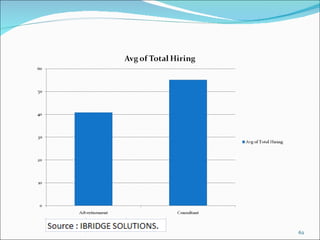
Graphical Comparison
Success Factors Customer realization of Product. Quality of a Product is determined.  Exposes company’s Culture  Ramp Up Awareness of Brand among masses and hence  increase Demand
Use of Advertisements in Recruitment Process. Creating awareness of Job Opportunities in the specified field of Interest. Finding Desirable Candidates Keeping an competitive edge over competitors as more advertisements attracts best of the job seekers. Advertisement is the fastest way to spread recruitment hiring information .
Evaluation and Effects  Newspapers   Advantages – Short lead time, flexible, reach large audience, community prestige, intense coverage, reader control of exposure, coordination with national advertising, merchandising service, segment consumer by geography. Disadvantages -- short life span, may be expensive relative to other media, hasty reading, poor reproduction, lack of creativity.
  Radio Advantages – audio capacity, short lead time, low cost relative to other media, reach demographic and geographic segmented audience, reach large audience. Disadvantages – don’t have visual capacity, fragmented and inflexible, temporary nature of message. Magazines and Journals  Advantages -- selectivity for demographic and geographic segments, high in quality reproduction, lasts as long as magazine is kept, prestigious advertisement is credibility of magazine is high, extra services, issue may be read by more than one person. Disadvantages – long lead time, lack of flexibility in gaining attention, often limited control over location of advertisement.
Television  Advantages -- impact mass coverage, repetition, flexibility in getting attention of consumer, prestige, visual and audio capabilities, short lead time. Disadvantages -- temporary nature of message, high cost relative to other media, high mortality rate for commercials, evidence of public distrust, lack of selectivity, hard to target customer, requires production specialists
Outdoor Advertising  Advantages – inexpensive relative to other media, quick communication of simple ideas, repetition of exposure to customers, ability to promote products available for sale nearby Disadvantages -- brevity   of the message, short exposure time, cannot target customer, public concern over aesthetics.
Internet  & Direct Mail Advantages – flexibility in reaching target audience, short lead time, intense coverage, flexibility of format, complete information, easy to personalize Disadvantages -- high cost per person, dependency on quality of mailing list, consumer resistance, may be considered as junk mail, may be difficult and expensive to access mailing lists
What is induction? Induction is process meant to help the new employee to settle down quickly into the job by becoming familiar with the people, the surroundings, the job, the firm and the industry. Induction is the process of acquainting the new employees with the existing culture and practices of the new organization.
What is induction for? To sort out all anxiety of recruited person. To ensure the effective integration of staff. History and introduction of founders. Understand the standards and rules (written and unwritten) of the organisation.  Introduction to the company/department and its personnel structure.
Contd..... Relevant personnel policies, such as training, promotion and health and safety. To clear doubtful situation between new employee and existing one.
Who needs special attention? Institute leavers. People returning to work after a break. Disabled employees. Management trainees. Employees with language difficulties.
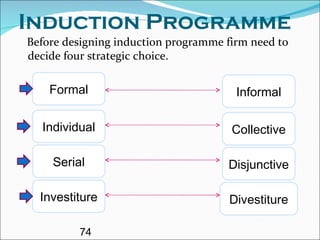
Induction Programme Before designing induction programme firm need to decide four strategic choice. Formal Informal Divestiture Collective Individual Investiture Serial Disjunctive
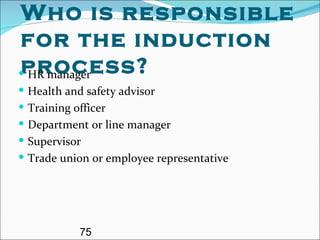
Who is responsible for the induction process? HR manager Health and safety advisor Training officer Department or line manager Supervisor Trade union or employee representative
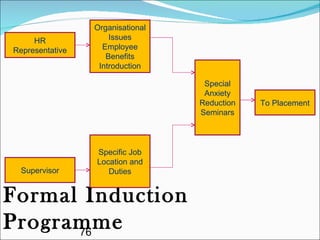
Formal Induction Programme HR Representative Organisational Issues Employee Benefits Introduction Supervisor Specific Job Location and Duties Special Anxiety Reduction Seminars To Placement
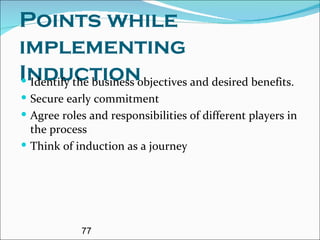
Points while implementing Induction  Identify the business objectives and desired benefits. Secure early commitment Agree roles and responsibilities of different players in the process Think of induction as a journey
Contd..... Engage staff prior to joining Have clear learning objectives for training sessions Respect the induction needs of different audiences Keep induction material up to date
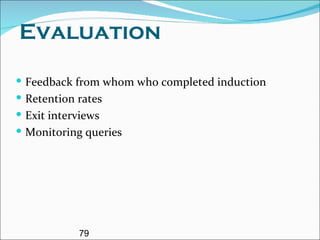
Evaluation Feedback from whom who completed induction Retention rates  Exit interviews Monitoring queries
Trends in Induction Chalk and talk session Questionnaire From practicalities to discussion about culture  Using technologies like e-learning Team building exercise
Problem in induction To keep it simple Supervisor is not trained enough Employee get so much of information in short span of time Large no. of forms Employee is thrown into action too soon Wrong perception develop in short span
Advantages of Good Induction Employee retention. Create good impression It creates good adhesion It take less time to familiarise Less turnover ratio Increase productivity  No chaos Cost reduction
In absence of Induction Uneasiness of new employee in the environment of the org. Poor integration in team  Low morale  Loss of productivity Failure to work with their highest potential Company image goes down
Contd..... Leads to Early leaving. It leads many problems like:- a) High employee turnover b) Lowering the morale of remaining staff  c) Additional cost for re-recruiting d) Damage the company reputation e) Affect new recruitment f) Leaver’s record is affected

Recruitment selection-process-methods-and-steps-1207897252784197-9

  • 1.
    RECRUITMENT, SELECTION, PROCESS,METHODS AND STEPS, ROLE OF RECRUITMENT CONSULTANT, ADVERTISMENT AND INDUCTION
  • 2.
    Recruitment:- Organizational activities that provide a pool of applicants for the purpose of filling job openings. It is a process of searching for prospective employees . Stimulating & Encouraging them to apply for jobs in the org.
  • 3.
    Factors Governing RecruitmentInternal Factors Recruitment Policy of the Org Size of the org & the Number of Employees Employed Cost Involved in Recruitment Growth & Expansion Plans of the Org. External Factors Supply & Demand of Specific Skills in the Market Political & Legal considerations such as Reservations of jobs for reserved Catagories Company’s Image Perception by the Job Seekers.
  • 4.
    Sources Of Recruitment:Present Employees Unsolicited Applicants Educational and Professional Instituitions Public Employment Offices Private employment Agencies Employee Referrals Help wanted Advertising Walk-Ins
  • 5.
    Selection: Is the process of discovering the qualifications & characteristics of the job applicant in order to establish their likely suitability for the job position. A good selection requires a methodical approach to the problem of finding the best matched person for the job
  • 6.
    Selection Process PreliminaryInterview Selection Tests Employment Interview Reference and Background Analysis Physical Examination Job Offer Employment Contract
  • 7.
    Use of psychologicaltest in selection
  • 8.
    Why choose testingObjectivity – good psychological tests are standardised on a large sample and provide normative data across a wide range of demographics and age cohorts. Well selected tests will allow you to demonstrate talents that may otherwise not be evident. Validity – psychometric tests are a more valid method of assessment than interviews, academic achievement & reference checks, and when utilised in combination (for example in an assessment centre) are highly predictive of future job performance. Cost – the cost of selection errors is large for both the employer and the employee. Psychometric tests help to minimise costs while maximizing potential fit between the candidate and the job.
  • 9.
    Brief history oftests Comparisons of human attributes and differences have a very long history. Hippocrates – (400BC) attempted to theoretically define four basic temperament types: sanguine (optimistic), melancholic (depressed), choleric (irritable) and phlegmatic (listless and sluggish). Galton - (19th century) measured human individual differences in terms of ability to discriminate between stimuli. Binet - devised tests to measure differenced in specific human abilities. Now numerous tests measure specific abilities, strengths and competencies.
  • 10.
    Army Alpha andBeta tests (WW1) – developed out of an urgent need to select personnel with specific aptitudes for training in specialist and strategic roles. Today – Psychological tests widely used in selection practices.
  • 11.
    Psychological tests (definitionand dimensions) A selection procedure measure the personality characteristics of applicants that are related to future job performance. Personality tests typically measure one or more of five personality dimensions: Extroversion, Emotional stability, Agreeableness, Conscientiousness and Openness to experience.
  • 12.
    Types Of PsychologicalTests Psychological tests fall into several categories : Aptitude tests : It refers to potentiality that a person has to profit from certain kind of training. Achievement tests: It helps to measure the proficiency that a person has been able to achieve. Intelligence tests : It attempts to measure the intelligence—that is, basic ability to understand the world around you, assimilate its functioning, and apply this knowledge to enhance the quality of your life. Or, as Alfred Whitehead said about intelligence, “it enables the individual to profit by error without being slaughtered by it.”[ 1 ] Intelligence, therefore, is a measure of a potential, not a measure of what you’ve learned (as in an achievement test), and so it is supposed to be independent of culture. IQ=Mental Age/Actual Age*100 For example, a six year old child with a mental age of 6 would have an IQ of 100 (the “average” IQ score); a six year old child with a mental age of 9 would have an IQ of 150.  Today, intelligence is measured according to individual deviation from standardized norms, with 100 being the average.
  • 13.
    Cont… Neuropsychological tests : It attempts to measure deficits in cognitive functioning (i.e., your ability to think, speak, reason, etc.) that may result from some sort of brain damage, such as a stroke or a brain injury. Occupational tests : It attempts to match your interests with the interests of persons in known careers. The logic here is that if the things that interest you in life match up with, say, the things that interest most school teachers, then you might make a good school teacher yourself. Personality tests : It attempts to measure your basic personality style and are most used in research or forensic settings to help with clinical diagnoses. Two of the most well-known personality tests are 1. Minnesota Multiphasic Personality Inventory (MMPI), or the revised MMPI-2, composed of several hundred “yes or no” questions, and 2. Rorschach (the “inkblot test”), composed of several cards of inkblots—you simply give a description of the images and feelings you experience in looking at the blots.   Specific clinical tests :It attempts to measure specific clinical matters, such as your current level of anxiety or depression.  
  • 14.
    USES OF TESTSEvaluation of right candidate Proper selection of candidate Identifying the candidates personality
  • 15.
    Places Where PsychologicalTesting Is Used Colleges or Educational Institutes Army,Navy etc. Bank Airlines Companies Schools So, now a days in most of the places candidates are evaluated on the basis of the psychological test.
  • 16.
    Advantages can resultin lower turnover due if applicants are selected for traits that are highly correlated with employees who have high longevity within the organization can reveal more information about applicant's abilities and interests can identify interpersonal traits that may be needed for certain jobs
  • 17.
    Disadvantages difficult tomeasure personality traits that may not be well defined applicant's training and experience may have greater impact on job performance than applicant's personality responses by applicant may may be altered by applicant's desire to respond in a way they feel would result in their selection lack of diversity if all selected applicants have same personality traits cost may be prohibitive for both the test and interpretation of results lack of evidence to support validity of use of personality tests
  • 18.
    Tips Select traitscarefully : An employer that selects applicants with high degree of 'assertiveness', 'independence', and 'self-confidence' may end up excluding females significantly more than males which would result in adverse impact. Select tests carefully: Any tests should have been analyzed for (high) reliability and (low) adverse impact. Not used exclusively: Personality tests should not be the sole instrument used for selecting applicants. Rather, they should be used in conjunction with other procedures as one element of the selection process. Applicants should not be selected on the basis of personality tests alone.
  • 19.
    Types of InterviewsStructured Unstructured Mixed Behavioral Stressful
  • 20.
    BARRIERS TO EFFECTIVESELECTION Perception Fairness Validity Reliability Pressure
  • 21.
    Stages In SelectionProcess: Stage 1: Screening Of Application Forms. Stage 2: Tests--Intelligence, Aptitude, Technical, Psychometric, Ability, Interest. Stage 3: Selection Interview. Stage 4: Selection Decision
  • 22.
    RECRUITMENT PROCESS PRACTICES BY CAPGEMINI INDIA
  • 23.
  • 24.
    RECRUITMENT PROCESS FORFRESHER WRITTEN /APPTITUDE. GROUP DISCUSSION. PSYCHOMETRIC TEST(CONDITIONAL). TECHNICAL INTERVIEWS(CONDITIONAL). HR INTERVIEWS.
  • 25.
    RECRUITMENT PROCESS FORHIGHER POST PSYCHOMETRIC TEST. BUSINESS GAME. HR INTERVIEWS.
  • 26.
    SELECTION PROCEDURE/STEPS 1 PRELIMINARY SCREENING 2 SENDING APPLICATION FORMS 3 TRADE TEST 4 WRITTEN TEST 5 PSYCHOLOGICAL TEST 6 INTERVIEW 7 PHYSICAL TEST 8 ON THE JOB TEST 9 REFERENCE 10 ORIENTATION 11 FINAL SELECTION 12 INTIMATION TO SALARY DEPT.
  • 27.
    Difficulties in Recruitmentprocess Talent Acquistion. Expensive. Time Constraint. Retention of employees. Managing low attrition rate. Budget.
  • 28.
    Challenges in Recruitent& Selection: Talent Shortage Attrition Rate Reservations and other Gov. Policies Remoteness of Job Scrutinity of employee’s credentials
  • 29.
    Basic Diff. BetweenRecruitment and Selection: Recruitment- searching for and attracting applicants qualified to fill vacant positions Selection- Analyzing the qualifications of applicants and deciding upon those who show the most potential
  • 30.
    Case Study: SelectionAnd Recruitment Practices in Wipro Tech Wipro Tech is an information technology service company established in India in 1980. Headquarter Bangalore Rank Third largest IT services company in India Employees Strength 78,000 as of September 2007
  • 31.
    Q & ASession with WIPRO HR: How requiremnt arises in Wipro?  Acquisition of Projects, as per needs of PM,TL. How do you come to know about technology on which the workforce have to be recruited.  Project manager, technical lead handover(or mail) HR team about Job description as well as little bit project description ,& required technical competencies.
  • 32.
    Cont.... How doyou come to know about no. of candidates to be recruited?  First do check about current workforce which is on bench and having the required skill then we decide about no. of candidate to be recruited. What's the first process of recruitment?  If the recruitment is on small level and the skillset is easily available then we scan our database for candidates but if the recruitment is very large and skillset is presice (or scarcity of skillset ) then we give the advt in news papers.
  • 33.
    Cont.... What isthe next step you follow ?  We shortlisted the resume on the basis of skill and experience and availability of skill set in market, then we invite them for further process like Aptitude Test ,Group Discussion, Interview.
  • 34.
    Cont.... What kindof professionals can find job opportunities with the company?  We have a rigorous recruitment process to ensure that we hire the best talent in the industry. All our HR processes are competency based. Educational qualifications are function dependent. In addition to a good education, we look for candidates with high potential, integrity and the ability to lead the organisation in future. Our main focus is on `internal growth' and hence we look for candidates who are steady, interested in building a career with Wipro and who bring a new perspective to the organisation.
  • 35.
    Cont... What kindof retention policies do you implement to fight attrition?  Our values and culture, freedom and autonomy, exciting challenges and opportunities for career advancement are our key retention tools. We work in a highly charged environment with talented and successful people that motivate one and all. We believe that apart from salaries, employees seek fast growth, exciting work environment and opportunity to make a difference through entrepreneurial ventures, amongst other things. Each employee has a career growth plan in place. Based on the career plan we give each of them opportunity to work in various functions to get a wide and varied exposure. We also have a compensation design, which aggressively differentiates between performers and non-performers. We were arguably the first FMCG company in India to offer stock options to employees. We also purge the bottom 10% on a regular basis so that they do not become a liability for others.
  • 36.
  • 37.
    What is ConsultantA consultant (from the Latin consultare means "to discuss" ) is a professional who provides advice in a particular area of expertise such as accountancy, the environment, technology, law, human resources, marketing, medicine, finance, public affairs, communication, engineering, graphic design, or waste management. A consultant is self-employed or works for a consultancy firm, usually with multiple and changing clients.
  • 38.
    Types of Consultant Environmental consultants. Technology Consultant. Human Resource Consultant Marketing Consultant Law Consultant Medicine Consultant Finance Consultant and many more….
  • 39.
    What Is RecruitmentConsultant "Recruitment consultants work with companies to help them find the right people for their positions. They also work for candidates to find a role that is suitable for them. The key skill of a recruitment consultant is to meet the needs of both the client and the candidate to ensure the best mutual fit; this is not simply a case of skills matching but of truly understanding the business and its culture, as well as the aspirations of the candidate."
  • 40.
    Recruitment Consultant ActivitiesA recruitment consultant is responsible for helping employer clients to recruit staff for job vacancies. These vacancies can be permanent or temporary roles. Recruitment consultants develop an understanding of their client's requirements, then identify potential staff (candidates) through existing contacts or by advertising roles/headhunting (executive search). They assess candidates' skills through interviews, tests and background checks, then make recommendations to their client. Consultants also provide advice to both clients and candidates on salary levels, training requirements and career opportunities. Developing solid relationships with clients is integral to the role. .
  • 41.
    » Typical work activitiesA recruitment consultant's role is demanding and diverse. using marketing and business knowledge to extend company contacts. identifying and evaluating employers' recruitment needs. negotiating terms of employment. interviewing potential candidates clarifying and negotiating salary and benefits relating to the role. headhunting - identifying and approaching suitable candidates. monitoring candidates once placed. collecting feedback from employers on the performance of candidates who have previously been placed with them. maintaining current records and personal statistics for review against performance targets. documenting clients' details and vacancy requirements in a brief.
  • 42.
    Various Players InRecruitment Consultancy At National Level 3P Consultant Pvt. Ltd. ABC International Placement Services Active Consultant Beta Consultancy HR Services Browse Consulting Career Graph CareerIndia Dynamic Consultant Enterprise Consulting HUDDAR Human Ware India JCG Associates and many more……
  • 43.
    At Global LevelADD Resources BLT Camron James Osiris Connections Prism Executive Recruitment
  • 44.
    What makes aGood Recruitment Consultant To be successful in the recruitment industry you must: be ambitious and confident be goal orientated have good interpersonal and communications skills be a good team player be able to handle multiple priorities be tenacious be a problem solver be able to work to deadlines and targets enjoy responsibility and working in a high-pressure environment have a good sense of humour  
  • 45.
    Opportunity as aRecruitment Consultant A chance to work with a large successful organization. An opportunity to develop within the Recruitment Industry with one of the most supportive and resourceful organizations. A role that could provide you with a solid future within Recruitment. A competitive annual salary and excellent commission packages Fantastic training and mentoring opportunities
  • 46.
    Challenges Faced ByRecruitment Consultant Develop expertise in those strategic areas, where the consultants have not developed expertise when firm is focused and the consultant is a generalist. Reinforce and update knowledge and skills in the areas of focus of the firm when the firm is focused and the consultant is an expert. Provide the consultants exposure to areas where they do not have expertise in a non focused firm with expert consultant. Here, the long-term objectives of the consulting firm is to operate in a wide range of sections/functions. Expose the consultants to all upcoming sectors/functions in a non-focused firm with generalist consultant . Three key areas which every consultant should be well conversant 1)knowledge and skills related to Man-management. 2)Business development, and Quality assurance. 3) evaluation technique.
  • 47.
    To maintain Effectivenessand Efficiency. Innovation and Quality Assurance are two key elements in the success of any consulting firm. Maintain the customer relationship.
  • 48.
    Advantages FastResponse Broad customer base in private and public sectors Improved attraction and recruitment strategies Identifies and prepares potential job applicants who will be appropriate candidates. Higher succession rate of the selection process by reducing the number of visibility under-qualified or overqualified job applicants.
  • 49.
    Disadvantages Non -ethicalstrategies. It won't always work. Cost.
  • 50.
  • 51.
    ADVERTISEMENT What isadvertisement? Advertising is a one-way communication whose purpose is to inform potential customers about products and services and how to obtain them For Recruitment – To provide information that will attract a significant pool of qualified candidates and discourage unqualified ones from applying.
  • 52.
    Various kinds ofAdvertisement Media (E.g. billboards, printed flyers , radio, web banners, web popups, human directorial, magazines, newspapers, posters) Above the line Media: Press, TV, Outdoor, posters, and radio ( recognized ad agencies get commission from these media) Below-the-line Media: Direct mail, Sale Promotion, merchandizing, exhibitions
  • 53.
    Price Advertisement Covert Advertisement Local Service advertisement Business to Business Advertisement Direct Response Advertisement Various kinds of Advertisement
  • 54.
    Medium for RecruitmentAdvertising Television (e.g. News pop-ups, Commercial ads like Accenture & many more) Radio (e.g. Radio Mirchi… ) Magazines (e.g. Business Today, Winning Edge, Human capital…) Newspapers (e.g. Blind Box Ads, Business accents, Times classified etc..) Internet (e.g. Web portal like Naukri.com, Monster.com…) Direct Mail
  • 55.
  • 56.
  • 57.
  • 63.
    Success Factors Customerrealization of Product. Quality of a Product is determined. Exposes company’s Culture Ramp Up Awareness of Brand among masses and hence increase Demand
  • 64.
    Use of Advertisementsin Recruitment Process. Creating awareness of Job Opportunities in the specified field of Interest. Finding Desirable Candidates Keeping an competitive edge over competitors as more advertisements attracts best of the job seekers. Advertisement is the fastest way to spread recruitment hiring information .
  • 65.
    Evaluation and Effects Newspapers Advantages – Short lead time, flexible, reach large audience, community prestige, intense coverage, reader control of exposure, coordination with national advertising, merchandising service, segment consumer by geography. Disadvantages -- short life span, may be expensive relative to other media, hasty reading, poor reproduction, lack of creativity.
  • 66.
      Radio Advantages– audio capacity, short lead time, low cost relative to other media, reach demographic and geographic segmented audience, reach large audience. Disadvantages – don’t have visual capacity, fragmented and inflexible, temporary nature of message. Magazines and Journals Advantages -- selectivity for demographic and geographic segments, high in quality reproduction, lasts as long as magazine is kept, prestigious advertisement is credibility of magazine is high, extra services, issue may be read by more than one person. Disadvantages – long lead time, lack of flexibility in gaining attention, often limited control over location of advertisement.
  • 67.
    Television Advantages-- impact mass coverage, repetition, flexibility in getting attention of consumer, prestige, visual and audio capabilities, short lead time. Disadvantages -- temporary nature of message, high cost relative to other media, high mortality rate for commercials, evidence of public distrust, lack of selectivity, hard to target customer, requires production specialists
  • 68.
    Outdoor Advertising Advantages – inexpensive relative to other media, quick communication of simple ideas, repetition of exposure to customers, ability to promote products available for sale nearby Disadvantages -- brevity of the message, short exposure time, cannot target customer, public concern over aesthetics.
  • 69.
    Internet &Direct Mail Advantages – flexibility in reaching target audience, short lead time, intense coverage, flexibility of format, complete information, easy to personalize Disadvantages -- high cost per person, dependency on quality of mailing list, consumer resistance, may be considered as junk mail, may be difficult and expensive to access mailing lists
  • 70.
    What is induction?Induction is process meant to help the new employee to settle down quickly into the job by becoming familiar with the people, the surroundings, the job, the firm and the industry. Induction is the process of acquainting the new employees with the existing culture and practices of the new organization.
  • 71.
    What is inductionfor? To sort out all anxiety of recruited person. To ensure the effective integration of staff. History and introduction of founders. Understand the standards and rules (written and unwritten) of the organisation. Introduction to the company/department and its personnel structure.
  • 72.
    Contd..... Relevant personnelpolicies, such as training, promotion and health and safety. To clear doubtful situation between new employee and existing one.
  • 73.
    Who needs specialattention? Institute leavers. People returning to work after a break. Disabled employees. Management trainees. Employees with language difficulties.
  • 74.
    Induction Programme Beforedesigning induction programme firm need to decide four strategic choice. Formal Informal Divestiture Collective Individual Investiture Serial Disjunctive
  • 75.
    Who is responsiblefor the induction process? HR manager Health and safety advisor Training officer Department or line manager Supervisor Trade union or employee representative
  • 76.
    Formal Induction ProgrammeHR Representative Organisational Issues Employee Benefits Introduction Supervisor Specific Job Location and Duties Special Anxiety Reduction Seminars To Placement
  • 77.
    Points while implementingInduction Identify the business objectives and desired benefits. Secure early commitment Agree roles and responsibilities of different players in the process Think of induction as a journey
  • 78.
    Contd..... Engage staffprior to joining Have clear learning objectives for training sessions Respect the induction needs of different audiences Keep induction material up to date
  • 79.
    Evaluation Feedback fromwhom who completed induction Retention rates Exit interviews Monitoring queries
  • 80.
    Trends in InductionChalk and talk session Questionnaire From practicalities to discussion about culture Using technologies like e-learning Team building exercise
  • 81.
    Problem in inductionTo keep it simple Supervisor is not trained enough Employee get so much of information in short span of time Large no. of forms Employee is thrown into action too soon Wrong perception develop in short span
  • 82.
    Advantages of GoodInduction Employee retention. Create good impression It creates good adhesion It take less time to familiarise Less turnover ratio Increase productivity No chaos Cost reduction
  • 83.
    In absence ofInduction Uneasiness of new employee in the environment of the org. Poor integration in team Low morale Loss of productivity Failure to work with their highest potential Company image goes down
  • 84.
    Contd..... Leads toEarly leaving. It leads many problems like:- a) High employee turnover b) Lowering the morale of remaining staff c) Additional cost for re-recruiting d) Damage the company reputation e) Affect new recruitment f) Leaver’s record is affected