SEI CMMI Presentation
1
Pratyush Majumdar
Tech Lead
Skilrock Technologies
Objectives
 To understand CMMI Level 3
 Processes Implementation
 Folder Structure - To understand Implementation of
Standard CMMI Process in Skilrock
 Difference between Development and maintenance
Projects
 Roles and Responsibilities
 GAP Analysis
2Skilrock Technologies
What is CMMI
 CMMI (Capability Maturity Model Integration) is a
proven industry framework to improve product quality
and development efficiency for both hardware and
software
 CMMI uses 5 levels to describe the maturity of an
organization
 Behavioral changes are needed at both management
and staff levels
3Skilrock Technologies
Level 5
Initial
Level 1
Processes are unpredictable, poorly controlled, reactive.
Managed
Level 2
Processes are planned, documented, performed,
monitored, and controlled at the project level. Often
reactive.
Defined
Level 3
Processes are well characterized and
understood. Processes, standards, procedures,
tools, etc. are defined at the organizational
(Organization X ) level. Proactive.
Quantitatively
Managed
Level 4
Processes are controlled using
statistical and other quantitative
techniques.
Optimizing
Process performance
continually improved through
incremental and innovative
technological improvements.
4Skilrock Technologies
Maturity Level Process Characteristics Behavior
5
OPTIMIZING
Focus is on continuous
quantitative improvement
Focus on "fire prevention";
improvement anticipated and
desired, and impacts assessed.
4
QUANTITATIVELY
MANAGED
Process is measured
and controlled
Greater sense of teamwork and inter-
dependencies
3
DEFINED
Process is characterized for
the organization and is
proactive
Reliance on defined process. People
understand, support and follow the
process.
2
MANAGED
Process is characterized
for projects and is often
reactive
Over reliance on experience of good
people – when they go, the process
goes.
1
INITIAL
Process is unpredictable,
poorly controlled, and
reactive
Focus on "fire fighting"
Effectiveness is low – frustration high
5Skilrock Technologies
Process Areas (PA)
 Basic functions that need to be performed within each
of the 5 Maturity Levels
 Within each PA there are Goals to be achieved and
within each Goal there are Practices, work products,
etc. to be followed that will support each of the Goals.
 For Maturity Level 2 – 7 Process Areas
 For Maturity Level 3 – 11 Process Areas
 For Maturity Level 4 – 2 Process Areas (Out of Scope)
 For Maturity Level 5 – 2 Process Areas (Out of Scope)
6Skilrock Technologies
Maturity Level 2 (Managed)
 CM - Configuration Management
 MA - Measurement and Analysis
 PMC - Project Monitoring and Control
 PP - Project Planning
 PPQA - Process and Product Quality Assurance
 REQM - Requirements Management
 SAM - Supplier Agreement Management
7Skilrock Technologies
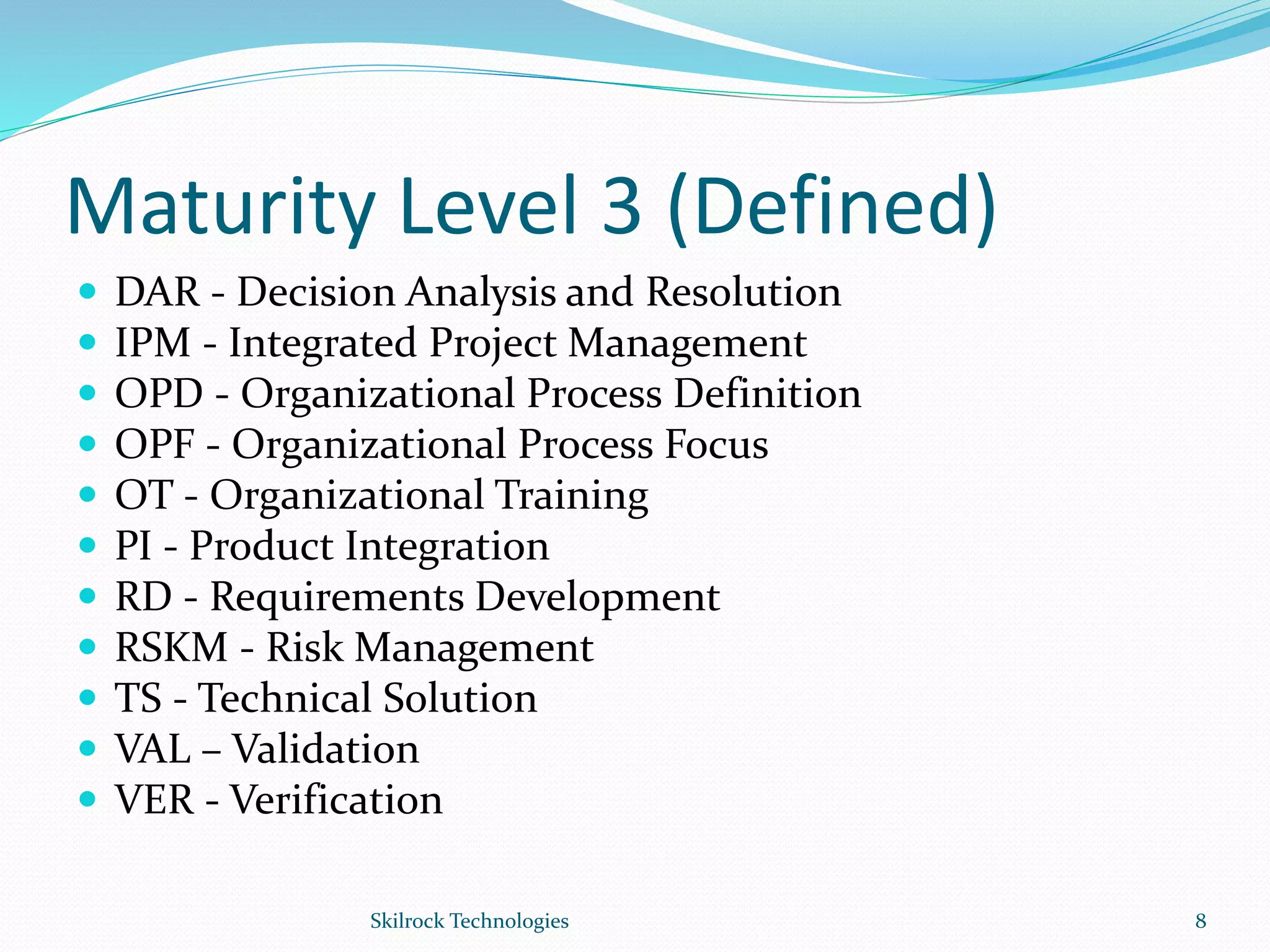
Maturity Level 3 (Defined)
 DAR - Decision Analysis and Resolution
 IPM - Integrated Project Management
 OPD - Organizational Process Definition
 OPF - Organizational Process Focus
 OT - Organizational Training
 PI - Product Integration
 RD - Requirements Development
 RSKM - Risk Management
 TS - Technical Solution
 VAL – Validation
 VER - Verification
8Skilrock Technologies
 The purpose of Configuration Management (CM) is
to establish and maintain the integrity of work
products using configuration identification,
configuration control, configuration status accounting,
and configuration audits.
 CM PLAN
 CONFIG STATUS ACC
 CI LIST
 DIR STRUCTURE
 TOOL
 REPOSITORY
9Skilrock Technologies
 The purpose of Measurement and Analysis (MA) is
to develop and sustain a measurement capability used
to support management information needs.
 METRICS
10Skilrock Technologies
 The purpose of Project Monitoring and
Control (PMC) is to provide an understanding of the
project's progress so that appropriate corrective
actions can be taken when the project's performance
deviates significantly from the plan.
 STATUS
 MOM
 UPDATED PLAN
11Skilrock Technologies
 The purpose of Project Planning (PP) is to establish
and maintain plans that define project activities.
 PMP
 MPP
 REQ
 RISK WATCH LIST,
 CM PLAN
12Skilrock Technologies
 The purpose of Process and Product Quality
Assurance (PPQA) is to provide staff and
management with objective insight into processes and
associated work products.
 AUDIT REPORT
 PRODUCT AUDIT REPORT
13Skilrock Technologies
 The purpose of Requirements
Management (REQM) is to manage requirements of
the project’s products and product components and to
ensure alignment between those requirements and the
project’s plans and work products.
 CONCEPT
 CR LOG
 CHANGE REQ LOG
 RTM
 IMPACT ANALYSIS
14Skilrock Technologies
 The purpose of Supplier Agreement
Management (SAM) is to manage the acquisition of
products from suppliers.
15Skilrock Technologies
 The purpose of Decision Analysis and
Resolution (DAR) is to analyze possible decisions
using a formal evaluation process that evaluates
identified alternatives against established criteria.
16Skilrock Technologies
 The purpose of Integrated Project
Management (IPM) is to establish and manage the
project and the involvement of relevant stakeholders
according to an integrated and defined process that is
tailored from the organization’s set of standard
processes.
 PMP
 ESTIMATION SHEET
 TAILORING
 SPDB
 PROJECT CLOSURE
 LESSON LEARNED
17Skilrock Technologies
 The purpose of Organizational Process
Definition (OPD) is to establish and maintain a
usable set of organizational process assets, work
environment standards, and rules and guidelines for
teams.
 The purpose of Organizational Process Focus (OPF)
is to plan, implement, and deploy organizational
process improvements based on a thorough
understanding of current strengths and weaknesses of
the organization’s processes and process assets.
 The purpose of Organizational Training (OT) is to
develop skills and knowledge of people so they can
perform their roles effectively and efficiently.
18Skilrock Technologies
 The purpose of Product Integration (PI) is to assemble
the product from the product components, ensure that the
product, as integrated, behaves properly (i.e., possesses the
required functionality and quality attributes), and deliver
the product.
 INTEGRATION DOCUMENT
 USER MANUAL
 The purpose of Requirements Development (RD) is to
elicit, analyze, and establish customer, product, and
product component requirements.
 SRS/EQUIVALENT
19Skilrock Technologies
 The purpose of Risk Management (RSKM) is to
identify potential problems before they occur so that
risk handling activities can be planned and invoked as
needed across the life of the product or project to
mitigate adverse impacts on achieving objectives.
 RISK MGT PLAN
 The purpose of Technical Solution (TS) is to select,
design, and implement solutions to requirements.
Solutions, designs, and implementations encompass
products, product components, and product related
lifecycle processes either singly or in combination as
appropriate.
20Skilrock Technologies
 The purpose of Validation (VAL) is to demonstrate
that a product or product component fulfills its
intended use when placed in its intended
environment.
 SYSTEM TESTING
 The purpose of Verification (VER) is to ensure that
selected work products meet their specified
requirements.
 REVIEW & UNIT TESTING
21Skilrock Technologies
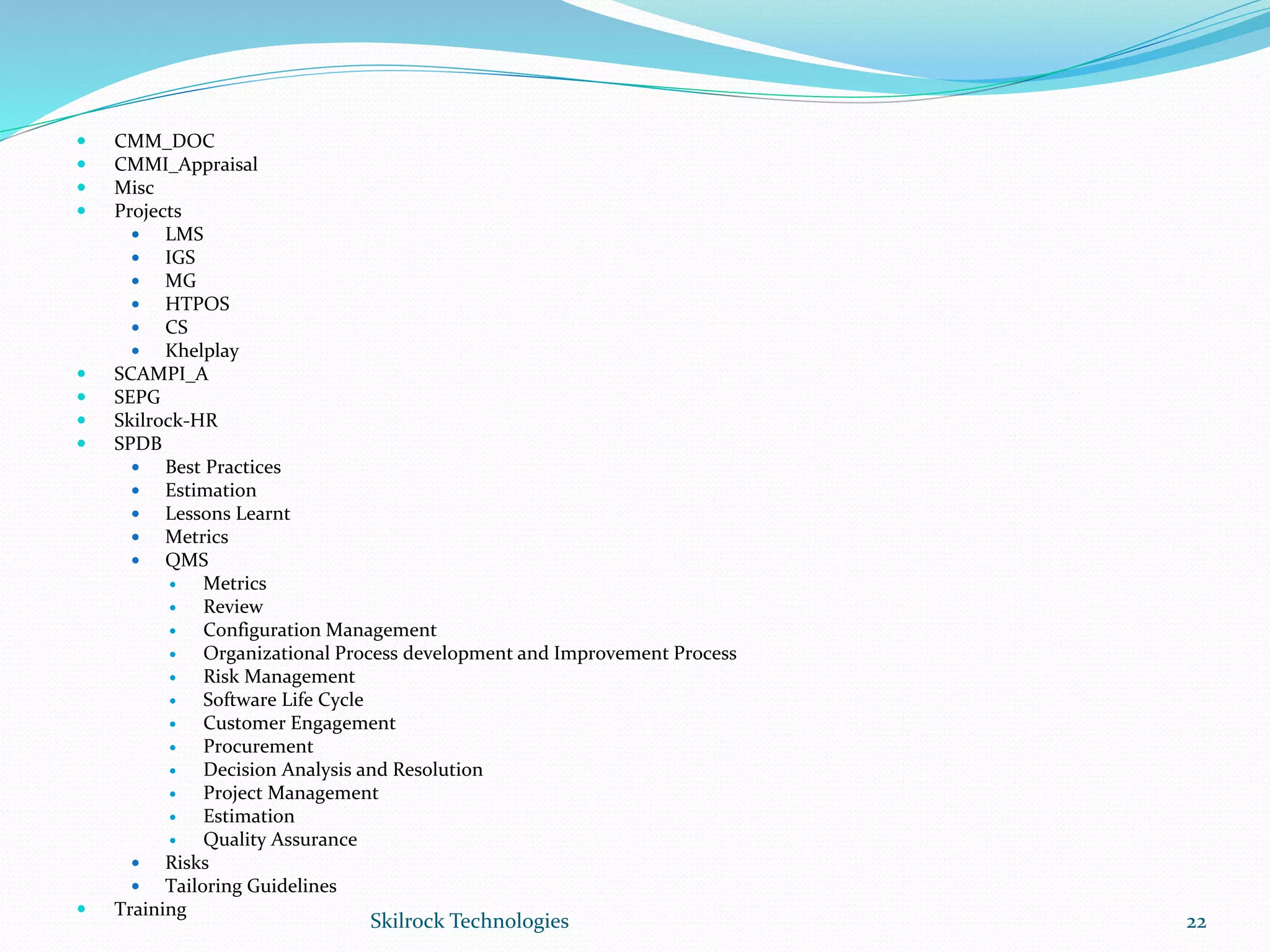
 CMM_DOC
 CMMI_Appraisal
 Misc
 Projects
 LMS
 IGS
 MG
 HTPOS
 CS
 Khelplay
 SCAMPI_A
 SEPG
 Skilrock-HR
 SPDB
 Best Practices
 Estimation
 Lessons Learnt
 Metrics
 QMS
 Metrics
 Review
 Configuration Management
 Organizational Process development and Improvement Process
 Risk Management
 Software Life Cycle
 Customer Engagement
 Procurement
 Decision Analysis and Resolution
 Project Management
 Estimation
 Quality Assurance
 Risks
 Tailoring Guidelines
 Training
22Skilrock Technologies
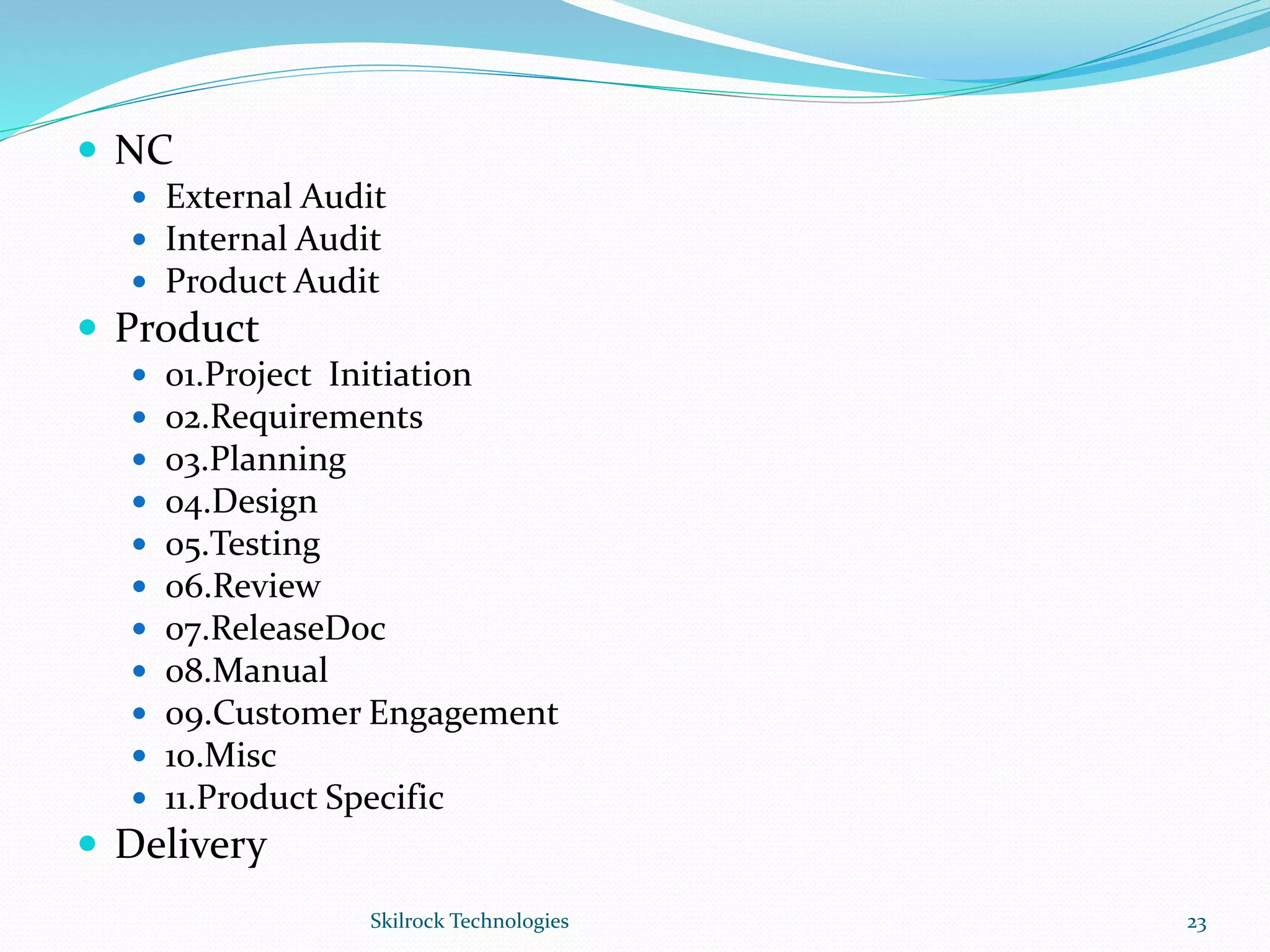
 NC
 External Audit
 Internal Audit
 Product Audit
 Product
 01.Project Initiation
 02.Requirements
 03.Planning
 04.Design
 05.Testing
 06.Review
 07.ReleaseDoc
 08.Manual
 09.Customer Engagement
 10.Misc
 11.Product Specific
 Delivery
23Skilrock Technologies
Projects
 Development Projects
 Khelplay
 Maintenance Projects
 LMS
 CS
 HTPOS
 MG
 IGS
24Skilrock Technologies
Roles and Responsibilities
 Project Manager
 Team Leader
 Developer
 Tester/QA
 Training Head
 SEPG Group
25Skilrock Technologies
GAP Analysis
 Analyzing the Gap in all the processes of respective
projects
 Closing all the backlogs
 Bringing the projects at par with standard CMMI
Processes
26Skilrock Technologies
THANK YOU
27Skilrock Technologies

SEI CMMI presentation

  • 1.
    SEI CMMI Presentation 1 PratyushMajumdar Tech Lead Skilrock Technologies Skilrock Technologies
  • 2.
    Objectives  To understandCMMI Level 3  Processes Implementation  Folder Structure - To understand Implementation of Standard CMMI Process in Skilrock  Difference between Development and maintenance Projects  Roles and Responsibilities  GAP Analysis 2Skilrock Technologies
  • 3.
    What is CMMI CMMI (Capability Maturity Model Integration) is a proven industry framework to improve product quality and development efficiency for both hardware and software  CMMI uses 5 levels to describe the maturity of an organization  Behavioral changes are needed at both management and staff levels 3Skilrock Technologies
  • 4.
    Level 5 Initial Level 1 Processesare unpredictable, poorly controlled, reactive. Managed Level 2 Processes are planned, documented, performed, monitored, and controlled at the project level. Often reactive. Defined Level 3 Processes are well characterized and understood. Processes, standards, procedures, tools, etc. are defined at the organizational (Organization X ) level. Proactive. Quantitatively Managed Level 4 Processes are controlled using statistical and other quantitative techniques. Optimizing Process performance continually improved through incremental and innovative technological improvements. 4Skilrock Technologies
  • 5.
    Maturity Level ProcessCharacteristics Behavior 5 OPTIMIZING Focus is on continuous quantitative improvement Focus on "fire prevention"; improvement anticipated and desired, and impacts assessed. 4 QUANTITATIVELY MANAGED Process is measured and controlled Greater sense of teamwork and inter- dependencies 3 DEFINED Process is characterized for the organization and is proactive Reliance on defined process. People understand, support and follow the process. 2 MANAGED Process is characterized for projects and is often reactive Over reliance on experience of good people – when they go, the process goes. 1 INITIAL Process is unpredictable, poorly controlled, and reactive Focus on "fire fighting" Effectiveness is low – frustration high 5Skilrock Technologies
  • 6.
    Process Areas (PA) Basic functions that need to be performed within each of the 5 Maturity Levels  Within each PA there are Goals to be achieved and within each Goal there are Practices, work products, etc. to be followed that will support each of the Goals.  For Maturity Level 2 – 7 Process Areas  For Maturity Level 3 – 11 Process Areas  For Maturity Level 4 – 2 Process Areas (Out of Scope)  For Maturity Level 5 – 2 Process Areas (Out of Scope) 6Skilrock Technologies
  • 7.
    Maturity Level 2(Managed)  CM - Configuration Management  MA - Measurement and Analysis  PMC - Project Monitoring and Control  PP - Project Planning  PPQA - Process and Product Quality Assurance  REQM - Requirements Management  SAM - Supplier Agreement Management 7Skilrock Technologies
  • 8.
    Maturity Level 3(Defined)  DAR - Decision Analysis and Resolution  IPM - Integrated Project Management  OPD - Organizational Process Definition  OPF - Organizational Process Focus  OT - Organizational Training  PI - Product Integration  RD - Requirements Development  RSKM - Risk Management  TS - Technical Solution  VAL – Validation  VER - Verification 8Skilrock Technologies
  • 9.
     The purposeof Configuration Management (CM) is to establish and maintain the integrity of work products using configuration identification, configuration control, configuration status accounting, and configuration audits.  CM PLAN  CONFIG STATUS ACC  CI LIST  DIR STRUCTURE  TOOL  REPOSITORY 9Skilrock Technologies
  • 10.
     The purposeof Measurement and Analysis (MA) is to develop and sustain a measurement capability used to support management information needs.  METRICS 10Skilrock Technologies
  • 11.
     The purposeof Project Monitoring and Control (PMC) is to provide an understanding of the project's progress so that appropriate corrective actions can be taken when the project's performance deviates significantly from the plan.  STATUS  MOM  UPDATED PLAN 11Skilrock Technologies
  • 12.
     The purposeof Project Planning (PP) is to establish and maintain plans that define project activities.  PMP  MPP  REQ  RISK WATCH LIST,  CM PLAN 12Skilrock Technologies
  • 13.
     The purposeof Process and Product Quality Assurance (PPQA) is to provide staff and management with objective insight into processes and associated work products.  AUDIT REPORT  PRODUCT AUDIT REPORT 13Skilrock Technologies
  • 14.
     The purposeof Requirements Management (REQM) is to manage requirements of the project’s products and product components and to ensure alignment between those requirements and the project’s plans and work products.  CONCEPT  CR LOG  CHANGE REQ LOG  RTM  IMPACT ANALYSIS 14Skilrock Technologies
  • 15.
     The purposeof Supplier Agreement Management (SAM) is to manage the acquisition of products from suppliers. 15Skilrock Technologies
  • 16.
     The purposeof Decision Analysis and Resolution (DAR) is to analyze possible decisions using a formal evaluation process that evaluates identified alternatives against established criteria. 16Skilrock Technologies
  • 17.
     The purposeof Integrated Project Management (IPM) is to establish and manage the project and the involvement of relevant stakeholders according to an integrated and defined process that is tailored from the organization’s set of standard processes.  PMP  ESTIMATION SHEET  TAILORING  SPDB  PROJECT CLOSURE  LESSON LEARNED 17Skilrock Technologies
  • 18.
     The purposeof Organizational Process Definition (OPD) is to establish and maintain a usable set of organizational process assets, work environment standards, and rules and guidelines for teams.  The purpose of Organizational Process Focus (OPF) is to plan, implement, and deploy organizational process improvements based on a thorough understanding of current strengths and weaknesses of the organization’s processes and process assets.  The purpose of Organizational Training (OT) is to develop skills and knowledge of people so they can perform their roles effectively and efficiently. 18Skilrock Technologies
  • 19.
     The purposeof Product Integration (PI) is to assemble the product from the product components, ensure that the product, as integrated, behaves properly (i.e., possesses the required functionality and quality attributes), and deliver the product.  INTEGRATION DOCUMENT  USER MANUAL  The purpose of Requirements Development (RD) is to elicit, analyze, and establish customer, product, and product component requirements.  SRS/EQUIVALENT 19Skilrock Technologies
  • 20.
     The purposeof Risk Management (RSKM) is to identify potential problems before they occur so that risk handling activities can be planned and invoked as needed across the life of the product or project to mitigate adverse impacts on achieving objectives.  RISK MGT PLAN  The purpose of Technical Solution (TS) is to select, design, and implement solutions to requirements. Solutions, designs, and implementations encompass products, product components, and product related lifecycle processes either singly or in combination as appropriate. 20Skilrock Technologies
  • 21.
     The purposeof Validation (VAL) is to demonstrate that a product or product component fulfills its intended use when placed in its intended environment.  SYSTEM TESTING  The purpose of Verification (VER) is to ensure that selected work products meet their specified requirements.  REVIEW & UNIT TESTING 21Skilrock Technologies
  • 22.
     CMM_DOC  CMMI_Appraisal Misc  Projects  LMS  IGS  MG  HTPOS  CS  Khelplay  SCAMPI_A  SEPG  Skilrock-HR  SPDB  Best Practices  Estimation  Lessons Learnt  Metrics  QMS  Metrics  Review  Configuration Management  Organizational Process development and Improvement Process  Risk Management  Software Life Cycle  Customer Engagement  Procurement  Decision Analysis and Resolution  Project Management  Estimation  Quality Assurance  Risks  Tailoring Guidelines  Training 22Skilrock Technologies
  • 23.
     NC  ExternalAudit  Internal Audit  Product Audit  Product  01.Project Initiation  02.Requirements  03.Planning  04.Design  05.Testing  06.Review  07.ReleaseDoc  08.Manual  09.Customer Engagement  10.Misc  11.Product Specific  Delivery 23Skilrock Technologies
  • 24.
    Projects  Development Projects Khelplay  Maintenance Projects  LMS  CS  HTPOS  MG  IGS 24Skilrock Technologies
  • 25.
    Roles and Responsibilities Project Manager  Team Leader  Developer  Tester/QA  Training Head  SEPG Group 25Skilrock Technologies
  • 26.
    GAP Analysis  Analyzingthe Gap in all the processes of respective projects  Closing all the backlogs  Bringing the projects at par with standard CMMI Processes 26Skilrock Technologies
  • 27.