The New Frontier and the Great Society
John F. Kennedy won the presidency in 1960.
He took office on
January 20, 1961, and
offered a vision of a
“New Frontier.”
The Kennedy/Nixon Debate
JFK’s New Frontier
His inaugural address inspired
many young Americans to serve
their country (“Ask not what your
country can do for you; ask what
you can do for your country.”).
Creation of Peace Corps
Space program – put man on the
moon by end of decade
Tax-cut to stimulate economy
Proposed medical assistance for
the aged, and increased federal
aid to education (both stalled in
Congress)
A New Military Policy
• Kennedy believed his most urgent task
was to redefine the nation’s nuclear
strategy
• His team developed a policy of flexible
response, which increased defense
spending in order to boost conventional
military forces and to create an elite
branch of the army called Special Forces
(Green Berets, SEALs)
• These changes enabled the United States
to fight limited wars around the world
while maintaining a balance of nuclear
power with the Soviet Union
Crisis Over Berlin
• Meeting with US President John F. Kennedy in
the Vienna summit on June 4, 1961, Premier
Khrushchev caused a new crisis when he
reissued his threat to sign a separate peace
treaty with East Germany
• However, this time he did so by issuing an
ultimatum, with a deadline of December 31,
1961.
• The three powers (British, French, Americans)
replied that no unilateral treaty could abrogate
their responsibilities and rights in West Berlin,
including the right of unobstructed access to
the city.
• The Berlin Wall was erected topped with
barbed wire to separate the two sides of the
city
The Cuban Missile Crisis
• The thirteen days referred to as the Cuban Missile
Crisis was a confrontation between the Soviet
Union/Cuba and the United States in October 1962
• In August 1962, after some unsuccessful operations
by the US to overthrow the Cuban regime (Bay of
Pigs, Operation Mongoose), the Cuban and Soviet
governments secretly began to build bases in Cuba
for a number of medium-range and intermediate-
range ballistic nuclear missiles
• This action followed the 1958 deployment of Thor
IRBMs in the UK and Jupiter IRBMs to Italy and
Turkey in 1961 – more than 100 US-built missiles
having the capability to strike Moscow with nuclear
warheads.
• On October 14, 1962, a United States Air Force U-2
plane on a photoreconnaissance mission captured
photographic proof of Soviet missile bases under
construction in Cuba.
The Cuban Missile Crisis
• The United States considered attacking Cuba via
air and sea, but decided on a military blockade
instead, calling it a "quarantine"
• The US announced that it would not permit
offensive weapons to be delivered to Cuba and
demanded that the Soviets dismantle the missile
bases already under construction or completed
in Cuba
• The Kennedy administration held only a slim
hope that the Kremlin would agree to their
demands, and expected a military confrontation.
• The Soviets publicly balked at the US demands,
but in secret back-channel communications
initiated a proposal to resolve the crisis
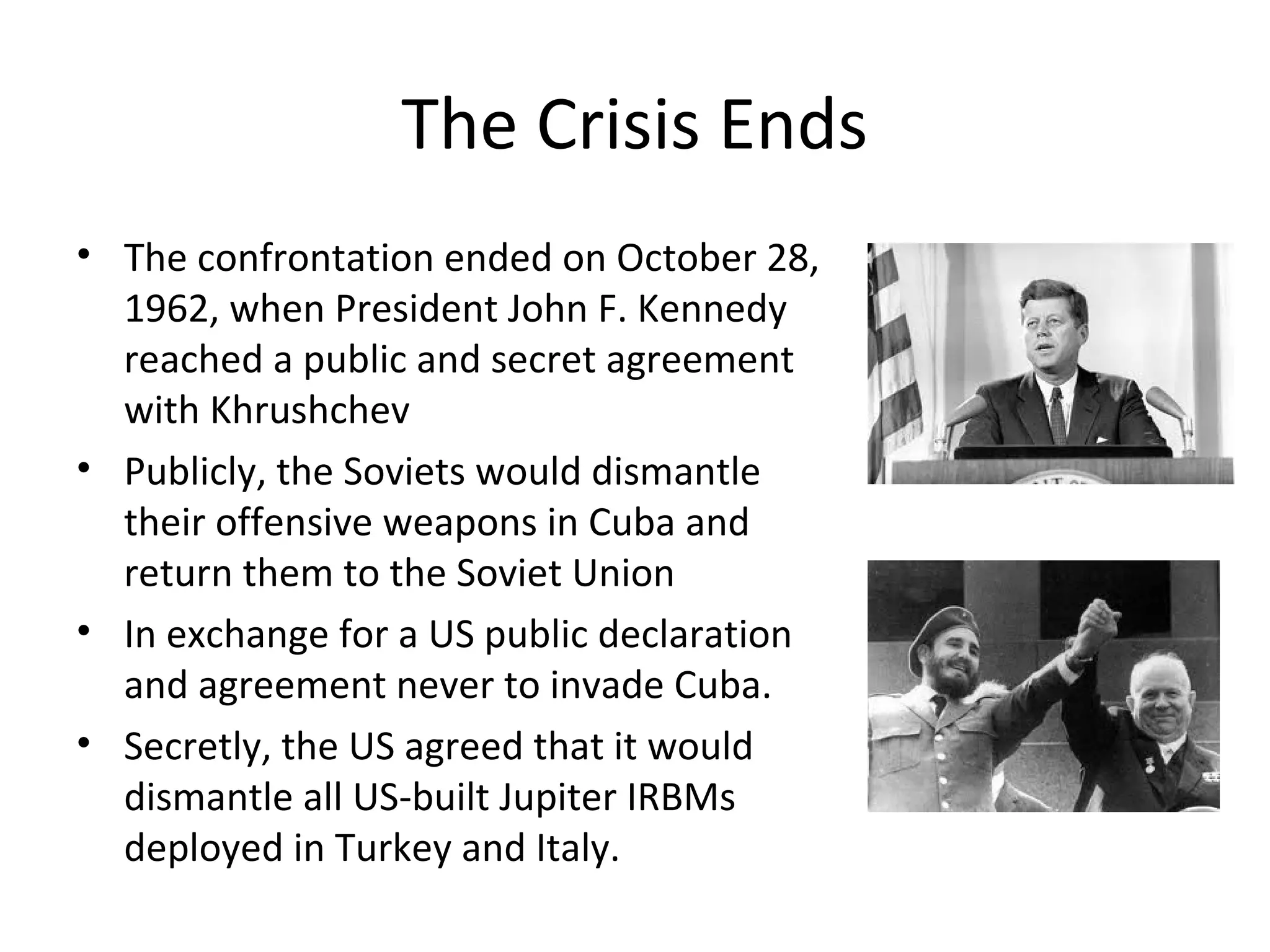
The Crisis Ends
• The confrontation ended on October 28,
1962, when President John F. Kennedy
reached a public and secret agreement
with Khrushchev
• Publicly, the Soviets would dismantle
their offensive weapons in Cuba and
return them to the Soviet Union
• In exchange for a US public declaration
and agreement never to invade Cuba.
• Secretly, the US agreed that it would
dismantle all US-built Jupiter IRBMs
deployed in Turkey and Italy.
Searching For Ways to Ease
Tensions
• The creation of a hot line
between the White House
and the Kremlin
• Limited Test Ban Treaty that
barred nuclear testing in the
atmosphere
The President is Assassinated
• On the morning of November 22, 1963
President Kennedy and the First Lady
flew to Dallas to meet with state
democratic leaders
• In route after passing the Texas School
Book Depository, rifle shots rang out
and President Kennedy was shot in the
head
• Lyndon B. Johnson was sworn in hours
later on Air Force One
• Lee Harvey Oswald was arrested and
charged with the murder of the
President
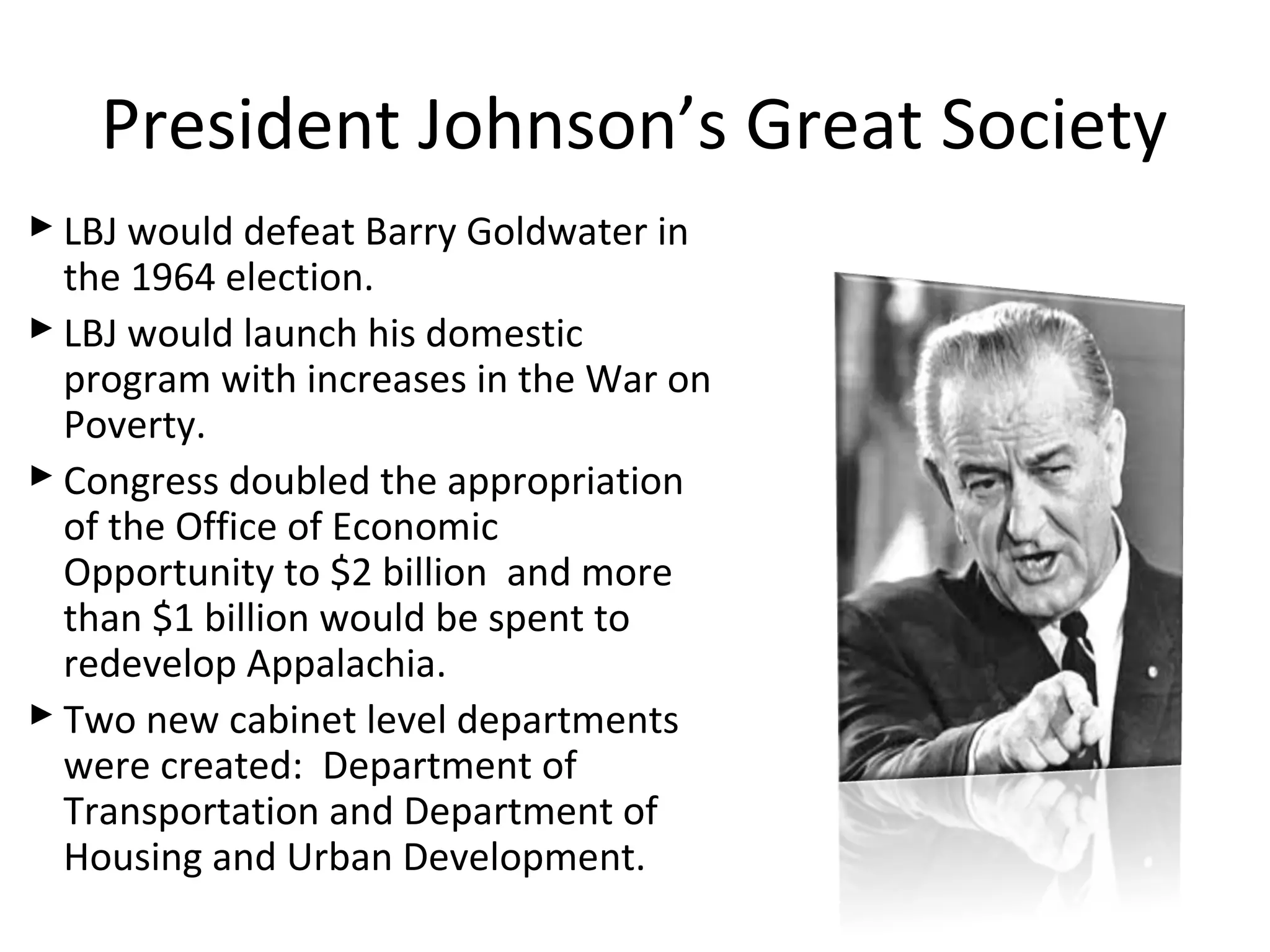
President Johnson’s Great Society
 LBJ would defeat Barry Goldwater in
the 1964 election.
 LBJ would launch his domestic
program with increases in the War on
Poverty.
 Congress doubled the appropriation
of the Office of Economic
Opportunity to $2 billion and more
than $1 billion would be spent to
redevelop Appalachia.
 Two new cabinet level departments
were created: Department of
Transportation and Department of
Housing and Urban Development.
President Johnson’s Great Society
 Aid to education, medical care for the
elderly and the indigent, and
immigration reform would be
enacted:
* Aid was funneled to students,
including those in parochial schools.
* Medicare for the elderly,
accompanied by Medicaid for the
poor, became a reality in 1965.
* The Immigration and Nationality
Act of 1965 abolished the “national
origin” quota system that had been in
place since 1921.

The 1960s The Charm and the Challenges

  • 1.
    The New Frontierand the Great Society
  • 2.
    John F. Kennedywon the presidency in 1960. He took office on January 20, 1961, and offered a vision of a “New Frontier.” The Kennedy/Nixon Debate
  • 3.
    JFK’s New Frontier Hisinaugural address inspired many young Americans to serve their country (“Ask not what your country can do for you; ask what you can do for your country.”). Creation of Peace Corps Space program – put man on the moon by end of decade Tax-cut to stimulate economy Proposed medical assistance for the aged, and increased federal aid to education (both stalled in Congress)
  • 4.
    A New MilitaryPolicy • Kennedy believed his most urgent task was to redefine the nation’s nuclear strategy • His team developed a policy of flexible response, which increased defense spending in order to boost conventional military forces and to create an elite branch of the army called Special Forces (Green Berets, SEALs) • These changes enabled the United States to fight limited wars around the world while maintaining a balance of nuclear power with the Soviet Union
  • 5.
    Crisis Over Berlin •Meeting with US President John F. Kennedy in the Vienna summit on June 4, 1961, Premier Khrushchev caused a new crisis when he reissued his threat to sign a separate peace treaty with East Germany • However, this time he did so by issuing an ultimatum, with a deadline of December 31, 1961. • The three powers (British, French, Americans) replied that no unilateral treaty could abrogate their responsibilities and rights in West Berlin, including the right of unobstructed access to the city. • The Berlin Wall was erected topped with barbed wire to separate the two sides of the city
  • 6.
    The Cuban MissileCrisis • The thirteen days referred to as the Cuban Missile Crisis was a confrontation between the Soviet Union/Cuba and the United States in October 1962 • In August 1962, after some unsuccessful operations by the US to overthrow the Cuban regime (Bay of Pigs, Operation Mongoose), the Cuban and Soviet governments secretly began to build bases in Cuba for a number of medium-range and intermediate- range ballistic nuclear missiles • This action followed the 1958 deployment of Thor IRBMs in the UK and Jupiter IRBMs to Italy and Turkey in 1961 – more than 100 US-built missiles having the capability to strike Moscow with nuclear warheads. • On October 14, 1962, a United States Air Force U-2 plane on a photoreconnaissance mission captured photographic proof of Soviet missile bases under construction in Cuba.
  • 7.
    The Cuban MissileCrisis • The United States considered attacking Cuba via air and sea, but decided on a military blockade instead, calling it a "quarantine" • The US announced that it would not permit offensive weapons to be delivered to Cuba and demanded that the Soviets dismantle the missile bases already under construction or completed in Cuba • The Kennedy administration held only a slim hope that the Kremlin would agree to their demands, and expected a military confrontation. • The Soviets publicly balked at the US demands, but in secret back-channel communications initiated a proposal to resolve the crisis
  • 8.
    The Crisis Ends •The confrontation ended on October 28, 1962, when President John F. Kennedy reached a public and secret agreement with Khrushchev • Publicly, the Soviets would dismantle their offensive weapons in Cuba and return them to the Soviet Union • In exchange for a US public declaration and agreement never to invade Cuba. • Secretly, the US agreed that it would dismantle all US-built Jupiter IRBMs deployed in Turkey and Italy.
  • 9.
    Searching For Waysto Ease Tensions • The creation of a hot line between the White House and the Kremlin • Limited Test Ban Treaty that barred nuclear testing in the atmosphere
  • 10.
    The President isAssassinated • On the morning of November 22, 1963 President Kennedy and the First Lady flew to Dallas to meet with state democratic leaders • In route after passing the Texas School Book Depository, rifle shots rang out and President Kennedy was shot in the head • Lyndon B. Johnson was sworn in hours later on Air Force One • Lee Harvey Oswald was arrested and charged with the murder of the President
  • 11.
    President Johnson’s GreatSociety  LBJ would defeat Barry Goldwater in the 1964 election.  LBJ would launch his domestic program with increases in the War on Poverty.  Congress doubled the appropriation of the Office of Economic Opportunity to $2 billion and more than $1 billion would be spent to redevelop Appalachia.  Two new cabinet level departments were created: Department of Transportation and Department of Housing and Urban Development.
  • 12.
    President Johnson’s GreatSociety  Aid to education, medical care for the elderly and the indigent, and immigration reform would be enacted: * Aid was funneled to students, including those in parochial schools. * Medicare for the elderly, accompanied by Medicaid for the poor, became a reality in 1965. * The Immigration and Nationality Act of 1965 abolished the “national origin” quota system that had been in place since 1921.