
PRESENTED BY :-
 Rabindra Saha
 Mohit Nagal
 Swarnima Gaur
 Ankur Agrawal
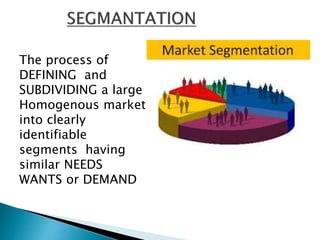
The process of
DEFINING and
SUBDIVIDING a large
Homogenous market
into clearly
identifiable
segments having
similar NEEDS
WANTS or DEMAND
 To capture a particular category or set of
market more effectively & efficiently
 To divide the load of target amongst the
work force
 To focus on the test and preference related to
the customer of a particular segment
 GEOGRAPHIC
 DEMOGRAPHIC
 SOCIOGRAPHIC
 PSYCHOGRAPHIC
 —Urban / Rural : Accordingly, marketing
strategies must be designed depending upon
their likes, dislikes, moods, preferences,
fashions and buying habits.
 —Locality : There are differences in terms of
buying patterns of people residing at Parel
and Parle, within a city like Mumbai.
 AGE
 GENDER
 INCOME
 EDUCATION
 FAMILY SIZE
 Cultural Influences
 Influence of Social Class
 Influence of Reference Groups
 Life-Style
 Personality
 Focus of the Company
 Increase in competitiveness
 Market expansion
 Customer retention
 Consumers are misinterpreted
 Costing is not taken into consideration
 There are too many brands
 Consumer are confused
Queries and Suggestions

Segmantation

  • 1.
    PRESENTED BY :- Rabindra Saha  Mohit Nagal  Swarnima Gaur  Ankur Agrawal
  • 2.
    The process of DEFININGand SUBDIVIDING a large Homogenous market into clearly identifiable segments having similar NEEDS WANTS or DEMAND
  • 3.
     To capturea particular category or set of market more effectively & efficiently  To divide the load of target amongst the work force  To focus on the test and preference related to the customer of a particular segment
  • 5.
     GEOGRAPHIC  DEMOGRAPHIC SOCIOGRAPHIC  PSYCHOGRAPHIC
  • 6.
     —Urban /Rural : Accordingly, marketing strategies must be designed depending upon their likes, dislikes, moods, preferences, fashions and buying habits.  —Locality : There are differences in terms of buying patterns of people residing at Parel and Parle, within a city like Mumbai.
  • 7.
     AGE  GENDER INCOME  EDUCATION  FAMILY SIZE
  • 8.
     Cultural Influences Influence of Social Class  Influence of Reference Groups
  • 9.
  • 10.
     Focus ofthe Company  Increase in competitiveness  Market expansion  Customer retention
  • 11.
     Consumers aremisinterpreted  Costing is not taken into consideration  There are too many brands  Consumer are confused
  • 12.