Big Data and its Impact on Health Care
Presented By,
Dr. S. LILLY SHEEBA,
Associate Professor,
Department of Computer Science & Engineering,
SRMIST, Ramapuram,
Chennai - 600089.
1
Contents
• How much time will it take to query this?
• In a minute...
• Big Data
• Characteristics of Big Data – 3 V’s
• Volume
• Velocity
• Variety
• Applications of
• Big Data and Covid -19
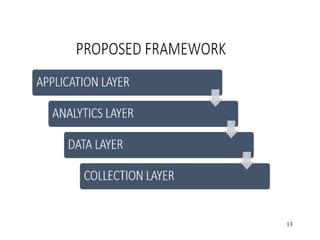
• Proposed Framework
• References
2
How much time will it take to query this?
• Excel: A table of 500 MB
• Access: A table of 10 GB
• SQL: A table of 50 GB
• Running on 20, 980, 000 GB Google file. It deals with
more than 20 PB/ day.(1TB-1000GB; 1PB-1000PB)
3
In a minute .......
• 204 million Emails received
• 2 million search queries/day
• 48 hours of video on YouTube uploaded
• 217 new users on Mobile Web
• 34000 likes on Facebook
4
BIG DATA
• Collection of large and complex datasets
• Difficult to process using traditional DBMS tools or
traditional data processing applications
• Requires new architecture, techniques, algorithms and
analytics to manage and extract hidden knowledge
5
CHARACTERISTICS OF BIGDATA – 3V’s
• Volume
– Quality of Data
• Velocity
– Speed of Data
• Variety
– Types of Data
6
VOLUME
• Face book ingests 500 TB of new data per day
• Boeing 737 generates 240 TB of flight data during a single
flight.
• Large amount of data in case of pandemic outbreak
7
VELOCITY
• Online gaming supports millions of concurrent users, each
producing multiple inputs/second
• Stock trading algorithms reflect market changes within
microseconds
• Click – likes streams and ad impressions capture user
behavior of millions of events/second
8
VARIETY
• Big Data supports simple types like
– Numbers
– Dates
– String
• It also supports complex types like
– Geospatial Data
– 3D Data
– Audio & Video Data
– Unstructured Text
9
COVID-19 and a pandemic outbreak.....
– Total people infected stands at 11 crore globally
– Total fatality stands at 25 lakh globally
– Lead to
• Burst of cases
• Larger amount of health data
• Different data storage technologies to store this
– Data here acts as a vital source
• of information and knowledge
• for research activities about the virus or pandemic
• to device measures to fight the virus and its after-
effects
• to tackle the pandemic
10
Big Data and COVID-19
– Benefits of using Big Data
• can be used to digitally store a large amount of data
of COVID patients(infected, recovered and expired)
• helps to analyze the patterns, associations and the
differences
• helps to analyze the effectiveness of the control
measures used in controlling the advances of the
pandemic
• checks the spreading of the virus
• assists in developing future preventive methods
11
Big Data and COVID-19 [contd..]
– Several data digitized include
• Patient location
• Proximity
• Patient-Reported Travel
• Co-Morbidity
• Patient Physiology
• Current Symptoms
– Big Data Analytics renders itself useful to
• Scientists
• Health Workers
• Epidemiologists
12
13
PROPOSED FRAMEWORK [2]
[2]
14
1. Telecommunication Operations
2. Internet
3. Electronic Medical Record
4. Hospital Information System
5. Government Information System
6. Epidemic Prevention System
7. Smart Device
8. Questionnaire
Collection Layer
PROPOSED FRAMEWORK [3]
[2]
15
1. Location Data
2. Travel Data
3. Medical Data
4. Health Status Data
5. News Media Data
6. Government Data
7. Online Consumption of Data
Data Layer
PROPOSED FRAMEWORK [4]
16
1. Descriptive Analysis
2. Diagnostic Analysis
3. Predictive Analysis
4. Prescriptive Analysis
Analytics Layer
PROPOSED FRAMEWORK [5]
17
1. Personnel Tracking
2. Epidemic Surveillance
3. Early Warning
4. Tracing of virus sources
5. Drug Screening
6. Medical Treatment
7. Resource Allocation
8. Production & Delivery
Epidemic Monitoring
And
Surveillance Layer
[Application]
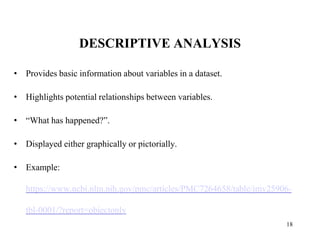
DESCRIPTIVE ANALYSIS
• Provides basic information about variables in a dataset.
• Highlights potential relationships between variables.
• “What has happened?”.
• Displayed either graphically or pictorially.
• Example:
https://www.ncbi.nlm.nih.gov/pmc/articles/PMC7264658/table/jmv25906-
tbl-0001/?report=objectonly
18
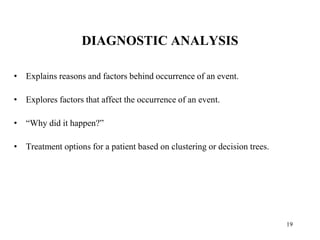
DIAGNOSTIC ANALYSIS
• Explains reasons and factors behind occurrence of an event.
• Explores factors that affect the occurrence of an event.
• “Why did it happen?”
• Treatment options for a patient based on clustering or decision trees.
19
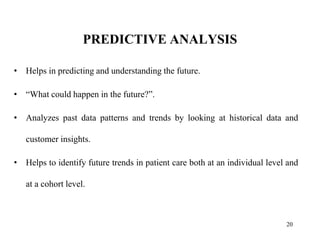
PREDICTIVE ANALYSIS
• Helps in predicting and understanding the future.
• “What could happen in the future?”.
• Analyzes past data patterns and trends by looking at historical data and
customer insights.
• Helps to identify future trends in patient care both at an individual level and
at a cohort level.
20
PRESCRIPTIVE ANALYSIS
• Helps in recommending the best possible courses of action.
• “What should be done?”
• Enables health care decision–makers to optimize recommendation for the
best course of action for patients and health workers.
• “What if ? “ scenarios are used to access the impact of choosing one action
over the other.
21
REFERENCES
1. S. Sharma and V. Mangat, "Technology and Trends to Handle Big Data:
Survey," 2015 Fifth International Conference on Advanced Computing &
Communication Technologies,Haryana,2015,266-271.[DOI: 10.1109/
ACCT.2015.121]
2. Burghard C: Big Data and Analytics Key to Accountable Care Success.
2012, IDC Health Insights.[URL:https://www.waysquare.com/big-data-
and-analytics-key-to-accountable-care-success/]
3. Feldman B, Martin EM, Skotnes T: “Big Data in Healthcare Hype and
Hope.” October 2012.Dr.Bonnie 360.
4. Raghupathi W, Raghupathi V. Big data analytics in healthcare: promise
and potential. Health Inf Sci Syst.2014.
5. Ginsberg J, Mohebbi M H, Patel R, et al. Detecting influenza epidemics
using search engine query data.Nature,2009, 457(7232):1012-1014
22
REFERENCES-contd.
6. Hui-Jun Qiu, Lian-Xiong Yuan, Qing-Wu Wu, Yu-Qi Zhou, Rui
Zheng, Xue-Kun Huang, Qin-Tai Yang, Using the internet search
data to investigate symptom characteristics of COVID-19: A big data
study, World Journal of Otorhinolaryngology - Head and Neck
Surgery,2020.
7. Salman Y. Guraya,Transforming laparoendoscopic surgical protocols
during the COVID-19 pandemic; big data analytics, resource
allocation and operational considerations, International Journal of
Surgery 2020 August;80:21-25.
8. Ayyoubzadeh SM, Ayyoubzadeh SM, Zahedi H, Ahmadi M, R
Niakan Kalhori S. Predicting COVID-19 Incidence Through Analysis
of Google Trends Data in Iran: Data Mining and Deep Learning Pilot
Study. JMIR Public Health Surveill.2020;6(2):e18828.
9. Haleem A, Javaid M, Khan IH, Vaishya R. Significant Applications
of Big Data in COVID-19 Pandemic. Indian J Orthop.2020;54(4):1-
3. 23
REFERENCES-contd.
10. Bragazzi NL, Dai H, Damiani G, Behzadifar M, Martini M, Wu J.
How Big Data and Artificial Intelligence Can Help Better Manage the
COVID-19 Pandemic. Int J Environ Res Public
Health.2020;17(9):3176.
24
Thank you
25

Innovative project1

  • 1.
    Big Data andits Impact on Health Care Presented By, Dr. S. LILLY SHEEBA, Associate Professor, Department of Computer Science & Engineering, SRMIST, Ramapuram, Chennai - 600089. 1
  • 2.
    Contents • How muchtime will it take to query this? • In a minute... • Big Data • Characteristics of Big Data – 3 V’s • Volume • Velocity • Variety • Applications of • Big Data and Covid -19 • Proposed Framework • References 2
  • 3.
    How much timewill it take to query this? • Excel: A table of 500 MB • Access: A table of 10 GB • SQL: A table of 50 GB • Running on 20, 980, 000 GB Google file. It deals with more than 20 PB/ day.(1TB-1000GB; 1PB-1000PB) 3
  • 4.
    In a minute....... • 204 million Emails received • 2 million search queries/day • 48 hours of video on YouTube uploaded • 217 new users on Mobile Web • 34000 likes on Facebook 4
  • 5.
    BIG DATA • Collectionof large and complex datasets • Difficult to process using traditional DBMS tools or traditional data processing applications • Requires new architecture, techniques, algorithms and analytics to manage and extract hidden knowledge 5
  • 6.
    CHARACTERISTICS OF BIGDATA– 3V’s • Volume – Quality of Data • Velocity – Speed of Data • Variety – Types of Data 6
  • 7.
    VOLUME • Face bookingests 500 TB of new data per day • Boeing 737 generates 240 TB of flight data during a single flight. • Large amount of data in case of pandemic outbreak 7
  • 8.
    VELOCITY • Online gamingsupports millions of concurrent users, each producing multiple inputs/second • Stock trading algorithms reflect market changes within microseconds • Click – likes streams and ad impressions capture user behavior of millions of events/second 8
  • 9.
    VARIETY • Big Datasupports simple types like – Numbers – Dates – String • It also supports complex types like – Geospatial Data – 3D Data – Audio & Video Data – Unstructured Text 9
  • 10.
    COVID-19 and apandemic outbreak..... – Total people infected stands at 11 crore globally – Total fatality stands at 25 lakh globally – Lead to • Burst of cases • Larger amount of health data • Different data storage technologies to store this – Data here acts as a vital source • of information and knowledge • for research activities about the virus or pandemic • to device measures to fight the virus and its after- effects • to tackle the pandemic 10
  • 11.
    Big Data andCOVID-19 – Benefits of using Big Data • can be used to digitally store a large amount of data of COVID patients(infected, recovered and expired) • helps to analyze the patterns, associations and the differences • helps to analyze the effectiveness of the control measures used in controlling the advances of the pandemic • checks the spreading of the virus • assists in developing future preventive methods 11
  • 12.
    Big Data andCOVID-19 [contd..] – Several data digitized include • Patient location • Proximity • Patient-Reported Travel • Co-Morbidity • Patient Physiology • Current Symptoms – Big Data Analytics renders itself useful to • Scientists • Health Workers • Epidemiologists 12
  • 13.
  • 14.
    PROPOSED FRAMEWORK [2] [2] 14 1.Telecommunication Operations 2. Internet 3. Electronic Medical Record 4. Hospital Information System 5. Government Information System 6. Epidemic Prevention System 7. Smart Device 8. Questionnaire Collection Layer
  • 15.
    PROPOSED FRAMEWORK [3] [2] 15 1.Location Data 2. Travel Data 3. Medical Data 4. Health Status Data 5. News Media Data 6. Government Data 7. Online Consumption of Data Data Layer
  • 16.
    PROPOSED FRAMEWORK [4] 16 1.Descriptive Analysis 2. Diagnostic Analysis 3. Predictive Analysis 4. Prescriptive Analysis Analytics Layer
  • 17.
    PROPOSED FRAMEWORK [5] 17 1.Personnel Tracking 2. Epidemic Surveillance 3. Early Warning 4. Tracing of virus sources 5. Drug Screening 6. Medical Treatment 7. Resource Allocation 8. Production & Delivery Epidemic Monitoring And Surveillance Layer [Application]
  • 18.
    DESCRIPTIVE ANALYSIS • Providesbasic information about variables in a dataset. • Highlights potential relationships between variables. • “What has happened?”. • Displayed either graphically or pictorially. • Example: https://www.ncbi.nlm.nih.gov/pmc/articles/PMC7264658/table/jmv25906- tbl-0001/?report=objectonly 18
  • 19.
    DIAGNOSTIC ANALYSIS • Explainsreasons and factors behind occurrence of an event. • Explores factors that affect the occurrence of an event. • “Why did it happen?” • Treatment options for a patient based on clustering or decision trees. 19
  • 20.
    PREDICTIVE ANALYSIS • Helpsin predicting and understanding the future. • “What could happen in the future?”. • Analyzes past data patterns and trends by looking at historical data and customer insights. • Helps to identify future trends in patient care both at an individual level and at a cohort level. 20
  • 21.
    PRESCRIPTIVE ANALYSIS • Helpsin recommending the best possible courses of action. • “What should be done?” • Enables health care decision–makers to optimize recommendation for the best course of action for patients and health workers. • “What if ? “ scenarios are used to access the impact of choosing one action over the other. 21
  • 22.
    REFERENCES 1. S. Sharmaand V. Mangat, "Technology and Trends to Handle Big Data: Survey," 2015 Fifth International Conference on Advanced Computing & Communication Technologies,Haryana,2015,266-271.[DOI: 10.1109/ ACCT.2015.121] 2. Burghard C: Big Data and Analytics Key to Accountable Care Success. 2012, IDC Health Insights.[URL:https://www.waysquare.com/big-data- and-analytics-key-to-accountable-care-success/] 3. Feldman B, Martin EM, Skotnes T: “Big Data in Healthcare Hype and Hope.” October 2012.Dr.Bonnie 360. 4. Raghupathi W, Raghupathi V. Big data analytics in healthcare: promise and potential. Health Inf Sci Syst.2014. 5. Ginsberg J, Mohebbi M H, Patel R, et al. Detecting influenza epidemics using search engine query data.Nature,2009, 457(7232):1012-1014 22
  • 23.
    REFERENCES-contd. 6. Hui-Jun Qiu,Lian-Xiong Yuan, Qing-Wu Wu, Yu-Qi Zhou, Rui Zheng, Xue-Kun Huang, Qin-Tai Yang, Using the internet search data to investigate symptom characteristics of COVID-19: A big data study, World Journal of Otorhinolaryngology - Head and Neck Surgery,2020. 7. Salman Y. Guraya,Transforming laparoendoscopic surgical protocols during the COVID-19 pandemic; big data analytics, resource allocation and operational considerations, International Journal of Surgery 2020 August;80:21-25. 8. Ayyoubzadeh SM, Ayyoubzadeh SM, Zahedi H, Ahmadi M, R Niakan Kalhori S. Predicting COVID-19 Incidence Through Analysis of Google Trends Data in Iran: Data Mining and Deep Learning Pilot Study. JMIR Public Health Surveill.2020;6(2):e18828. 9. Haleem A, Javaid M, Khan IH, Vaishya R. Significant Applications of Big Data in COVID-19 Pandemic. Indian J Orthop.2020;54(4):1- 3. 23
  • 24.
    REFERENCES-contd. 10. Bragazzi NL,Dai H, Damiani G, Behzadifar M, Martini M, Wu J. How Big Data and Artificial Intelligence Can Help Better Manage the COVID-19 Pandemic. Int J Environ Res Public Health.2020;17(9):3176. 24
  • 25.